Power point presentation on
Unit 5
Production management
Presented by
Amey .V. Shejwal
Vaibhav .P. Urade
Rahul .Y. Borse
Nikhil .H. Patil
Pratik . A. Wankar
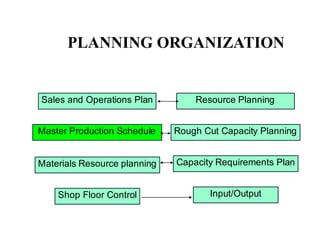
PLANNING ORGANIZATION
Shop Floor Control
Materials Resource planning
Master Production Schedule
Sales and Operations Plan
Input/Output
Capacity Requirements Plan
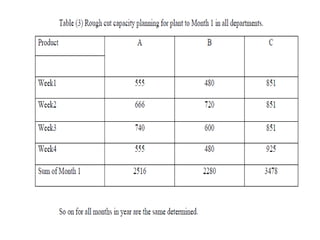
Rough Cut Capacity Planning
Resource Planning
3
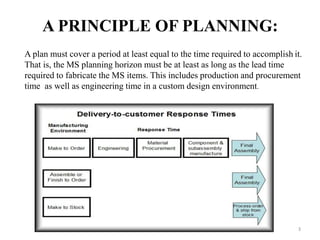
A PRINCIPLE OF PLANNING:
A plan must cover a period at least equal to the time required to accomplish it.
That is, the MS planning horizon must be at least as long as the lead time
required to fabricate the MS items. This includes production and procurement
time as well as engineering time in a custom design environment.
MASTER PLANNING
• Planning:-
– The principle of production planning and control lies
in the statement ‘First Plan Your Work and then Work
on Your Plan’.
– Main functions of production planning and control
includes planning, routing, scheduling, dispatching and
follow-up.
• Planning is deciding in advance what to do, how to do it, when to do it and
who is to do it. Planning bridges the gap from where we are, to where we
want to go. It makes it possible for things to occur which would not
otherwise happen.
• Routing may be defined as the selection of path which each part of the
product will follow, which being transformed from raw material to finished
products. Routing determines the most advantageous path to be followed
from department to department and machine to machine till raw material
gets its final shape.
• Scheduling determines the programmer for the operations. Scheduling may
be defined as ‘the fixation of time and date for each operation’ as well as it
determines the sequence of operations to be followed.
• Dispatching is concerned with the starting the processes. It
gives necessary authority so as to start a particular work,
which has already been planned under ‘Routing’ and
‘Scheduling’. Therefore, dispatching is ‘release of orders and
instruction for the starting of production for any item in
acceptance with the route sheet and schedule charts’.
• The function of FOLLOW-UP is to report daily the progress
of work in each shop in a prescribed preform and to
investigate the causes of deviations from the planned
performance.
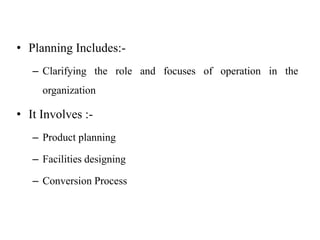
• Planning Includes:-
– Clarifying the role and focuses of operation in the
organization
• It Involves :-
– Product planning
– Facilities designing
– Conversion Process
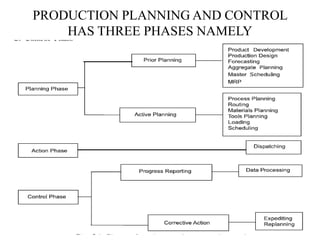
PRODUCTION PLANNING AND CONTROL
HAS THREE PHASES NAMELY
• Production planning (PP) is responsible for
making the aggregate plan of using production
resources (workforce, equipment) and material to
meet customer orders.
• Typically, the plan covers a wide time horizon of
several months. Besides giving the date of
completing each customer order, production
planning determines the capacity and material
requirements of production over time.
Production planning state's:-
• When materials should arrive,
• Which activities should be outsourced to
subcontractors,
• When to increase or decrease the workforce
level
LEAD TIME ESTIMATIONS
• According to the traditional approach, production
planning in make to order production systems is
still based on lead time estimations and on MRP
logic
• In this approach, customer orders are segmented
with milestones, and the time needed to reach the
next milestone is estimated by production lead
times. Estimates are based on past experience
rather than on the actual production load
ACTUAL PRODUCTION
CAPACITIES
• The MRP system determines the timing of these milestones
backward from the due dates of the customer orders.
• At this stage of the planning process the actual production
capacities are considered only implicitly, i.e., through the
lead times, which again are based on historic data.
• In the subsequent stage, when the timing of production
activities has already been set, production capacities are
allocated to the specific customer orders.
• If in a certain period of time, the in-house capacity is not
sufficient to meet demands, decisions are made as whether
to extend the capacity of the scarce resource or to involve
subcontractors.
OPERATIONS PLANNING AND SCHEDULING
SYSTEMS
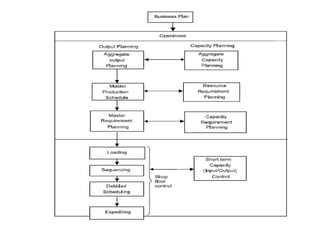
• Operations planning and scheduling systems concern
with the volume and timing of outputs, the utilization
of operations capacity at desired levels for
competitive effectiveness. These systems must fit
together activities at various levels, form top to
bottom, in support of one another, as shown in Fig
COMPONENTS OF OPERATIONS PLANNING
AND SCHEDULING SYSTEM
• THE BUSINESS PLAN
– The business plan is an agreement between all functional areas—
finance, production, marketing, engineering, R & D—about the level of
activity and the products they are committed to support. The business
plan is not concerned with all the details and specific timing of the
actions for executing the plan. Instead, it determines a feasible general
posture for competing to achieve its major goals
• AGGREGATE PRODUCTION (OUTPUT) PLANNING
– The process of determining output levels of product groups over the
coming six to eighteen months on a weekly or monthly basis. It
identifies the overall level of outputs in support of the business plan
• AGGREGATE CAPACITY PLANNING
– It is the process of testing the feasibility of aggregate output
plans and evaluating overall capacity utilization. A statement of
desired output is useful only if it is feasible. Thus, it addresses
the supply side of the firm’s ability to meet the demand. As a
result, the aggregate planning process balances output levels,
capacity constraints, and temporary capacity adjustments to meet
demand and utilize capacity at desired levels during the coming
months
• MASTER PRODUCTION SCHEDULING
– MPS is a schedule showing week by week how many of each
product must be produced according to customer orders and
demand forecasts. Its purpose is to meet the demand for
individual products in the product group.
• SHOP FLOOR CONTROL
– Shop floor control involves the activities that execute and
control shop operations namely loading, sequencing,
detailed scheduling and expediting jobs in production. It
coordinates the weekly and daily activities that get jobs
done.
• LOADING
– Each job (customer order) may have its unique product
specification and, hence, it is unique through various work
centers in the facility. As new job orders are released, they
are assigned or allocated among the work centers, thus
establishing how much of a load each work center must
carry during the coming planning period. This assignment
is known as loading (sometimes called shop loading as
machine loading).
• SEQUENCING
– This stage establishes the priorities for jobs in the queues (waiting lines) at the work
centers. Priority sequencing specifies the order in which the waiting jobs are processed; it
requires the adoption of a priority sequencing rule.
• EXPEDITING
– Expediting is a process of tracking a job’s progress and taking special actions to move it
through the facility. In tracking a job’s progress, special action may be needed to keep
the job moving through the facility on time
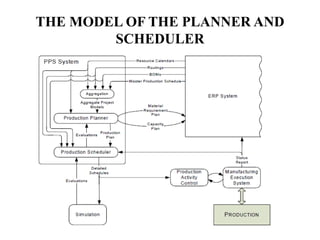
THE MODEL OF THE PLANNER AND
SCHEDULER
PRODUCTION PLANNER
• The challenge of production planning is the
timing of the activities in medium term, over
a typically 3-6 months long time horizon with
a time unit of one week.
• The generated plans must comply with the
project deadlines,
– obtain effective utilization of the resources
with finite capacity,
– keep stock levels low, and on the whole,
minimize the cost of the production.
PLANNER WORKS WITH THE
FOLLOWING INPUT DATA
• Specification of customer orders as given in the
master production schedule;
• Bill of Materials (BOMs) of products;
• Routings (sequence, processing time and resource
requirements) of operations; and
• Detailed calendar of available resource (machine,
workforce) capacities.
SCHEDULING
• It is responsible for making detailed, executable schedules that
achieve the goals set by production plans. Hence, scheduling
has to assign finite capacity resources to production operations
as well as to determine their order of execution.
• So as to guarantee that all shop orders can be executed in time
and that load on resources never exceeds available capacity,
scheduling has to unify the resource and temporal aspects of
production at the most detailed level of aggregation
SCHEDULING PRODUCTION
• Before production begins the manager must
know what product is being produced and how
many.
• This information is gained through production
planning and control personnel
SCHEDULING PRODUCTION –
4 MAIN TASKS
• Routing: deciding where the work is to be done
• Scheduling: deciding when the work is to be started
and completed
• Dispatching: issuing work orders to start actual
production
• Expediting: seeing that the work is progressing on
schedule
PRINCIPLES OF SCHEDULING
1. The principle of optimum task size: Scheduling
tends to achieve maximum efficiency when the
task sizes are small, and all tasks of same order
of magnitude.
2. Principle of optimum production plan: The
planning should be such that it imposes and
equal load on all plants.
3. Principle of optimum sequence: Scheduling
tends to achieve the maximum efficiency when
the work is planned so that work hours are
normally used in the same sequence.
SCHEDULING PRODUCTION
• The line production routing sheet is used to help
schedule.
• The goal is to use 100% of the manufacturing plant.
• Schedules are based on:
– Sales forecasts by day, week, and month for each product
– Inventory levels for both raw materials and finished
products
– Manufacturing capacity to be schedules in terms of the
number of products that can be produced per hour or day
• Schedules determine the parts or products that should
be manufactured each day the plant operates
SCHEDULING PRODUCTION
• Production schedules most also consider lead
time, including the time it takes to:
– Order and receive materials and parts that must be
purchased
– Make parts from materials
– Assemble parts into products
– Package products for delivery
THE SCHEDULER
• The ultimate goal of scheduling is to unfold the medium term
production plan into an executable detailed schedule.
• The scheduler has to determine the order of the operations and
the resource allocations with respect to the technological,
temporal and capacity constraints. Our short-term scheduler
performs finite capacity scheduling with respect to detailed
technological and capacity constraints.
• The scheduling horizon is as long as the time unit of the
planner (i.e., one week), while the scheduling time unit is 0.1
hour.
• The set of operations to be scheduled are determined
by disaggregating the activities that fall into a given
time unit in the medium-term production plan.
• If an activity covers several weeks, then its operations
are distributed in this period proportional to the
activity’s intensities.
• Typically, schedules are generated for the next few
weeks only.
• The master schedule (MS) is a presentation
of the demand, including
– The forecast and
– The backlog (customer orders received),
– The master production schedule (the supply plan),
– The projected on hand (POH) inventory,
– The available-to-promise (ATP) quantity
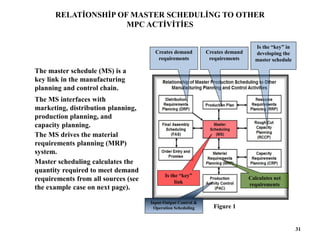
31
Figure 1
Is the “key”
link
Is the “key” in
developing the
master schedule
Creates demand
requirements
Creates demand
requirements
Calculates net
requirements
The master schedule (MS) is a
key link in the manufacturing
planning and control chain.
The MS interfaces with
marketing, distribution planning,
production planning, and
capacity planning.
The MS drives the material
requirements planning (MRP)
system.
Master scheduling calculates the
quantity required to meet demand
requirements from all sources (see
the example case on next page).
Input-Output Control &
Operation Scheduling
RELATİONSHİP OF MASTER SCHEDULİNG TO OTHER
MPC ACTİVİTİES
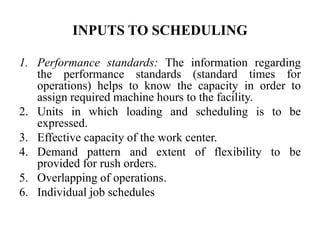
INPUTS TO SCHEDULING
1. Performance standards: The information regarding
the performance standards (standard times for
operations) helps to know the capacity in order to
assign required machine hours to the facility.
2. Units in which loading and scheduling is to be
expressed.
3. Effective capacity of the work center.
4. Demand pattern and extent of flexibility to be
provided for rush orders.
5. Overlapping of operations.
6. Individual job schedules
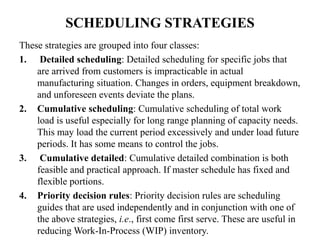
SCHEDULING STRATEGIES
These strategies are grouped into four classes:
1. Detailed scheduling: Detailed scheduling for specific jobs that
are arrived from customers is impracticable in actual
manufacturing situation. Changes in orders, equipment breakdown,
and unforeseen events deviate the plans.
2. Cumulative scheduling: Cumulative scheduling of total work
load is useful especially for long range planning of capacity needs.
This may load the current period excessively and under load future
periods. It has some means to control the jobs.
3. Cumulative detailed: Cumulative detailed combination is both
feasible and practical approach. If master schedule has fixed and
flexible portions.
4. Priority decision rules: Priority decision rules are scheduling
guides that are used independently and in conjunction with one of
the above strategies, i.e., first come first serve. These are useful in
reducing Work-In-Process (WIP) inventory.
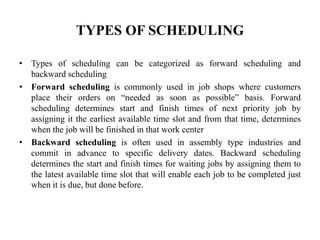
TYPES OF SCHEDULING
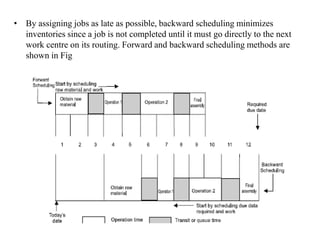
• Types of scheduling can be categorized as forward scheduling and
backward scheduling
• Forward scheduling is commonly used in job shops where customers
place their orders on “needed as soon as possible” basis. Forward
scheduling determines start and finish times of next priority job by
assigning it the earliest available time slot and from that time, determines
when the job will be finished in that work center
• Backward scheduling is often used in assembly type industries and
commit in advance to specific delivery dates. Backward scheduling
determines the start and finish times for waiting jobs by assigning them to
the latest available time slot that will enable each job to be completed just
when it is due, but done before.
• By assigning jobs as late as possible, backward scheduling minimizes
inventories since a job is not completed until it must go directly to the next
work centre on its routing. Forward and backward scheduling methods are
shown in Fig
SCHEDULING METHODOLOGY
• The scheduling methodology depends upon the type
of industry, organization, product, and level of
sophistication required. They are:
1. Charts and boards,
2. Priority decision rules,
3. Mathematical programming methods
GANTT CHARTS AND BOARDS
• Gantt charts and associated scheduling boards have been
extensively used scheduling devices in the past, although many
of the charts are now drawn by computer. Gantt charts are
extremely easy to understand and can quickly reveal the
current or planned situation to all concerned. They are used in
several forms, namely,
a) Scheduling or progress charts, which depicts the
sequential schedule;
b) Load charts, which show the work assigned to a group of
workers or machines; and
c) Record a chart, which are used to record the actual
operating times and delays of workers and machines.
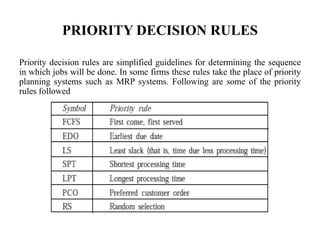
PRIORITY DECISION RULES
Priority decision rules are simplified guidelines for determining the sequence
in which jobs will be done. In some firms these rules take the place of priority
planning systems such as MRP systems. Following are some of the priority
rules followed
MATHEMATICAL PROGRAMMING
METHODS
• Scheduling is a complex resource allocation problem. Firms
process capacity, labour skills, materials and they seek to
allocate their use so as to maximize a profit or service
objective, or perhaps meet a demand while minimizing costs.
The following are some of the models used in scheduling and
production control.
(a) Linear programming model: Here all the constraints and
objective functions are formulated as a linear equation
and then problem is solved for optimality. Simplex
method, transportation methods and assignment method
are major methods used here.
(b) PERT/CPM network model: PERT/CPM network is the
network showing the sequence of operations for a project
and the precedence relation between the activities to be
completed.
RCCP
WHAT IS RCCP?
• The most common problem which is encountered in operating MRP
based systems is the existence of an overstated MPS. An overstated
master production schedule is the one which orders more than the
production resources can complete. An overstated MPS causes:-
• raw materials and WIP inventories to increase because more materials
are purchased and released to the shop than are completed and shipped.
• It also causes a buildup of queues on the shop floor.
• Since jobs have to wait to be processed, actual lead times increase,
causing ship dates to be missed.
• As lead times increase, forecast over the planning horizon becomes less
accurate.
• This is because, forecasts are more accurate for shorter periods than for
longer ones. Thus, overstated master production schedules lead to
missed due dates
Because of all the above given reasons,
validating the MPS with respect to available
capacity is an extremely important step in
MRP. The term used for this validation
exercise is “Rough Cut Capacity Planning
(RCCP)”.
There are three approaches to perform rough cut capacity planning:
1. Capacity planning using overall factors (CPOF) :
It is the least detailed approach. Capacity requirement is quickly computed
but is insensitive to shifts in product mix.
2. “Bill of labor” (or bill of required types of machine hours) approach :
It involves multiplying two matrices, “the bill of labor” and the “master
production schedule”. This approach picks up shifts in product mix, but
does not consider lead time offsets. It strictly assumes a lot-for-lot policy
for setting lot sizes. When other techniques, such as economic order
quantity etc. is used, then this approach gives a very rough estimate.
3. “Resource Profile” approach :
It is exactly same as “Bill of labor approach”, except that it takes lead-time
offsets into account. Again, it strictly assumes a lot-for-lot policy for
setting lot sizes as in the case of “bill of labor approach”.
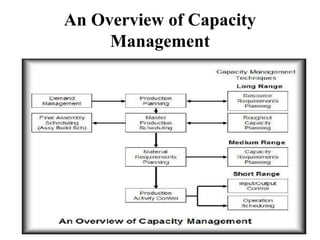
An Overview of Capacity
Management
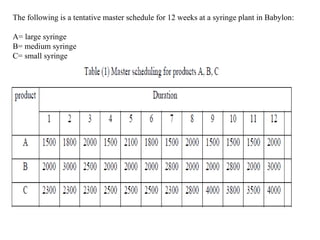
The following is a tentative master schedule for 12 weeks at a syringe plant in Babylon:
A= large syringe
B= medium syringe
C= small syringe
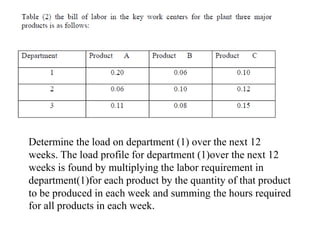
Determine the load on department (1) over the next 12
weeks. The load profile for department (1)over the next 12
weeks is found by multiplying the labor requirement in
department(1)for each product by the quantity of that product
to be produced in each week and summing the hours required
for all products in each week.
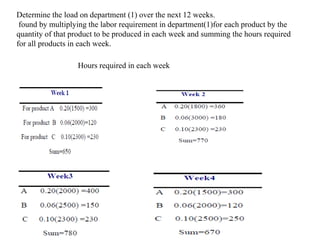
Determine the load on department (1) over the next 12 weeks.
found by multiplying the labor requirement in department(1)for each product by the
quantity of that product to be produced in each week and summing the hours required
for all products in each week.
Hours required in each week
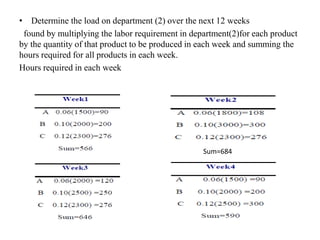
• Determine the load on department (2) over the next 12 weeks
found by multiplying the labor requirement in department(2)for each product
by the quantity of that product to be produced in each week and summing the
hours required for all products in each week.
Hours required in each week
Sum=684
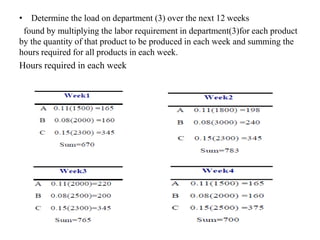
• Determine the load on department (3) over the next 12 weeks
found by multiplying the labor requirement in department(3)for each product
by the quantity of that product to be produced in each week and summing the
hours required for all products in each week.
Hours required in each week
PROCESS
PLANNING
51
INTRODUCTION
• Process Planning
 Known as:
– manufacturing planning
– material processing
– process engineering
– machine routing
 Definition:
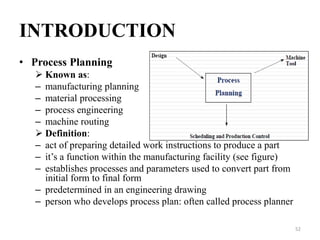
– act of preparing detailed work instructions to produce a part
– it’s a function within the manufacturing facility (see figure)
– establishes processes and parameters used to convert part from
initial form to final form
– predetermined in an engineering drawing
– person who develops process plan: often called process planner
52
• Functions included in process planning:
– Raw material preparation
– Processes selection
– Process sequencing
– Machining parameter selection
– Tool path planning
– Machine selection
– Fixture selection
53
• Factors Affecting Process Plan Selection:
– Shape
– Tolerance
– Surface finish
– Size
– Material type
– Quantity
– Value of the product
– Urgency
– Manufacturing system itself
• Two approaches to carry out task of process planning:
– Manual Process Planning
– Computer Aided Process Planning (CAPP)
54
Manual Process Planning
• Process planner must have following knowledge:
– Ability to interpret an engineering drawing
– Familiarity with manufacturing processes and practice
– Familiarity with tooling and fixtures
– Know what resources are available in the shop
– Know how to use reference books (e.g. machinability data
handbooks)
– Ability to do computations on machining time and cost
– Familiarity with raw materials
55
• Some necessary steps to prepare a process plan :
– Study overall shape of part ⇒ identify features, all critical
dimensions
– Thoroughly study the drawing; try to identify all
manufacturing features and notes
– Determine best raw material shape to use if raw stock not
given
– Identify datum surfaces; Use information on datum
surfaces to determine the setups
– Select machines for each setup.
– Determine rough sequence of operations necessary to
create all the features for each setup
56
Process Plan
• Process Plan :
– operation sheet
– route sheet
– operation planning summary
• Detailed plan contains:
– route
– processes
– process parameters
– machine and tool selections
– fixtures
57
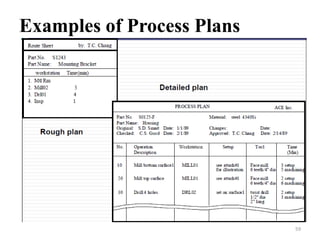
• The level of details in the plan depends on the application:
Operation: a process
Operation Plan (Op-plan): description of an operation
includes tools, machines to be used, process parameters,
machining time, etc.
Op-plan sequence: Summary of a process plan
58
Examples of Process Plans
59
Processes Selection
• A wide variety of manufacturing processes are used to produce
a workpiece
• These processes can be classified as:
– Casting processes
– Forming and shaping processes
– Machining processes
– Joining processes
– Finishing processes
60
• Features that must be considered in selecting machining
processes include:
– part features
– required dimensional and geometric accuracy and tolerance
– required surface finish
– available resources, including NC machines and cutting
tools
– cost
61
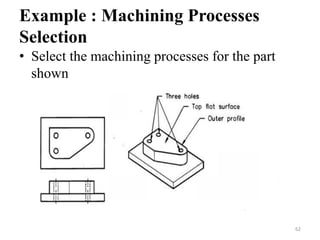
Example : Machining Processes
Selection
• Select the machining processes for the part
shown
62
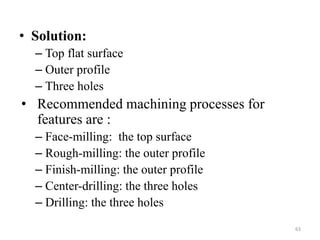
• Solution:
– Top flat surface
– Outer profile
– Three holes
• Recommended machining processes for
features are :
– Face-milling: the top surface
– Rough-milling: the outer profile
– Finish-milling: the outer profile
– Center-drilling: the three holes
– Drilling: the three holes
63
Typical processing sequence
• Typical processing sequence to fabricate a discrete part –
– A basic process
– One or more secondary processes
– Operations to enhance physical properties
– Finishing processes
64
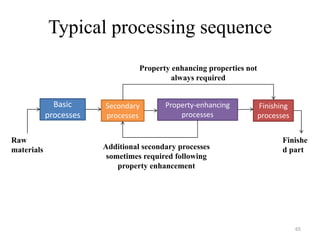
Typical processing sequence
65
Basic
processes
Secondary
processes
Property-enhancing
processes
Finishing
processes
Finishe
d part
Raw
materials
Property enhancing properties not
always required
Additional secondary processes
sometimes required following
property enhancement
Computer Aided process planning
• During the last several decades, there has been considerable
interest in automating the process planning function by
computer systems
• Shop people knowledgeable in manufacturing processes are
gradually retiring
• An alternative approach to process planning is needed and
computer-aided process planning(CAPP) provides this
alternative
• CAPP Systems
• CAPP systems are designed around either of two approaches :
– Retrieval systems
– Generative systems
66

Production management

  • 1.
    Power point presentationon Unit 5 Production management Presented by Amey .V. Shejwal Vaibhav .P. Urade Rahul .Y. Borse Nikhil .H. Patil Pratik . A. Wankar
  • 2.
    PLANNING ORGANIZATION Shop FloorControl Materials Resource planning Master Production Schedule Sales and Operations Plan Input/Output Capacity Requirements Plan Rough Cut Capacity Planning Resource Planning
  • 3.
    3 A PRINCIPLE OFPLANNING: A plan must cover a period at least equal to the time required to accomplish it. That is, the MS planning horizon must be at least as long as the lead time required to fabricate the MS items. This includes production and procurement time as well as engineering time in a custom design environment.
  • 4.
    MASTER PLANNING • Planning:- –The principle of production planning and control lies in the statement ‘First Plan Your Work and then Work on Your Plan’. – Main functions of production planning and control includes planning, routing, scheduling, dispatching and follow-up.
  • 5.
    • Planning isdeciding in advance what to do, how to do it, when to do it and who is to do it. Planning bridges the gap from where we are, to where we want to go. It makes it possible for things to occur which would not otherwise happen. • Routing may be defined as the selection of path which each part of the product will follow, which being transformed from raw material to finished products. Routing determines the most advantageous path to be followed from department to department and machine to machine till raw material gets its final shape. • Scheduling determines the programmer for the operations. Scheduling may be defined as ‘the fixation of time and date for each operation’ as well as it determines the sequence of operations to be followed.
  • 6.
    • Dispatching isconcerned with the starting the processes. It gives necessary authority so as to start a particular work, which has already been planned under ‘Routing’ and ‘Scheduling’. Therefore, dispatching is ‘release of orders and instruction for the starting of production for any item in acceptance with the route sheet and schedule charts’. • The function of FOLLOW-UP is to report daily the progress of work in each shop in a prescribed preform and to investigate the causes of deviations from the planned performance.
  • 7.
    • Planning Includes:- –Clarifying the role and focuses of operation in the organization • It Involves :- – Product planning – Facilities designing – Conversion Process
  • 8.
    PRODUCTION PLANNING ANDCONTROL HAS THREE PHASES NAMELY
  • 9.
    • Production planning(PP) is responsible for making the aggregate plan of using production resources (workforce, equipment) and material to meet customer orders. • Typically, the plan covers a wide time horizon of several months. Besides giving the date of completing each customer order, production planning determines the capacity and material requirements of production over time.
  • 10.
    Production planning state's:- •When materials should arrive, • Which activities should be outsourced to subcontractors, • When to increase or decrease the workforce level
  • 11.
    LEAD TIME ESTIMATIONS •According to the traditional approach, production planning in make to order production systems is still based on lead time estimations and on MRP logic • In this approach, customer orders are segmented with milestones, and the time needed to reach the next milestone is estimated by production lead times. Estimates are based on past experience rather than on the actual production load
  • 12.
    ACTUAL PRODUCTION CAPACITIES • TheMRP system determines the timing of these milestones backward from the due dates of the customer orders. • At this stage of the planning process the actual production capacities are considered only implicitly, i.e., through the lead times, which again are based on historic data. • In the subsequent stage, when the timing of production activities has already been set, production capacities are allocated to the specific customer orders. • If in a certain period of time, the in-house capacity is not sufficient to meet demands, decisions are made as whether to extend the capacity of the scarce resource or to involve subcontractors.
  • 13.
    OPERATIONS PLANNING ANDSCHEDULING SYSTEMS • Operations planning and scheduling systems concern with the volume and timing of outputs, the utilization of operations capacity at desired levels for competitive effectiveness. These systems must fit together activities at various levels, form top to bottom, in support of one another, as shown in Fig
  • 15.
    COMPONENTS OF OPERATIONSPLANNING AND SCHEDULING SYSTEM • THE BUSINESS PLAN – The business plan is an agreement between all functional areas— finance, production, marketing, engineering, R & D—about the level of activity and the products they are committed to support. The business plan is not concerned with all the details and specific timing of the actions for executing the plan. Instead, it determines a feasible general posture for competing to achieve its major goals • AGGREGATE PRODUCTION (OUTPUT) PLANNING – The process of determining output levels of product groups over the coming six to eighteen months on a weekly or monthly basis. It identifies the overall level of outputs in support of the business plan
  • 16.
    • AGGREGATE CAPACITYPLANNING – It is the process of testing the feasibility of aggregate output plans and evaluating overall capacity utilization. A statement of desired output is useful only if it is feasible. Thus, it addresses the supply side of the firm’s ability to meet the demand. As a result, the aggregate planning process balances output levels, capacity constraints, and temporary capacity adjustments to meet demand and utilize capacity at desired levels during the coming months • MASTER PRODUCTION SCHEDULING – MPS is a schedule showing week by week how many of each product must be produced according to customer orders and demand forecasts. Its purpose is to meet the demand for individual products in the product group.
  • 17.
    • SHOP FLOORCONTROL – Shop floor control involves the activities that execute and control shop operations namely loading, sequencing, detailed scheduling and expediting jobs in production. It coordinates the weekly and daily activities that get jobs done. • LOADING – Each job (customer order) may have its unique product specification and, hence, it is unique through various work centers in the facility. As new job orders are released, they are assigned or allocated among the work centers, thus establishing how much of a load each work center must carry during the coming planning period. This assignment is known as loading (sometimes called shop loading as machine loading).
  • 18.
    • SEQUENCING – Thisstage establishes the priorities for jobs in the queues (waiting lines) at the work centers. Priority sequencing specifies the order in which the waiting jobs are processed; it requires the adoption of a priority sequencing rule. • EXPEDITING – Expediting is a process of tracking a job’s progress and taking special actions to move it through the facility. In tracking a job’s progress, special action may be needed to keep the job moving through the facility on time
  • 19.
    THE MODEL OFTHE PLANNER AND SCHEDULER
  • 20.
    PRODUCTION PLANNER • Thechallenge of production planning is the timing of the activities in medium term, over a typically 3-6 months long time horizon with a time unit of one week. • The generated plans must comply with the project deadlines, – obtain effective utilization of the resources with finite capacity, – keep stock levels low, and on the whole, minimize the cost of the production.
  • 21.
    PLANNER WORKS WITHTHE FOLLOWING INPUT DATA • Specification of customer orders as given in the master production schedule; • Bill of Materials (BOMs) of products; • Routings (sequence, processing time and resource requirements) of operations; and • Detailed calendar of available resource (machine, workforce) capacities.
  • 22.
    SCHEDULING • It isresponsible for making detailed, executable schedules that achieve the goals set by production plans. Hence, scheduling has to assign finite capacity resources to production operations as well as to determine their order of execution. • So as to guarantee that all shop orders can be executed in time and that load on resources never exceeds available capacity, scheduling has to unify the resource and temporal aspects of production at the most detailed level of aggregation
  • 23.
    SCHEDULING PRODUCTION • Beforeproduction begins the manager must know what product is being produced and how many. • This information is gained through production planning and control personnel
  • 24.
    SCHEDULING PRODUCTION – 4MAIN TASKS • Routing: deciding where the work is to be done • Scheduling: deciding when the work is to be started and completed • Dispatching: issuing work orders to start actual production • Expediting: seeing that the work is progressing on schedule
  • 25.
    PRINCIPLES OF SCHEDULING 1.The principle of optimum task size: Scheduling tends to achieve maximum efficiency when the task sizes are small, and all tasks of same order of magnitude. 2. Principle of optimum production plan: The planning should be such that it imposes and equal load on all plants. 3. Principle of optimum sequence: Scheduling tends to achieve the maximum efficiency when the work is planned so that work hours are normally used in the same sequence.
  • 26.
    SCHEDULING PRODUCTION • Theline production routing sheet is used to help schedule. • The goal is to use 100% of the manufacturing plant. • Schedules are based on: – Sales forecasts by day, week, and month for each product – Inventory levels for both raw materials and finished products – Manufacturing capacity to be schedules in terms of the number of products that can be produced per hour or day • Schedules determine the parts or products that should be manufactured each day the plant operates
  • 27.
    SCHEDULING PRODUCTION • Productionschedules most also consider lead time, including the time it takes to: – Order and receive materials and parts that must be purchased – Make parts from materials – Assemble parts into products – Package products for delivery
  • 28.
    THE SCHEDULER • Theultimate goal of scheduling is to unfold the medium term production plan into an executable detailed schedule. • The scheduler has to determine the order of the operations and the resource allocations with respect to the technological, temporal and capacity constraints. Our short-term scheduler performs finite capacity scheduling with respect to detailed technological and capacity constraints. • The scheduling horizon is as long as the time unit of the planner (i.e., one week), while the scheduling time unit is 0.1 hour.
  • 29.
    • The setof operations to be scheduled are determined by disaggregating the activities that fall into a given time unit in the medium-term production plan. • If an activity covers several weeks, then its operations are distributed in this period proportional to the activity’s intensities. • Typically, schedules are generated for the next few weeks only.
  • 30.
    • The masterschedule (MS) is a presentation of the demand, including – The forecast and – The backlog (customer orders received), – The master production schedule (the supply plan), – The projected on hand (POH) inventory, – The available-to-promise (ATP) quantity
  • 31.
    31 Figure 1 Is the“key” link Is the “key” in developing the master schedule Creates demand requirements Creates demand requirements Calculates net requirements The master schedule (MS) is a key link in the manufacturing planning and control chain. The MS interfaces with marketing, distribution planning, production planning, and capacity planning. The MS drives the material requirements planning (MRP) system. Master scheduling calculates the quantity required to meet demand requirements from all sources (see the example case on next page). Input-Output Control & Operation Scheduling RELATİONSHİP OF MASTER SCHEDULİNG TO OTHER MPC ACTİVİTİES
  • 32.
    INPUTS TO SCHEDULING 1.Performance standards: The information regarding the performance standards (standard times for operations) helps to know the capacity in order to assign required machine hours to the facility. 2. Units in which loading and scheduling is to be expressed. 3. Effective capacity of the work center. 4. Demand pattern and extent of flexibility to be provided for rush orders. 5. Overlapping of operations. 6. Individual job schedules
  • 33.
    SCHEDULING STRATEGIES These strategiesare grouped into four classes: 1. Detailed scheduling: Detailed scheduling for specific jobs that are arrived from customers is impracticable in actual manufacturing situation. Changes in orders, equipment breakdown, and unforeseen events deviate the plans. 2. Cumulative scheduling: Cumulative scheduling of total work load is useful especially for long range planning of capacity needs. This may load the current period excessively and under load future periods. It has some means to control the jobs. 3. Cumulative detailed: Cumulative detailed combination is both feasible and practical approach. If master schedule has fixed and flexible portions. 4. Priority decision rules: Priority decision rules are scheduling guides that are used independently and in conjunction with one of the above strategies, i.e., first come first serve. These are useful in reducing Work-In-Process (WIP) inventory.
  • 34.
    TYPES OF SCHEDULING •Types of scheduling can be categorized as forward scheduling and backward scheduling • Forward scheduling is commonly used in job shops where customers place their orders on “needed as soon as possible” basis. Forward scheduling determines start and finish times of next priority job by assigning it the earliest available time slot and from that time, determines when the job will be finished in that work center • Backward scheduling is often used in assembly type industries and commit in advance to specific delivery dates. Backward scheduling determines the start and finish times for waiting jobs by assigning them to the latest available time slot that will enable each job to be completed just when it is due, but done before.
  • 35.
    • By assigningjobs as late as possible, backward scheduling minimizes inventories since a job is not completed until it must go directly to the next work centre on its routing. Forward and backward scheduling methods are shown in Fig
  • 36.
    SCHEDULING METHODOLOGY • Thescheduling methodology depends upon the type of industry, organization, product, and level of sophistication required. They are: 1. Charts and boards, 2. Priority decision rules, 3. Mathematical programming methods
  • 37.
    GANTT CHARTS ANDBOARDS • Gantt charts and associated scheduling boards have been extensively used scheduling devices in the past, although many of the charts are now drawn by computer. Gantt charts are extremely easy to understand and can quickly reveal the current or planned situation to all concerned. They are used in several forms, namely, a) Scheduling or progress charts, which depicts the sequential schedule; b) Load charts, which show the work assigned to a group of workers or machines; and c) Record a chart, which are used to record the actual operating times and delays of workers and machines.
  • 38.
    PRIORITY DECISION RULES Prioritydecision rules are simplified guidelines for determining the sequence in which jobs will be done. In some firms these rules take the place of priority planning systems such as MRP systems. Following are some of the priority rules followed
  • 39.
    MATHEMATICAL PROGRAMMING METHODS • Schedulingis a complex resource allocation problem. Firms process capacity, labour skills, materials and they seek to allocate their use so as to maximize a profit or service objective, or perhaps meet a demand while minimizing costs. The following are some of the models used in scheduling and production control. (a) Linear programming model: Here all the constraints and objective functions are formulated as a linear equation and then problem is solved for optimality. Simplex method, transportation methods and assignment method are major methods used here. (b) PERT/CPM network model: PERT/CPM network is the network showing the sequence of operations for a project and the precedence relation between the activities to be completed.
  • 40.
  • 41.
    WHAT IS RCCP? •The most common problem which is encountered in operating MRP based systems is the existence of an overstated MPS. An overstated master production schedule is the one which orders more than the production resources can complete. An overstated MPS causes:- • raw materials and WIP inventories to increase because more materials are purchased and released to the shop than are completed and shipped. • It also causes a buildup of queues on the shop floor. • Since jobs have to wait to be processed, actual lead times increase, causing ship dates to be missed. • As lead times increase, forecast over the planning horizon becomes less accurate. • This is because, forecasts are more accurate for shorter periods than for longer ones. Thus, overstated master production schedules lead to missed due dates
  • 42.
    Because of allthe above given reasons, validating the MPS with respect to available capacity is an extremely important step in MRP. The term used for this validation exercise is “Rough Cut Capacity Planning (RCCP)”.
  • 43.
    There are threeapproaches to perform rough cut capacity planning: 1. Capacity planning using overall factors (CPOF) : It is the least detailed approach. Capacity requirement is quickly computed but is insensitive to shifts in product mix. 2. “Bill of labor” (or bill of required types of machine hours) approach : It involves multiplying two matrices, “the bill of labor” and the “master production schedule”. This approach picks up shifts in product mix, but does not consider lead time offsets. It strictly assumes a lot-for-lot policy for setting lot sizes. When other techniques, such as economic order quantity etc. is used, then this approach gives a very rough estimate. 3. “Resource Profile” approach : It is exactly same as “Bill of labor approach”, except that it takes lead-time offsets into account. Again, it strictly assumes a lot-for-lot policy for setting lot sizes as in the case of “bill of labor approach”.
  • 44.
    An Overview ofCapacity Management
  • 45.
    The following isa tentative master schedule for 12 weeks at a syringe plant in Babylon: A= large syringe B= medium syringe C= small syringe
  • 46.
    Determine the loadon department (1) over the next 12 weeks. The load profile for department (1)over the next 12 weeks is found by multiplying the labor requirement in department(1)for each product by the quantity of that product to be produced in each week and summing the hours required for all products in each week.
  • 47.
    Determine the loadon department (1) over the next 12 weeks. found by multiplying the labor requirement in department(1)for each product by the quantity of that product to be produced in each week and summing the hours required for all products in each week. Hours required in each week
  • 48.
    • Determine theload on department (2) over the next 12 weeks found by multiplying the labor requirement in department(2)for each product by the quantity of that product to be produced in each week and summing the hours required for all products in each week. Hours required in each week Sum=684
  • 49.
    • Determine theload on department (3) over the next 12 weeks found by multiplying the labor requirement in department(3)for each product by the quantity of that product to be produced in each week and summing the hours required for all products in each week. Hours required in each week
  • 51.
  • 52.
    INTRODUCTION • Process Planning Known as: – manufacturing planning – material processing – process engineering – machine routing  Definition: – act of preparing detailed work instructions to produce a part – it’s a function within the manufacturing facility (see figure) – establishes processes and parameters used to convert part from initial form to final form – predetermined in an engineering drawing – person who develops process plan: often called process planner 52
  • 53.
    • Functions includedin process planning: – Raw material preparation – Processes selection – Process sequencing – Machining parameter selection – Tool path planning – Machine selection – Fixture selection 53
  • 54.
    • Factors AffectingProcess Plan Selection: – Shape – Tolerance – Surface finish – Size – Material type – Quantity – Value of the product – Urgency – Manufacturing system itself • Two approaches to carry out task of process planning: – Manual Process Planning – Computer Aided Process Planning (CAPP) 54
  • 55.
    Manual Process Planning •Process planner must have following knowledge: – Ability to interpret an engineering drawing – Familiarity with manufacturing processes and practice – Familiarity with tooling and fixtures – Know what resources are available in the shop – Know how to use reference books (e.g. machinability data handbooks) – Ability to do computations on machining time and cost – Familiarity with raw materials 55
  • 56.
    • Some necessarysteps to prepare a process plan : – Study overall shape of part ⇒ identify features, all critical dimensions – Thoroughly study the drawing; try to identify all manufacturing features and notes – Determine best raw material shape to use if raw stock not given – Identify datum surfaces; Use information on datum surfaces to determine the setups – Select machines for each setup. – Determine rough sequence of operations necessary to create all the features for each setup 56
  • 57.
    Process Plan • ProcessPlan : – operation sheet – route sheet – operation planning summary • Detailed plan contains: – route – processes – process parameters – machine and tool selections – fixtures 57
  • 58.
    • The levelof details in the plan depends on the application: Operation: a process Operation Plan (Op-plan): description of an operation includes tools, machines to be used, process parameters, machining time, etc. Op-plan sequence: Summary of a process plan 58
  • 59.
  • 60.
    Processes Selection • Awide variety of manufacturing processes are used to produce a workpiece • These processes can be classified as: – Casting processes – Forming and shaping processes – Machining processes – Joining processes – Finishing processes 60
  • 61.
    • Features thatmust be considered in selecting machining processes include: – part features – required dimensional and geometric accuracy and tolerance – required surface finish – available resources, including NC machines and cutting tools – cost 61
  • 62.
    Example : MachiningProcesses Selection • Select the machining processes for the part shown 62
  • 63.
    • Solution: – Topflat surface – Outer profile – Three holes • Recommended machining processes for features are : – Face-milling: the top surface – Rough-milling: the outer profile – Finish-milling: the outer profile – Center-drilling: the three holes – Drilling: the three holes 63
  • 64.
    Typical processing sequence •Typical processing sequence to fabricate a discrete part – – A basic process – One or more secondary processes – Operations to enhance physical properties – Finishing processes 64
  • 65.
    Typical processing sequence 65 Basic processes Secondary processes Property-enhancing processes Finishing processes Finishe dpart Raw materials Property enhancing properties not always required Additional secondary processes sometimes required following property enhancement
  • 66.
    Computer Aided processplanning • During the last several decades, there has been considerable interest in automating the process planning function by computer systems • Shop people knowledgeable in manufacturing processes are gradually retiring • An alternative approach to process planning is needed and computer-aided process planning(CAPP) provides this alternative • CAPP Systems • CAPP systems are designed around either of two approaches : – Retrieval systems – Generative systems 66

Editor's Notes