OPM 533 12- Operations Management Managing Quality Chapter 12
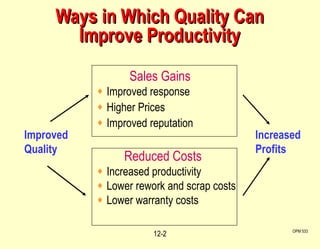
Ways in Which Quality Can Improve Productivity Sales Gains Improved response Higher Prices Improved reputation OPM 533 12- Reduced Costs Increased productivity Lower rework and scrap costs Lower warranty costs Increased Profits Improved Quality
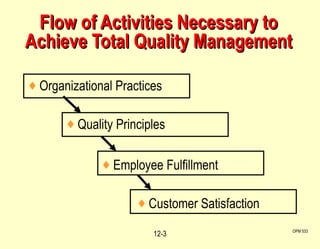
Flow of Activities Necessary to Achieve Total Quality Management Organizational Practices OPM 533 12- Quality Principles Employee Fulfillment Customer Satisfaction
1. Organizational Practices Leadership Mission statement Effective operating procedure Staff support Training Yields: What is important and what is to be accomplished OPM 533 12-
2. Quality Principles Customer focus Continuous improvement Employee empowerment Benchmarking Just-in-time Tools of TQM Yields: How to do what is important and to be accomplished OPM 533 12-
3. Employment Fulfillment Empowerment Organizational commitment Yields: Employees’ attitudes that they can accomplish what is important and to be accomplished OPM 533 12-
4. Customer Satisfaction Winning orders Repeat customers Yields: An effective organization with a competitive advantage OPM 533 12-
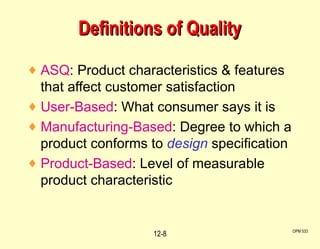
Definitions of Quality ASQ : Product characteristics & features that affect customer satisfaction User-Based : What consumer says it is Manufacturing-Based : Degree to which a product conforms to  design  specification Product-Based : Level of measurable product characteristic OPM 533 12-
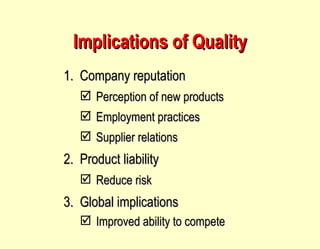
Implications of Quality Company reputation Perception of new products Employment practices Supplier relations Product liability Reduce risk Global implications Improved ability to compete
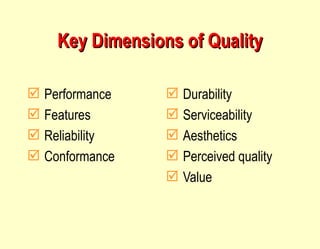
Key Dimensions of Quality Performance Features Reliability Conformance Durability Serviceability Aesthetics Perceived quality Value
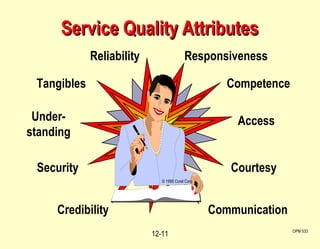
Service Quality Attributes OPM 533 12- Under- standing Tangibles Reliability Communication Credibility Security Responsiveness Competence Courtesy Access © 1995 Corel Corp.
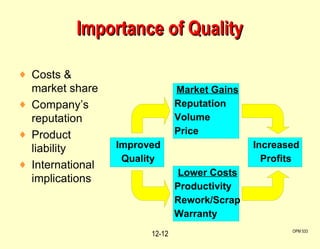
Importance of Quality OPM 533 12- Costs & market share Company’s reputation Product  liability International implications Increased Profits Lower Costs Productivity Rework/Scrap Warranty Market Gains Reputation Volume Price Improved Quality
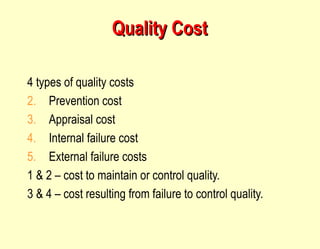
Quality Cost 4 types of quality costs Prevention cost Appraisal cost Internal failure cost External failure costs 1 & 2 – cost to maintain or control quality. 3 & 4 – cost resulting from failure to control quality.
Prevention cost Cost associated with preventing defects before they happen. Costs of trying to prevent poor quality products from reaching the consumer. Eg.process design, product design, employee training and vendor program.
Appraisal costs Cost incurred in assessing or auditing the level of quality. These are the costs of measuring, testing and analyzing materials, parts, product and the production process to ensure that the product quality specifications are being conformed to. Example cost of inspection and testing, test equipment or devices.
Internal failure costs Cost incurred for correcting or reworking on products or services due to defects incurred during the production process. It pertains to defects found before the product left the factory. Example: Rework costs, process failure costs, process downtown costs and price downgrading costs.
External failure costs External failure costs are costs incurred after the customer has received a poor-quality product. Example: customer complaint costs, product returns costs, warranty claim costs, loss of market share and lawsuit arising from injury or property damages from use of the product or service.
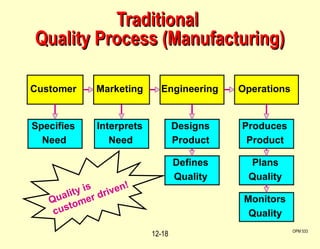
Traditional  Quality Process (Manufacturing) OPM 533 12- Specifies Need Customer Interprets Need Marketing Designs Product Defines Quality Engineering Produces Product Plans Quality Monitors Quality Operations Quality is customer driven!
TQM Encompasses entire organization, from supplier to customer Stresses a commitment by management to have a continuing, company-wide, drive toward excellence in all aspects of products and services that are important to the customer. OPM 533 12-
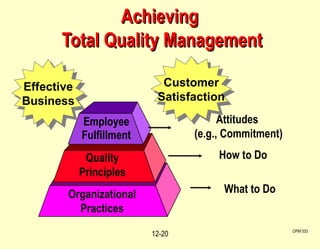
Achieving  Total Quality Management OPM 533 12- Organizational Practices Quality Principles Employee Fulfillment Attitudes  (e.g., Commitment) How to Do What to Do Effective Business Customer Satisfaction
Deming’s Fourteen Points Create consistency of purpose Lead to promote change Build quality into the products Build long term relationships Continuously improve product, quality, and service Start training Emphasize leadership OPM 533 12-
Deming’s Points - continued Drive out fear Break down barriers between departments Stop haranguing workers Support, help, improve Remove barriers to pride in work Institute a vigorous program of education and self-improvement Put everybody in the company to work on the transformation OPM 533 12-
Seven Concepts of TQM Continuous improvement Six Sigma Employee empowerment Benchmarking Just-in-time (JIT) Taguchi concepts Knowledge of TQM tools
Continuous Improvement Represents continual improvement of all processes  Involves all operations and work centers including suppliers and customers People, Equipment, Materials, Procedures
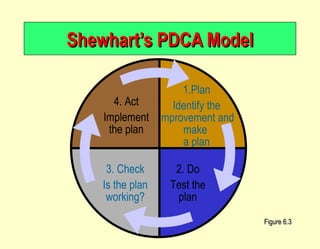
Shewhart’s PDCA Model Figure 6.3 2. Do Test the plan 3. Check Is the plan working? 4. Act Implement the plan Plan Identify the improvement and make  a plan
Six Sigma Originally developed by Motorola, Six Sigma refers to an extremely high measure of process capability A Six Sigma capable process will return no more than 3.4 defects per million operations (DPMO) Highly structured approach to process improvement
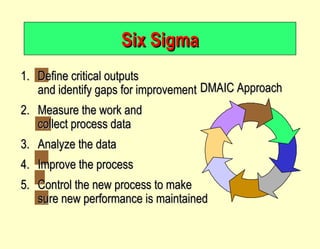
Six Sigma DMAIC Approach Define critical outputs  and identify gaps for improvement Measure the work and  collect process data Analyze the data Improve the process Control the new process to make sure new performance is maintained
Six Sigma Implementation Emphasize DPMO as a standard metric Provide extensive training Focus on corporate sponsor support (Champions) Create qualified process improvement experts (Black Belts, Green Belts, etc.) Set stretch objectives This cannot be accomplished without a major commitment from top level management
Employee Empowerment Getting employees involved in product and process improvements 85% of quality problems are due to process and material   Techniques Build communication networks that include employees Develop open, supportive supervisors Move responsibility to employees Build a high-morale organization Create formal team structures
Quality Circles Group of employees who meet regularly to solve problems Trained in planning, problem solving, and statistical methods Often led by a facilitator Very effective when done properly
Benchmarking Use internal benchmarking if you’re big enough Selecting best practices to use as a standard for performance Determine what to  benchmark Form a benchmark team Identify benchmarking partners Collect and analyze benchmarking information Take action to match or exceed the benchmark
Best Practices for Resolving Customer Complaints Make it easy for clients to complain Respond quickly to complaints Resolve complaints on first contact Use computers to manage complaints Recruit the best for customer service jobs
Just-in-Time (JIT) Relationship to quality: JIT cuts the cost of quality JIT improves quality Better quality means less inventory and better, easier-to-employ JIT system
Just-in-Time (JIT) ‘ Pull’ system of production scheduling including supply management Production only when signaled Allows reduced inventory levels Inventory costs money and hides process and material problems Encourages improved process and product quality
Taguchi Concepts Experimental design methods to improve product and process design Identify key component and process variables affecting product variation Taguchi Concepts Quality robustness Quality loss function Target-oriented quality
Quality Robustness Ability to produce products uniformly in adverse manufacturing and environmental conditions Remove the effects of adverse conditions Small variations in materials and process do not destroy product quality
Quality Loss Function Shows that costs increase as the product moves away from what the customer wants Costs include customer dissatisfaction, warranty and service, internal scrap and repair, and costs to society Traditional conformance specifications are too simplistic
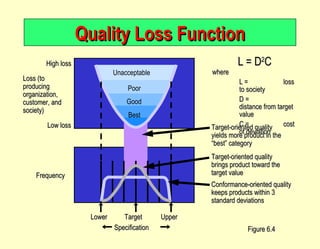
Quality Loss Function Figure 6.4 Unacceptable Poor Good Best High loss Loss (to producing organization, customer, and society) Low loss Frequency Lower Target Upper Specification Target-oriented quality yields more product in the “best” category Target-oriented quality brings product toward the target value Conformance-oriented quality keeps products within 3 standard deviations L = D 2 C where L = loss to society D = distance from target value C = cost of deviation
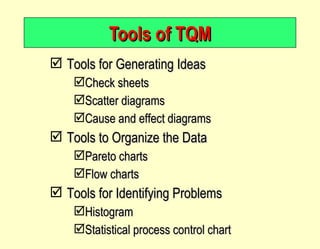
Tools of TQM Tools for Generating Ideas Check sheets Scatter diagrams Cause and effect diagrams Tools to Organize the Data Pareto charts Flow charts Tools for Identifying Problems Histogram Statistical process control chart
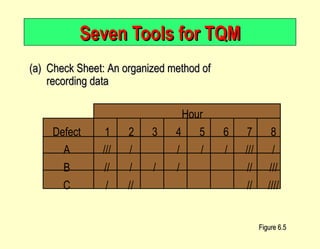
Seven Tools for TQM / / / / /// / // /// // //// /// // / Hour Defect 1 2 3 4 5 6 7 8 A B C / / // / (a) Check Sheet: An organized method of recording data Figure 6.5
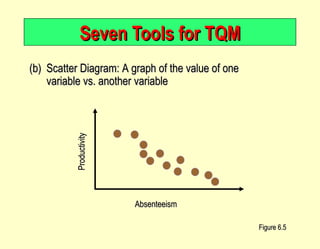
Seven Tools for TQM (b) Scatter Diagram: A graph of the value of one variable vs. another variable Figure 6.5 Absenteeism Productivity
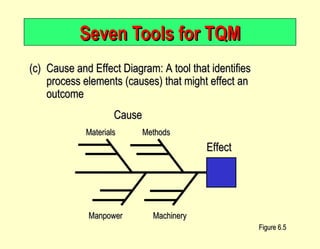
Seven Tools for TQM (c) Cause and Effect Diagram: A tool that identifies process elements (causes) that might effect an outcome Figure 6.5 Cause Materials Methods Manpower Machinery Effect
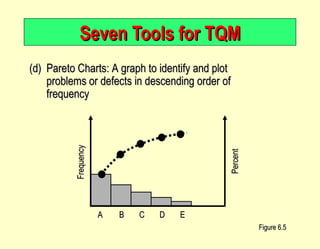
Seven Tools for TQM (d) Pareto Charts: A graph to identify and plot problems or defects in descending order of frequency Figure 6.5 Frequency Percent A B C D E
Seven Tools for TQM (e) Flow Charts (Process Diagrams): A chart that describes the steps in a process Figure 6.5
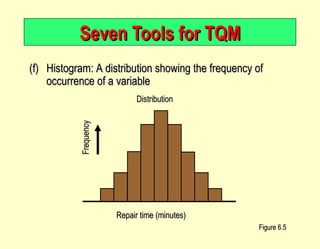
Seven Tools for TQM (f) Histogram: A distribution showing the frequency of occurrence of a variable Figure 6.5 Distribution Repair time (minutes) Frequency
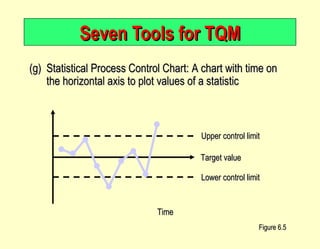
Seven Tools for TQM (g) Statistical Process Control Chart: A chart with time on the horizontal axis to plot values of a statistic Figure 6.5 Upper control limit Target value Lower control limit Time
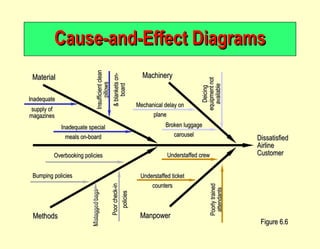
Cause-and-Effect Diagrams Figure 6.6 Material Machinery Methods Manpower Inadequate supply of magazines Inadequate special meals on-board Insufficient clean pillows & blankets on-board Broken luggage carousel Mechanical delay on plane Deicing equipment not available Overbooking policies Bumping policies Mistagged bags Poor check-in policies Understaffed ticket counters Understaffed crew Poorly trained attendants Dissatisfied Airline Customer
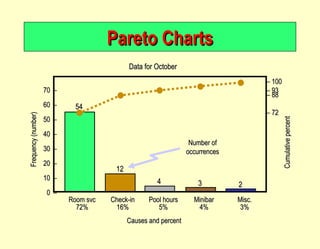
Pareto Charts Number of occurrences Room svc Check-in Pool hours Minibar Misc. 72% 16% 5% 4% 3% 12 4 3 2 54 –   100 –   93 –   88 –   72 70  – 60  – 50  – 40  – 30  – 20  – 10  – 0  – Frequency (number) Causes and percent Cumulative percent Data for October
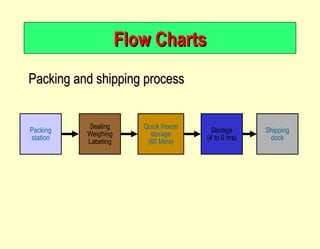
Flow Charts Packing and shipping process Shipping dock Storage (4 to 6 hrs) Quick freeze storage (60 Mins) Sealing Weighing Labeling Packing station
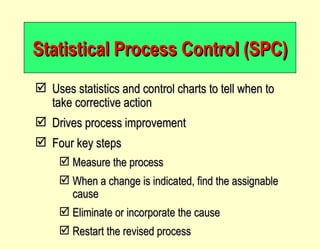
Statistical Process Control (SPC) Uses statistics and control charts to tell when to take corrective action Drives process improvement Four key steps Measure the process When a change is indicated, find the assignable cause Eliminate or incorporate the cause Restart the revised process
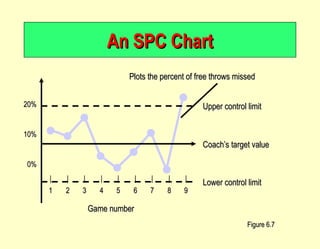
An SPC Chart Figure 6.7 Upper control limit Coach’s target value Lower control limit Game number | | | | | | | | | 1 2 3 4 5 6 7 8 9 20% 10% 0% Plots the percent of free throws missed
Inspection Involves examining items to see if an item is good or defective Detect a defective product Does not correct deficiencies in process or product It is expensive Issues When to inspect Where in process to inspect
Purpose of Inspection To maintain certain standards in producing products To meet customer specifications To find defective products which can be reworked or correct before the process is completed. To find problems in the production process that can be corrected before defects can occur. To provide information concerning the effectiveness of individual workers and particular department Some industries use inspection to grade products
Types of Inspection 100 % inspection Inspect each unit that is we received or produced. When 100% inspection is used? Cost of inspection is cheaper than defective cost Probability of quality variation is high Risks of unacceptable quality are high Low volume of output Testing are not destructive
Sampling Inspection Sampling inspection involve the use of statistical sampling to check the quality of a batch of products or to check whether a process is working properly. Sampling inspection involves inspection of only a few products, which represent a sample of the total number of products produced. When sampling inspection is used? Mechanical production is used rather than manual production. The cost of inspection is high. High volume of output Sensitive items which is easy destroy When destructive testing is involved  Not critical product
When and Where to Inspect At the supplier’s plant while the supplier is producing At your facility upon receipt of goods from the supplier Before costly or irreversible processes During the step-by-step production processes When production or service is complete Before delivery from your facility At the point of customer contact
Inspection Many problems Worker fatigue Measurement error Process variability Cannot inspect quality into a product Robust design, empowered employees, and sound processes are better solutions
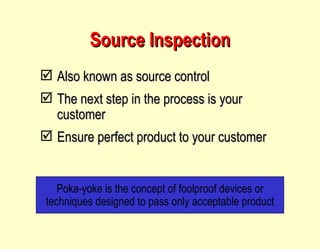
Source Inspection Also known as source control The next step in the process is your customer Ensure perfect product to your customer Poka-yoke is the concept of foolproof devices or techniques designed to pass only acceptable product
Service quality is more difficult to measure than for goods Service quality perceptions depend on  Expectations versus reality Process and outcome Types of service quality Normal: Routine service delivery Exceptional: How problems are handled TQM In Services OPM 533 12-
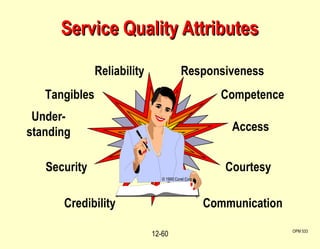
Service Quality Attributes OPM 533 12- Under- standing Tangibles Reliability Communication Credibility Security Responsiveness Competence Courtesy Access © 1995 Corel Corp.
Determinants of Service Quality Reliability  – consistency and dependability Responsiveness  – willingness/readiness of employees to provide service; timeliness Competence  – possession of skills and knowledge required to perform service Access  – approachability and ease of contact Courtesy  – politeness, respect, consideration, friendliness of contact personnel OPM 533 12-
Determinants of Service Quality Communication  – keeping customers informed in languages they understand Credibility  – trustworthiness, believability, honesty Security  – freedom from danger, risk or doubt Understanding/knowing the customer  – making the effort to understands the customer’s needs Tangibles  – the physical evidence of the service OPM 533 12-

C12 quality

  • 1.
    OPM 533 12-Operations Management Managing Quality Chapter 12
  • 2.
    Ways in WhichQuality Can Improve Productivity Sales Gains Improved response Higher Prices Improved reputation OPM 533 12- Reduced Costs Increased productivity Lower rework and scrap costs Lower warranty costs Increased Profits Improved Quality
  • 3.
    Flow of ActivitiesNecessary to Achieve Total Quality Management Organizational Practices OPM 533 12- Quality Principles Employee Fulfillment Customer Satisfaction
  • 4.
    1. Organizational PracticesLeadership Mission statement Effective operating procedure Staff support Training Yields: What is important and what is to be accomplished OPM 533 12-
  • 5.
    2. Quality PrinciplesCustomer focus Continuous improvement Employee empowerment Benchmarking Just-in-time Tools of TQM Yields: How to do what is important and to be accomplished OPM 533 12-
  • 6.
    3. Employment FulfillmentEmpowerment Organizational commitment Yields: Employees’ attitudes that they can accomplish what is important and to be accomplished OPM 533 12-
  • 7.
    4. Customer SatisfactionWinning orders Repeat customers Yields: An effective organization with a competitive advantage OPM 533 12-
  • 8.
    Definitions of QualityASQ : Product characteristics & features that affect customer satisfaction User-Based : What consumer says it is Manufacturing-Based : Degree to which a product conforms to design specification Product-Based : Level of measurable product characteristic OPM 533 12-
  • 9.
    Implications of QualityCompany reputation Perception of new products Employment practices Supplier relations Product liability Reduce risk Global implications Improved ability to compete
  • 10.
    Key Dimensions ofQuality Performance Features Reliability Conformance Durability Serviceability Aesthetics Perceived quality Value
  • 11.
    Service Quality AttributesOPM 533 12- Under- standing Tangibles Reliability Communication Credibility Security Responsiveness Competence Courtesy Access © 1995 Corel Corp.
  • 12.
    Importance of QualityOPM 533 12- Costs & market share Company’s reputation Product liability International implications Increased Profits Lower Costs Productivity Rework/Scrap Warranty Market Gains Reputation Volume Price Improved Quality
  • 13.
    Quality Cost 4types of quality costs Prevention cost Appraisal cost Internal failure cost External failure costs 1 & 2 – cost to maintain or control quality. 3 & 4 – cost resulting from failure to control quality.
  • 14.
    Prevention cost Costassociated with preventing defects before they happen. Costs of trying to prevent poor quality products from reaching the consumer. Eg.process design, product design, employee training and vendor program.
  • 15.
    Appraisal costs Costincurred in assessing or auditing the level of quality. These are the costs of measuring, testing and analyzing materials, parts, product and the production process to ensure that the product quality specifications are being conformed to. Example cost of inspection and testing, test equipment or devices.
  • 16.
    Internal failure costsCost incurred for correcting or reworking on products or services due to defects incurred during the production process. It pertains to defects found before the product left the factory. Example: Rework costs, process failure costs, process downtown costs and price downgrading costs.
  • 17.
    External failure costsExternal failure costs are costs incurred after the customer has received a poor-quality product. Example: customer complaint costs, product returns costs, warranty claim costs, loss of market share and lawsuit arising from injury or property damages from use of the product or service.
  • 18.
    Traditional QualityProcess (Manufacturing) OPM 533 12- Specifies Need Customer Interprets Need Marketing Designs Product Defines Quality Engineering Produces Product Plans Quality Monitors Quality Operations Quality is customer driven!
  • 19.
    TQM Encompasses entireorganization, from supplier to customer Stresses a commitment by management to have a continuing, company-wide, drive toward excellence in all aspects of products and services that are important to the customer. OPM 533 12-
  • 20.
    Achieving TotalQuality Management OPM 533 12- Organizational Practices Quality Principles Employee Fulfillment Attitudes (e.g., Commitment) How to Do What to Do Effective Business Customer Satisfaction
  • 21.
    Deming’s Fourteen PointsCreate consistency of purpose Lead to promote change Build quality into the products Build long term relationships Continuously improve product, quality, and service Start training Emphasize leadership OPM 533 12-
  • 22.
    Deming’s Points -continued Drive out fear Break down barriers between departments Stop haranguing workers Support, help, improve Remove barriers to pride in work Institute a vigorous program of education and self-improvement Put everybody in the company to work on the transformation OPM 533 12-
  • 23.
    Seven Concepts ofTQM Continuous improvement Six Sigma Employee empowerment Benchmarking Just-in-time (JIT) Taguchi concepts Knowledge of TQM tools
  • 24.
    Continuous Improvement Representscontinual improvement of all processes Involves all operations and work centers including suppliers and customers People, Equipment, Materials, Procedures
  • 25.
    Shewhart’s PDCA ModelFigure 6.3 2. Do Test the plan 3. Check Is the plan working? 4. Act Implement the plan Plan Identify the improvement and make a plan
  • 26.
    Six Sigma Originallydeveloped by Motorola, Six Sigma refers to an extremely high measure of process capability A Six Sigma capable process will return no more than 3.4 defects per million operations (DPMO) Highly structured approach to process improvement
  • 27.
    Six Sigma DMAICApproach Define critical outputs and identify gaps for improvement Measure the work and collect process data Analyze the data Improve the process Control the new process to make sure new performance is maintained
  • 28.
    Six Sigma ImplementationEmphasize DPMO as a standard metric Provide extensive training Focus on corporate sponsor support (Champions) Create qualified process improvement experts (Black Belts, Green Belts, etc.) Set stretch objectives This cannot be accomplished without a major commitment from top level management
  • 29.
    Employee Empowerment Gettingemployees involved in product and process improvements 85% of quality problems are due to process and material Techniques Build communication networks that include employees Develop open, supportive supervisors Move responsibility to employees Build a high-morale organization Create formal team structures
  • 30.
    Quality Circles Groupof employees who meet regularly to solve problems Trained in planning, problem solving, and statistical methods Often led by a facilitator Very effective when done properly
  • 31.
    Benchmarking Use internalbenchmarking if you’re big enough Selecting best practices to use as a standard for performance Determine what to benchmark Form a benchmark team Identify benchmarking partners Collect and analyze benchmarking information Take action to match or exceed the benchmark
  • 32.
    Best Practices forResolving Customer Complaints Make it easy for clients to complain Respond quickly to complaints Resolve complaints on first contact Use computers to manage complaints Recruit the best for customer service jobs
  • 33.
    Just-in-Time (JIT) Relationshipto quality: JIT cuts the cost of quality JIT improves quality Better quality means less inventory and better, easier-to-employ JIT system
  • 34.
    Just-in-Time (JIT) ‘Pull’ system of production scheduling including supply management Production only when signaled Allows reduced inventory levels Inventory costs money and hides process and material problems Encourages improved process and product quality
  • 35.
    Taguchi Concepts Experimentaldesign methods to improve product and process design Identify key component and process variables affecting product variation Taguchi Concepts Quality robustness Quality loss function Target-oriented quality
  • 36.
    Quality Robustness Abilityto produce products uniformly in adverse manufacturing and environmental conditions Remove the effects of adverse conditions Small variations in materials and process do not destroy product quality
  • 37.
    Quality Loss FunctionShows that costs increase as the product moves away from what the customer wants Costs include customer dissatisfaction, warranty and service, internal scrap and repair, and costs to society Traditional conformance specifications are too simplistic
  • 38.
    Quality Loss FunctionFigure 6.4 Unacceptable Poor Good Best High loss Loss (to producing organization, customer, and society) Low loss Frequency Lower Target Upper Specification Target-oriented quality yields more product in the “best” category Target-oriented quality brings product toward the target value Conformance-oriented quality keeps products within 3 standard deviations L = D 2 C where L = loss to society D = distance from target value C = cost of deviation
  • 39.
    Tools of TQMTools for Generating Ideas Check sheets Scatter diagrams Cause and effect diagrams Tools to Organize the Data Pareto charts Flow charts Tools for Identifying Problems Histogram Statistical process control chart
  • 40.
    Seven Tools forTQM / / / / /// / // /// // //// /// // / Hour Defect 1 2 3 4 5 6 7 8 A B C / / // / (a) Check Sheet: An organized method of recording data Figure 6.5
  • 41.
    Seven Tools forTQM (b) Scatter Diagram: A graph of the value of one variable vs. another variable Figure 6.5 Absenteeism Productivity
  • 42.
    Seven Tools forTQM (c) Cause and Effect Diagram: A tool that identifies process elements (causes) that might effect an outcome Figure 6.5 Cause Materials Methods Manpower Machinery Effect
  • 43.
    Seven Tools forTQM (d) Pareto Charts: A graph to identify and plot problems or defects in descending order of frequency Figure 6.5 Frequency Percent A B C D E
  • 44.
    Seven Tools forTQM (e) Flow Charts (Process Diagrams): A chart that describes the steps in a process Figure 6.5
  • 45.
    Seven Tools forTQM (f) Histogram: A distribution showing the frequency of occurrence of a variable Figure 6.5 Distribution Repair time (minutes) Frequency
  • 46.
    Seven Tools forTQM (g) Statistical Process Control Chart: A chart with time on the horizontal axis to plot values of a statistic Figure 6.5 Upper control limit Target value Lower control limit Time
  • 47.
    Cause-and-Effect Diagrams Figure6.6 Material Machinery Methods Manpower Inadequate supply of magazines Inadequate special meals on-board Insufficient clean pillows & blankets on-board Broken luggage carousel Mechanical delay on plane Deicing equipment not available Overbooking policies Bumping policies Mistagged bags Poor check-in policies Understaffed ticket counters Understaffed crew Poorly trained attendants Dissatisfied Airline Customer
  • 48.
    Pareto Charts Numberof occurrences Room svc Check-in Pool hours Minibar Misc. 72% 16% 5% 4% 3% 12 4 3 2 54 – 100 – 93 – 88 – 72 70 – 60 – 50 – 40 – 30 – 20 – 10 – 0 – Frequency (number) Causes and percent Cumulative percent Data for October
  • 49.
    Flow Charts Packingand shipping process Shipping dock Storage (4 to 6 hrs) Quick freeze storage (60 Mins) Sealing Weighing Labeling Packing station
  • 50.
    Statistical Process Control(SPC) Uses statistics and control charts to tell when to take corrective action Drives process improvement Four key steps Measure the process When a change is indicated, find the assignable cause Eliminate or incorporate the cause Restart the revised process
  • 51.
    An SPC ChartFigure 6.7 Upper control limit Coach’s target value Lower control limit Game number | | | | | | | | | 1 2 3 4 5 6 7 8 9 20% 10% 0% Plots the percent of free throws missed
  • 52.
    Inspection Involves examiningitems to see if an item is good or defective Detect a defective product Does not correct deficiencies in process or product It is expensive Issues When to inspect Where in process to inspect
  • 53.
    Purpose of InspectionTo maintain certain standards in producing products To meet customer specifications To find defective products which can be reworked or correct before the process is completed. To find problems in the production process that can be corrected before defects can occur. To provide information concerning the effectiveness of individual workers and particular department Some industries use inspection to grade products
  • 54.
    Types of Inspection100 % inspection Inspect each unit that is we received or produced. When 100% inspection is used? Cost of inspection is cheaper than defective cost Probability of quality variation is high Risks of unacceptable quality are high Low volume of output Testing are not destructive
  • 55.
    Sampling Inspection Samplinginspection involve the use of statistical sampling to check the quality of a batch of products or to check whether a process is working properly. Sampling inspection involves inspection of only a few products, which represent a sample of the total number of products produced. When sampling inspection is used? Mechanical production is used rather than manual production. The cost of inspection is high. High volume of output Sensitive items which is easy destroy When destructive testing is involved Not critical product
  • 56.
    When and Whereto Inspect At the supplier’s plant while the supplier is producing At your facility upon receipt of goods from the supplier Before costly or irreversible processes During the step-by-step production processes When production or service is complete Before delivery from your facility At the point of customer contact
  • 57.
    Inspection Many problemsWorker fatigue Measurement error Process variability Cannot inspect quality into a product Robust design, empowered employees, and sound processes are better solutions
  • 58.
    Source Inspection Alsoknown as source control The next step in the process is your customer Ensure perfect product to your customer Poka-yoke is the concept of foolproof devices or techniques designed to pass only acceptable product
  • 59.
    Service quality ismore difficult to measure than for goods Service quality perceptions depend on Expectations versus reality Process and outcome Types of service quality Normal: Routine service delivery Exceptional: How problems are handled TQM In Services OPM 533 12-
  • 60.
    Service Quality AttributesOPM 533 12- Under- standing Tangibles Reliability Communication Credibility Security Responsiveness Competence Courtesy Access © 1995 Corel Corp.
  • 61.
    Determinants of ServiceQuality Reliability – consistency and dependability Responsiveness – willingness/readiness of employees to provide service; timeliness Competence – possession of skills and knowledge required to perform service Access – approachability and ease of contact Courtesy – politeness, respect, consideration, friendliness of contact personnel OPM 533 12-
  • 62.
    Determinants of ServiceQuality Communication – keeping customers informed in languages they understand Credibility – trustworthiness, believability, honesty Security – freedom from danger, risk or doubt Understanding/knowing the customer – making the effort to understands the customer’s needs Tangibles – the physical evidence of the service OPM 533 12-

Editor's Notes

  • #3 This slide not only looks at the impact of quality on productivity - it also enables you to begin a discussion as to the meaning of quality (or perhaps the differing meanings among different people). To many people, the notion of “high quality” carries with it the assumption of “high price.” This slide provides an initial point to challenge that assumption.
  • #4 This slide simply introduces the four activities. Subsequent slides expand on each.
  • #5 One might begin discussion of this slide by introducing the difference between “leadership” and “management.” The point should also be made, again, about the need for involvement and commitment throughout the organization.
  • #6 Some students may find the notion of “continuous improvement” (Why can’t we do it right the first time?) and “employee empowerment” (Doesn’t this reduce or abrogate the role of the manager?) the most difficult to accept. If you have not done so already, this might be a good time to discuss each in some depth. The following slide may be used in a discussion of empowerment.
  • #7 This slide can be used to form the basis for a discussion of empowerment. If you wish to discuss empowerment - begin by asking students to define the term. You may find students are already comfortable with the term, in which case the discussion can be rather short; or, you may find they have unrealistic expectations (or desires?) - in which case you may wish to pursue the discussion at greater length. It may be helpful to ask students to identify the benefits and pitfalls to both management and worker. (For example, empowerment requires workers to assume greater responsibility.)
  • #8 The main point that one might make with this slide is that the customer is, ultimately, the most important person in your business.
  • #9 Once you have introduced these definitions of quality, ask students to provide example of products that use them.
  • #11 7
  • #12 Although the text considers service quality at the end of the chapter, you may wish, at this point, to contrast the notion of quality for goods with that for services. If not, skip this slide - it is repeated at the point at which the issues are raised in the text.
  • #13 This slide simply illustrates the relationships between quality and other elements of the firm.
  • #19 Students might be asked what problems they would foresee in implementing this process.
  • #20 A point to be made here is that TQM is not a program but a philosophy.
  • #21 Again, a point to be made here is the universality required to achieve TQM.
  • #22 One point to make here is that this list represents a recent expression of Demings 14 points - the list is still evolving. Students may notice that many of these fourteen points seem to be simply common sense. If they raise this issue - ask them to consider jobs they have held. Were these points emphasized or implemented by their employers? If not, why not? This part of the discussion can be used to raise again the issue that proper approaches to quality are not “programs,” with limited involvement and finite duration, but rather philosophies which must become ingrained throughout the organization.
  • #60 At this point, you might consider going back to the slides illustrating the differences between goods and services. Those slides are provided next. If you do not wish to use them, simply skip to the final slide in the sequence.
  • #61 This slide is a repeat of the earlier one on Service Quality Attributes as that topic appears at this point in the text.