Second
Edition
2
Business
Process
Management
Key Concepts
Business Process Management
Business Process Management (BPM) is a systematic approach that is used to
make an organization's workflow effective, efficient and responsive to
changing environment.
Purpose of BPM
To reduce human error and avoid miscommunication. Link operational
processes to corporate strategies. Measure performance indicators from
processes for evaluation of business success.
Business Process Model
A Business Process Model (BPMd) typically consists of workflow diagrams,
descriptions, inputs and outputs, KPIs and data that provide both overview and
detailed information about an organization’s business processes.
3
Key Concepts
4
Utility of Business Process Model
It helps to measure requirements of a process and eliminates the risk of
losing value through inefficient or inappropriate activities.
BPM Software
Software that allows users to create BPM diagrams and integrate process
content with critical business entities (departments, resources, etc.) Please
refer to Appendix A for more details about BPM soft-wares.
Business Process Re-engineering (BPR)
The realignment of business process strategies through the use of an analytic
tool and an intense consultation process. BPR is an off-shoot of BPM
implementation that involves a great deal of risk due to change
management.
Key Concepts
5
Business Process Design (BPD)
BPD is the systematic working by which an organization understands, defines and
documents the business activities that enable it to function efficiently, effectively
and economically.
Business Process Model (BPMd)
Illustrated description of business processes, usually created with flow diagrams.
The model contains the relationship between activities, processes, sub-processes and
information, as well as roles, the organization and resources. It is also termed as
Business Process Mapping.
Workflow Simulation & Analysis
An executable specification of a workflow that is used to simulate the behavior of
the workflow under different circumstances. This application is a typical example of
decision support in matters as BPR and operational control. Various qualitative and
quantitative analytical methods have been developed to assess the effectiveness of
existing or new workflows.
Important Terms
6
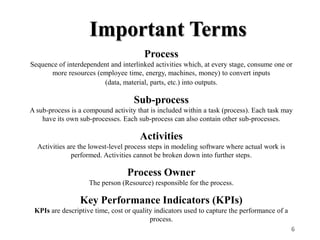
Process
Sequence of interdependent and interlinked activities which, at every stage, consume one or
more resources (employee time, energy, machines, money) to convert inputs
(data, material, parts, etc.) into outputs.
Sub-process
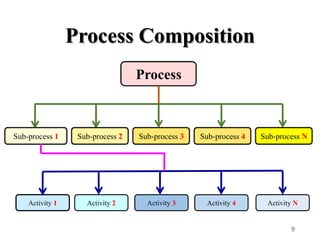
A sub-process is a compound activity that is included within a task (process). Each task may
have its own sub-processes. Each sub-process can also contain other sub-processes.
Activities
Activities are the lowest-level process steps in modeling software where actual work is
performed. Activities cannot be broken down into further steps.
Process Owner
The person (Resource) responsible for the process.
Key Performance Indicators (KPIs)
KPIs are descriptive time, cost or quality indicators used to capture the performance of a
process.
Important Terms
7
Job Description or Roles
Roles represent specific skill sets, responsibilities or positions in a business
environment. Roles allow the modeler to define criteria required for performing the
activity, rather than the specific individuals who will perform the activity.
Scope of a Process
It describes the boundaries of a process and includes start and end points, the
context in which the process is performed and elements excluded from that context.
Workflow Diagram
It refers to a simple form of flowchart depicting the flow of tasks or actions from
one person or group to another. It typically consists of a set of symbols
representing actions or individuals connected by arrows indicating the flow from
one to another.
Benefits of BPM
8
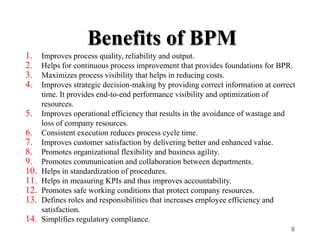
1. Improves process quality, reliability and output.
2. Helps for continuous process improvement that provides foundations for BPR.
3. Maximizes process visibility that helps in reducing costs.
4. Improves strategic decision-making by providing correct information at correct
time. It provides end-to-end performance visibility and optimization of
resources.
5. Improves operational efficiency that results in the avoidance of wastage and
loss of company resources.
6. Consistent execution reduces process cycle time.
7. Improves customer satisfaction by delivering better and enhanced value.
8. Promotes organizational flexibility and business agility.
9. Promotes communication and collaboration between departments.
10. Helps in standardization of procedures.
11. Helps in measuring KPIs and thus improves accountability.
12. Promotes safe working conditions that protect company resources.
13. Defines roles and responsibilities that increases employee efficiency and
satisfaction.
14. Simplifies regulatory compliance.
Process Composition
9
Process
Sub-process 1 Sub-process 2 Sub-process 3 Sub-process 4 Sub-process N
Activity 1 Activity 4Activity 3 Activity NActivity 2
BPM Life-Cycle
10
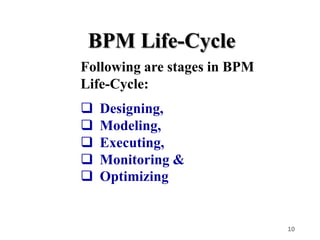
Following are stages in BPM
Life-Cycle:
 Designing,
 Modeling,
 Executing,
 Monitoring &
 Optimizing
1. Designing
12
BPD is the systematic working by which an organization understands, defines and
documents the business activities that enable it to function efficiently, effectively and
economically.
The purpose of BPD is to ensure that processes are optimized, effective, meet
customer requirements, support and sustain organizational development and growth.
Designing a process that improves corporate performance is a challenging task that
requires multi-disciplinary expertise and a plethora of inputs (for instance,
organizational strategies, goals, constraints, human and technical capabilities, etc.).
The most common requirements of a BPD are:
 Customer and supply chain management
 Operational performance improvement
 Business process integration and automation
 Cost reduction
 New business opportunities.
2. Modeling
13
The output of a BPD project is a streamlined, comprehensive, easy-to-use
model of the ways in which a business delivers output to its customers. One of
the key purposes of process modeling is to provide a “process view” of the
business.
BPMd typically consists of a set of diagrams, textual descriptions and data
elements that provide both overview and detailed information about the
business processes in a format that is easily understood by everyone.
The key components of a typical BPMd are as given below:
 The set of processes and activities that take place within an organization
 A written description of each process or activity or task
 Workflow diagrams
 Inputs & outputs
 KPIs
3. Executing
14
It refers to automating processes by using
BPM application software that executes the required steps
of a process. BPM soft-wares are either purchased or
developed to fit to the requirements of a company. Please
refer to Appendix A for BPM soft-wares.
4. Monitoring
15
Monitoring refers to tracking of individual processes, so that
information about them can be checked.
An example of the tracking is being able to determine the stage of a
customer order (e.g. order arrived, awaiting delivery, invoice paid) so
that problems in its operation can be identified and corrected.
The degree of monitoring depends on what information a business
requires to evaluate and analyze and how that business needs it to be
monitored, in real-time, near real-time or ad-hoc. Here, business
activity monitoring extends and expands the monitoring tools
generally provided by Business Process Management Suites
(BPMS).
5. Optimizing
16
Refers to retrieving process performance information from
monitoring phase, identifying the potential or
actual problems, recognizing the opportunities for cost
cuttings or further improvements and then, applying those
enhancements in the design of the process. In more specific
terms, optimizing may include the following activities:
 Improve processes and performance by reducing inefficiencies
identified during monitoring.
 Simulate these changes using “what-if” simulation.
 Determine which changes will deliver the maximum improvement.
 Build the processes on firm footing.
17
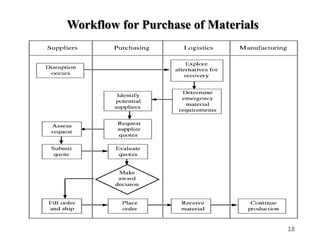
Workflow for Purchase of Materials
18
19
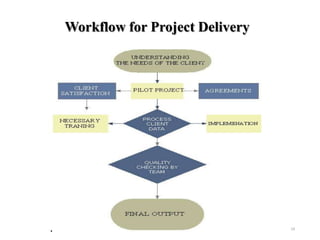
Workflow for Project Delivery
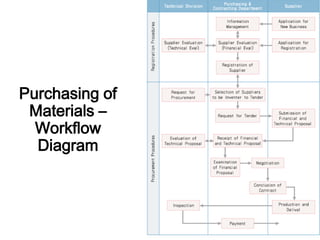
Purchasing of
Materials –
Workflow
Diagram
20
21
Brief Background
22
Hammer and Champy (1990s) felt that the design of workflow in most
large companies was based on facts about
technology, people, practices, and organizational goals that were no longer
applicable.
They suggested seven principles of re-engineering to streamline the work
process and, thereby, achieve significant levels of improvement in
quality, time management, and cost:
1. Organize around outcomes, not tasks.
2. Identify all the processes in an organization and prioritize them in order of
redesign urgency.
3. Integrate information processing work into the real work that produces the
information.
4. Treat geographically dispersed resources as though they were centralized.
5. Link parallel activities in the workflow instead of just integrating their results.
6. Put the decision point where the work is performed, and build control into the
process.
7. Capture information once and at the source.
Methodology
23
BPR involves the redesign of business processes to achieve improvements in
productivity, cycle time, quality and cost.
BPR review starts with the description of existing business processes to
deliver more value to the customers.
BPR typically adopts a new value system that places emphasis on customer
needs. They remove unnecessary organizational layers and eliminate
unproductive activities in two key areas.
First, BPR redesigns functional organizations into cross-functional teams.
Second, BPR uses technology to improve data dissemination and decision
making process.
Case Study -- Taco Bell
24
Taco Bell (founded in 1962, California) created K-Minus Program
(Kitchen-less Restaurant) based on the fact that they are a retail service
company, not a manufacturing company. In the new process, meat, beans,
corn shells, lettuce, tomatoes and cheese for their products are prepared
outside of the restaurants in central commissaries. At Taco Bell
restaurants, the food ingredients are prepared when ordered for customer
consumption. Taco Bell has produced the following results: greater quality
control, better employee morale, fewer employee accidents and injuries, big
savings and more time to focus on the customer satisfaction. Currently,
they are redefining how to deliver their food services, by taking their food
service to public gathering places such as dining centers, schools,
universities, airports, and stadia. Taco Bell has progressed from a $. 500
million regional company in 1982 to a $. 1.9 billion in 2009 a national
company. (Hammer & Champy 1993, pg. 178-179)
Abbreviations
25
#
Abbreviation
s
Complete Term
1 IT Information Technology
2 BPD Business Process Design
3 BPM Business Process Management
4 BPMd Business Process Model
5 BPMS Business Process Management Suites
6 KPIs Key Performance Indicators
Appendix A: List of BPM soft-wares
26
# BPM Software Website
1 Accu Process Modeler http://www.accuprocess.com
2 RunMyJobs http://www.runmyjobs.com
3 BPMS http://www.sydle.com
4 BPM from IBM http://www-142.ibm.com
5 ProcessMaker http://www.processmaker.com
6 Appian BPM Suite http://www.appian.com
7 webMethods BPMS http://www.softwareag.com
8 Ultimus BPM & Workflow Solution
Software
http://www.ultimus.com
9 Progress® Savvion®, http://www.progress.com
10 Sequence KineticsTM BPM Software http://www.pnmsoft.com/
11 Oracle Business Process Management
Suite
http://www.oracle.com/us/technologies/bp
m
12 Skelta BPM & Workflow Software http://www.skelta.com
13 SharePoint 2010 https://www.microsoft.com
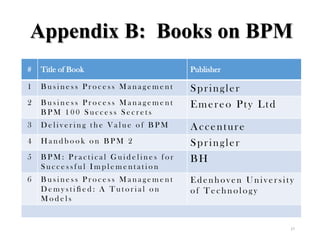
Appendix B: Books on BPM
27
# Title of Book Publisher
1 B u s i n e s s P r o c e s s M a n a g e m e n t Springler
2 B u s i n e s s P r o c e s s M a n a g e m e n t
B P M 1 0 0 S u c c e s s S e c r e t s
Emereo Pty Ltd
3 D e l i v e r i n g t h e V a l u e o f B P M Accenture
4 H a n d b o o k o n B P M 2 Springler
5 B P M : P r a c t i c a l G u i d e l i n e s f o r
S u c c e s s f u l I m p l e m e n t a t i o n
BH
6 B u s i n e s s P r o c e s s M a n a g e m e n t
D e m y s t i fi e d : A T u t o r i a l o n
M o d e l s
Edenhoven University
of Technology
A Presentation by:
Ahmad Tariq Bhatti
Contact details:
Email id: at.bhatty@gmail.com
28

Business Process Management

  • 1.
  • 2.
  • 3.
    Key Concepts Business ProcessManagement Business Process Management (BPM) is a systematic approach that is used to make an organization's workflow effective, efficient and responsive to changing environment. Purpose of BPM To reduce human error and avoid miscommunication. Link operational processes to corporate strategies. Measure performance indicators from processes for evaluation of business success. Business Process Model A Business Process Model (BPMd) typically consists of workflow diagrams, descriptions, inputs and outputs, KPIs and data that provide both overview and detailed information about an organization’s business processes. 3
  • 4.
    Key Concepts 4 Utility ofBusiness Process Model It helps to measure requirements of a process and eliminates the risk of losing value through inefficient or inappropriate activities. BPM Software Software that allows users to create BPM diagrams and integrate process content with critical business entities (departments, resources, etc.) Please refer to Appendix A for more details about BPM soft-wares. Business Process Re-engineering (BPR) The realignment of business process strategies through the use of an analytic tool and an intense consultation process. BPR is an off-shoot of BPM implementation that involves a great deal of risk due to change management.
  • 5.
    Key Concepts 5 Business ProcessDesign (BPD) BPD is the systematic working by which an organization understands, defines and documents the business activities that enable it to function efficiently, effectively and economically. Business Process Model (BPMd) Illustrated description of business processes, usually created with flow diagrams. The model contains the relationship between activities, processes, sub-processes and information, as well as roles, the organization and resources. It is also termed as Business Process Mapping. Workflow Simulation & Analysis An executable specification of a workflow that is used to simulate the behavior of the workflow under different circumstances. This application is a typical example of decision support in matters as BPR and operational control. Various qualitative and quantitative analytical methods have been developed to assess the effectiveness of existing or new workflows.
  • 6.
    Important Terms 6 Process Sequence ofinterdependent and interlinked activities which, at every stage, consume one or more resources (employee time, energy, machines, money) to convert inputs (data, material, parts, etc.) into outputs. Sub-process A sub-process is a compound activity that is included within a task (process). Each task may have its own sub-processes. Each sub-process can also contain other sub-processes. Activities Activities are the lowest-level process steps in modeling software where actual work is performed. Activities cannot be broken down into further steps. Process Owner The person (Resource) responsible for the process. Key Performance Indicators (KPIs) KPIs are descriptive time, cost or quality indicators used to capture the performance of a process.
  • 7.
    Important Terms 7 Job Descriptionor Roles Roles represent specific skill sets, responsibilities or positions in a business environment. Roles allow the modeler to define criteria required for performing the activity, rather than the specific individuals who will perform the activity. Scope of a Process It describes the boundaries of a process and includes start and end points, the context in which the process is performed and elements excluded from that context. Workflow Diagram It refers to a simple form of flowchart depicting the flow of tasks or actions from one person or group to another. It typically consists of a set of symbols representing actions or individuals connected by arrows indicating the flow from one to another.
  • 8.
    Benefits of BPM 8 1.Improves process quality, reliability and output. 2. Helps for continuous process improvement that provides foundations for BPR. 3. Maximizes process visibility that helps in reducing costs. 4. Improves strategic decision-making by providing correct information at correct time. It provides end-to-end performance visibility and optimization of resources. 5. Improves operational efficiency that results in the avoidance of wastage and loss of company resources. 6. Consistent execution reduces process cycle time. 7. Improves customer satisfaction by delivering better and enhanced value. 8. Promotes organizational flexibility and business agility. 9. Promotes communication and collaboration between departments. 10. Helps in standardization of procedures. 11. Helps in measuring KPIs and thus improves accountability. 12. Promotes safe working conditions that protect company resources. 13. Defines roles and responsibilities that increases employee efficiency and satisfaction. 14. Simplifies regulatory compliance.
  • 9.
    Process Composition 9 Process Sub-process 1Sub-process 2 Sub-process 3 Sub-process 4 Sub-process N Activity 1 Activity 4Activity 3 Activity NActivity 2
  • 10.
    BPM Life-Cycle 10 Following arestages in BPM Life-Cycle:  Designing,  Modeling,  Executing,  Monitoring &  Optimizing
  • 12.
    1. Designing 12 BPD isthe systematic working by which an organization understands, defines and documents the business activities that enable it to function efficiently, effectively and economically. The purpose of BPD is to ensure that processes are optimized, effective, meet customer requirements, support and sustain organizational development and growth. Designing a process that improves corporate performance is a challenging task that requires multi-disciplinary expertise and a plethora of inputs (for instance, organizational strategies, goals, constraints, human and technical capabilities, etc.). The most common requirements of a BPD are:  Customer and supply chain management  Operational performance improvement  Business process integration and automation  Cost reduction  New business opportunities.
  • 13.
    2. Modeling 13 The outputof a BPD project is a streamlined, comprehensive, easy-to-use model of the ways in which a business delivers output to its customers. One of the key purposes of process modeling is to provide a “process view” of the business. BPMd typically consists of a set of diagrams, textual descriptions and data elements that provide both overview and detailed information about the business processes in a format that is easily understood by everyone. The key components of a typical BPMd are as given below:  The set of processes and activities that take place within an organization  A written description of each process or activity or task  Workflow diagrams  Inputs & outputs  KPIs
  • 14.
    3. Executing 14 It refersto automating processes by using BPM application software that executes the required steps of a process. BPM soft-wares are either purchased or developed to fit to the requirements of a company. Please refer to Appendix A for BPM soft-wares.
  • 15.
    4. Monitoring 15 Monitoring refersto tracking of individual processes, so that information about them can be checked. An example of the tracking is being able to determine the stage of a customer order (e.g. order arrived, awaiting delivery, invoice paid) so that problems in its operation can be identified and corrected. The degree of monitoring depends on what information a business requires to evaluate and analyze and how that business needs it to be monitored, in real-time, near real-time or ad-hoc. Here, business activity monitoring extends and expands the monitoring tools generally provided by Business Process Management Suites (BPMS).
  • 16.
    5. Optimizing 16 Refers toretrieving process performance information from monitoring phase, identifying the potential or actual problems, recognizing the opportunities for cost cuttings or further improvements and then, applying those enhancements in the design of the process. In more specific terms, optimizing may include the following activities:  Improve processes and performance by reducing inefficiencies identified during monitoring.  Simulate these changes using “what-if” simulation.  Determine which changes will deliver the maximum improvement.  Build the processes on firm footing.
  • 17.
  • 18.
    Workflow for Purchaseof Materials 18
  • 19.
  • 20.
  • 21.
  • 22.
    Brief Background 22 Hammer andChampy (1990s) felt that the design of workflow in most large companies was based on facts about technology, people, practices, and organizational goals that were no longer applicable. They suggested seven principles of re-engineering to streamline the work process and, thereby, achieve significant levels of improvement in quality, time management, and cost: 1. Organize around outcomes, not tasks. 2. Identify all the processes in an organization and prioritize them in order of redesign urgency. 3. Integrate information processing work into the real work that produces the information. 4. Treat geographically dispersed resources as though they were centralized. 5. Link parallel activities in the workflow instead of just integrating their results. 6. Put the decision point where the work is performed, and build control into the process. 7. Capture information once and at the source.
  • 23.
    Methodology 23 BPR involves theredesign of business processes to achieve improvements in productivity, cycle time, quality and cost. BPR review starts with the description of existing business processes to deliver more value to the customers. BPR typically adopts a new value system that places emphasis on customer needs. They remove unnecessary organizational layers and eliminate unproductive activities in two key areas. First, BPR redesigns functional organizations into cross-functional teams. Second, BPR uses technology to improve data dissemination and decision making process.
  • 24.
    Case Study --Taco Bell 24 Taco Bell (founded in 1962, California) created K-Minus Program (Kitchen-less Restaurant) based on the fact that they are a retail service company, not a manufacturing company. In the new process, meat, beans, corn shells, lettuce, tomatoes and cheese for their products are prepared outside of the restaurants in central commissaries. At Taco Bell restaurants, the food ingredients are prepared when ordered for customer consumption. Taco Bell has produced the following results: greater quality control, better employee morale, fewer employee accidents and injuries, big savings and more time to focus on the customer satisfaction. Currently, they are redefining how to deliver their food services, by taking their food service to public gathering places such as dining centers, schools, universities, airports, and stadia. Taco Bell has progressed from a $. 500 million regional company in 1982 to a $. 1.9 billion in 2009 a national company. (Hammer & Champy 1993, pg. 178-179)
  • 25.
    Abbreviations 25 # Abbreviation s Complete Term 1 ITInformation Technology 2 BPD Business Process Design 3 BPM Business Process Management 4 BPMd Business Process Model 5 BPMS Business Process Management Suites 6 KPIs Key Performance Indicators
  • 26.
    Appendix A: Listof BPM soft-wares 26 # BPM Software Website 1 Accu Process Modeler http://www.accuprocess.com 2 RunMyJobs http://www.runmyjobs.com 3 BPMS http://www.sydle.com 4 BPM from IBM http://www-142.ibm.com 5 ProcessMaker http://www.processmaker.com 6 Appian BPM Suite http://www.appian.com 7 webMethods BPMS http://www.softwareag.com 8 Ultimus BPM & Workflow Solution Software http://www.ultimus.com 9 Progress® Savvion®, http://www.progress.com 10 Sequence KineticsTM BPM Software http://www.pnmsoft.com/ 11 Oracle Business Process Management Suite http://www.oracle.com/us/technologies/bp m 12 Skelta BPM & Workflow Software http://www.skelta.com 13 SharePoint 2010 https://www.microsoft.com
  • 27.
    Appendix B: Bookson BPM 27 # Title of Book Publisher 1 B u s i n e s s P r o c e s s M a n a g e m e n t Springler 2 B u s i n e s s P r o c e s s M a n a g e m e n t B P M 1 0 0 S u c c e s s S e c r e t s Emereo Pty Ltd 3 D e l i v e r i n g t h e V a l u e o f B P M Accenture 4 H a n d b o o k o n B P M 2 Springler 5 B P M : P r a c t i c a l G u i d e l i n e s f o r S u c c e s s f u l I m p l e m e n t a t i o n BH 6 B u s i n e s s P r o c e s s M a n a g e m e n t D e m y s t i fi e d : A T u t o r i a l o n M o d e l s Edenhoven University of Technology
  • 28.
    A Presentation by: AhmadTariq Bhatti Contact details: Email id: at.bhatty@gmail.com 28