Improving Product Development with Value Engineering http://www.linkedin.com/in/brucesauter A Framework for Synergy, Collaboration, Exploration,  Discovery & Innovation
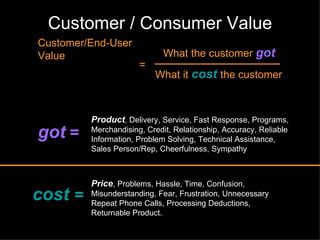
Customer / Consumer Value Customer/End-User Value  What the customer  got What it  cost   the customer = got  = Product , Delivery, Service, Fast Response, Programs, Merchandising, Credit, Relationship, Accuracy, Reliable Information, Problem Solving, Technical Assistance, Sales Person/Rep, Cheerfulness, Sympathy cost  = Price , Problems, Hassle, Time, Confusion, Misunderstanding, Fear, Frustration, Unnecessary Repeat Phone Calls, Processing Deductions, Returnable Product.
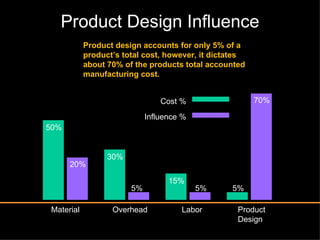
Material Overhead Labor Product Design 50% 20% 30% 5% 5% 15% 5% 70% Cost % Influence % Product design accounts for only 5% of a product’s total cost, however, it dictates about 70% of the products total accounted manufacturing cost. Product Design Influence
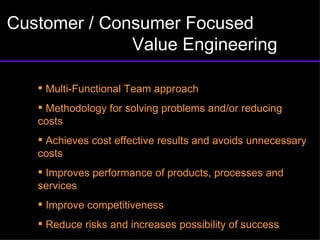
Customer / Consumer Focused  Value Engineering Multi-Functional Team approach Methodology for solving problems and/or reducing costs Achieves cost effective results and avoids unnecessary costs Improves performance of products, processes and services Improve competitiveness Reduce risks and increases possibility of success
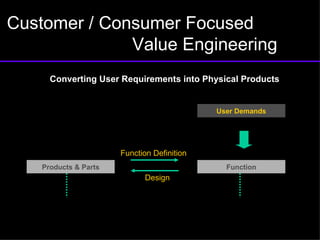
Function User Demands Products & Parts Physical Properties Functional Properties Function Definition Design Converting User Requirements into Physical Products Customer / Consumer Focused  Value Engineering
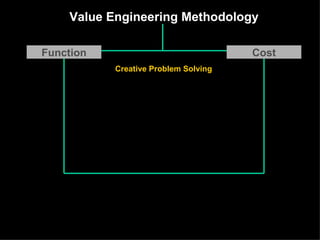
Value Engineering Methodology Function Cost Creative Problem Solving
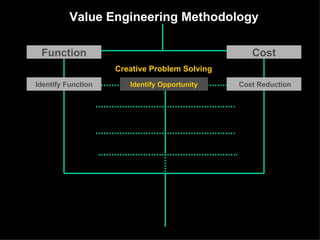
Value Engineering Methodology Function Cost Identify Function Cost Reduction Identify Opportunity Creative Problem Solving
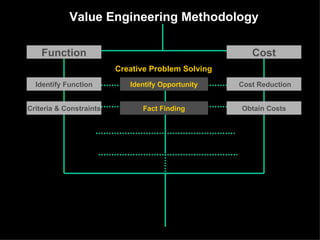
Value Engineering Methodology Function Cost Identify Function Criteria & Constraints Cost Reduction Obtain Costs Identify Opportunity Fact Finding Creative Problem Solving
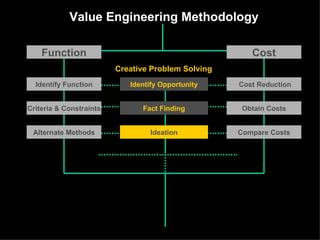
Value Engineering Methodology Function Cost Identify Function Criteria & Constraints Alternate Methods Cost Reduction Obtain Costs Compare Costs Identify Opportunity Fact Finding Ideation Creative Problem Solving
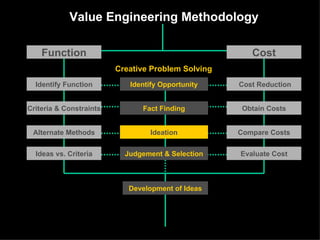
Value Engineering Methodology Function Cost Identify Function Criteria & Constraints Alternate Methods Ideas vs. Criteria Cost Reduction Obtain Costs Compare Costs Evaluate Cost Identify Opportunity Fact Finding Ideation Judgement & Selection Creative Problem Solving Development of Ideas
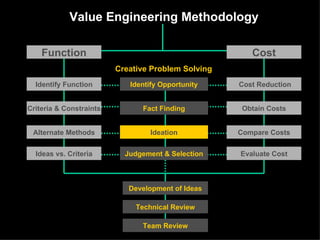
Value Engineering Methodology Function Cost Identify Function Criteria & Constraints Alternate Methods Ideas vs. Criteria Cost Reduction Obtain Costs Compare Costs Evaluate Cost Identify Opportunity Fact Finding Ideation Judgement & Selection Creative Problem Solving Development of Ideas Technical Review Team Review
Improving Product Development  with  Value Engineering A Framework for Synergy, Collaboration, Exploration,  Discovery & Innovation http://www.linkedin.com/in/brucesauter

Value Engineering

  • 1.
    Improving Product Developmentwith Value Engineering http://www.linkedin.com/in/brucesauter A Framework for Synergy, Collaboration, Exploration, Discovery & Innovation
  • 2.
    Customer / ConsumerValue Customer/End-User Value What the customer got What it cost the customer = got = Product , Delivery, Service, Fast Response, Programs, Merchandising, Credit, Relationship, Accuracy, Reliable Information, Problem Solving, Technical Assistance, Sales Person/Rep, Cheerfulness, Sympathy cost = Price , Problems, Hassle, Time, Confusion, Misunderstanding, Fear, Frustration, Unnecessary Repeat Phone Calls, Processing Deductions, Returnable Product.
  • 3.
    Material Overhead LaborProduct Design 50% 20% 30% 5% 5% 15% 5% 70% Cost % Influence % Product design accounts for only 5% of a product’s total cost, however, it dictates about 70% of the products total accounted manufacturing cost. Product Design Influence
  • 4.
    Customer / ConsumerFocused Value Engineering Multi-Functional Team approach Methodology for solving problems and/or reducing costs Achieves cost effective results and avoids unnecessary costs Improves performance of products, processes and services Improve competitiveness Reduce risks and increases possibility of success
  • 5.
    Function User DemandsProducts & Parts Physical Properties Functional Properties Function Definition Design Converting User Requirements into Physical Products Customer / Consumer Focused Value Engineering
  • 6.
    Value Engineering MethodologyFunction Cost Creative Problem Solving
  • 7.
    Value Engineering MethodologyFunction Cost Identify Function Cost Reduction Identify Opportunity Creative Problem Solving
  • 8.
    Value Engineering MethodologyFunction Cost Identify Function Criteria & Constraints Cost Reduction Obtain Costs Identify Opportunity Fact Finding Creative Problem Solving
  • 9.
    Value Engineering MethodologyFunction Cost Identify Function Criteria & Constraints Alternate Methods Cost Reduction Obtain Costs Compare Costs Identify Opportunity Fact Finding Ideation Creative Problem Solving
  • 10.
    Value Engineering MethodologyFunction Cost Identify Function Criteria & Constraints Alternate Methods Ideas vs. Criteria Cost Reduction Obtain Costs Compare Costs Evaluate Cost Identify Opportunity Fact Finding Ideation Judgement & Selection Creative Problem Solving Development of Ideas
  • 11.
    Value Engineering MethodologyFunction Cost Identify Function Criteria & Constraints Alternate Methods Ideas vs. Criteria Cost Reduction Obtain Costs Compare Costs Evaluate Cost Identify Opportunity Fact Finding Ideation Judgement & Selection Creative Problem Solving Development of Ideas Technical Review Team Review
  • 12.
    Improving Product Development with Value Engineering A Framework for Synergy, Collaboration, Exploration, Discovery & Innovation http://www.linkedin.com/in/brucesauter

Editor's Notes

  • #2 In this hyper competitive business world, new product development has become the most supported and protected activity to provide the product and services we need to fight off foreign and competitive competitors and for future survival. There are many processes that have been developed over the years to improve the outcomes of the product development efforts. Value Engineering is one of these time proven dynamic techniques. Value Engineering is also known as Value Analysis, Value Management or Function Analysis. VE/VA has expanded its role from its beginnings of focusing on cutting costs after the design was finished. Today VE/VA has been combined with other tools such as FAST and QFD making it a more holistic customer focused approach to value. VE is used to identify design improvements, develop and evaluate trade-off studies and build management consensus on the design concept. Value Engineering can be used throughout the design process to identify cost trade-offs and opportunities for improvement. Next slide