MAKE OR BUY DECISION
By:
J.Immanuel Durai Raj
Assistant Professor
St.Joseph’s Insititute of Technoloy
OMR, Chennai-600119
MAKE OR BUY DECISION
In a given situation, the organization should evaluate
each of the above make or buy alternatives and then
select the alternative which results in the lowest cost.
This is an important decision since it affects the
productivity of the organization.
Thus, the make or buy decision should be reviewed
periodically, say, every 1 to 3 years.
This is mainly to cope with the changes in the level of
competition and various other environmental factors.
CRITERIA FOR MAKE OR BUY
Criteria for make
1.The finished product can be made cheaper by the firm
than by outside suppliers.
2.The finished product is being manufactured only by a
limited number of outside firms which are unable to
meet the demand.
3. The part has an importance for the firm and requires
extremely close quality control.
4. The part can be manufactured with the firm’s existing
facilities and similar to other items in which the
company has manufacturing experience.
Criteria for buy
1. Requires high investments on facilities which are already
available at suppliers plant.
2. The company does not have facilities to make it and there
are more profitable opportunities for investing company’s
capital.
3. Existing facilities of the company can be used more
economically to make other parts.
4. The skill of personnel employed by the company is not
readily adaptable to make the part.
5. Patent or other legal barriers prevent the company for
making the part.
6. Demand for the part is either temporary or seasonal.
APPROACHES FOR MAKE OR BUY DECISION
1. Simple cost analysis
2. Economic analysis
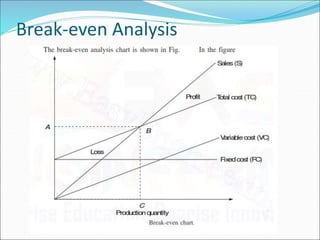
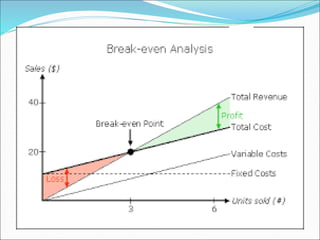
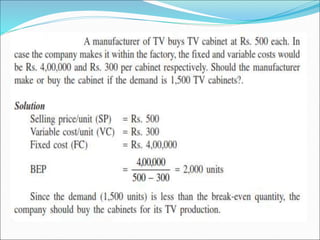
3. Break-even analysis
Simple Cost Analysis
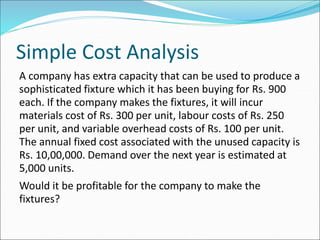
A company has extra capacity that can be used to produce a
sophisticated fixture which it has been buying for Rs. 900
each. If the company makes the fixtures, it will incur
materials cost of Rs. 300 per unit, labour costs of Rs. 250
per unit, and variable overhead costs of Rs. 100 per unit.
The annual fixed cost associated with the unused capacity is
Rs. 10,00,000. Demand over the next year is estimated at
5,000 units.
Would it be profitable for the company to make the
fixtures?
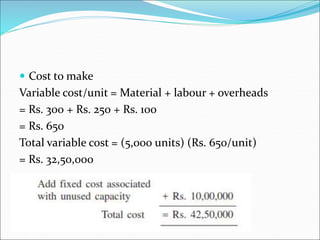
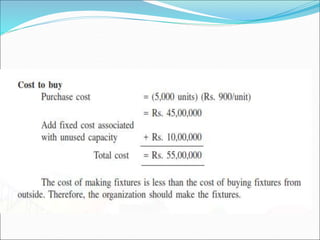
 Cost to make
Variable cost/unit = Material + labour + overheads
= Rs. 300 + Rs. 250 + Rs. 100
= Rs. 650
Total variable cost = (5,000 units) (Rs. 650/unit)
= Rs. 32,50,000
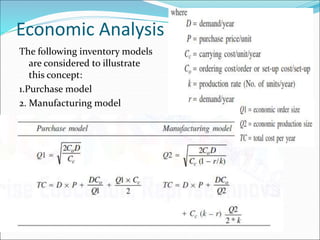
Economic Analysis
The following inventory models
are considered to illustrate
this concept:
1.Purchase model
2. Manufacturing model
Break-even Analysis
Make or buy decision

Make or buy decision

  • 1.
    MAKE OR BUYDECISION By: J.Immanuel Durai Raj Assistant Professor St.Joseph’s Insititute of Technoloy OMR, Chennai-600119
  • 2.
    MAKE OR BUYDECISION In a given situation, the organization should evaluate each of the above make or buy alternatives and then select the alternative which results in the lowest cost. This is an important decision since it affects the productivity of the organization. Thus, the make or buy decision should be reviewed periodically, say, every 1 to 3 years. This is mainly to cope with the changes in the level of competition and various other environmental factors.
  • 4.
    CRITERIA FOR MAKEOR BUY Criteria for make 1.The finished product can be made cheaper by the firm than by outside suppliers. 2.The finished product is being manufactured only by a limited number of outside firms which are unable to meet the demand. 3. The part has an importance for the firm and requires extremely close quality control. 4. The part can be manufactured with the firm’s existing facilities and similar to other items in which the company has manufacturing experience.
  • 5.
    Criteria for buy 1.Requires high investments on facilities which are already available at suppliers plant. 2. The company does not have facilities to make it and there are more profitable opportunities for investing company’s capital. 3. Existing facilities of the company can be used more economically to make other parts. 4. The skill of personnel employed by the company is not readily adaptable to make the part. 5. Patent or other legal barriers prevent the company for making the part. 6. Demand for the part is either temporary or seasonal.
  • 6.
    APPROACHES FOR MAKEOR BUY DECISION 1. Simple cost analysis 2. Economic analysis 3. Break-even analysis
  • 7.
    Simple Cost Analysis Acompany has extra capacity that can be used to produce a sophisticated fixture which it has been buying for Rs. 900 each. If the company makes the fixtures, it will incur materials cost of Rs. 300 per unit, labour costs of Rs. 250 per unit, and variable overhead costs of Rs. 100 per unit. The annual fixed cost associated with the unused capacity is Rs. 10,00,000. Demand over the next year is estimated at 5,000 units. Would it be profitable for the company to make the fixtures?
  • 8.
     Cost tomake Variable cost/unit = Material + labour + overheads = Rs. 300 + Rs. 250 + Rs. 100 = Rs. 650 Total variable cost = (5,000 units) (Rs. 650/unit) = Rs. 32,50,000
  • 10.
    Economic Analysis The followinginventory models are considered to illustrate this concept: 1.Purchase model 2. Manufacturing model
  • 11.