Training Evaluation
By,
Nainsi Raj
MBA (31)
Evaluation
It is a process of establishing a worth of training.
The ‘worth’, which means the value, merit or excellence of the
thing.
Evaluation is a ………..
State of mind, rather than a
set of techniques
Purpose of Evaluation
Feedback - on the effectiveness of the training activities
Control - over the provision of training
Intervention - into the organizational processes that affect
training
Benefits of Evaluation
Improved quality of training activities
Improved ability of the trainers to relate inputs to outputs
Better discrimination of training activities between those that are worthy of
support and those that should be dropped
Better integration of training offered and on-the job development
Better co-operation between trainers and line-managers in the development
of staff
Evidence of the contribution that training and development are making to
the organization
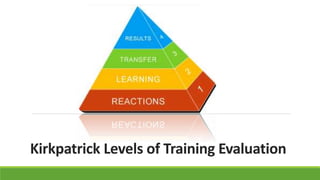
Kirkpatrick Levels of Training Evaluation
Donald Kirkpatrick
Kirkpatrick developed a model of training evaluation in
1959.
Arguably the most widely used approach.
Simple, Flexible and Complete
4-level model.
Why Evaluate?
Should the program be continued?
How can the program be improved?
How can we ensure regulatory compliance?
How can we maximize training effectiveness?
How can we be sure training is aligned with strategy?
How can we demonstrate the value of training?
The Four Levels of Evaluation
Level I: Evaluate Reaction
Level II: Evaluate Learning
Level III: Evaluate Behavior
Level IV: Evaluate Results
Fifth level was recently “added” for return on
investment (“ROI”) but this was not in Kirkpatrick’s
original model
Relationship Between Levels
Each subsequent level is predicated upon
doing evaluation at lower level
A Level 3 will be of marginal use, if a Level 2
evaluation is not conducted
Level 1 - Reaction
Was the environment suitable for learning?
Level 2 - Knowledge
Did they learn anything
Level 3 - Behavior
KSA being used on the job?
Level 4 - Results
Was it worth it?
assessingeachlevelcan weyieldactionableresults
Slide 11
Improve
Learning Environment
Improve
Knowledge/Skill transfer
Check
Performance Environment
Check Requirements,
Systems and Processes
Level 1 - Reaction
Was the environment suitable for learning?
Level 2 - Knowledge
Did they learn anything
Level 3 - Behavior
KSA being used on the job?
Level 4 - Results
Was it worth it?
Types of Assessments Used at Each Level
Type Form
Summative
Correlation of business results
with other assessment results
Summative Observation of Performance
360° Survey
Diagnostic
Summative
Self-assessment
Test
Reaction
Formative
Survey
Real-time Polling
Quizzing
Level 1 - Reaction
Was the environment suitable for learning?
Level 2 - Knowledge
Did they learn anything
Level 3 - Behavior
KSA being used on the job?
Level 4 - Results
Was it worth it?
Reaction - What Is It?
How favorably participants react to the training
(“Customer satisfaction”)
• Collects reactions to instructor, course, and learning
environment
• Communicates to trainees that their feedback is valued
• Can provide quantitative information
Reaction - How to Perform
Determine what you want to find out
Design a form to collect/quantify reactions
Do Immediately
Develop acceptable scoring standards
Follow-up as appropriate.
Learning - What Is It?
Knowledge
Skills
Attitudes
Learning - How to Perform
Use a control group, if feasible
Evaluate knowledge, skills, and/or attitudes before and after
Get 100% participation or use statistical sample
Follow-up as appropriate.
Behavior- What Is It?
Transfer of knowledge, skills, and/or attitude to the
real world.
Measure achievement of performance objectives.
Behavior - What It Looks Like
Observe performer, first-hand.
Survey key people who observe performer.
Use checklists, questionnaires, interviews, or
combinations.
Behavior - How to Perform
Evaluate before and after training
Allow ample time before observing
Survey key people
Results - What Is It?
Assesses “bottom line,” final results.
Definition of “results” dependent upon the goal of
the training program.
Results - How to Perform
Use a control group
Allow time for results to be realized
Measure before and after the program
Consider cost versus benefits
Be satisfied with evidence when proof is not possible.
Evaluation Techniques
Evaluation Levels
Methods
1
Reaction
2
Learning
3
Behavior
4
Results
Survey ● ● ● ●
Questionnaire/Interview ● ● ● ●
Focus Group ● ● ● ●
Knowledge Test/Check ●
Skills Observation ● ●
Presentations ● ●
Action Planning ● ● ●
Action Learning ●
Key Business HR Metrics ●
Training evaluation

Training evaluation

  • 1.
  • 2.
    Evaluation It is aprocess of establishing a worth of training. The ‘worth’, which means the value, merit or excellence of the thing.
  • 3.
    Evaluation is a……….. State of mind, rather than a set of techniques
  • 4.
    Purpose of Evaluation Feedback- on the effectiveness of the training activities Control - over the provision of training Intervention - into the organizational processes that affect training
  • 5.
    Benefits of Evaluation Improvedquality of training activities Improved ability of the trainers to relate inputs to outputs Better discrimination of training activities between those that are worthy of support and those that should be dropped Better integration of training offered and on-the job development Better co-operation between trainers and line-managers in the development of staff Evidence of the contribution that training and development are making to the organization
  • 6.
    Kirkpatrick Levels ofTraining Evaluation
  • 7.
    Donald Kirkpatrick Kirkpatrick developeda model of training evaluation in 1959. Arguably the most widely used approach. Simple, Flexible and Complete 4-level model.
  • 8.
    Why Evaluate? Should theprogram be continued? How can the program be improved? How can we ensure regulatory compliance? How can we maximize training effectiveness? How can we be sure training is aligned with strategy? How can we demonstrate the value of training?
  • 9.
    The Four Levelsof Evaluation Level I: Evaluate Reaction Level II: Evaluate Learning Level III: Evaluate Behavior Level IV: Evaluate Results Fifth level was recently “added” for return on investment (“ROI”) but this was not in Kirkpatrick’s original model
  • 10.
    Relationship Between Levels Eachsubsequent level is predicated upon doing evaluation at lower level A Level 3 will be of marginal use, if a Level 2 evaluation is not conducted Level 1 - Reaction Was the environment suitable for learning? Level 2 - Knowledge Did they learn anything Level 3 - Behavior KSA being used on the job? Level 4 - Results Was it worth it?
  • 11.
    assessingeachlevelcan weyieldactionableresults Slide 11 Improve LearningEnvironment Improve Knowledge/Skill transfer Check Performance Environment Check Requirements, Systems and Processes Level 1 - Reaction Was the environment suitable for learning? Level 2 - Knowledge Did they learn anything Level 3 - Behavior KSA being used on the job? Level 4 - Results Was it worth it?
  • 12.
    Types of AssessmentsUsed at Each Level Type Form Summative Correlation of business results with other assessment results Summative Observation of Performance 360° Survey Diagnostic Summative Self-assessment Test Reaction Formative Survey Real-time Polling Quizzing Level 1 - Reaction Was the environment suitable for learning? Level 2 - Knowledge Did they learn anything Level 3 - Behavior KSA being used on the job? Level 4 - Results Was it worth it?
  • 13.
    Reaction - WhatIs It? How favorably participants react to the training (“Customer satisfaction”) • Collects reactions to instructor, course, and learning environment • Communicates to trainees that their feedback is valued • Can provide quantitative information
  • 14.
    Reaction - Howto Perform Determine what you want to find out Design a form to collect/quantify reactions Do Immediately Develop acceptable scoring standards Follow-up as appropriate.
  • 15.
    Learning - WhatIs It? Knowledge Skills Attitudes
  • 16.
    Learning - Howto Perform Use a control group, if feasible Evaluate knowledge, skills, and/or attitudes before and after Get 100% participation or use statistical sample Follow-up as appropriate.
  • 17.
    Behavior- What IsIt? Transfer of knowledge, skills, and/or attitude to the real world. Measure achievement of performance objectives.
  • 18.
    Behavior - WhatIt Looks Like Observe performer, first-hand. Survey key people who observe performer. Use checklists, questionnaires, interviews, or combinations.
  • 19.
    Behavior - Howto Perform Evaluate before and after training Allow ample time before observing Survey key people
  • 20.
    Results - WhatIs It? Assesses “bottom line,” final results. Definition of “results” dependent upon the goal of the training program.
  • 21.
    Results - Howto Perform Use a control group Allow time for results to be realized Measure before and after the program Consider cost versus benefits Be satisfied with evidence when proof is not possible.
  • 22.
    Evaluation Techniques Evaluation Levels Methods 1 Reaction 2 Learning 3 Behavior 4 Results Survey● ● ● ● Questionnaire/Interview ● ● ● ● Focus Group ● ● ● ● Knowledge Test/Check ● Skills Observation ● ● Presentations ● ● Action Planning ● ● ● Action Learning ● Key Business HR Metrics ●