Spreading the Gospel of Efficiency Thinkers –II Barth, Gilbreths, Gantt and Emerson
Others Involved in the Scientific Management Movement Carl George Lange Barth Henry L. Gantt Frank Gilbreth Lillian Gilbreth Harrington Emerson
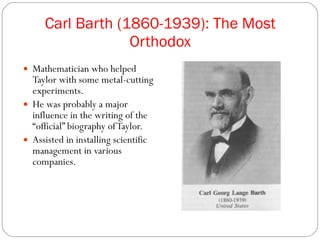
Carl Barth (1860-1939): The Most Orthodox Mathematician who helped Taylor with some metal-cutting experiments. He was probably a major influence in the writing of the “official” biography of Taylor. Assisted in installing scientific management in various companies.
Carl Barth One company was the Franklin Motor Car Company which was noteworthy because it preceded Henry Ford’s moving assembly line. Note: Scientific Management lost its importance to the auto industry once the assembly line was implemented.  Work was placed on a belt and individuals were no longer able to influence their output and therefore their reward. Barth created a “slide rule” for every machine for scientific measurements.
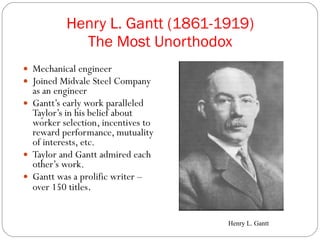
Henry L. Gantt (1861-1919) The Most Unorthodox Mechanical engineer Joined Midvale Steel Company as an engineer Gantt’s early work paralleled Taylor’s in his belief about worker selection, incentives to reward performance, mutuality of interests, etc.  Taylor and Gantt admired each other’s work. Gantt was a prolific writer – over 150 titles . Henry L. Gantt
Books and other contributions Works, wages and Profits-1910 Individual Leadership-1916 Organizing for work -1919 Papers : A bonus system of rewarding Labour-1902 A graphical daily balance of manufacture-1903 Training workmen in habits of industry and cooperation-1908 The relations between production and cost-1915
Henry L. Gantt: Task and Bonus System Implemented task work with a bonus to stimulate performance. When he discovered that this provided little incentive beyond meeting the standard, he modified the payment plan. He influenced Taylor because Taylor believed Gantt’s plan was better. Rewards to supervisors when their employees came up to standard (rewarded development of employees). Emphasized importance of morale, training, and development of employees.
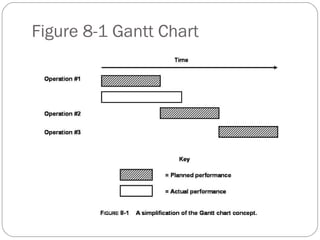
Figure 8-1 Gantt Chart
The Gantt Chart Steadily evolved into a valuable tool for planning and controlling work. Widely used during World War I. Became an international management technique. A forerunner of subsequent planning and controlling techniques such as major milestones, PERT & CPM.
Other Gantt Ideas He understood the importance of trade unions in an industrial society better than Taylor The New Machine – a group headed by Gantt to promote the idea that engineers should be industrial leaders. Social responsibility – Gantt’s concern that business should not lose sight of its service role in the economy.
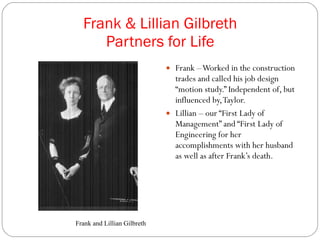
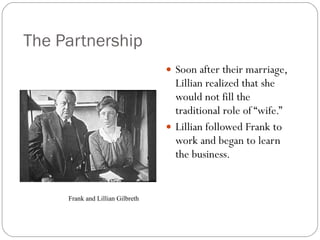
Frank & Lillian Gilbreth Partners for Life Frank – Worked in the construction trades and called his job design “motion study.” Independent of, but influenced by, Taylor. Lillian – our “First Lady of Management” and “First Lady of Engineering for her accomplishments with her husband as well as after Frank’s death. Frank and Lillian Gilbreth
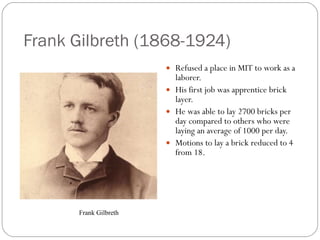
Frank Gilbreth (1868-1924) Refused a place in MIT to work as a laborer. His first job was apprentice brick layer. He was able to lay 2700 bricks per day compared to others who were laying an average of 1000 per day. Motions to lay a brick reduced to 4 from 18. Frank Gilbreth
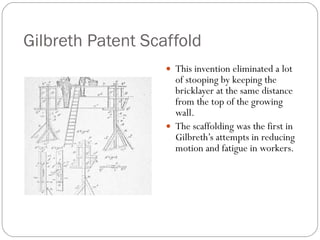
Gilbreth Patent Scaffold This invention eliminated a lot of stooping by keeping the bricklayer at the same distance from the top of the growing wall. The scaffolding was the first in Gilbreth’s attempts in reducing motion and fatigue in workers.
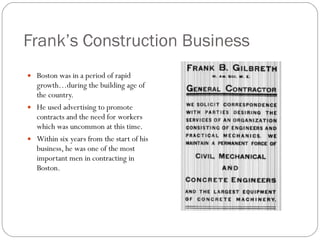
Frank’s Construction Business Boston was in a period of rapid growth…during the building age of the country. He used advertising to promote contracts and the need for workers which was uncommon at this time. Within six years from the start of his business, he was one of the most important men in contracting in Boston.
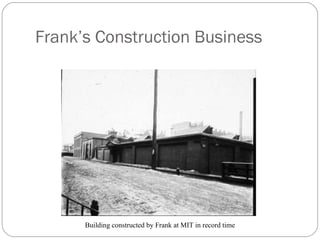
Frank’s Construction Business Building constructed by Frank at MIT in record time
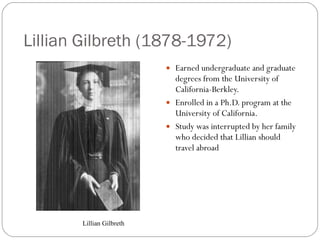
Lillian Gilbreth (1878-1972) Earned undergraduate and graduate degrees from the University of California-Berkley. Enrolled in a Ph.D. program at the University of California. Study was interrupted by her family who decided that Lillian should travel abroad Lillian Gilbreth
The Partnership Soon after their marriage, Lillian realized that she would not fill the traditional role of “wife.” Lillian followed Frank to work and began to learn the business. Frank and Lillian Gilbreth
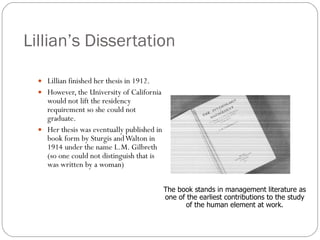
Lillian’s Dissertation Lillian finished her thesis in 1912. However, the University of California would not lift the residency requirement so she could not graduate. Her thesis was eventually published in book form by Sturgis and Walton in 1914 under the name L.M. Gilbreth (so one could not distinguish that is was written by a woman) The book stands in management literature as one of the earliest contributions to the study of the human element at work.
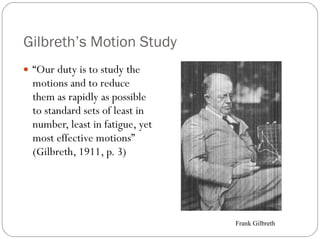
Gilbreth’s Motion Study “ Our duty is to study the motions and to reduce them as rapidly as possible to standard sets of least in number, least in fatigue, yet most effective motions” (Gilbreth, 1911, p. 3) Frank Gilbreth
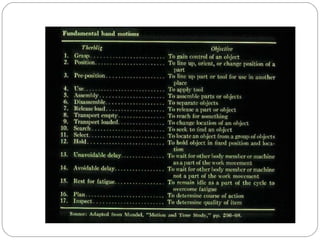
Therbligs Frank developed a list of seventeen basic movements to aid him in analyzing motion. Each movement was called a “therblig.” These fundamental movements, which could not be broken down into other motions, gave Frank a way to accurately analyze elements of any movement a worker may make. Can you determine the origin of the term “therblig?”
 
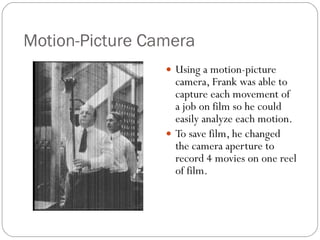
Motion-Picture Camera Using a motion-picture camera, Frank was able to capture each movement of a job on film so he could easily analyze each motion. To save film, he changed the camera aperture to record 4 movies on one reel of film.
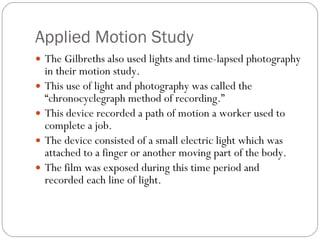
Applied Motion Study The Gilbreths also used lights and time-lapsed photography in their motion study. This use of light and photography was called the “chronocyclegraph method of recording.” This device recorded a path of motion a worker used to complete a job. The device consisted of a small electric light which was attached to a finger or another moving part of the body. The film was exposed during this time period and recorded each line of light.
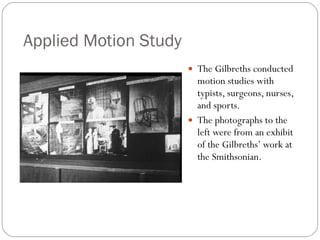
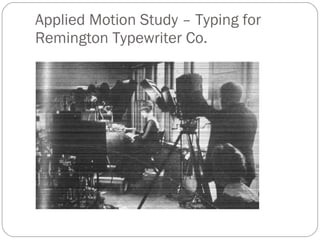
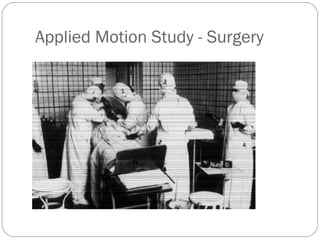
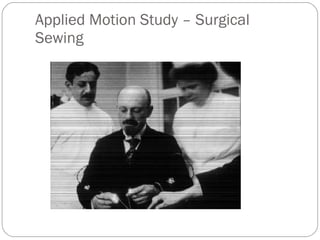
Applied Motion Study The Gilbreths conducted motion studies with typists, surgeons, nurses, and sports. The photographs to the left were from an exhibit of the Gilbreths’ work at the Smithsonian.
Applied Motion Study – Typing for Remington Typewriter Co.
Applied Motion Study - Surgery
Applied Motion Study – Surgical Sewing
Fatigue Studies Through proper rest breaks, fatigue could be reduced. Suggestions: Reduced working hours so that employees had sufficient time to recover and be prepared for the next working day. Longer lunch periods, coffee or tea breaks. To make rest breaks more attractive to employees, the Gilbreths suggested that organizations could provide proper reclining chairs, lunch rooms, rest rooms, or other entertainment.
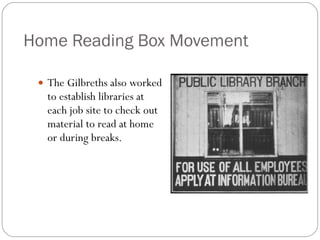
Home Reading Box Movement The Gilbreths also worked to establish libraries at each job site to check out material to read at home or during breaks.
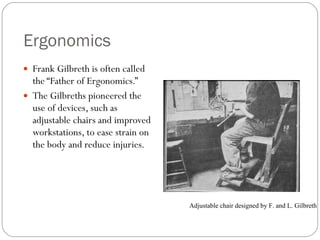
Ergonomics Frank Gilbreth is often called the “Father of Ergonomics.” The Gilbreths pioneered the use of devices, such as adjustable chairs and improved workstations, to ease strain on the body and reduce injuries. Adjustable chair designed by F. and L. Gilbreth
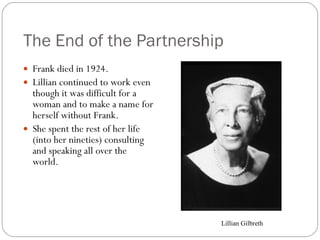
The End of the Partnership Frank died in 1924. Lillian continued to work even though it was difficult for a woman and to make a name for herself without Frank. She spent the rest of her life (into her nineties) consulting and speaking all over the world. Lillian Gilbreth
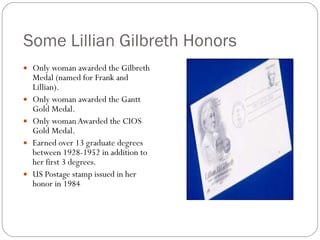
Some Lillian Gilbreth Honors Only woman awarded the Gilbreth Medal (named for Frank and Lillian). Only woman awarded the Gantt Gold Medal. Only woman Awarded the CIOS Gold Medal. Earned over 13 graduate degrees between 1928-1952 in addition to her first 3 degrees. US Postage stamp issued in her honor in 1984
Books and papers of Frank Gilbreth Concrete System-1908 Bricklaying System-1909 Motion Study-1911 Primer of Scientific Management-1912 Fatigue Study-1916 The writings of the Gilbreth-1943 Lillian’s Books The psychology of Management The quest of the one best way The Foreman and Manpower Management Papers : “ What scientific Management means to America’s Industrial position”-1915 “ Process Charts”-1921….and many others
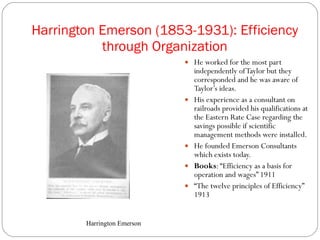
Harrington Emerson (1853-1931): Efficiency through Organization He worked for the most part  independently of Taylor but they corresponded and he was aware of Taylor’s ideas. His experience as a consultant on railroads provided his qualifications at the Eastern Rate Case regarding the savings possible if scientific management methods were installed. He founded Emerson Consultants which exists today. Books : “Efficiency as a basis for operation and wages” 1911 “ The twelve principles of Efficiency” 1913 Harrington Emerson
Harrington Emerson’s Ideas Lack of organization was a major problem. He proposed the line-staff organization as a way of bringing staff knowledge to assist the line managers. His line-staff idea was similar to Taylor’s desire to use the knowledge of functional foreman, but an improvement since it did not split the chain of command. He took Taylor’s idea of setting performance standards and applied this to cost accounting. Standards should be established for what the costs  should  be, rather than estimating costs from previous records.
Harrington Emerson’s Ideas Emerson provided 120% wages for 100% performance (the standard) and that increased if the worker produced more. Of Emerson’s numerous “principles,” clearly defined ideals (objectives), participative decision making, and the proper use of staff stand out as the more unique of his ideas.
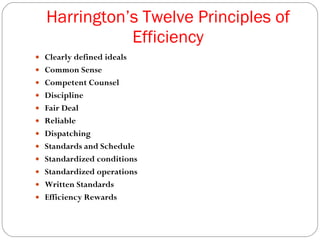
Harrington’s Twelve Principles of Efficiency Clearly defined ideals Common Sense Competent Counsel Discipline Fair Deal Reliable Dispatching Standards and Schedule Standardized conditions Standardized operations Written Standards Efficiency Rewards

Gilbreths and gantt

  • 1.
    Spreading the Gospelof Efficiency Thinkers –II Barth, Gilbreths, Gantt and Emerson
  • 2.
    Others Involved inthe Scientific Management Movement Carl George Lange Barth Henry L. Gantt Frank Gilbreth Lillian Gilbreth Harrington Emerson
  • 3.
    Carl Barth (1860-1939):The Most Orthodox Mathematician who helped Taylor with some metal-cutting experiments. He was probably a major influence in the writing of the “official” biography of Taylor. Assisted in installing scientific management in various companies.
  • 4.
    Carl Barth Onecompany was the Franklin Motor Car Company which was noteworthy because it preceded Henry Ford’s moving assembly line. Note: Scientific Management lost its importance to the auto industry once the assembly line was implemented. Work was placed on a belt and individuals were no longer able to influence their output and therefore their reward. Barth created a “slide rule” for every machine for scientific measurements.
  • 5.
    Henry L. Gantt(1861-1919) The Most Unorthodox Mechanical engineer Joined Midvale Steel Company as an engineer Gantt’s early work paralleled Taylor’s in his belief about worker selection, incentives to reward performance, mutuality of interests, etc. Taylor and Gantt admired each other’s work. Gantt was a prolific writer – over 150 titles . Henry L. Gantt
  • 6.
    Books and othercontributions Works, wages and Profits-1910 Individual Leadership-1916 Organizing for work -1919 Papers : A bonus system of rewarding Labour-1902 A graphical daily balance of manufacture-1903 Training workmen in habits of industry and cooperation-1908 The relations between production and cost-1915
  • 7.
    Henry L. Gantt:Task and Bonus System Implemented task work with a bonus to stimulate performance. When he discovered that this provided little incentive beyond meeting the standard, he modified the payment plan. He influenced Taylor because Taylor believed Gantt’s plan was better. Rewards to supervisors when their employees came up to standard (rewarded development of employees). Emphasized importance of morale, training, and development of employees.
  • 8.
  • 9.
    The Gantt ChartSteadily evolved into a valuable tool for planning and controlling work. Widely used during World War I. Became an international management technique. A forerunner of subsequent planning and controlling techniques such as major milestones, PERT & CPM.
  • 10.
    Other Gantt IdeasHe understood the importance of trade unions in an industrial society better than Taylor The New Machine – a group headed by Gantt to promote the idea that engineers should be industrial leaders. Social responsibility – Gantt’s concern that business should not lose sight of its service role in the economy.
  • 11.
    Frank & LillianGilbreth Partners for Life Frank – Worked in the construction trades and called his job design “motion study.” Independent of, but influenced by, Taylor. Lillian – our “First Lady of Management” and “First Lady of Engineering for her accomplishments with her husband as well as after Frank’s death. Frank and Lillian Gilbreth
  • 12.
    Frank Gilbreth (1868-1924)Refused a place in MIT to work as a laborer. His first job was apprentice brick layer. He was able to lay 2700 bricks per day compared to others who were laying an average of 1000 per day. Motions to lay a brick reduced to 4 from 18. Frank Gilbreth
  • 13.
    Gilbreth Patent ScaffoldThis invention eliminated a lot of stooping by keeping the bricklayer at the same distance from the top of the growing wall. The scaffolding was the first in Gilbreth’s attempts in reducing motion and fatigue in workers.
  • 14.
    Frank’s Construction BusinessBoston was in a period of rapid growth…during the building age of the country. He used advertising to promote contracts and the need for workers which was uncommon at this time. Within six years from the start of his business, he was one of the most important men in contracting in Boston.
  • 15.
    Frank’s Construction BusinessBuilding constructed by Frank at MIT in record time
  • 16.
    Lillian Gilbreth (1878-1972)Earned undergraduate and graduate degrees from the University of California-Berkley. Enrolled in a Ph.D. program at the University of California. Study was interrupted by her family who decided that Lillian should travel abroad Lillian Gilbreth
  • 17.
    The Partnership Soonafter their marriage, Lillian realized that she would not fill the traditional role of “wife.” Lillian followed Frank to work and began to learn the business. Frank and Lillian Gilbreth
  • 18.
    Lillian’s Dissertation Lillianfinished her thesis in 1912. However, the University of California would not lift the residency requirement so she could not graduate. Her thesis was eventually published in book form by Sturgis and Walton in 1914 under the name L.M. Gilbreth (so one could not distinguish that is was written by a woman) The book stands in management literature as one of the earliest contributions to the study of the human element at work.
  • 19.
    Gilbreth’s Motion Study“ Our duty is to study the motions and to reduce them as rapidly as possible to standard sets of least in number, least in fatigue, yet most effective motions” (Gilbreth, 1911, p. 3) Frank Gilbreth
  • 20.
    Therbligs Frank developeda list of seventeen basic movements to aid him in analyzing motion. Each movement was called a “therblig.” These fundamental movements, which could not be broken down into other motions, gave Frank a way to accurately analyze elements of any movement a worker may make. Can you determine the origin of the term “therblig?”
  • 21.
  • 22.
    Motion-Picture Camera Usinga motion-picture camera, Frank was able to capture each movement of a job on film so he could easily analyze each motion. To save film, he changed the camera aperture to record 4 movies on one reel of film.
  • 23.
    Applied Motion StudyThe Gilbreths also used lights and time-lapsed photography in their motion study. This use of light and photography was called the “chronocyclegraph method of recording.” This device recorded a path of motion a worker used to complete a job. The device consisted of a small electric light which was attached to a finger or another moving part of the body. The film was exposed during this time period and recorded each line of light.
  • 24.
    Applied Motion StudyThe Gilbreths conducted motion studies with typists, surgeons, nurses, and sports. The photographs to the left were from an exhibit of the Gilbreths’ work at the Smithsonian.
  • 25.
    Applied Motion Study– Typing for Remington Typewriter Co.
  • 26.
  • 27.
    Applied Motion Study– Surgical Sewing
  • 28.
    Fatigue Studies Throughproper rest breaks, fatigue could be reduced. Suggestions: Reduced working hours so that employees had sufficient time to recover and be prepared for the next working day. Longer lunch periods, coffee or tea breaks. To make rest breaks more attractive to employees, the Gilbreths suggested that organizations could provide proper reclining chairs, lunch rooms, rest rooms, or other entertainment.
  • 29.
    Home Reading BoxMovement The Gilbreths also worked to establish libraries at each job site to check out material to read at home or during breaks.
  • 30.
    Ergonomics Frank Gilbrethis often called the “Father of Ergonomics.” The Gilbreths pioneered the use of devices, such as adjustable chairs and improved workstations, to ease strain on the body and reduce injuries. Adjustable chair designed by F. and L. Gilbreth
  • 31.
    The End ofthe Partnership Frank died in 1924. Lillian continued to work even though it was difficult for a woman and to make a name for herself without Frank. She spent the rest of her life (into her nineties) consulting and speaking all over the world. Lillian Gilbreth
  • 32.
    Some Lillian GilbrethHonors Only woman awarded the Gilbreth Medal (named for Frank and Lillian). Only woman awarded the Gantt Gold Medal. Only woman Awarded the CIOS Gold Medal. Earned over 13 graduate degrees between 1928-1952 in addition to her first 3 degrees. US Postage stamp issued in her honor in 1984
  • 33.
    Books and papersof Frank Gilbreth Concrete System-1908 Bricklaying System-1909 Motion Study-1911 Primer of Scientific Management-1912 Fatigue Study-1916 The writings of the Gilbreth-1943 Lillian’s Books The psychology of Management The quest of the one best way The Foreman and Manpower Management Papers : “ What scientific Management means to America’s Industrial position”-1915 “ Process Charts”-1921….and many others
  • 34.
    Harrington Emerson (1853-1931):Efficiency through Organization He worked for the most part independently of Taylor but they corresponded and he was aware of Taylor’s ideas. His experience as a consultant on railroads provided his qualifications at the Eastern Rate Case regarding the savings possible if scientific management methods were installed. He founded Emerson Consultants which exists today. Books : “Efficiency as a basis for operation and wages” 1911 “ The twelve principles of Efficiency” 1913 Harrington Emerson
  • 35.
    Harrington Emerson’s IdeasLack of organization was a major problem. He proposed the line-staff organization as a way of bringing staff knowledge to assist the line managers. His line-staff idea was similar to Taylor’s desire to use the knowledge of functional foreman, but an improvement since it did not split the chain of command. He took Taylor’s idea of setting performance standards and applied this to cost accounting. Standards should be established for what the costs should be, rather than estimating costs from previous records.
  • 36.
    Harrington Emerson’s IdeasEmerson provided 120% wages for 100% performance (the standard) and that increased if the worker produced more. Of Emerson’s numerous “principles,” clearly defined ideals (objectives), participative decision making, and the proper use of staff stand out as the more unique of his ideas.
  • 37.
    Harrington’s Twelve Principlesof Efficiency Clearly defined ideals Common Sense Competent Counsel Discipline Fair Deal Reliable Dispatching Standards and Schedule Standardized conditions Standardized operations Written Standards Efficiency Rewards