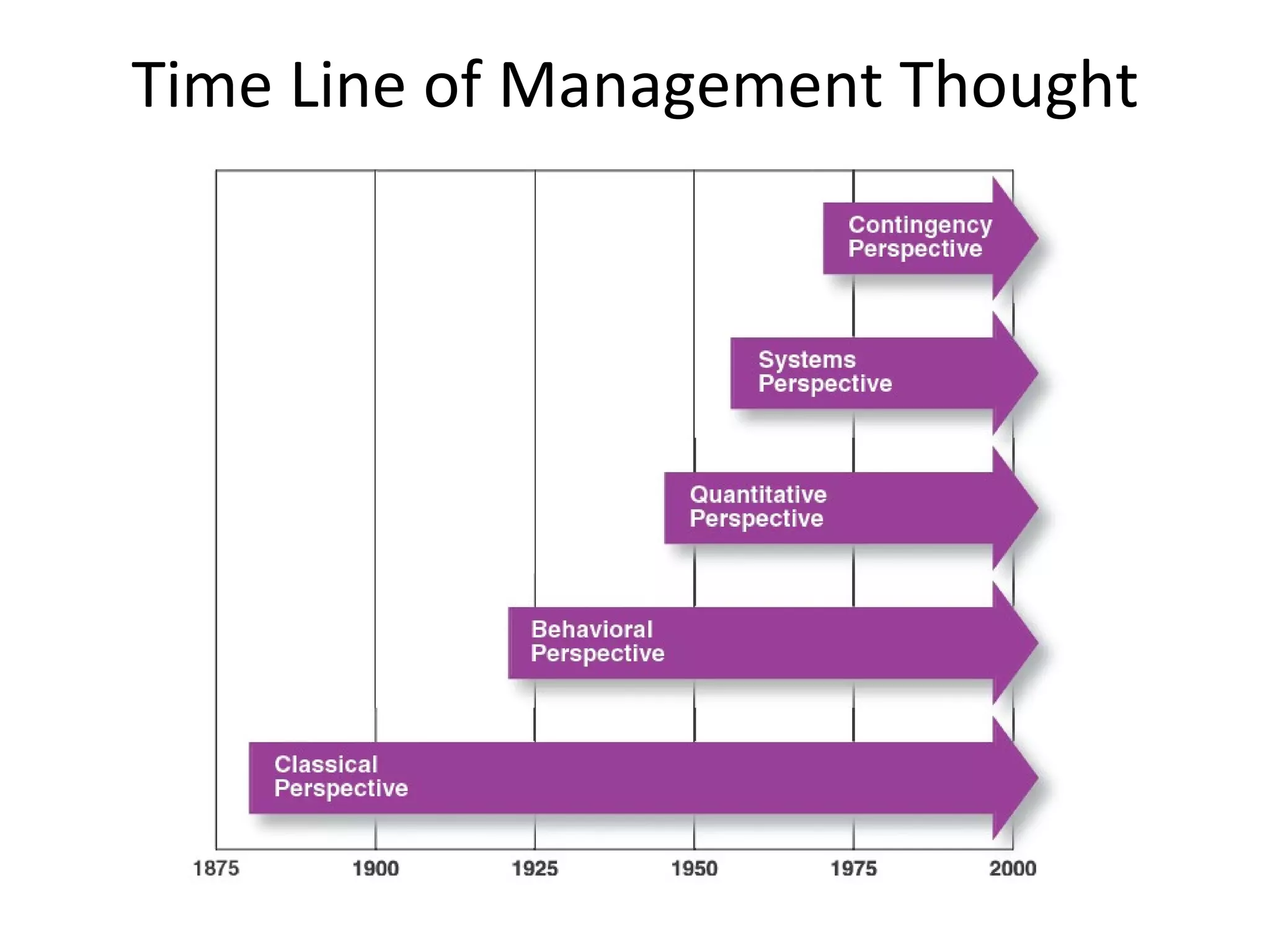
Time Line of Management Thought
PREVIEW Review Classical Theories of Organizations Taylor’s Theory of Scientific Management Fayol’s Administrative Theory Weber’s Theory of Bureaucracy Humanistic Theories of Organizations Human Relations Theory The Hawthorne Studies Mary Parker Follet Chester Barnard McGregor’s Theory X and Theory Y Human Resources Theory Likert’s Systems Theory (Four Systems of Management) Blake and Mouton’s (Blake and McCanse) Managerial Grid
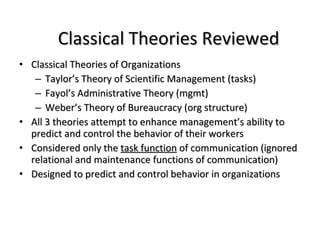
Classical Theories Reviewed Classical Theories of Organizations  Taylor’s Theory of Scientific Management (tasks) Fayol’s Administrative Theory (mgmt) Weber’s Theory of Bureaucracy (org structure) All 3 theories attempt to enhance management’s ability to predict and control the behavior of their workers Considered only the  task function  of communication (ignored relational and maintenance functions of communication) Designed to predict and control behavior in organizations
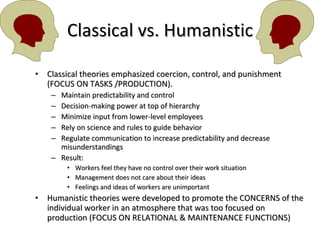
Classical vs. Humanistic Classical theories emphasized coercion, control, and punishment (FOCUS ON TASKS /PRODUCTION). Maintain predictability and control Decision-making power at top of hierarchy Minimize input from lower-level employees Rely on science and rules to guide behavior Regulate communication to increase predictability and decrease misunderstandings Result:  Workers feel they have no control over their work situation Management does not care about their ideas Feelings and ideas of workers are unimportant Humanistic theories were developed to promote the CONCERNS of the individual worker in an atmosphere that was too focused on production (FOCUS ON RELATIONAL & MAINTENANCE FUNCTIONS)
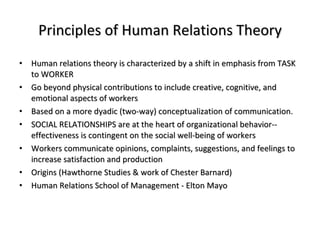
Principles of Human Relations Theory Human relations theory is characterized by a shift in emphasis from TASK to WORKER Go beyond physical contributions to include creative, cognitive, and emotional aspects of workers Based on a more dyadic (two-way) conceptualization of communication. SOCIAL RELATIONSHIPS are at the heart of organizational behavior--effectiveness is contingent on the social well-being of workers Workers communicate opinions, complaints, suggestions, and feelings to increase satisfaction and production Origins (Hawthorne Studies & work of Chester Barnard) Human Relations School of Management - Elton Mayo
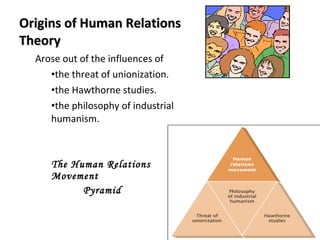
Origins of Human Relations  Theory Arose out of the influences of the threat of unionization. the Hawthorne studies. the philosophy of industrial humanism. The Human Relations Movement  Pyramid
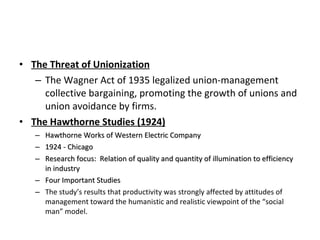
The Threat of Unionization The Wagner Act of 1935 legalized union-management collective bargaining, promoting the growth of unions and union avoidance by firms. The Hawthorne Studies (1924) Hawthorne Works of Western Electric Company 1924 - Chicago Research focus:  Relation of quality and quantity of illumination to efficiency in industry Four Important Studies The study’s results that productivity was strongly affected by attitudes of management toward the humanistic and realistic viewpoint of the “social man” model.
Industrial Humanism Followed the classical perspective in the development of management thought. Is associated with the contributions of : Mary Parker Follett Elton Mayo Douglas McGregor Chester Barnard And others
Mary Parker Follett(1868-1933) Attached great importance to socio-psychological problems  Was of the view that conflict is not necessarily destructive..it may be constructive also Concluded that a key to effective management was coordination. Felt that managers needed to coordinate and harmonize group effort rather than force and coerce people. Believed that management is a continuous, dynamic process. Felt that the best decisions would be made by people who were closest to the situation.
Follett on Effective Work Groups Four principles of coordination to promote effective work groups: Coordination requires that people be in direct contact with one another. Coordination is essential during the initial stages of any endeavor. Coordination must address all factors and phases of any endeavor.  Coordination is a continuous, ongoing process
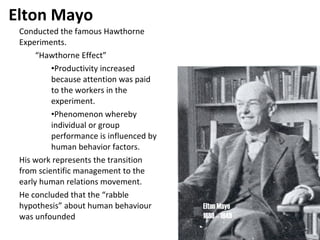
Elton Mayo Conducted the famous Hawthorne Experiments. “ Hawthorne Effect” Productivity increased because attention was paid to the workers in the experiment. Phenomenon whereby individual or group performance is influenced by human behavior factors. His work represents the transition from scientific management to the early human relations movement. He concluded that the “rabble hypothesis” about human behaviour was unfounded Elton Mayo 1880 – 1949
“ The Hawthorne Studies” Illumination Study  (November 1924) Designed to test the effect of lighting intensity on worker productivity influence of human relations on work behavior Relay Assembly Test Room Study  (1927-1932) Assembly of telephone relays (35 parts - 4 machine screws)  Production and satisfaction increased Workers’ increased production and satisfaction related to supervisory practices Human interrelationships are important contributing factors to worker productivity Bottom Line:  Supervisory practices increase employee morale AND productivity Interviewing Program  (1928-1930) Investigate connection between supervisory practices and employee morale Employees expressed their ideas and feelings (e.g.,  likes and dislikes) Process more important than actual results Bank Wiring Room Observation Study  (November 1931 - May 1932) Social groups can influence production and individual work behavior How is social control manifested on the shop floor? Informal organization  affect employee behavior positively  within formal organizational structure
Illumination  Studies – 1924-1927 Funded by General Electric Conducted by The National Research Council (NRC) of the National Academy of Sciences with engineers from MIT Measured Light Intensity vs. Worker Output Result – Each change resulted in higher output and reported greater employee satisfaction Conclusions:  Light intensity has no conclusive effect on output Productivity has a psychological component – Researchers interaction with the workers influenced higher performance Concept of “Hawthorne Effect” was created
Relay Assembly Test Experiments   1927-1929   Western Electric wanted more information Harvard researchers brought in to analyze the results – Elton Mayo & Fritz Roethlisberger Group of 6 Women – (5) Assemblers and (1) Layout Operator One Observer – Explained every incremental change and recorded results Manipulated factors of production to measure effect on output: Pay Incentives Length of Work Day & Work Week Use of Rest Periods Company Sponsored Meals Management Visits / Special Attention Result – Most changes resulted in higher output and reported greater employee satisfaction Conclusions:  Experiments yielded positive effects even with negative influences – workers’ output will increase as a response to attention Strong social bonds were created within the test group.  Workers are influenced by need for recognition, security and sense of belonging
Relay Assembly Room #2  -  1928-1929 Measured output changes with pay incentive changes Special observation room to re-test some of the factors on other groups Workers were paid the group bonus incentives Results During nine weeks there was 13% increase in the output on average per person Conclusion:  Pay incentives were a relevant factor in output increases but not the only factor.
Mica Splitting Test Group - 1928-1931 Measured output changes with changes in work conditions only: Special Observation Room Length of Work Day Use of Rest Periods Workers stayed on established Piece-rate compensation Result - Productivity increased by 15% over standard output base Conclusions:  Productivity is affected by non-pay considerations Social dynamics are a basis of worker performance
Plant Interview Program – 1925-1932 1925-1927 – Objective Questions Work Conditions Work Relationships Yes/No Answers 1928-1932 – Conversational / Non-directive Attentive Sympathetic Listening Concern for personal needs Increased in time from 30-90 minutes Result – Remarkable positive employee perceptions: Working Condition Improved  Better Wages  Conclusions:  New Supervisory Style improved worker morale Complaints reflected personal and/or social barriers that needed attention in order to  raise  productivity
Bank Wiring Observation Group – 1931-1932 14 Male Workers Few Special Conditions Segregated work area No Management Visits Supervision would remain the same Observer would record data only – no interaction with workers New incentive pay rate was established for the small group Any increases in output would be included in departmental pay incentives Result – No appreciable changes in output Conclusions:  Well established performance norms existed in the group Informal Social Organization dictated little deviation from established production standards – Systemic Soldiering Informal Social Organizations protect workers from managers who Raise production standards Cut pay rates Challenge workplace norms
Hawthorne Studies - Implications Illumination Study  (November 1924) The mere practice of observing people’s behavior tends to alter their behavior (Hawthorne Effect) Relay Assembly Test Room Study  (1927-1932) Relationships between workers and their supervisors are powerful Human interrelationships increase the amount and quality of worker participation in decision making Interviewing Program  (1928-1930) Demonstrated powerful influence of upward communication Workers were asked for opinions, told they mattered, and positive attitudes toward company increased Bank Wiring Room Observation Study  (November 1931 - May 1932) Led future theorists to account for the existence of informal communication Taken together, these studies helped to document the powerful nature of social relations in the workplace and moved managers more toward the interpersonal aspects of organizing.
Chester Barnard: The Emergence of Communication Considered a bridge between classical and human relations theories The Functions of the Executive ( 1938) Argues for . . .  strict lines of communication - classical theory a “human-based system of organization” The potential of every worker and the centrality of communication to the organizing process Six Issues Relevant to Organizational Communication Formal vs. Informal Organization Cooperation Communication Incentives Authority Zone of Indifference
Felt that executives serve two primary functions: Must establish and maintain a communications system among employees. Must establish the objectives of the organization and motivate employees. Developed an  acceptance theory of authority : Authority of a manager flows from the ability of subordinates to accept or reject an order from the manager once they: Comprehend what the order requires of them. Review the order’s consistency with organization goals. Perceive a personal benefit in obeying the order
Six Issues Relevant to Organizational Communication Formal vs. Informal Organization Formal Organization - a system of consciously coordinated activities or forces of two or more persons.  (definite, structured, common purpose) Persons are able to communicate with one another Willing to contribute action To accomplish a common purpose Informal Organization - based on myriad interactions that take place throughout an organization’s history. Indefinite Structure less No definite subdivisions of personnel Results:  customs, mores, folklore, institutions, social norms, ideals -- may lead to formal organization
Six Issues Relevant to Organizational Communication Cooperation Necessary component of formal organization The expression of the net satisfactions or dissatisfactions experienced or anticipated by each individual in comparison with those experienced or anticipated through alternative opportunities Communication Critical to cooperation The most universal form of human cooperation, and perhaps the most complex, is speech The most likely reason for the success of cooperation and the reason for its failure System of communication:  known, formal channels which are as direct (short) as possible, where the complete line of communication is used, the supervisory heads must be competent, the line of communication should not be interrupted, and every communication should be authenticated. Barnard’s system lacks relationship formation and maintenance mechanisms
Incentives Should be available Authority Associated with securing cooperation for organizational members The interrelationship among the originator of the communication, the communication itself, and the receiver Authority of position OVER Authority of Leadership (knowledge & ability). Zone of Indifference - orders followed Marks the boundaries of what employees will consider doing without question, based on expectations developed on entering the organization. Barnard drew attention away from formal organizational structures toward communication, cooperation, and the informal organization.  His work was integrated by other theorists in the human relations movement.
Douglas McGregor Douglas McGregor (1906-1964) Articulated basic principles of human relations theory The Human Side of Enterprise  (1960, 1985) To understand human behavior, one must discover the theoretical assumptions upon which behavior is based Especially interested in the behavior of managers toward workers “ Every managerial act rests on assumptions, generalizations, and hypotheses--that is to say, on theory . . . Theory and practice are inseparable.” Two Objectives: Predict and control behavior Tap Unrealized potential Theory X - Classical Theory Theory Y - Human Relations Theory FOCUS:  Manager’s assumptions about HUMAN NATURE
Theory X and Theory Y Theory X managers perceive that their subordinates have an inherent dislike of work and will avoid it if at all possible. Theory Y managers perceive that their subordinates enjoy work and that they will gain satisfaction from performing their jobs.
 
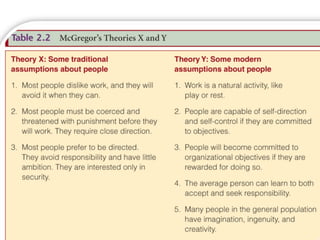
Theory X and Theory Y:  Linkage with management theories Theory X - Classical Theory Three Assumptions The average human being has an inherent dislike of work and will avoid it. Most people must be coerced, controlled, directed, and  threatened with punishment The average human being prefers to be directed, wishes to avoid responsibility, has relatively little ambition, wants security. Neither explains nor describes human nature
Theory Y - Human Relations Theory A ssumptions Physical and mental effort in work is similar to play / rest. External control and the threat of punishment are not the only strategies Commitment to objectives is a function of the rewards associated with their achievement The average human being learns, under proper conditions, not only to accept but to seek responsibility The capacity to exercise a high degree of imagination, ingenuity, and creativity in the solution of organizational problems is widely distributed in the population Intellectual potentialities of the average human being are underutilized A more positive perspective of human nature The KEY to control and quality production is  commitment to organizational objectives
 
Blake and Mouton’s Managerial Grid Stresses interrelationship between production (task) and people Management’s main purpose is to promote a culture in the organization that allows for high production at the same time that employees are fostered in their professional and personal development Managerial Grid - now Leadership Grid (Blake & McCanse) (Figure 3.3, p. 59) FOCUS:  Manger’s Assumptions about CONCERN for PEOPLE and CONCERN for PRODUCTION Concern for PEOPLE Degree of personal commitment to one’s job Trust-based accountability (vs. obedience-based accountability) Self-esteem for the individual Interpersonal relationships with co-workers Concern for PRODUCTION Use of people and technology to accomplish organizational tasks Concern for is not about quantity or quality Assessment instrument does not represent personality traits of the manager -- instead, indicate a specific orientation to production and people
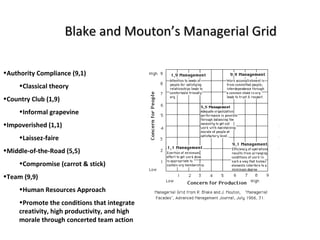
Blake and Mouton’s Managerial Grid Authority Compliance (9,1) Classical theory Country Club (1,9) Informal grapevine Impoverished (1,1) Laissez-faire Middle-of-the-Road (5,5) Compromise (carrot & stick) Team (9,9) Human Resources Approach Promote the conditions that integrate creativity, high productivity, and high morale through concerted team action

Human behaviour school

  • 1.
    Time Line ofManagement Thought
  • 2.
    PREVIEW Review ClassicalTheories of Organizations Taylor’s Theory of Scientific Management Fayol’s Administrative Theory Weber’s Theory of Bureaucracy Humanistic Theories of Organizations Human Relations Theory The Hawthorne Studies Mary Parker Follet Chester Barnard McGregor’s Theory X and Theory Y Human Resources Theory Likert’s Systems Theory (Four Systems of Management) Blake and Mouton’s (Blake and McCanse) Managerial Grid
  • 3.
    Classical Theories ReviewedClassical Theories of Organizations Taylor’s Theory of Scientific Management (tasks) Fayol’s Administrative Theory (mgmt) Weber’s Theory of Bureaucracy (org structure) All 3 theories attempt to enhance management’s ability to predict and control the behavior of their workers Considered only the task function of communication (ignored relational and maintenance functions of communication) Designed to predict and control behavior in organizations
  • 4.
    Classical vs. HumanisticClassical theories emphasized coercion, control, and punishment (FOCUS ON TASKS /PRODUCTION). Maintain predictability and control Decision-making power at top of hierarchy Minimize input from lower-level employees Rely on science and rules to guide behavior Regulate communication to increase predictability and decrease misunderstandings Result: Workers feel they have no control over their work situation Management does not care about their ideas Feelings and ideas of workers are unimportant Humanistic theories were developed to promote the CONCERNS of the individual worker in an atmosphere that was too focused on production (FOCUS ON RELATIONAL & MAINTENANCE FUNCTIONS)
  • 5.
    Principles of HumanRelations Theory Human relations theory is characterized by a shift in emphasis from TASK to WORKER Go beyond physical contributions to include creative, cognitive, and emotional aspects of workers Based on a more dyadic (two-way) conceptualization of communication. SOCIAL RELATIONSHIPS are at the heart of organizational behavior--effectiveness is contingent on the social well-being of workers Workers communicate opinions, complaints, suggestions, and feelings to increase satisfaction and production Origins (Hawthorne Studies & work of Chester Barnard) Human Relations School of Management - Elton Mayo
  • 6.
    Origins of HumanRelations Theory Arose out of the influences of the threat of unionization. the Hawthorne studies. the philosophy of industrial humanism. The Human Relations Movement Pyramid
  • 7.
    The Threat ofUnionization The Wagner Act of 1935 legalized union-management collective bargaining, promoting the growth of unions and union avoidance by firms. The Hawthorne Studies (1924) Hawthorne Works of Western Electric Company 1924 - Chicago Research focus: Relation of quality and quantity of illumination to efficiency in industry Four Important Studies The study’s results that productivity was strongly affected by attitudes of management toward the humanistic and realistic viewpoint of the “social man” model.
  • 8.
    Industrial Humanism Followedthe classical perspective in the development of management thought. Is associated with the contributions of : Mary Parker Follett Elton Mayo Douglas McGregor Chester Barnard And others
  • 9.
    Mary Parker Follett(1868-1933)Attached great importance to socio-psychological problems Was of the view that conflict is not necessarily destructive..it may be constructive also Concluded that a key to effective management was coordination. Felt that managers needed to coordinate and harmonize group effort rather than force and coerce people. Believed that management is a continuous, dynamic process. Felt that the best decisions would be made by people who were closest to the situation.
  • 10.
    Follett on EffectiveWork Groups Four principles of coordination to promote effective work groups: Coordination requires that people be in direct contact with one another. Coordination is essential during the initial stages of any endeavor. Coordination must address all factors and phases of any endeavor. Coordination is a continuous, ongoing process
  • 11.
    Elton Mayo Conductedthe famous Hawthorne Experiments. “ Hawthorne Effect” Productivity increased because attention was paid to the workers in the experiment. Phenomenon whereby individual or group performance is influenced by human behavior factors. His work represents the transition from scientific management to the early human relations movement. He concluded that the “rabble hypothesis” about human behaviour was unfounded Elton Mayo 1880 – 1949
  • 12.
    “ The HawthorneStudies” Illumination Study (November 1924) Designed to test the effect of lighting intensity on worker productivity influence of human relations on work behavior Relay Assembly Test Room Study (1927-1932) Assembly of telephone relays (35 parts - 4 machine screws) Production and satisfaction increased Workers’ increased production and satisfaction related to supervisory practices Human interrelationships are important contributing factors to worker productivity Bottom Line: Supervisory practices increase employee morale AND productivity Interviewing Program (1928-1930) Investigate connection between supervisory practices and employee morale Employees expressed their ideas and feelings (e.g., likes and dislikes) Process more important than actual results Bank Wiring Room Observation Study (November 1931 - May 1932) Social groups can influence production and individual work behavior How is social control manifested on the shop floor? Informal organization affect employee behavior positively within formal organizational structure
  • 13.
    Illumination Studies– 1924-1927 Funded by General Electric Conducted by The National Research Council (NRC) of the National Academy of Sciences with engineers from MIT Measured Light Intensity vs. Worker Output Result – Each change resulted in higher output and reported greater employee satisfaction Conclusions: Light intensity has no conclusive effect on output Productivity has a psychological component – Researchers interaction with the workers influenced higher performance Concept of “Hawthorne Effect” was created
  • 14.
    Relay Assembly TestExperiments 1927-1929 Western Electric wanted more information Harvard researchers brought in to analyze the results – Elton Mayo & Fritz Roethlisberger Group of 6 Women – (5) Assemblers and (1) Layout Operator One Observer – Explained every incremental change and recorded results Manipulated factors of production to measure effect on output: Pay Incentives Length of Work Day & Work Week Use of Rest Periods Company Sponsored Meals Management Visits / Special Attention Result – Most changes resulted in higher output and reported greater employee satisfaction Conclusions: Experiments yielded positive effects even with negative influences – workers’ output will increase as a response to attention Strong social bonds were created within the test group. Workers are influenced by need for recognition, security and sense of belonging
  • 15.
    Relay Assembly Room#2 - 1928-1929 Measured output changes with pay incentive changes Special observation room to re-test some of the factors on other groups Workers were paid the group bonus incentives Results During nine weeks there was 13% increase in the output on average per person Conclusion: Pay incentives were a relevant factor in output increases but not the only factor.
  • 16.
    Mica Splitting TestGroup - 1928-1931 Measured output changes with changes in work conditions only: Special Observation Room Length of Work Day Use of Rest Periods Workers stayed on established Piece-rate compensation Result - Productivity increased by 15% over standard output base Conclusions: Productivity is affected by non-pay considerations Social dynamics are a basis of worker performance
  • 17.
    Plant Interview Program– 1925-1932 1925-1927 – Objective Questions Work Conditions Work Relationships Yes/No Answers 1928-1932 – Conversational / Non-directive Attentive Sympathetic Listening Concern for personal needs Increased in time from 30-90 minutes Result – Remarkable positive employee perceptions: Working Condition Improved Better Wages Conclusions: New Supervisory Style improved worker morale Complaints reflected personal and/or social barriers that needed attention in order to raise productivity
  • 18.
    Bank Wiring ObservationGroup – 1931-1932 14 Male Workers Few Special Conditions Segregated work area No Management Visits Supervision would remain the same Observer would record data only – no interaction with workers New incentive pay rate was established for the small group Any increases in output would be included in departmental pay incentives Result – No appreciable changes in output Conclusions: Well established performance norms existed in the group Informal Social Organization dictated little deviation from established production standards – Systemic Soldiering Informal Social Organizations protect workers from managers who Raise production standards Cut pay rates Challenge workplace norms
  • 19.
    Hawthorne Studies -Implications Illumination Study (November 1924) The mere practice of observing people’s behavior tends to alter their behavior (Hawthorne Effect) Relay Assembly Test Room Study (1927-1932) Relationships between workers and their supervisors are powerful Human interrelationships increase the amount and quality of worker participation in decision making Interviewing Program (1928-1930) Demonstrated powerful influence of upward communication Workers were asked for opinions, told they mattered, and positive attitudes toward company increased Bank Wiring Room Observation Study (November 1931 - May 1932) Led future theorists to account for the existence of informal communication Taken together, these studies helped to document the powerful nature of social relations in the workplace and moved managers more toward the interpersonal aspects of organizing.
  • 20.
    Chester Barnard: TheEmergence of Communication Considered a bridge between classical and human relations theories The Functions of the Executive ( 1938) Argues for . . . strict lines of communication - classical theory a “human-based system of organization” The potential of every worker and the centrality of communication to the organizing process Six Issues Relevant to Organizational Communication Formal vs. Informal Organization Cooperation Communication Incentives Authority Zone of Indifference
  • 21.
    Felt that executivesserve two primary functions: Must establish and maintain a communications system among employees. Must establish the objectives of the organization and motivate employees. Developed an acceptance theory of authority : Authority of a manager flows from the ability of subordinates to accept or reject an order from the manager once they: Comprehend what the order requires of them. Review the order’s consistency with organization goals. Perceive a personal benefit in obeying the order
  • 22.
    Six Issues Relevantto Organizational Communication Formal vs. Informal Organization Formal Organization - a system of consciously coordinated activities or forces of two or more persons. (definite, structured, common purpose) Persons are able to communicate with one another Willing to contribute action To accomplish a common purpose Informal Organization - based on myriad interactions that take place throughout an organization’s history. Indefinite Structure less No definite subdivisions of personnel Results: customs, mores, folklore, institutions, social norms, ideals -- may lead to formal organization
  • 23.
    Six Issues Relevantto Organizational Communication Cooperation Necessary component of formal organization The expression of the net satisfactions or dissatisfactions experienced or anticipated by each individual in comparison with those experienced or anticipated through alternative opportunities Communication Critical to cooperation The most universal form of human cooperation, and perhaps the most complex, is speech The most likely reason for the success of cooperation and the reason for its failure System of communication: known, formal channels which are as direct (short) as possible, where the complete line of communication is used, the supervisory heads must be competent, the line of communication should not be interrupted, and every communication should be authenticated. Barnard’s system lacks relationship formation and maintenance mechanisms
  • 24.
    Incentives Should beavailable Authority Associated with securing cooperation for organizational members The interrelationship among the originator of the communication, the communication itself, and the receiver Authority of position OVER Authority of Leadership (knowledge & ability). Zone of Indifference - orders followed Marks the boundaries of what employees will consider doing without question, based on expectations developed on entering the organization. Barnard drew attention away from formal organizational structures toward communication, cooperation, and the informal organization. His work was integrated by other theorists in the human relations movement.
  • 25.
    Douglas McGregor DouglasMcGregor (1906-1964) Articulated basic principles of human relations theory The Human Side of Enterprise (1960, 1985) To understand human behavior, one must discover the theoretical assumptions upon which behavior is based Especially interested in the behavior of managers toward workers “ Every managerial act rests on assumptions, generalizations, and hypotheses--that is to say, on theory . . . Theory and practice are inseparable.” Two Objectives: Predict and control behavior Tap Unrealized potential Theory X - Classical Theory Theory Y - Human Relations Theory FOCUS: Manager’s assumptions about HUMAN NATURE
  • 26.
    Theory X andTheory Y Theory X managers perceive that their subordinates have an inherent dislike of work and will avoid it if at all possible. Theory Y managers perceive that their subordinates enjoy work and that they will gain satisfaction from performing their jobs.
  • 27.
  • 28.
    Theory X andTheory Y: Linkage with management theories Theory X - Classical Theory Three Assumptions The average human being has an inherent dislike of work and will avoid it. Most people must be coerced, controlled, directed, and threatened with punishment The average human being prefers to be directed, wishes to avoid responsibility, has relatively little ambition, wants security. Neither explains nor describes human nature
  • 29.
    Theory Y -Human Relations Theory A ssumptions Physical and mental effort in work is similar to play / rest. External control and the threat of punishment are not the only strategies Commitment to objectives is a function of the rewards associated with their achievement The average human being learns, under proper conditions, not only to accept but to seek responsibility The capacity to exercise a high degree of imagination, ingenuity, and creativity in the solution of organizational problems is widely distributed in the population Intellectual potentialities of the average human being are underutilized A more positive perspective of human nature The KEY to control and quality production is commitment to organizational objectives
  • 30.
  • 31.
    Blake and Mouton’sManagerial Grid Stresses interrelationship between production (task) and people Management’s main purpose is to promote a culture in the organization that allows for high production at the same time that employees are fostered in their professional and personal development Managerial Grid - now Leadership Grid (Blake & McCanse) (Figure 3.3, p. 59) FOCUS: Manger’s Assumptions about CONCERN for PEOPLE and CONCERN for PRODUCTION Concern for PEOPLE Degree of personal commitment to one’s job Trust-based accountability (vs. obedience-based accountability) Self-esteem for the individual Interpersonal relationships with co-workers Concern for PRODUCTION Use of people and technology to accomplish organizational tasks Concern for is not about quantity or quality Assessment instrument does not represent personality traits of the manager -- instead, indicate a specific orientation to production and people
  • 32.
    Blake and Mouton’sManagerial Grid Authority Compliance (9,1) Classical theory Country Club (1,9) Informal grapevine Impoverished (1,1) Laissez-faire Middle-of-the-Road (5,5) Compromise (carrot & stick) Team (9,9) Human Resources Approach Promote the conditions that integrate creativity, high productivity, and high morale through concerted team action