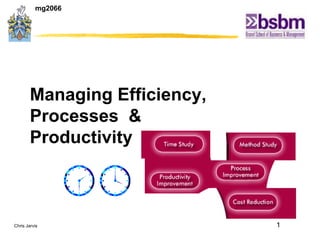
Managing Efficiency, Processes  & Productivity
Work Study generic term for management services and system engineering techniques, used to investigate  methods of performing work (method study)  and improve its efficiency and economy the time taken to do it (work measurement) with a view to rationalization, routinisation, utilisation, cost and incentive improvement the worker-work system-technology relationship: how this is best designed and improved (ergonomics and the human-machine-information interfaces)
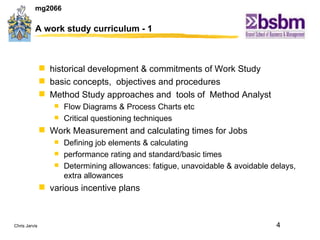
Productivity a measure of performance. broadly a ratio of output to input, i.e. comparing amount produced (output) with resources used (input)  materials, machinery, labour, capital, energy  --- a combination  What improvements have there been over the last 50 years in  construction productivity payroll processing Car servicing banking How do we evaluate productivity levels and identify areas for improvement?
A work study curriculum - 1 historical development & commitments of Work Study  basic concepts,  objectives and procedures Method Study approaches and  tools of  Method Analyst  Flow Diagrams & Process Charts etc Critical questioning techniques  Work Measurement and calculating times for Jobs Defining job elements & calculating  performance rating and standard/basic times Determining allowances: fatigue, unavoidable & avoidable delays, extra allowances various incentive plans
A work study curriculum - 2 examining worker-machine relationships  workload &  line balancing & staff/machine inefficiencies material handling, human controls, tools and devices Workstation  layout &  design (EU work-station directive) Occupation Health &  Safety:signals,  reaction times, eyes, backs, RSI safety criteria, preventing accidents Ergonomics & human-machine-environment interfaces use of visual displays for dynamic information Designing for:  lighting systems, industrial noise, thermal controls, vibration etc Systems analysis the human-machine information system data capture and processing  design of the user interface Business process re-engineering (BPR)
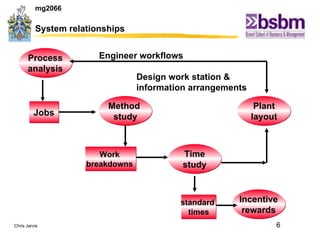
System relationships Process analysis Method  study Plant layout Incentive rewards Time study Jobs Work  breakdowns  standard  times Engineer workflows  Design work station &  information arrangements
Nature of the Theory organised common sense, human ingenuity & creation of tools functional and assumed to be neutral/unemotional critical questioning & taking nothing for granted focus on efficiencies, utilisation and costs predictability and control over quality maximise use (utilisation) of compliant labour & capital - unit costing machine & economic man vs. social/sentient  Separation of worker from means of production
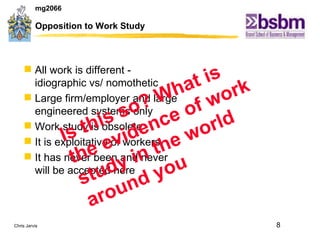
Opposition to Work Study All work is different - idiographic vs/ nomothetic Large firm/employer and large engineered systems only Work study is obsolete It is exploitative of workers It has never been and never will be accepted here Is this so? What is the evidence of work study in the world around you
Pioneers of efficiency measurement & systems Gunpowder manufacture Chinese ceramics industry Adam Smith observations of French - pin making Pioneers of agrarian and industrial revolutions Abraham Derby & Josiah Wedgwood Madame Guillotine, Springfield Rifle F W Taylor at Bethlehem Steel work Henry Gantt Frank and Lillian Gilbreth Time and motion study Charles Bedaux Work measurement
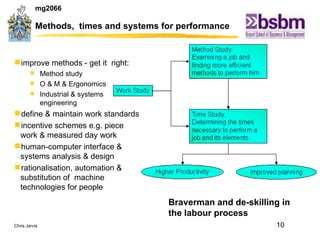
Methods,  times and systems for performance improve methods - get it  right: Method study O & M & Ergonomics Industrial & systems engineering define & maintain work standards incentive schemes e.g. piece work & measured day work human-computer interface &  systems analysis & design rationalisation, automation & substitution of  machine technologies for people Braverman and de-skilling in the labour process
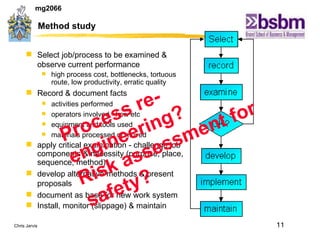
Method study Select job/process to be examined & observe current performance  high process cost, bottlenecks, tortuous route, low productivity, erratic quality Record & document facts activities performed operators involved - how etc equipment and tools used materials processed or moved apply critical examination  - challenge job components & necessity (purpose, place, sequence, method). develop alternative methods &  present proposals document as base for new work system Install, monitor (slippage) & maintain Process re-engineering? Risk assessment for safety?
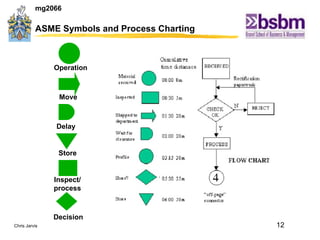
ASME Symbols and Process Charting Operation Move Delay Store Inspect/ process Decision
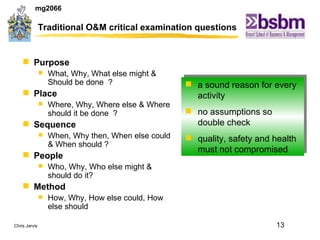
Traditional O&M critical examination questions Purpose  What, Why, What else might & Should be done  ? Place Where, Why, Where else & Where should it be done  ? Sequence When, Why then, When else could & When should ? People Who, Why, Who else might & should do it? Method How, Why, How else could, How else should a sound reason for every activity no assumptions so double check quality, safety and health must not compromised
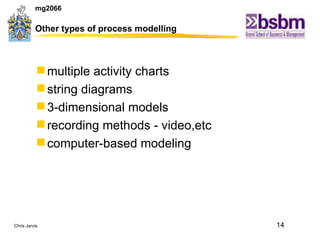
Other types of process modelling multiple activity charts string diagrams 3-dimensional models recording methods - video,etc computer-based modeling
Measuring Work  Why define/measure work? standard, reliable methods control performance & quality obtain predictability defined labour costs & performance set pay rates & provide data for effort-reward relationship Why set standard times assumptions about competent, motivated workers be clear about "allowances" & fatigue Toyota Avensis 10000 mile service MOT testing Service times & queue management Banks Airline check-in Call centres Out-sourcing & service level agreements Work-load balancing Work related bonuses
Work Measurement techniques to establish the time for a qualified, motivated  worker to carry out a task at a defined rate of working.  time Study: establish standard times - management knowledge rate operator performance - criteria for appraisal gather information to calculate production capabilities & data for capacity planning. define/cost work content of finished goods and services e.g. for charging & estimating
A Time Study select job & identify the work tasks  check the method  - is it efficient/agreed? start a Time Study sheet & break work task into "units"  several times with a stop watch & for a sample of workers,  time measure  completion times for each unit of work in the job sequence average for each worker determine & apply worker effort rating for each worker (BSI scale)  Apply fatigue, personal & other allowances From the observation data (worker average times) calculate standard time for the task Assumes:  set sequence, routine work cycle (all workers), little discretion, 100% effort rating - trained/qualified, motivated/committed, working at normal pace & not fatigued Fix standard time and enter into measured work manual/database
Example standard time calculation 13.39 minutes  Standard time Total 4.55  110%  + 15%  3.60  3 5.81 110%  + 5% 4.80  2 3.03  110%  +10% 2.50  1 Standard time Effort % Relaxation % Basic time Element
Incentive Schemes What are incentives? Effort-reward relationships  Economic orientation & motivation Time rates of pay & assumptions/requirements Piecework Measured day work Group Schemes Incentive scheme problems Criticism and prevalence cost savings ? economy of operation ? easily understood ? maintain safety standards ? equitable to all ? control and improve effectiveness & standards ? common goal ?
Process Analysis and BPR Management services & business process re-engineering how work is done & data for planning, staffing & control functions. applied across a wide range of industrial/commercial activity: manufacturing, office, service industries, facilities layout, materials handling, logistics, IT and IS Identify process components & interrelationships (inputs, processes/transformations, rules, outputs, interfaces break down the process into its logical sub processes (work breakdown structure) map using  process flow charts etc describe the business process &  jobs at sub process levels document for: capacity planning, quality (zero defects & process orientation, inspection), operator intervention, safety, accounting/cost, planned maintenance, JIT purposes Clearly represented in the development and adoption of on-line computer systems
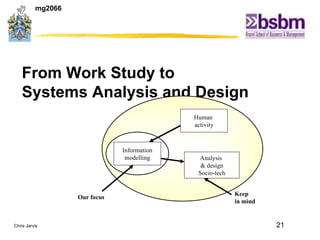
From Work Study to  Systems Analysis and Design Information modelling Analysis  & design Socio-tech Human  activity Keep  in mind Our focus
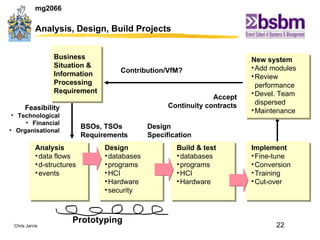
Analysis, Design, Build Projects Implement Fine-tune Conversion Training Cut-over Build & test databases programs HCI Hardware Design databases programs HCI Hardware security Design Specification Business Situation & Information  Processing Requirement Feasibility Technological Financial Organisational Analysis data flows d-structures events BSOs, TSOs Requirements New system Add modules Review performance Devel. Team dispersed Maintenance Accept Continuity contracts Contribution/VfM? Prototyping
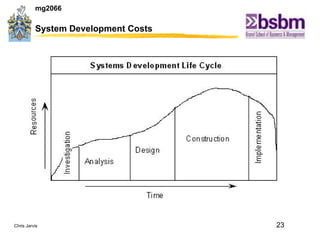
System Development Costs
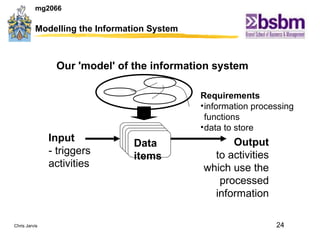
Modelling the Information System Our 'model' of the information system Input - triggers  activities Requirements information processing functions data to store Output to activities which use the processed information Data  items
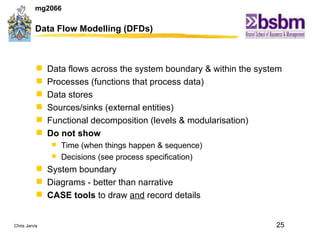
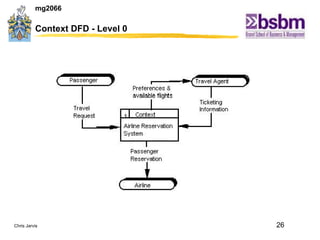
Data Flow Modelling (DFDs) Data flows across the system boundary & within the system Processes (functions that process data) Data stores Sources/sinks (external entities) Functional decomposition (levels & modularisation) Do not show Time (when things happen & sequence) Decisions (see process specification) System boundary Diagrams - better than narrative CASE tools  to draw  and  record details
Context DFD - Level 0
Level 1 DFD
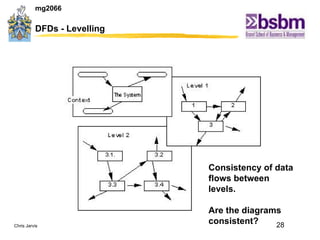
DFDs - Levelling Consistency of data flows between levels. Are the diagrams consistent?
Logical Data Modelling data captured  by the system Analyse the data entities, attributes and relationships Entities things (physical or conceptual) of interest that the system needs to store information about. Attributes The data items stored in each occurrence of an entity Relationships how the data in one entity may be related (for functional purposes) to another) Create database schema for developers and DB managers system processes use the data - jobs, calculations, reports maintain the access rules, security and integrity of the data
Events acting on data applies interviewed final accept/reject enrols/pays assessed graduates leaves Identify all processes Map against the LDM Data updates Referential integrity & validation Menus, screens, reports
Example: Dabbs plc Customers place sales orders A single order may contain several products Each customer is in one of 500 areas Each customer is serviced by one of 6 depots Each customer is allocated a depot depending on their area location All products are stocked at all depots
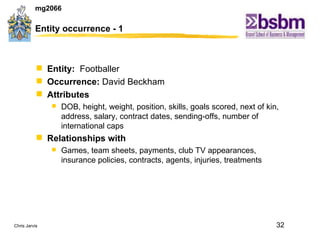
Entity occurrence - 1 Entity:  Footballer Occurrence:  David Beckham Attributes DOB, height, weight, position, skills, goals scored, next of kin, address, salary, contract dates, sending-offs, number of international caps Relationships with Games, team sheets, payments, club TV appearances, insurance policies, contracts, agents, injuries, treatments
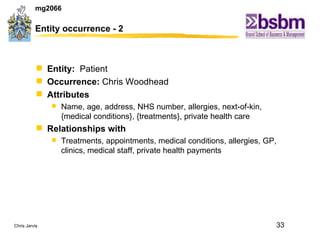
Entity occurrence - 2 Entity:  Patient Occurrence:  Chris Woodhead Attributes Name, age, address, NHS number, allergies, next-of-kin, {medical conditions}, {treatments}, private health care Relationships with Treatments, appointments, medical conditions, allergies, GP, clinics, medical staff, private health payments

Workstudy

  • 1.
  • 2.
    Work Study genericterm for management services and system engineering techniques, used to investigate methods of performing work (method study) and improve its efficiency and economy the time taken to do it (work measurement) with a view to rationalization, routinisation, utilisation, cost and incentive improvement the worker-work system-technology relationship: how this is best designed and improved (ergonomics and the human-machine-information interfaces)
  • 3.
    Productivity a measureof performance. broadly a ratio of output to input, i.e. comparing amount produced (output) with resources used (input) materials, machinery, labour, capital, energy --- a combination What improvements have there been over the last 50 years in construction productivity payroll processing Car servicing banking How do we evaluate productivity levels and identify areas for improvement?
  • 4.
    A work studycurriculum - 1 historical development & commitments of Work Study basic concepts, objectives and procedures Method Study approaches and tools of Method Analyst Flow Diagrams & Process Charts etc Critical questioning techniques Work Measurement and calculating times for Jobs Defining job elements & calculating performance rating and standard/basic times Determining allowances: fatigue, unavoidable & avoidable delays, extra allowances various incentive plans
  • 5.
    A work studycurriculum - 2 examining worker-machine relationships workload & line balancing & staff/machine inefficiencies material handling, human controls, tools and devices Workstation layout & design (EU work-station directive) Occupation Health & Safety:signals, reaction times, eyes, backs, RSI safety criteria, preventing accidents Ergonomics & human-machine-environment interfaces use of visual displays for dynamic information Designing for: lighting systems, industrial noise, thermal controls, vibration etc Systems analysis the human-machine information system data capture and processing design of the user interface Business process re-engineering (BPR)
  • 6.
    System relationships Processanalysis Method study Plant layout Incentive rewards Time study Jobs Work breakdowns standard times Engineer workflows Design work station & information arrangements
  • 7.
    Nature of theTheory organised common sense, human ingenuity & creation of tools functional and assumed to be neutral/unemotional critical questioning & taking nothing for granted focus on efficiencies, utilisation and costs predictability and control over quality maximise use (utilisation) of compliant labour & capital - unit costing machine & economic man vs. social/sentient Separation of worker from means of production
  • 8.
    Opposition to WorkStudy All work is different - idiographic vs/ nomothetic Large firm/employer and large engineered systems only Work study is obsolete It is exploitative of workers It has never been and never will be accepted here Is this so? What is the evidence of work study in the world around you
  • 9.
    Pioneers of efficiencymeasurement & systems Gunpowder manufacture Chinese ceramics industry Adam Smith observations of French - pin making Pioneers of agrarian and industrial revolutions Abraham Derby & Josiah Wedgwood Madame Guillotine, Springfield Rifle F W Taylor at Bethlehem Steel work Henry Gantt Frank and Lillian Gilbreth Time and motion study Charles Bedaux Work measurement
  • 10.
    Methods, timesand systems for performance improve methods - get it right: Method study O & M & Ergonomics Industrial & systems engineering define & maintain work standards incentive schemes e.g. piece work & measured day work human-computer interface & systems analysis & design rationalisation, automation & substitution of machine technologies for people Braverman and de-skilling in the labour process
  • 11.
    Method study Selectjob/process to be examined & observe current performance high process cost, bottlenecks, tortuous route, low productivity, erratic quality Record & document facts activities performed operators involved - how etc equipment and tools used materials processed or moved apply critical examination - challenge job components & necessity (purpose, place, sequence, method). develop alternative methods & present proposals document as base for new work system Install, monitor (slippage) & maintain Process re-engineering? Risk assessment for safety?
  • 12.
    ASME Symbols andProcess Charting Operation Move Delay Store Inspect/ process Decision
  • 13.
    Traditional O&M criticalexamination questions Purpose What, Why, What else might & Should be done ? Place Where, Why, Where else & Where should it be done ? Sequence When, Why then, When else could & When should ? People Who, Why, Who else might & should do it? Method How, Why, How else could, How else should a sound reason for every activity no assumptions so double check quality, safety and health must not compromised
  • 14.
    Other types ofprocess modelling multiple activity charts string diagrams 3-dimensional models recording methods - video,etc computer-based modeling
  • 15.
    Measuring Work Why define/measure work? standard, reliable methods control performance & quality obtain predictability defined labour costs & performance set pay rates & provide data for effort-reward relationship Why set standard times assumptions about competent, motivated workers be clear about "allowances" & fatigue Toyota Avensis 10000 mile service MOT testing Service times & queue management Banks Airline check-in Call centres Out-sourcing & service level agreements Work-load balancing Work related bonuses
  • 16.
    Work Measurement techniquesto establish the time for a qualified, motivated worker to carry out a task at a defined rate of working. time Study: establish standard times - management knowledge rate operator performance - criteria for appraisal gather information to calculate production capabilities & data for capacity planning. define/cost work content of finished goods and services e.g. for charging & estimating
  • 17.
    A Time Studyselect job & identify the work tasks check the method - is it efficient/agreed? start a Time Study sheet & break work task into "units" several times with a stop watch & for a sample of workers, time measure completion times for each unit of work in the job sequence average for each worker determine & apply worker effort rating for each worker (BSI scale) Apply fatigue, personal & other allowances From the observation data (worker average times) calculate standard time for the task Assumes: set sequence, routine work cycle (all workers), little discretion, 100% effort rating - trained/qualified, motivated/committed, working at normal pace & not fatigued Fix standard time and enter into measured work manual/database
  • 18.
    Example standard timecalculation 13.39 minutes Standard time Total 4.55 110% + 15% 3.60 3 5.81 110% + 5% 4.80 2 3.03 110% +10% 2.50 1 Standard time Effort % Relaxation % Basic time Element
  • 19.
    Incentive Schemes Whatare incentives? Effort-reward relationships Economic orientation & motivation Time rates of pay & assumptions/requirements Piecework Measured day work Group Schemes Incentive scheme problems Criticism and prevalence cost savings ? economy of operation ? easily understood ? maintain safety standards ? equitable to all ? control and improve effectiveness & standards ? common goal ?
  • 20.
    Process Analysis andBPR Management services & business process re-engineering how work is done & data for planning, staffing & control functions. applied across a wide range of industrial/commercial activity: manufacturing, office, service industries, facilities layout, materials handling, logistics, IT and IS Identify process components & interrelationships (inputs, processes/transformations, rules, outputs, interfaces break down the process into its logical sub processes (work breakdown structure) map using process flow charts etc describe the business process & jobs at sub process levels document for: capacity planning, quality (zero defects & process orientation, inspection), operator intervention, safety, accounting/cost, planned maintenance, JIT purposes Clearly represented in the development and adoption of on-line computer systems
  • 21.
    From Work Studyto Systems Analysis and Design Information modelling Analysis & design Socio-tech Human activity Keep in mind Our focus
  • 22.
    Analysis, Design, BuildProjects Implement Fine-tune Conversion Training Cut-over Build & test databases programs HCI Hardware Design databases programs HCI Hardware security Design Specification Business Situation & Information Processing Requirement Feasibility Technological Financial Organisational Analysis data flows d-structures events BSOs, TSOs Requirements New system Add modules Review performance Devel. Team dispersed Maintenance Accept Continuity contracts Contribution/VfM? Prototyping
  • 23.
  • 24.
    Modelling the InformationSystem Our 'model' of the information system Input - triggers activities Requirements information processing functions data to store Output to activities which use the processed information Data items
  • 25.
    Data Flow Modelling(DFDs) Data flows across the system boundary & within the system Processes (functions that process data) Data stores Sources/sinks (external entities) Functional decomposition (levels & modularisation) Do not show Time (when things happen & sequence) Decisions (see process specification) System boundary Diagrams - better than narrative CASE tools to draw and record details
  • 26.
  • 27.
  • 28.
    DFDs - LevellingConsistency of data flows between levels. Are the diagrams consistent?
  • 29.
    Logical Data Modellingdata captured by the system Analyse the data entities, attributes and relationships Entities things (physical or conceptual) of interest that the system needs to store information about. Attributes The data items stored in each occurrence of an entity Relationships how the data in one entity may be related (for functional purposes) to another) Create database schema for developers and DB managers system processes use the data - jobs, calculations, reports maintain the access rules, security and integrity of the data
  • 30.
    Events acting ondata applies interviewed final accept/reject enrols/pays assessed graduates leaves Identify all processes Map against the LDM Data updates Referential integrity & validation Menus, screens, reports
  • 31.
    Example: Dabbs plcCustomers place sales orders A single order may contain several products Each customer is in one of 500 areas Each customer is serviced by one of 6 depots Each customer is allocated a depot depending on their area location All products are stocked at all depots
  • 32.
    Entity occurrence -1 Entity: Footballer Occurrence: David Beckham Attributes DOB, height, weight, position, skills, goals scored, next of kin, address, salary, contract dates, sending-offs, number of international caps Relationships with Games, team sheets, payments, club TV appearances, insurance policies, contracts, agents, injuries, treatments
  • 33.
    Entity occurrence -2 Entity: Patient Occurrence: Chris Woodhead Attributes Name, age, address, NHS number, allergies, next-of-kin, {medical conditions}, {treatments}, private health care Relationships with Treatments, appointments, medical conditions, allergies, GP, clinics, medical staff, private health payments