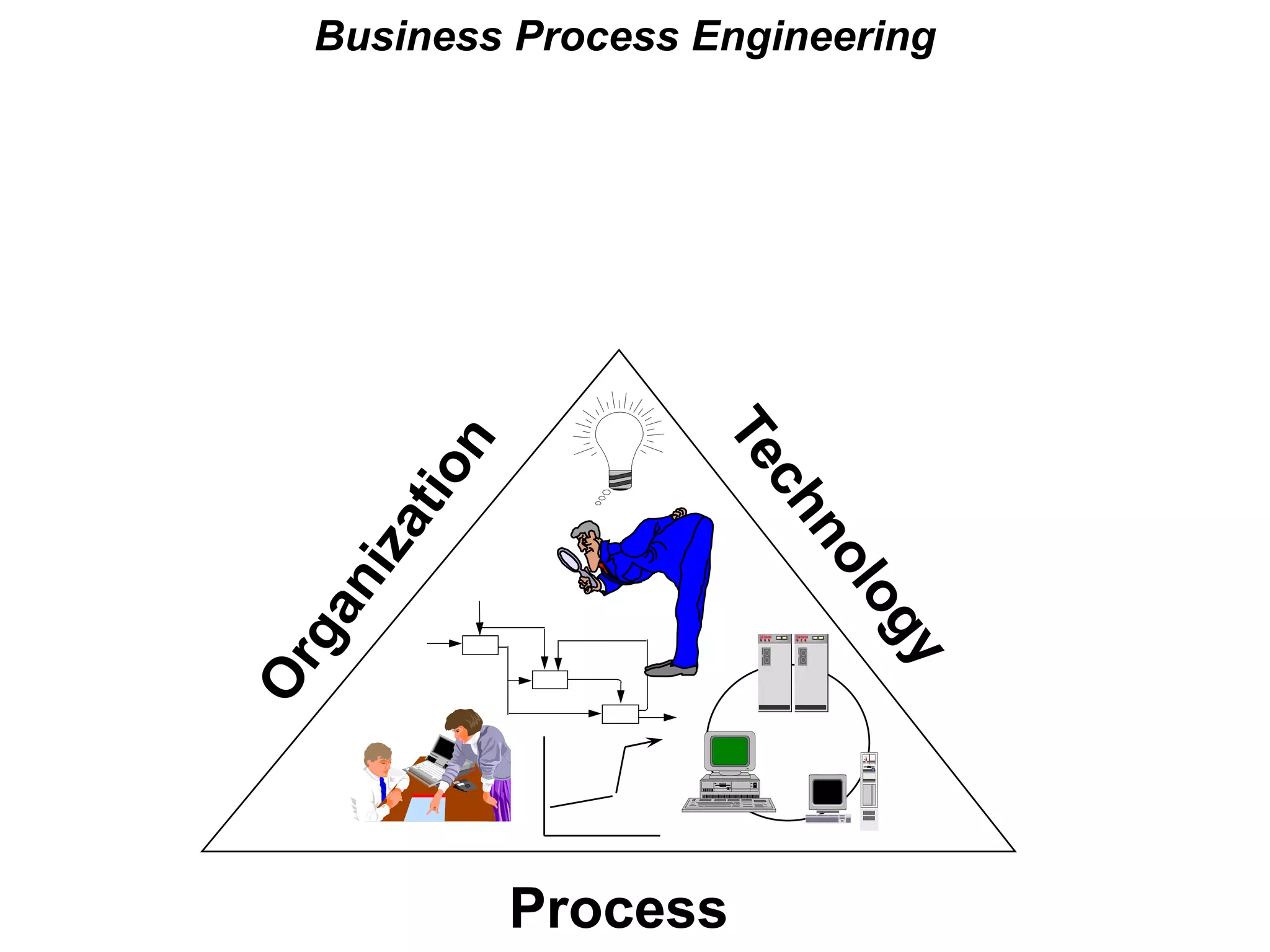
Business Process Engineering
Process
- 2 -© Minder Chen, 1993-2011
BPR & The Organization
- 3 -© Minder Chen, 1993-2011
What is BPR?
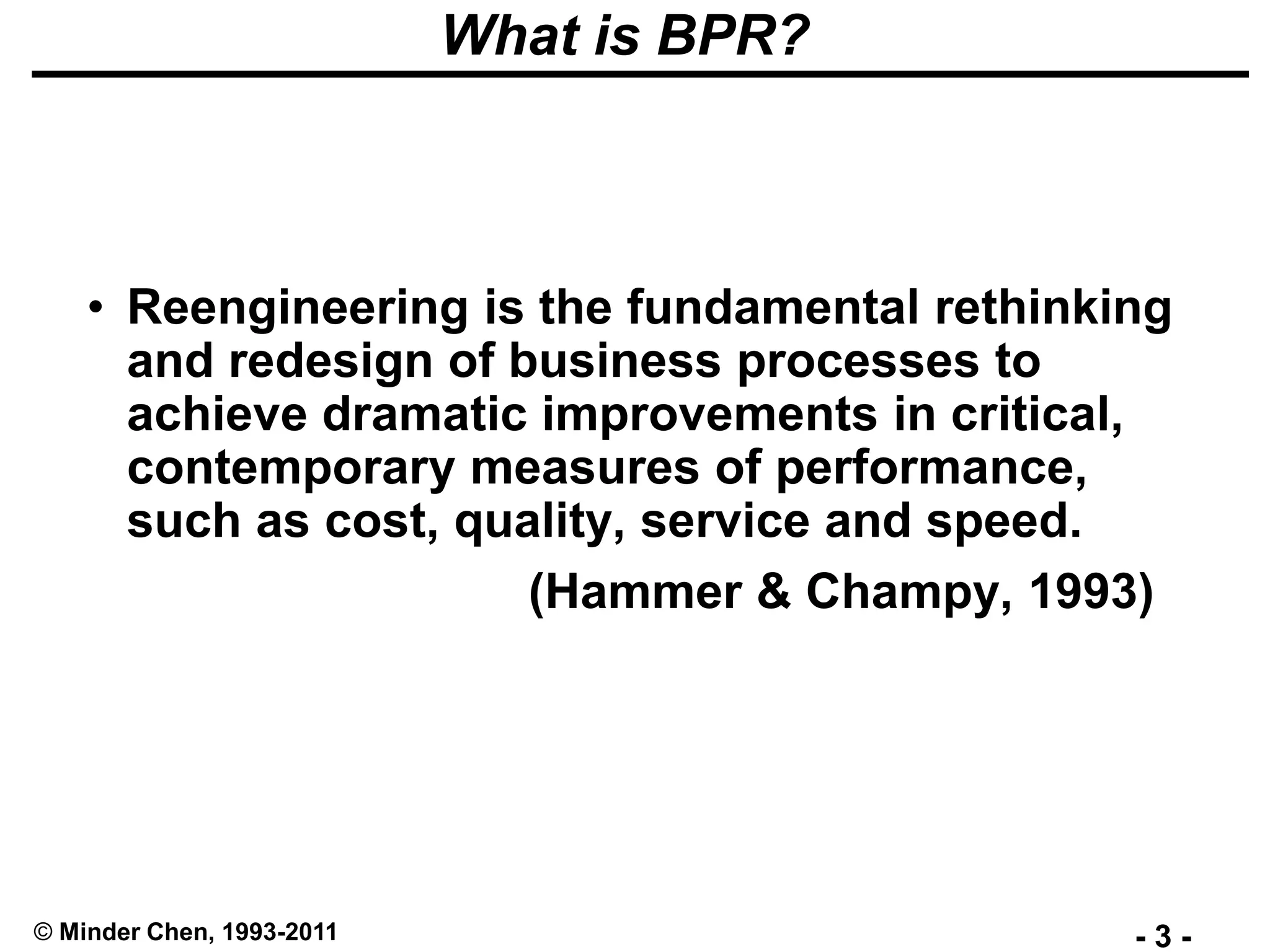
• Reengineering is the fundamental rethinking
and redesign of business processes to
achieve dramatic improvements in critical,
contemporary measures of performance,
such as cost, quality, service and speed.
(Hammer & Champy, 1993)
- 4 -© Minder Chen, 1993-2011
BPR is Not?
• Automation
• Downsizing
• Outsourcing
- 5 -© Minder Chen, 1993-2011
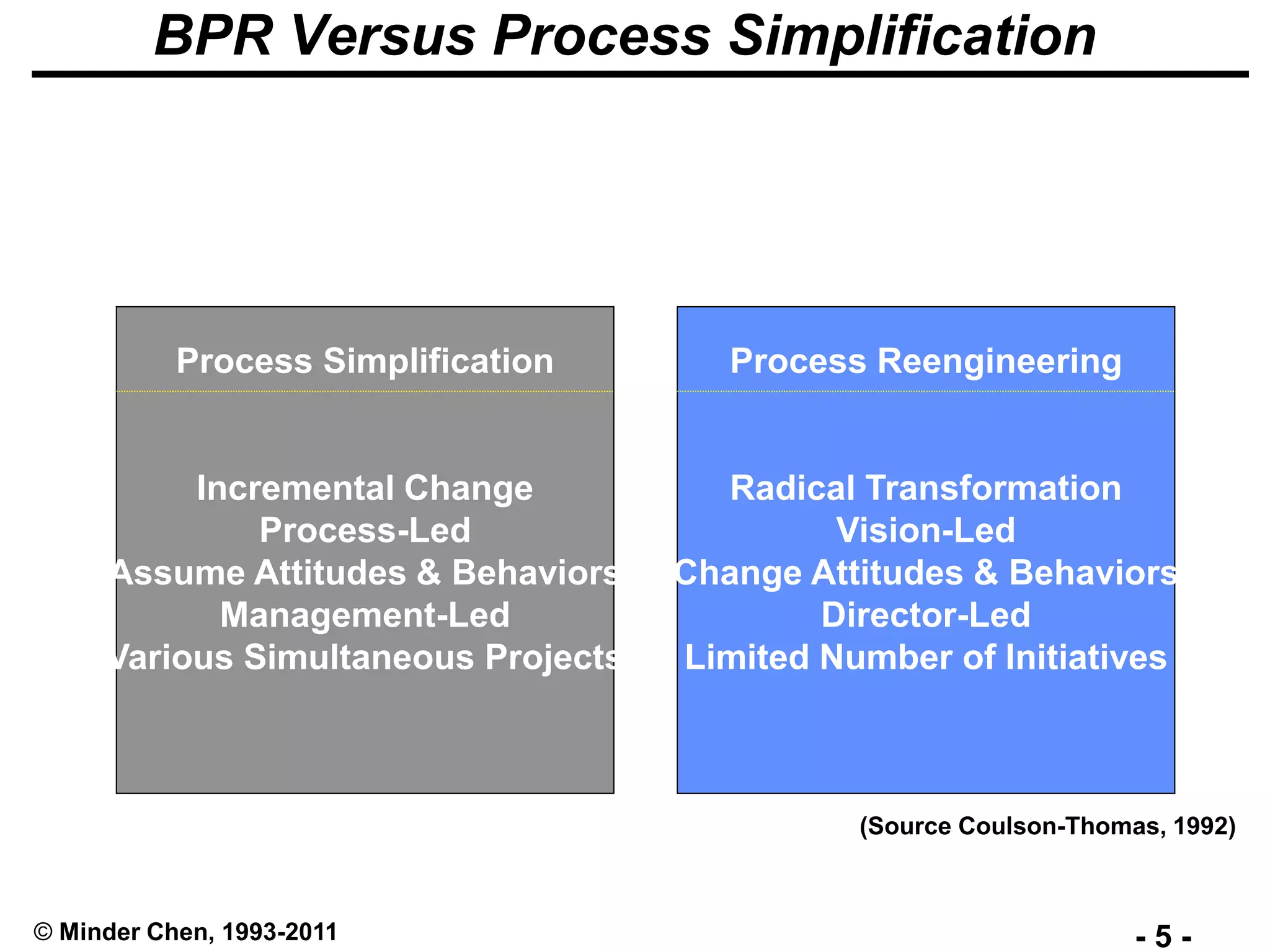
BPR Versus Process Simplification
Process Reengineering
Radical Transformation
Vision-Led
Change Attitudes & Behaviors
Director-Led
Limited Number of Initiatives
Process Simplification
Incremental Change
Process-Led
Assume Attitudes & Behaviors
Management-Led
Various Simultaneous Projects
(Source Coulson-Thomas, 1992)
- 6 -© Minder Chen, 1993-2011
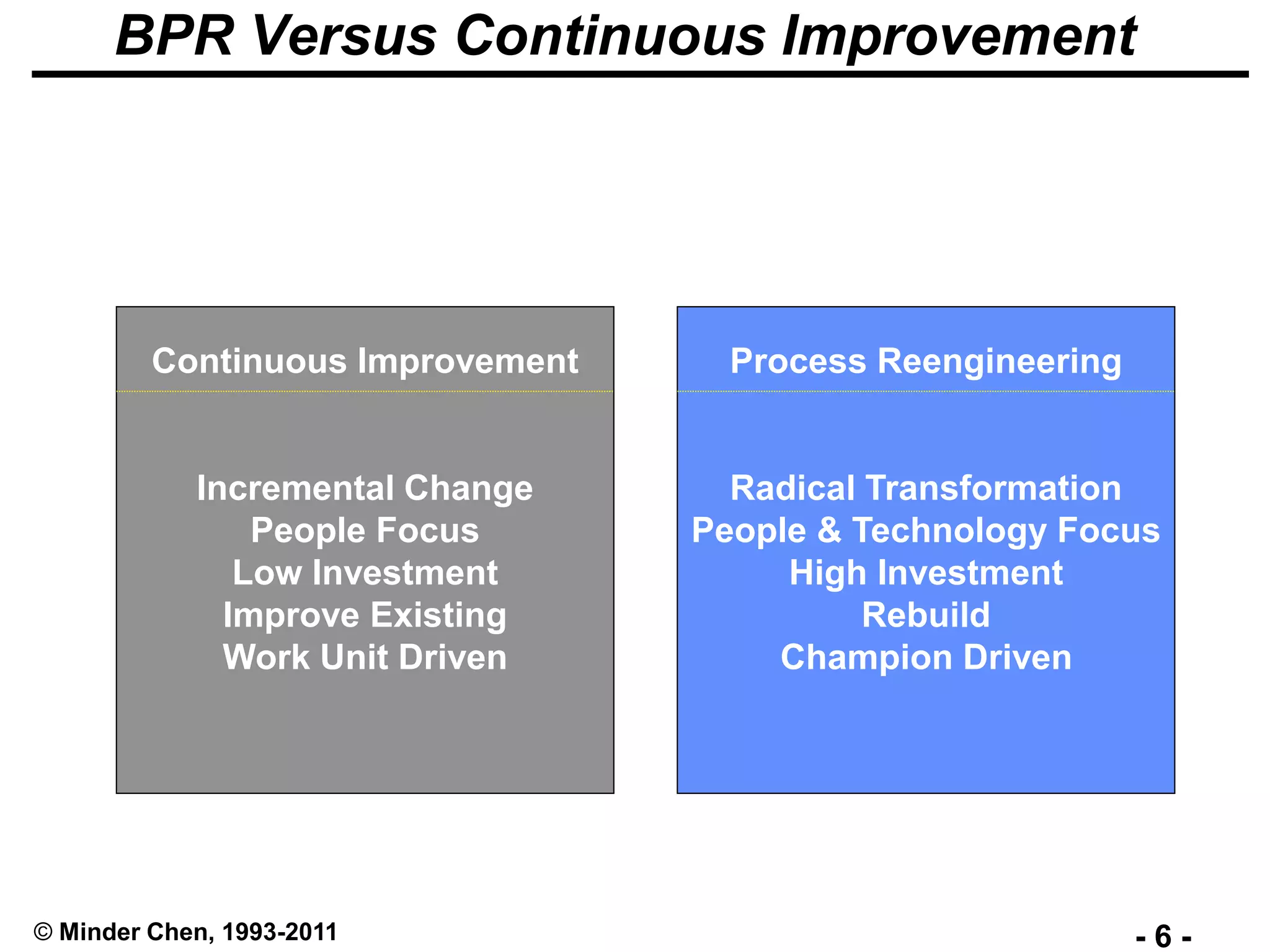
BPR Versus Continuous Improvement
Process Reengineering
Radical Transformation
People & Technology Focus
High Investment
Rebuild
Champion Driven
Continuous Improvement
Incremental Change
People Focus
Low Investment
Improve Existing
Work Unit Driven
- 7 -© Minder Chen, 1993-2011
What is a Process?
• A specific ordering of work activities across
time and space, with a beginning, an end, and
clearly identified inputs and outputs: a
structure for action.
(Davenport, 1993)
- 8 -© Minder Chen, 1993-2011
What is a Business Process?
• A group of logically related tasks that use the
firm's resources to provide customer-oriented
results in support of the organization's
objectives
- 9 -© Minder Chen, 1993-2011
Why Reengineer?
• Customers
– Demanding
– Sophistication
– Changing Needs
• Competition
– Local
– Global
- 10 -© Minder Chen, 1993-2011
Why Reengineer?
• Change
– Technology
– Customer Preferences
- 11 -© Minder Chen, 1993-2011
Why Organizations Don’t Reengineer?
• Complacency
• Political Resistance
• New Developments
• Fear of Unknown and Failure
- 12 -© Minder Chen, 1993-2011
Performance
• BPR seeks improvements of
– Cost
– Quality
– Service
– Speed
- 13 -© Minder Chen, 1993-2011
Origins
• Scientific Management. FW Taylor (1856-1915).
• Frederick Herzberg - Job Enrichment
• Deming et al - Total Quality Management and
Kaizen
• In Search of Excellence (Peters and Waterman)
• Value-Added Analysis (Porter).
- 14 -© Minder Chen, 1993-2011
Key Characteristics
• Systems Philosophy
• Global Perspective on Business Processes
• Radical Improvement
• Integrated Change
• People Centred
• Focus on End-Customers
• Process-Based
- 15 -© Minder Chen, 1993-2011
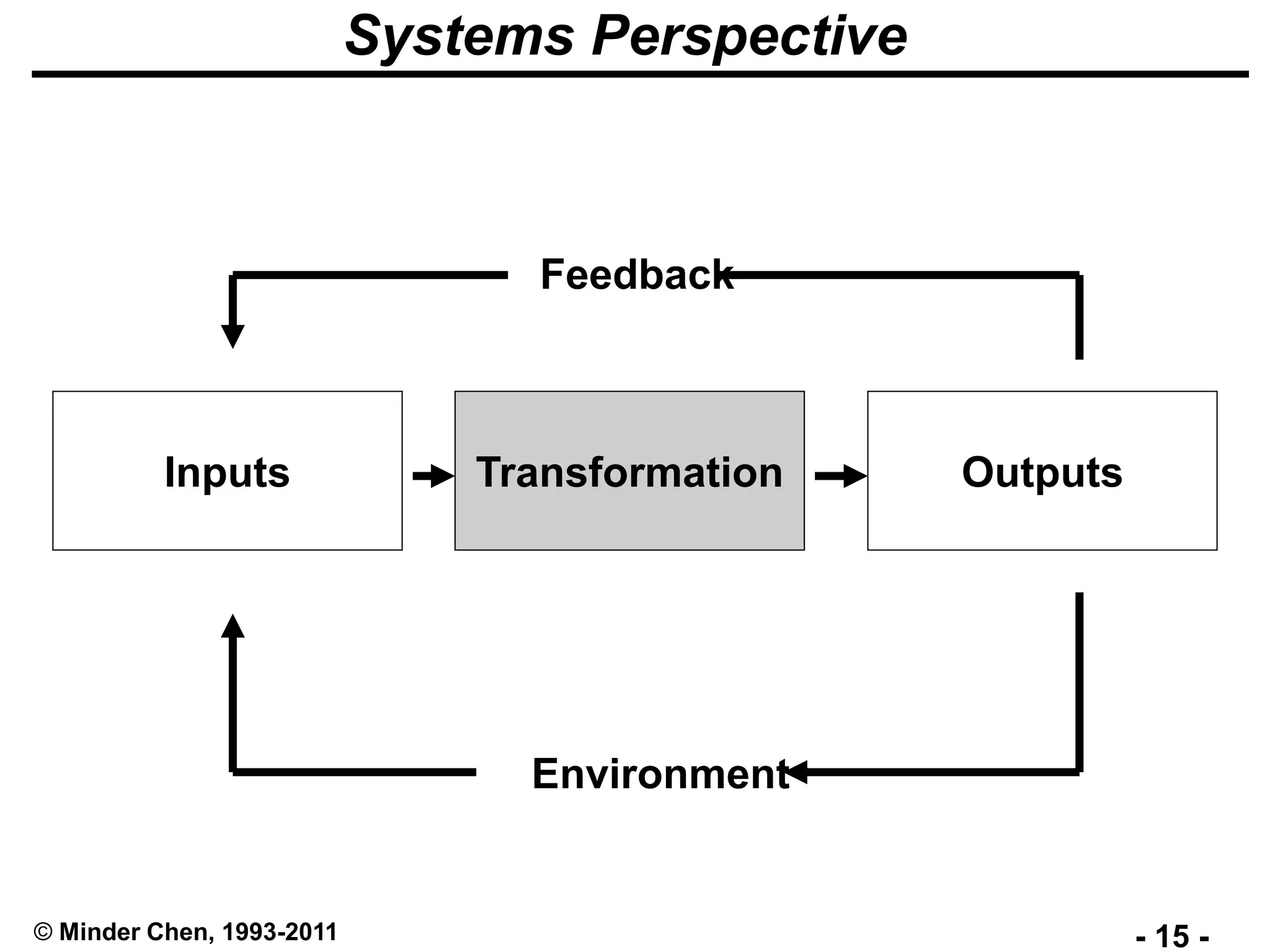
TransformationInputs Outputs
Feedback
Environment
Systems Perspective
- 16 -© Minder Chen, 1993-2011
Process Based
• Added Value
– BPR Initiatives must add-value over and above the
existing process
• Customer-Led
– BPR Initiatives must meet the needs of the
customer
- 17 -© Minder Chen, 1993-2011
Radical Improvement
• Sustainable
– Process improvements need to become firmly
rooted within the organization
• Stepped Approach
– Process improvements will not happen over night
they need to be gradually introduced
– Also assists the acceptance by staff of the change
- 18 -© Minder Chen, 1993-2011
Integrated Change
• Viable Solutions
– Process improvements must be viable and practical
• Balanced Improvements
– Process improvements must be realistic
- 19 -© Minder Chen, 1993-2011
People-Centred
• Business Understanding
• Empowerment & Participation
• Organizational Culture
- 20 -© Minder Chen, 1993-2011
Focus on End-Customers
• Process improvements must relate to the needs
of the organization and be relevant to the end-
customers to which they are designed to serve
- 21 -© Minder Chen, 1993-2011
BPR Symbols
- 22 -© Minder Chen, 1993-2011
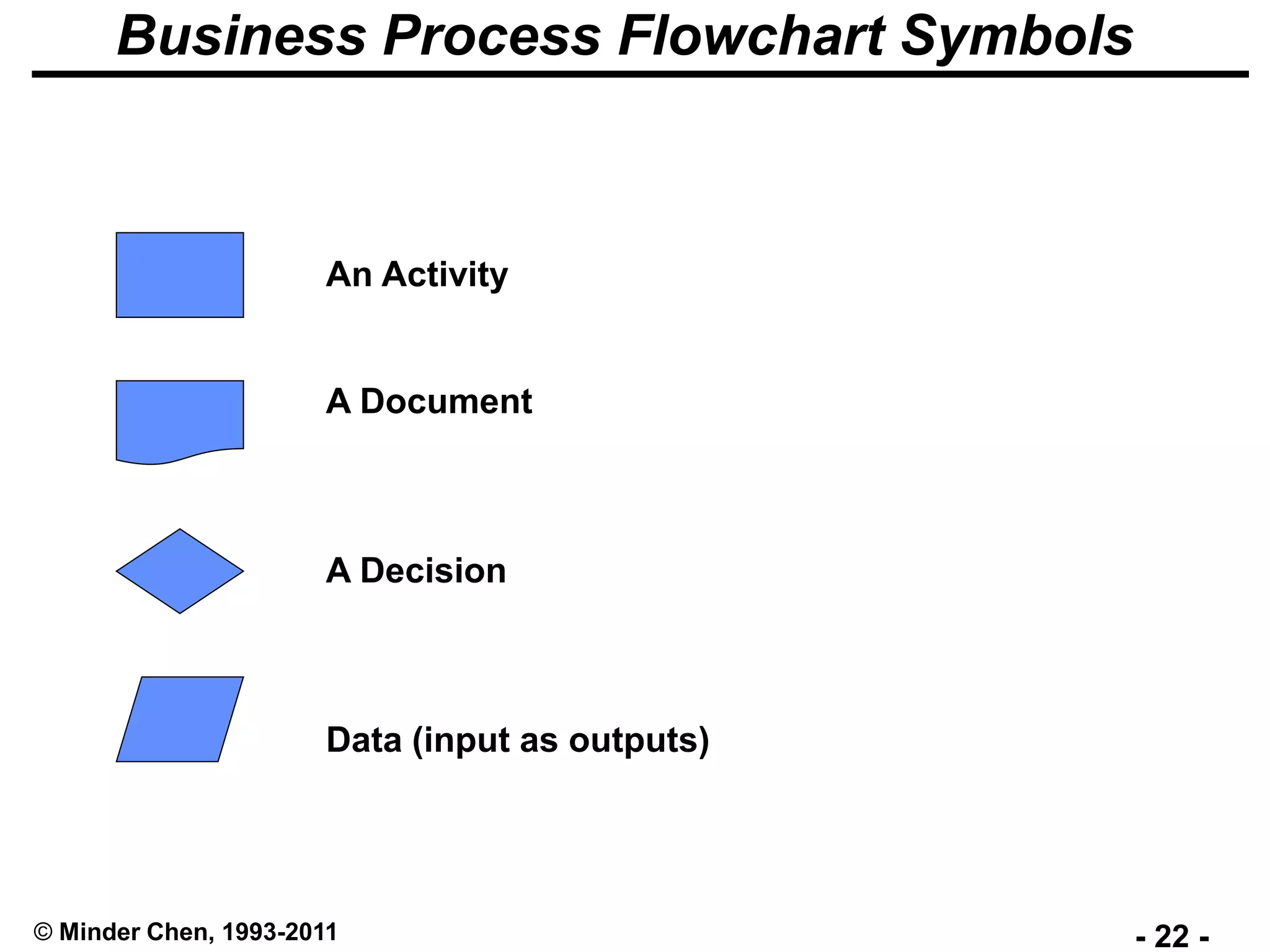
Business Process Flowchart Symbols
An Activity
A Document
A Decision
Data (input as outputs)
- 23 -© Minder Chen, 1993-2011
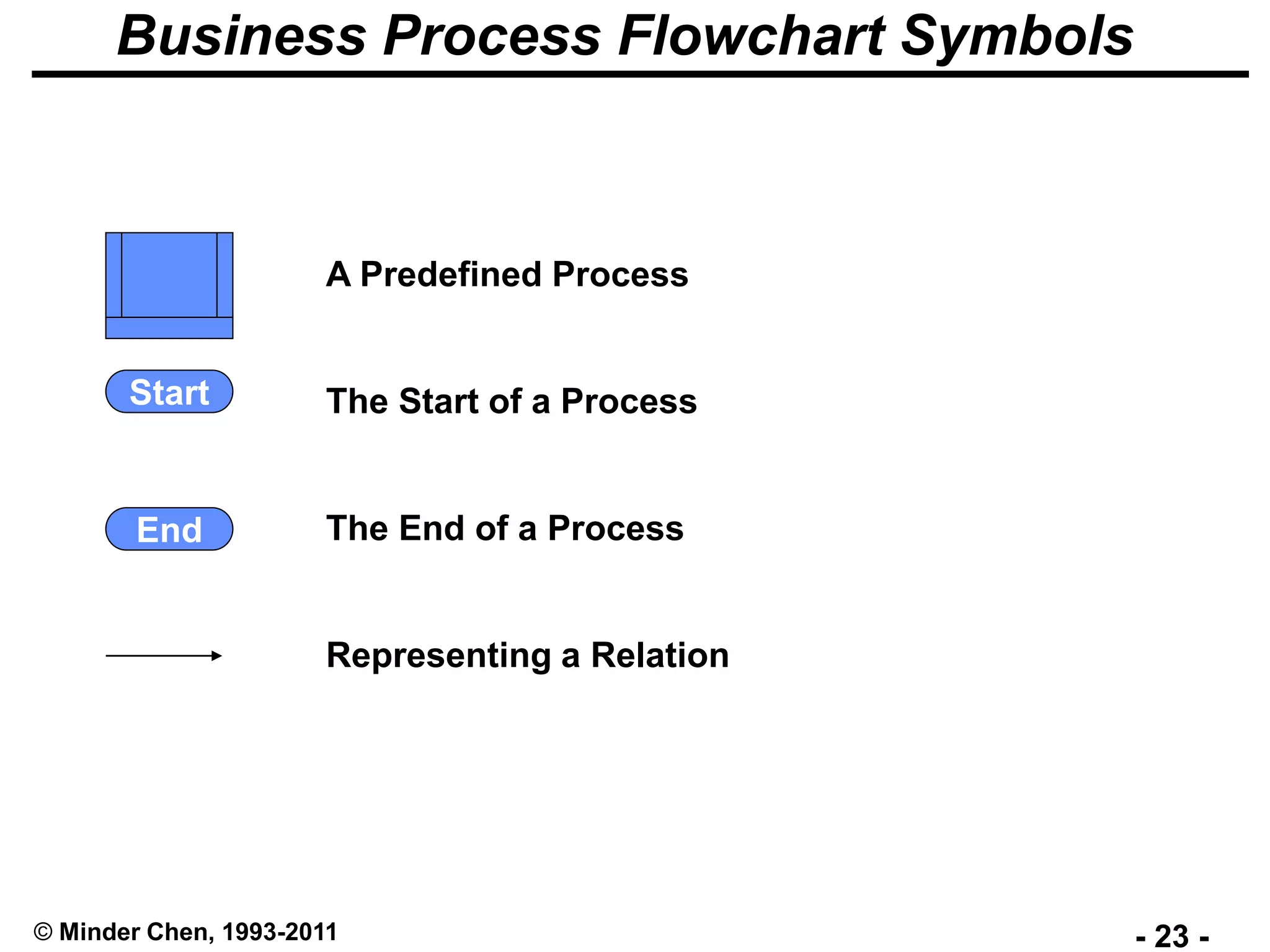
Business Process Flowchart Symbols
A Predefined Process
The Start of a Process
The End of a Process
Representing a Relation
Start
End
- 24 -© Minder Chen, 1993-2011
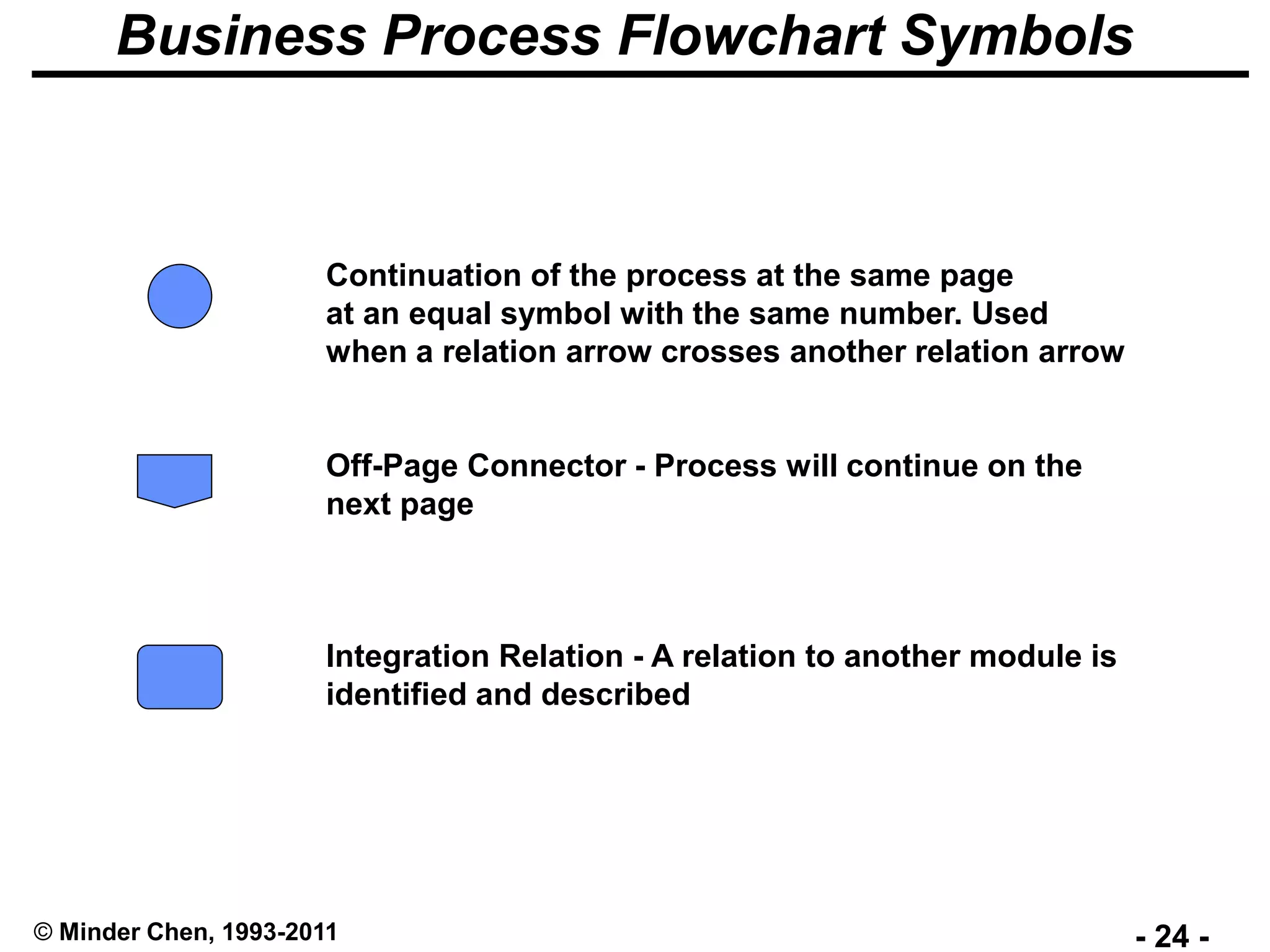
Business Process Flowchart Symbols
Continuation of the process at the same page
at an equal symbol with the same number. Used
when a relation arrow crosses another relation arrow
Off-Page Connector - Process will continue on the
next page
Integration Relation - A relation to another module is
identified and described
- 25 -© Minder Chen, 1993-2011
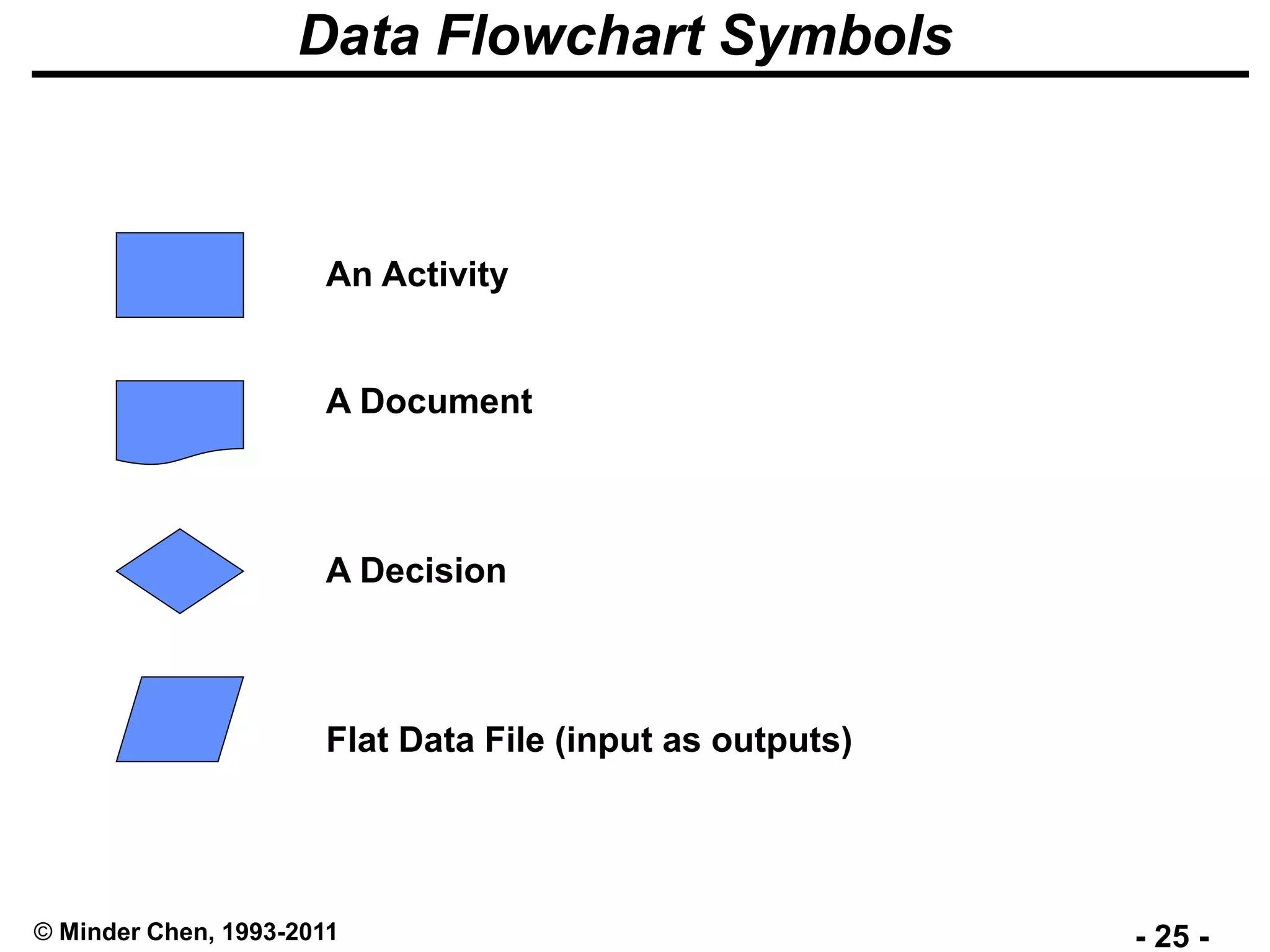
Data Flowchart Symbols
An Activity
A Document
A Decision
Flat Data File (input as outputs)
- 26 -© Minder Chen, 1993-2011
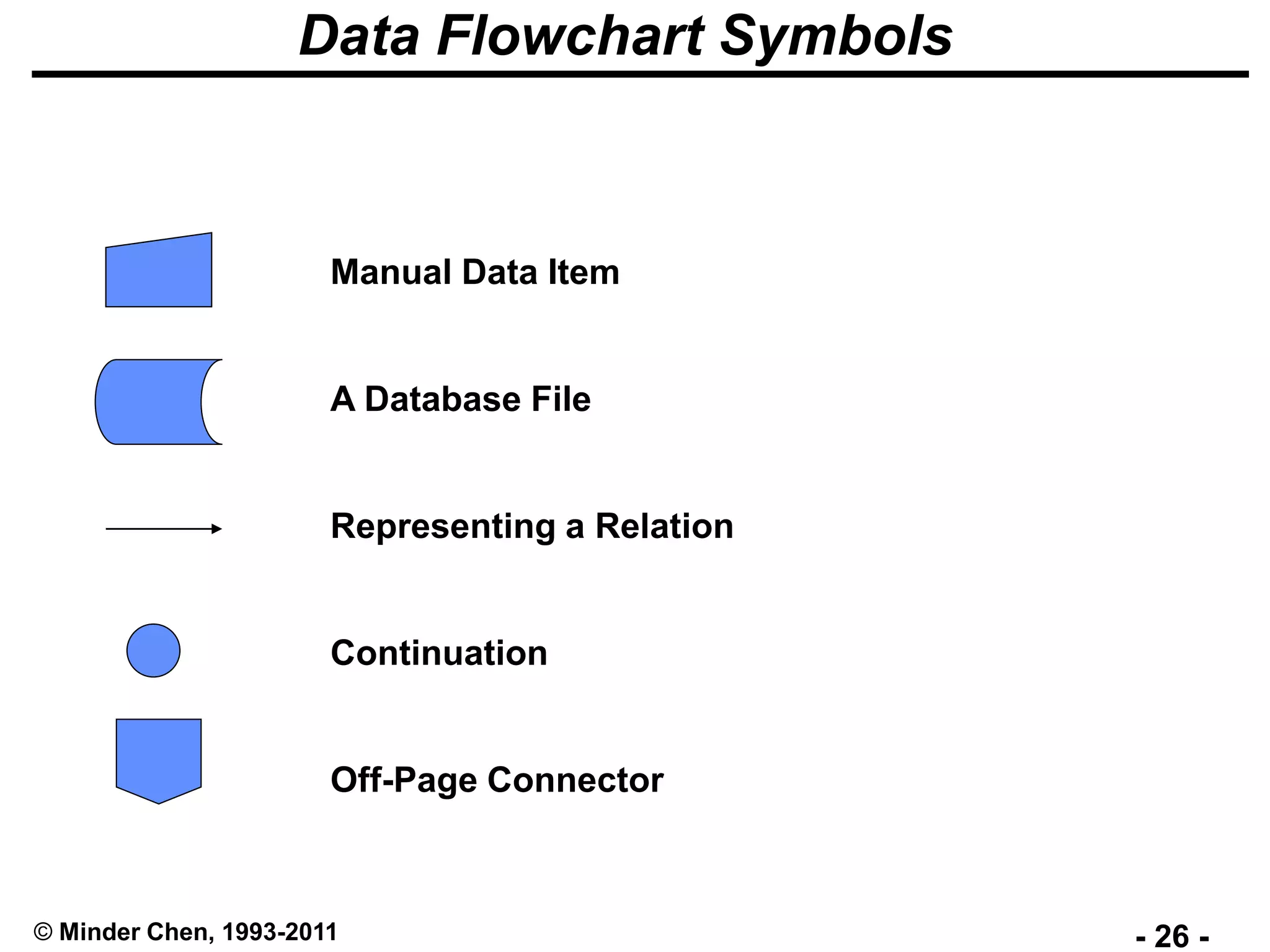
Data Flowchart Symbols
Manual Data Item
A Database File
Representing a Relation
Continuation
Off-Page Connector
- 27 -© Minder Chen, 1993-2011
Rules For Data Symbols
- 28 -© Minder Chen, 1993-2011
Rules For Data Symbols
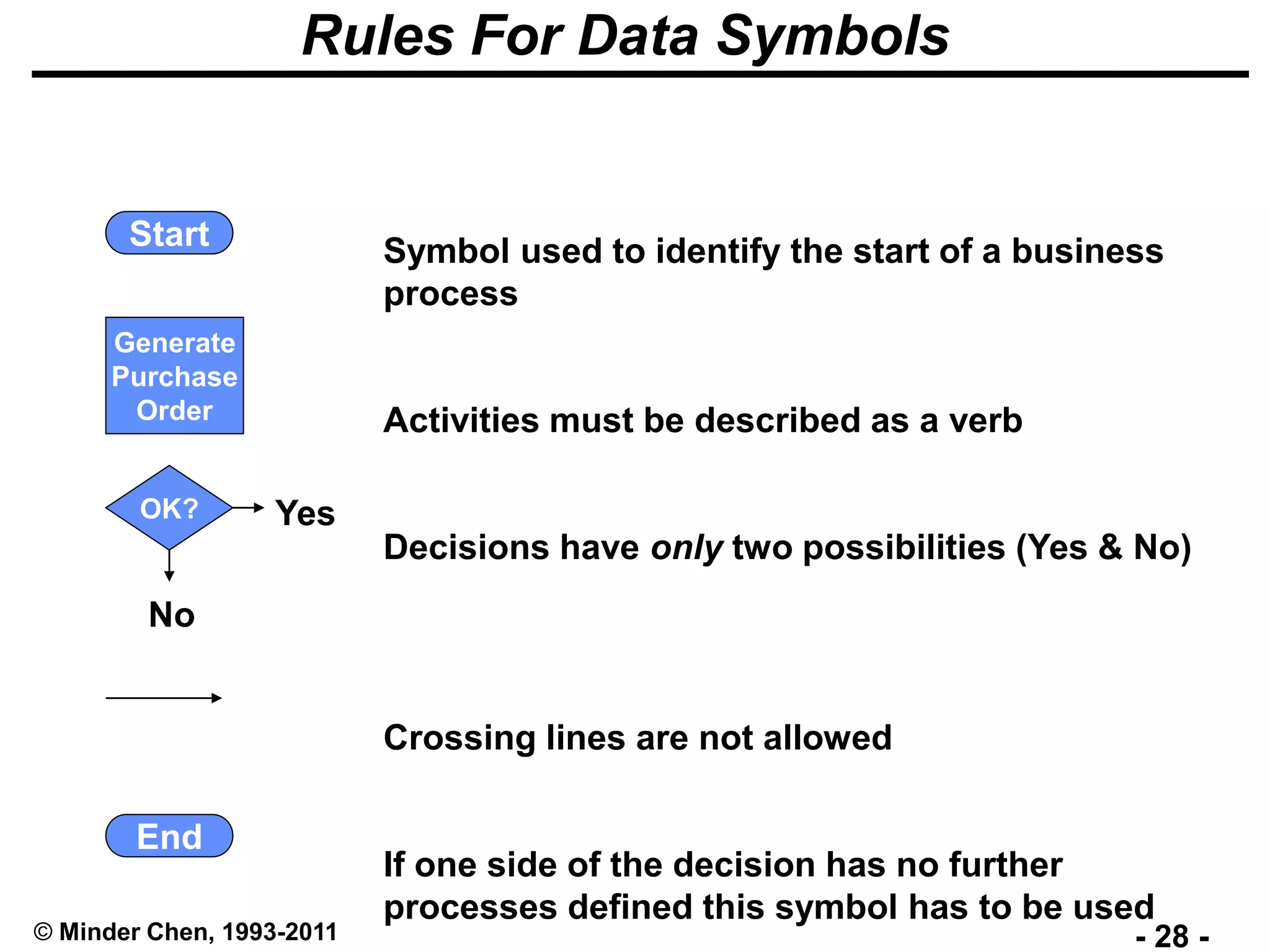
Start
End
Generate
Purchase
Order
OK? Yes
No
Symbol used to identify the start of a business
process
Activities must be described as a verb
Decisions have only two possibilities (Yes & No)
Crossing lines are not allowed
If one side of the decision has no further
processes defined this symbol has to be used
- 29 -© Minder Chen, 1993-2011
Rules For Data Symbols
Purchase
Order
Posting
of Bonus
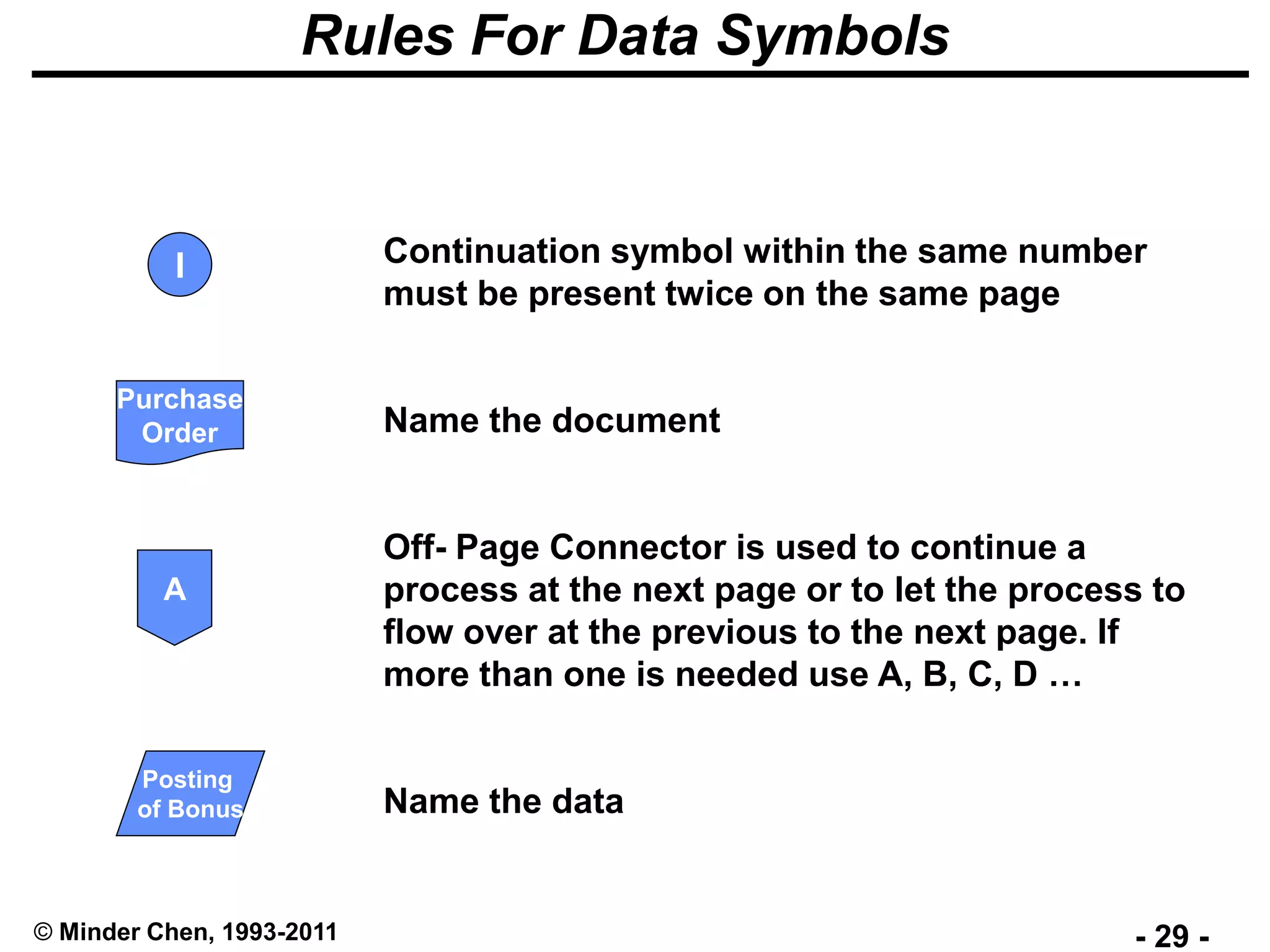
I
A
Continuation symbol within the same number
must be present twice on the same page
Name the document
Off- Page Connector is used to continue a
process at the next page or to let the process to
flow over at the previous to the next page. If
more than one is needed use A, B, C, D …
Name the data
- 30 -© Minder Chen, 1993-2011
Rules For Data Symbols
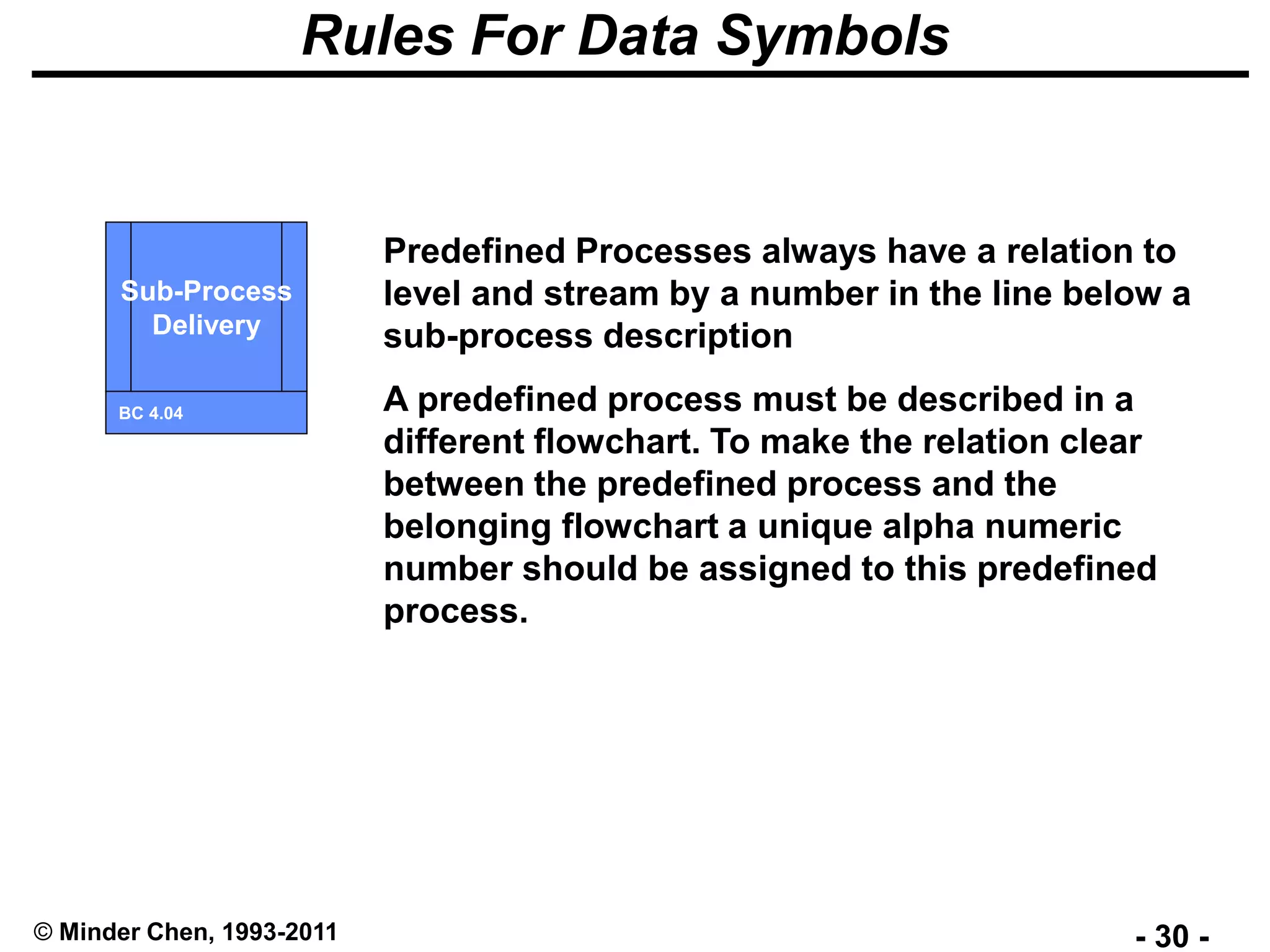
Sub-Process
Delivery
BC 4.04
Predefined Processes always have a relation to
level and stream by a number in the line below a
sub-process description
A predefined process must be described in a
different flowchart. To make the relation clear
between the predefined process and the
belonging flowchart a unique alpha numeric
number should be assigned to this predefined
process.
- 31 -© Minder Chen, 1993-2011
Version Management
• For different versions of a business process or
data flow some mandatory information must be
on the flowchart.
– Name of the business process
– Unique number of the business process
– Revision number
– Date of last change
– Author
– Page number with total pages
- 32 -© Minder Chen, 1993-2011
Implementing a BPR Strategy
- 33 -© Minder Chen, 1993-2011
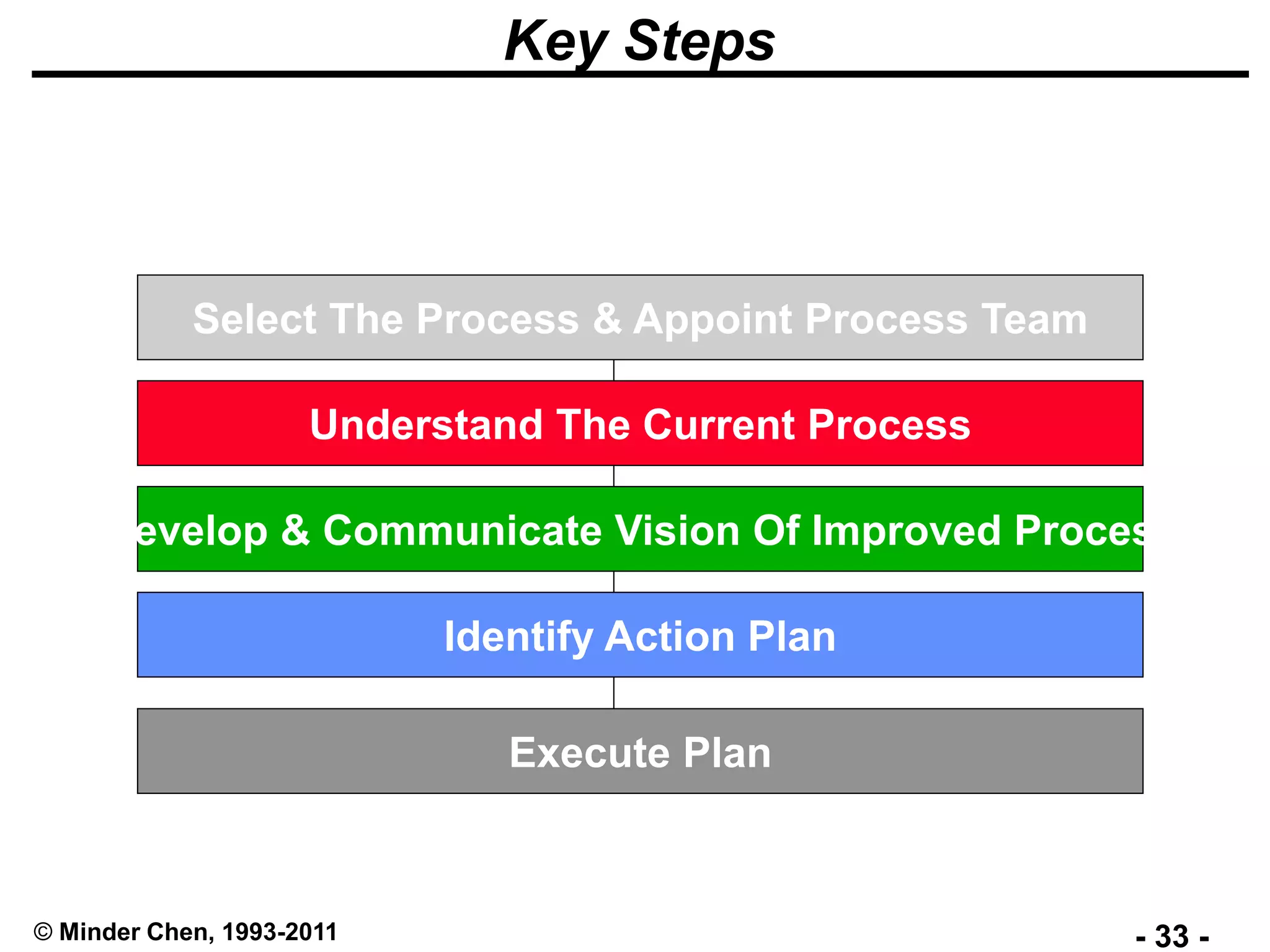
Key Steps
Select The Process & Appoint Process Team
Understand The Current Process
Develop & Communicate Vision Of Improved Process
Identify Action Plan
Execute Plan
- 34 -© Minder Chen, 1993-2011
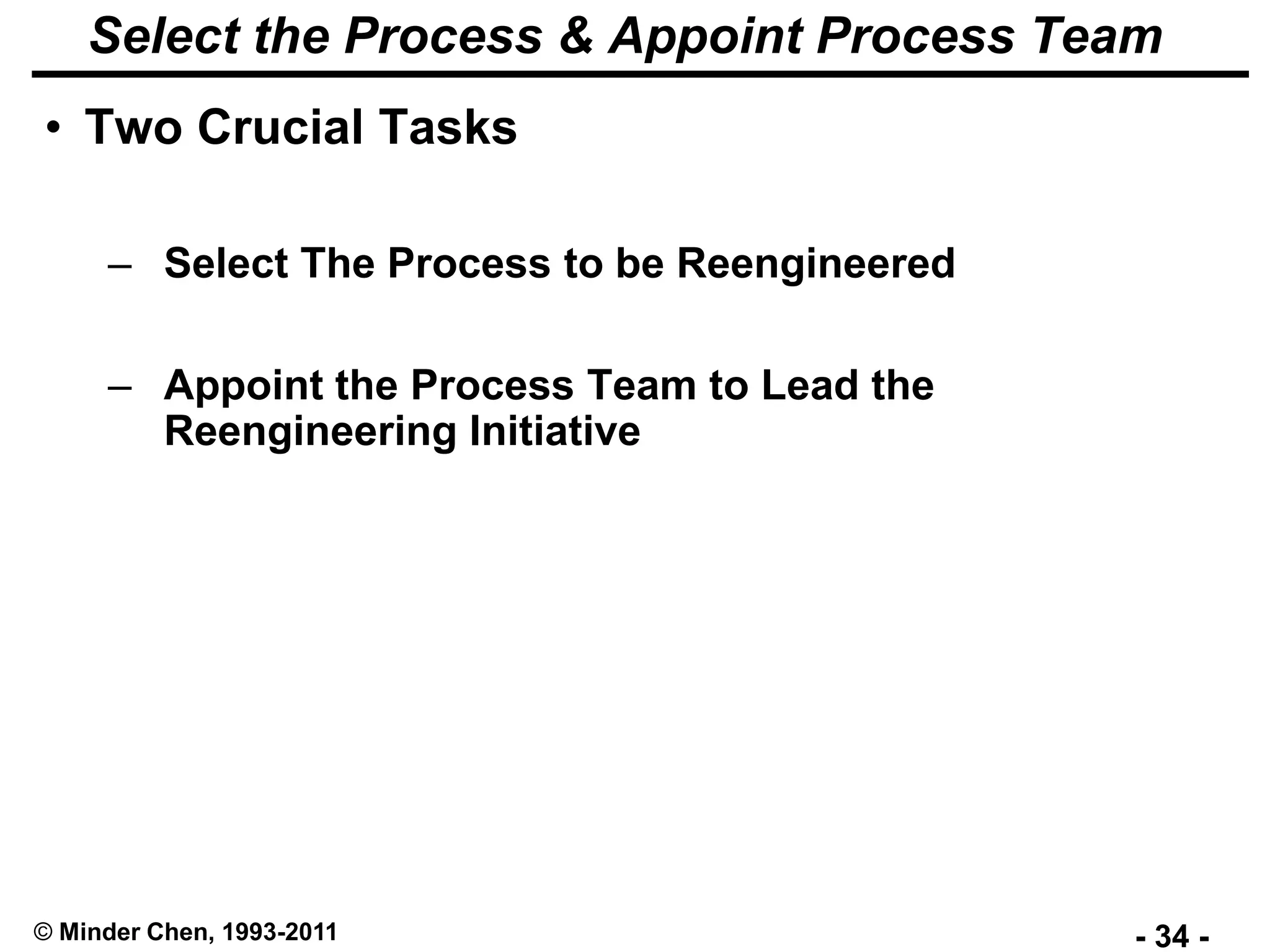
Select the Process & Appoint Process Team
• Two Crucial Tasks
– Select The Process to be Reengineered
– Appoint the Process Team to Lead the
Reengineering Initiative
- 35 -© Minder Chen, 1993-2011
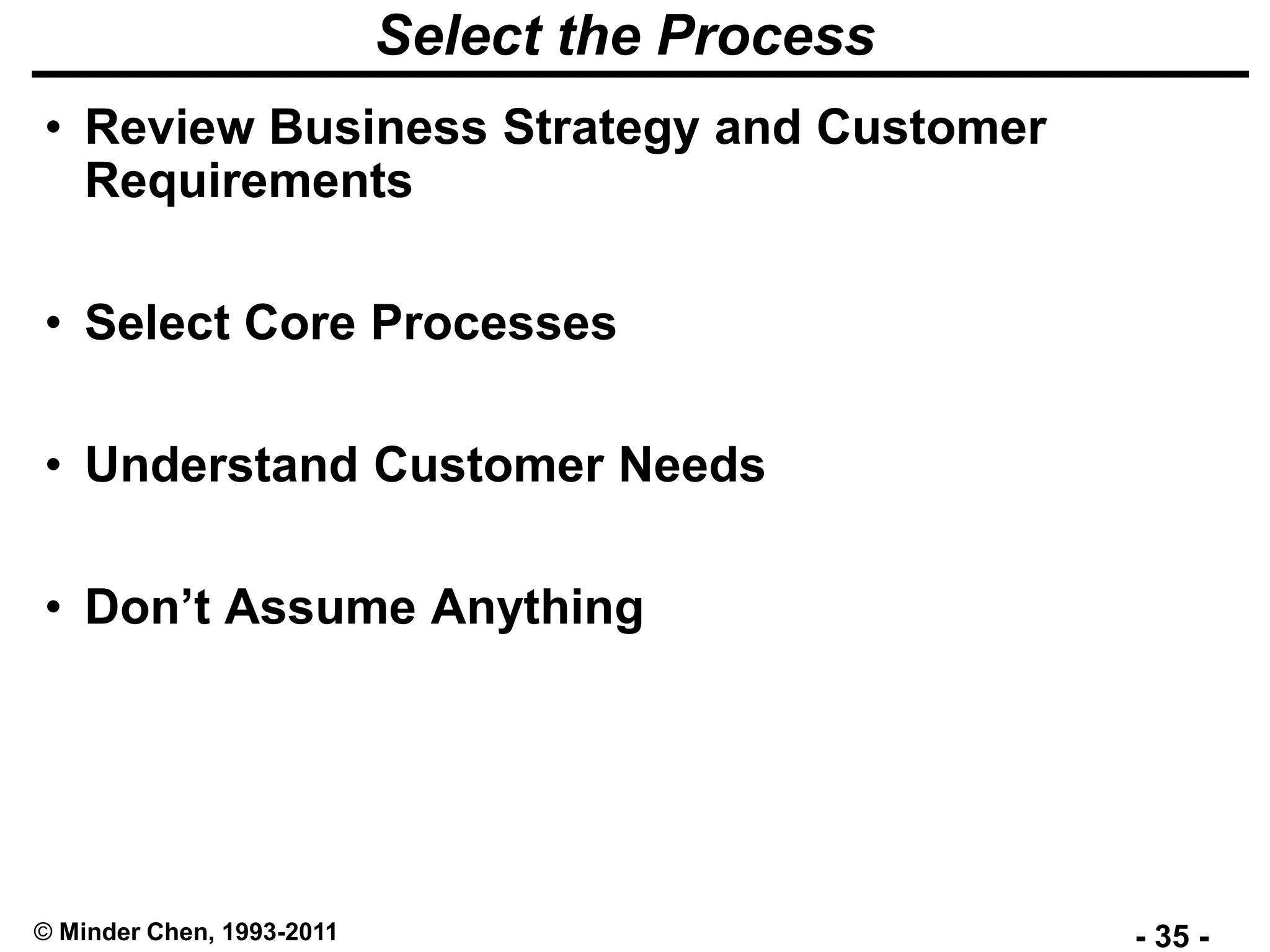
Select the Process
• Review Business Strategy and Customer
Requirements
• Select Core Processes
• Understand Customer Needs
• Don’t Assume Anything
- 36 -© Minder Chen, 1993-2011
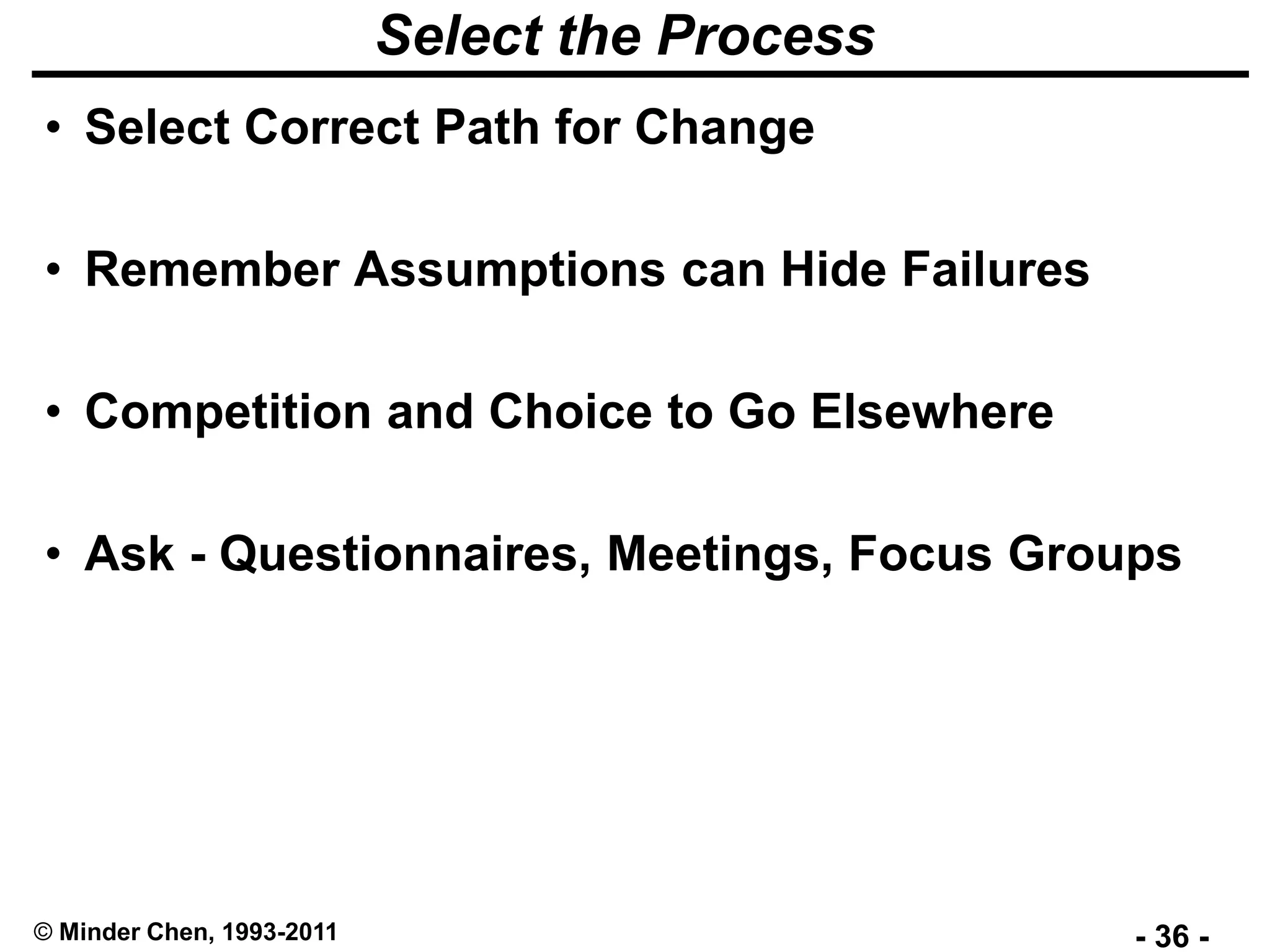
Select the Process
• Select Correct Path for Change
• Remember Assumptions can Hide Failures
• Competition and Choice to Go Elsewhere
• Ask - Questionnaires, Meetings, Focus Groups
- 37 -© Minder Chen, 1993-2011
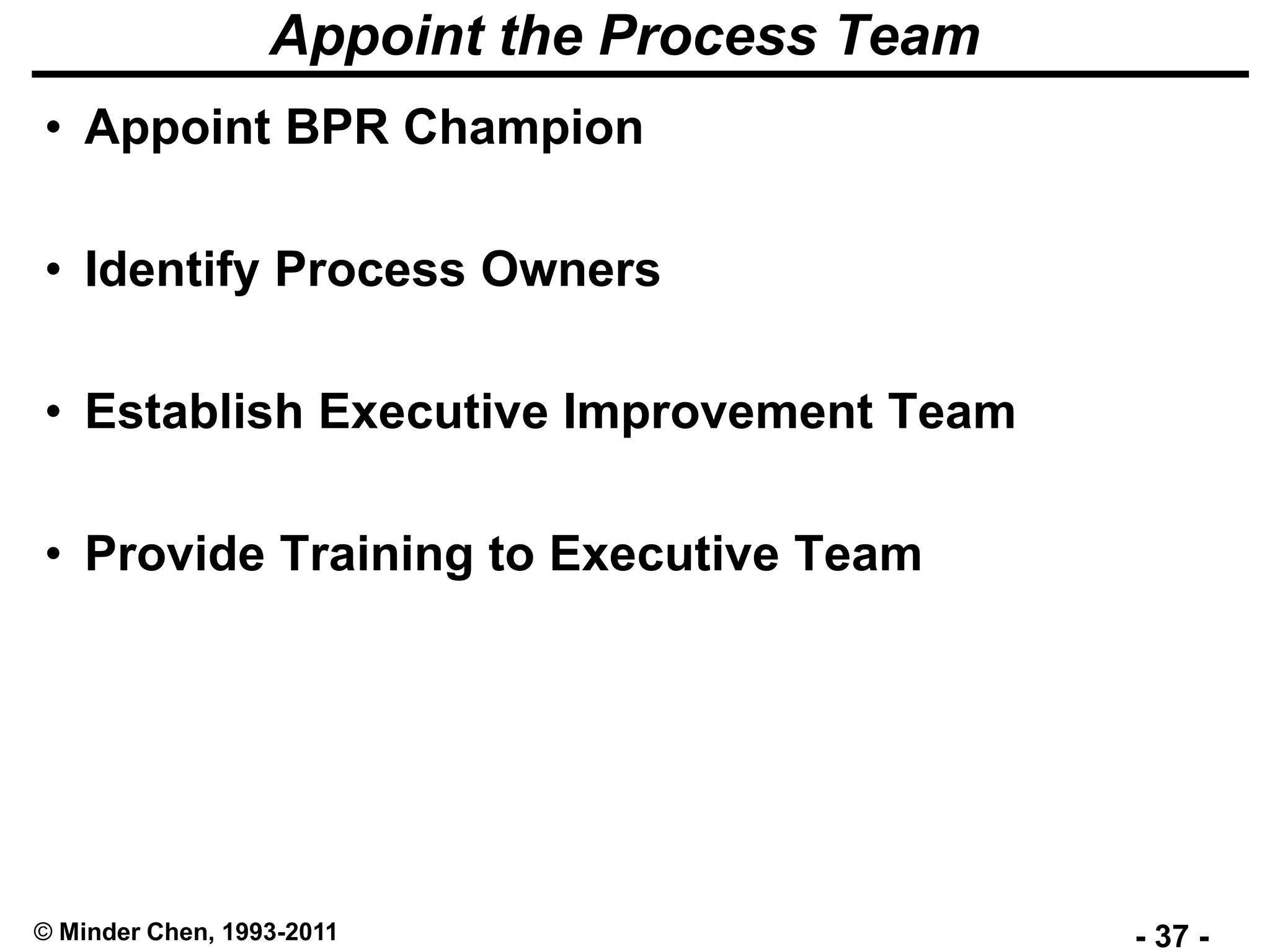
Appoint the Process Team
• Appoint BPR Champion
• Identify Process Owners
• Establish Executive Improvement Team
• Provide Training to Executive Team
- 38 -© Minder Chen, 1993-2011
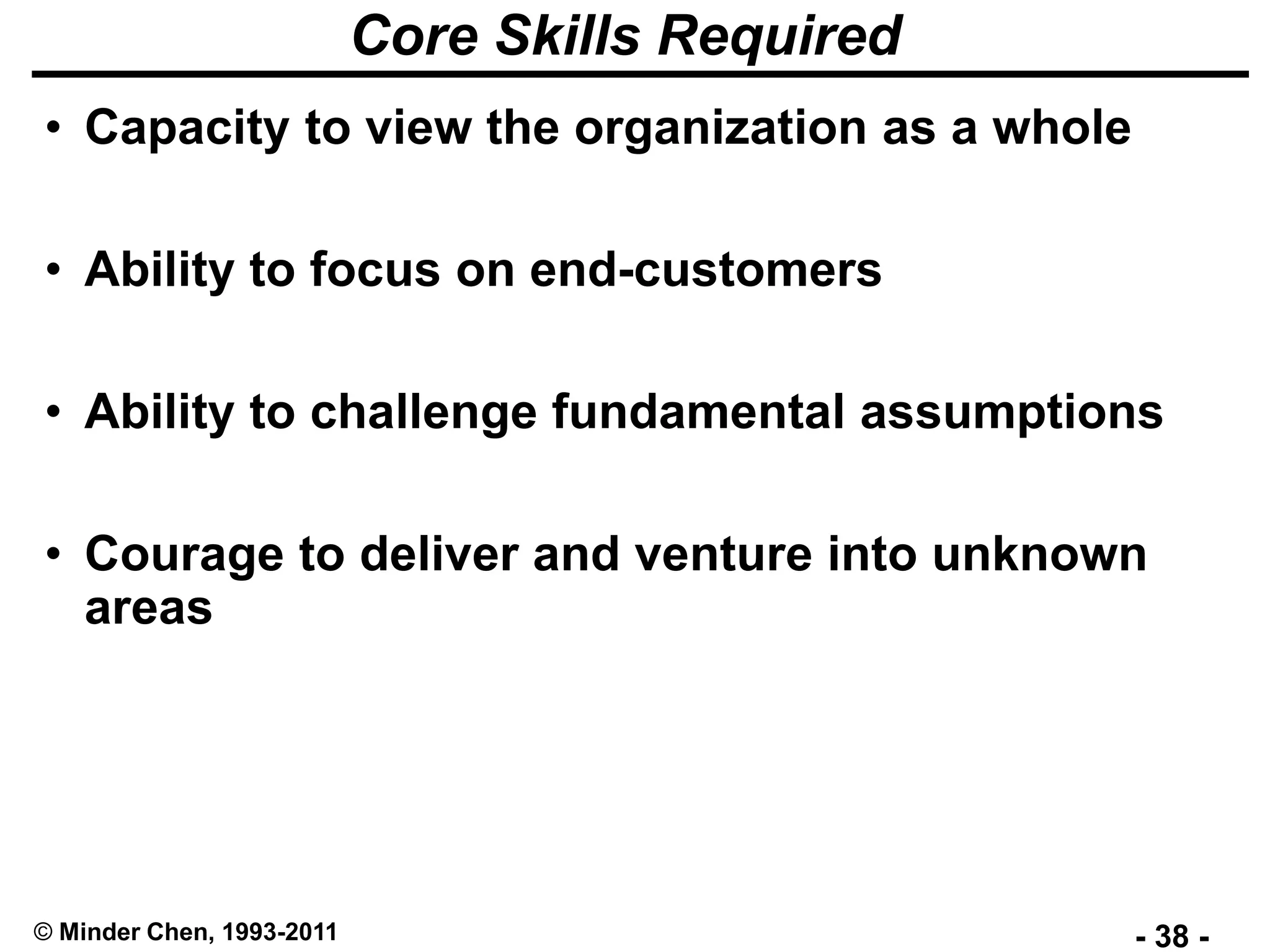
Core Skills Required
• Capacity to view the organization as a whole
• Ability to focus on end-customers
• Ability to challenge fundamental assumptions
• Courage to deliver and venture into unknown
areas
- 39 -© Minder Chen, 1993-2011
Core Skills Required
• Ability to assume individual and collective
responsibility
• Employ ‘Bridge Builders’
- 40 -© Minder Chen, 1993-2011
Use of Consultants
• Used to generate internal capacity
• Appropriate when a implementation is needed
quickly
• Ensure that adequate consultation is sought
from staff so that the initiative is organization-
led and not consultant-driven
• Control should never be handed over to the
consultant
- 41 -© Minder Chen, 1993-2011
Understand the Current Process
• Develop a Process Overview
• Clearly define the process
– Mission
– Scope
– Boundaries
• Set business and customer
measurements
• Understand customers expectations
from the process (staff including
process team)
- 42 -© Minder Chen, 1993-2011
Understand the Current Process
• Clearly Identify Improvement
Opportunities
– Quality
– Rework
• Document the Process
– Cost
– Time
– Value Data
- 43 -© Minder Chen, 1993-2011
Understand the Current Process
• Carefully resolve any
inconsistencies
– Existing -- New Process
– Ideal -- Realistic Process
- 44 -© Minder Chen, 1993-2011
Develop & Communicate Vision of Improved Process
• Communicate with all employees so that they
are aware of the vision of the future
• Always provide information on the progress of
the BPR initiative - good and bad.
• Demonstrate assurance that the BPR initiative
is both necessary and properly managed
- 45 -© Minder Chen, 1993-2011
Develop & Communicate Vision of Improved Process
• Promote individual development by indicating
options that are available
• Indicate actions required and those responsible
• Tackle any actions that need resolution
• Direct communication to reinforce new patterns
of desired behavior
- 46 -© Minder Chen, 1993-2011
Identify Action Plan
• Develop an Improvement Plan
• Appoint Process Owners
• Simplify the Process to Reduce Process Time
• Remove any Bureaucracy that may hinder
implementation
- 47 -© Minder Chen, 1993-2011
Identify Action Plan
• Remove no-value-added activities
• Standardize Process and Automate Where
Possible
• Up-grade Equipment
• Plan/schedule the changes
- 48 -© Minder Chen, 1993-2011
Identify Action Plan
• Construct in-house metrics and targets
• Introduce and firmly establish a feedback
system
• Audit, Audit, Audit
- 49 -© Minder Chen, 1993-2011
Execute Plan
• Qualify/certify the process
• Perform periodic qualification reviews
• Define and eliminate process problems
• Evaluate the change impact on the business
and on customers
• Benchmark the process
• Provide advanced team training
- 50 -© Minder Chen, 1993-2011
Information Technology & BPR
- 51 -© Minder Chen, 1993-2011
Benefits From IT
• Assists the Implementation of Business
Processes
– Enables Product & Service Innovations
– Improve Operational Efficiency
– Coordinate Vendors & Customers in the Process
Chain
- 52 -© Minder Chen, 1993-2011
Computer Aided BPR (CABPR)
• Focus
– Business Processes
– Process Redesign
– Process Implementation
- 53 -© Minder Chen, 1993-2011
BPR Challenges
- 54 -© Minder Chen, 1993-2011
Common Problems
• Process Simplification is Common - True BPR
is Not
• Desire to Change Not Strong Enough
• Start Point the Existing Process Not a Blank
Slate
• Commitment to Existing Processes Too Strong
– REMEMBER - “If it ain’t broke …”
• Quick Fix Approach
- 55 -© Minder Chen, 1993-2011
Common Problems with BPR
• Process under review too big or too small
• Reliance on existing process too strong
• The Costs of the Change Seem Too Large
• BPR Isolated Activity not Aligned to the
Business Objectives
• Allocation of Resources
• Poor Timing and Planning
• Keeping the Team and Organization on Target
- 56 -© Minder Chen, 1993-2011
Summary
• Reengineering is a fundamental rethinking and
redesign of business processes to achieve
dramatic improvements
• BPR has emerged from key management
traditions such as scientific management and
systems thinking
• Rules and symbols play an integral part of all
BPR initiatives
- 57 -© Minder Chen, 1993-2011
Summary
• Don’t assume anything - remember BPR is
fundamental rethinking of business processes
- 58 -© Minder Chen, 1993-2011
BPR
•PART -2
- 59 -© Minder Chen, 1993-2011
Definition of Reengineering
The fundamental rethinking
and radical redesign of
core business processes to
achieve dramatic improvements in
critical performance measures such
as quality, cost, and cycle time.
Source: Adapted from Hammer and Champy, Reengineering the Corporation, 1993
- 60 -© Minder Chen, 1993-2011
What Business Reengineering Is Not?
• Automating: Paving the cow paths.
(Automate poor processes.)
• Downsizing: Doing less with less. Cut
costs or reduce payrolls.
BPR involves innovation: Creating new
products and services, as well as positive
thinking are critical to the success of
BPR.
- 61 -© Minder Chen, 1993-2011
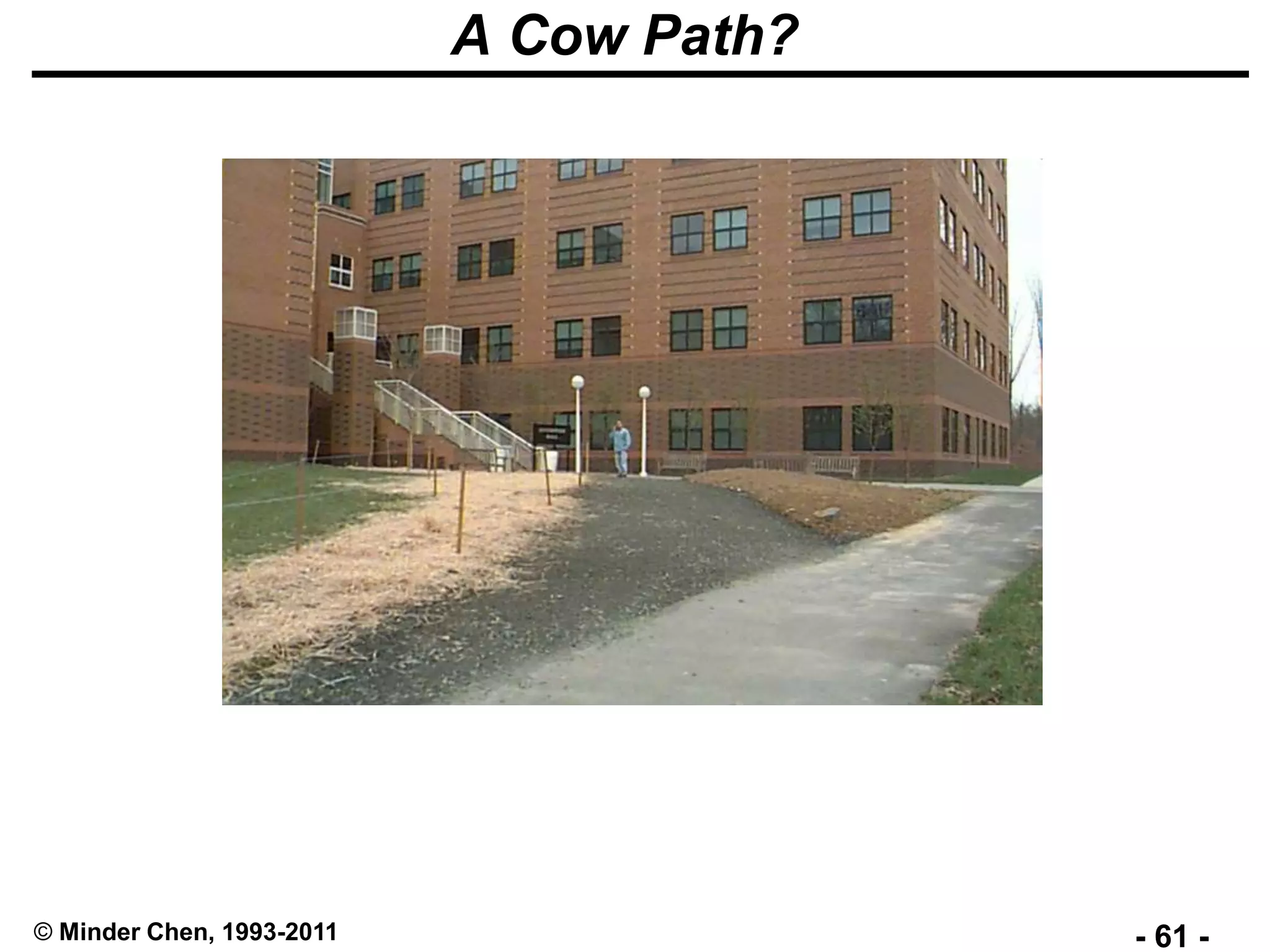
A Cow Path?
- 62 -© Minder Chen, 1993-2011
Reengineering Is ...
• Obliterate what you have now and
start from scratch.
• Transform every aspect of your
organization.
Source: Michael Hammer, “Reengineering Work: Don’t Automate, Obliterate,”
Harvard Business Review, July-August, 1990, pp. 104-112.
Extremist's View
- 63 -© Minder Chen, 1993-2011
Definition of Process
• A process is simply a structured, measured set
of activities designed to produce a specific
output for a particular customers or market.
-- Thomas Davenport
• Characteristics:
– A specific sequencing of work activities across time
and place
– A beginning and an end
– Clearly defined inputs and outputs
– Customer-focus
– How the work is done
– Process ownership
– Measurable and meaningful performance
- 64 -© Minder Chen, 1993-2011
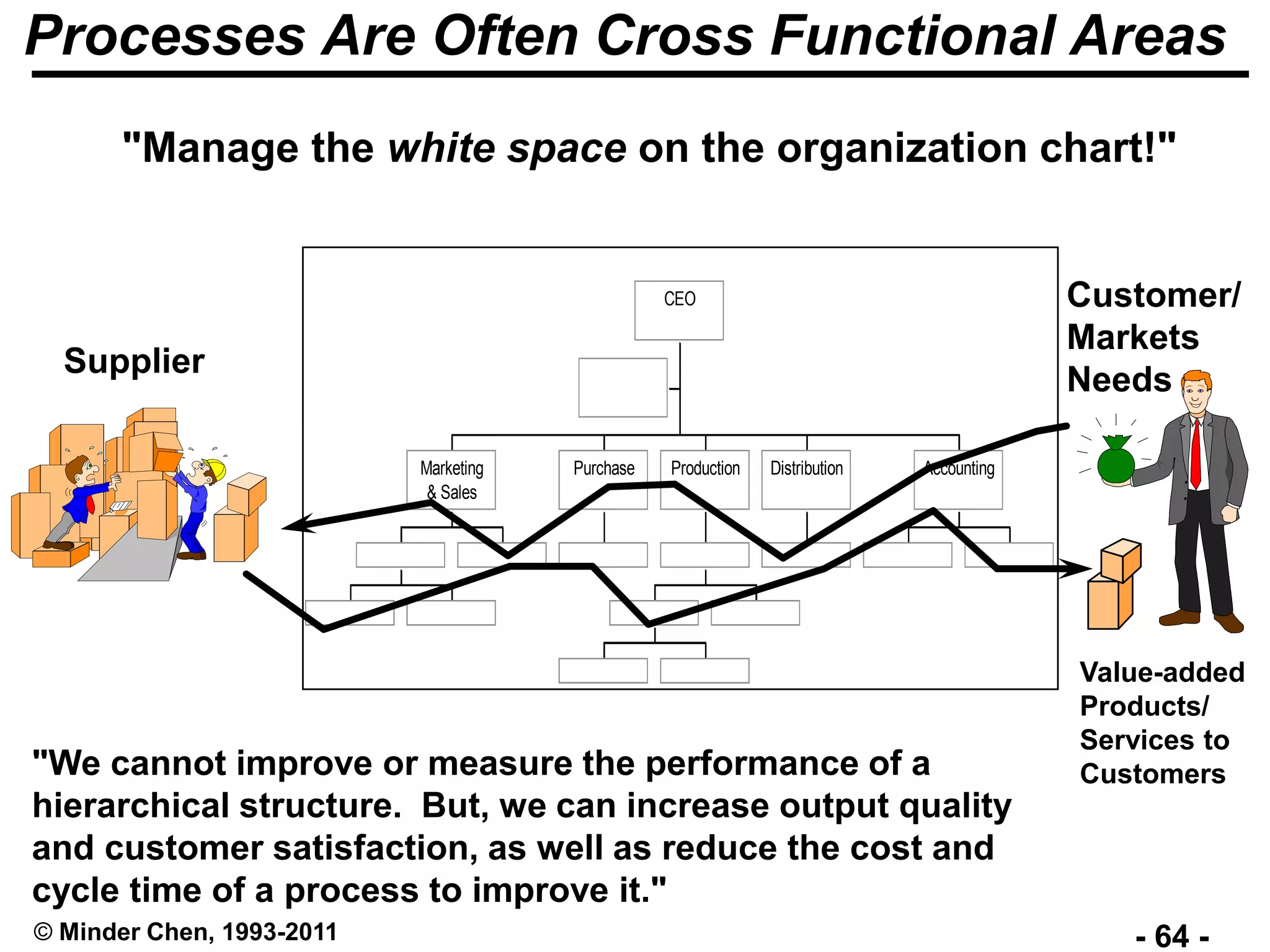
Processes Are Often Cross Functional Areas
Marketing
& Sales
Purchase Production Distribution Accounting
CEO
Supplier
Customer/
Markets
Needs
Value-added
Products/
Services to
Customers
"Manage the white space on the organization chart!"
"We cannot improve or measure the performance of a
hierarchical structure. But, we can increase output quality
and customer satisfaction, as well as reduce the cost and
cycle time of a process to improve it."
- 65 -© Minder Chen, 1993-2011
BPR Examples
• Ford: Accounts Payable
• Mutual Benefit Life: New Life Insurance Policy
Application
• Capital Holding Co.: Customer Service Process
• Taco Bell: Company-wide BPR
• Others
- 66 -© Minder Chen, 1993-2011
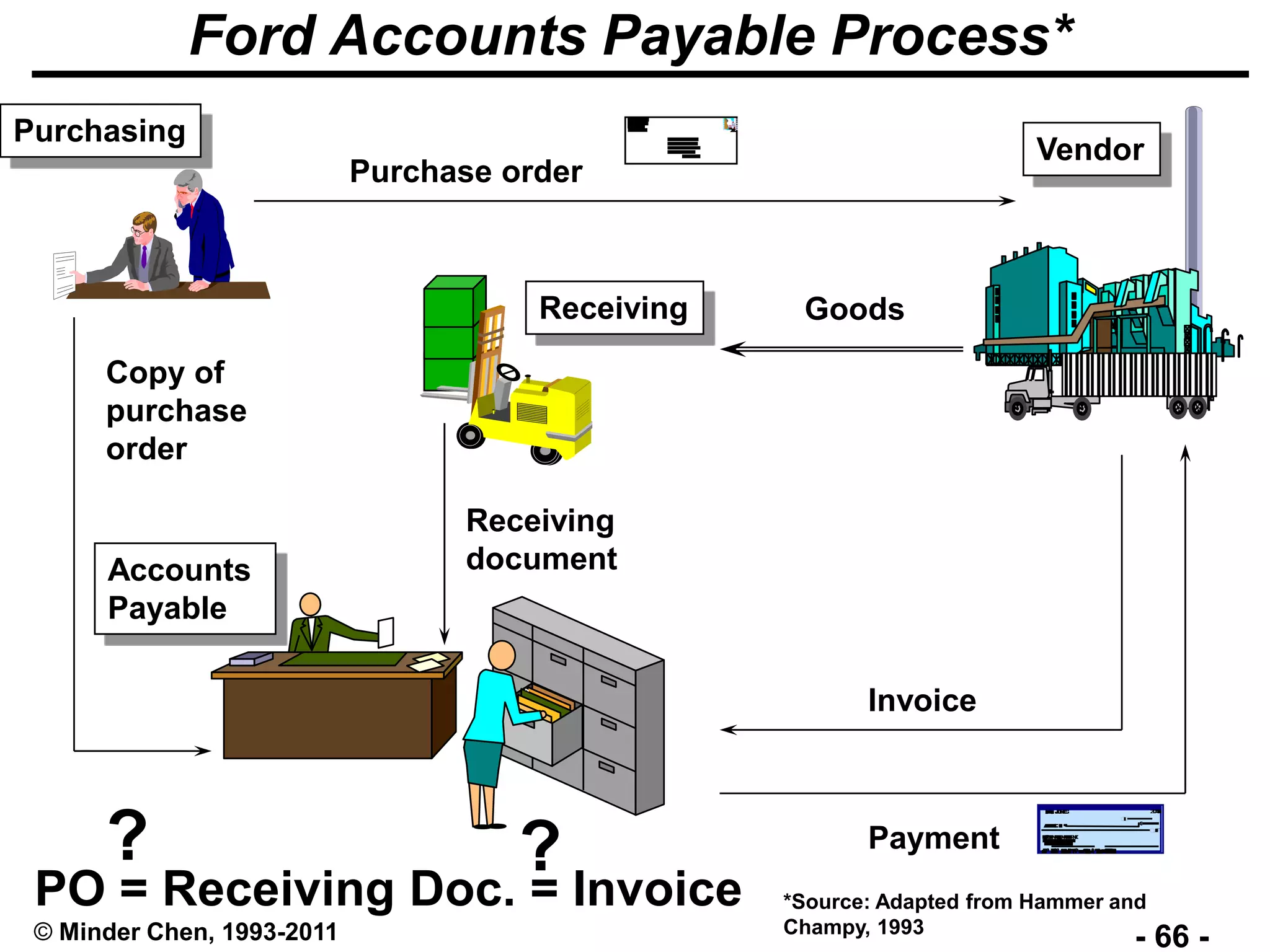
Ford Accounts Payable Process*
Accounts
Payable
Vendor
GoodsReceiving
Payment
Invoice
Receiving
document
Purchasing
Purchase order
Copy of
purchase
order
PO = Receiving Doc. = Invoice *Source: Adapted from Hammer and
Champy, 1993
? ?
- 67 -© Minder Chen, 1993-2011
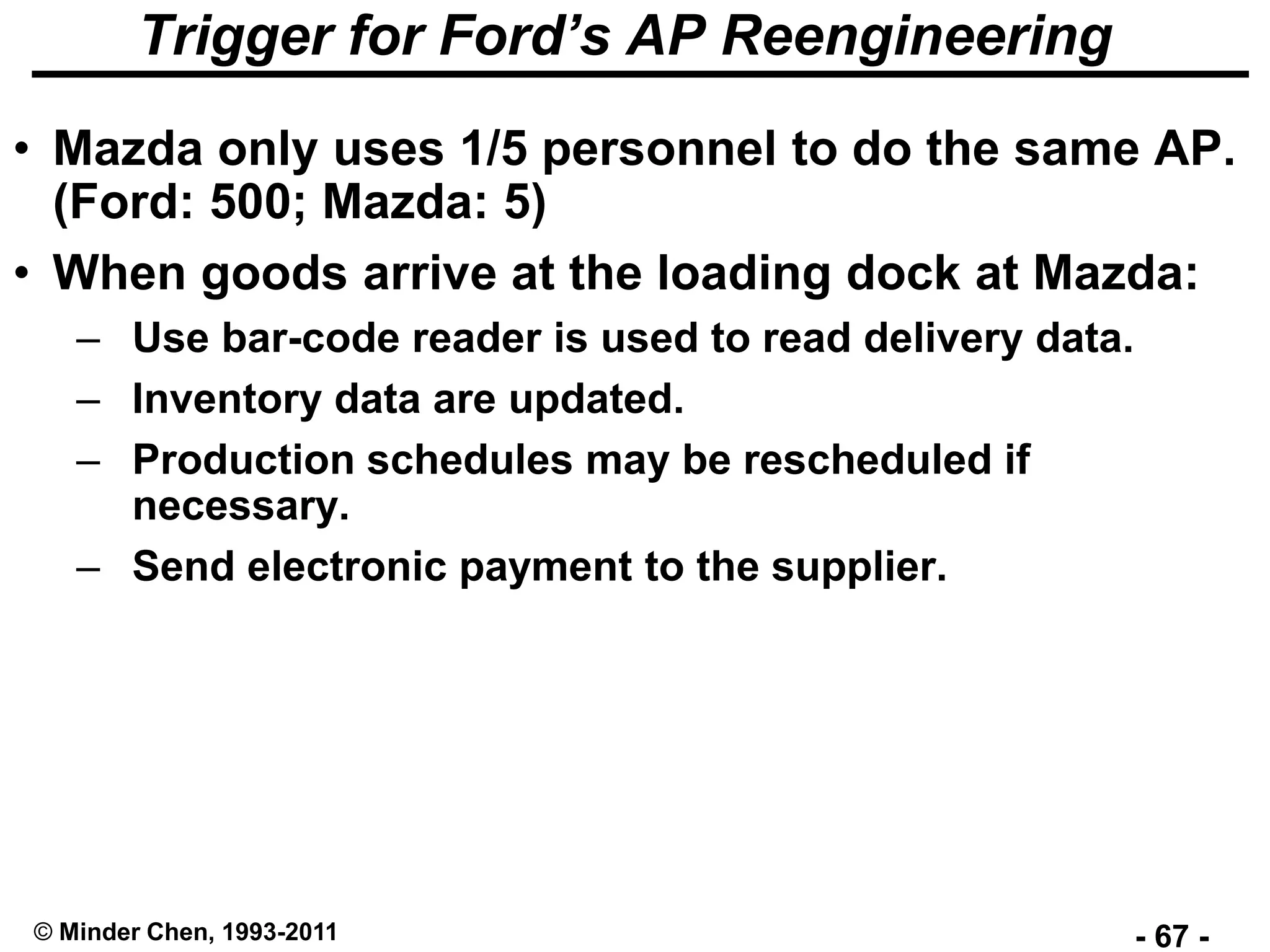
Trigger for Ford’s AP Reengineering
• Mazda only uses 1/5 personnel to do the same AP.
(Ford: 500; Mazda: 5)
• When goods arrive at the loading dock at Mazda:
– Use bar-code reader is used to read delivery data.
– Inventory data are updated.
– Production schedules may be rescheduled if
necessary.
– Send electronic payment to the supplier.
- 68 -© Minder Chen, 1993-2011
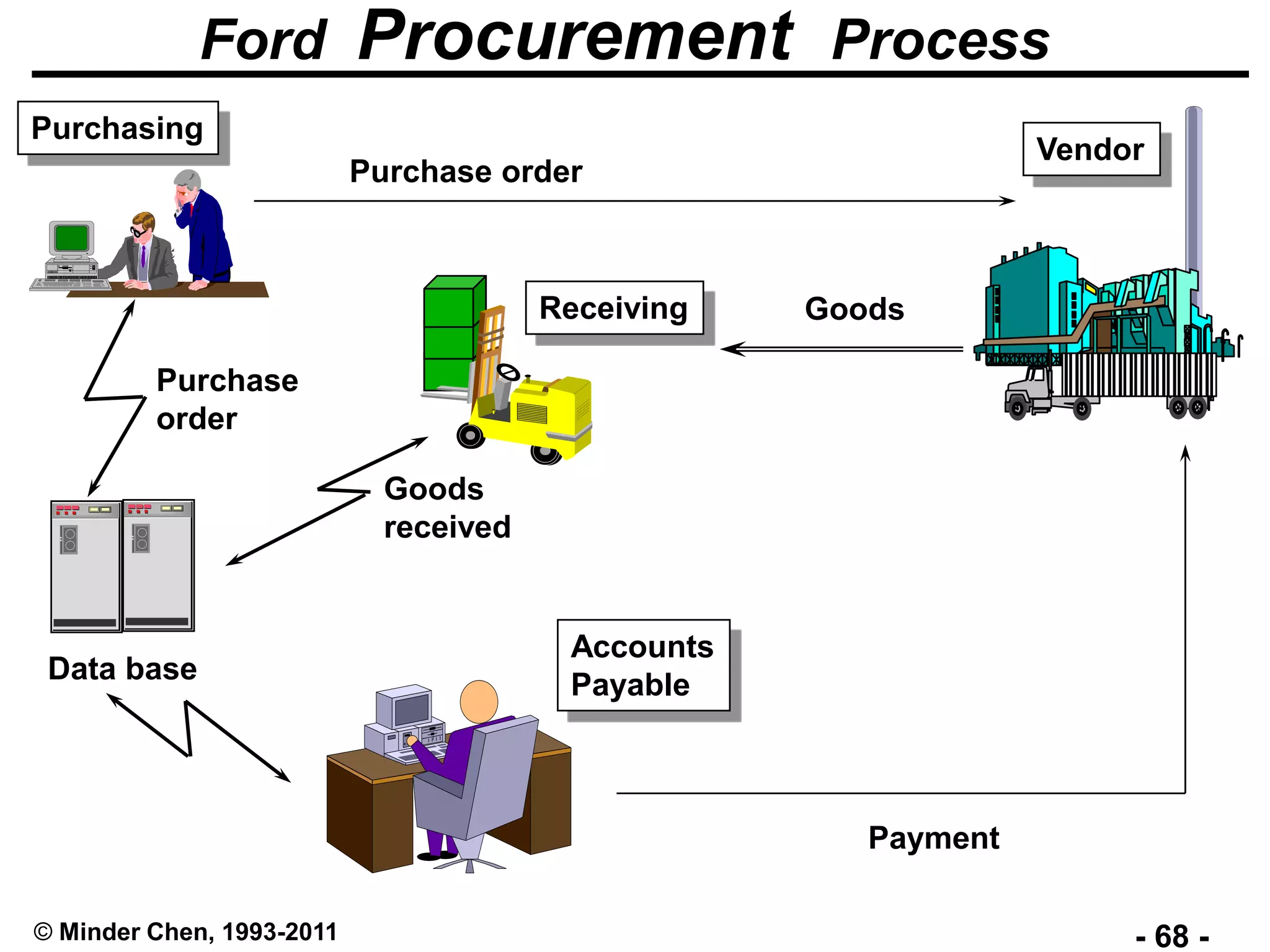
Ford Procurement Process
Accounts
Payable
Vendor
GoodsReceiving
Payment
Goods
received
Purchasing
Purchase order
Purchase
order
Data base
- 69 -© Minder Chen, 1993-2011
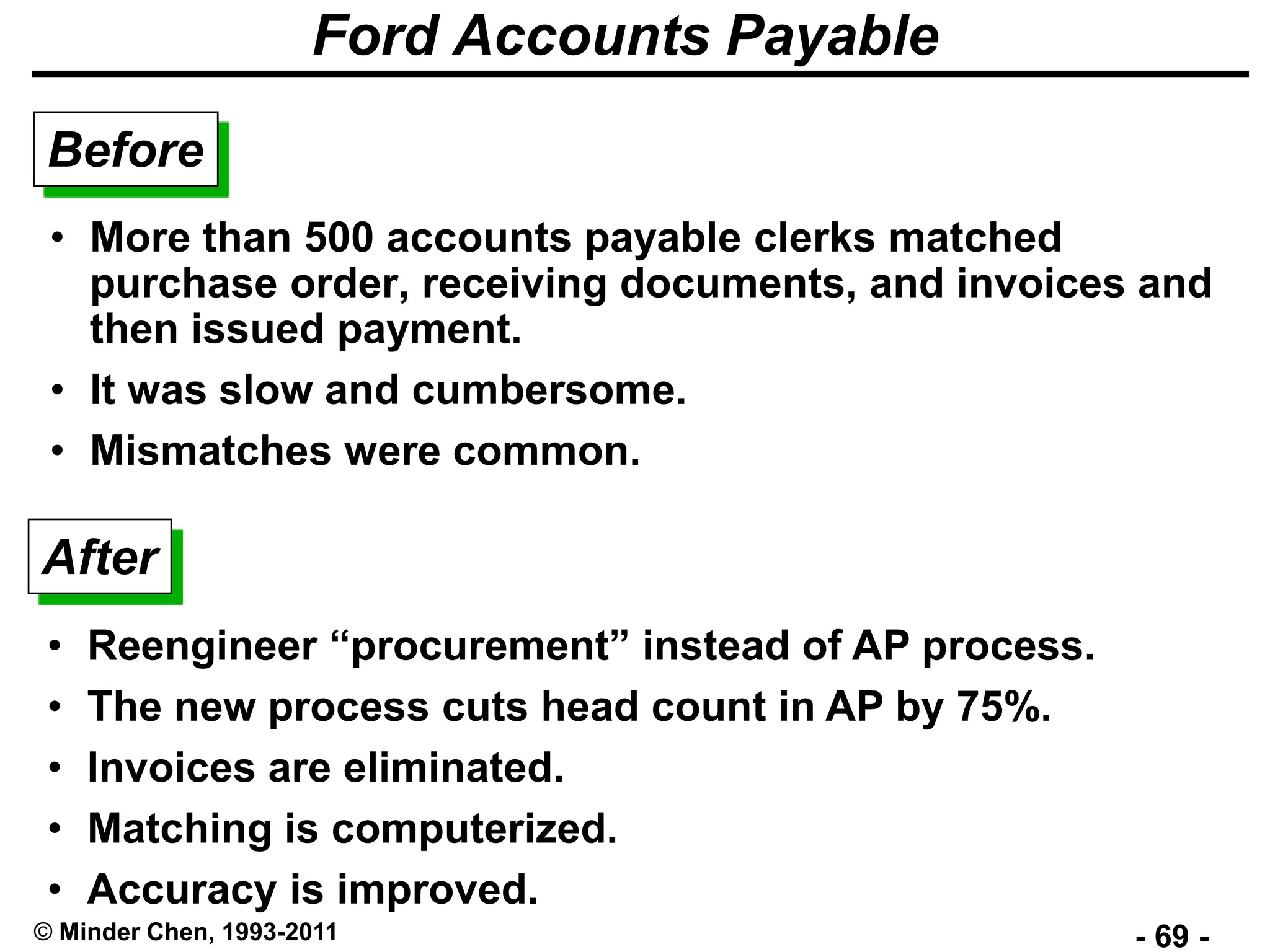
Ford Accounts Payable
Before
After
• More than 500 accounts payable clerks matched
purchase order, receiving documents, and invoices and
then issued payment.
• It was slow and cumbersome.
• Mismatches were common.
• Reengineer “procurement” instead of AP process.
• The new process cuts head count in AP by 75%.
• Invoices are eliminated.
• Matching is computerized.
• Accuracy is improved.
- 70 -© Minder Chen, 1993-2011
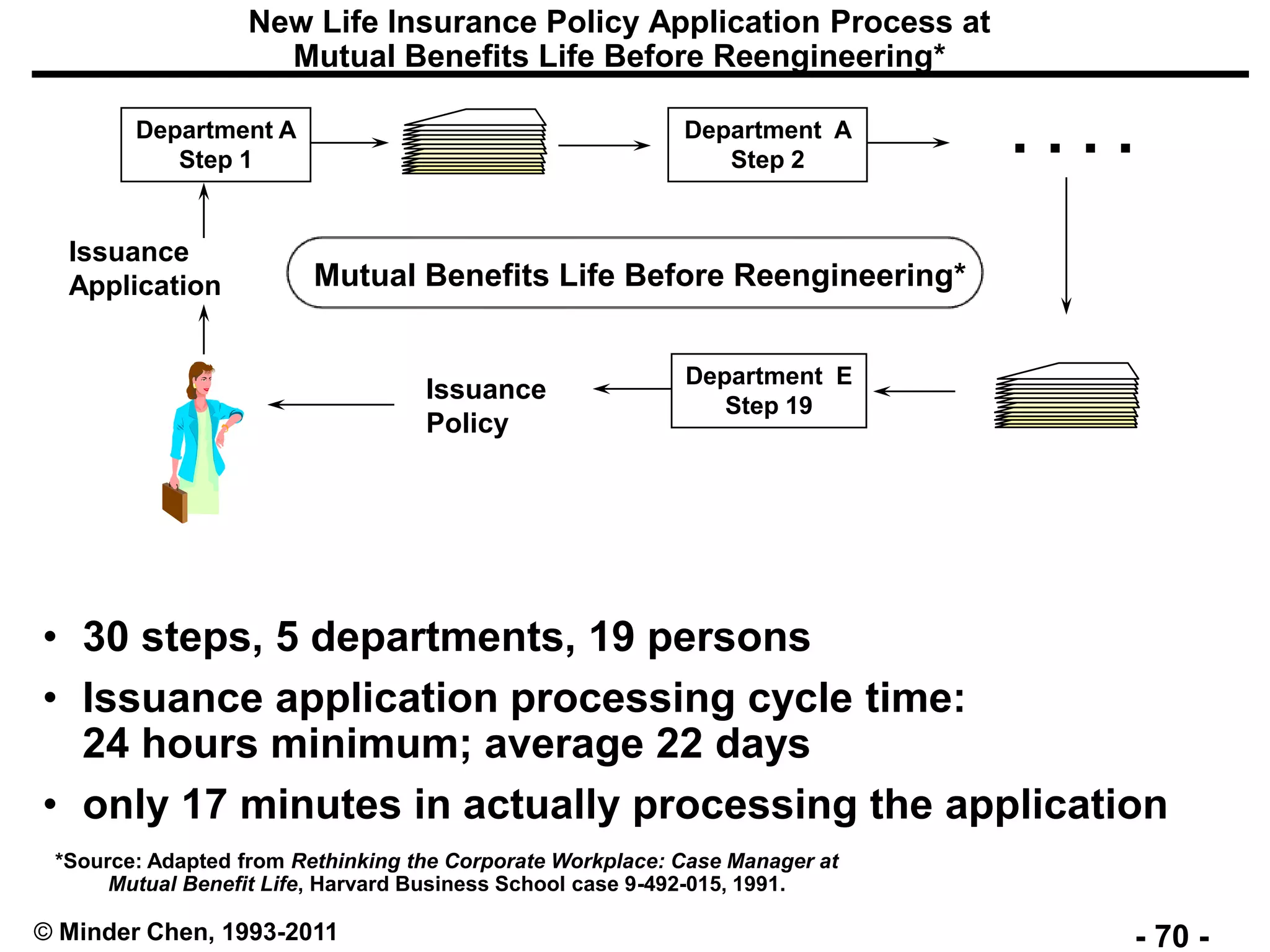
• 30 steps, 5 departments, 19 persons
• Issuance application processing cycle time:
24 hours minimum; average 22 days
• only 17 minutes in actually processing the application
Department A
Step 1
Department A
Step 2
Department E
Step 19
. . . .
Issuance
Application
Issuance
Policy
New Life Insurance Policy Application Process at
Mutual Benefits Life Before Reengineering*
*Source: Adapted from Rethinking the Corporate Workplace: Case Manager at
Mutual Benefit Life, Harvard Business School case 9-492-015, 1991.
Mutual Benefits Life Before Reengineering*
- 71 -© Minder Chen, 1993-2011
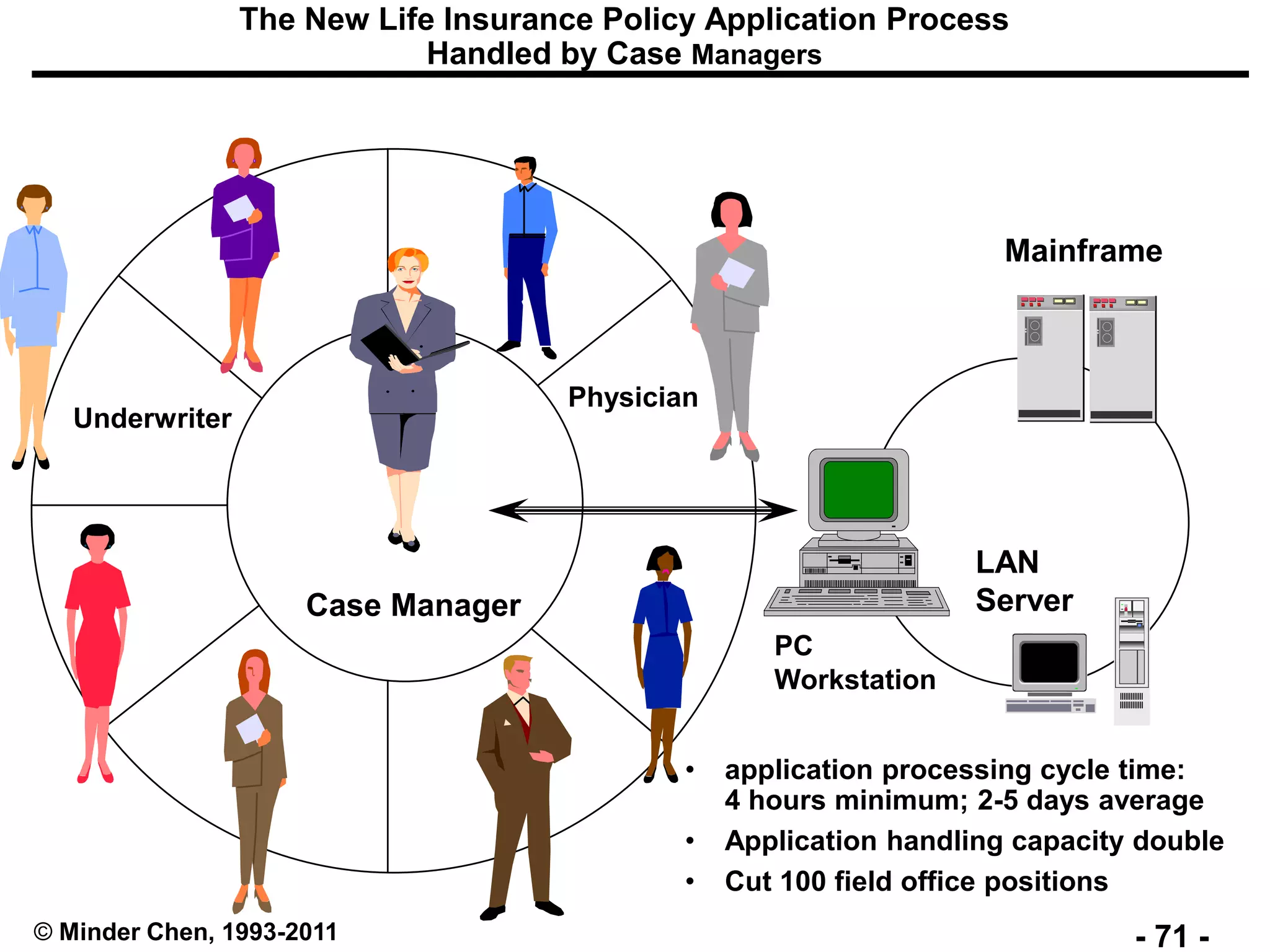
The New Life Insurance Policy Application Process
Handled by Case Managers
Case Manager
Underwriter
Physician
Mainframe
LAN
Server
PC
Workstation
• application processing cycle time:
4 hours minimum; 2-5 days average
• Application handling capacity double
• Cut 100 field office positions
- 72 -© Minder Chen, 1993-2011
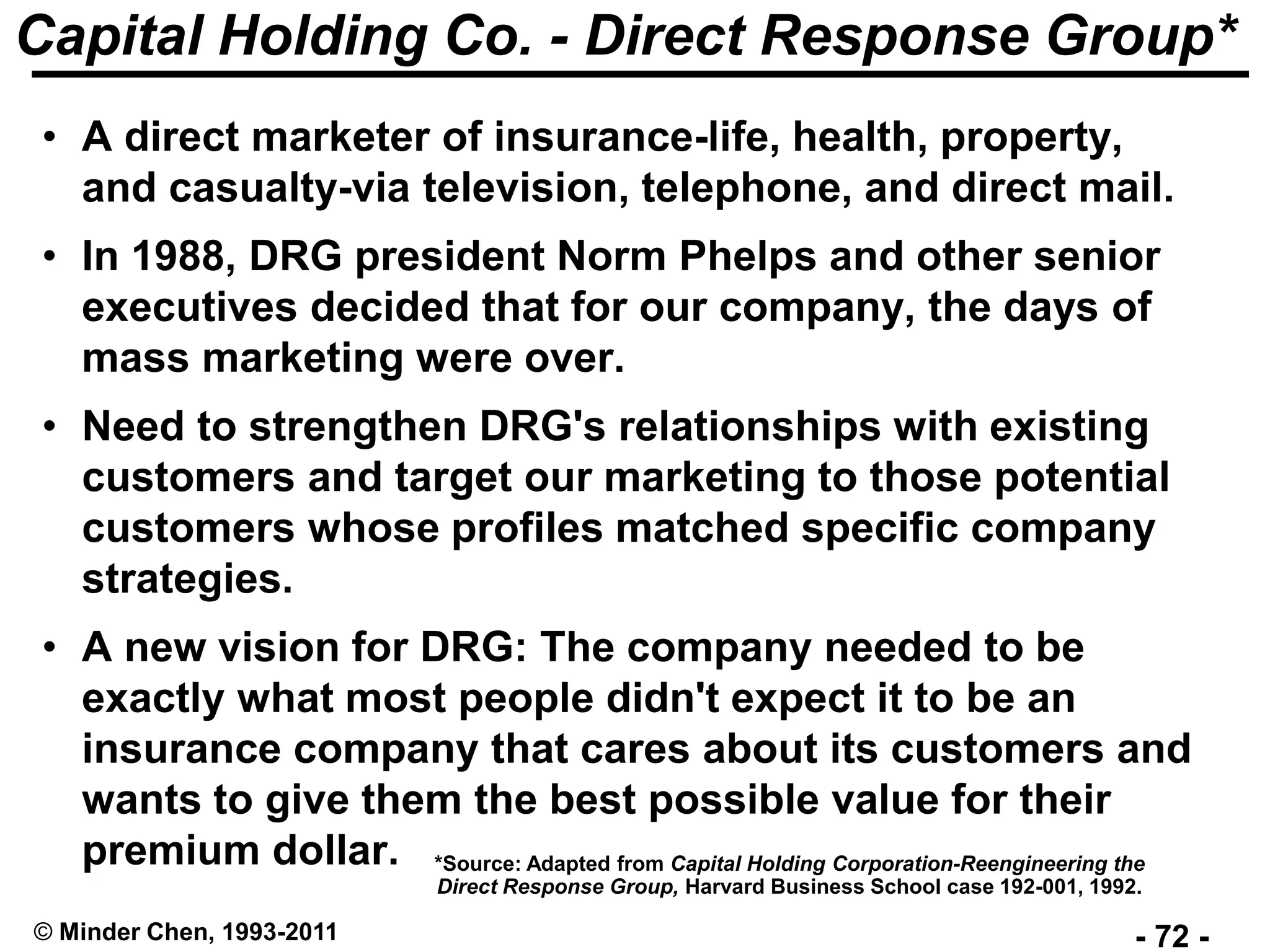
Capital Holding Co. - Direct Response Group*
• A direct marketer of insurance-life, health, property,
and casualty-via television, telephone, and direct mail.
• In 1988, DRG president Norm Phelps and other senior
executives decided that for our company, the days of
mass marketing were over.
• Need to strengthen DRG's relationships with existing
customers and target our marketing to those potential
customers whose profiles matched specific company
strategies.
• A new vision for DRG: The company needed to be
exactly what most people didn't expect it to be an
insurance company that cares about its customers and
wants to give them the best possible value for their
premium dollar. *Source: Adapted from Capital Holding Corporation-Reengineering the
Direct Response Group, Harvard Business School case 192-001, 1992.
- 73 -© Minder Chen, 1993-2011
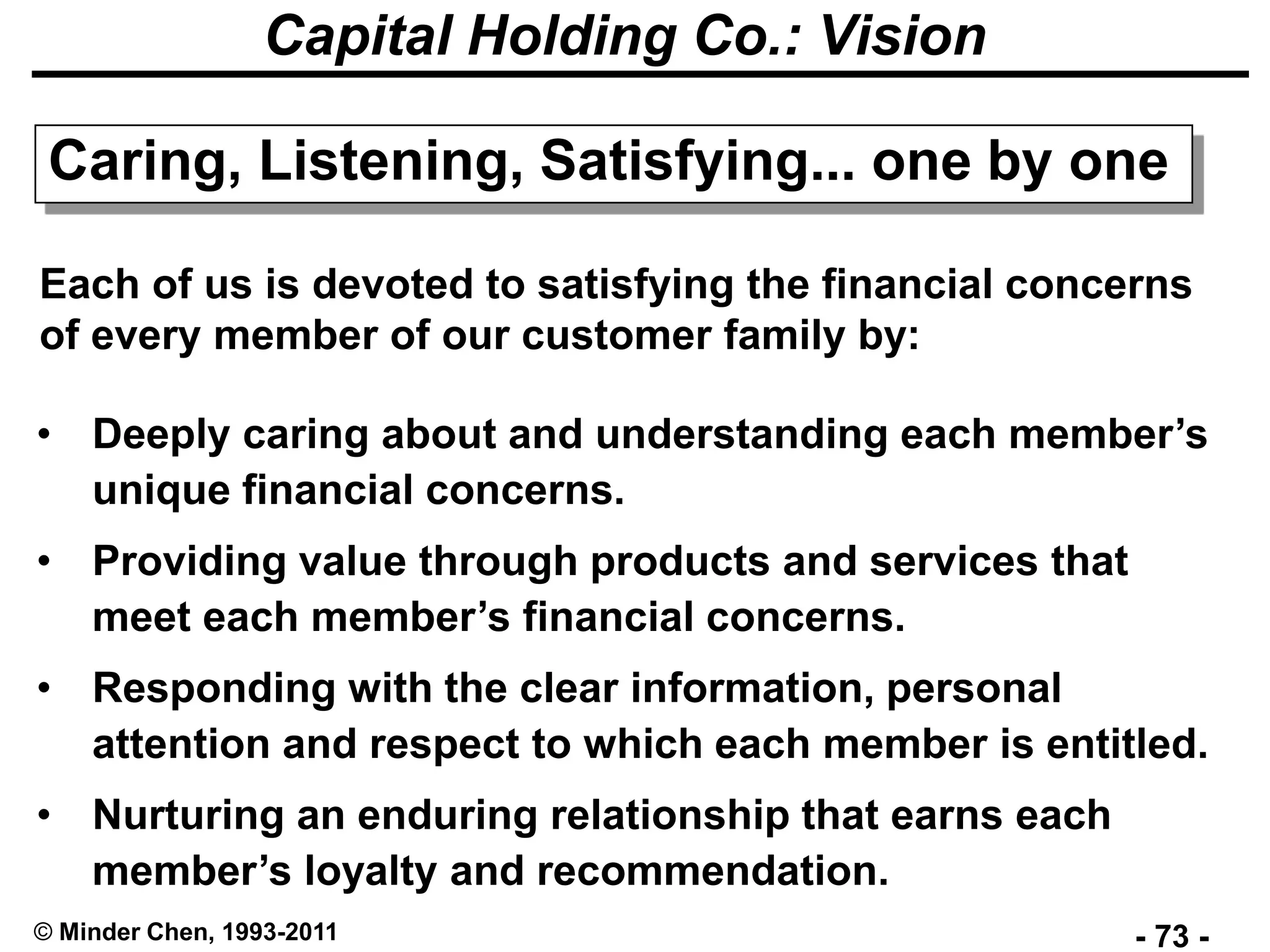
Capital Holding Co.: Vision
Caring, Listening, Satisfying... one by one
Each of us is devoted to satisfying the financial concerns
of every member of our customer family by:
• Deeply caring about and understanding each member’s
unique financial concerns.
• Providing value through products and services that
meet each member’s financial concerns.
• Responding with the clear information, personal
attention and respect to which each member is entitled.
• Nurturing an enduring relationship that earns each
member’s loyalty and recommendation.
- 74 -© Minder Chen, 1993-2011
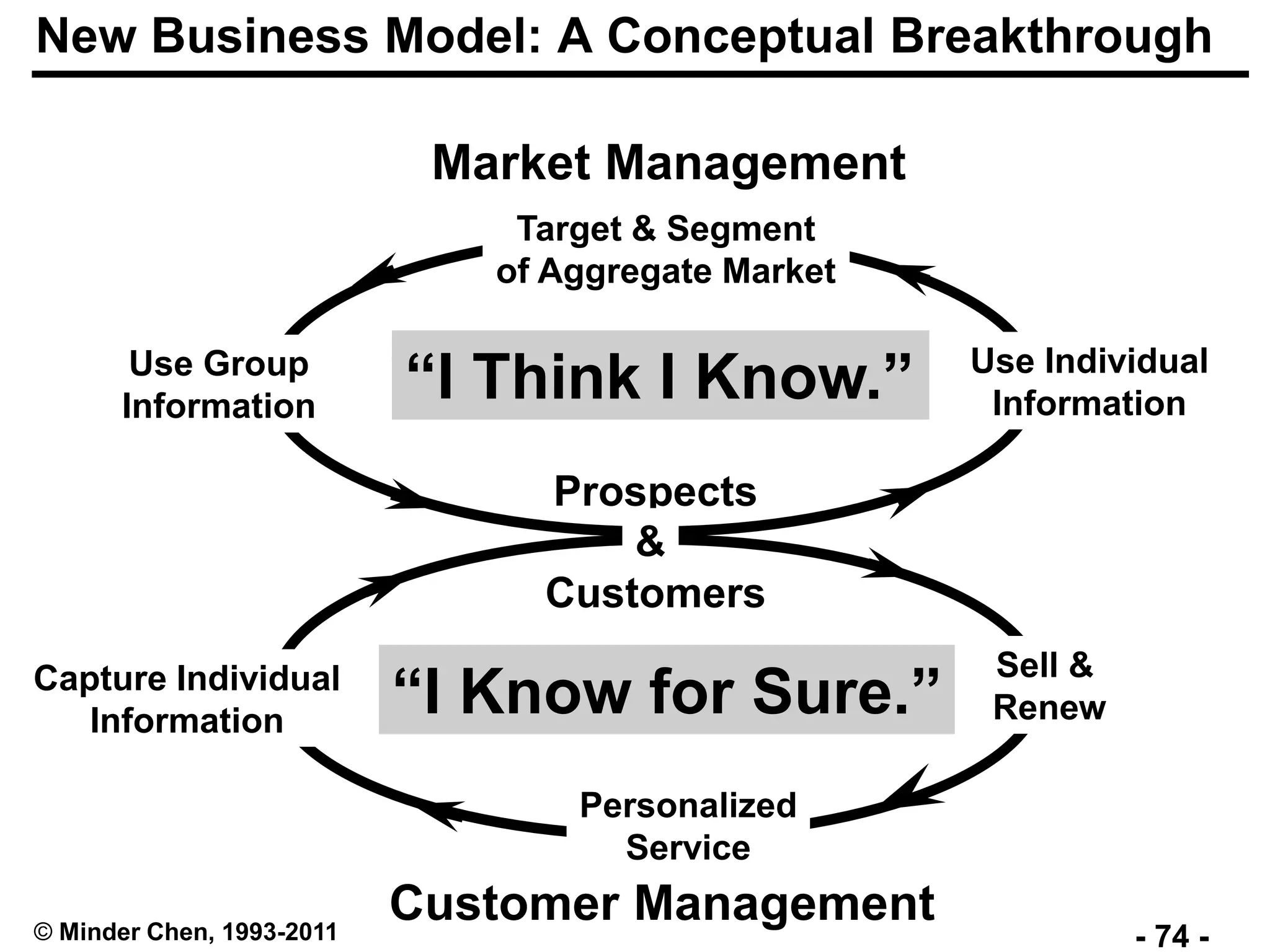
New Business Model: A Conceptual Breakthrough
Target & Segment
of Aggregate Market
Use Individual
Information
Use Group
Information
Prospects
Customers
Sell &
Renew
Capture Individual
Information
&
Personalized
Service
“I Think I Know.”
“I Know for Sure.”
Market Management
Customer Management
- 75 -© Minder Chen, 1993-2011
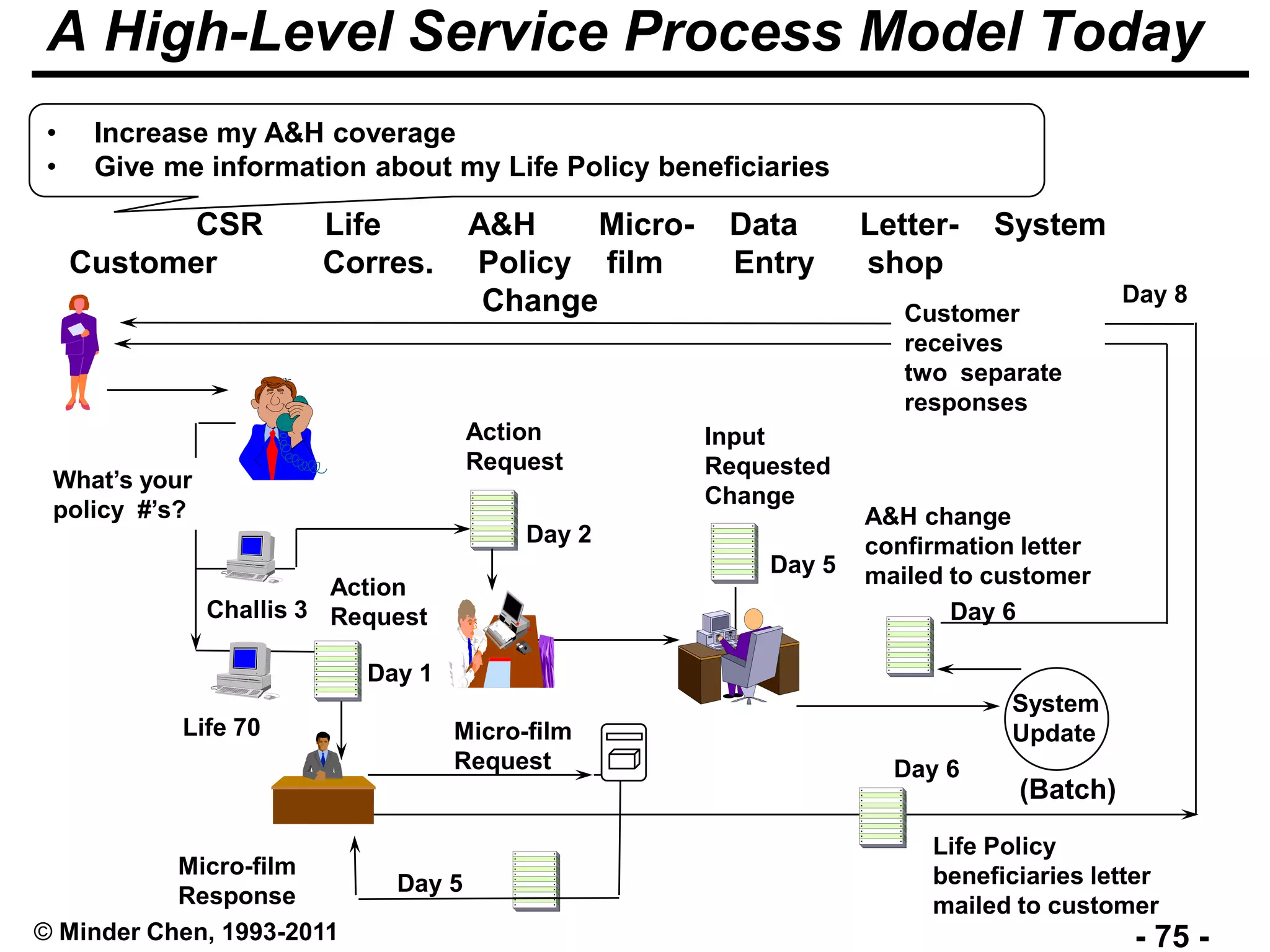
A High-Level Service Process Model Today
CSR Life A&H Micro- Data Letter- System
Customer Corres. Policy film Entry shop
Change
What’s your
policy #’s?
Challis 3
Life 70 Micro-film
Request
Action
Request
Day 1
Micro-film
Response Day 5
• Increase my A&H coverage
• Give me information about my Life Policy beneficiaries
Action
Request
Day 2
Input
Requested
Change
Day 5
A&H change
confirmation letter
mailed to customer
System
Update
Life Policy
beneficiaries letter
mailed to customer
Day 6
Day 6
(Batch)
Day 8
Customer
receives
two separate
responses
- 76 -© Minder Chen, 1993-2011
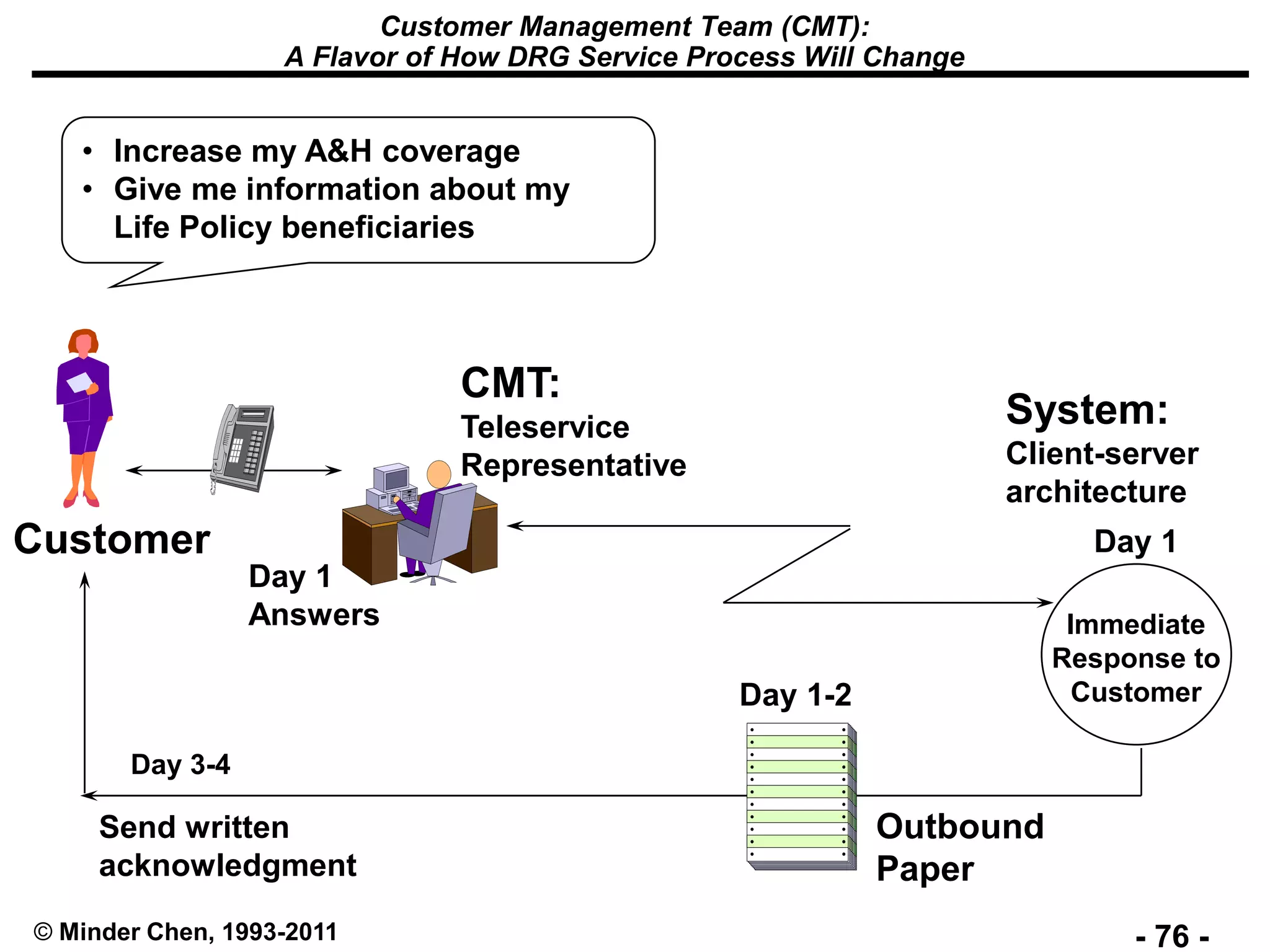
Customer Management Team (CMT):
A Flavor of How DRG Service Process Will Change
Immediate
Response to
Customer
Day 1
Answers
Day 3-4
Day 1-2
Day 1
Send written
acknowledgment
• Increase my A&H coverage
• Give me information about my
Life Policy beneficiaries
Customer
CMT:
Teleservice
Representative
System:
Client-server
architecture
Outbound
Paper
- 77 -© Minder Chen, 1993-2011
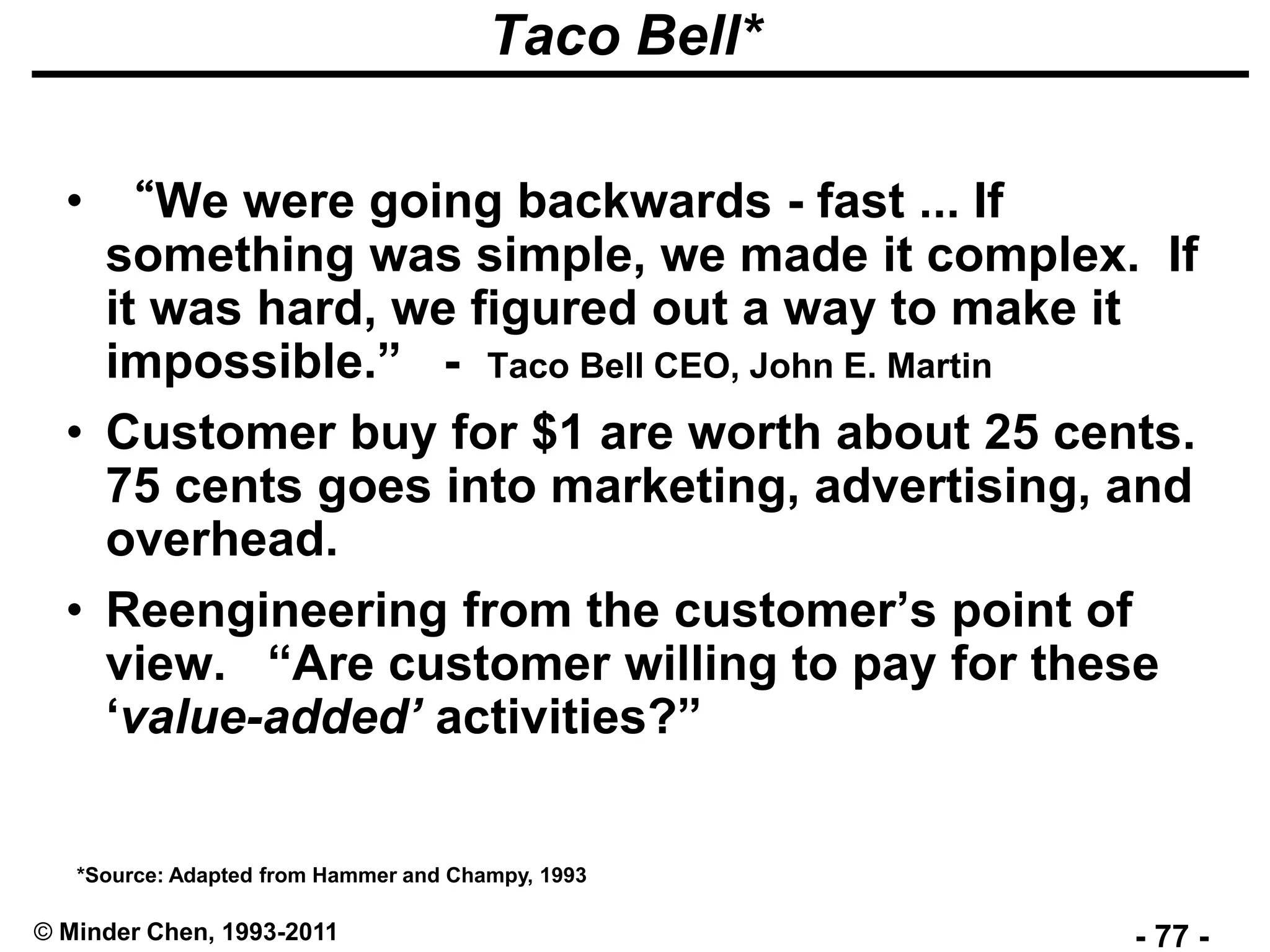
Taco Bell*
• “We were going backwards - fast ... If
something was simple, we made it complex. If
it was hard, we figured out a way to make it
impossible.” - Taco Bell CEO, John E. Martin
• Customer buy for $1 are worth about 25 cents.
75 cents goes into marketing, advertising, and
overhead.
• Reengineering from the customer’s point of
view. “Are customer willing to pay for these
‘value-added’ activities?”
*Source: Adapted from Hammer and Champy, 1993
- 78 -© Minder Chen, 1993-2011
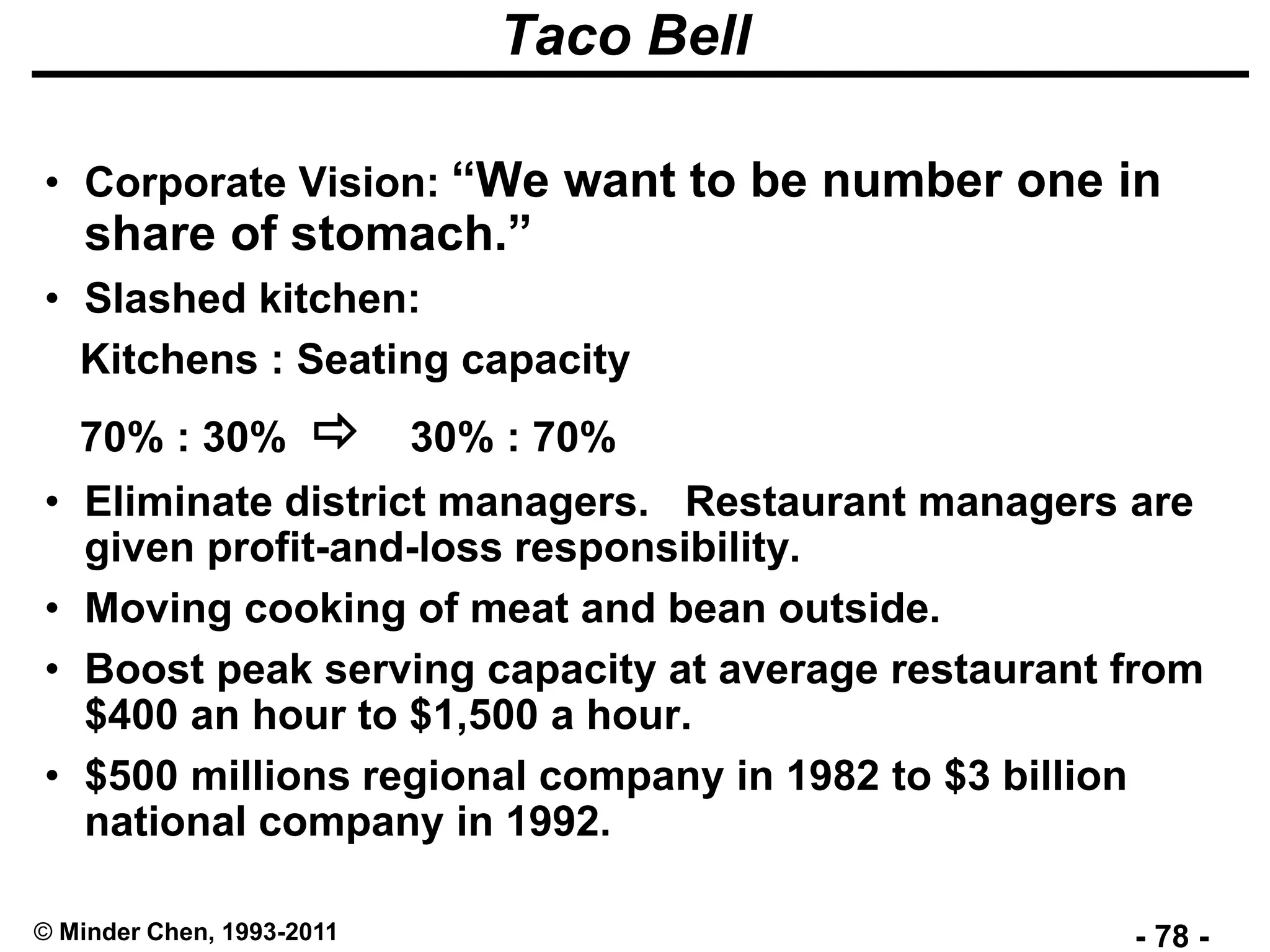
Taco Bell
• Corporate Vision: “We want to be number one in
share of stomach.”
• Slashed kitchen:
Kitchens : Seating capacity
70% : 30%  30% : 70%
• Eliminate district managers. Restaurant managers are
given profit-and-loss responsibility.
• Moving cooking of meat and bean outside.
• Boost peak serving capacity at average restaurant from
$400 an hour to $1,500 a hour.
• $500 millions regional company in 1982 to $3 billion
national company in 1992.
- 79 -© Minder Chen, 1993-2011
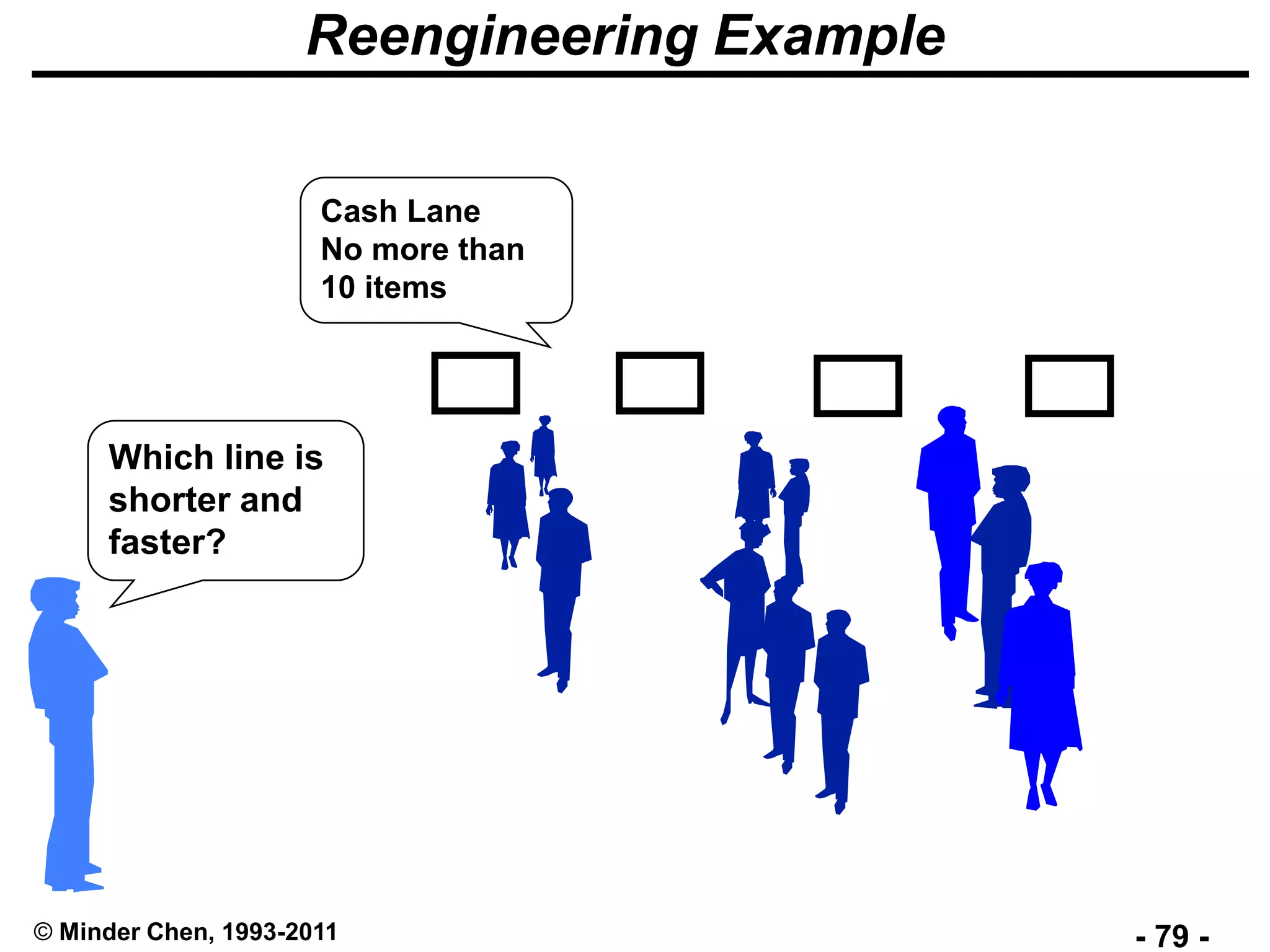
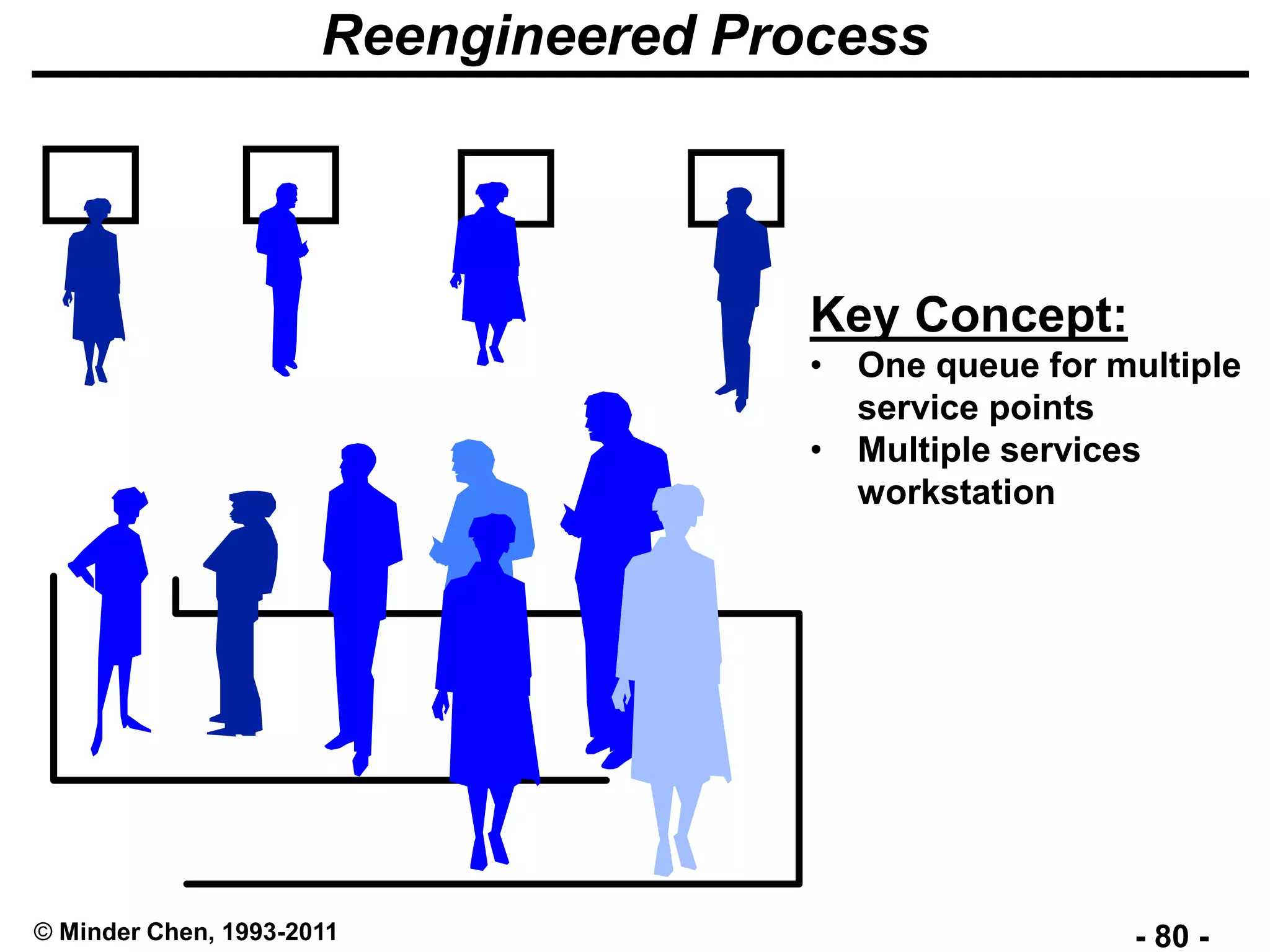
Reengineering Example
Which line is
shorter and
faster?
Cash Lane
No more than
10 items
- 80 -© Minder Chen, 1993-2011
Reengineered Process
Key Concept:
• One queue for multiple
service points
• Multiple services
workstation
- 81 -© Minder Chen, 1993-2011
BPR Principles
• Organize around outcomes, not tasks.
• Have those who use the output of the process
perform the process.
• Subsume information-processing work into the
real work that produces the information.
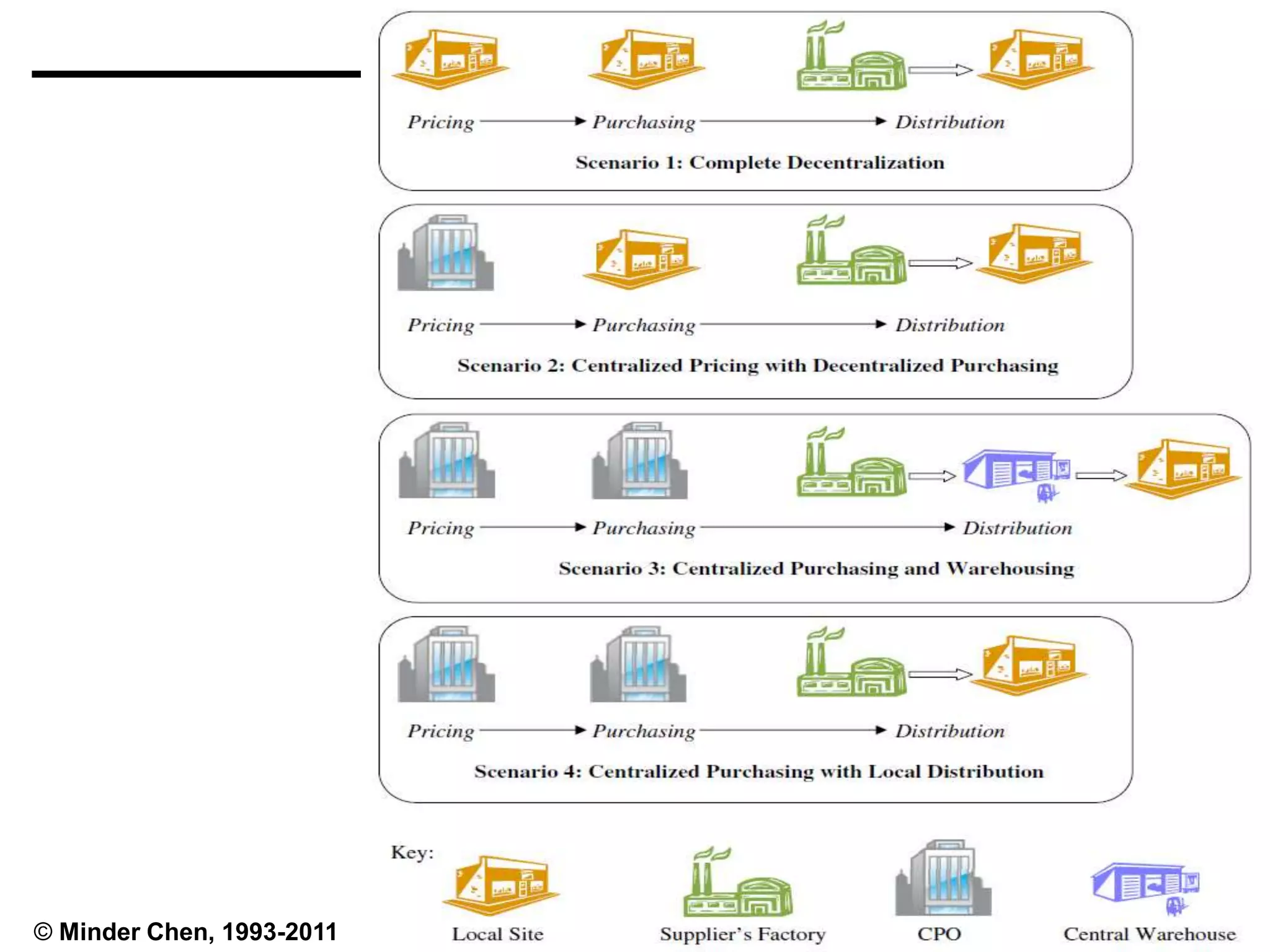
• Treat geographically dispersed resources as
though they were centralized.
• Link parallel activities instead of integrating
their results.
• Put decision points where the work is
performed and build controls into the process.
• Capture information once and at the source.
Source: Michael Hammer, “Reengineering Work: Don’t Automate, Obliterate,”
Harvard Business Review, July-August, 1990, pp. 104-112.
- 82 -© Minder Chen, 1993-2011
- 83 -© Minder Chen, 1993-2011
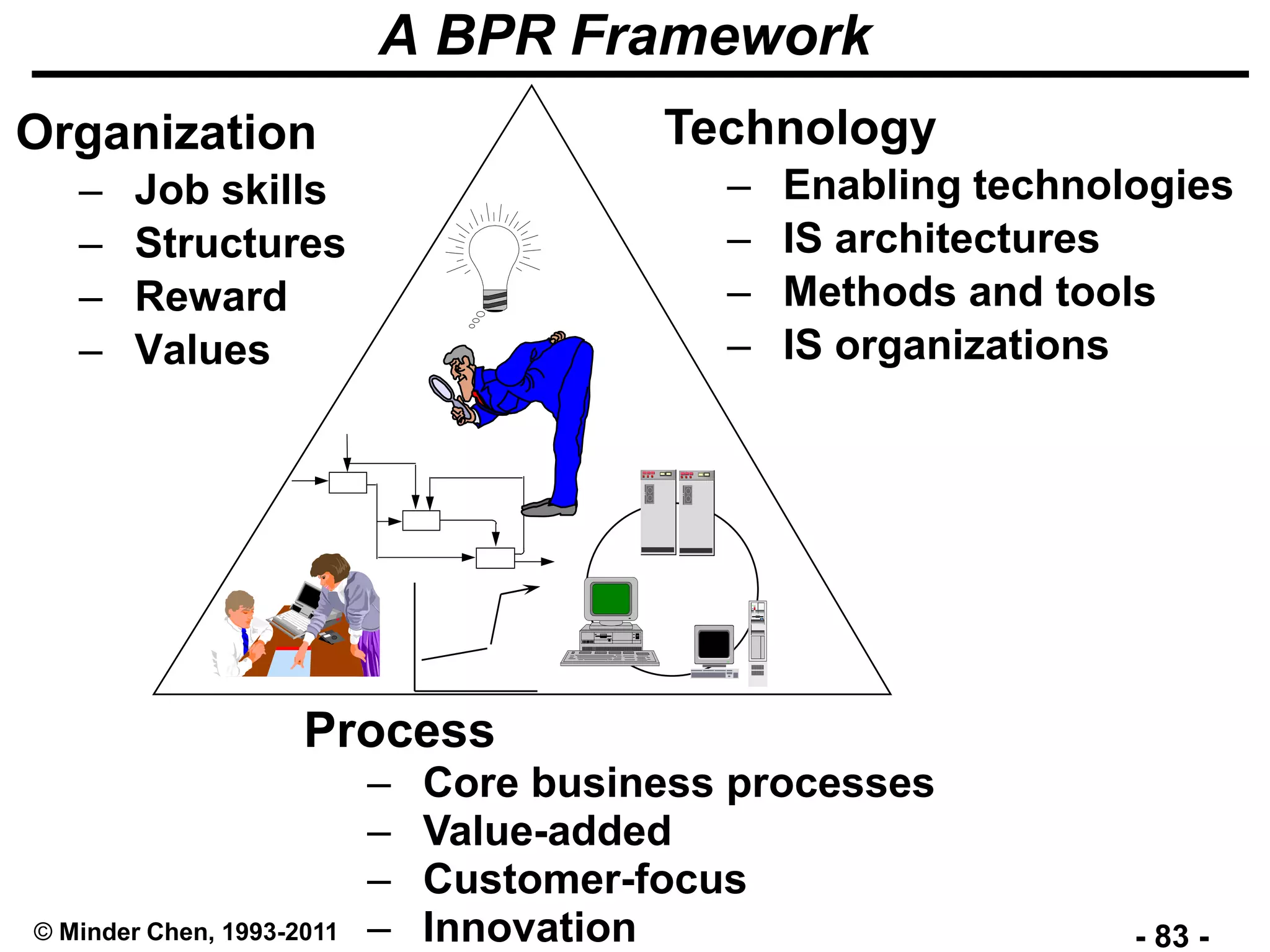
A BPR Framework
Organization
– Job skills
– Structures
– Reward
– Values
Technology
– Enabling technologies
– IS architectures
– Methods and tools
– IS organizations
Process
– Core business processes
– Value-added
– Customer-focus
– Innovation
- 84 -© Minder Chen, 1993-2011
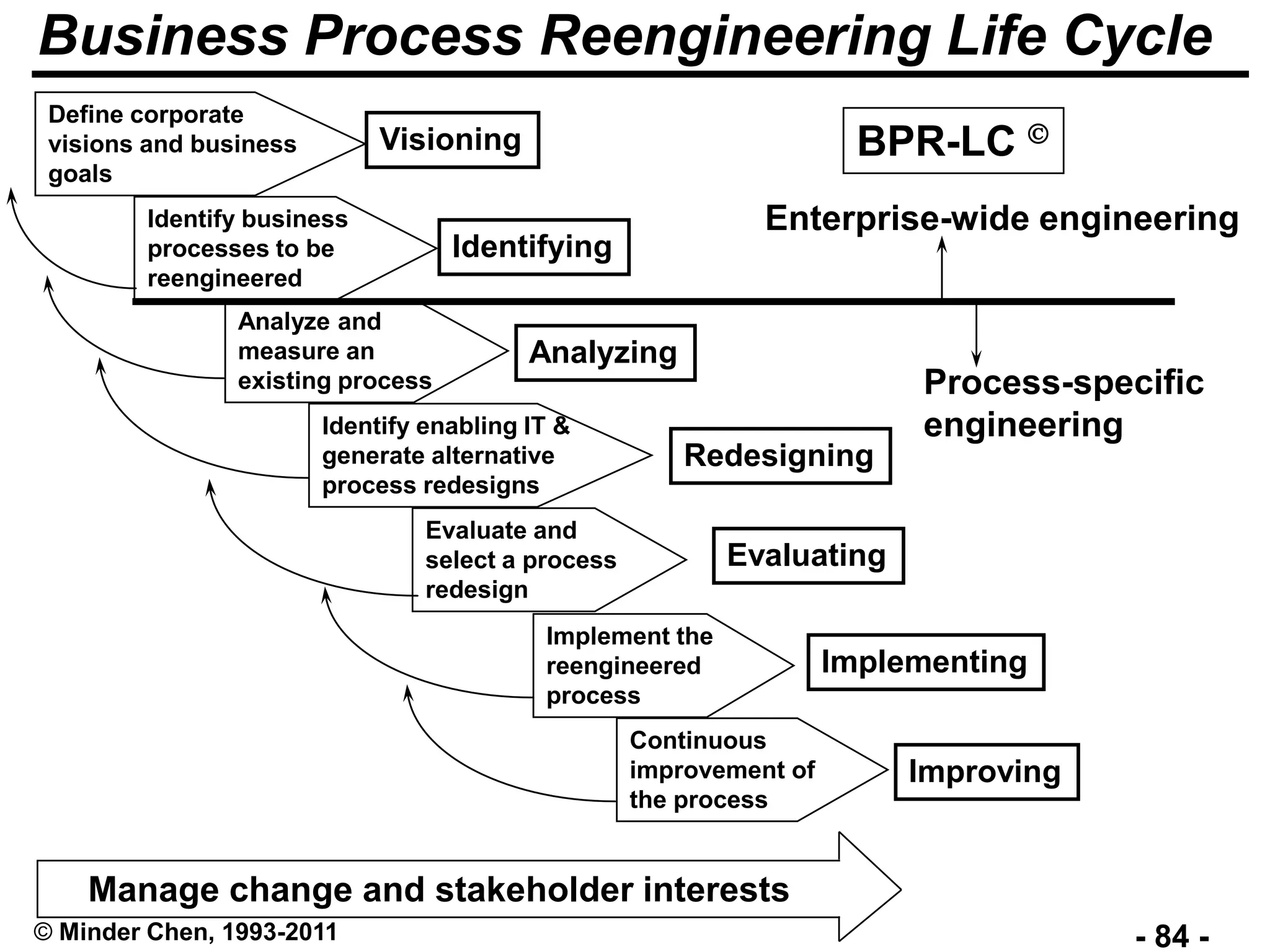
Business Process Reengineering Life Cycle
Define corporate
visions and business
goals
Identify business
processes to be
reengineered
Analyze and
measure an
existing process
Identify enabling IT &
generate alternative
process redesigns
Evaluate and
select a process
redesign
Implement the
reengineered
process
Continuous
improvement of
the process
Visioning
Identifying
Analyzing
Redesigning
Evaluating
Implementing
Improving
Manage change and stakeholder interests
BPR-LC 
Enterprise-wide engineering
Process-specific
engineering
- 85 -© Minder Chen, 1993-2011
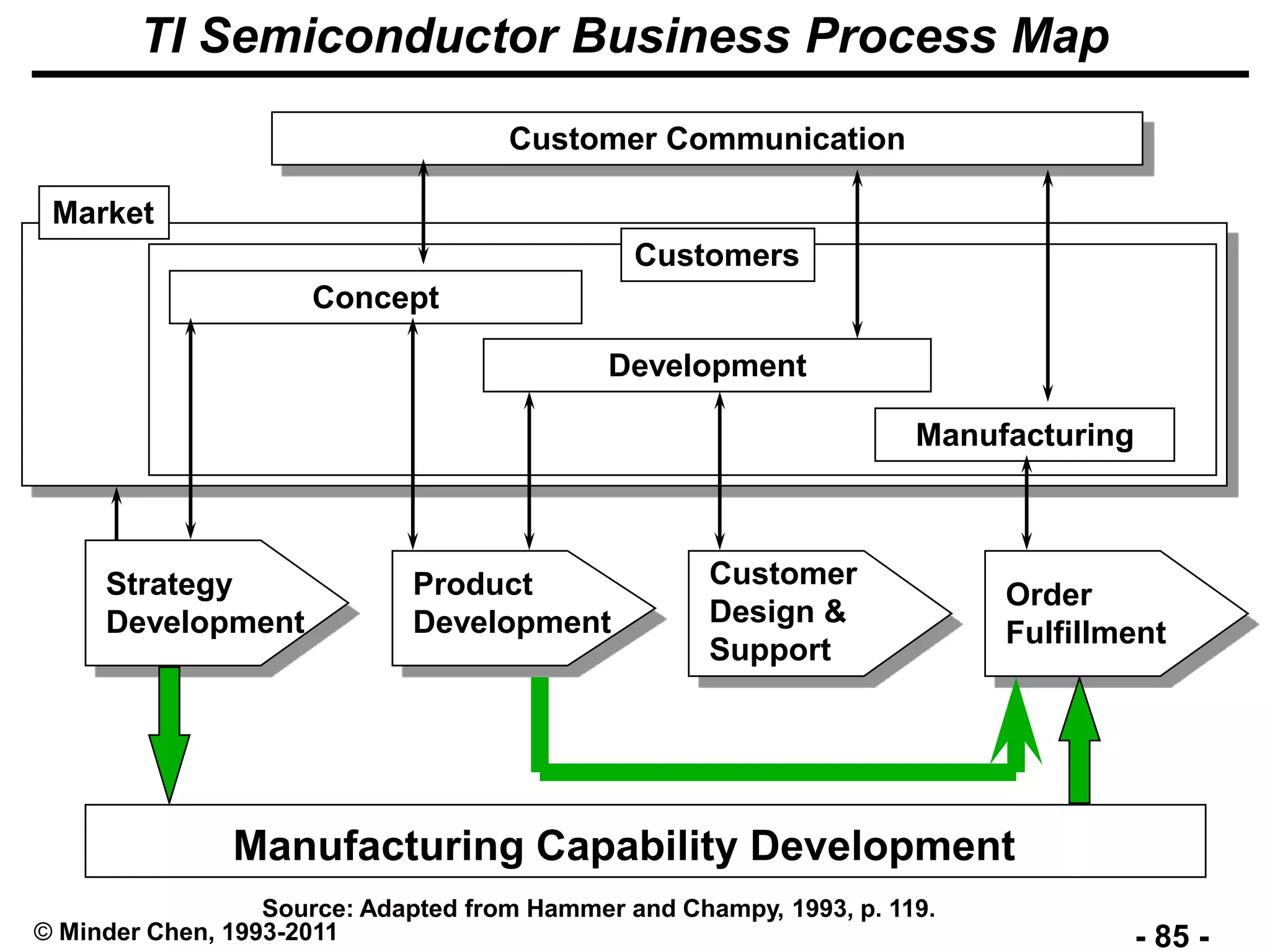
TI Semiconductor Business Process Map
Manufacturing Capability Development
Strategy
Development
Product
Development
Customer
Design &
Support
Order
Fulfillment
Concept
Development
Manufacturing
Market
Customers
Customer Communication
Source: Adapted from Hammer and Champy, 1993, p. 119.
- 86 -© Minder Chen, 1993-2011
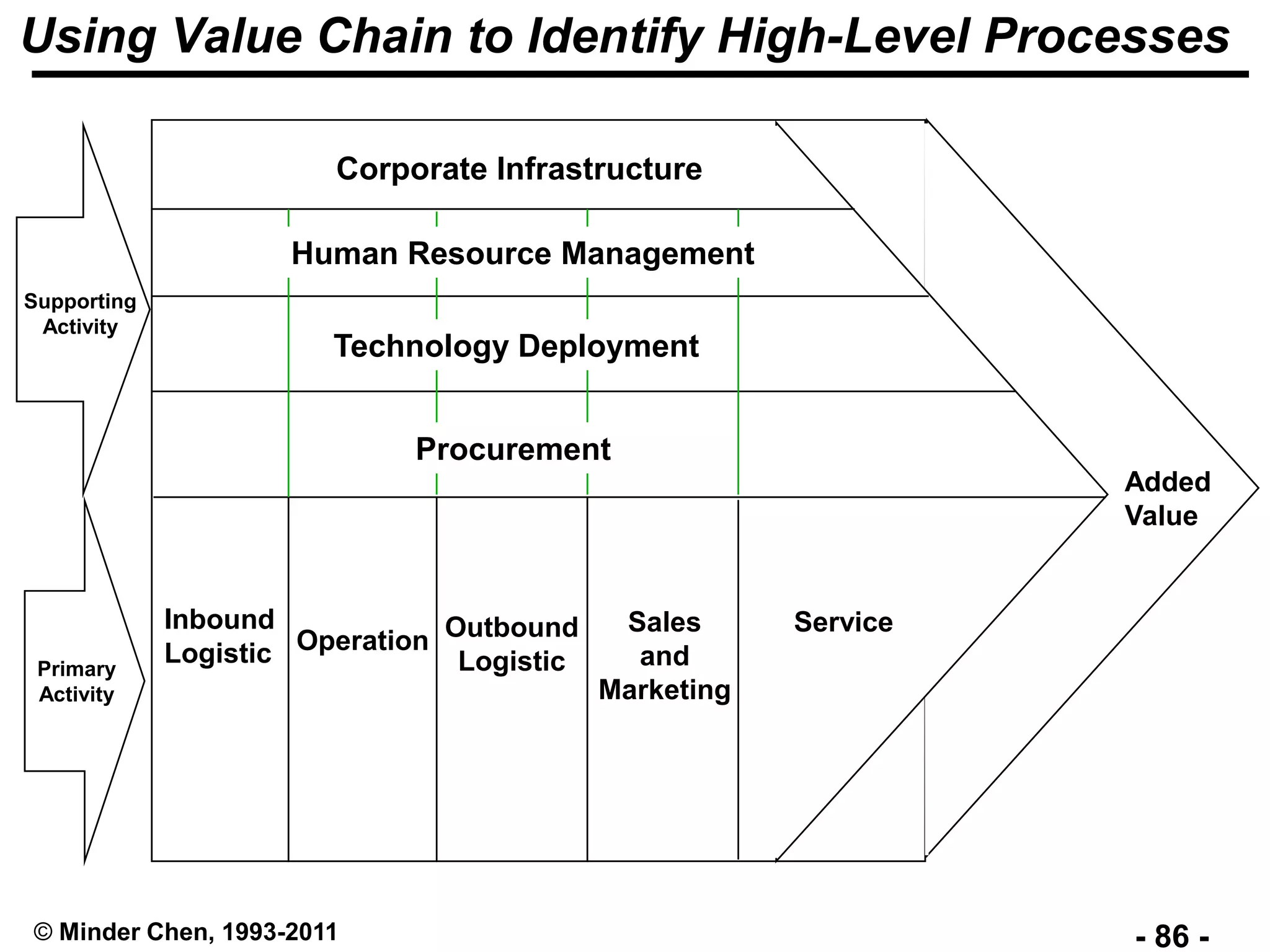
Using Value Chain to Identify High-Level Processes
Added
Value
Corporate Infrastructure
Inbound
Logistic Operation Outbound
Logistic
ServiceSales
and
Marketing
Primary
Activity
Supporting
Activity
Human Resource Management
Procurement
Technology Deployment
- 87 -© Minder Chen, 1993-2011
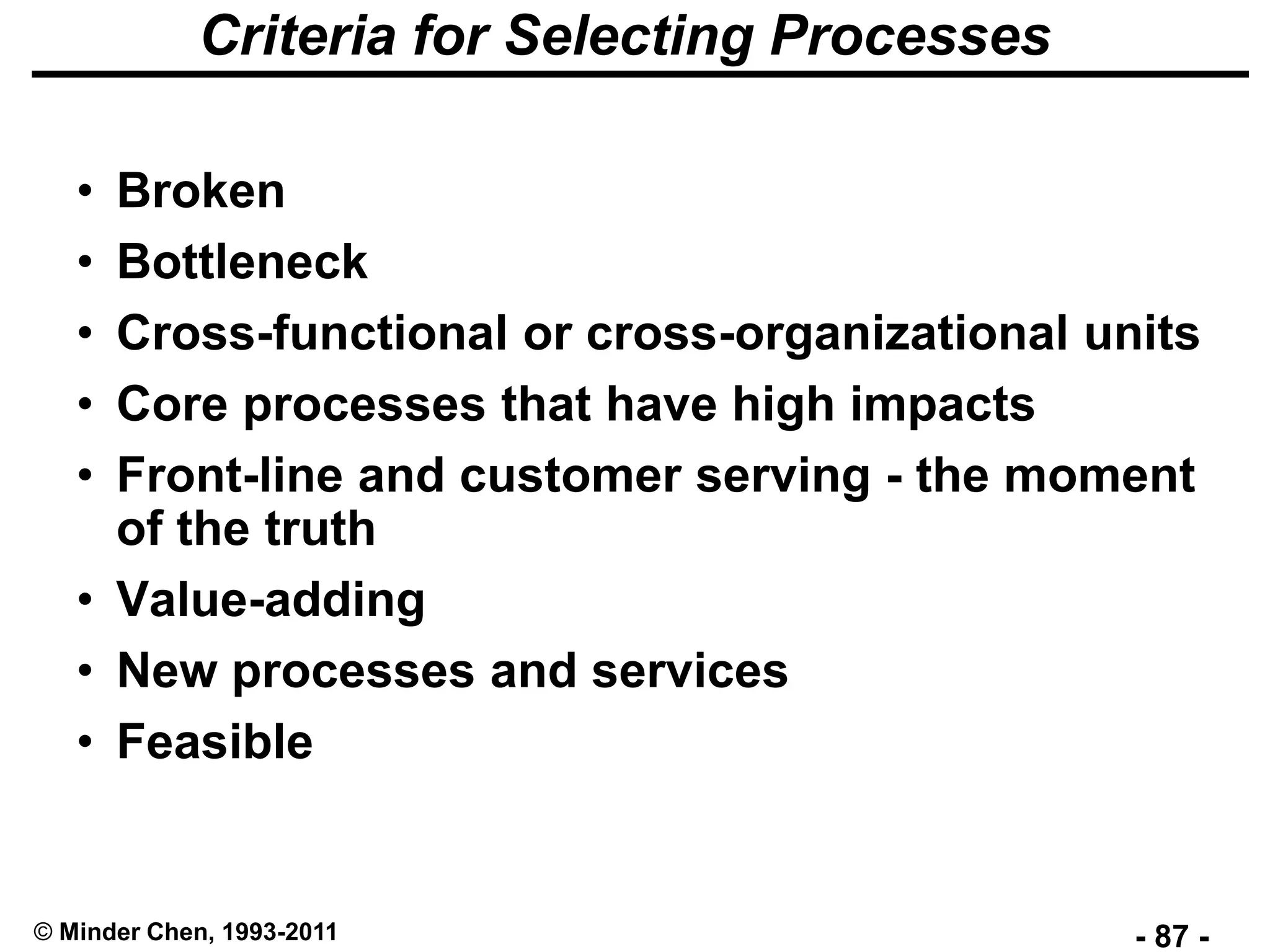
Criteria for Selecting Processes
• Broken
• Bottleneck
• Cross-functional or cross-organizational units
• Core processes that have high impacts
• Front-line and customer serving - the moment
of the truth
• Value-adding
• New processes and services
• Feasible
- 88 -© Minder Chen, 1993-2011
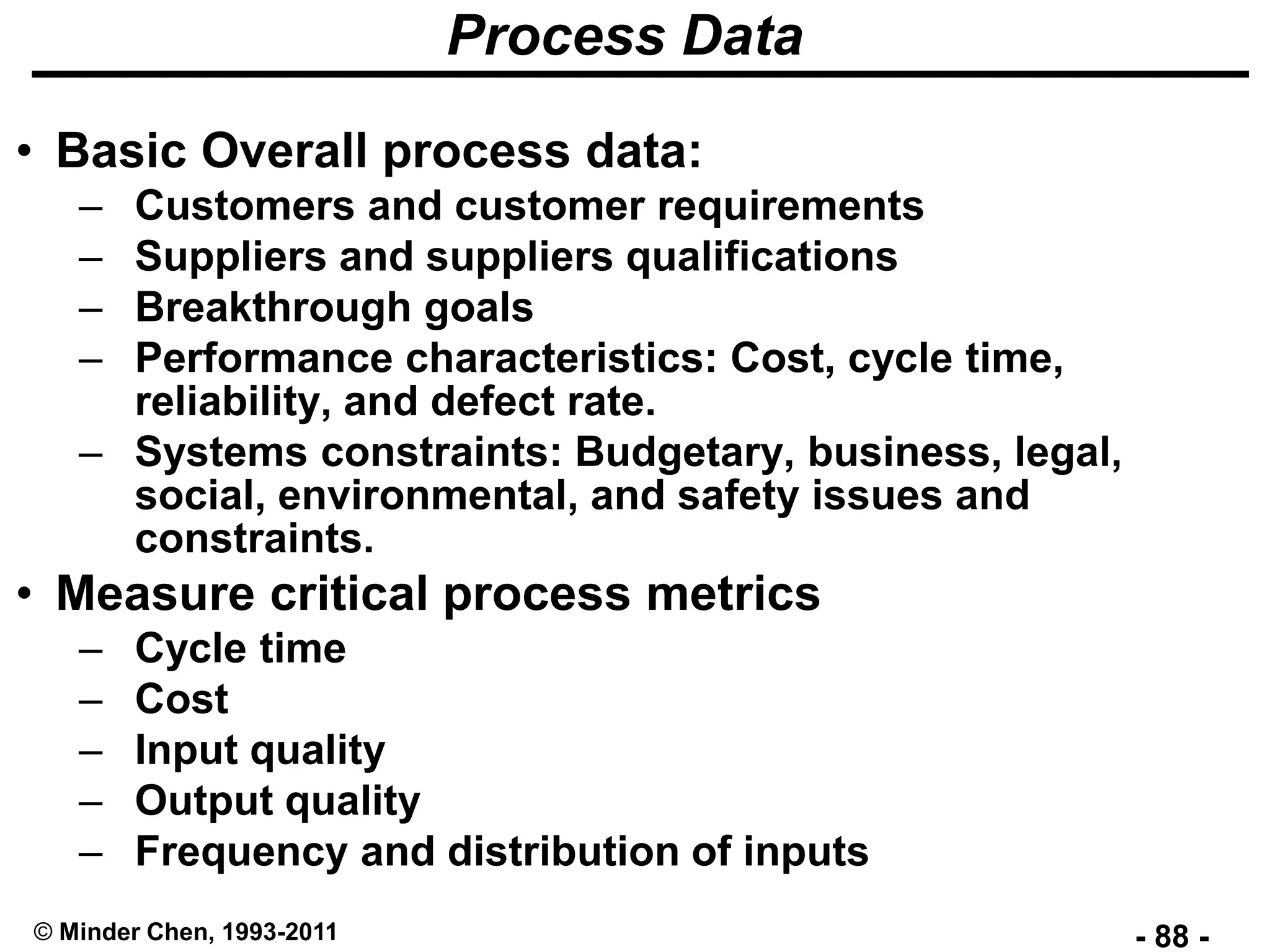
Process Data
• Basic Overall process data:
– Customers and customer requirements
– Suppliers and suppliers qualifications
– Breakthrough goals
– Performance characteristics: Cost, cycle time,
reliability, and defect rate.
– Systems constraints: Budgetary, business, legal,
social, environmental, and safety issues and
constraints.
• Measure critical process metrics
– Cycle time
– Cost
– Input quality
– Output quality
– Frequency and distribution of inputs
- 89 -© Minder Chen, 1993-2011
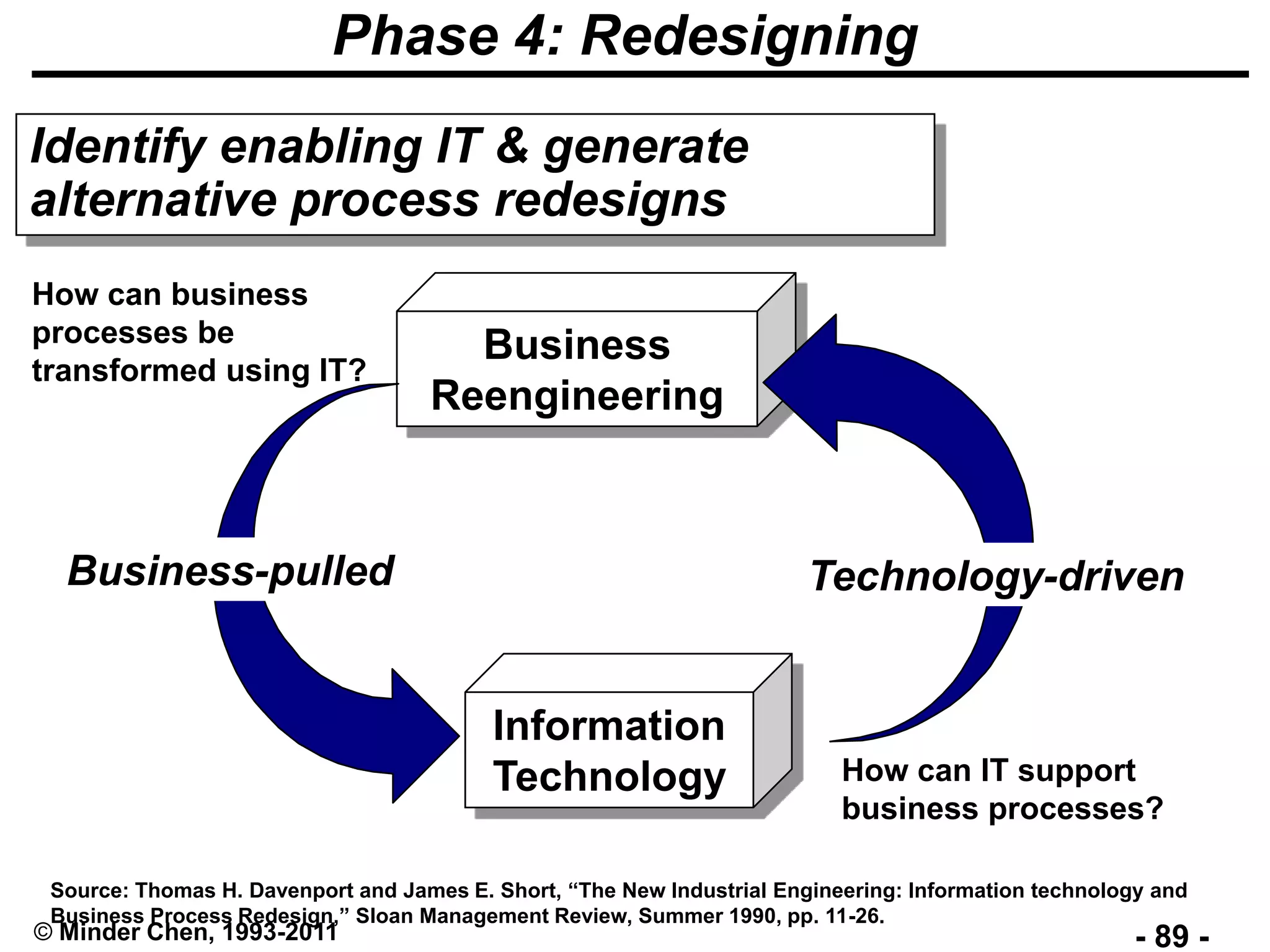
Phase 4: Redesigning
Identify enabling IT & generate
alternative process redesigns
Information
Technology
Business
Reengineering
How can IT support
business processes?
How can business
processes be
transformed using IT?
Source: Thomas H. Davenport and James E. Short, “The New Industrial Engineering: Information technology and
Business Process Redesign,” Sloan Management Review, Summer 1990, pp. 11-26.
Technology-drivenBusiness-pulled
- 90 -© Minder Chen, 1993-2011
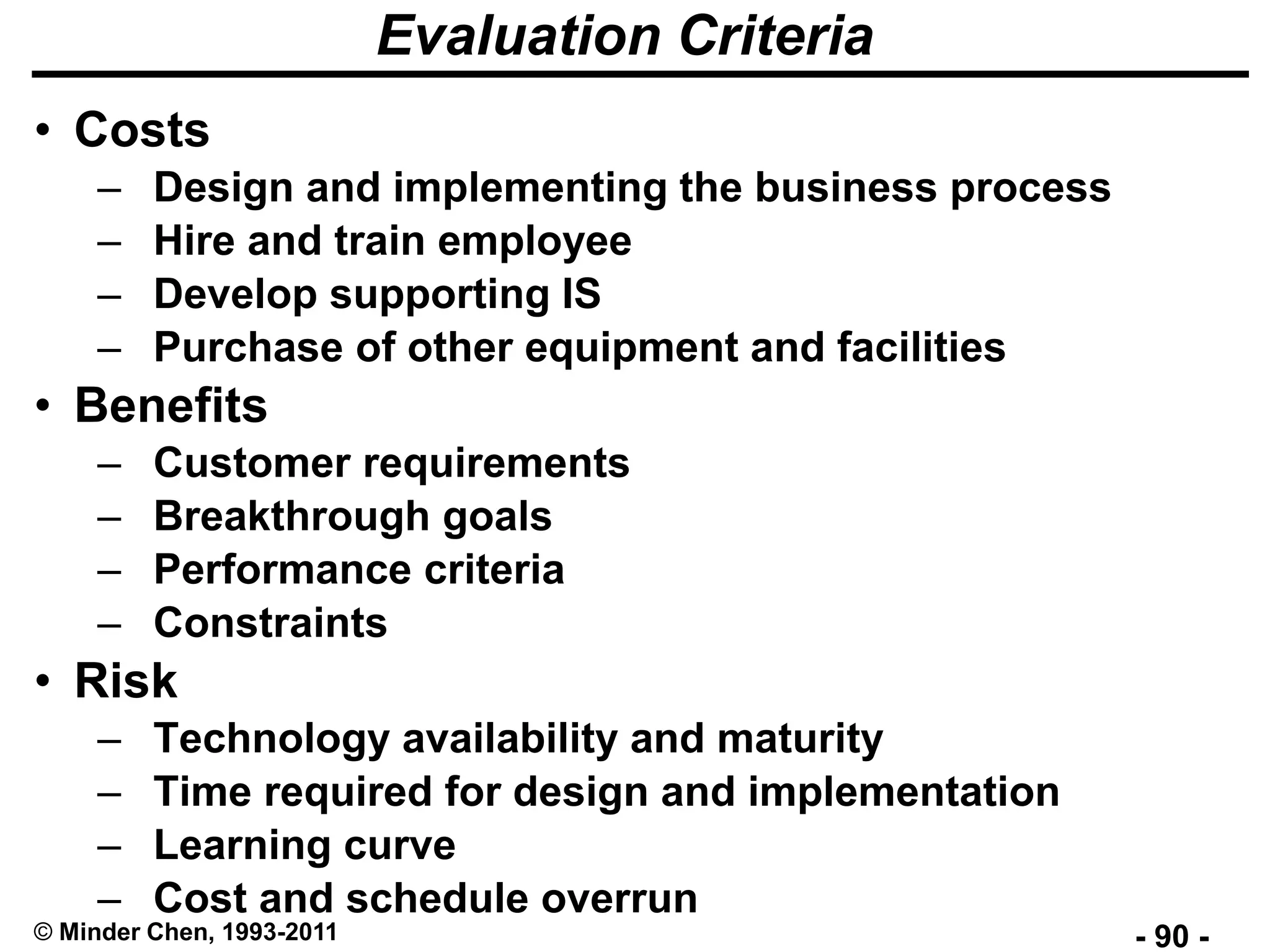
Evaluation Criteria
• Costs
– Design and implementing the business process
– Hire and train employee
– Develop supporting IS
– Purchase of other equipment and facilities
• Benefits
– Customer requirements
– Breakthrough goals
– Performance criteria
– Constraints
• Risk
– Technology availability and maturity
– Time required for design and implementation
– Learning curve
– Cost and schedule overrun
- 91 -© Minder Chen, 1993-2011
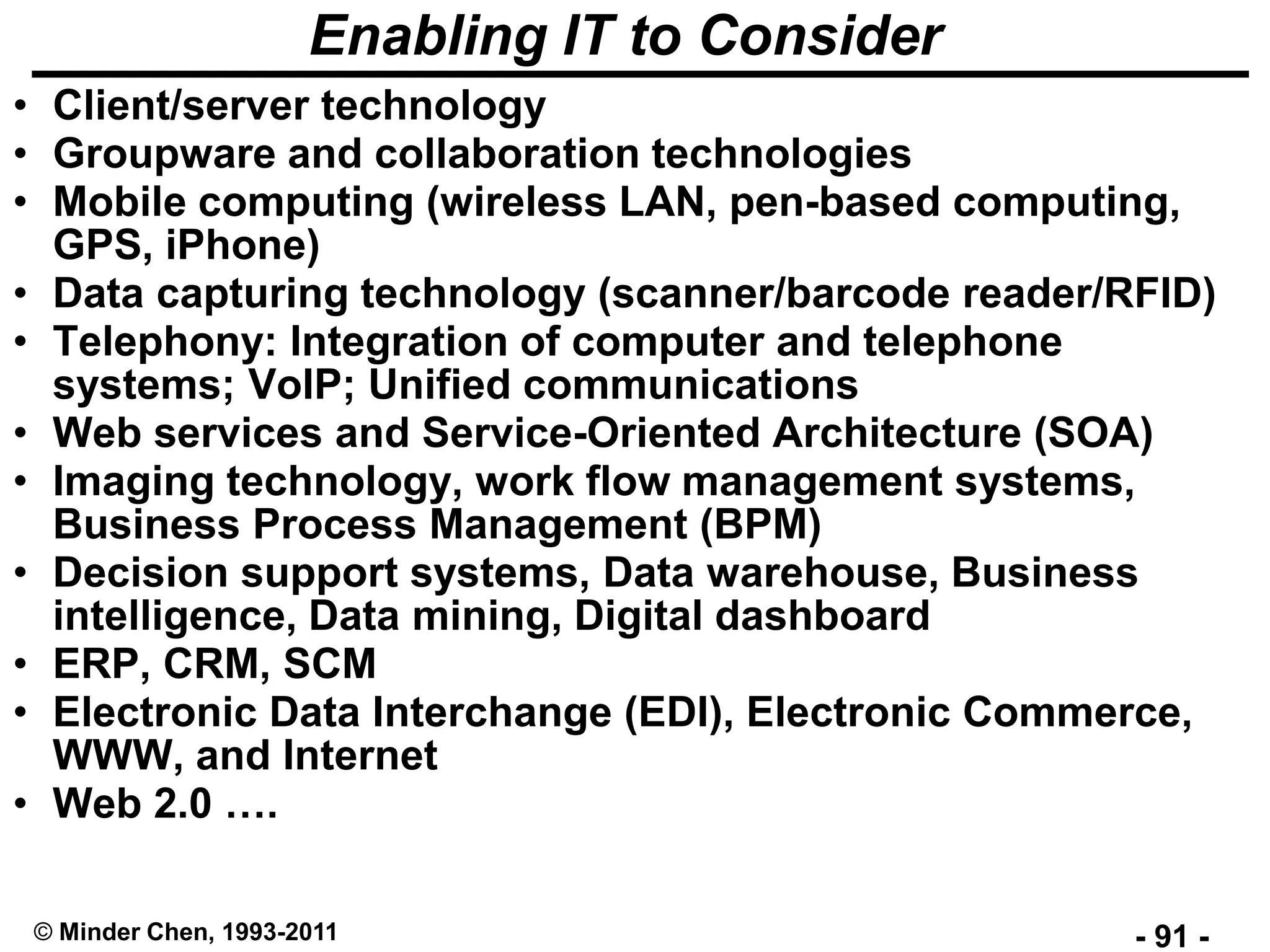
Enabling IT to Consider
• Client/server technology
• Groupware and collaboration technologies
• Mobile computing (wireless LAN, pen-based computing,
GPS, iPhone)
• Data capturing technology (scanner/barcode reader/RFID)
• Telephony: Integration of computer and telephone
systems; VoIP; Unified communications
• Web services and Service-Oriented Architecture (SOA)
• Imaging technology, work flow management systems,
Business Process Management (BPM)
• Decision support systems, Data warehouse, Business
intelligence, Data mining, Digital dashboard
• ERP, CRM, SCM
• Electronic Data Interchange (EDI), Electronic Commerce,
WWW, and Internet
• Web 2.0 ….
- 92 -© Minder Chen, 1993-2011
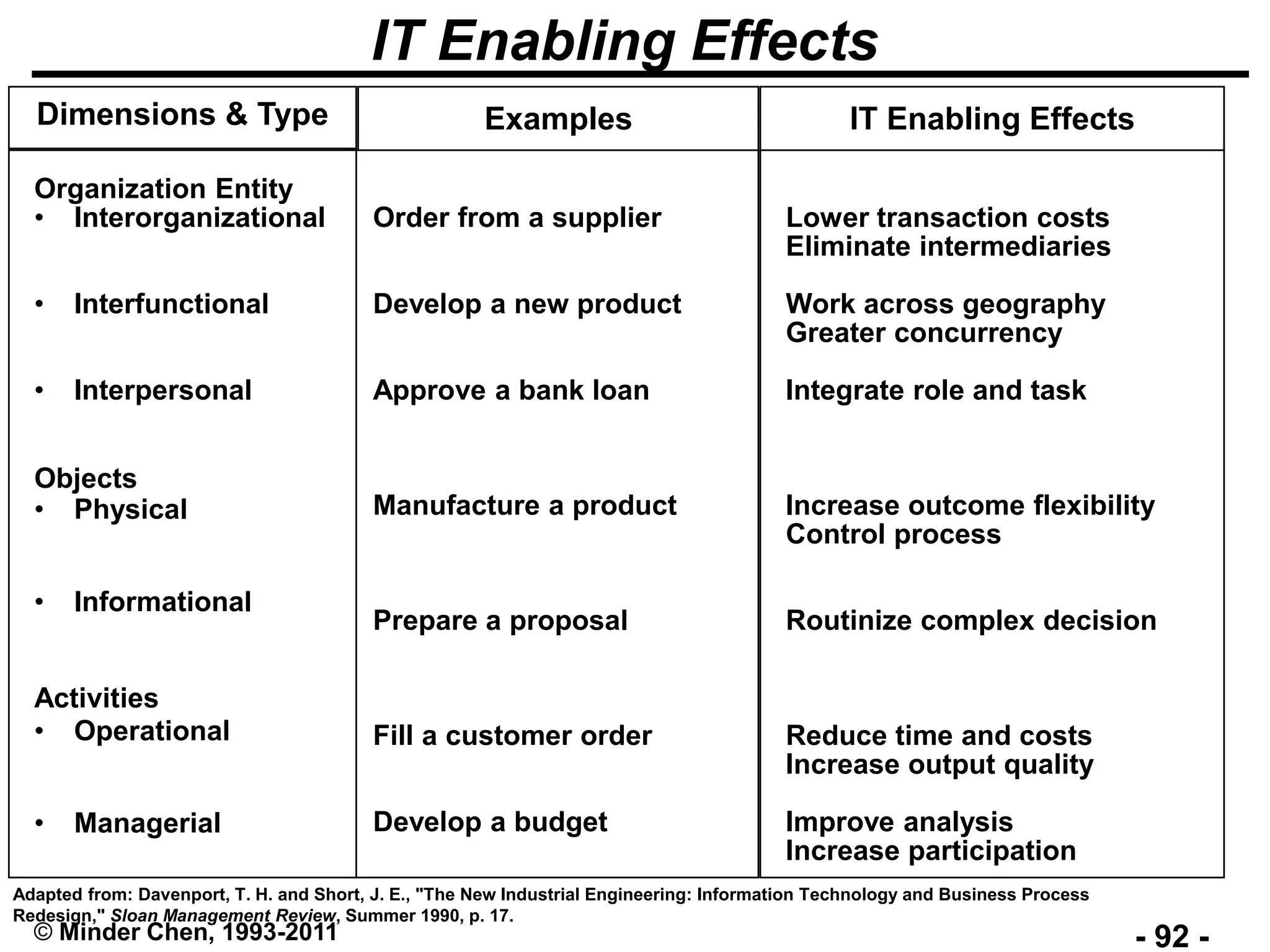
IT Enabling Effects
Dimensions & Type Examples IT Enabling Effects
Order from a supplier
Develop a new product
Approve a bank loan
Manufacture a product
Prepare a proposal
Fill a customer order
Develop a budget
Lower transaction costs
Eliminate intermediaries
Work across geography
Greater concurrency
Integrate role and task
Increase outcome flexibility
Control process
Routinize complex decision
Reduce time and costs
Increase output quality
Improve analysis
Increase participation
Adapted from: Davenport, T. H. and Short, J. E., "The New Industrial Engineering: Information Technology and Business Process
Redesign," Sloan Management Review, Summer 1990, p. 17.
Organization Entity
• Interorganizational
• Interfunctional
• Interpersonal
Objects
• Physical
• Informational
Activities
• Operational
• Managerial
- 93 -© Minder Chen, 1993-2011
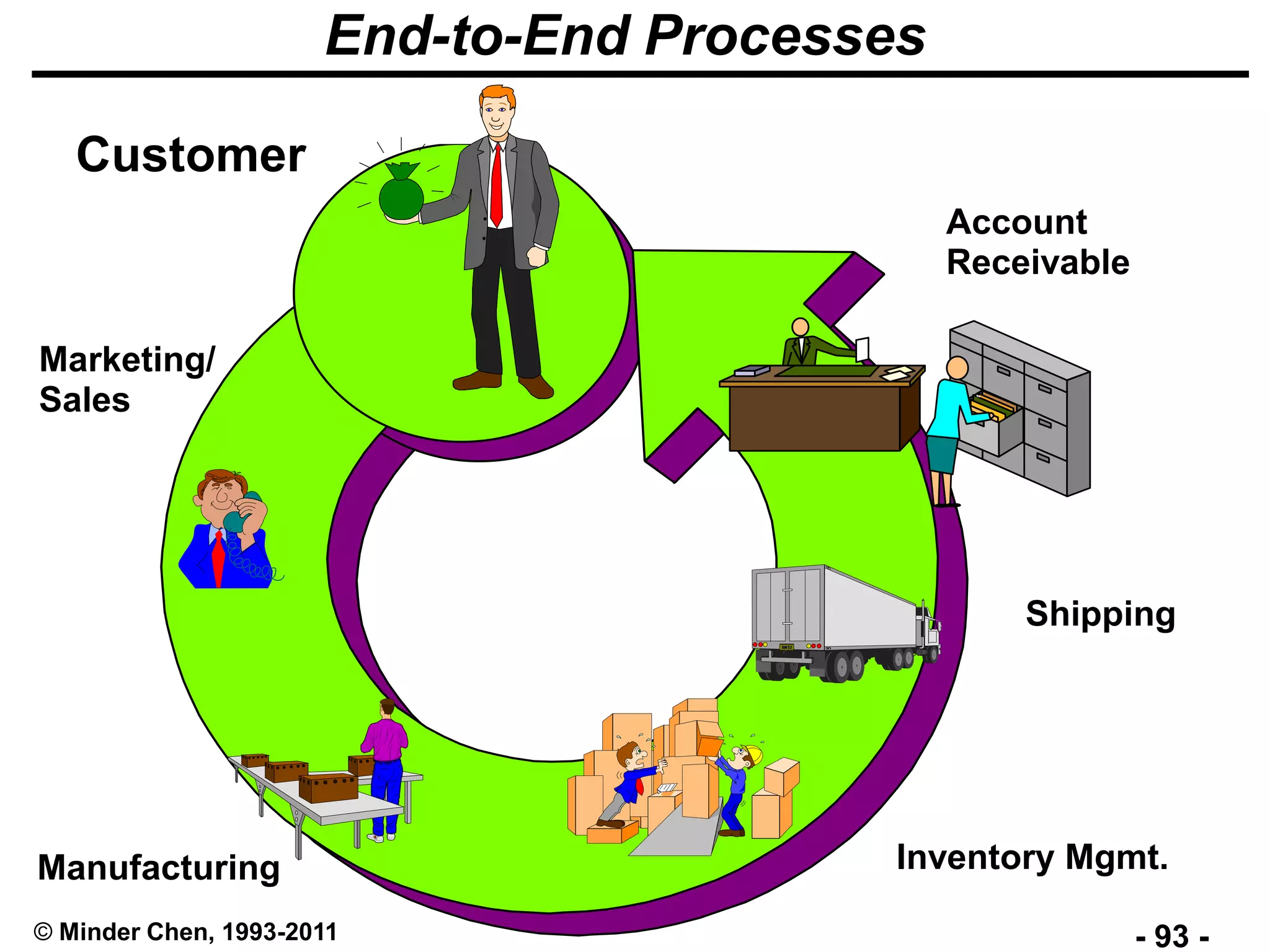
End-to-End Processes
Customer
Manufacturing Inventory Mgmt.
Shipping
Marketing/
Sales
Account
Receivable
- 94 -© Minder Chen, 1993-2011
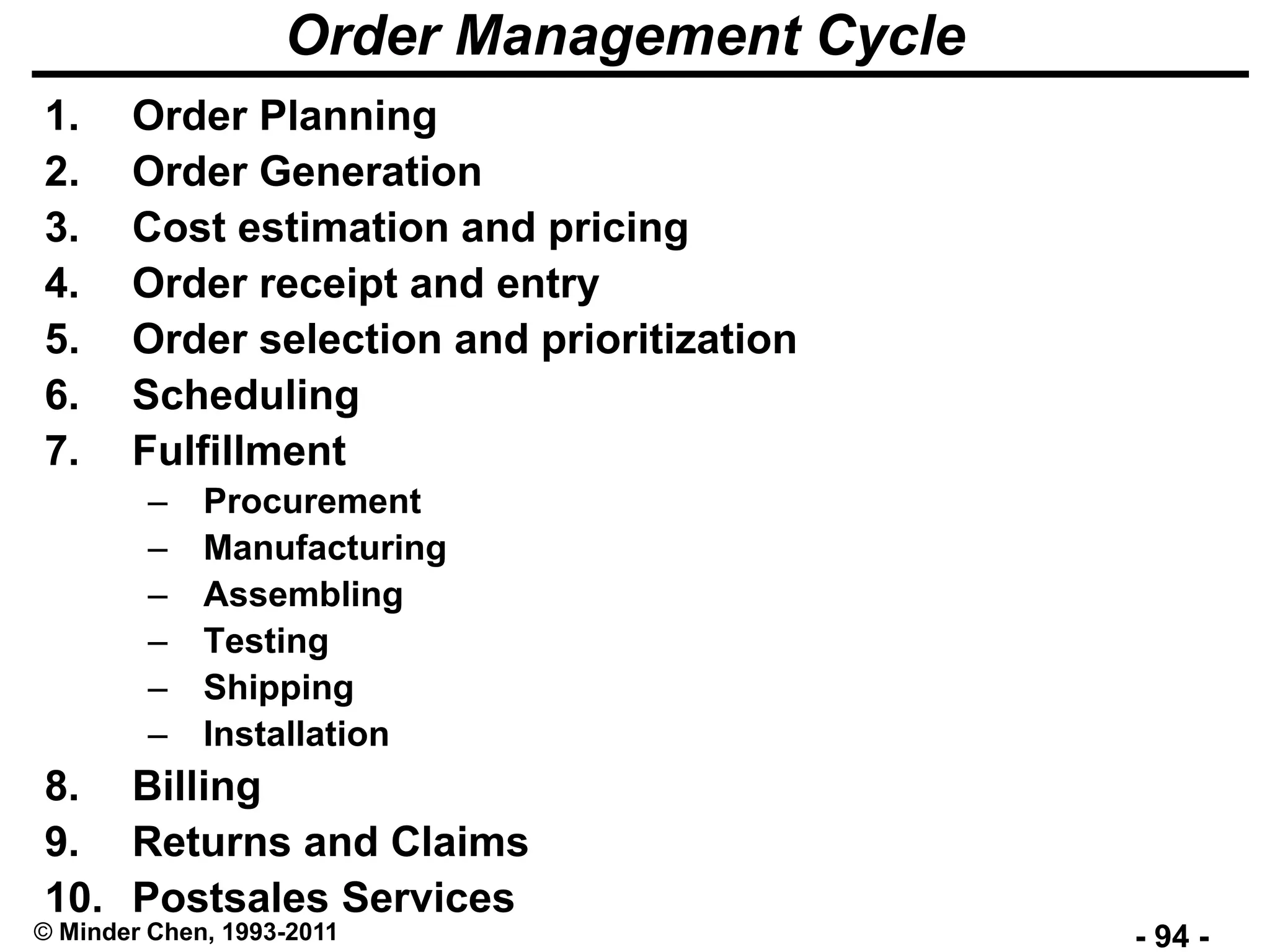
Order Management Cycle
1. Order Planning
2. Order Generation
3. Cost estimation and pricing
4. Order receipt and entry
5. Order selection and prioritization
6. Scheduling
7. Fulfillment
– Procurement
– Manufacturing
– Assembling
– Testing
– Shipping
– Installation
8. Billing
9. Returns and Claims
10. Postsales Services
- 95 -© Minder Chen, 1993-2011
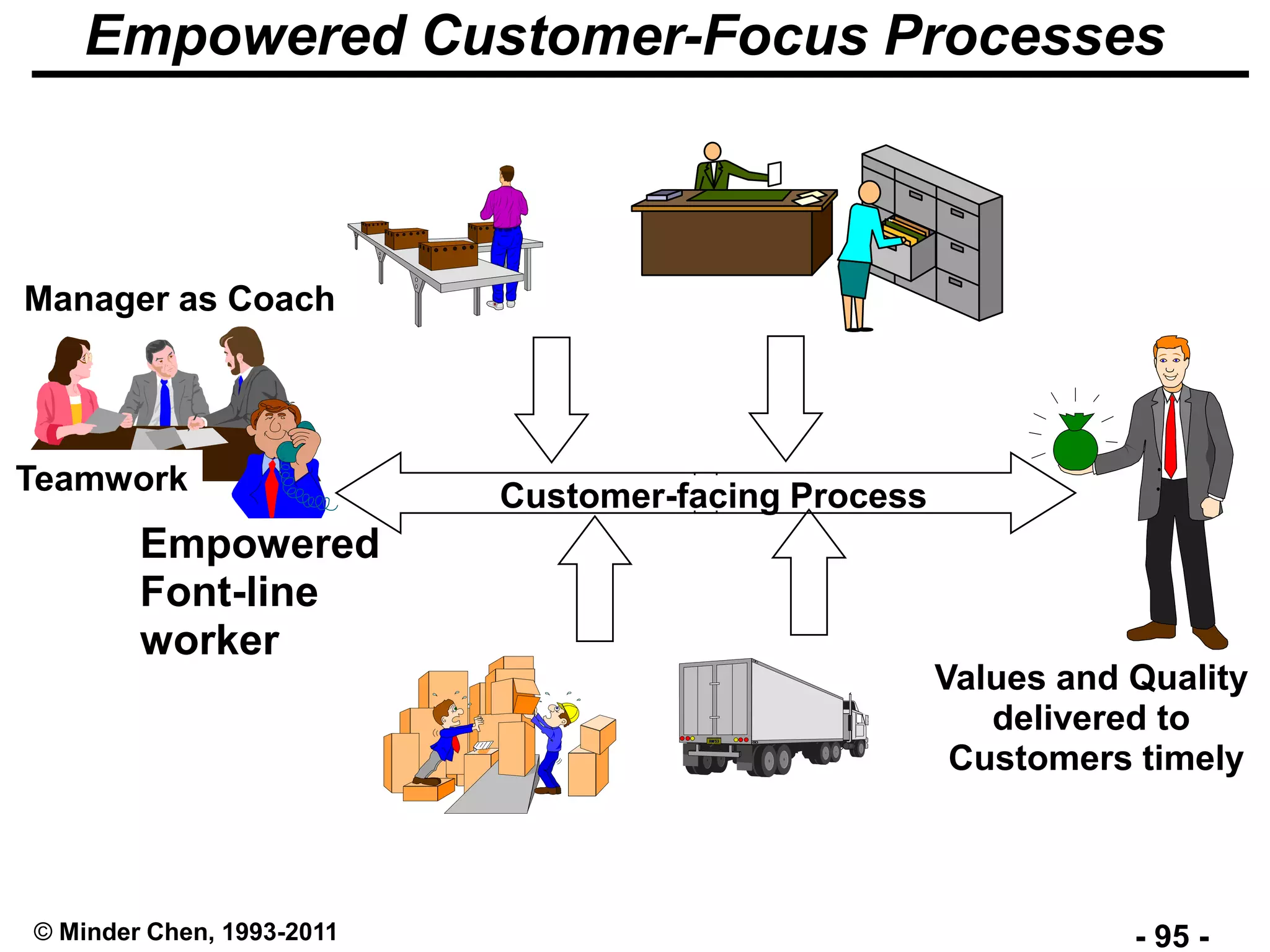
Empowered Customer-Focus Processes
Values and Quality
delivered to
Customers timely
Empowered
Font-line
worker
Customer-facing Process
Manager as Coach
Teamwork
- 96 -© Minder Chen, 1993-2011
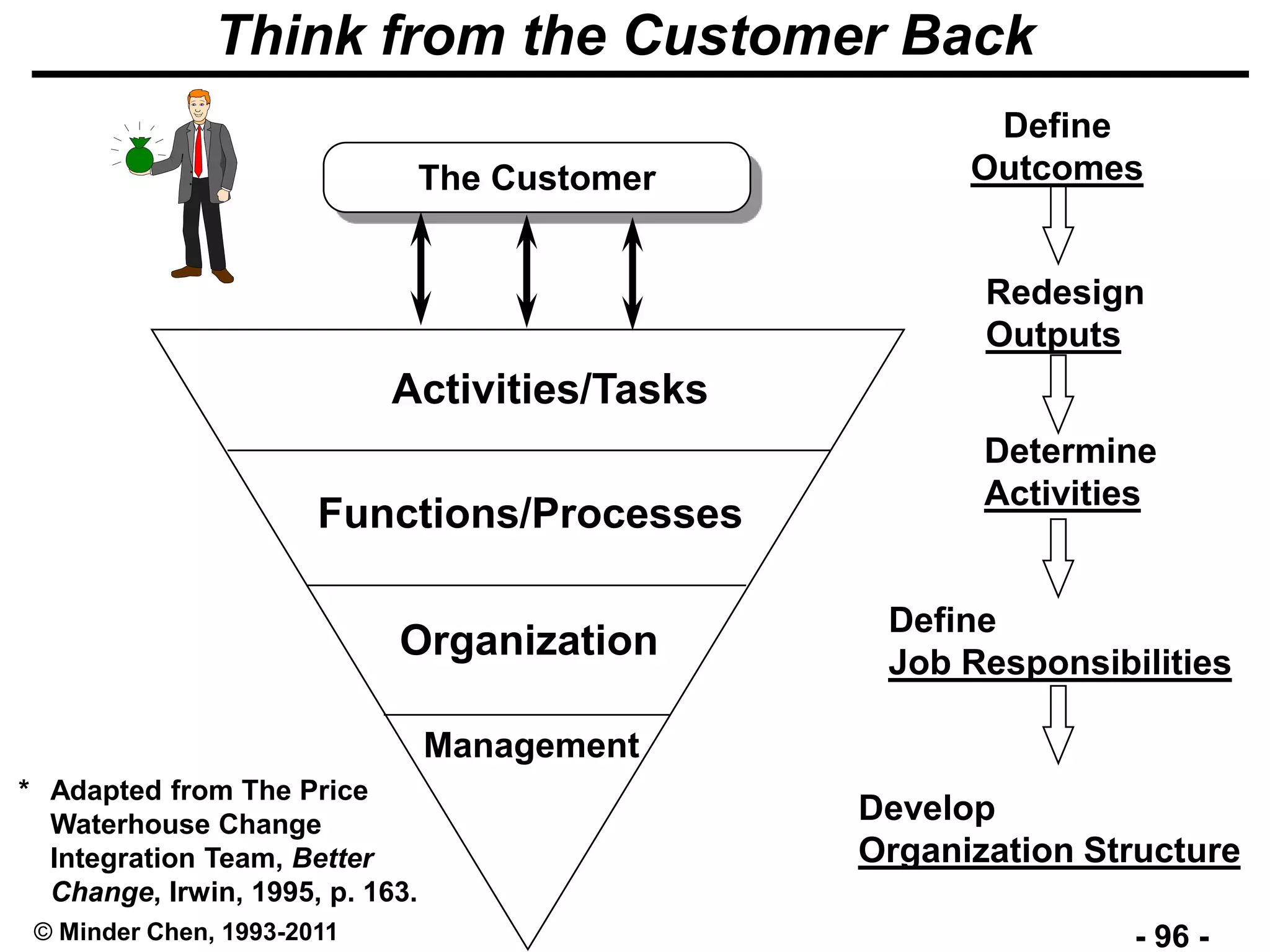
Think from the Customer Back
The Customer
Management
Organization
Functions/Processes
Activities/Tasks
Define
Outcomes
Redesign
Outputs
Determine
Activities
Define
Job Responsibilities
Develop
Organization Structure
* Adapted from The Price
Waterhouse Change
Integration Team, Better
Change, Irwin, 1995, p. 163.
- 97 -© Minder Chen, 1993-2011
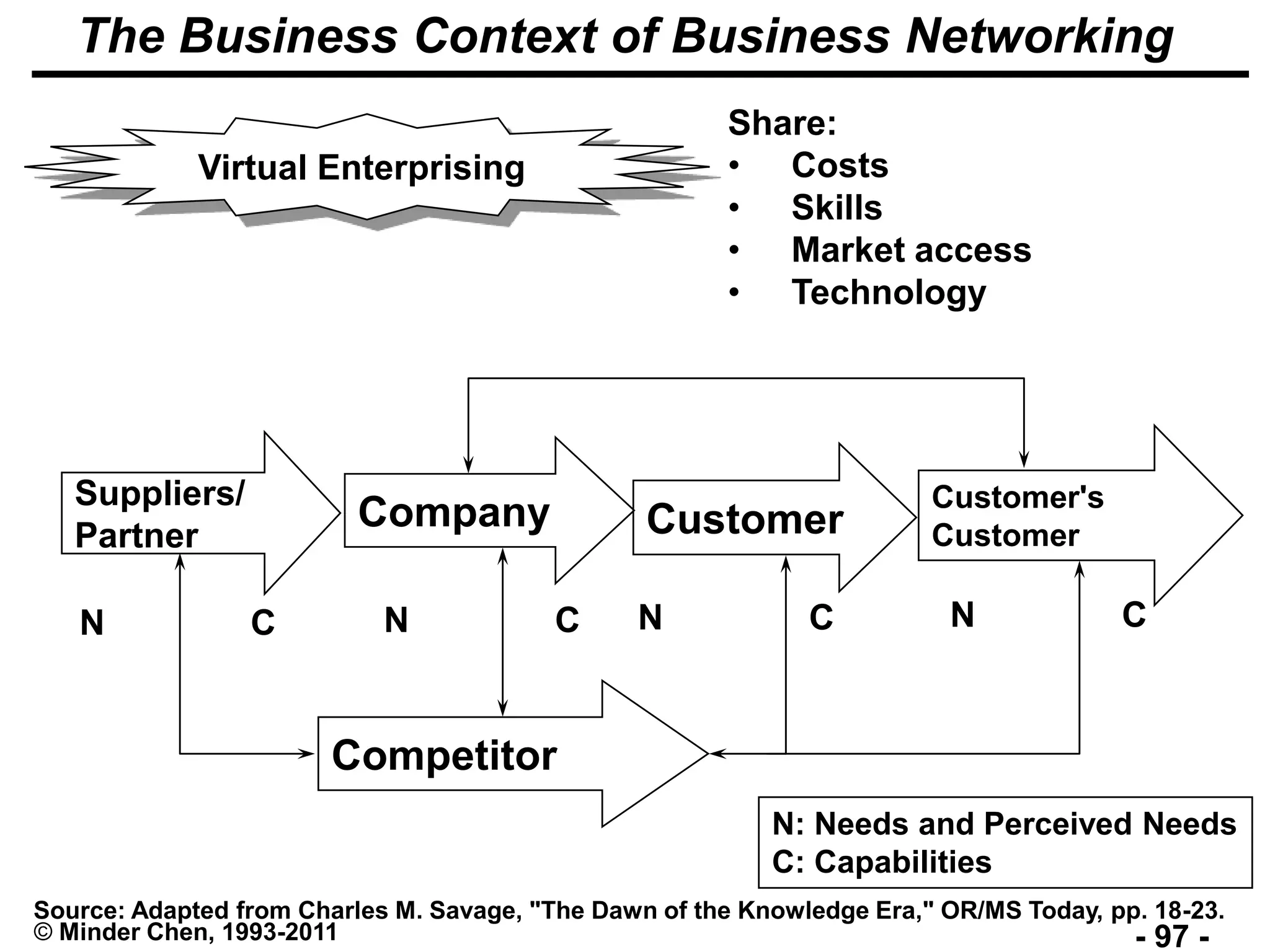
The Business Context of Business Networking
Company Customer
Customer's
Customer
Suppliers/
Partner
N C N C N C N C
N: Needs and Perceived Needs
C: Capabilities
Source: Adapted from Charles M. Savage, "The Dawn of the Knowledge Era," OR/MS Today, pp. 18-23.
Virtual Enterprising
Competitor
Share:
• Costs
• Skills
• Market access
• Technology
- 98 -© Minder Chen, 1993-2011
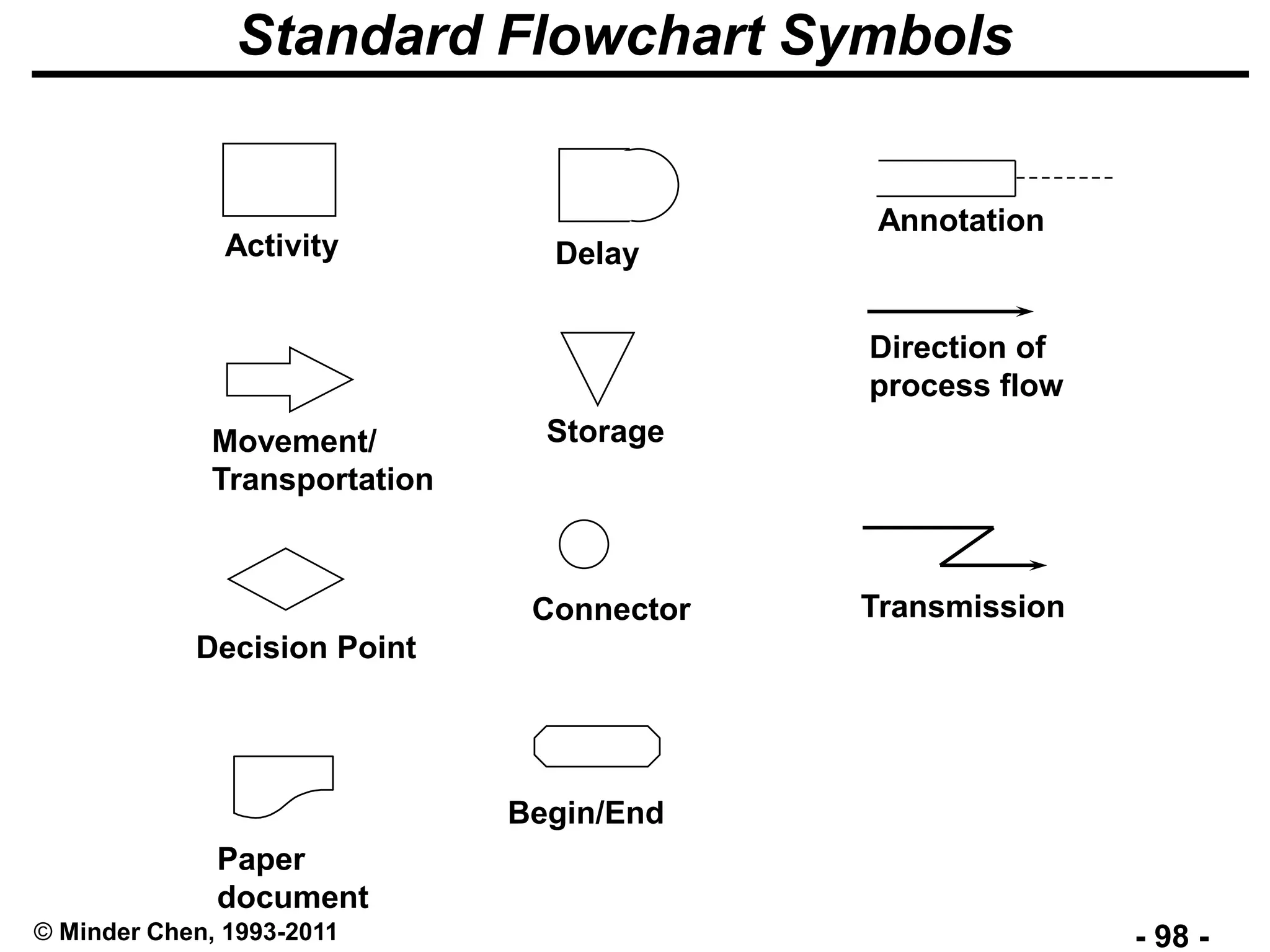
Standard Flowchart Symbols
Activity
Movement/
Transportation
Decision Point
Paper
document
Delay
Storage
Connector
Begin/End
Annotation
Direction of
process flow
Transmission
- 99 -© Minder Chen, 1993-2011
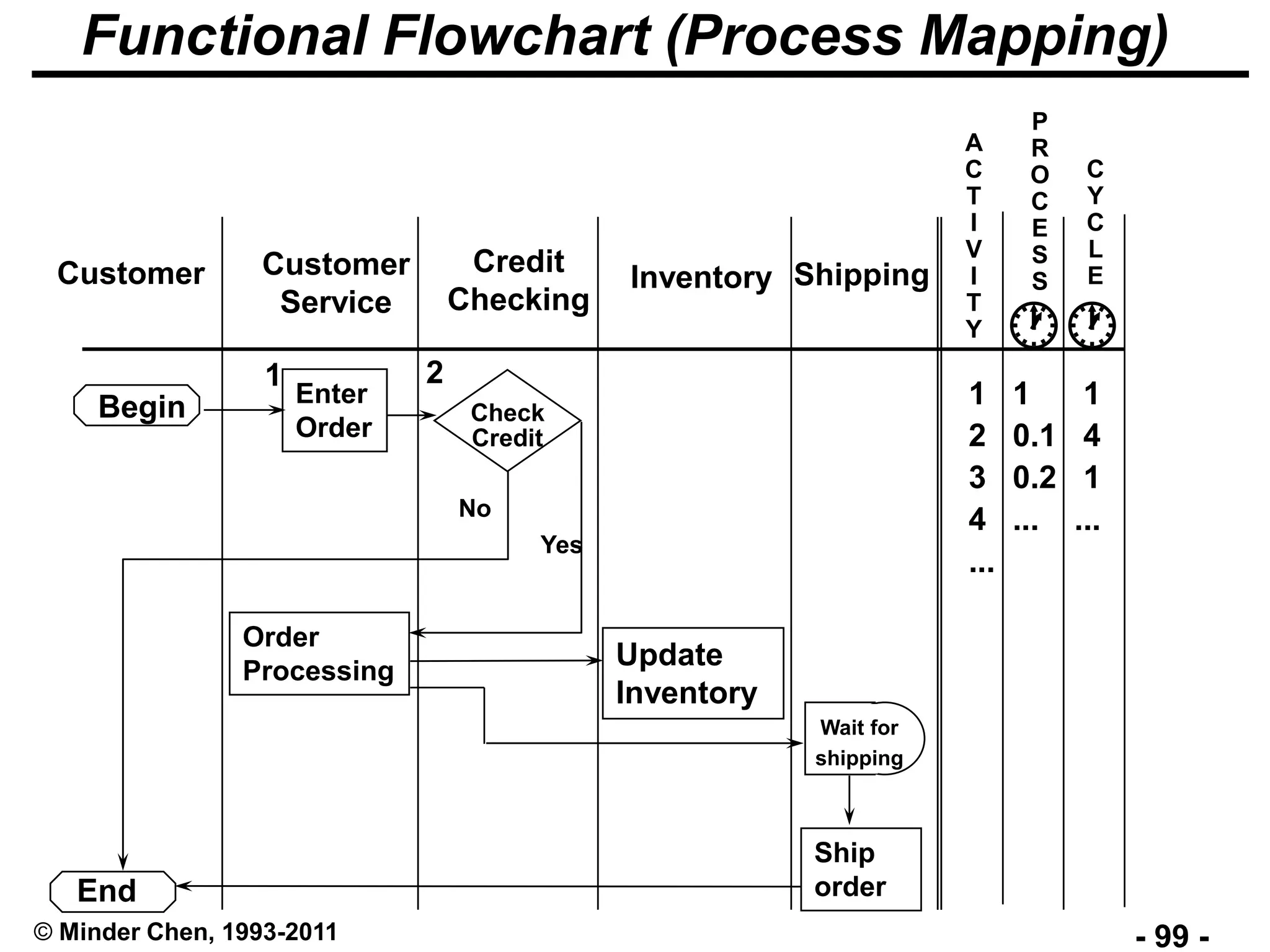
Functional Flowchart (Process Mapping)
Customer
Service
Credit
Checking
Inventory Shipping
Begin Enter
Order
Check
Credit
Yes
Order
Processing
Update
Inventory
Ship
orderEnd
P
R
O
C
E
S
S

C
Y
C
L
E

1 2
1 1 1
2 0.1 4
3 0.2 1
4 ... ...
...
A
C
T
I
V
I
T
Y
Wait for
shipping
No
Customer
- 100 -© Minder Chen, 1993-2011
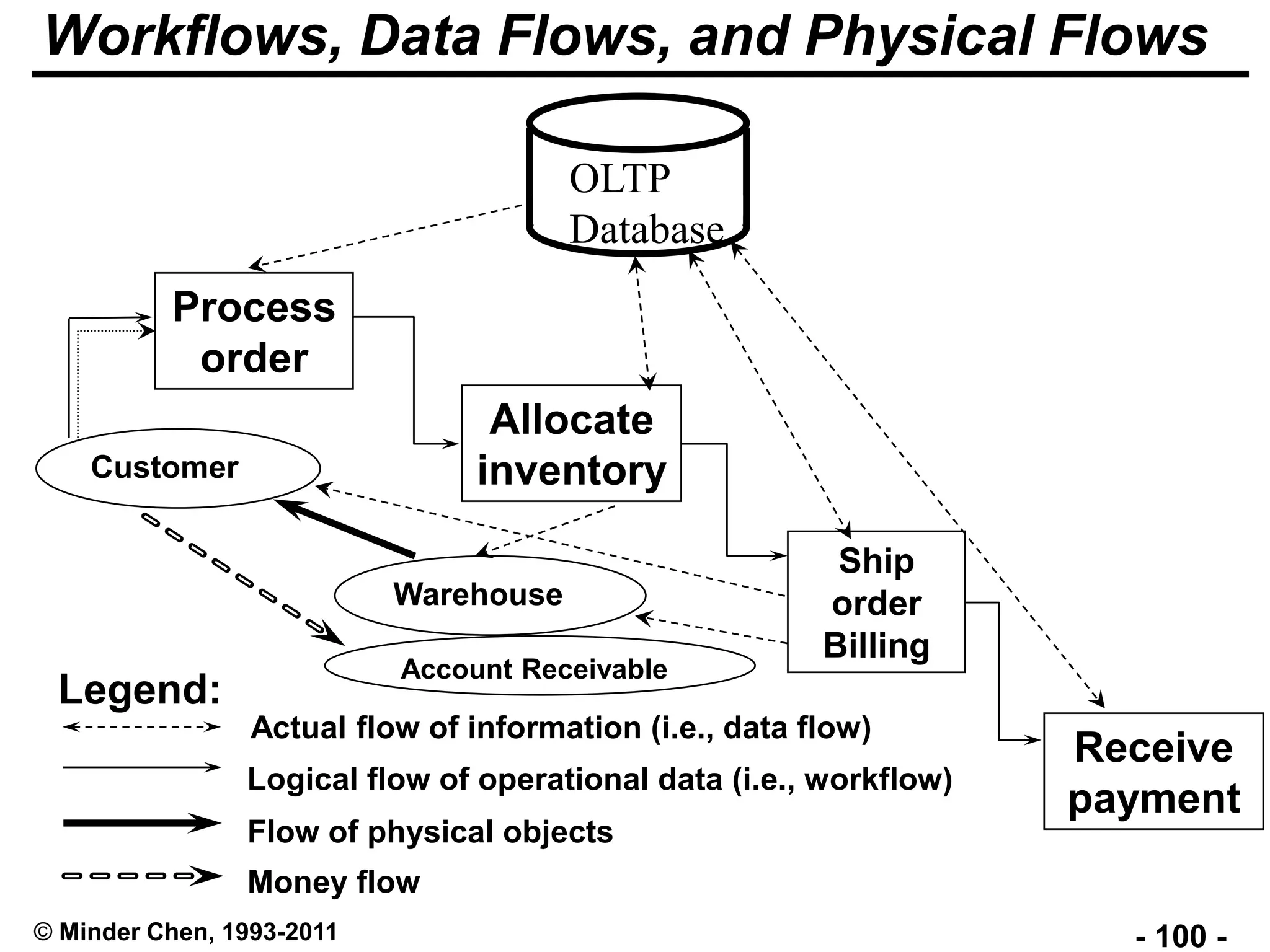
Process
order
Allocate
inventory
Ship
order
Billing
Receive
payment
Actual flow of information (i.e., data flow)
Logical flow of operational data (i.e., workflow)
Flow of physical objects
Money flow
Legend:
Warehouse
Customer
OLTP
Database
Workflows, Data Flows, and Physical Flows
Account Receivable
- 101 -© Minder Chen, 1993-2011
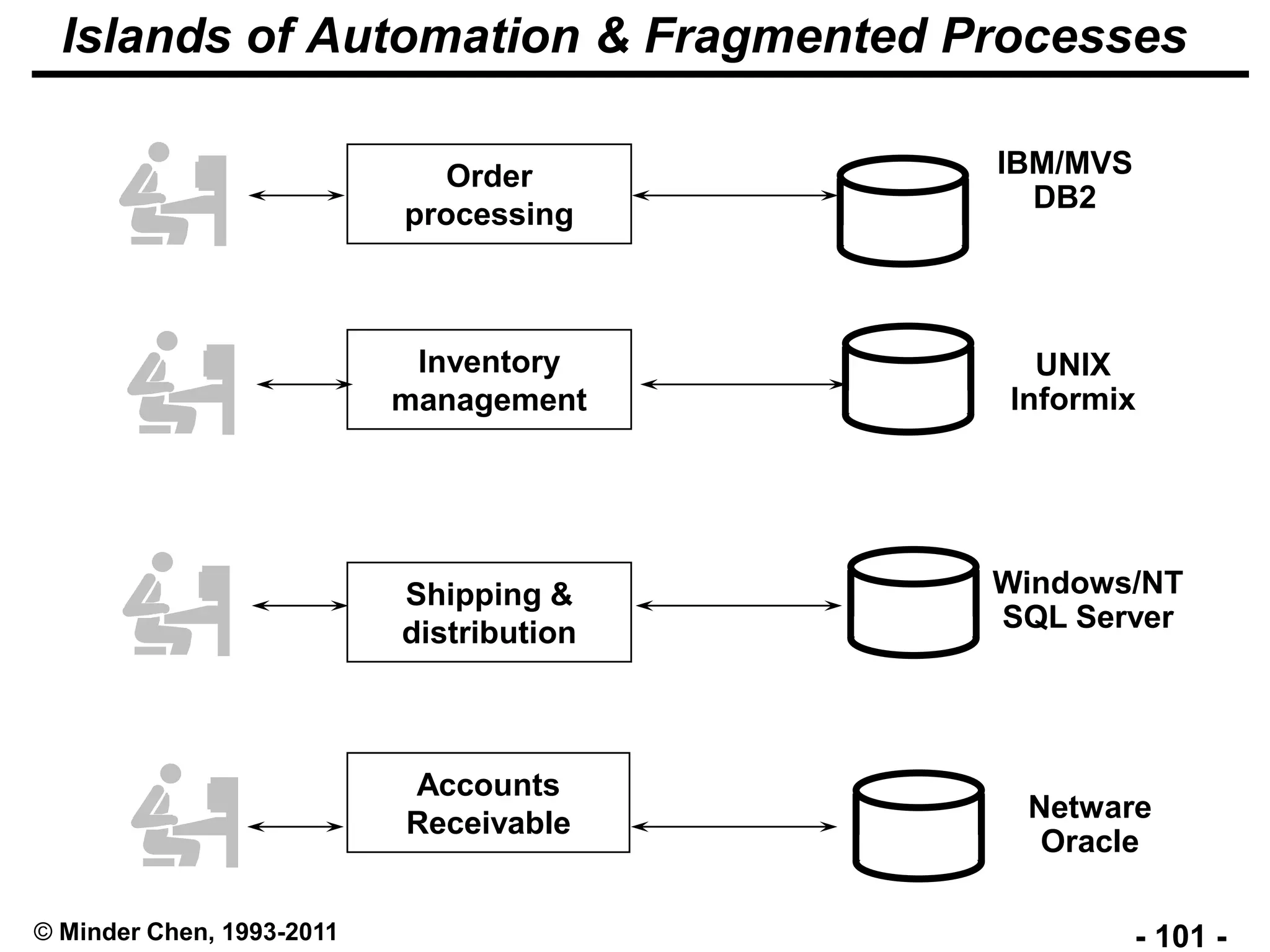
Islands of Automation & Fragmented Processes
Order
processing
Inventory
management
Shipping &
distribution
Accounts
Receivable
IBM/MVS
DB2
UNIX
Informix
Windows/NT
SQL Server
Netware
Oracle
- 102 -© Minder Chen, 1993-2011
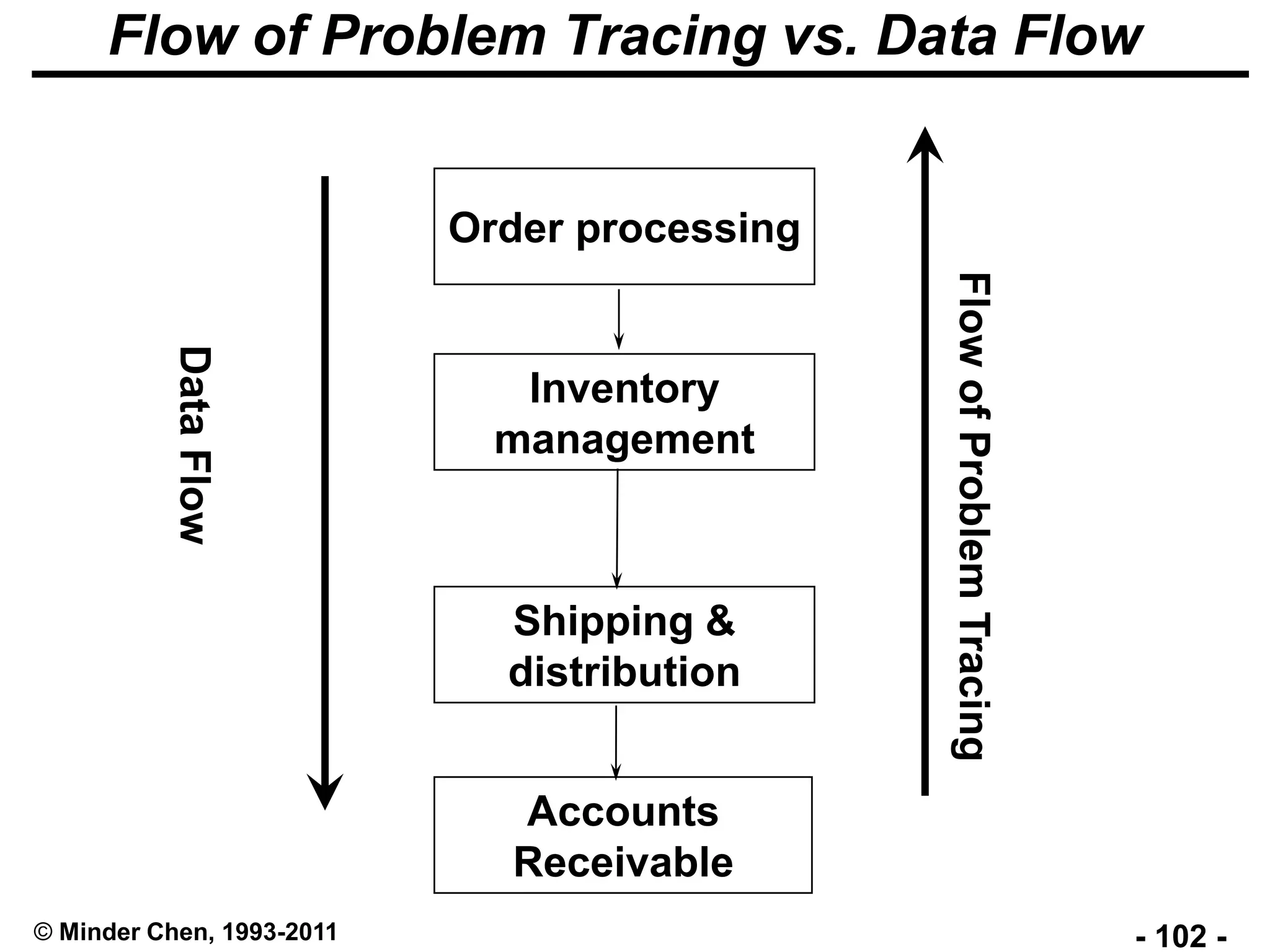
Flow of Problem Tracing vs. Data Flow
Order processing
Inventory
management
Shipping &
distribution
Accounts
Receivable
FlowofProblemTracing
DataFlow
- 103 -© Minder Chen, 1993-2011
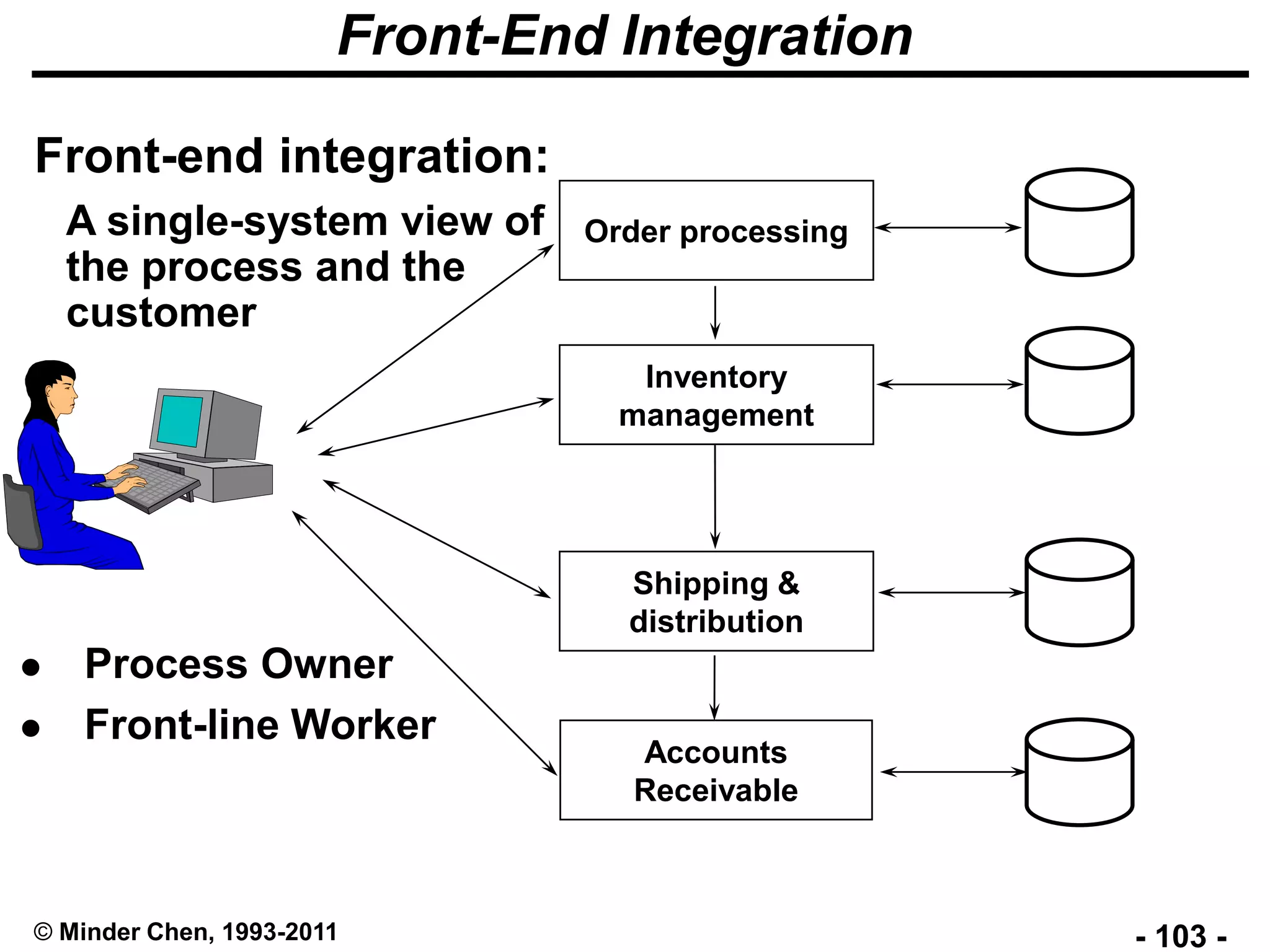
Front-End Integration
Order processing
Inventory
management
Shipping &
distribution
Accounts
Receivable
 Process Owner
 Front-line Worker
Front-end integration:
A single-system view of
the process and the
customer
- 104 -© Minder Chen, 1993-2011
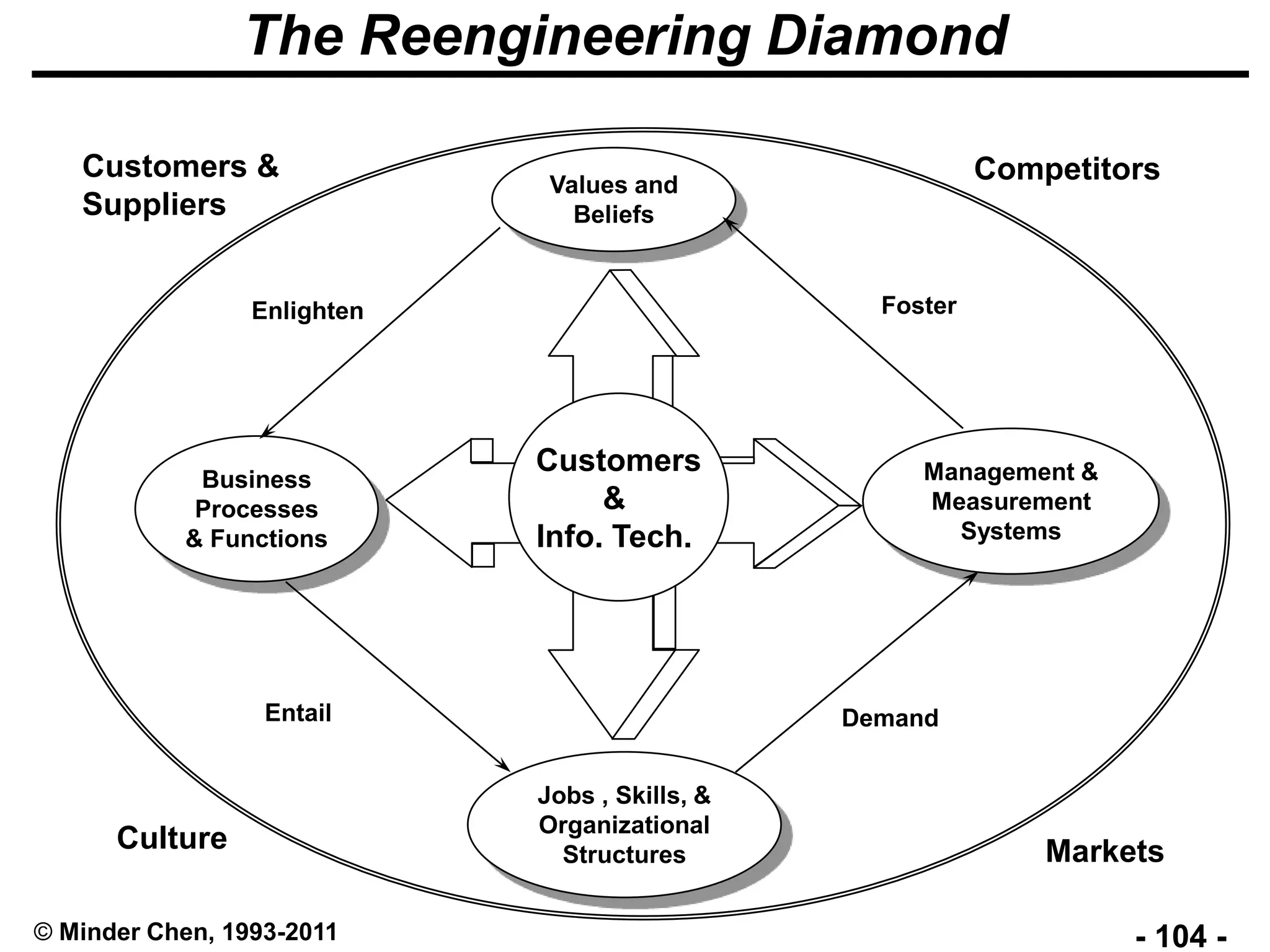
The Reengineering Diamond
Business
Processes
& Functions
Management &
Measurement
Systems
Jobs , Skills, &
Organizational
Structures
Values and
Beliefs
Enlighten
Entail Demand
Foster
Culture
Customers
&
Info. Tech.
Competitors
Markets
Customers &
Suppliers

4 business process reengineering

  • 1.
  • 2.
    - 2 -©Minder Chen, 1993-2011 BPR & The Organization
  • 3.
    - 3 -©Minder Chen, 1993-2011 What is BPR? • Reengineering is the fundamental rethinking and redesign of business processes to achieve dramatic improvements in critical, contemporary measures of performance, such as cost, quality, service and speed. (Hammer & Champy, 1993)
  • 4.
    - 4 -©Minder Chen, 1993-2011 BPR is Not? • Automation • Downsizing • Outsourcing
  • 5.
    - 5 -©Minder Chen, 1993-2011 BPR Versus Process Simplification Process Reengineering Radical Transformation Vision-Led Change Attitudes & Behaviors Director-Led Limited Number of Initiatives Process Simplification Incremental Change Process-Led Assume Attitudes & Behaviors Management-Led Various Simultaneous Projects (Source Coulson-Thomas, 1992)
  • 6.
    - 6 -©Minder Chen, 1993-2011 BPR Versus Continuous Improvement Process Reengineering Radical Transformation People & Technology Focus High Investment Rebuild Champion Driven Continuous Improvement Incremental Change People Focus Low Investment Improve Existing Work Unit Driven
  • 7.
    - 7 -©Minder Chen, 1993-2011 What is a Process? • A specific ordering of work activities across time and space, with a beginning, an end, and clearly identified inputs and outputs: a structure for action. (Davenport, 1993)
  • 8.
    - 8 -©Minder Chen, 1993-2011 What is a Business Process? • A group of logically related tasks that use the firm's resources to provide customer-oriented results in support of the organization's objectives
  • 9.
    - 9 -©Minder Chen, 1993-2011 Why Reengineer? • Customers – Demanding – Sophistication – Changing Needs • Competition – Local – Global
  • 10.
    - 10 -©Minder Chen, 1993-2011 Why Reengineer? • Change – Technology – Customer Preferences
  • 11.
    - 11 -©Minder Chen, 1993-2011 Why Organizations Don’t Reengineer? • Complacency • Political Resistance • New Developments • Fear of Unknown and Failure
  • 12.
    - 12 -©Minder Chen, 1993-2011 Performance • BPR seeks improvements of – Cost – Quality – Service – Speed
  • 13.
    - 13 -©Minder Chen, 1993-2011 Origins • Scientific Management. FW Taylor (1856-1915). • Frederick Herzberg - Job Enrichment • Deming et al - Total Quality Management and Kaizen • In Search of Excellence (Peters and Waterman) • Value-Added Analysis (Porter).
  • 14.
    - 14 -©Minder Chen, 1993-2011 Key Characteristics • Systems Philosophy • Global Perspective on Business Processes • Radical Improvement • Integrated Change • People Centred • Focus on End-Customers • Process-Based
  • 15.
    - 15 -©Minder Chen, 1993-2011 TransformationInputs Outputs Feedback Environment Systems Perspective
  • 16.
    - 16 -©Minder Chen, 1993-2011 Process Based • Added Value – BPR Initiatives must add-value over and above the existing process • Customer-Led – BPR Initiatives must meet the needs of the customer
  • 17.
    - 17 -©Minder Chen, 1993-2011 Radical Improvement • Sustainable – Process improvements need to become firmly rooted within the organization • Stepped Approach – Process improvements will not happen over night they need to be gradually introduced – Also assists the acceptance by staff of the change
  • 18.
    - 18 -©Minder Chen, 1993-2011 Integrated Change • Viable Solutions – Process improvements must be viable and practical • Balanced Improvements – Process improvements must be realistic
  • 19.
    - 19 -©Minder Chen, 1993-2011 People-Centred • Business Understanding • Empowerment & Participation • Organizational Culture
  • 20.
    - 20 -©Minder Chen, 1993-2011 Focus on End-Customers • Process improvements must relate to the needs of the organization and be relevant to the end- customers to which they are designed to serve
  • 21.
    - 21 -©Minder Chen, 1993-2011 BPR Symbols
  • 22.
    - 22 -©Minder Chen, 1993-2011 Business Process Flowchart Symbols An Activity A Document A Decision Data (input as outputs)
  • 23.
    - 23 -©Minder Chen, 1993-2011 Business Process Flowchart Symbols A Predefined Process The Start of a Process The End of a Process Representing a Relation Start End
  • 24.
    - 24 -©Minder Chen, 1993-2011 Business Process Flowchart Symbols Continuation of the process at the same page at an equal symbol with the same number. Used when a relation arrow crosses another relation arrow Off-Page Connector - Process will continue on the next page Integration Relation - A relation to another module is identified and described
  • 25.
    - 25 -©Minder Chen, 1993-2011 Data Flowchart Symbols An Activity A Document A Decision Flat Data File (input as outputs)
  • 26.
    - 26 -©Minder Chen, 1993-2011 Data Flowchart Symbols Manual Data Item A Database File Representing a Relation Continuation Off-Page Connector
  • 27.
    - 27 -©Minder Chen, 1993-2011 Rules For Data Symbols
  • 28.
    - 28 -©Minder Chen, 1993-2011 Rules For Data Symbols Start End Generate Purchase Order OK? Yes No Symbol used to identify the start of a business process Activities must be described as a verb Decisions have only two possibilities (Yes & No) Crossing lines are not allowed If one side of the decision has no further processes defined this symbol has to be used
  • 29.
    - 29 -©Minder Chen, 1993-2011 Rules For Data Symbols Purchase Order Posting of Bonus I A Continuation symbol within the same number must be present twice on the same page Name the document Off- Page Connector is used to continue a process at the next page or to let the process to flow over at the previous to the next page. If more than one is needed use A, B, C, D … Name the data
  • 30.
    - 30 -©Minder Chen, 1993-2011 Rules For Data Symbols Sub-Process Delivery BC 4.04 Predefined Processes always have a relation to level and stream by a number in the line below a sub-process description A predefined process must be described in a different flowchart. To make the relation clear between the predefined process and the belonging flowchart a unique alpha numeric number should be assigned to this predefined process.
  • 31.
    - 31 -©Minder Chen, 1993-2011 Version Management • For different versions of a business process or data flow some mandatory information must be on the flowchart. – Name of the business process – Unique number of the business process – Revision number – Date of last change – Author – Page number with total pages
  • 32.
    - 32 -©Minder Chen, 1993-2011 Implementing a BPR Strategy
  • 33.
    - 33 -©Minder Chen, 1993-2011 Key Steps Select The Process & Appoint Process Team Understand The Current Process Develop & Communicate Vision Of Improved Process Identify Action Plan Execute Plan
  • 34.
    - 34 -©Minder Chen, 1993-2011 Select the Process & Appoint Process Team • Two Crucial Tasks – Select The Process to be Reengineered – Appoint the Process Team to Lead the Reengineering Initiative
  • 35.
    - 35 -©Minder Chen, 1993-2011 Select the Process • Review Business Strategy and Customer Requirements • Select Core Processes • Understand Customer Needs • Don’t Assume Anything
  • 36.
    - 36 -©Minder Chen, 1993-2011 Select the Process • Select Correct Path for Change • Remember Assumptions can Hide Failures • Competition and Choice to Go Elsewhere • Ask - Questionnaires, Meetings, Focus Groups
  • 37.
    - 37 -©Minder Chen, 1993-2011 Appoint the Process Team • Appoint BPR Champion • Identify Process Owners • Establish Executive Improvement Team • Provide Training to Executive Team
  • 38.
    - 38 -©Minder Chen, 1993-2011 Core Skills Required • Capacity to view the organization as a whole • Ability to focus on end-customers • Ability to challenge fundamental assumptions • Courage to deliver and venture into unknown areas
  • 39.
    - 39 -©Minder Chen, 1993-2011 Core Skills Required • Ability to assume individual and collective responsibility • Employ ‘Bridge Builders’
  • 40.
    - 40 -©Minder Chen, 1993-2011 Use of Consultants • Used to generate internal capacity • Appropriate when a implementation is needed quickly • Ensure that adequate consultation is sought from staff so that the initiative is organization- led and not consultant-driven • Control should never be handed over to the consultant
  • 41.
    - 41 -©Minder Chen, 1993-2011 Understand the Current Process • Develop a Process Overview • Clearly define the process – Mission – Scope – Boundaries • Set business and customer measurements • Understand customers expectations from the process (staff including process team)
  • 42.
    - 42 -©Minder Chen, 1993-2011 Understand the Current Process • Clearly Identify Improvement Opportunities – Quality – Rework • Document the Process – Cost – Time – Value Data
  • 43.
    - 43 -©Minder Chen, 1993-2011 Understand the Current Process • Carefully resolve any inconsistencies – Existing -- New Process – Ideal -- Realistic Process
  • 44.
    - 44 -©Minder Chen, 1993-2011 Develop & Communicate Vision of Improved Process • Communicate with all employees so that they are aware of the vision of the future • Always provide information on the progress of the BPR initiative - good and bad. • Demonstrate assurance that the BPR initiative is both necessary and properly managed
  • 45.
    - 45 -©Minder Chen, 1993-2011 Develop & Communicate Vision of Improved Process • Promote individual development by indicating options that are available • Indicate actions required and those responsible • Tackle any actions that need resolution • Direct communication to reinforce new patterns of desired behavior
  • 46.
    - 46 -©Minder Chen, 1993-2011 Identify Action Plan • Develop an Improvement Plan • Appoint Process Owners • Simplify the Process to Reduce Process Time • Remove any Bureaucracy that may hinder implementation
  • 47.
    - 47 -©Minder Chen, 1993-2011 Identify Action Plan • Remove no-value-added activities • Standardize Process and Automate Where Possible • Up-grade Equipment • Plan/schedule the changes
  • 48.
    - 48 -©Minder Chen, 1993-2011 Identify Action Plan • Construct in-house metrics and targets • Introduce and firmly establish a feedback system • Audit, Audit, Audit
  • 49.
    - 49 -©Minder Chen, 1993-2011 Execute Plan • Qualify/certify the process • Perform periodic qualification reviews • Define and eliminate process problems • Evaluate the change impact on the business and on customers • Benchmark the process • Provide advanced team training
  • 50.
    - 50 -©Minder Chen, 1993-2011 Information Technology & BPR
  • 51.
    - 51 -©Minder Chen, 1993-2011 Benefits From IT • Assists the Implementation of Business Processes – Enables Product & Service Innovations – Improve Operational Efficiency – Coordinate Vendors & Customers in the Process Chain
  • 52.
    - 52 -©Minder Chen, 1993-2011 Computer Aided BPR (CABPR) • Focus – Business Processes – Process Redesign – Process Implementation
  • 53.
    - 53 -©Minder Chen, 1993-2011 BPR Challenges
  • 54.
    - 54 -©Minder Chen, 1993-2011 Common Problems • Process Simplification is Common - True BPR is Not • Desire to Change Not Strong Enough • Start Point the Existing Process Not a Blank Slate • Commitment to Existing Processes Too Strong – REMEMBER - “If it ain’t broke …” • Quick Fix Approach
  • 55.
    - 55 -©Minder Chen, 1993-2011 Common Problems with BPR • Process under review too big or too small • Reliance on existing process too strong • The Costs of the Change Seem Too Large • BPR Isolated Activity not Aligned to the Business Objectives • Allocation of Resources • Poor Timing and Planning • Keeping the Team and Organization on Target
  • 56.
    - 56 -©Minder Chen, 1993-2011 Summary • Reengineering is a fundamental rethinking and redesign of business processes to achieve dramatic improvements • BPR has emerged from key management traditions such as scientific management and systems thinking • Rules and symbols play an integral part of all BPR initiatives
  • 57.
    - 57 -©Minder Chen, 1993-2011 Summary • Don’t assume anything - remember BPR is fundamental rethinking of business processes
  • 58.
    - 58 -©Minder Chen, 1993-2011 BPR •PART -2
  • 59.
    - 59 -©Minder Chen, 1993-2011 Definition of Reengineering The fundamental rethinking and radical redesign of core business processes to achieve dramatic improvements in critical performance measures such as quality, cost, and cycle time. Source: Adapted from Hammer and Champy, Reengineering the Corporation, 1993
  • 60.
    - 60 -©Minder Chen, 1993-2011 What Business Reengineering Is Not? • Automating: Paving the cow paths. (Automate poor processes.) • Downsizing: Doing less with less. Cut costs or reduce payrolls. BPR involves innovation: Creating new products and services, as well as positive thinking are critical to the success of BPR.
  • 61.
    - 61 -©Minder Chen, 1993-2011 A Cow Path?
  • 62.
    - 62 -©Minder Chen, 1993-2011 Reengineering Is ... • Obliterate what you have now and start from scratch. • Transform every aspect of your organization. Source: Michael Hammer, “Reengineering Work: Don’t Automate, Obliterate,” Harvard Business Review, July-August, 1990, pp. 104-112. Extremist's View
  • 63.
    - 63 -©Minder Chen, 1993-2011 Definition of Process • A process is simply a structured, measured set of activities designed to produce a specific output for a particular customers or market. -- Thomas Davenport • Characteristics: – A specific sequencing of work activities across time and place – A beginning and an end – Clearly defined inputs and outputs – Customer-focus – How the work is done – Process ownership – Measurable and meaningful performance
  • 64.
    - 64 -©Minder Chen, 1993-2011 Processes Are Often Cross Functional Areas Marketing & Sales Purchase Production Distribution Accounting CEO Supplier Customer/ Markets Needs Value-added Products/ Services to Customers "Manage the white space on the organization chart!" "We cannot improve or measure the performance of a hierarchical structure. But, we can increase output quality and customer satisfaction, as well as reduce the cost and cycle time of a process to improve it."
  • 65.
    - 65 -©Minder Chen, 1993-2011 BPR Examples • Ford: Accounts Payable • Mutual Benefit Life: New Life Insurance Policy Application • Capital Holding Co.: Customer Service Process • Taco Bell: Company-wide BPR • Others
  • 66.
    - 66 -©Minder Chen, 1993-2011 Ford Accounts Payable Process* Accounts Payable Vendor GoodsReceiving Payment Invoice Receiving document Purchasing Purchase order Copy of purchase order PO = Receiving Doc. = Invoice *Source: Adapted from Hammer and Champy, 1993 ? ?
  • 67.
    - 67 -©Minder Chen, 1993-2011 Trigger for Ford’s AP Reengineering • Mazda only uses 1/5 personnel to do the same AP. (Ford: 500; Mazda: 5) • When goods arrive at the loading dock at Mazda: – Use bar-code reader is used to read delivery data. – Inventory data are updated. – Production schedules may be rescheduled if necessary. – Send electronic payment to the supplier.
  • 68.
    - 68 -©Minder Chen, 1993-2011 Ford Procurement Process Accounts Payable Vendor GoodsReceiving Payment Goods received Purchasing Purchase order Purchase order Data base
  • 69.
    - 69 -©Minder Chen, 1993-2011 Ford Accounts Payable Before After • More than 500 accounts payable clerks matched purchase order, receiving documents, and invoices and then issued payment. • It was slow and cumbersome. • Mismatches were common. • Reengineer “procurement” instead of AP process. • The new process cuts head count in AP by 75%. • Invoices are eliminated. • Matching is computerized. • Accuracy is improved.
  • 70.
    - 70 -©Minder Chen, 1993-2011 • 30 steps, 5 departments, 19 persons • Issuance application processing cycle time: 24 hours minimum; average 22 days • only 17 minutes in actually processing the application Department A Step 1 Department A Step 2 Department E Step 19 . . . . Issuance Application Issuance Policy New Life Insurance Policy Application Process at Mutual Benefits Life Before Reengineering* *Source: Adapted from Rethinking the Corporate Workplace: Case Manager at Mutual Benefit Life, Harvard Business School case 9-492-015, 1991. Mutual Benefits Life Before Reengineering*
  • 71.
    - 71 -©Minder Chen, 1993-2011 The New Life Insurance Policy Application Process Handled by Case Managers Case Manager Underwriter Physician Mainframe LAN Server PC Workstation • application processing cycle time: 4 hours minimum; 2-5 days average • Application handling capacity double • Cut 100 field office positions
  • 72.
    - 72 -©Minder Chen, 1993-2011 Capital Holding Co. - Direct Response Group* • A direct marketer of insurance-life, health, property, and casualty-via television, telephone, and direct mail. • In 1988, DRG president Norm Phelps and other senior executives decided that for our company, the days of mass marketing were over. • Need to strengthen DRG's relationships with existing customers and target our marketing to those potential customers whose profiles matched specific company strategies. • A new vision for DRG: The company needed to be exactly what most people didn't expect it to be an insurance company that cares about its customers and wants to give them the best possible value for their premium dollar. *Source: Adapted from Capital Holding Corporation-Reengineering the Direct Response Group, Harvard Business School case 192-001, 1992.
  • 73.
    - 73 -©Minder Chen, 1993-2011 Capital Holding Co.: Vision Caring, Listening, Satisfying... one by one Each of us is devoted to satisfying the financial concerns of every member of our customer family by: • Deeply caring about and understanding each member’s unique financial concerns. • Providing value through products and services that meet each member’s financial concerns. • Responding with the clear information, personal attention and respect to which each member is entitled. • Nurturing an enduring relationship that earns each member’s loyalty and recommendation.
  • 74.
    - 74 -©Minder Chen, 1993-2011 New Business Model: A Conceptual Breakthrough Target & Segment of Aggregate Market Use Individual Information Use Group Information Prospects Customers Sell & Renew Capture Individual Information & Personalized Service “I Think I Know.” “I Know for Sure.” Market Management Customer Management
  • 75.
    - 75 -©Minder Chen, 1993-2011 A High-Level Service Process Model Today CSR Life A&H Micro- Data Letter- System Customer Corres. Policy film Entry shop Change What’s your policy #’s? Challis 3 Life 70 Micro-film Request Action Request Day 1 Micro-film Response Day 5 • Increase my A&H coverage • Give me information about my Life Policy beneficiaries Action Request Day 2 Input Requested Change Day 5 A&H change confirmation letter mailed to customer System Update Life Policy beneficiaries letter mailed to customer Day 6 Day 6 (Batch) Day 8 Customer receives two separate responses
  • 76.
    - 76 -©Minder Chen, 1993-2011 Customer Management Team (CMT): A Flavor of How DRG Service Process Will Change Immediate Response to Customer Day 1 Answers Day 3-4 Day 1-2 Day 1 Send written acknowledgment • Increase my A&H coverage • Give me information about my Life Policy beneficiaries Customer CMT: Teleservice Representative System: Client-server architecture Outbound Paper
  • 77.
    - 77 -©Minder Chen, 1993-2011 Taco Bell* • “We were going backwards - fast ... If something was simple, we made it complex. If it was hard, we figured out a way to make it impossible.” - Taco Bell CEO, John E. Martin • Customer buy for $1 are worth about 25 cents. 75 cents goes into marketing, advertising, and overhead. • Reengineering from the customer’s point of view. “Are customer willing to pay for these ‘value-added’ activities?” *Source: Adapted from Hammer and Champy, 1993
  • 78.
    - 78 -©Minder Chen, 1993-2011 Taco Bell • Corporate Vision: “We want to be number one in share of stomach.” • Slashed kitchen: Kitchens : Seating capacity 70% : 30%  30% : 70% • Eliminate district managers. Restaurant managers are given profit-and-loss responsibility. • Moving cooking of meat and bean outside. • Boost peak serving capacity at average restaurant from $400 an hour to $1,500 a hour. • $500 millions regional company in 1982 to $3 billion national company in 1992.
  • 79.
    - 79 -©Minder Chen, 1993-2011 Reengineering Example Which line is shorter and faster? Cash Lane No more than 10 items
  • 80.
    - 80 -©Minder Chen, 1993-2011 Reengineered Process Key Concept: • One queue for multiple service points • Multiple services workstation
  • 81.
    - 81 -©Minder Chen, 1993-2011 BPR Principles • Organize around outcomes, not tasks. • Have those who use the output of the process perform the process. • Subsume information-processing work into the real work that produces the information. • Treat geographically dispersed resources as though they were centralized. • Link parallel activities instead of integrating their results. • Put decision points where the work is performed and build controls into the process. • Capture information once and at the source. Source: Michael Hammer, “Reengineering Work: Don’t Automate, Obliterate,” Harvard Business Review, July-August, 1990, pp. 104-112.
  • 82.
    - 82 -©Minder Chen, 1993-2011
  • 83.
    - 83 -©Minder Chen, 1993-2011 A BPR Framework Organization – Job skills – Structures – Reward – Values Technology – Enabling technologies – IS architectures – Methods and tools – IS organizations Process – Core business processes – Value-added – Customer-focus – Innovation
  • 84.
    - 84 -©Minder Chen, 1993-2011 Business Process Reengineering Life Cycle Define corporate visions and business goals Identify business processes to be reengineered Analyze and measure an existing process Identify enabling IT & generate alternative process redesigns Evaluate and select a process redesign Implement the reengineered process Continuous improvement of the process Visioning Identifying Analyzing Redesigning Evaluating Implementing Improving Manage change and stakeholder interests BPR-LC  Enterprise-wide engineering Process-specific engineering
  • 85.
    - 85 -©Minder Chen, 1993-2011 TI Semiconductor Business Process Map Manufacturing Capability Development Strategy Development Product Development Customer Design & Support Order Fulfillment Concept Development Manufacturing Market Customers Customer Communication Source: Adapted from Hammer and Champy, 1993, p. 119.
  • 86.
    - 86 -©Minder Chen, 1993-2011 Using Value Chain to Identify High-Level Processes Added Value Corporate Infrastructure Inbound Logistic Operation Outbound Logistic ServiceSales and Marketing Primary Activity Supporting Activity Human Resource Management Procurement Technology Deployment
  • 87.
    - 87 -©Minder Chen, 1993-2011 Criteria for Selecting Processes • Broken • Bottleneck • Cross-functional or cross-organizational units • Core processes that have high impacts • Front-line and customer serving - the moment of the truth • Value-adding • New processes and services • Feasible
  • 88.
    - 88 -©Minder Chen, 1993-2011 Process Data • Basic Overall process data: – Customers and customer requirements – Suppliers and suppliers qualifications – Breakthrough goals – Performance characteristics: Cost, cycle time, reliability, and defect rate. – Systems constraints: Budgetary, business, legal, social, environmental, and safety issues and constraints. • Measure critical process metrics – Cycle time – Cost – Input quality – Output quality – Frequency and distribution of inputs
  • 89.
    - 89 -©Minder Chen, 1993-2011 Phase 4: Redesigning Identify enabling IT & generate alternative process redesigns Information Technology Business Reengineering How can IT support business processes? How can business processes be transformed using IT? Source: Thomas H. Davenport and James E. Short, “The New Industrial Engineering: Information technology and Business Process Redesign,” Sloan Management Review, Summer 1990, pp. 11-26. Technology-drivenBusiness-pulled
  • 90.
    - 90 -©Minder Chen, 1993-2011 Evaluation Criteria • Costs – Design and implementing the business process – Hire and train employee – Develop supporting IS – Purchase of other equipment and facilities • Benefits – Customer requirements – Breakthrough goals – Performance criteria – Constraints • Risk – Technology availability and maturity – Time required for design and implementation – Learning curve – Cost and schedule overrun
  • 91.
    - 91 -©Minder Chen, 1993-2011 Enabling IT to Consider • Client/server technology • Groupware and collaboration technologies • Mobile computing (wireless LAN, pen-based computing, GPS, iPhone) • Data capturing technology (scanner/barcode reader/RFID) • Telephony: Integration of computer and telephone systems; VoIP; Unified communications • Web services and Service-Oriented Architecture (SOA) • Imaging technology, work flow management systems, Business Process Management (BPM) • Decision support systems, Data warehouse, Business intelligence, Data mining, Digital dashboard • ERP, CRM, SCM • Electronic Data Interchange (EDI), Electronic Commerce, WWW, and Internet • Web 2.0 ….
  • 92.
    - 92 -©Minder Chen, 1993-2011 IT Enabling Effects Dimensions & Type Examples IT Enabling Effects Order from a supplier Develop a new product Approve a bank loan Manufacture a product Prepare a proposal Fill a customer order Develop a budget Lower transaction costs Eliminate intermediaries Work across geography Greater concurrency Integrate role and task Increase outcome flexibility Control process Routinize complex decision Reduce time and costs Increase output quality Improve analysis Increase participation Adapted from: Davenport, T. H. and Short, J. E., "The New Industrial Engineering: Information Technology and Business Process Redesign," Sloan Management Review, Summer 1990, p. 17. Organization Entity • Interorganizational • Interfunctional • Interpersonal Objects • Physical • Informational Activities • Operational • Managerial
  • 93.
    - 93 -©Minder Chen, 1993-2011 End-to-End Processes Customer Manufacturing Inventory Mgmt. Shipping Marketing/ Sales Account Receivable
  • 94.
    - 94 -©Minder Chen, 1993-2011 Order Management Cycle 1. Order Planning 2. Order Generation 3. Cost estimation and pricing 4. Order receipt and entry 5. Order selection and prioritization 6. Scheduling 7. Fulfillment – Procurement – Manufacturing – Assembling – Testing – Shipping – Installation 8. Billing 9. Returns and Claims 10. Postsales Services
  • 95.
    - 95 -©Minder Chen, 1993-2011 Empowered Customer-Focus Processes Values and Quality delivered to Customers timely Empowered Font-line worker Customer-facing Process Manager as Coach Teamwork
  • 96.
    - 96 -©Minder Chen, 1993-2011 Think from the Customer Back The Customer Management Organization Functions/Processes Activities/Tasks Define Outcomes Redesign Outputs Determine Activities Define Job Responsibilities Develop Organization Structure * Adapted from The Price Waterhouse Change Integration Team, Better Change, Irwin, 1995, p. 163.
  • 97.
    - 97 -©Minder Chen, 1993-2011 The Business Context of Business Networking Company Customer Customer's Customer Suppliers/ Partner N C N C N C N C N: Needs and Perceived Needs C: Capabilities Source: Adapted from Charles M. Savage, "The Dawn of the Knowledge Era," OR/MS Today, pp. 18-23. Virtual Enterprising Competitor Share: • Costs • Skills • Market access • Technology
  • 98.
    - 98 -©Minder Chen, 1993-2011 Standard Flowchart Symbols Activity Movement/ Transportation Decision Point Paper document Delay Storage Connector Begin/End Annotation Direction of process flow Transmission
  • 99.
    - 99 -©Minder Chen, 1993-2011 Functional Flowchart (Process Mapping) Customer Service Credit Checking Inventory Shipping Begin Enter Order Check Credit Yes Order Processing Update Inventory Ship orderEnd P R O C E S S  C Y C L E  1 2 1 1 1 2 0.1 4 3 0.2 1 4 ... ... ... A C T I V I T Y Wait for shipping No Customer
  • 100.
    - 100 -©Minder Chen, 1993-2011 Process order Allocate inventory Ship order Billing Receive payment Actual flow of information (i.e., data flow) Logical flow of operational data (i.e., workflow) Flow of physical objects Money flow Legend: Warehouse Customer OLTP Database Workflows, Data Flows, and Physical Flows Account Receivable
  • 101.
    - 101 -©Minder Chen, 1993-2011 Islands of Automation & Fragmented Processes Order processing Inventory management Shipping & distribution Accounts Receivable IBM/MVS DB2 UNIX Informix Windows/NT SQL Server Netware Oracle
  • 102.
    - 102 -©Minder Chen, 1993-2011 Flow of Problem Tracing vs. Data Flow Order processing Inventory management Shipping & distribution Accounts Receivable FlowofProblemTracing DataFlow
  • 103.
    - 103 -©Minder Chen, 1993-2011 Front-End Integration Order processing Inventory management Shipping & distribution Accounts Receivable  Process Owner  Front-line Worker Front-end integration: A single-system view of the process and the customer
  • 104.
    - 104 -©Minder Chen, 1993-2011 The Reengineering Diamond Business Processes & Functions Management & Measurement Systems Jobs , Skills, & Organizational Structures Values and Beliefs Enlighten Entail Demand Foster Culture Customers & Info. Tech. Competitors Markets Customers & Suppliers