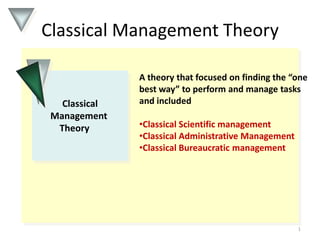
1Classical Management TheoryA theory that focused on finding the “one best way” to perform and manage tasks and includedClassical Scientific management
Classical Administrative Management
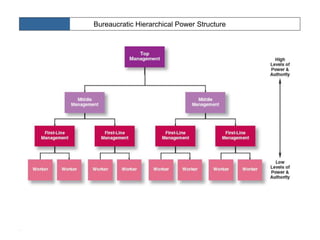
Classical Bureaucratic managementClassicalManagement      Theory
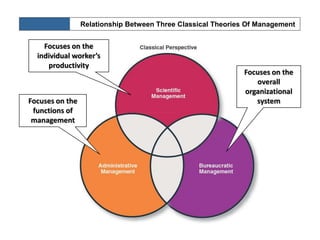
2Classical Management TheoryClassicalScientificSchoolFocused on the manufacturing environment and individual’s work productivity and efficiencyClassicalAdministrativeSchoolEmphasized the flow of information and how organizations should operate/functions of management ClassicalBureaucratic SchoolIdentified Organization as a system and management as a study of this system Emphasized the flow of information and how organizations should operate
Relationship Between Three Classical Theories Of ManagementFocuses on the individual worker’s productivityFocuses on the overall organizational systemFocuses on the functions of management
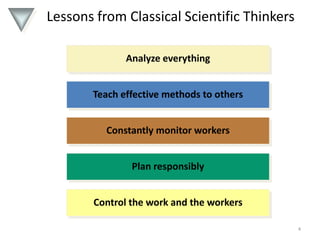
4Lessons from Classical Scientific ThinkersAnalyze everythingTeach effective methods to othersConstantly monitor workersPlan responsiblyControl the work and the workers
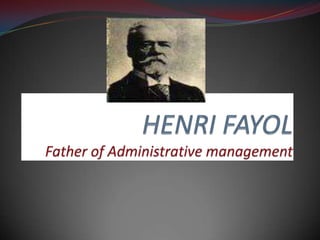
HENRI FAYOLFather of Administrative management
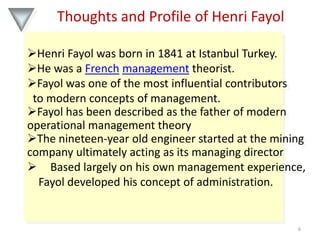
Thoughts and Profile of Henri Fayol6Henri Fayol was born in 1841 at Istanbul Turkey.
He was a Frenchmanagement theorist.
Fayol was one of the most influential contributors   to modern concepts of management.Fayol has been described as the father of modern operational management theoryThe nineteen-year old engineer started at the mining company ultimately acting as its managing directorBased largely on his own management experience,     Fayol developed his concept of administration.
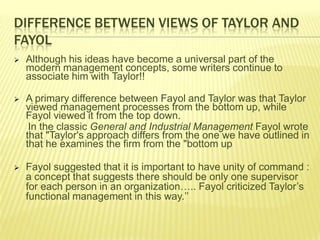
Difference between views of Taylor and FayolAlthough his ideas have become a universal part of the modern management concepts, some writers continue to associate him with Taylor!!
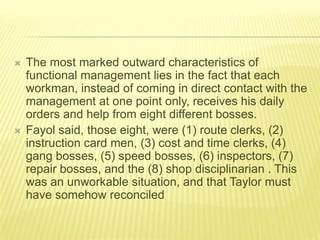
A primary difference between Fayol and Taylor was that Taylor viewed management processes from the bottom up, while Fayol viewed it from the top down.      In the classic General and Industrial Management Fayol wrote that "Taylor's approach differs from the one we have outlined in that he examines the firm from the "bottom upFayol suggested that it is important to have unity of command : a concept that suggests there should be only one supervisor for each person in an organization….. Fayol criticized Taylor’s functional management in this way.’’ The most marked outward characteristics of functional management lies in the fact that each workman, instead of coming in direct contact with the management at one point only, receives his daily orders and help from eight different bosses. Fayol said, those eight, were (1) route clerks, (2) instruction card men, (3) cost and time clerks, (4) gang bosses, (5) speed bosses, (6) inspectors, (7) repair bosses, and the (8) shop disciplinarian . This  was an unworkable situation, and that Taylor must have somehow reconciled
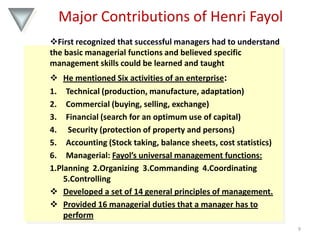
Major Contributions of Henri Fayol9First recognized that successful managers had to understand the basic managerial functions and believed specific management skills could be learned and taught
He mentioned Six activities of an enterprise:Technical (production, manufacture, adaptation)Commercial (buying, selling, exchange)Financial (search for an optimum use of capital) Security (protection of property and persons)Accounting (Stock taking, balance sheets, cost statistics)Managerial: Fayol’s universal management functions:1.Planning  2.Organizing  3.Commanding  4.Coordinating 5.ControllingDeveloped a set of 14 general principles of management.
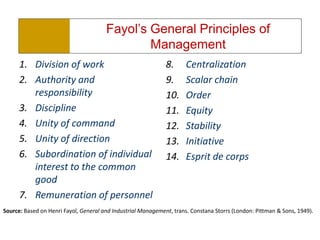
Provided 16 managerial duties that a manager has to performFayol’s General Principles of Management.Division of workAuthority and responsibilityDisciplineUnity of commandUnity of directionSubordination of individual interest to the common goodRemuneration of personnelCentralizationScalar chainOrderEquityStabilityInitiativeEsprit de corpsSource: Based on Henri Fayol, General and Industrial Management, trans. Constana Storrs (London: Pittman & Sons, 1949).
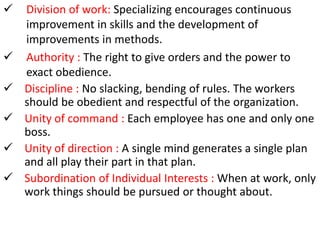
Division of work: Specializing encourages continuous improvement in skills and the development of improvements in methods.
Authority : The right to give orders and the power to exact obedience.
Discipline : No slacking, bending of rules. The workers should be obedient and respectful of the organization.

Henry fayol

  • 1.
    1Classical Management TheoryAtheory that focused on finding the “one best way” to perform and manage tasks and includedClassical Scientific management
  • 2.
  • 3.
  • 4.
    2Classical Management TheoryClassicalScientificSchoolFocusedon the manufacturing environment and individual’s work productivity and efficiencyClassicalAdministrativeSchoolEmphasized the flow of information and how organizations should operate/functions of management ClassicalBureaucratic SchoolIdentified Organization as a system and management as a study of this system Emphasized the flow of information and how organizations should operate
  • 5.
    Relationship Between ThreeClassical Theories Of ManagementFocuses on the individual worker’s productivityFocuses on the overall organizational systemFocuses on the functions of management
  • 6.
    4Lessons from ClassicalScientific ThinkersAnalyze everythingTeach effective methods to othersConstantly monitor workersPlan responsiblyControl the work and the workers
  • 7.
    HENRI FAYOLFather ofAdministrative management
  • 8.
    Thoughts and Profileof Henri Fayol6Henri Fayol was born in 1841 at Istanbul Turkey.
  • 9.
    He was aFrenchmanagement theorist.
  • 10.
    Fayol was oneof the most influential contributors to modern concepts of management.Fayol has been described as the father of modern operational management theoryThe nineteen-year old engineer started at the mining company ultimately acting as its managing directorBased largely on his own management experience, Fayol developed his concept of administration.
  • 11.
    Difference between viewsof Taylor and FayolAlthough his ideas have become a universal part of the modern management concepts, some writers continue to associate him with Taylor!!
  • 12.
    A primary differencebetween Fayol and Taylor was that Taylor viewed management processes from the bottom up, while Fayol viewed it from the top down. In the classic General and Industrial Management Fayol wrote that "Taylor's approach differs from the one we have outlined in that he examines the firm from the "bottom upFayol suggested that it is important to have unity of command : a concept that suggests there should be only one supervisor for each person in an organization….. Fayol criticized Taylor’s functional management in this way.’’ The most marked outward characteristics of functional management lies in the fact that each workman, instead of coming in direct contact with the management at one point only, receives his daily orders and help from eight different bosses. Fayol said, those eight, were (1) route clerks, (2) instruction card men, (3) cost and time clerks, (4) gang bosses, (5) speed bosses, (6) inspectors, (7) repair bosses, and the (8) shop disciplinarian . This was an unworkable situation, and that Taylor must have somehow reconciled
  • 13.
    Major Contributions ofHenri Fayol9First recognized that successful managers had to understand the basic managerial functions and believed specific management skills could be learned and taught
  • 14.
    He mentioned Sixactivities of an enterprise:Technical (production, manufacture, adaptation)Commercial (buying, selling, exchange)Financial (search for an optimum use of capital) Security (protection of property and persons)Accounting (Stock taking, balance sheets, cost statistics)Managerial: Fayol’s universal management functions:1.Planning 2.Organizing 3.Commanding 4.Coordinating 5.ControllingDeveloped a set of 14 general principles of management.
  • 15.
    Provided 16 managerialduties that a manager has to performFayol’s General Principles of Management.Division of workAuthority and responsibilityDisciplineUnity of commandUnity of directionSubordination of individual interest to the common goodRemuneration of personnelCentralizationScalar chainOrderEquityStabilityInitiativeEsprit de corpsSource: Based on Henri Fayol, General and Industrial Management, trans. Constana Storrs (London: Pittman & Sons, 1949).
  • 16.
    Division of work:Specializing encourages continuous improvement in skills and the development of improvements in methods.
  • 17.
    Authority : Theright to give orders and the power to exact obedience.
  • 18.
    Discipline : Noslacking, bending of rules. The workers should be obedient and respectful of the organization.