The document provides an introduction and history of business process re-engineering (BPR). It discusses how BPR aims to fundamentally rethink and radically redesign business processes to achieve dramatic improvements in performance. BPR focuses on completely redesigning processes from scratch rather than automating existing processes. It emphasizes starting without preconceptions and focusing on what processes should be, rather than what they are currently.
BPR - EvolutionOrganisations aim to increase productivity & quality service and to reduce cost Traditional organisation structure, customer services and business methods are out-dated Low barriers to entry, hence stiffer competition - locally & globally Current business are: customer-focused and market driven process-focused and team-oriented Focused on speed & response time focused on customer relationships
3.
Business concepts of1990 Rework of TQM, continuous improvement Survey results shows that BPR was unsuccessful BPR leaders - James Champy; Thomas Davenport Deming and Juran discussed about BPR in TQM reports BPR was introduced in 70’s to the manufacturing environment BPR - Origins
4.
Business Process Davenport& Short’s definition ” a set of logically related tasks performed to achieve a defined business outcome . A structured, measured set of activities designed to produce a specified output for a particular customer or market. It implies a strong emphasis on how work is done within an organization” - Davenport & Short, 1990
5.
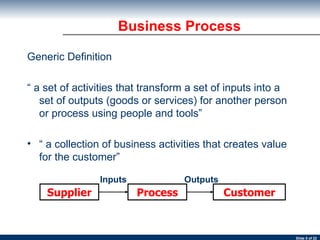
Business Process GenericDefinition “ a set of activities that transform a set of inputs into a set of outputs (goods or services) for another person or process using people and tools” “ a collection of business activities that creates value for the customer” Inputs Supplier Process Customer Outputs
6.
Business Process Whatare Business processes? sequences and combinations of business activities. management processes control and coordinate these activities and ensure that business objectives are delivered. support processes, the name implies, provide infrastructural and other assistance to business processes. Business Processes can be further differentiated into knowledge-based and operational processes .
7.
What are Knowledge-basedprocesses? Product development, research activities, advertisement, and management consulting. These processes typically are of non-standard nature They rely on the knowledge and creativity of the persons involved. Knowledge-based processes are not dominant in Business Reengineering projects. - Davenport; Jarvenpaa; Beers, 1996 Knowledge-based Processes
8.
Operational Processes Whatare Operational processes ? Customer service, procurement, and manufacturing. They are at the heart of most Business Reengineering efforts. They are classified by their relative stability, standardisation and repeatability. Operational processes are further classified into key and secondary processes. Key processes directly support the mission and the strategies of the company.
9.
Business Process ComponentsThey have people / customers (internal or external) They have information and decision made They have channels to transmit information They cross organizational boundaries, i.e., they occur across or between organizational sub-units
10.
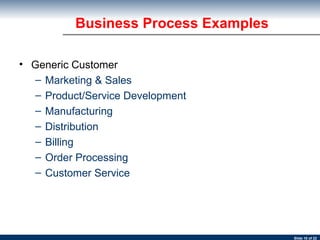
Generic Customer Marketing& Sales Product/Service Development Manufacturing Distribution Billing Order Processing Customer Service Business Process Examples
11.
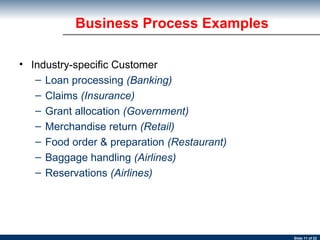
Business Process ExamplesIndustry-specific Customer Loan processing (Banking) Claims (Insurance) Grant allocation (Government) Merchandise return (Retail) Food order & preparation (Restaurant) Baggage handling (Airlines) Reservations (Airlines)
12.
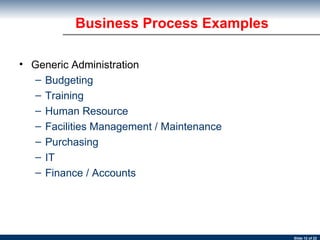
Business Process ExamplesGeneric Administration Budgeting Training Human Resource Facilities Management / Maintenance Purchasing IT Finance / Accounts
13.
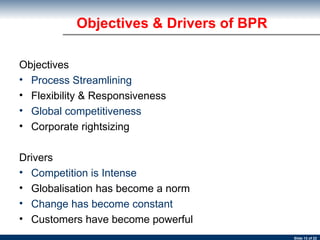
Objectives Process StreamliningFlexibility & Responsiveness Global competitiveness Corporate rightsizing Drivers Competition is Intense Globalisation has become a norm Change has become constant Customers have become powerful Objectives & Drivers of BPR
14.
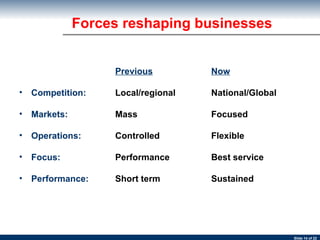
Forces reshaping businessesPrevious Now Competition : Local/regional National/Global Markets: Mass Focused Operations: Controlled Flexible Focus: Performance Best service Performance: Short term Sustained
15.
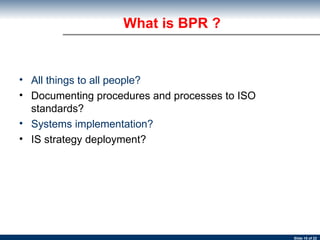
All things toall people? Documenting procedures and processes to ISO standards? Systems implementation? IS strategy deployment? What is BPR ?
16.
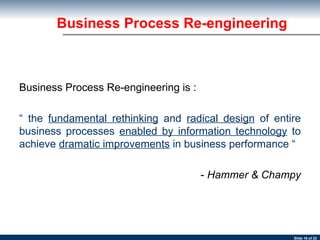
Business Process Re-engineeringBusiness Process Re-engineering is : “ the fundamental rethinking and radical design of entire business processes enabled by information technology to achieve dramatic improvements in business performance “ - Hammer & Champy
17.
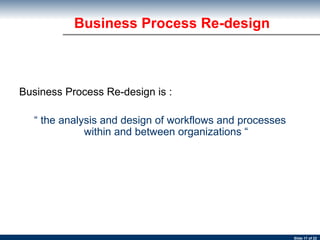
Business Process Re-designis : “ the analysis and design of workflows and processes within and between organizations “ Business Process Re-design
18.
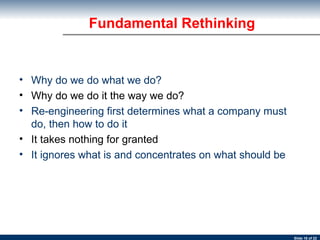
Fundamental Rethinking Whydo we do what we do? Why do we do it the way we do? Re-engineering first determines what a company must do, then how to do it It takes nothing for granted It ignores what is and concentrates on what should be
19.
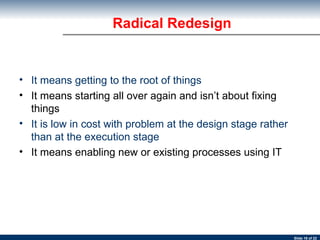
It means gettingto the root of things It means starting all over again and isn’t about fixing things It is low in cost with problem at the design stage rather than at the execution stage It means enabling new or existing processes using IT Radical Redesign
20.
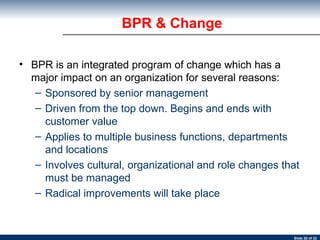
BPR is anintegrated program of change which has a major impact on an organization for several reasons: Sponsored by senior management Driven from the top down. Begins and ends with customer value Applies to multiple business functions, departments and locations Involves cultural, organizational and role changes that must be managed Radical improvements will take place BPR & Change
21.
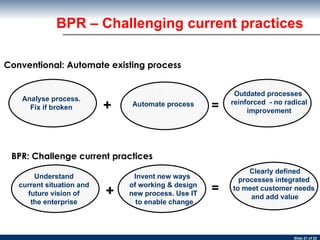
BPR – Challengingcurrent practices BPR: Challenge current practices + = + = Analyse process. Fix if broken Automate process Outdated processes reinforced - no radical improvement Understand current situation and future vision of the enterprise Invent new ways of working & design new process. Use IT to enable change Conventional: Automate existing process Clearly defined processes integrated to meet customer needs and add value