

1
AISSMS COLLEGE OF PHARMACY, PUNE-01
Prepared by
SHIVANI KAILAS CHAUDHARI
M. Pharmacy
(Dept. of Quality Assurance)
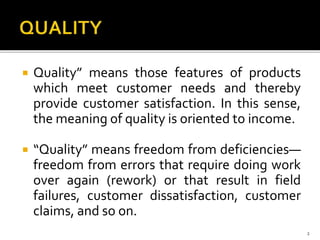
 Quality” means those features of products
which meet customer needs and thereby
provide customer satisfaction. In this sense,
the meaning of quality is oriented to income.
 “Quality” means freedom from deficiencies—
freedom from errors that require doing work
over again (rework) or that result in field
failures, customer dissatisfaction, customer
claims, and so on.
2
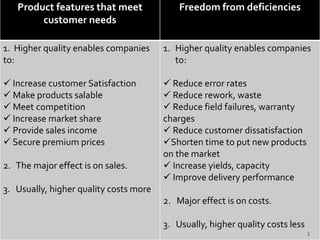
Product features that meet
customer needs
Freedom from deficiencies
1. Higher quality enables companies
to:
 Increase customer Satisfaction
 Make products salable
 Meet competition
 Increase market share
 Provide sales income
 Secure premium prices
2. The major effect is on sales.
3. Usually, higher quality costs more
1. Higher quality enables companies
to:
 Reduce error rates
 Reduce rework, waste
 Reduce field failures, warranty
charges
 Reduce customer dissatisfaction
Shorten time to put new products
on the market
 Increase yields, capacity
 Improve delivery performance
2. Major effect is on costs.
3. Usually, higher quality costs less
3
4
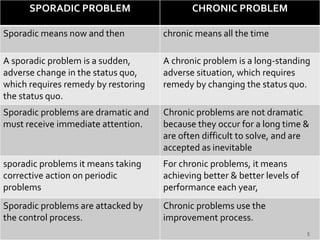
SPORADIC PROBLEM CHRONIC PROBLEM
Sporadic means now and then chronic means all the time
A sporadic problem is a sudden,
adverse change in the status quo,
which requires remedy by restoring
the status quo.
A chronic problem is a long-standing
adverse situation, which requires
remedy by changing the status quo.
Sporadic problems are dramatic and
must receive immediate attention.
Chronic problems are not dramatic
because they occur for a long time &
are often difficult to solve, and are
accepted as inevitable
sporadic problems it means taking
corrective action on periodic
problems
For chronic problems, it means
achieving better & better levels of
performance each year,
Sporadic problems are attacked by
the control process.
Chronic problems use the
improvement process.
5
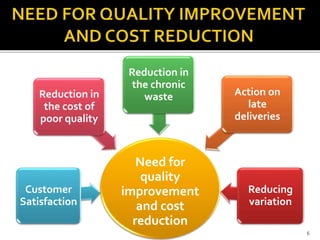
Need for
quality
improvement
and cost
reduction
Customer
Satisfaction
Reduction in
the cost of
poor quality
Reduction in
the chronic
waste Action on
late
deliveries
Reducing
variation
6
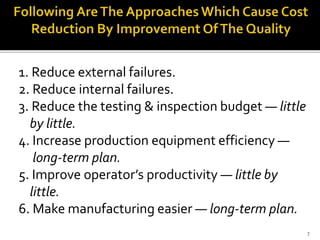
1. Reduce external failures.
2. Reduce internal failures.
3. Reduce the testing & inspection budget — little
by little.
4. Increase production equipment efficiency —
long-term plan.
5. Improve operator’s productivity — little by
little.
6. Make manufacturing easier — long-term plan.
7
 Joseph M. Juran, Frank M. Gryna, et al:
“Juran’s Quality Planning & Analysis for
Enterprise Quality”, 5th Edition, McGraw-hill
Publication, Pg No: 29, 33- 35, 59, 64-65, 67
 Joseph M. Juran, A. Blanton Godfrey: “ Juran’s
Quality Handbook”, 5th Edition, Mcgraw-hill
Publication, Pg No: 2.1-2.2, 2.5-2.7, 3.2-3.3,
4.2, 4.5, 5.3, 8.14- 8.16
8

Quality improvement and cost reduction

  • 1.
    1 AISSMS COLLEGE OFPHARMACY, PUNE-01 Prepared by SHIVANI KAILAS CHAUDHARI M. Pharmacy (Dept. of Quality Assurance)
  • 2.
     Quality” meansthose features of products which meet customer needs and thereby provide customer satisfaction. In this sense, the meaning of quality is oriented to income.  “Quality” means freedom from deficiencies— freedom from errors that require doing work over again (rework) or that result in field failures, customer dissatisfaction, customer claims, and so on. 2
  • 3.
    Product features thatmeet customer needs Freedom from deficiencies 1. Higher quality enables companies to:  Increase customer Satisfaction  Make products salable  Meet competition  Increase market share  Provide sales income  Secure premium prices 2. The major effect is on sales. 3. Usually, higher quality costs more 1. Higher quality enables companies to:  Reduce error rates  Reduce rework, waste  Reduce field failures, warranty charges  Reduce customer dissatisfaction Shorten time to put new products on the market  Increase yields, capacity  Improve delivery performance 2. Major effect is on costs. 3. Usually, higher quality costs less 3
  • 4.
  • 5.
    SPORADIC PROBLEM CHRONICPROBLEM Sporadic means now and then chronic means all the time A sporadic problem is a sudden, adverse change in the status quo, which requires remedy by restoring the status quo. A chronic problem is a long-standing adverse situation, which requires remedy by changing the status quo. Sporadic problems are dramatic and must receive immediate attention. Chronic problems are not dramatic because they occur for a long time & are often difficult to solve, and are accepted as inevitable sporadic problems it means taking corrective action on periodic problems For chronic problems, it means achieving better & better levels of performance each year, Sporadic problems are attacked by the control process. Chronic problems use the improvement process. 5
  • 6.
    Need for quality improvement and cost reduction Customer Satisfaction Reductionin the cost of poor quality Reduction in the chronic waste Action on late deliveries Reducing variation 6
  • 7.
    1. Reduce externalfailures. 2. Reduce internal failures. 3. Reduce the testing & inspection budget — little by little. 4. Increase production equipment efficiency — long-term plan. 5. Improve operator’s productivity — little by little. 6. Make manufacturing easier — long-term plan. 7
  • 8.
     Joseph M.Juran, Frank M. Gryna, et al: “Juran’s Quality Planning & Analysis for Enterprise Quality”, 5th Edition, McGraw-hill Publication, Pg No: 29, 33- 35, 59, 64-65, 67  Joseph M. Juran, A. Blanton Godfrey: “ Juran’s Quality Handbook”, 5th Edition, Mcgraw-hill Publication, Pg No: 2.1-2.2, 2.5-2.7, 3.2-3.3, 4.2, 4.5, 5.3, 8.14- 8.16 8