Business process Re-engineering 
The assumption of an absolute determinism is the 
essential foundation of every scientific enquiry. 
― Max Planck, 
Dilawar Abbas
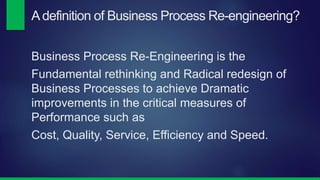
A definition of Business Process Re-engineering? 
Business Process Re-Engineering is the 
Fundamental rethinking and Radical redesign of 
Business Processes to achieve Dramatic 
improvements in the critical measures of 
Performance such as 
Cost, Quality, Service, Efficiency and Speed.
Re-Engineering is NOT 
 Automation for existing ineffective processes. 
 Sophisticated computerization of obsolete processes. 
 Playing with organization structures. 
 Downsizing - doing less with less. 
 Reorganizing. 
 Change Management 
 ISO9000
Reason for Re-engineering 
OLD ERA 
 High Depends 
 Efficiency 
 Control 
NEW ERA 
 High Competition 
 Innovation 
 Speed 
 Service & Quality
. . . follow process and progress 
will follow.
Effectiveness 
To improve service and 
satisfy customer needs, 
while lowering costs. 
Automation 
use technology to automate 
the 
"AS-IS" process to make it 
happen faster 
V/ 
S
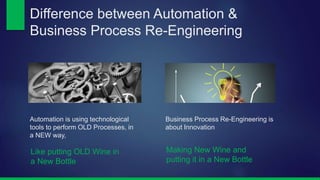
Difference between Automation & 
Business Process Re-Engineering 
Business Process Re-Engineering is 
about Innovation 
Making New Wine and 
putting it in a New Bottle 
Automation is using technological 
tools to perform OLD Processes, in 
a NEW way, 
Like putting OLD Wine in 
a New Bottle
3 Goals of Business Process Re-Engineering 
Customer Friendliness Effectiveness Efficiency 
• Meeting customer 
requirements closely 
• Providing 
convenience 
• Outcome based 
approach 
• Gaining loyalty of 
customers 
• Image and branding 
• Cost 
• Time 
• Effort
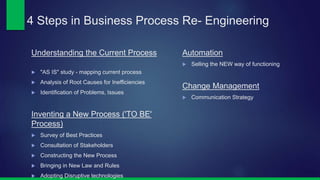
4 Steps in Business Process Re- Engineering 
Understanding the Current Process 
 "AS IS" study - mapping current process 
 Analysis of Root Causes for Inefficiencies 
 Identification of Problems, Issues 
Inventing a New Process ('TO BE' 
Process) 
 Survey of Best Practices 
 Consultation of Stakeholders 
 Constructing the New Process 
 Bringing in New Law and Rules 
 Adopting Disruptive technologies 
Automation 
 Selling the NEW way of functioning 
Change Management 
 Communication Strategy
9 Changes Occasioned by Business Process 
Re-Engineering 
Work Units Change • from functional departments to process teams 
Job Changes • from simple task to multiple-dimensional work 
People's role change • From controlled to empowered 
Job preparation changes • from training to education 
Measures of Performances 
& Compensation Change • from activity to results 
Criteria for career 
advancement change • from performance to ability 
Values change • from protective to productive 
Organizational Structure 
Change • from hierarchical to flat 
Executive change • from scorekeepers to leaders
Critical Success Factors in Business Process 
Re-Engineering 
1. Clear Vision for Transformation 
2. Top management commitment 
3. Identification of Core Processes for Business Process Re-Engineering 
4. Ambitious Business Process Re-Engineering Team 
5. Knowledge of Re-Engineering techniques 
6. Engaging external consultants 
7. Tolerance of "genuine failures" 
8. Change Management
Critical Failure Factors in Business Process 
Re-Engineering 
1. Trying to Fix a process instead of Changing it. 
2. Lack of focus on Business-critical Processes 
3. Lack of holistic approach 
4. Willingness to settle for minor results 
5. Quitting too early 
6. Limiting the scope of Business Processing Engineering by existing constraints 
7. Dominance of existing corporate culture 
8. Adopting bottom-up approach 
9. Poor leadership 
10. Trying to avoid making anyone unhappy 
11. Dragging the Business Process Re-Engineering exercise too long.
Scope of Business Process Re-Engineering 
Intra-functional 
 Small scope within department, least impact 
Inter-functional 
 Horizontal view across departments, more impact 
Inter-organizational 
 Broad view including entire supply & delivery chain, most impact
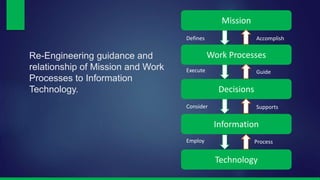
Re-Engineering guidance and 
relationship of Mission and Work 
Processes to Information 
Technology. 
Mission 
Defines Accomplish 
Work Processes 
Execute Guide 
Decisions 
Consider Supports 
Information 
Employ Process 
Technology
Why Organizations do not Re-Engineer 
Complacency 
Political Resistance 
New Developments 
Fear of Unknown and Failure
The essence of Business 
Process Re-Engineering is 
Transformation 
The essence of Business Process Re- 
Engineering is 
Transformation
A 4-Pronged Approach to Transformation 
Transformation 
Transforming 
Process 
• Eliminate 
• Simplify 
• Automate 
• Base of Trust 
• Integrate 
• Join Up 
• Legislate 
Transforming 
Culture 
• Competency 
• Helful 
• Polite 
• Professional 
• Adaptation of Change 
Using 
Technology 
• Enterprise wide 
Architecture 
• Centralized System 
• Unified Database 
• Unified Networks 
• Web Based System 
Transforming 
People 
• Training 
• Change Management 
• Consultation 
• Empowerment 
• Education 
• Awareness
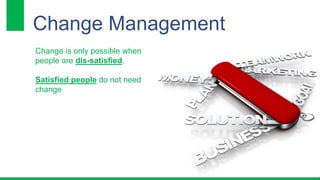
Change Management 
Change is only possible when 
people are dis-satisfied. 
Satisfied people do not need 
change
What Change Management Is & What 
it is Not 
1. Change management is not a stand-alone process for designing a business solution. 
2. Change management is the processes, tools and techniques for managing the people-side 
of change. 
3. Change management is not a process improvement method. 
4. Change management is a method for reducing and managing resistance to change when 
implementing process, technology or organizational change. 
5. Change management is not a stand-alone technique for improving organizational 
performance. 
6. Change management is a necessary component for any organizational performance 
improvement process to succeed, including programs like: Six Sigma, Business Process 
Reengineering, Total Quality Management, Organizational Development, Restructuring 
and continuous process improvement. 
7. Change management is how we drive the adoption and usage we need to realize 
business results.
Change Advisory Board 
 A change advisory board (CAB) delivers support to a change management team by 
approving requested changes and assisting in the assessment and prioritization of changes. 
This body is generally made up of IT and Business representatives that include: a change 
manager, user managers and groups, technical experts, possible third parties and customers 
(if required). 
 It is advised to form a Change Advisory Board in-order to manage the Change Planning & 
Implementation. 
Chairman 
Change Advisory Board 
Permanent 
Board Members 
Temporary Board Members 
(Department Based)
We are what we repeatedly do. 
Excellence then, is not an act, but a habit.
Readiness Analysis 
1. Is there a compelling business need for strategic change? 
2. Is the organization prepared to challenge it status quo? 
3. Would it have the courage to create a new vision? 
4. What's the degree and quality of sponsorship and commitment of senior 
management? 
5. Are they prepared to be deeply involved? 
6. Do they have the energy to follow through the entire change process? 
7. Is the organization prepared to commit resources (time, energy, money) to 
undertake the Business Process Re-Engineering project? 
8. What is the overall organization's attitude towards change? 
9. Is the organization prepared to overcome resistance to change? 
10. You create dissatisfaction, if you want people to change.
Business Process Re-Engineering 
Team Composition 
1. Top Management: CEO / COO as SPONSOR 
2. Senior & Middle Management in EXECUTIVE TEAM 
3. Selected Senior & Junior Management Staff to form 
PROCESS TEAMS 
4. Enthusiastic and energetic individual as Business Process 
Re-Engineering Coordinator 
5. Business Process Engineers
Thank You

Business Process Re-Engineering

  • 1.
    Business process Re-engineering The assumption of an absolute determinism is the essential foundation of every scientific enquiry. ― Max Planck, Dilawar Abbas
  • 2.
    A definition ofBusiness Process Re-engineering? Business Process Re-Engineering is the Fundamental rethinking and Radical redesign of Business Processes to achieve Dramatic improvements in the critical measures of Performance such as Cost, Quality, Service, Efficiency and Speed.
  • 3.
    Re-Engineering is NOT  Automation for existing ineffective processes.  Sophisticated computerization of obsolete processes.  Playing with organization structures.  Downsizing - doing less with less.  Reorganizing.  Change Management  ISO9000
  • 4.
    Reason for Re-engineering OLD ERA  High Depends  Efficiency  Control NEW ERA  High Competition  Innovation  Speed  Service & Quality
  • 5.
    . . .follow process and progress will follow.
  • 6.
    Effectiveness To improveservice and satisfy customer needs, while lowering costs. Automation use technology to automate the "AS-IS" process to make it happen faster V/ S
  • 7.
    Difference between Automation& Business Process Re-Engineering Business Process Re-Engineering is about Innovation Making New Wine and putting it in a New Bottle Automation is using technological tools to perform OLD Processes, in a NEW way, Like putting OLD Wine in a New Bottle
  • 8.
    3 Goals ofBusiness Process Re-Engineering Customer Friendliness Effectiveness Efficiency • Meeting customer requirements closely • Providing convenience • Outcome based approach • Gaining loyalty of customers • Image and branding • Cost • Time • Effort
  • 9.
    4 Steps inBusiness Process Re- Engineering Understanding the Current Process  "AS IS" study - mapping current process  Analysis of Root Causes for Inefficiencies  Identification of Problems, Issues Inventing a New Process ('TO BE' Process)  Survey of Best Practices  Consultation of Stakeholders  Constructing the New Process  Bringing in New Law and Rules  Adopting Disruptive technologies Automation  Selling the NEW way of functioning Change Management  Communication Strategy
  • 10.
    9 Changes Occasionedby Business Process Re-Engineering Work Units Change • from functional departments to process teams Job Changes • from simple task to multiple-dimensional work People's role change • From controlled to empowered Job preparation changes • from training to education Measures of Performances & Compensation Change • from activity to results Criteria for career advancement change • from performance to ability Values change • from protective to productive Organizational Structure Change • from hierarchical to flat Executive change • from scorekeepers to leaders
  • 11.
    Critical Success Factorsin Business Process Re-Engineering 1. Clear Vision for Transformation 2. Top management commitment 3. Identification of Core Processes for Business Process Re-Engineering 4. Ambitious Business Process Re-Engineering Team 5. Knowledge of Re-Engineering techniques 6. Engaging external consultants 7. Tolerance of "genuine failures" 8. Change Management
  • 12.
    Critical Failure Factorsin Business Process Re-Engineering 1. Trying to Fix a process instead of Changing it. 2. Lack of focus on Business-critical Processes 3. Lack of holistic approach 4. Willingness to settle for minor results 5. Quitting too early 6. Limiting the scope of Business Processing Engineering by existing constraints 7. Dominance of existing corporate culture 8. Adopting bottom-up approach 9. Poor leadership 10. Trying to avoid making anyone unhappy 11. Dragging the Business Process Re-Engineering exercise too long.
  • 13.
    Scope of BusinessProcess Re-Engineering Intra-functional  Small scope within department, least impact Inter-functional  Horizontal view across departments, more impact Inter-organizational  Broad view including entire supply & delivery chain, most impact
  • 14.
    Re-Engineering guidance and relationship of Mission and Work Processes to Information Technology. Mission Defines Accomplish Work Processes Execute Guide Decisions Consider Supports Information Employ Process Technology
  • 15.
    Why Organizations donot Re-Engineer Complacency Political Resistance New Developments Fear of Unknown and Failure
  • 16.
    The essence ofBusiness Process Re-Engineering is Transformation The essence of Business Process Re- Engineering is Transformation
  • 17.
    A 4-Pronged Approachto Transformation Transformation Transforming Process • Eliminate • Simplify • Automate • Base of Trust • Integrate • Join Up • Legislate Transforming Culture • Competency • Helful • Polite • Professional • Adaptation of Change Using Technology • Enterprise wide Architecture • Centralized System • Unified Database • Unified Networks • Web Based System Transforming People • Training • Change Management • Consultation • Empowerment • Education • Awareness
  • 18.
    Change Management Changeis only possible when people are dis-satisfied. Satisfied people do not need change
  • 19.
    What Change ManagementIs & What it is Not 1. Change management is not a stand-alone process for designing a business solution. 2. Change management is the processes, tools and techniques for managing the people-side of change. 3. Change management is not a process improvement method. 4. Change management is a method for reducing and managing resistance to change when implementing process, technology or organizational change. 5. Change management is not a stand-alone technique for improving organizational performance. 6. Change management is a necessary component for any organizational performance improvement process to succeed, including programs like: Six Sigma, Business Process Reengineering, Total Quality Management, Organizational Development, Restructuring and continuous process improvement. 7. Change management is how we drive the adoption and usage we need to realize business results.
  • 20.
    Change Advisory Board  A change advisory board (CAB) delivers support to a change management team by approving requested changes and assisting in the assessment and prioritization of changes. This body is generally made up of IT and Business representatives that include: a change manager, user managers and groups, technical experts, possible third parties and customers (if required).  It is advised to form a Change Advisory Board in-order to manage the Change Planning & Implementation. Chairman Change Advisory Board Permanent Board Members Temporary Board Members (Department Based)
  • 21.
    We are whatwe repeatedly do. Excellence then, is not an act, but a habit.
  • 22.
    Readiness Analysis 1.Is there a compelling business need for strategic change? 2. Is the organization prepared to challenge it status quo? 3. Would it have the courage to create a new vision? 4. What's the degree and quality of sponsorship and commitment of senior management? 5. Are they prepared to be deeply involved? 6. Do they have the energy to follow through the entire change process? 7. Is the organization prepared to commit resources (time, energy, money) to undertake the Business Process Re-Engineering project? 8. What is the overall organization's attitude towards change? 9. Is the organization prepared to overcome resistance to change? 10. You create dissatisfaction, if you want people to change.
  • 23.
    Business Process Re-Engineering Team Composition 1. Top Management: CEO / COO as SPONSOR 2. Senior & Middle Management in EXECUTIVE TEAM 3. Selected Senior & Junior Management Staff to form PROCESS TEAMS 4. Enthusiastic and energetic individual as Business Process Re-Engineering Coordinator 5. Business Process Engineers
  • 24.