Business Architecture:
Upwards, Downwards, Sideways, Back
Tom Graves, Tetradian Consulting
Business architecture:
What’s this about?
What is business-architecture?
Where do we start?
What is
Business Architecture?
Business-architecture is
the architecture
– the structure and the story –
of the business of the business.
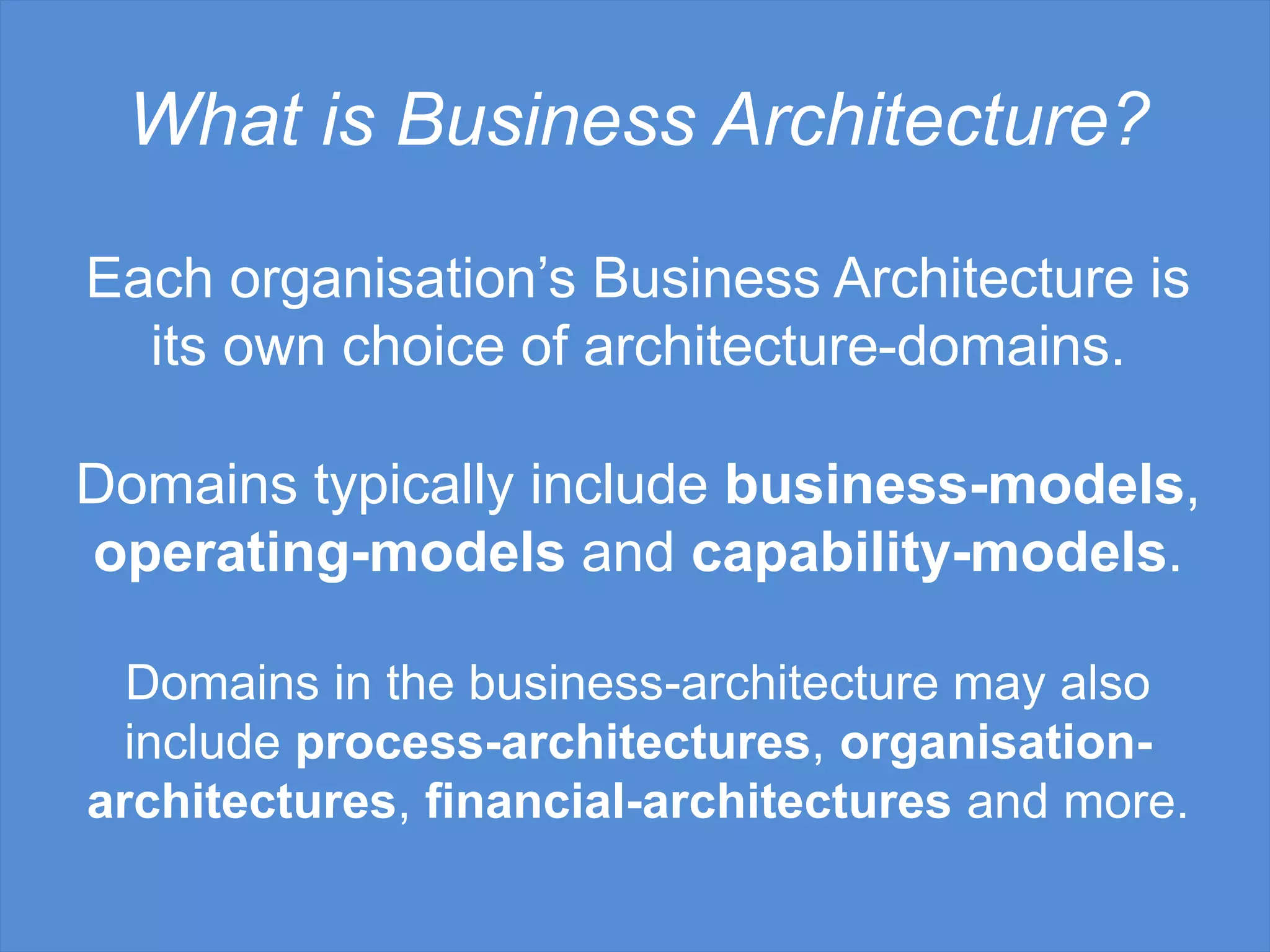
What is Business Architecture?
Domains typically include business-models,
operating-models and capability-models.
Domains in the business-architecture may also
include process-architectures, organisation-
architectures, financial-architectures and more.
Each organisation’s Business Architecture is
its own choice of architecture-domains.
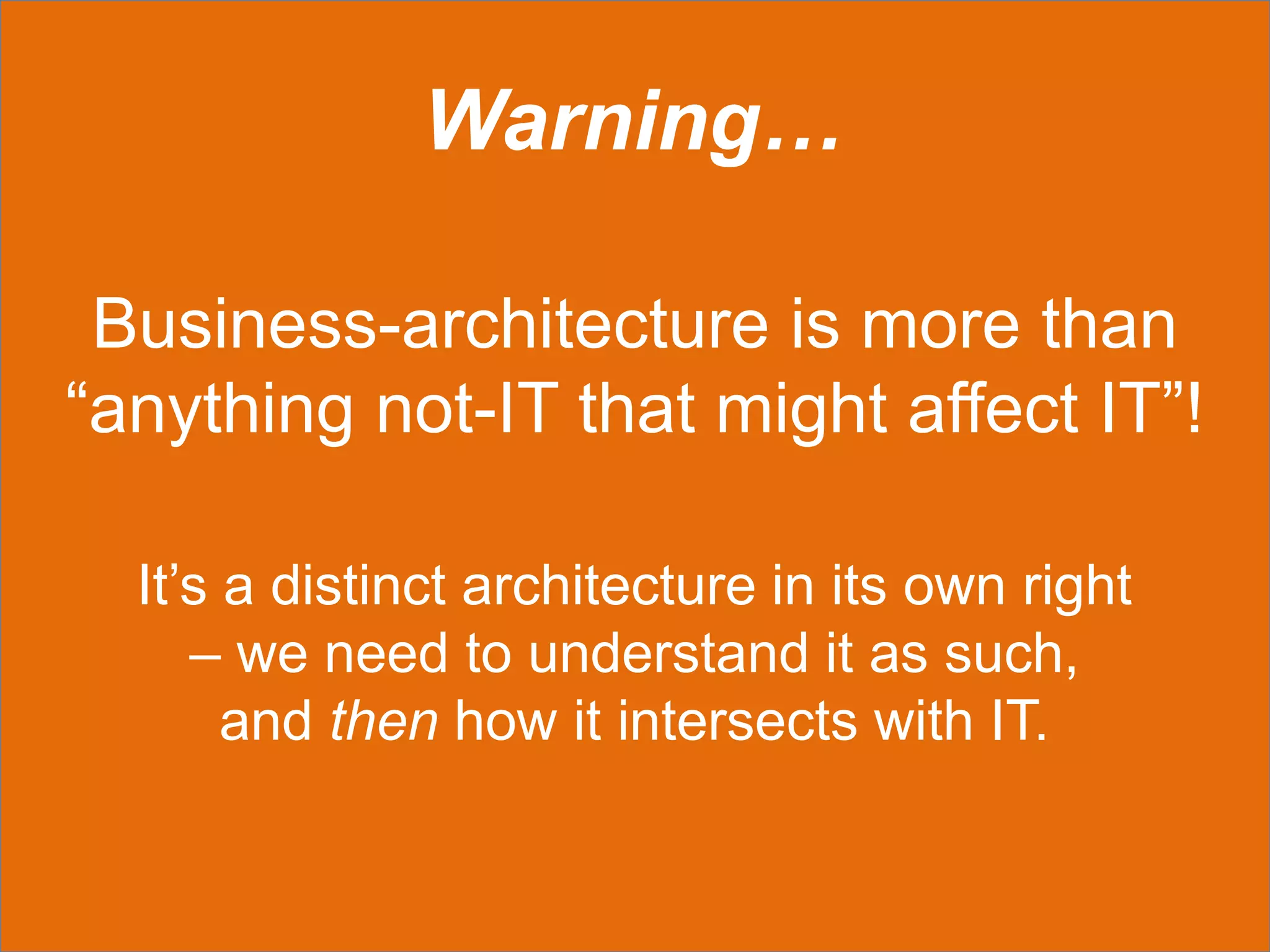
Warning…
It’s a distinct architecture in its own right
– we need to understand it as such,
and then how it intersects with IT.
Business-architecture is more than
“anything not-IT that might affect IT”!
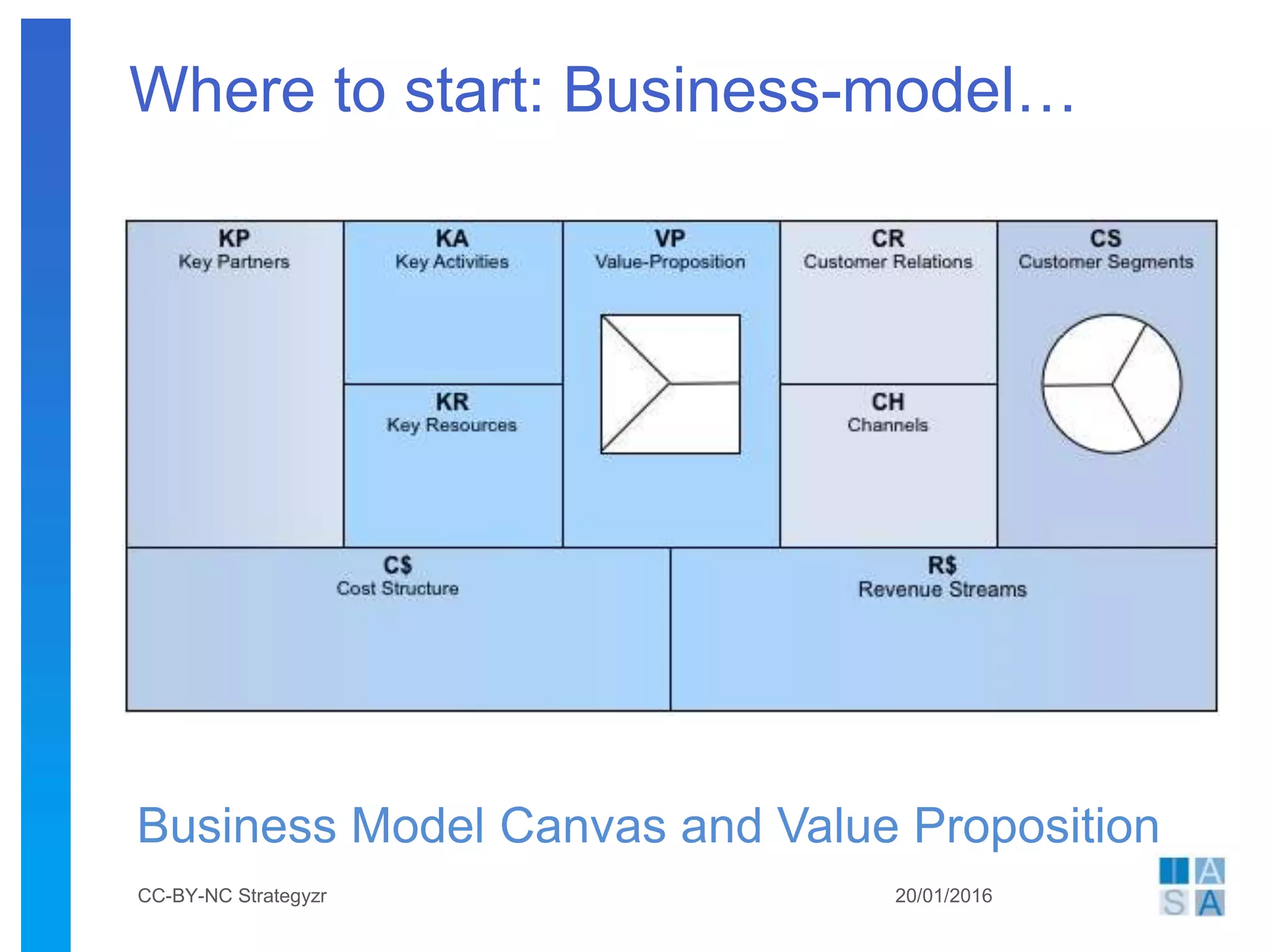
Where to start: Business-model…
Business Model Canvas and Value Proposition
20/01/2016CC-BY-NC Strategyzr
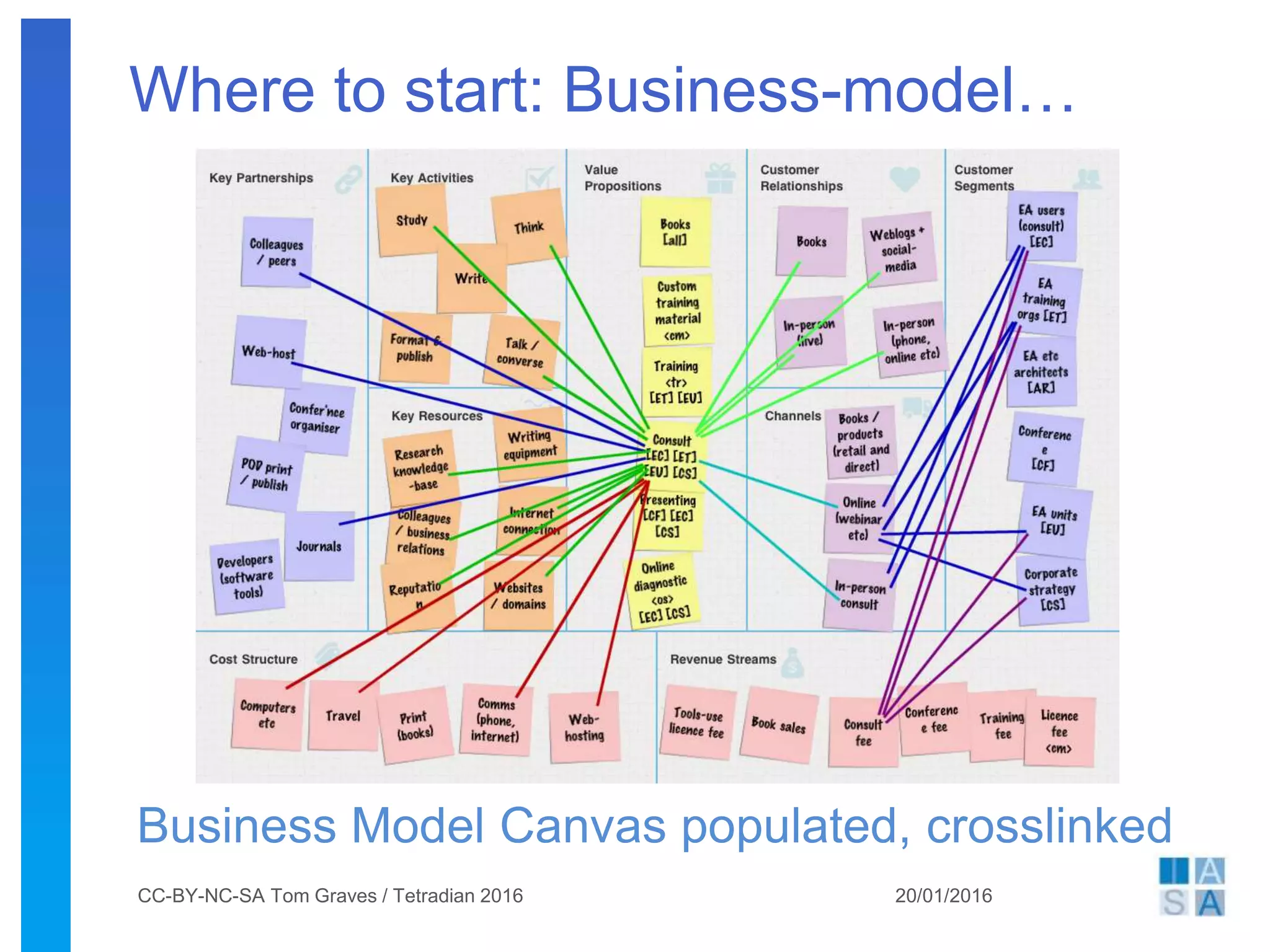
Where to start: Business-model…
Business Model Canvas populated, crosslinked
20/01/2016CC-BY-NC-SA Tom Graves / Tetradian 2016
Where to start: Business-model…
Business-model as descriptive story
20/01/2016CC-BY-NC Strategyzr
Where to start: Capability-maps…
Capability-map: Functional Business Model
Accept Orders
Contact
Customer
Manage the Business
Deliver Orders
Support the Business
Process Orders
Consolidate
Orders
Manage
Production
Management
Manage
Licensee
Outbound
Operations
Manage
Materials
Receipt and
Verification
Manage
Facility
Pre-
Production
Processing
Manage Container &
Label Strategies
Manage Vehicles
Manage Equipment and
Equipment-Strategies
Manage
Facility
Property
Manage
Relationship
with
Licensees
Manage
Asset
Service
Providers
Manage Transport
Sub-Contracts for
Delivery
Manage NCR-Code
Configurations
Define
Processing
Strategies
Define
Performance
Management
Manage Production
Systems Strategies
Design and
Develop Facility
Infrastructure
Manage Production-
Planning Strategies
Manage
Facility
Information
Manage Core
Business
Manage Post-
Production
Operations
Setup for
Contractor
Delivery
Manage
Equipment
Maintenance
Manage
Production
Operations
Accept
from
Agency
Accept
from
Contractor
Accept at
Facility
Accept at
Customer
Location
Manage FinanceManage Human Resources
Manage Facility
Administration
Manage
Materials
Strategies
Prepare
Customer
Transfer
Support
Customer
Bulk Orders
Handle
Customer
Complaints
& Inquiries
Process
Service
Requests
Fulfil
Order
Prepare
Fulfillmen
Transfer
Support Bu
Fulfillmen
Orders
Handle
Fulfillmen
Complaint
& Inquirie
Process
Fulfillmen
Requests
20/01/2016CC-BY-NC-SA Tom Graves / Tetradian 2016
Where to start: Capability-maps…
Three-tier Functional Business Model
Customer
OutboundInbound
Support
Transport
Process
Check and prepare
vehicle
Road Transport
Operations
Drop Off Orders &
empty containers
Handle vehicle
incidents (breakdowns,
re-fuel, etc.)
Capture transport run
events
Drive transport vehicle
between locations
Pick Up Orders &
empty containers
Complete preparation
of orders into
consignments
Commence carrier
service
Carrier staff verify
consignment details & hand
over consignment to
contractor
Lodge consignments
with carrier
Verify / accept
consignment
Visit "trans-ship" port
Complete carrier
service
Receive & verify
consignments
Handle consignment
exceptions
Separate and store
containers etc. in preparation
for transport to facility
Domestic Carrier Transport
Operations
Planning & Monitoring of
Carrier Services
Determine required
lodgement &
handover times
Receive new/
updated schedules
from carriers
Develop & maintain
carrier lodgement
schedules
Monitor carrier
services & provide
corrective action
Assess disputed/
late consignments
Transport Facility
Management
Time and
Attendance
Monitoring & Control
Review Facility
Performance & implement
improvements
Planning &
Scheduling
Staffing & Rostering
Manage
Stream orders
into production
batches
Manage batch
containers prior
to pick up
Consolidate
Orders
Create & Maintain
Facility NCR-Code
Plans
Estimate Production
Volumes
Plan & Schedule
Production
Operations
Staffing & Rostering
Time and
Attendance
Monitor Order
Processing
Review Facility
Performance & imp.
improvements
Corrective Action for
Processing
Quality Control
Dock Management
Production
Management
Corrective Action for
Transport &
Delivery
Materials
Receipt and
Verification
Inspection of
inbound materials
Process “Under
Bond” Materials
Process Hazardous
Materials
Handover Materials
to Warehouse
Licensee
Outbound
Operations
Inspection of
outbound product
Prepare licensee
consignment for
despatch
Capture outbound
volumes and
events
Despatch outbound
product via licensee
carrier
Receive Transfers
at Facility
Transfers Damage
Check
Slotting /
Sequencing
Interleaving
Pre-Mould Verify
Slippage
Adjustment
Batch Alignment for
Moulding
Pre-Production
Processing at
Facility
Capture Processing
Events
Prepare Customer
Transfer
Plan Transfer
Production
Prepare Transfer
Data
Prepare Transfer
Production
Prepare Transfer
Documentation
Support Customer
Bulk Orders
Advise customer
of bulk-order
issues
Manage
Customer Order
Quality
Support customer
bulk orders
Handle Customer
Complaints &
Inquiries
Receive & record
notification of
problems
Investigate &
resolve problems
Report Status of
Order
Handle general
inquiries
Process Service
Requests
Process Requests
Process Other
Requests
Process Payment
for Service
Consumable
Tools
Management
Specify Tools
requirements
Acquire & Locate
Consumable Tools
Maintain inventory of
Consumable Tools
Manage & perform
maintenance of
Consumable Tools
Container & Label
Management
Specify container
requirements
Acquire & Supply
Containers
Manage & perform
maintenance of
containers
Maintain inventory of
containers
Label Policy & Design
Manage Label Stock
Specify vehicle
requirements
Vehicle
Management
Purchase or Lease
vehicles (&
accessories)
Dispose of vehicles
Maintain inventory of
vehicles
Manage contracts
with fuel suppliers
Monitor payments to
fuel suppliers
Manage allocation of
vehicles to facilities
Manage vehicle
registration &
insurance
Prepare claims for
diesel & alternative
fuel grant
Manage
maintenance of
vehicles
Design, Specify &
Evaluate New
Equipment
Purchase/Dispose
Equipment &
Spares
Install & Relocate
Equipment
Develop
Maintenance
Strategies
Monitor & Optimise
Performance &
Reliability
Equipment
Management
Ensure Logistics &
OH&S Compliance
Manage Equipment
Configuration
Manage Technical
Documents &
Support Systems
Manage Inventory,
Repairs & Stores
Infrastructure
Property
Management
Specify Property
Requirements
Acquire Property
Dispose of Property
Manage Building
Administration
Establish & Maintain
Relationships with
Licensees
Manage
Relationship with
Licensees
Calculate Revenue due
from Licensees
Specify materials
requirements
Materials
Management
Acquire & Locate
Materials
Maintain inventory
of Materials
Select & Manage
Asset Maintenance
Service Providers
Evaluate & select
Asset Maintenance
Service Providers
Establish & maintain
Asset Maintenance
Contracts
Monitor Service
Provider performance
Terminate Contract
Manage Transport
Sub-Contractors
Maintain Contractor
Service Information
Evaluate & Select
Transport
Contractors
Establish & Maintain
Transport Contracts
Monitor Contractor
Performance
Manage Payments
to Contractors
Terminate Contract
Select & Manage
Agencies
Evaluate & Select
Agencies
Establish & Maintain
Contracts with
Agencies
Monitor Agencies
Performance
Manage Payments
To/From Agencies
Terminate Contract
with Agency
NCR-Code
Management
NCR-Data Strategy,
Policy &
Procedures
Maintain NCR
Information
Maintain Machine
Configuration Data
NCR Configuration
Improvement
Manage Machine-
Specific NCR
Configuration
NCR Code-Sharing
Management &
Support
Processing Policy,
Procedures &
Governance
Processing
Strategies
Sorting Strategy &
Design
Develop Processing
Plans
Measurement of
Service Quality
Measure Financial
Performance
Measurement of
Resource Utilisation
Performance
Analysis
Performance
Management
Production
Systems
Initiate Project
Evaluate
Solutions
Finalise Project
Systems support
& maintenance
Develop /
Enhance System
Implement
System
Determine
business systems
strategies
Systems control
& Administration
Specify Facility
Requirements
Model Proposed
Solutions
Select & Design
Preferred
Solution
Plan & Schedule
Facility
Development
Implement
Facility Changes
Construct
Facilities &
Equipment
Facility / Infrastructure
Design & Development
Production
Planning
Determine prod’n
strategy &
direction
Capacity Planning
Investment
Planning
Determine prod’n
principles &
policies
Legislative
Compliance
Develop & maintain
Dangerous Goods
policies & procedures
Production
Capability
Analysis
Manage Facility
Information
Define Costing
Reference Data
Maintain Prod’n
Structure
Information
Define terminology,
& codes
Manage barcoding
standards, formats
& characteristics
Manage central
storage of event
information
Manage
inventory of
scanners
Manage central
storage of production
volumes
International Carrier
Transport Operations
Receive inbound
containers at origin
port
Handover outbound
containers at
destination port
Transport bond
containers from origin
port to destination port
Manage Core
Business
Develop Business
Strategies
Manage business
performance &
operations
Co-ordinate
Projects
Develop Business
Plans
Manage Projects
Develop business
perf. measures
& targets
Receive Container
from Contractor
Drop-Off
Setup for
Contractor
Delivery
Receive Misdirected
Container from
Contractor
Deliver Container
via Contractor
Record errors &
notify customer
Store articles
Verify Customer
Pick-up
Handle
Undeliverables
(including missorts)
Calculate Priority
Delivery Charge
Capture Contractor
Delivery Events
Despatch Container
for Contractor
Pick-Up
Handle delivery
vehicle incidents
Check & Prepare
Delivery Vehicles
Document Handover
to Transport
Driver
Capture
Non-Contractor
Delivery Events
Setup for
Non-Contractor
Delivery
Handle Customer
Returns
Deliver Container to
Customer
Operate Vehicle for
Transport Runs
Drop Off / Pick Up at
Facility Depot
Establish
Production Volumes
Time and
Attendance
Monitor Post-
Production
Operations
Corrective Action
Review Facility
Performance &
Implement
Improvements
Manage Post-
Production
Operations
Staffing & Rostering
Plan & Schedule
Operations
NCR-Code
Updates
Capture Machine
Configuration
Changes
Capture Tool
Changes
Capture Machine
Changes
Capture and Notify
NCR-Code Changes
Equipment
Maintenance
Plan & Schedule
Equipment
Maintenance
Perform & Reord
Equipment
Maintenance
Correct & Record
Equipment Faults &
Parts Usage
Monitor & Report
Maintenance
Compliance
Modify Equipment
Optimise
Equipment
Performance &
Reliability
Handle Non-Valid
Orders
Machine
Preparation
Moulding
Capture volumes
& machine
statistics
Prepare agency
consignments
Prepare product
for road transport
Production
Operations
Capture
production events
Inward Dock
Operations
Initial Preparation
Move Product
between
processing steps
Order
Configuration
Machine
Production
Manual
Preparation
Capture Order
Assemble Order
Prepare order
documentation
Accept from
Contractor
Accept Agency
Order
Capture inbound
order events
Receive inbound order
from agency
Print & apply
agency identifier
labels
Reconciliation of
agency bills &
orders
Record agency
order violations
Handover order
documentation to
transport driver
Receive Order
Lodgement
Accept at
Facility
Receive electronic
order via internet
Process electronic
order via email
Verify Order
Preparation &
Streaming
Handle Rejected
Orders
Capture Order
information
Process Payment
for Order
Handover Order
to Transport
Driver
Capture actual
acceptance
events
Verify Order
Accept at
Customer
Location
Finance
Provide Financial
Analysis & Direction
Support Business
Cases
Produce budgets &
forecasts
Manage Financial
Policy & Procedures
Record & monitor
expenditure
Human Resources
Succession
Planning
Recruitment
Maintain employee
records
Occupational Health
& Safety
Operational Training
Leave
Administration
Staff Development Industrial Relations
Facility Administration
General
Administration
Perform & Manage
Stores Function
Manage Technical
Documents
Maintain Technical
Help Desk
Capture
Consolidation
Events
Accept Inbound
Requests
20/01/2016CC-BY-NC-SA Tom Graves / Tetradian 2016
A cautionary tale…
Foiled by financial-architecture?
CC-BY-SA foam via Flickr
• Look upward to connect with big-picture
• Look downward to connect with real world
• Look sideways to connect all together
• Beware of the pressures to go backward
Four themes…
Business architecture:
Looking upward
What is the broader context for this
business-model?
How will the business-model make
sense to all of its stakeholders?
Why anything happens…
20/01/2016CC-BY-NC-SA Tom Graves / Tetradian 2016
The vision describes the desired-ends for action;
values guide action, describing how success would feel.
A tension exists between what is, and what we want
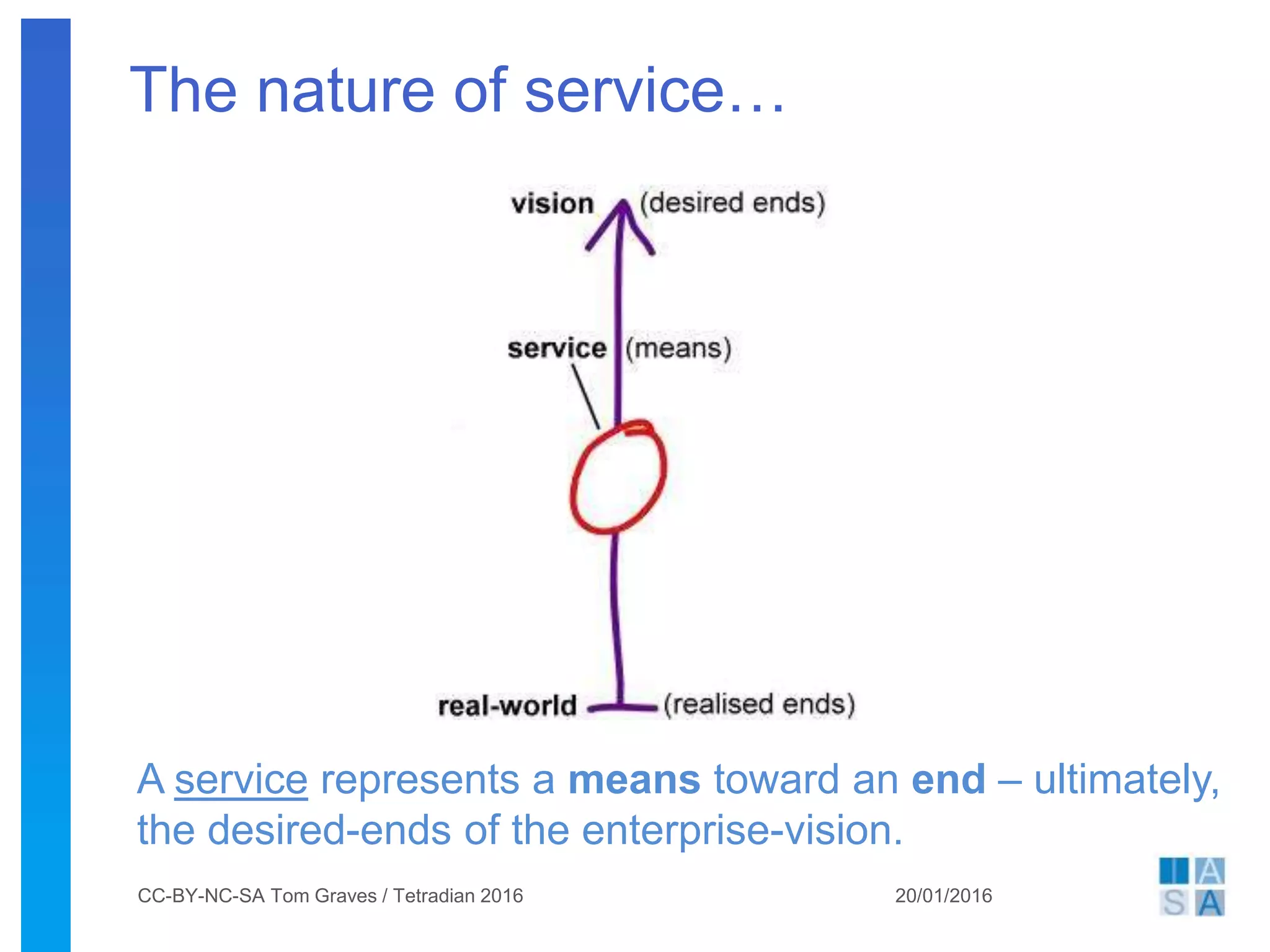
The nature of service…
20/01/2016CC-BY-NC-SA Tom Graves / Tetradian 2016
A service represents a means toward an end – ultimately,
the desired-ends of the enterprise-vision.
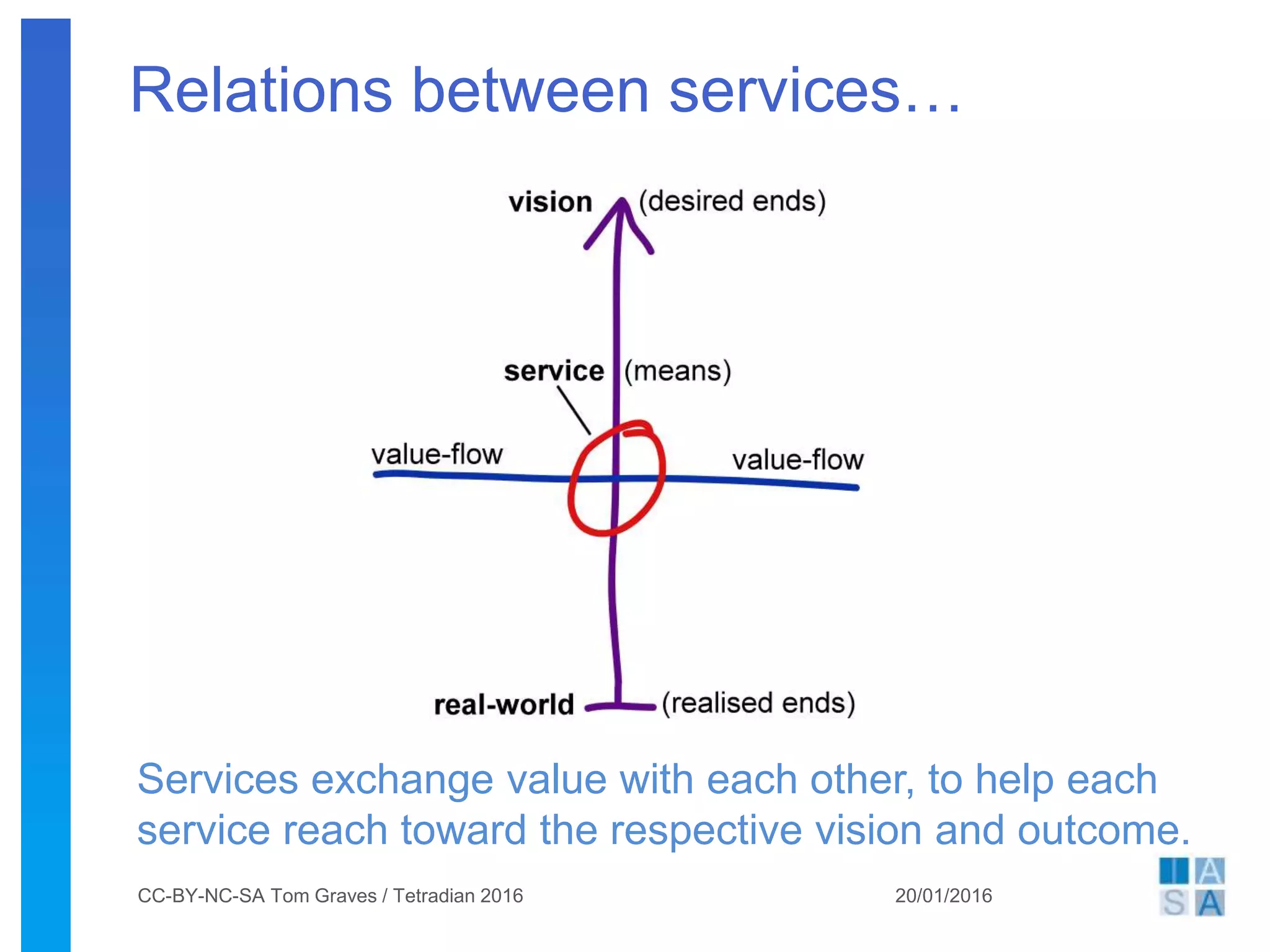
Relations between services…
20/01/2016CC-BY-NC-SA Tom Graves / Tetradian 2016
Services exchange value with each other, to help each
service reach toward the respective vision and outcome.
Values and value…
20/01/2016CC-BY-NC-SA Tom Graves / Tetradian 2016
Each service sits at an intersection of values (vertical) and
exchanges of value (horizontal)
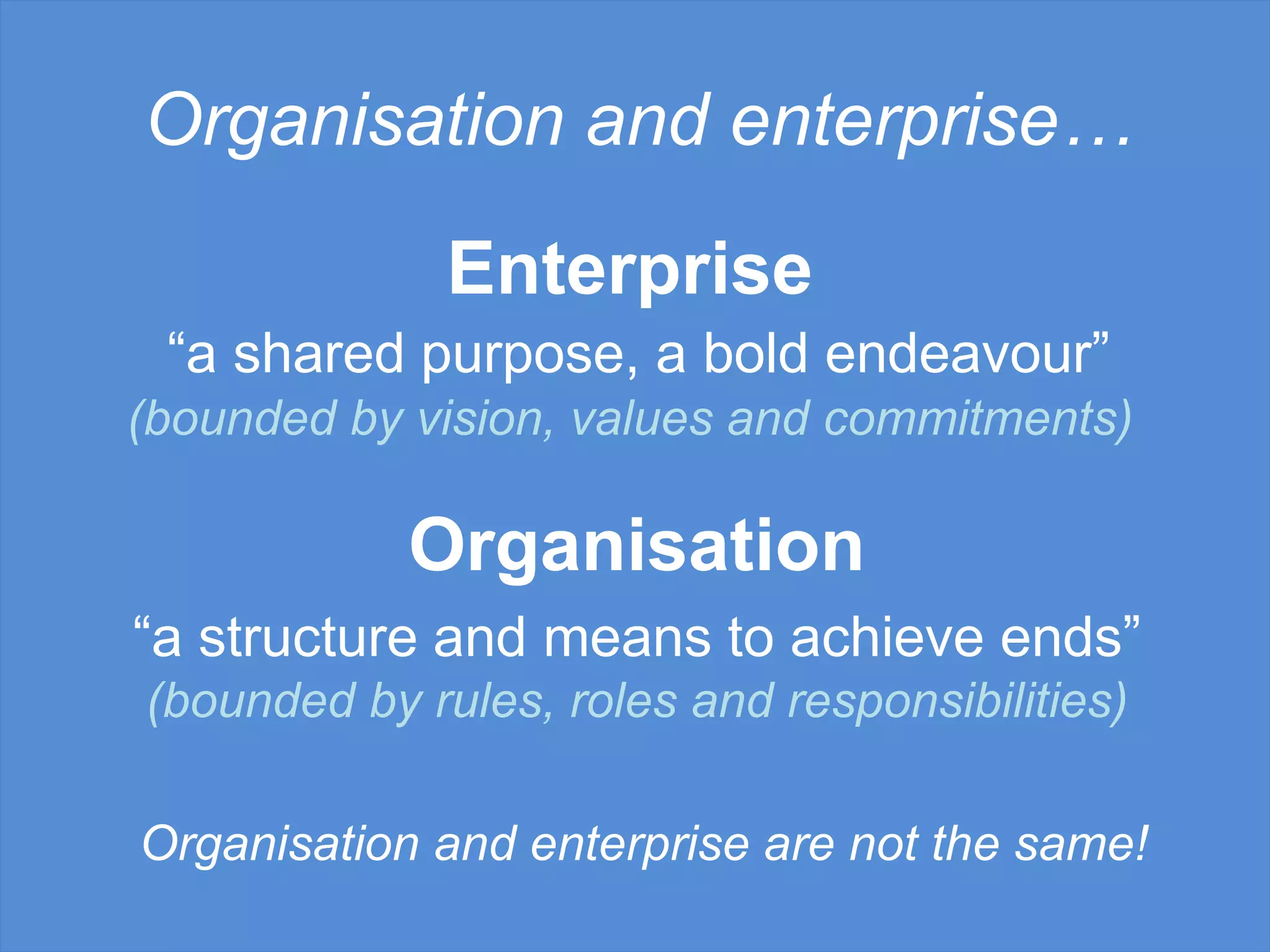
Organisation and enterprise…
Organisation
“a structure and means to achieve ends”
(bounded by rules, roles and responsibilities)
Organisation and enterprise are not the same!
Enterprise
“a shared purpose, a bold endeavour”
(bounded by vision, values and commitments)
Organisation as ‘the enterprise’
20/01/2016CC-BY-NC-SA Tom Graves / Tetradian 2016
This is almost entirely internal – no-one else involved.
Supply-chain as ‘the enterprise’
20/01/2016CC-BY-NC-SA Tom Graves / Tetradian 2016
This is about transactions with others, but usually from the
organisation’s view first, or only.
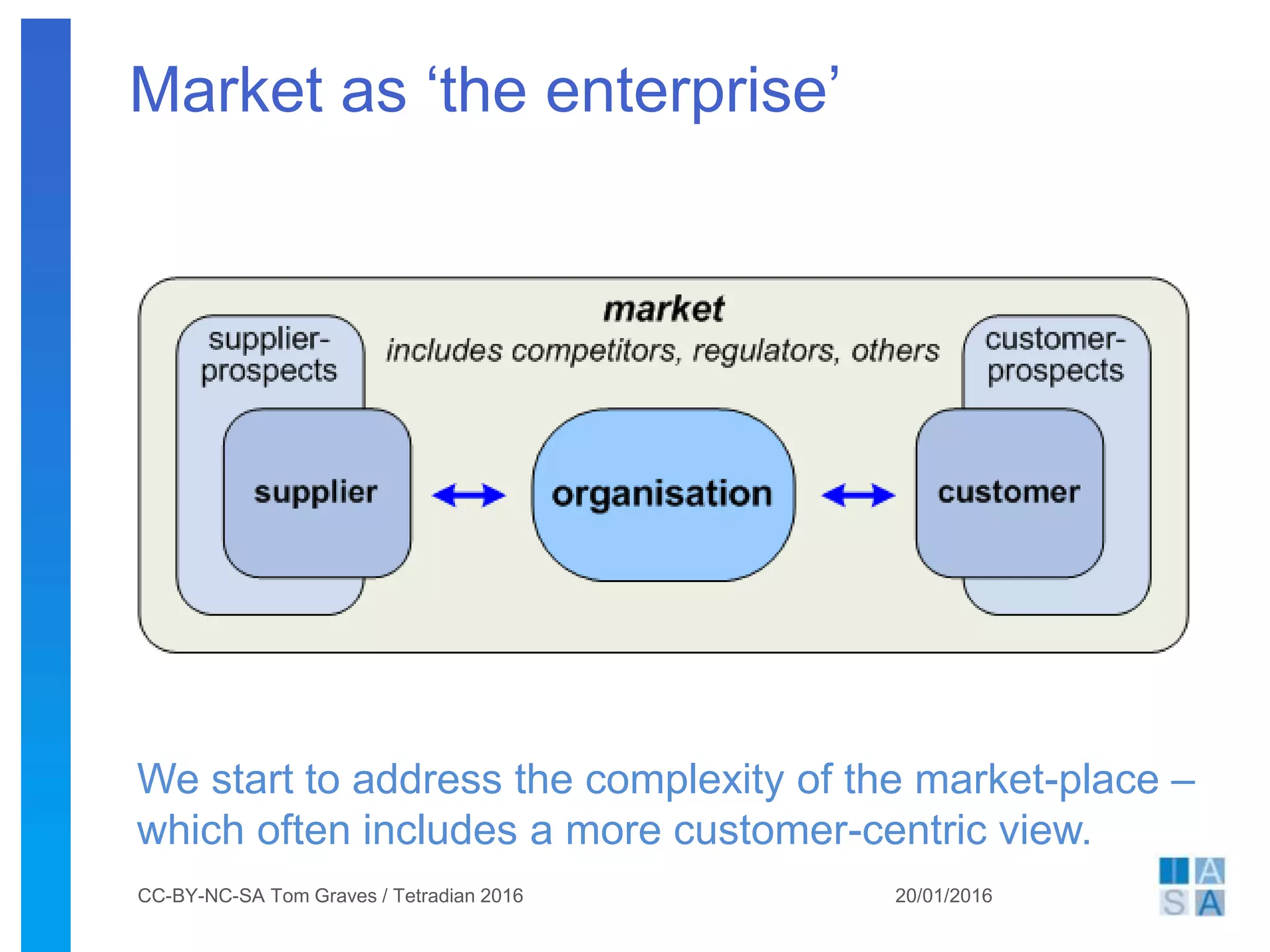
Market as ‘the enterprise’
20/01/2016CC-BY-NC-SA Tom Graves / Tetradian 2016
We start to address the complexity of the market-place –
which often includes a more customer-centric view.
Shared-story as ‘the enterprise’
20/01/2016CC-BY-NC-SA Tom Graves / Tetradian 2016
We engage with all of the complexities of the entire
shared-enterprise – the enterprise-as-itself.
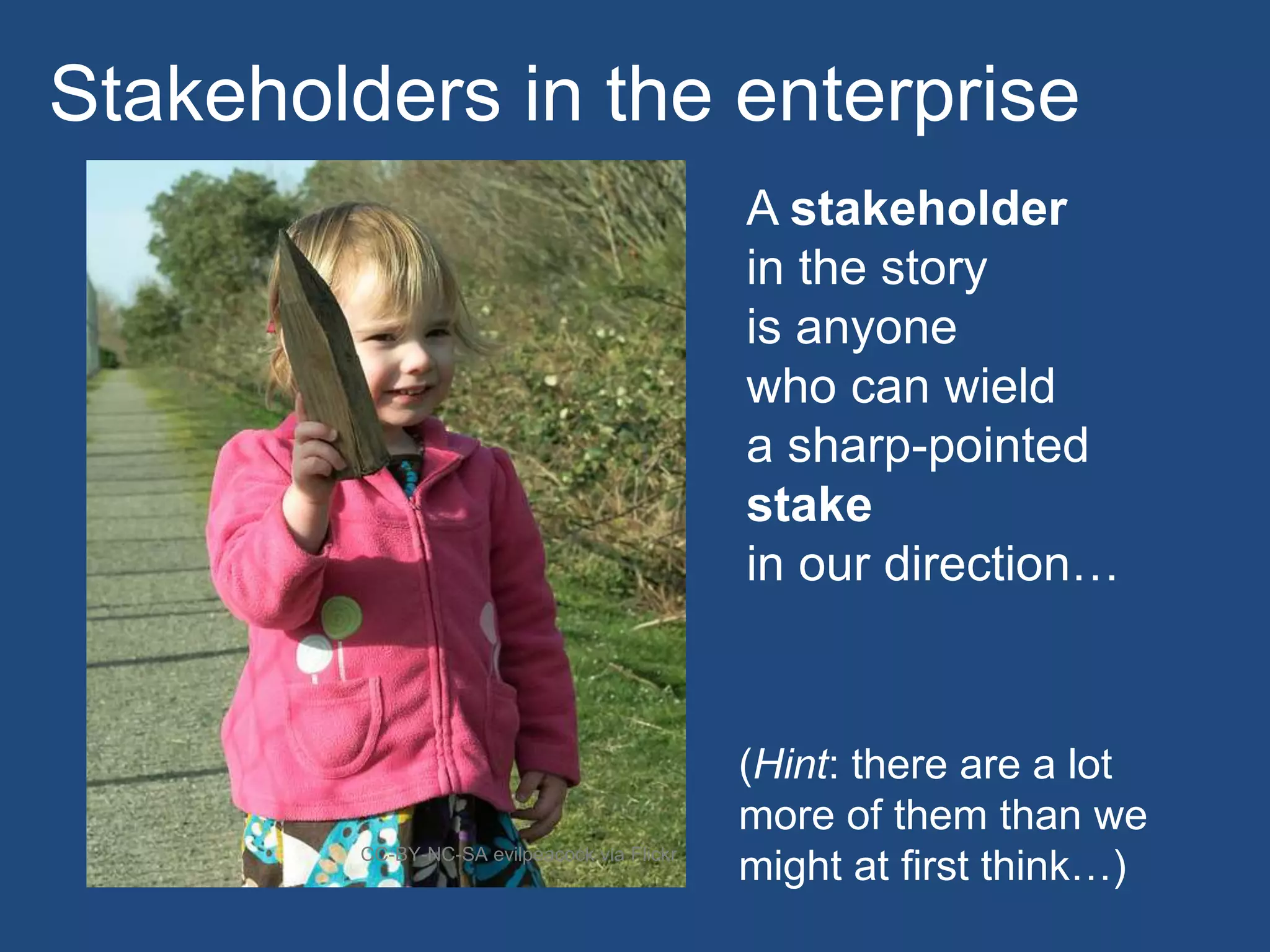
A stakeholder
in the story
is anyone
who can wield
a sharp-pointed
stake
in our direction…
CC-BY-NC-SA evilpeacock via Flickr
Stakeholders in the enterprise
(Hint: there are a lot
more of them than we
might at first think…)
Beware of anticlients…
Anticlients arise through deeply-held beliefs, or
from perceived betrayal by the organisation.
Do not ignore anticlient-risks!
– anticlients do not transact, but interact in the
story in ways that can destroy the organisation.
Anticlients share the same enterprise, but deeply
disagree with how the organisation operates within
that story.
Vision, purpose,
promise
This is also about how
we keep to our purpose,
and keep our promise…
…in a viable business,
we don’t make promises
that we can’t or won’t keep! Proximus, Belgium
A three-part ‘story’ that makes sense to all enterprise-stakeholders
Elements of a vision-statement
Action (‘How’): what is being done to
or with or about the concern
Example: “Ideas worth spreading”
Qualifier (‘Why’): the emotive driver
for action on the concern
Example: “Ideas worth spreading”
Concern (‘What’): the focus of interest
to everyone in the shared-enterprise
Example: “Ideas worth spreading”
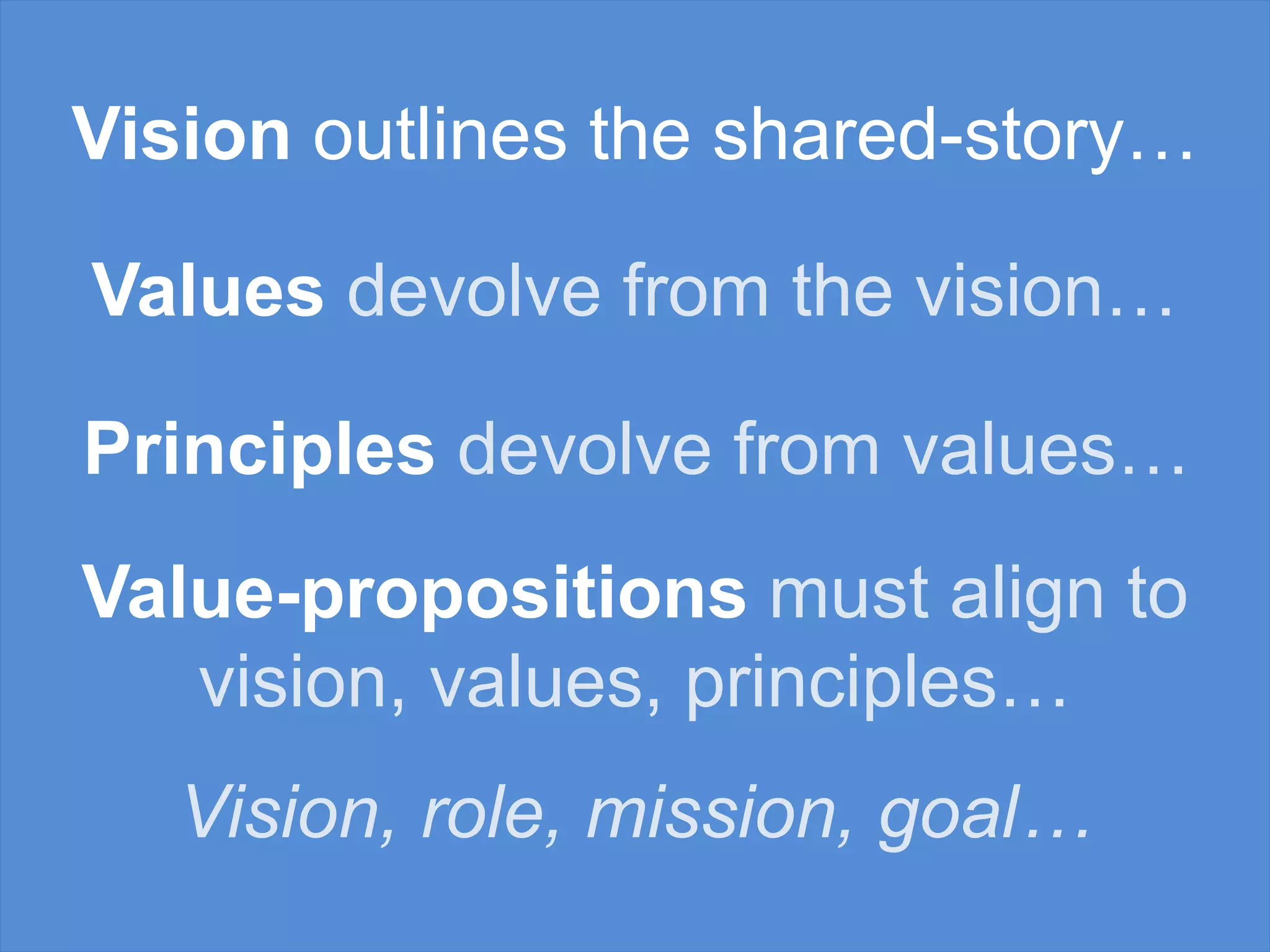
Vision outlines the shared-story…
Principles devolve from values…
Value-propositions must align to
vision, values, principles…
Vision, role, mission, goal…
Values devolve from the vision…
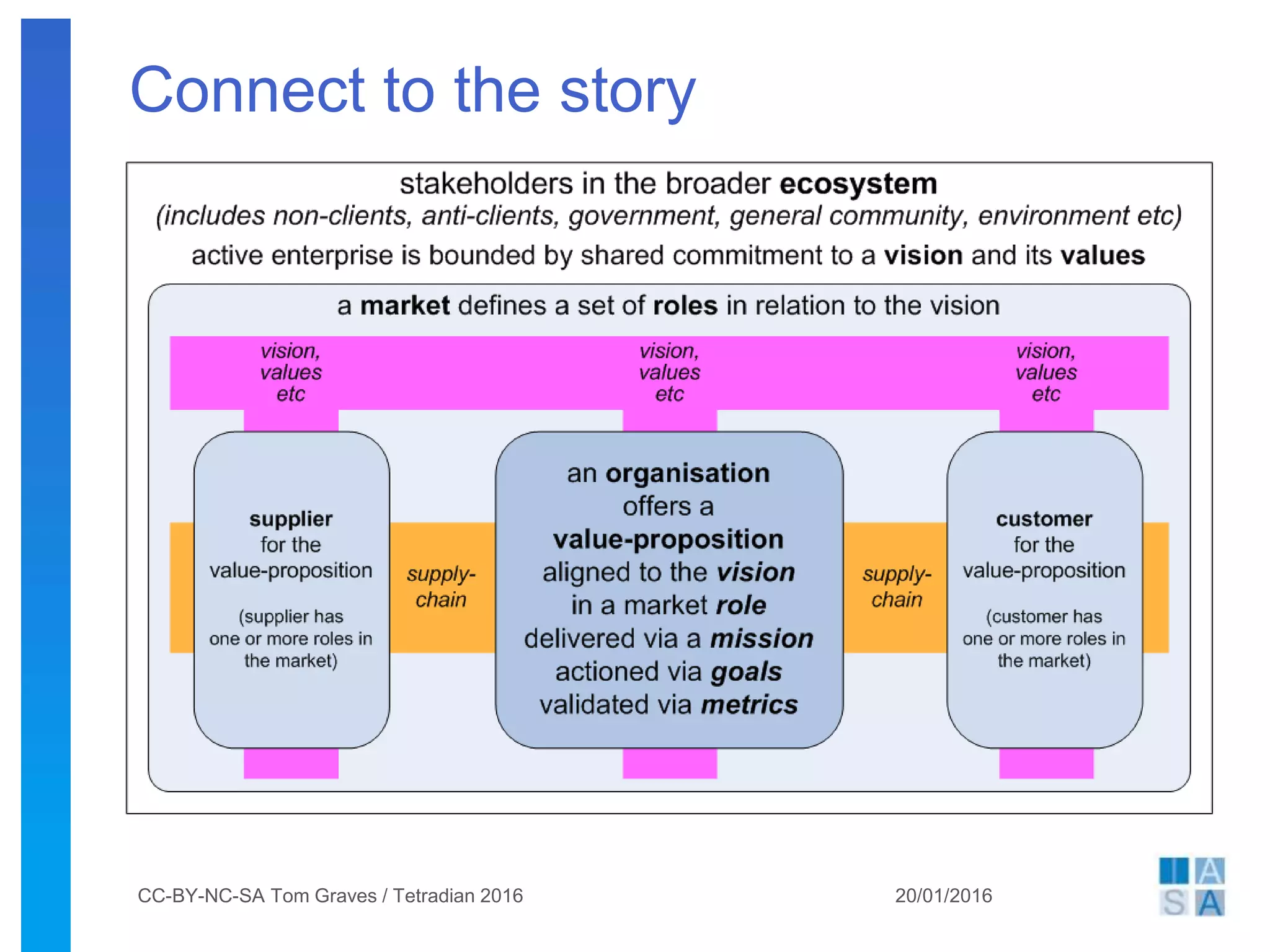
Connect to the story
20/01/2016CC-BY-NC-SA Tom Graves / Tetradian 2016
A cautionary tale…
Organisation as enterprise?
Business architecture:
Looking downward
How will the business-model be
implemented?
What are some of the hidden
‘gotchas’ that could break the
business-model?
Realising the business-model
Use SCORE to identify:
- capabilities needed for the business-model
- which can be bought-in or outsourced
- which capabilities must remain in-house
- the reasoning behind those decisions
Assemble from capabilities
(‘capability’ as ‘the ability to do work’)
Introducing SCORE
20/01/2016CC-BY-NC-SA Tom Graves / Tetradian 2016
Start with an assertion:
Everything in the enterprise
is or represents a service.
(If so, we can describe everything
in the same consistent, fractal way.)
(Business Model Canvas isn’t fractal
– it’s linked only to a single high-level view
– so we need to adapt that business-model
to a more fractal frame.)
Fractality is our friend…
allows us to use the same patterns
everywhere, at every level
Business-model to Enterprise Canvas
20/01/2016CC-BY-NC-SA Tom Graves / Tetradian 2016
KP
supplier
CS
customer
(KP)
supplier
relations
VP
value-
proposition
(KP)
supplier
channels
KR / KA
value-
creation
CH
customer
channels
CR
customer
relations
C$
value-
outlay
(C$ / R$)
value-
governance
R$
value-
return
KA
Key
Activities VP
Value-
PropositionKR
Key
Resources
CH
Channels
CR
Customer
Relationships
C$
Cost Structure
R$
Revenue Streams
KP
Key
Partners
CS
Customer
Segments
From an IT-centric view…
20/01/2016CC-BY-NC-SA Tom Graves / Tetradian 2016
…but it’s much more than just IT
20/01/2016CC-BY-NC-SA Tom Graves / Tetradian 2016
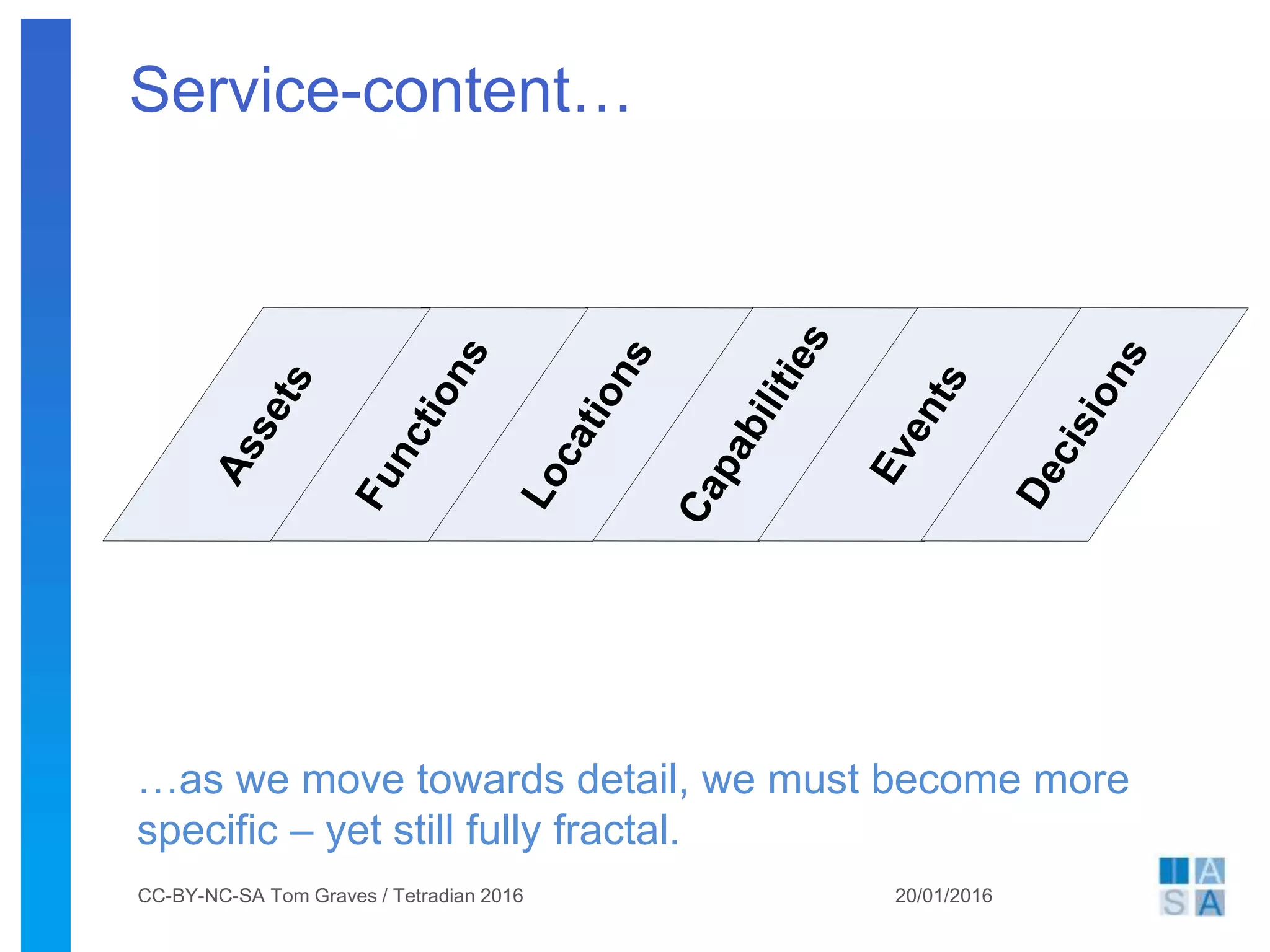
Service-content…
20/01/2016CC-BY-NC-SA Tom Graves / Tetradian 2016
We can view in various ways what services consist of –
but eventually we’ll need the full detail.
Service-content…
20/01/2016CC-BY-NC-SA Tom Graves / Tetradian 2016
At higher levels of abstraction (lists and relations only), we
can get away with simple Zachman-interrogatives…
What How Where Who When Why
Service-content…
20/01/2016CC-BY-NC-SA Tom Graves / Tetradian 2016
…as we move towards detail, we must become more
specific – yet still fully fractal.
Capabilities
Locations
Functions
Assets
Events
Decisions
Asset (‘What’)
- a resource for which
the enterprise acknowledges
responsibility
Composition:
any combination of asset-dimensions.
Function (external of ‘How’)
- external-facing interface, responsible
for service-contracts, protocols, SLAs,
etc;
accepts and returns assets
Composition:
any combination of asset-dimensions.
Location (‘Where’)
- a position within the terms of
a specific schema
Composition:
any combination of asset-dimensions,
plus time-as-location.
Capability (‘Who’ / ‘How’ / ‘What’)
- the ability to do something:
- agent enacts the capability
- action asset-type acted upon
- skill-level competence of the agent
Composition:
agent / action: asset-dimensions;
skill-level: skills/decision dimensions;
also recursively consists of other services
Event (‘When’)
- trigger for a function and underlying
capability
Composition:
any combination of asset-dimensions.
Decision / Reason (‘Why’)
- sensemaking / decision-making
for the service, and/or its type of
guidance or governance
Composition:
any combination of decision/skills dimensions.
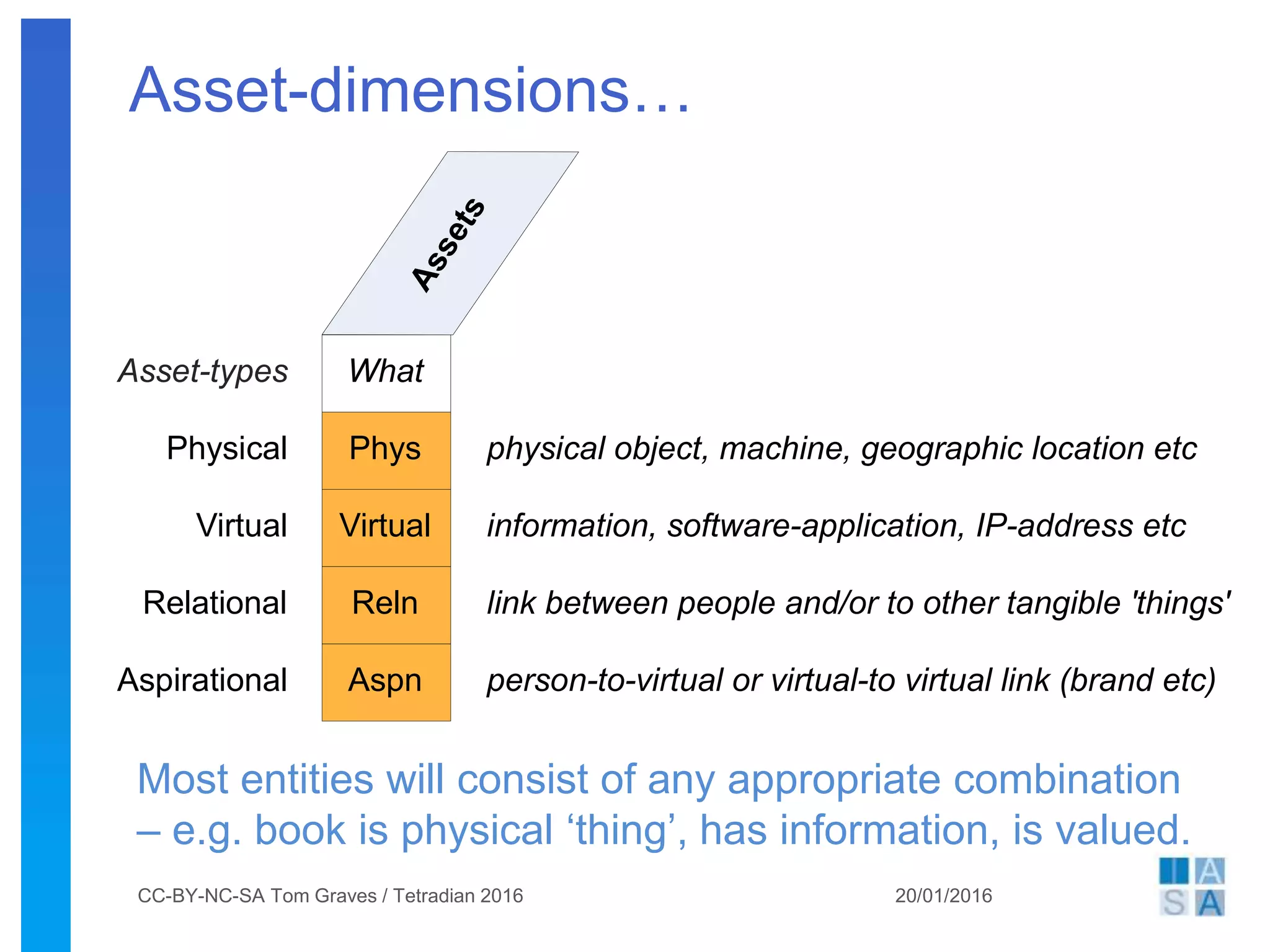
Asset-dimensions…
20/01/2016CC-BY-NC-SA Tom Graves / Tetradian 2016
Most entities will consist of any appropriate combination
– e.g. book is physical ‘thing’, has information, is valued.
Assets
Phys
Virtual
Reln
Aspn
physical object, machine, geographic location etc
information, software-application, IP-address etc
link between people and/or to other tangible 'things'
person-to-virtual or virtual-to virtual link (brand etc)
Physical
Virtual
Relational
Aspirational
WhatAsset-types
Decision/skills dimensions…
20/01/2016CC-BY-NC-SA Tom Graves / Tetradian 2016
Most contexts will need to include combinations of these.
Decisions
simple, linear, true/false or limited-quantitative
complicated, linear but allow for delays, feedback
complex, ambiguous, non-linear, 'wild-problems'
uniqueness, extreme-uncertainty, 'chaotic'
Rules
Algor’m
Guideln
Princpl
Rule-based (trainee)
Algorithmic (apprentice)
Guidelines (journeyman)
Principle-based (master)
WhyDecision/skill-types
Working with complexity
Some complexities must be removed, others
acknowledged and embraced
Use SCAN to identify:
- where complexity exists, in what form
- which complexities can be eliminated
- which complexities are inherent (‘wild’)
- what techniques to use for each
SCAN for complexity-mapping
20/01/2016CC-BY-NC-SA Tom Graves / Tetradian 2016
Ambiguous
but Actionable
Not-known,
None-of-the-above
Complicated
but Controllable
Simple
and Straightforward
(boundary of
effective-certainty)
(transition
from plan
to action)
(ORDER)
(UNORDER)
NOW!
Certain
(increasingly
uncertain)
(indefinite
future)
Order and unorder
20/01/2016CC-BY-NC-SA Tom Graves / Tetradian 2016
“Insanity
is doing
the same thing
and expecting
the same results”
(not Albert Einstein)
ORDER
(IT-type rules do work here)
UNORDER
(IT-type rules don’t work here)
“Insanity
is doing
the same thing
and expecting
different results”
(Albert Einstein)
certain uncertain
edge of
uncertainty
Same and different
20/01/2016CC-BY-NC-SA Tom Graves / Tetradian 2016
A quest for certainty:
analysis, algorithms,
identicality, efficiency,
business-rule engines,
executable models,
Six Sigma...
SAMENESS
(IT-systems do work well
here)
UNIQUENESS
(IT-systems don’t work
well here)
An acceptance of
uncertainty:
experiment, patterns,
probabilities, ‘design-
thinking’, unstructured
process...
certain uncertain
A surgical example…
20/01/2016CC-BY-NC-SA Tom Graves / Tetradian 2016
patient identity
surgery plan
emergency
action
theatre
booking
consumables
pre-op
complications
family
behaviour
surgical-staff
availability
change of
theatre-availability
action-records
equipment
plan
patient
condition
verify identity
NOW
!
certain uncertai
n
before
SCAN framework summary
20/01/2016CC-BY-NC-SA Tom Graves / Tetradian 2016
order unorder
SIMPLE
(enact)
regulation
rotation
(rules)
NOT-KNOWN
(explore)
reframe
rich-randomness
(principles)
COMPLICATED
(evaluate)
reciprocation
resonance
(algorithms)
AMBIGUOUS
(experiment)
recursion
reflexion
(patterns, guidelines)
NOW!
certain uncertain
plan
actual
before
A spectrum of services
also implies
a spectrum of governance:
governance of governance itself.
Backbone and edge
20/01/2016CC-BY-NC-SA Tom Graves / Tetradian 2016
order
(rules do work here)
unorder
(rules don’t work here)
fail-safe
(high-dependability)
safe-fail
(low-dependability)
analysis
(knowable result)
experiment
(unknowable result)
BACKBONE EDGE
Waterfall
(‘controlled’ change)
Agile
(iterative change)
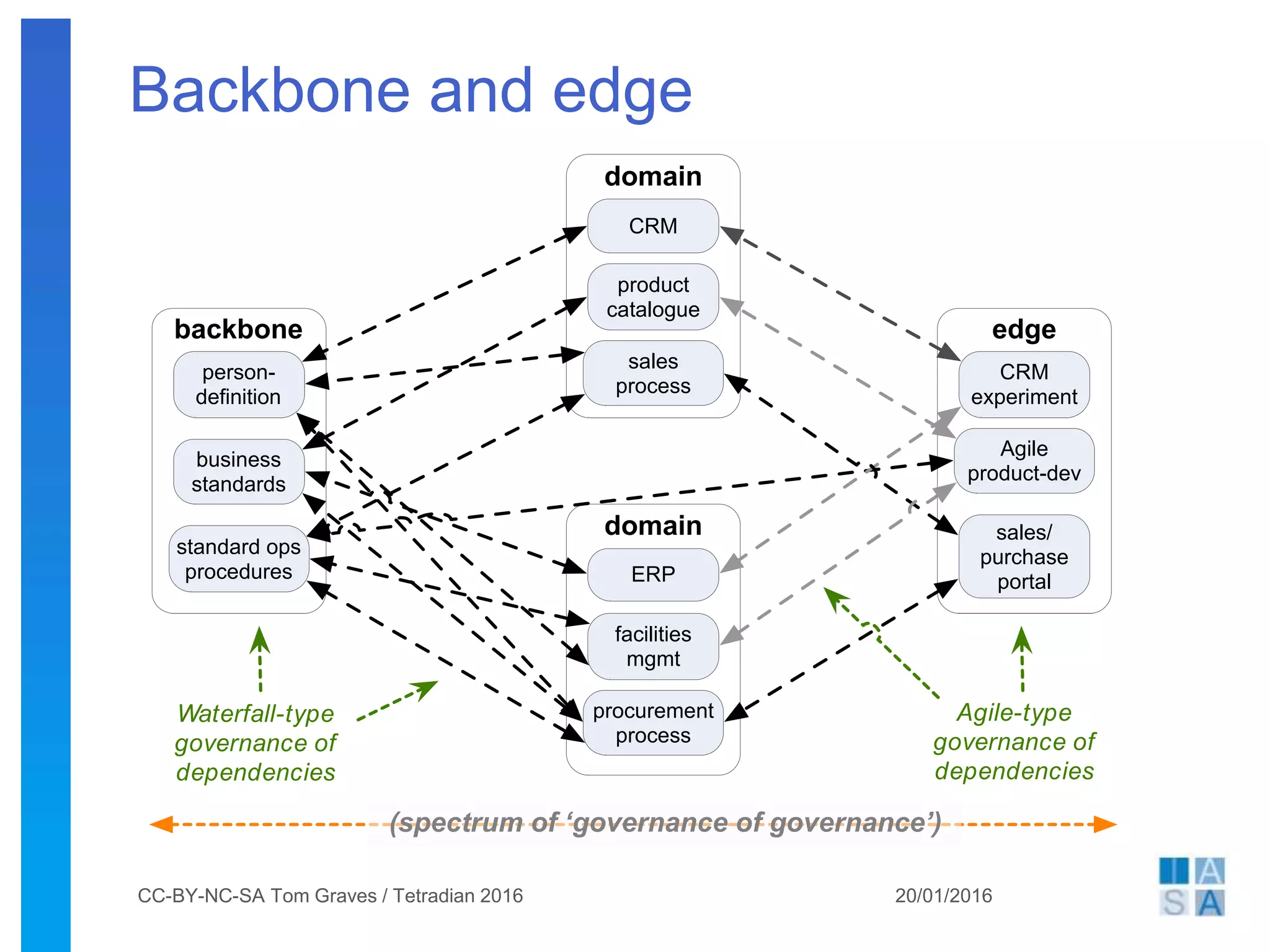
Backbone and edge
domain
CRM
product
catalogue
sales
process
backbone
person-
definition
business
standards
standard ops
procedures
edge
CRM
experiment
sales/
purchase
portal
Agile
product-dev
domain
ERP
facilities
mgmt
procurement
process
Agile-type
governance of
dependencies
Waterfall-type
governance of
dependencies
(spectrum of ‘governance of governance’)
20/01/2016CC-BY-NC-SA Tom Graves / Tetradian 2016
Backbone, domain and edge
20/01/2016CC-BY-NC-SA Tom Graves / Tetradian 2016
order unorder
fail-safe
(high-dependency)
BACKBONE
safe-fail
(low-dependency)
EDGE
plan
actual
Waterfall
(‘controlled’ change)
Agile
(iterative change)
Mixed
(guided change)
analysis
(knowable result)
DOMAIN
experiment
(unknowable result)
Pace-layering (and more)
Different elements change at different
rates – from days to decades.
Different elements have different lifetimes –
from nanoseconds to centuries.
Different elements reference other
elements that have different rates of
change, and different lifetimes.
It gets kinda complicated…
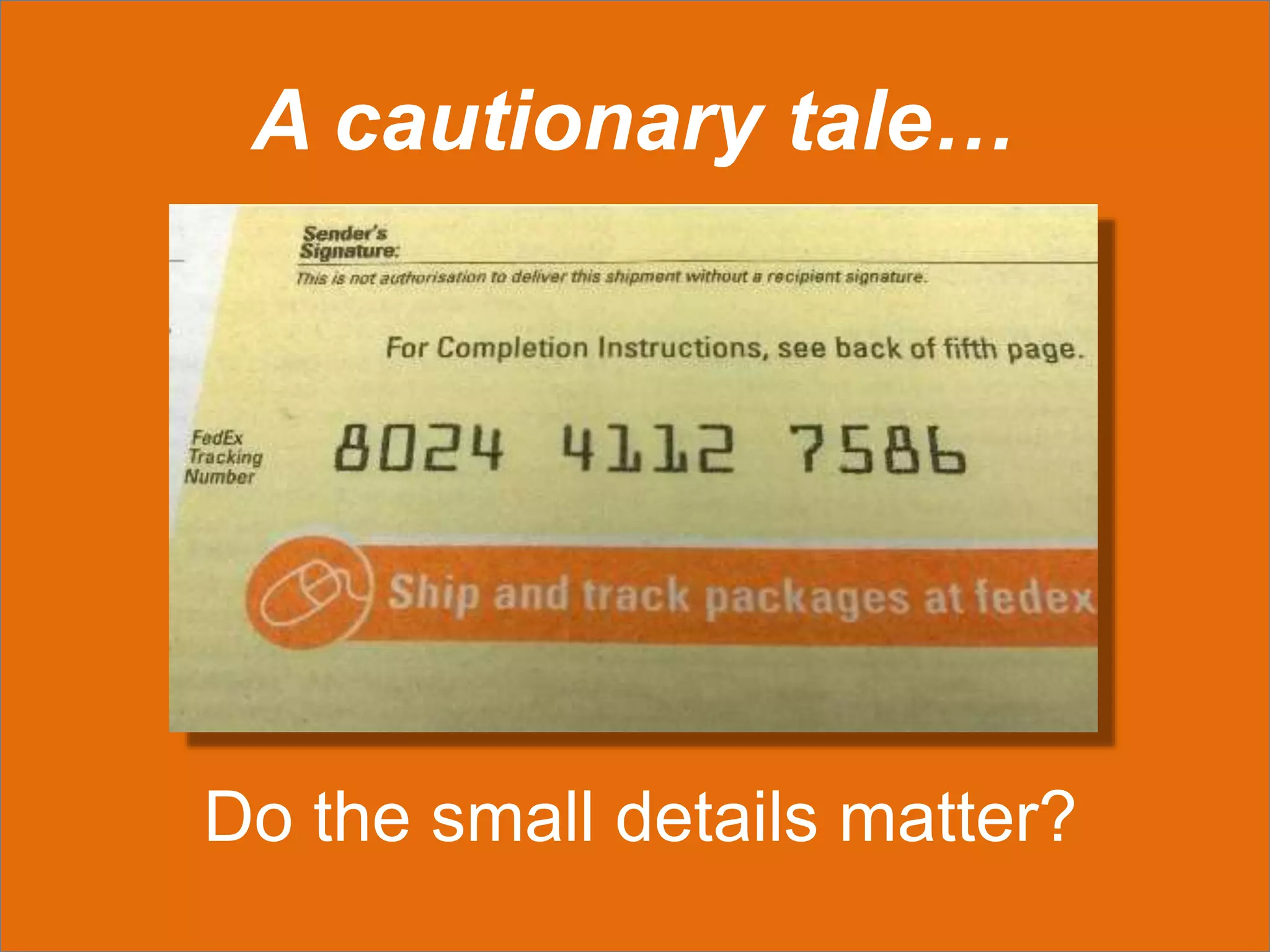
A cautionary tale…
Do the small details matter?
Business architecture:
Looking sideways
How do we ensure compliance in the
business-model?
How do we guide connection and
change?
How do connect to and support the
values of the broader enterprise?
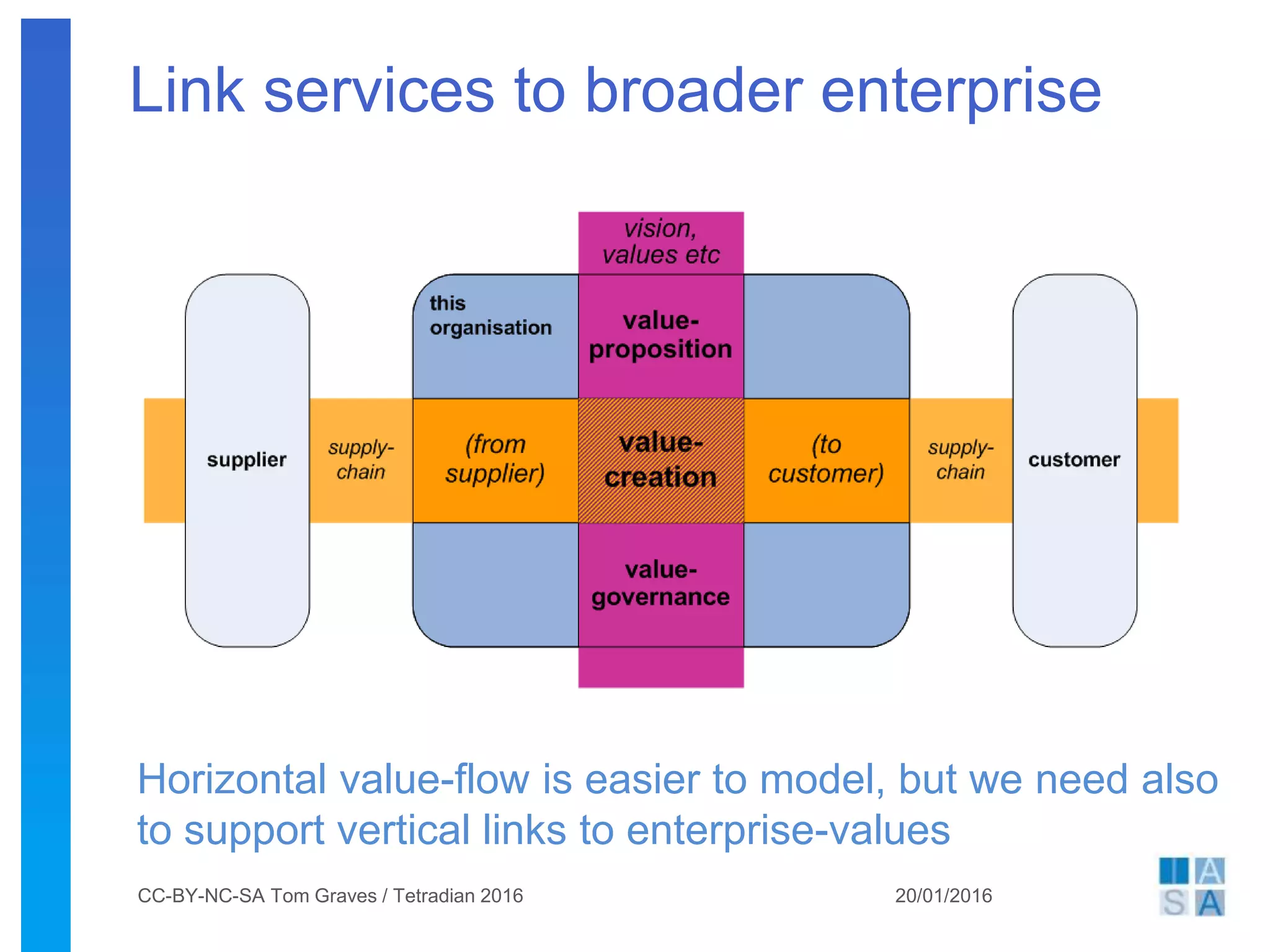
Link services to broader enterprise
20/01/2016CC-BY-NC-SA Tom Graves / Tetradian 2016
Horizontal value-flow is easier to model, but we need also
to support vertical links to enterprise-values
Interrelations between services
20/01/2016CC-BY-NC-SA Tom Graves / Tetradian 2016
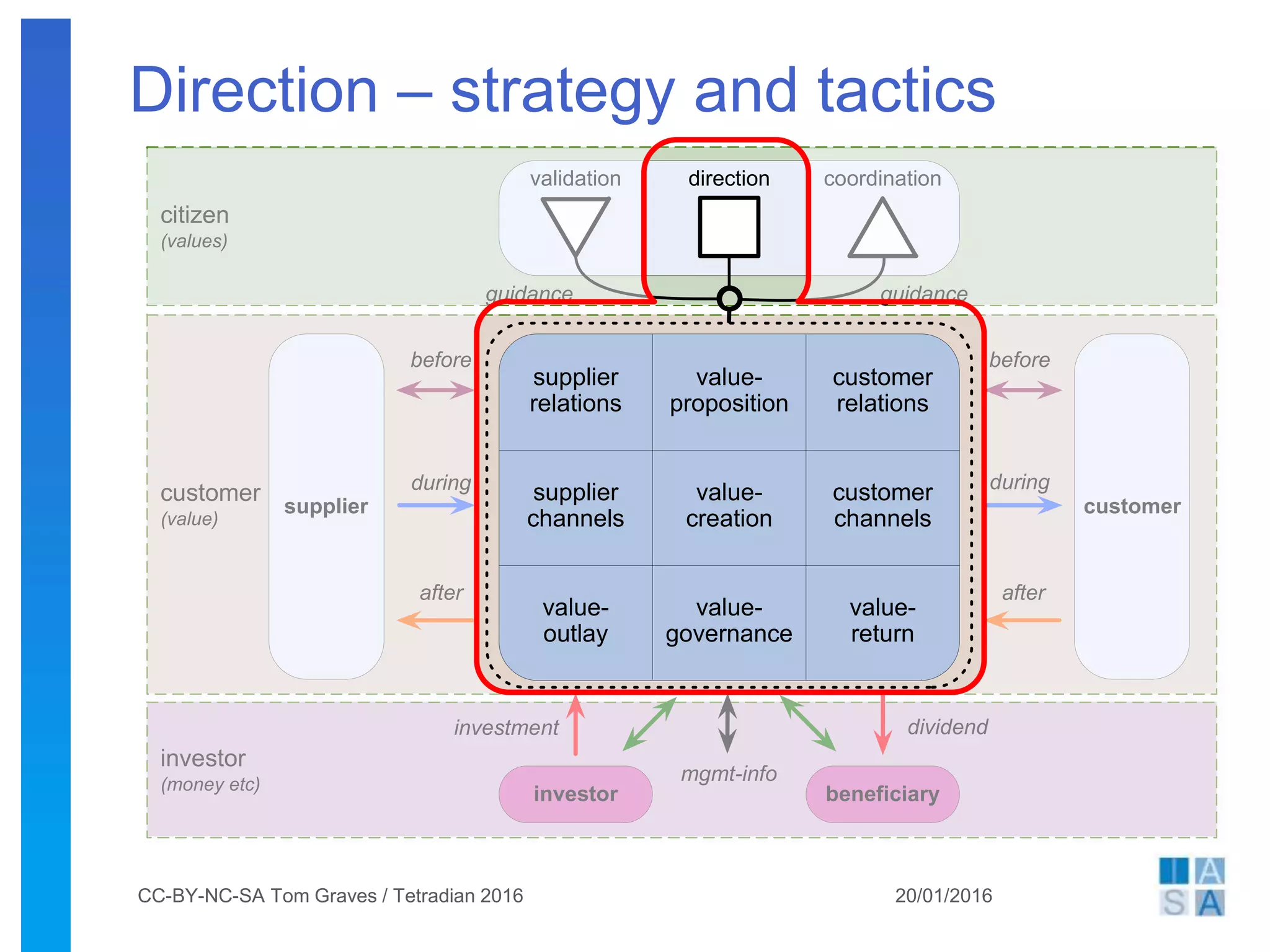
Direction – strategy and tactics
20/01/2016CC-BY-NC-SA Tom Graves / Tetradian 2016
investor
(money etc)
customer
(value)
citizen
(values)
supplier
relations
value-
proposition
supplier
channels
value-
creation
customer
channels
customer
relations
value-
outlay
value-
governance
value-
return
supplier customer
investor beneficiary
coordinationdirectionvalidation
before before
during during
after after
investment dividend
guidanceguidance
mgmt-info
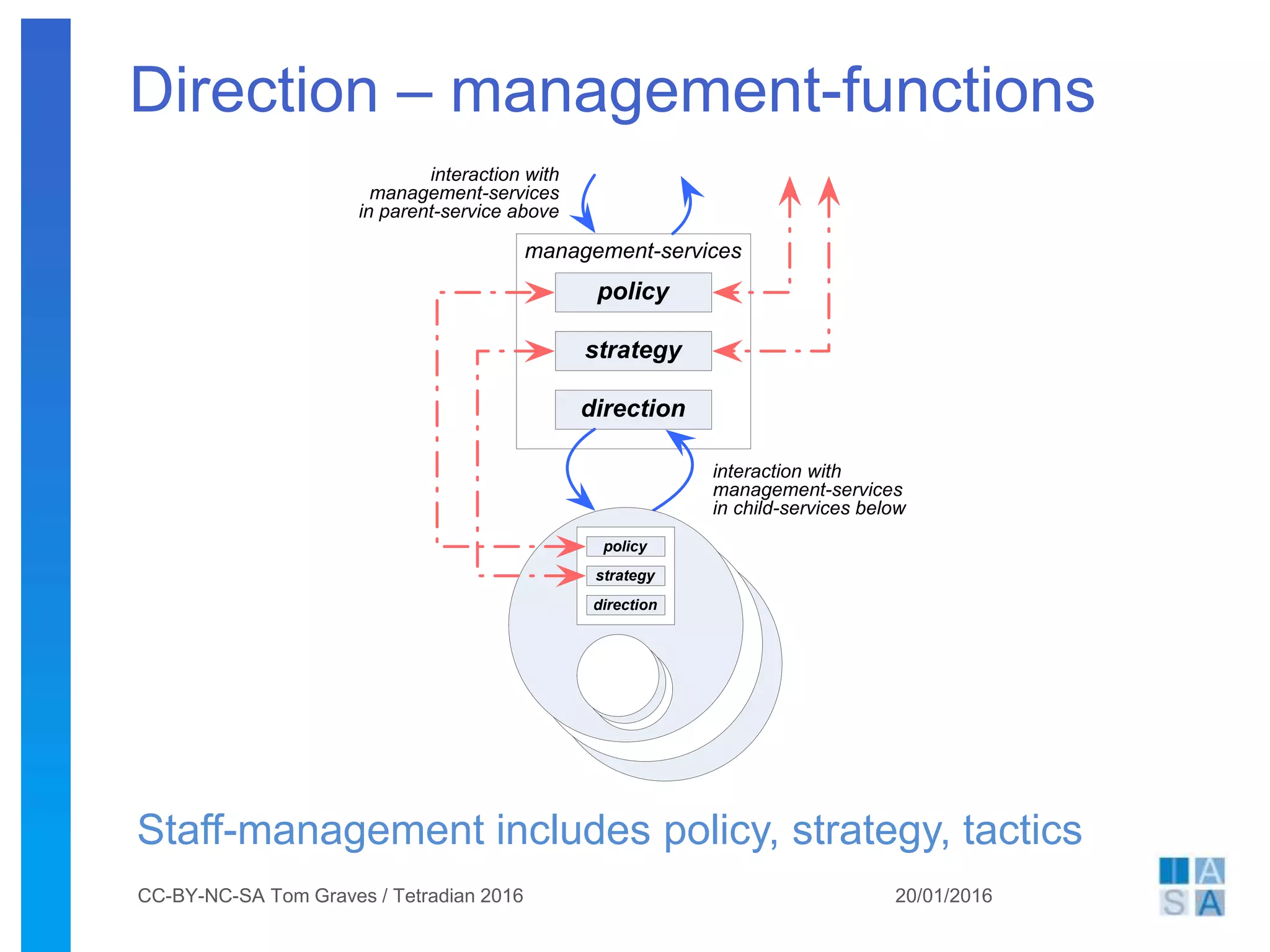
Direction – management-functions
20/01/2016CC-BY-NC-SA Tom Graves / Tetradian 2016
Staff-management includes policy, strategy, tactics
management-services
policy
strategy
direction
policy
strategy
direction
interaction with
management-services
in parent-service above
interaction with
management-services
in child-services below
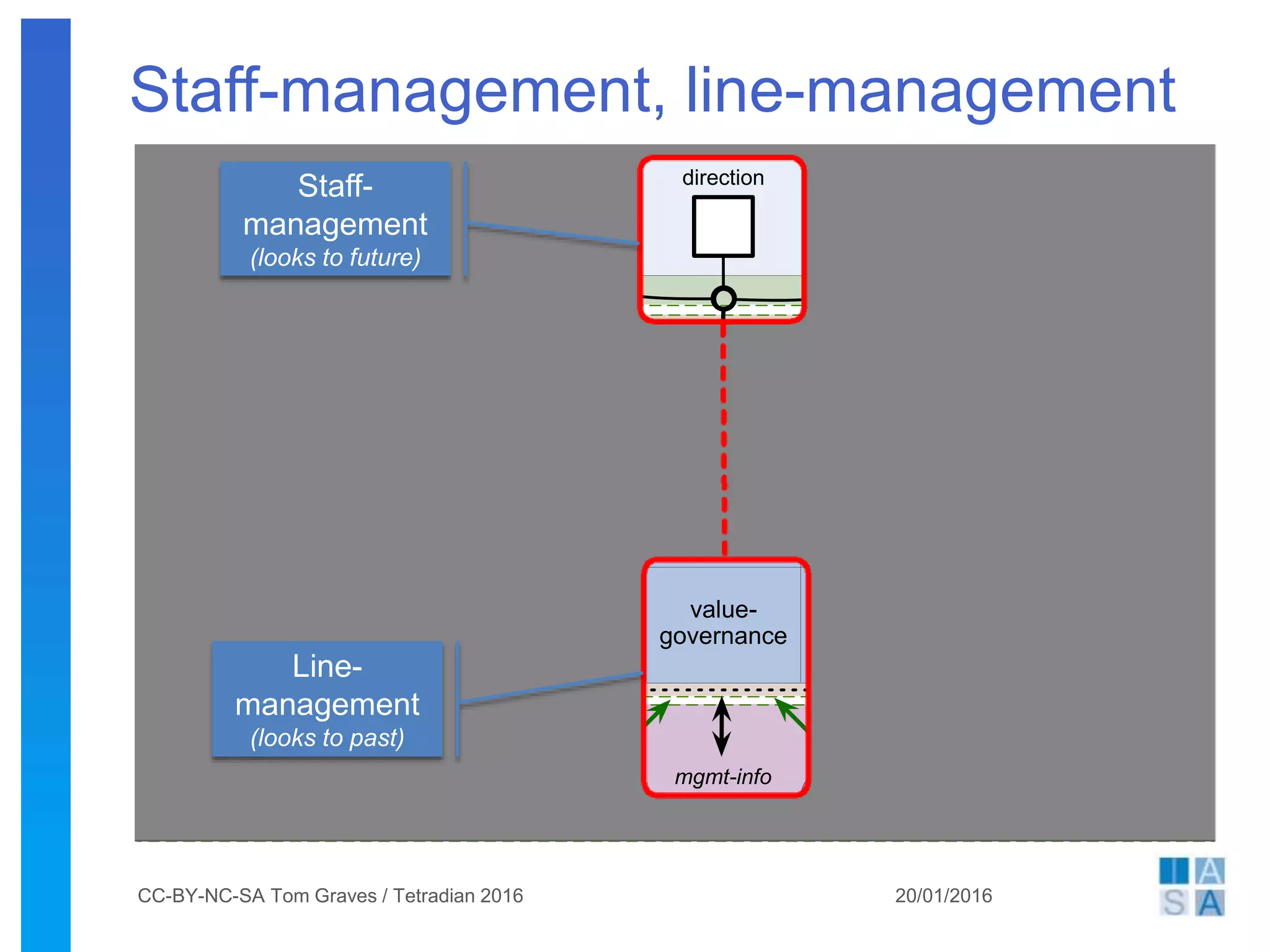
Staff-management, line-management
20/01/2016CC-BY-NC-SA Tom Graves / Tetradian 2016
investor
(money etc)
customer
(value)
citizen
(values)
supplier
relations
value-
proposition
supplier
channels
value-
creation
customer
channels
customer
relations
value-
outlay
value-
governance
value-
return
supplier customer
investor beneficiary
coordinationdirectionvalidation
before before
during during
after after
investment dividend
guidanceguidance
mgmt-info
Staff-
management
(looks to future)
Line-
management
(looks to past)
Coordination – action and change
20/01/2016CC-BY-NC-SA Tom Graves / Tetradian 2016
investor
(money etc)
customer
(value)
citizen
(values)
supplier
relations
value-
proposition
supplier
channels
value-
creation
customer
channels
customer
relations
value-
outlay
value-
governance
value-
return
supplier customer
investor beneficiary
coordinationdirectionvalidation
before before
during during
after after
investment dividend
guidanceguidance
mgmt-info
Coordination end-to-end
20/01/2016CC-BY-NC-SA Tom Graves / Tetradian 2016
investor
(money etc)
customer
(value)
citizen
(values)
supplier
relations
value-
proposition
supplier
channels
value-
creation
customer
channels
customer
relations
value-
outlay
value-
governance
value-
return
supplier customer
investor beneficiary
coordinationdirectionvalidation
before before
during during
after after
investment dividend
guidanceguidance
mgmt-info
Coordination over time
20/01/2016CC-BY-NC-SA Tom Graves / Tetradian 2016
investor
(money etc)
customer
(value)
citizen
(values)
supplier
relations
value-
proposition
supplier
channels
value-
creation
customer
channels
customer
relations
value-
outlay
value-
governance
value-
return
supplier customer
investor beneficiary
coordinationdirectionvalidation
before before
during during
after after
investment dividend
guidanceguidance
mgmt-info
Coordination – projects and change
20/01/2016CC-BY-NC-SA Tom Graves / Tetradian 2016
delivery-
service
management-services
policy
strategy
direction
develop
the business
change
the business
run
the business
delivery-
service
delivery-
service
Modes for coordination link to modes for direction
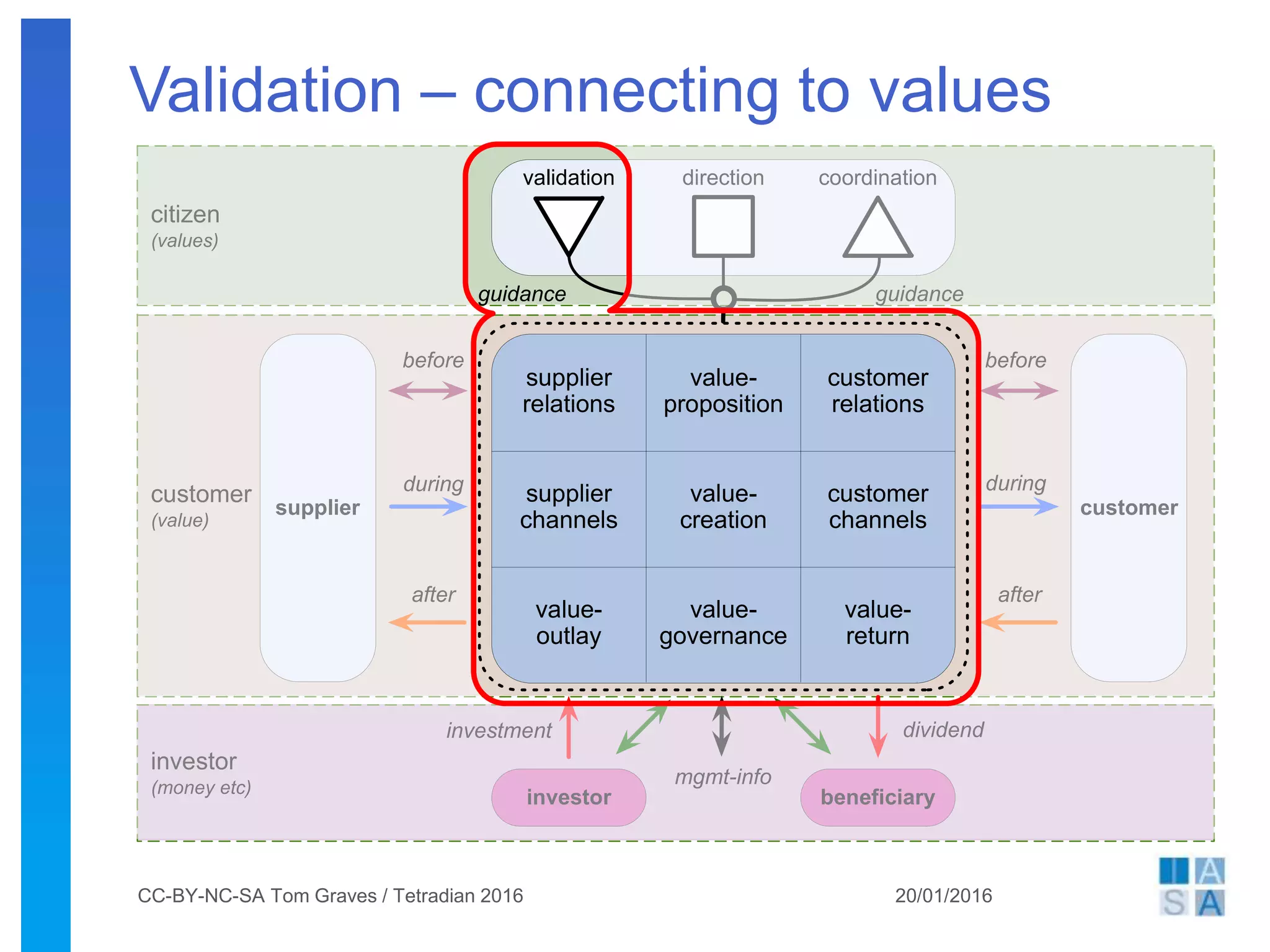
Validation – connecting to values
20/01/2016CC-BY-NC-SA Tom Graves / Tetradian 2016
investor
(money etc)
customer
(value)
citizen
(values)
supplier
relations
value-
proposition
supplier
channels
value-
creation
customer
channels
customer
relations
value-
outlay
value-
governance
value-
return
supplier customer
investor beneficiary
coordinationdirectionvalidation
before before
during during
after after
investment dividend
guidanceguidance
mgmt-info
Enterprise-values are
everyone’s responsibility.
(Enterprise-values typically include:
health-and-safety, security, reliability,
efficiency, effectiveness, financial-probity,
environment, ethics and many more.)
Supporting the values
- build awareness of the business-importance
of that value
- build capability to enact support
for that value in real-world action
- assess compliance on and support
continual-improvement on that value
For each enterprise-value,
we need support-services that:
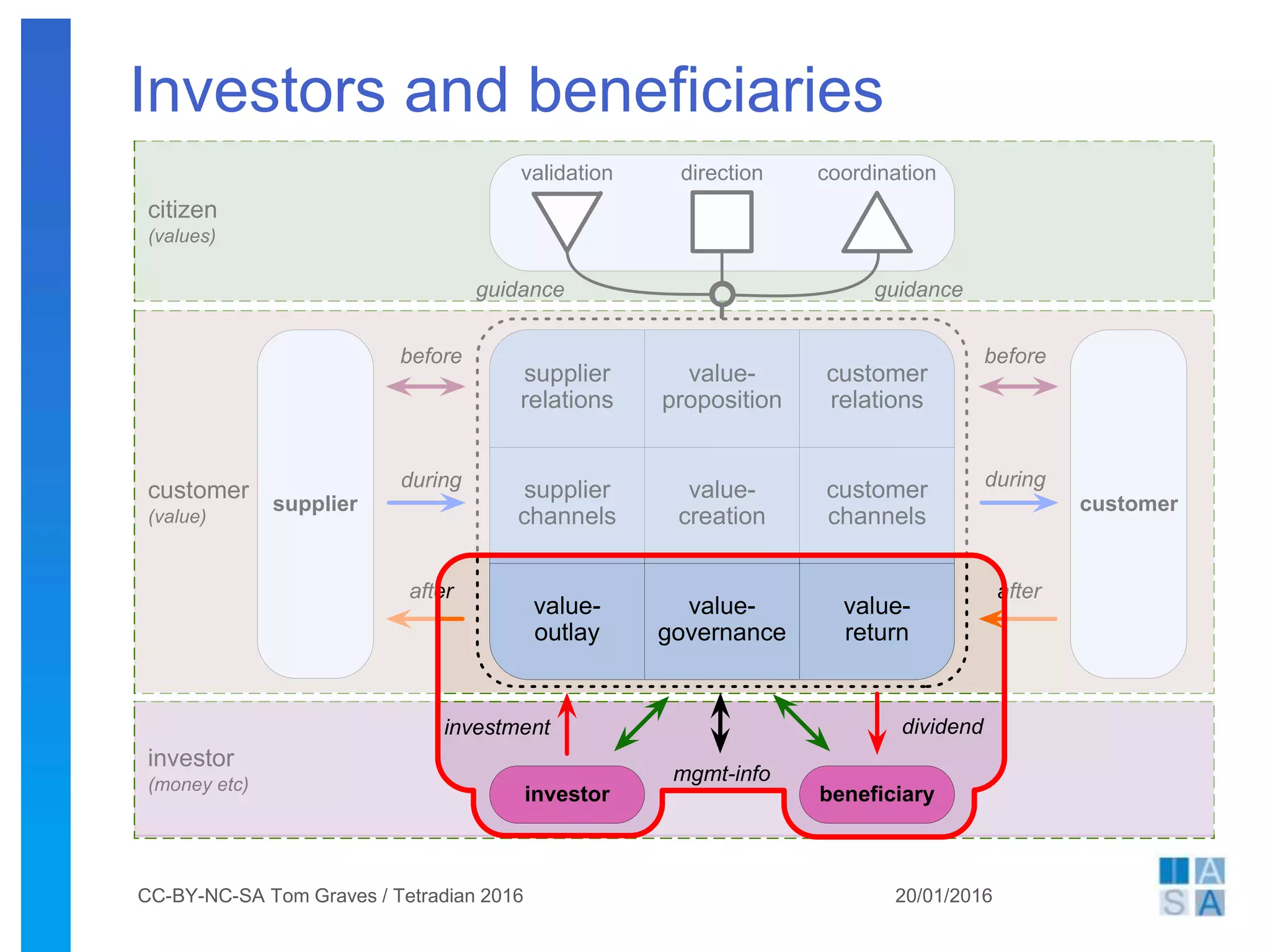
Investors and beneficiaries
20/01/2016CC-BY-NC-SA Tom Graves / Tetradian 2016
investor
(money etc)
customer
(value)
citizen
(values)
supplier
relations
value-
proposition
supplier
channels
value-
creation
customer
channels
customer
relations
value-
outlay
value-
governance
value-
return
supplier customer
investor beneficiary
coordinationdirectionvalidation
before before
during during
after after
investment dividend
guidanceguidance
mgmt-info
We need to consider
investments and returns
of every applicable type,
to and from
every type of stakeholder.
(‘Applicable type’ is determined
by the shared-enterprise values.)
Always start from the values.
(Not the money.)
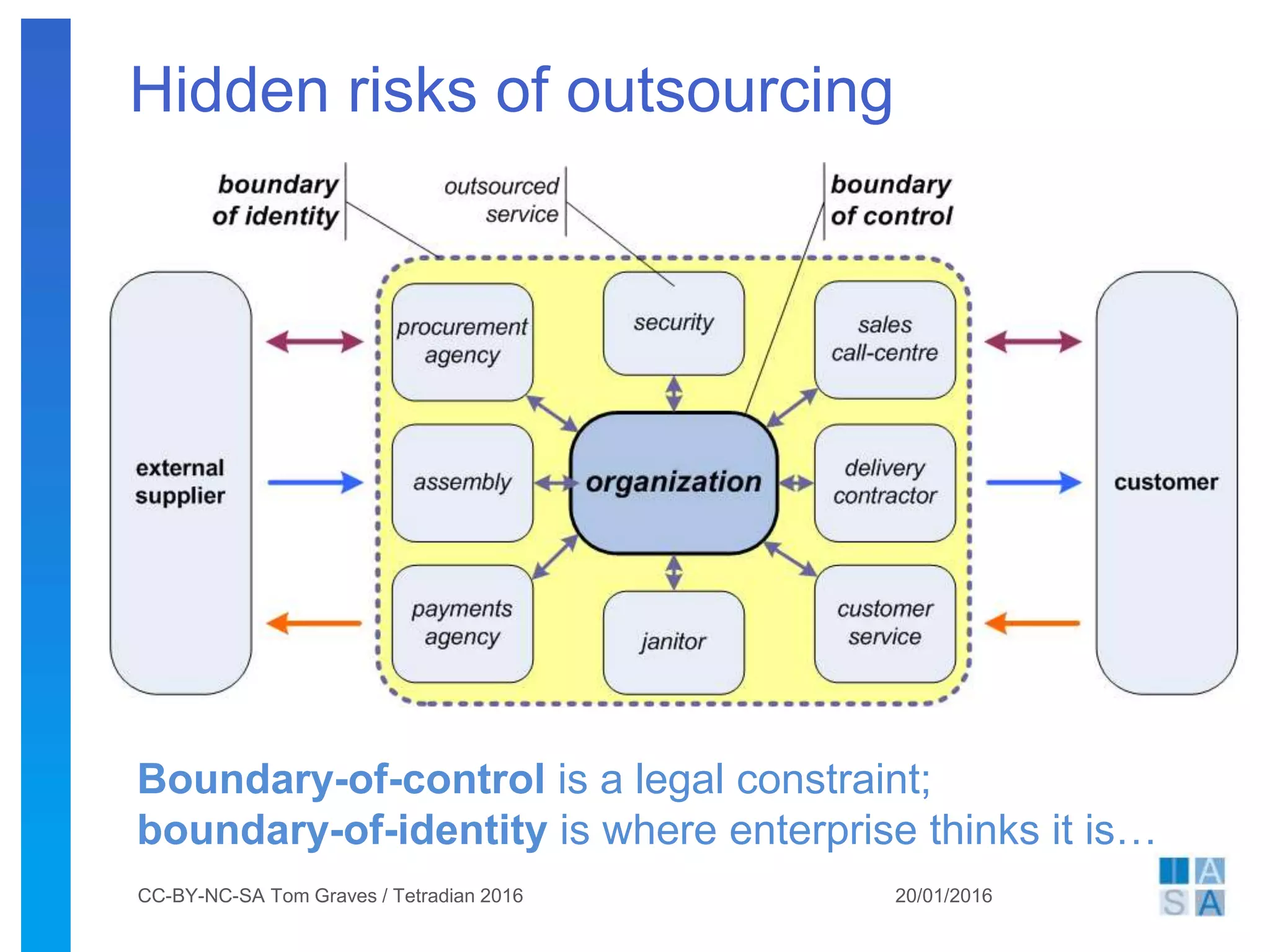
Hidden risks of outsourcing
20/01/2016CC-BY-NC-SA Tom Graves / Tetradian 2016
Boundary-of-control is a legal constraint;
boundary-of-identity is where enterprise thinks it is…
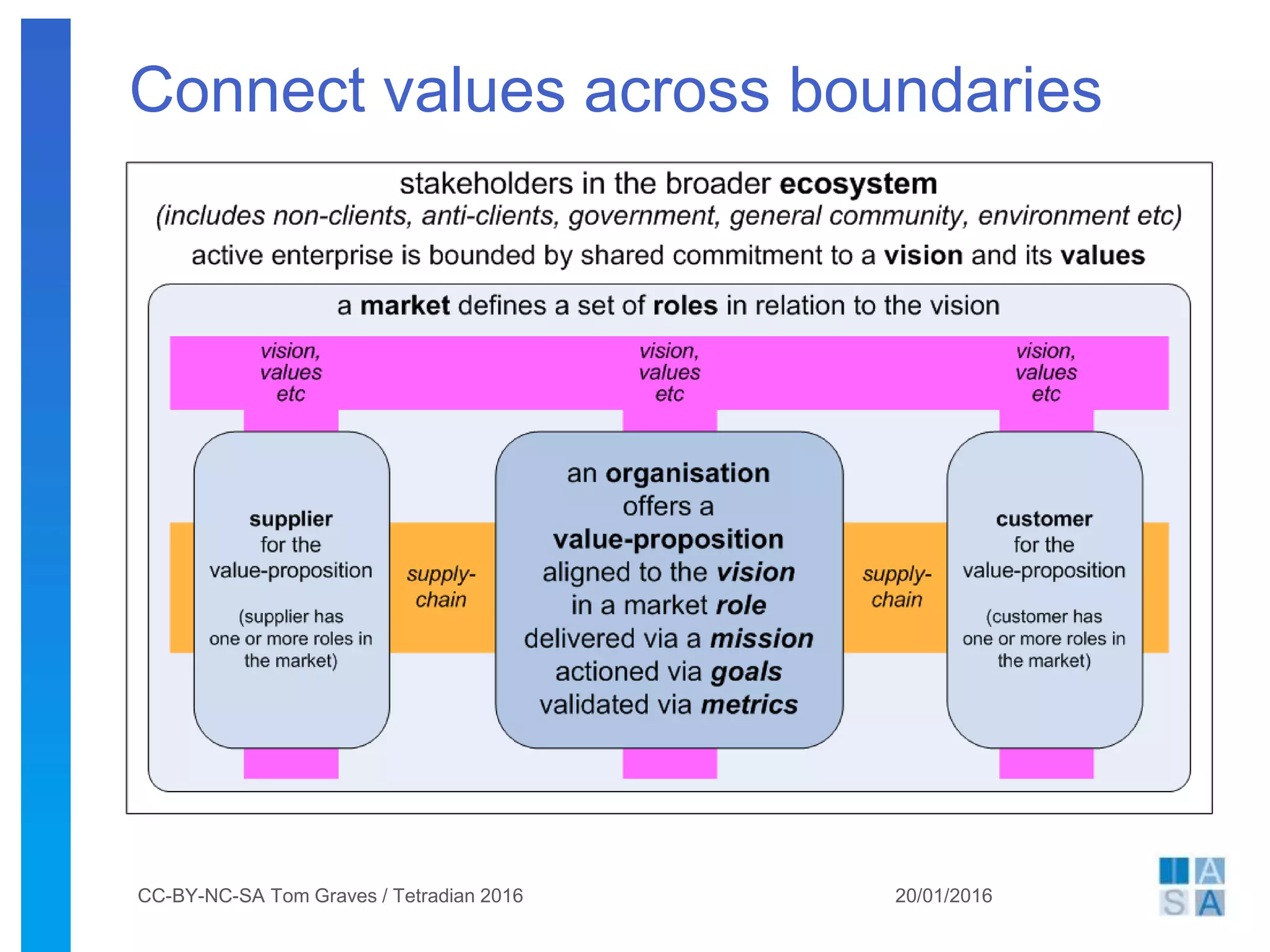
Connect values across boundaries
20/01/2016CC-BY-NC-SA Tom Graves / Tetradian 2016
A cautionary tale…
Playing ‘Pass The Grenade’?
Business architecture:
Not going backwards
What anti-patterns do we need to
avoid in the business-model and
business-architecture?
Upwards, downwards, sideways…
20/01/2016CC-BY-NC-SA Tom Graves / Tetradian 2016
the organisation within the shared-enterprise…
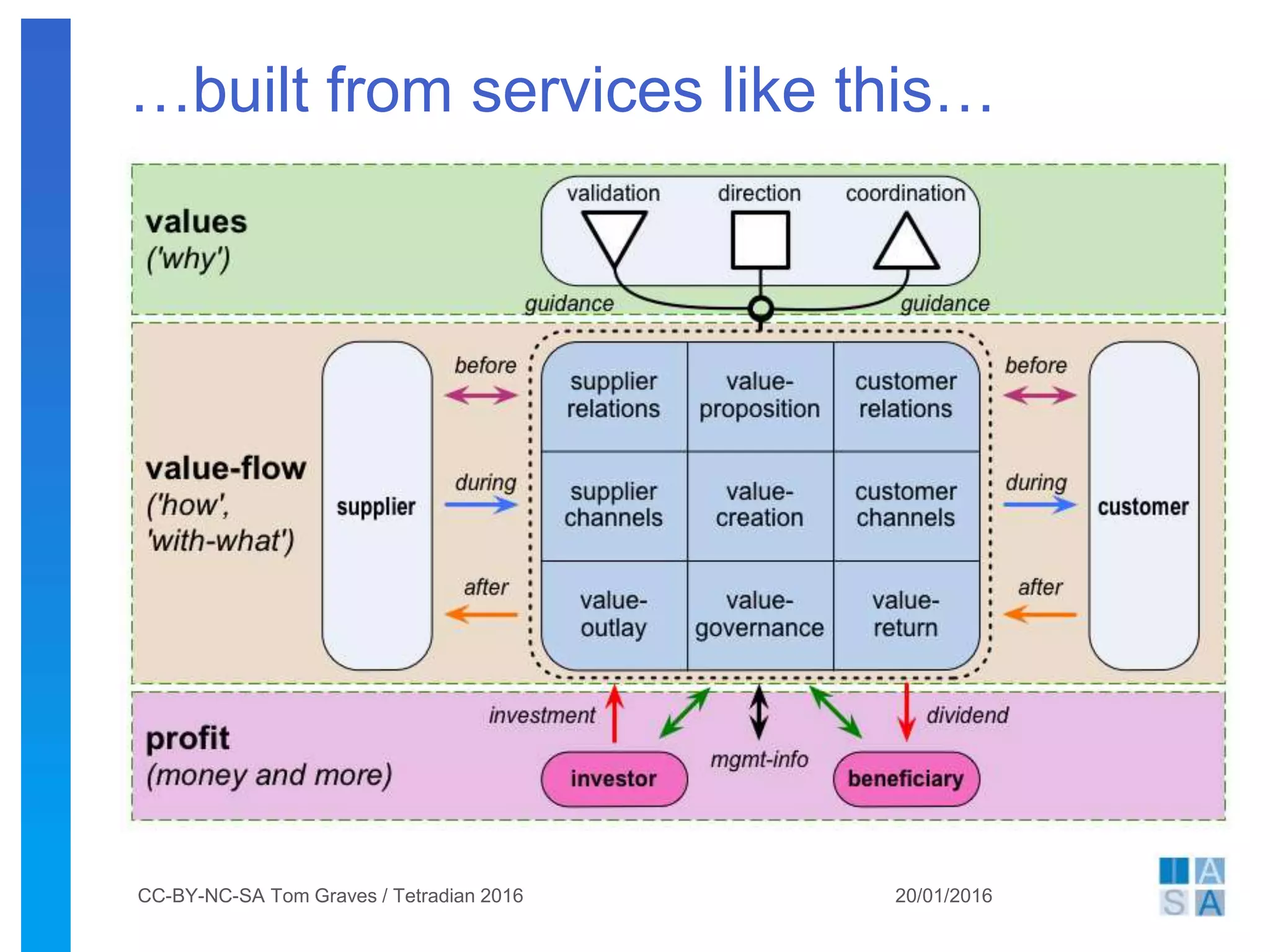
…built from services like this…
20/01/2016CC-BY-NC-SA Tom Graves / Tetradian 2016
…but there are all manner of
conceptual-errors that can cause
an organisation and its business-
model to become disastrously
inefficient and ineffective.
These include…
Business-Design Error #1:
“It’s all about us”
Leads to inability to engage
with customers and others,
and creates anticlient risks.
Business-Design Error #2:
“It’s all about efficiency”
Often leads to local-efficiencies
at the expense of
overall effectiveness.
Business-Design Error #3:
“It’s all about control”
Often leads to attempts to control
that which cannot be controlled
– inherently causing frustration
and failure.
Business-Design Error #4:
“It’s all about the silos”
Beware of Conway’s Law – it leads
to end-to-end fragmentation and
incomprehensible systems.
Business-Design Error #5:
“It’s all about the owners”
Over-focus on a single group of
stakeholders will increase risks from
anticlients and (many) others.
Business-Design Error #6:
“It’s all about the money”
Over-focus on money will distort all
forms of decision-making, and will
cause longer-term failure.
If we focus too much on money,
we lose track of the ‘why’ of values.
If we lose track of the ‘why’ of values,
we disconnect from the enterprise.
If we disconnect from the enterprise,
there’s no business…
Always start from the values.
(Not the money.)
Values-first architecture…
20/01/2016CC-BY-NC-SA Tom Graves / Tetradian 2016
Money-first architecture…
20/01/2016CC-BY-NC-SA Tom Graves / Tetradian 2016
The supposed ‘normal’ architecture for business
embeds all of those design-errors, and more…
A cautionary tale…
“Our strategy is last year +10%”
Summary
In business-architecture:
• Look upward
to connect with big-picture
• Look downward
to connect with the real world
• Look sideways
to connect everything together
• Beware of the pressures
to go backward to what doesn’t work
Contact: Tom Graves
Company: Tetradian Consulting
Twitter: @tetradian ( http://twitter.com/tetradian )
Website: http://tetradian.com
Weblog: http://weblog.tetradian.com
Slidedecks: http://www.slideshare.net/tetradian
Print-books: http://tetradianbooks.com
E-Books: http://leanpub.com/u/tetradian
Example
titles:
• Mapping the enterprise: modelling the enterprise as
services with the Enterprise Canvas (2010)
• The service-oriented enterprise: enterprise architecture and
viable services (2009)
• Doing enterprise-architecture: process and practice in the
real enterprise (2009)
Further information:

Business Architecture: Upwards, Downwards, Sideways, Back

  • 1.
    Business Architecture: Upwards, Downwards,Sideways, Back Tom Graves, Tetradian Consulting
  • 2.
    Business architecture: What’s thisabout? What is business-architecture? Where do we start?
  • 3.
    What is Business Architecture? Business-architectureis the architecture – the structure and the story – of the business of the business.
  • 4.
    What is BusinessArchitecture? Domains typically include business-models, operating-models and capability-models. Domains in the business-architecture may also include process-architectures, organisation- architectures, financial-architectures and more. Each organisation’s Business Architecture is its own choice of architecture-domains.
  • 5.
    Warning… It’s a distinctarchitecture in its own right – we need to understand it as such, and then how it intersects with IT. Business-architecture is more than “anything not-IT that might affect IT”!
  • 6.
    Where to start:Business-model… Business Model Canvas and Value Proposition 20/01/2016CC-BY-NC Strategyzr
  • 7.
    Where to start:Business-model… Business Model Canvas populated, crosslinked 20/01/2016CC-BY-NC-SA Tom Graves / Tetradian 2016
  • 8.
    Where to start:Business-model… Business-model as descriptive story 20/01/2016CC-BY-NC Strategyzr
  • 9.
    Where to start:Capability-maps… Capability-map: Functional Business Model Accept Orders Contact Customer Manage the Business Deliver Orders Support the Business Process Orders Consolidate Orders Manage Production Management Manage Licensee Outbound Operations Manage Materials Receipt and Verification Manage Facility Pre- Production Processing Manage Container & Label Strategies Manage Vehicles Manage Equipment and Equipment-Strategies Manage Facility Property Manage Relationship with Licensees Manage Asset Service Providers Manage Transport Sub-Contracts for Delivery Manage NCR-Code Configurations Define Processing Strategies Define Performance Management Manage Production Systems Strategies Design and Develop Facility Infrastructure Manage Production- Planning Strategies Manage Facility Information Manage Core Business Manage Post- Production Operations Setup for Contractor Delivery Manage Equipment Maintenance Manage Production Operations Accept from Agency Accept from Contractor Accept at Facility Accept at Customer Location Manage FinanceManage Human Resources Manage Facility Administration Manage Materials Strategies Prepare Customer Transfer Support Customer Bulk Orders Handle Customer Complaints & Inquiries Process Service Requests Fulfil Order Prepare Fulfillmen Transfer Support Bu Fulfillmen Orders Handle Fulfillmen Complaint & Inquirie Process Fulfillmen Requests 20/01/2016CC-BY-NC-SA Tom Graves / Tetradian 2016
  • 10.
    Where to start:Capability-maps… Three-tier Functional Business Model Customer OutboundInbound Support Transport Process Check and prepare vehicle Road Transport Operations Drop Off Orders & empty containers Handle vehicle incidents (breakdowns, re-fuel, etc.) Capture transport run events Drive transport vehicle between locations Pick Up Orders & empty containers Complete preparation of orders into consignments Commence carrier service Carrier staff verify consignment details & hand over consignment to contractor Lodge consignments with carrier Verify / accept consignment Visit "trans-ship" port Complete carrier service Receive & verify consignments Handle consignment exceptions Separate and store containers etc. in preparation for transport to facility Domestic Carrier Transport Operations Planning & Monitoring of Carrier Services Determine required lodgement & handover times Receive new/ updated schedules from carriers Develop & maintain carrier lodgement schedules Monitor carrier services & provide corrective action Assess disputed/ late consignments Transport Facility Management Time and Attendance Monitoring & Control Review Facility Performance & implement improvements Planning & Scheduling Staffing & Rostering Manage Stream orders into production batches Manage batch containers prior to pick up Consolidate Orders Create & Maintain Facility NCR-Code Plans Estimate Production Volumes Plan & Schedule Production Operations Staffing & Rostering Time and Attendance Monitor Order Processing Review Facility Performance & imp. improvements Corrective Action for Processing Quality Control Dock Management Production Management Corrective Action for Transport & Delivery Materials Receipt and Verification Inspection of inbound materials Process “Under Bond” Materials Process Hazardous Materials Handover Materials to Warehouse Licensee Outbound Operations Inspection of outbound product Prepare licensee consignment for despatch Capture outbound volumes and events Despatch outbound product via licensee carrier Receive Transfers at Facility Transfers Damage Check Slotting / Sequencing Interleaving Pre-Mould Verify Slippage Adjustment Batch Alignment for Moulding Pre-Production Processing at Facility Capture Processing Events Prepare Customer Transfer Plan Transfer Production Prepare Transfer Data Prepare Transfer Production Prepare Transfer Documentation Support Customer Bulk Orders Advise customer of bulk-order issues Manage Customer Order Quality Support customer bulk orders Handle Customer Complaints & Inquiries Receive & record notification of problems Investigate & resolve problems Report Status of Order Handle general inquiries Process Service Requests Process Requests Process Other Requests Process Payment for Service Consumable Tools Management Specify Tools requirements Acquire & Locate Consumable Tools Maintain inventory of Consumable Tools Manage & perform maintenance of Consumable Tools Container & Label Management Specify container requirements Acquire & Supply Containers Manage & perform maintenance of containers Maintain inventory of containers Label Policy & Design Manage Label Stock Specify vehicle requirements Vehicle Management Purchase or Lease vehicles (& accessories) Dispose of vehicles Maintain inventory of vehicles Manage contracts with fuel suppliers Monitor payments to fuel suppliers Manage allocation of vehicles to facilities Manage vehicle registration & insurance Prepare claims for diesel & alternative fuel grant Manage maintenance of vehicles Design, Specify & Evaluate New Equipment Purchase/Dispose Equipment & Spares Install & Relocate Equipment Develop Maintenance Strategies Monitor & Optimise Performance & Reliability Equipment Management Ensure Logistics & OH&S Compliance Manage Equipment Configuration Manage Technical Documents & Support Systems Manage Inventory, Repairs & Stores Infrastructure Property Management Specify Property Requirements Acquire Property Dispose of Property Manage Building Administration Establish & Maintain Relationships with Licensees Manage Relationship with Licensees Calculate Revenue due from Licensees Specify materials requirements Materials Management Acquire & Locate Materials Maintain inventory of Materials Select & Manage Asset Maintenance Service Providers Evaluate & select Asset Maintenance Service Providers Establish & maintain Asset Maintenance Contracts Monitor Service Provider performance Terminate Contract Manage Transport Sub-Contractors Maintain Contractor Service Information Evaluate & Select Transport Contractors Establish & Maintain Transport Contracts Monitor Contractor Performance Manage Payments to Contractors Terminate Contract Select & Manage Agencies Evaluate & Select Agencies Establish & Maintain Contracts with Agencies Monitor Agencies Performance Manage Payments To/From Agencies Terminate Contract with Agency NCR-Code Management NCR-Data Strategy, Policy & Procedures Maintain NCR Information Maintain Machine Configuration Data NCR Configuration Improvement Manage Machine- Specific NCR Configuration NCR Code-Sharing Management & Support Processing Policy, Procedures & Governance Processing Strategies Sorting Strategy & Design Develop Processing Plans Measurement of Service Quality Measure Financial Performance Measurement of Resource Utilisation Performance Analysis Performance Management Production Systems Initiate Project Evaluate Solutions Finalise Project Systems support & maintenance Develop / Enhance System Implement System Determine business systems strategies Systems control & Administration Specify Facility Requirements Model Proposed Solutions Select & Design Preferred Solution Plan & Schedule Facility Development Implement Facility Changes Construct Facilities & Equipment Facility / Infrastructure Design & Development Production Planning Determine prod’n strategy & direction Capacity Planning Investment Planning Determine prod’n principles & policies Legislative Compliance Develop & maintain Dangerous Goods policies & procedures Production Capability Analysis Manage Facility Information Define Costing Reference Data Maintain Prod’n Structure Information Define terminology, & codes Manage barcoding standards, formats & characteristics Manage central storage of event information Manage inventory of scanners Manage central storage of production volumes International Carrier Transport Operations Receive inbound containers at origin port Handover outbound containers at destination port Transport bond containers from origin port to destination port Manage Core Business Develop Business Strategies Manage business performance & operations Co-ordinate Projects Develop Business Plans Manage Projects Develop business perf. measures & targets Receive Container from Contractor Drop-Off Setup for Contractor Delivery Receive Misdirected Container from Contractor Deliver Container via Contractor Record errors & notify customer Store articles Verify Customer Pick-up Handle Undeliverables (including missorts) Calculate Priority Delivery Charge Capture Contractor Delivery Events Despatch Container for Contractor Pick-Up Handle delivery vehicle incidents Check & Prepare Delivery Vehicles Document Handover to Transport Driver Capture Non-Contractor Delivery Events Setup for Non-Contractor Delivery Handle Customer Returns Deliver Container to Customer Operate Vehicle for Transport Runs Drop Off / Pick Up at Facility Depot Establish Production Volumes Time and Attendance Monitor Post- Production Operations Corrective Action Review Facility Performance & Implement Improvements Manage Post- Production Operations Staffing & Rostering Plan & Schedule Operations NCR-Code Updates Capture Machine Configuration Changes Capture Tool Changes Capture Machine Changes Capture and Notify NCR-Code Changes Equipment Maintenance Plan & Schedule Equipment Maintenance Perform & Reord Equipment Maintenance Correct & Record Equipment Faults & Parts Usage Monitor & Report Maintenance Compliance Modify Equipment Optimise Equipment Performance & Reliability Handle Non-Valid Orders Machine Preparation Moulding Capture volumes & machine statistics Prepare agency consignments Prepare product for road transport Production Operations Capture production events Inward Dock Operations Initial Preparation Move Product between processing steps Order Configuration Machine Production Manual Preparation Capture Order Assemble Order Prepare order documentation Accept from Contractor Accept Agency Order Capture inbound order events Receive inbound order from agency Print & apply agency identifier labels Reconciliation of agency bills & orders Record agency order violations Handover order documentation to transport driver Receive Order Lodgement Accept at Facility Receive electronic order via internet Process electronic order via email Verify Order Preparation & Streaming Handle Rejected Orders Capture Order information Process Payment for Order Handover Order to Transport Driver Capture actual acceptance events Verify Order Accept at Customer Location Finance Provide Financial Analysis & Direction Support Business Cases Produce budgets & forecasts Manage Financial Policy & Procedures Record & monitor expenditure Human Resources Succession Planning Recruitment Maintain employee records Occupational Health & Safety Operational Training Leave Administration Staff Development Industrial Relations Facility Administration General Administration Perform & Manage Stores Function Manage Technical Documents Maintain Technical Help Desk Capture Consolidation Events Accept Inbound Requests 20/01/2016CC-BY-NC-SA Tom Graves / Tetradian 2016
  • 11.
    A cautionary tale… Foiledby financial-architecture? CC-BY-SA foam via Flickr
  • 12.
    • Look upwardto connect with big-picture • Look downward to connect with real world • Look sideways to connect all together • Beware of the pressures to go backward Four themes…
  • 13.
    Business architecture: Looking upward Whatis the broader context for this business-model? How will the business-model make sense to all of its stakeholders?
  • 14.
    Why anything happens… 20/01/2016CC-BY-NC-SATom Graves / Tetradian 2016 The vision describes the desired-ends for action; values guide action, describing how success would feel. A tension exists between what is, and what we want
  • 15.
    The nature ofservice… 20/01/2016CC-BY-NC-SA Tom Graves / Tetradian 2016 A service represents a means toward an end – ultimately, the desired-ends of the enterprise-vision.
  • 16.
    Relations between services… 20/01/2016CC-BY-NC-SATom Graves / Tetradian 2016 Services exchange value with each other, to help each service reach toward the respective vision and outcome.
  • 17.
    Values and value… 20/01/2016CC-BY-NC-SATom Graves / Tetradian 2016 Each service sits at an intersection of values (vertical) and exchanges of value (horizontal)
  • 18.
    Organisation and enterprise… Organisation “astructure and means to achieve ends” (bounded by rules, roles and responsibilities) Organisation and enterprise are not the same! Enterprise “a shared purpose, a bold endeavour” (bounded by vision, values and commitments)
  • 19.
    Organisation as ‘theenterprise’ 20/01/2016CC-BY-NC-SA Tom Graves / Tetradian 2016 This is almost entirely internal – no-one else involved.
  • 20.
    Supply-chain as ‘theenterprise’ 20/01/2016CC-BY-NC-SA Tom Graves / Tetradian 2016 This is about transactions with others, but usually from the organisation’s view first, or only.
  • 21.
    Market as ‘theenterprise’ 20/01/2016CC-BY-NC-SA Tom Graves / Tetradian 2016 We start to address the complexity of the market-place – which often includes a more customer-centric view.
  • 22.
    Shared-story as ‘theenterprise’ 20/01/2016CC-BY-NC-SA Tom Graves / Tetradian 2016 We engage with all of the complexities of the entire shared-enterprise – the enterprise-as-itself.
  • 23.
    A stakeholder in thestory is anyone who can wield a sharp-pointed stake in our direction… CC-BY-NC-SA evilpeacock via Flickr Stakeholders in the enterprise (Hint: there are a lot more of them than we might at first think…)
  • 24.
    Beware of anticlients… Anticlientsarise through deeply-held beliefs, or from perceived betrayal by the organisation. Do not ignore anticlient-risks! – anticlients do not transact, but interact in the story in ways that can destroy the organisation. Anticlients share the same enterprise, but deeply disagree with how the organisation operates within that story.
  • 25.
    Vision, purpose, promise This isalso about how we keep to our purpose, and keep our promise… …in a viable business, we don’t make promises that we can’t or won’t keep! Proximus, Belgium
  • 26.
    A three-part ‘story’that makes sense to all enterprise-stakeholders Elements of a vision-statement Action (‘How’): what is being done to or with or about the concern Example: “Ideas worth spreading” Qualifier (‘Why’): the emotive driver for action on the concern Example: “Ideas worth spreading” Concern (‘What’): the focus of interest to everyone in the shared-enterprise Example: “Ideas worth spreading”
  • 27.
    Vision outlines theshared-story… Principles devolve from values… Value-propositions must align to vision, values, principles… Vision, role, mission, goal… Values devolve from the vision…
  • 28.
    Connect to thestory 20/01/2016CC-BY-NC-SA Tom Graves / Tetradian 2016
  • 29.
  • 30.
    Business architecture: Looking downward Howwill the business-model be implemented? What are some of the hidden ‘gotchas’ that could break the business-model?
  • 31.
    Realising the business-model UseSCORE to identify: - capabilities needed for the business-model - which can be bought-in or outsourced - which capabilities must remain in-house - the reasoning behind those decisions Assemble from capabilities (‘capability’ as ‘the ability to do work’)
  • 32.
  • 33.
    Start with anassertion: Everything in the enterprise is or represents a service. (If so, we can describe everything in the same consistent, fractal way.)
  • 34.
    (Business Model Canvasisn’t fractal – it’s linked only to a single high-level view – so we need to adapt that business-model to a more fractal frame.) Fractality is our friend… allows us to use the same patterns everywhere, at every level
  • 35.
    Business-model to EnterpriseCanvas 20/01/2016CC-BY-NC-SA Tom Graves / Tetradian 2016 KP supplier CS customer (KP) supplier relations VP value- proposition (KP) supplier channels KR / KA value- creation CH customer channels CR customer relations C$ value- outlay (C$ / R$) value- governance R$ value- return KA Key Activities VP Value- PropositionKR Key Resources CH Channels CR Customer Relationships C$ Cost Structure R$ Revenue Streams KP Key Partners CS Customer Segments
  • 36.
    From an IT-centricview… 20/01/2016CC-BY-NC-SA Tom Graves / Tetradian 2016
  • 37.
    …but it’s muchmore than just IT 20/01/2016CC-BY-NC-SA Tom Graves / Tetradian 2016
  • 38.
    Service-content… 20/01/2016CC-BY-NC-SA Tom Graves/ Tetradian 2016 We can view in various ways what services consist of – but eventually we’ll need the full detail.
  • 39.
    Service-content… 20/01/2016CC-BY-NC-SA Tom Graves/ Tetradian 2016 At higher levels of abstraction (lists and relations only), we can get away with simple Zachman-interrogatives… What How Where Who When Why
  • 40.
    Service-content… 20/01/2016CC-BY-NC-SA Tom Graves/ Tetradian 2016 …as we move towards detail, we must become more specific – yet still fully fractal. Capabilities Locations Functions Assets Events Decisions
  • 41.
    Asset (‘What’) - aresource for which the enterprise acknowledges responsibility Composition: any combination of asset-dimensions.
  • 42.
    Function (external of‘How’) - external-facing interface, responsible for service-contracts, protocols, SLAs, etc; accepts and returns assets Composition: any combination of asset-dimensions.
  • 43.
    Location (‘Where’) - aposition within the terms of a specific schema Composition: any combination of asset-dimensions, plus time-as-location.
  • 44.
    Capability (‘Who’ /‘How’ / ‘What’) - the ability to do something: - agent enacts the capability - action asset-type acted upon - skill-level competence of the agent Composition: agent / action: asset-dimensions; skill-level: skills/decision dimensions; also recursively consists of other services
  • 45.
    Event (‘When’) - triggerfor a function and underlying capability Composition: any combination of asset-dimensions.
  • 46.
    Decision / Reason(‘Why’) - sensemaking / decision-making for the service, and/or its type of guidance or governance Composition: any combination of decision/skills dimensions.
  • 47.
    Asset-dimensions… 20/01/2016CC-BY-NC-SA Tom Graves/ Tetradian 2016 Most entities will consist of any appropriate combination – e.g. book is physical ‘thing’, has information, is valued. Assets Phys Virtual Reln Aspn physical object, machine, geographic location etc information, software-application, IP-address etc link between people and/or to other tangible 'things' person-to-virtual or virtual-to virtual link (brand etc) Physical Virtual Relational Aspirational WhatAsset-types
  • 48.
    Decision/skills dimensions… 20/01/2016CC-BY-NC-SA TomGraves / Tetradian 2016 Most contexts will need to include combinations of these. Decisions simple, linear, true/false or limited-quantitative complicated, linear but allow for delays, feedback complex, ambiguous, non-linear, 'wild-problems' uniqueness, extreme-uncertainty, 'chaotic' Rules Algor’m Guideln Princpl Rule-based (trainee) Algorithmic (apprentice) Guidelines (journeyman) Principle-based (master) WhyDecision/skill-types
  • 49.
    Working with complexity Somecomplexities must be removed, others acknowledged and embraced Use SCAN to identify: - where complexity exists, in what form - which complexities can be eliminated - which complexities are inherent (‘wild’) - what techniques to use for each
  • 50.
    SCAN for complexity-mapping 20/01/2016CC-BY-NC-SATom Graves / Tetradian 2016 Ambiguous but Actionable Not-known, None-of-the-above Complicated but Controllable Simple and Straightforward (boundary of effective-certainty) (transition from plan to action) (ORDER) (UNORDER) NOW! Certain (increasingly uncertain) (indefinite future)
  • 51.
    Order and unorder 20/01/2016CC-BY-NC-SATom Graves / Tetradian 2016 “Insanity is doing the same thing and expecting the same results” (not Albert Einstein) ORDER (IT-type rules do work here) UNORDER (IT-type rules don’t work here) “Insanity is doing the same thing and expecting different results” (Albert Einstein) certain uncertain edge of uncertainty
  • 52.
    Same and different 20/01/2016CC-BY-NC-SATom Graves / Tetradian 2016 A quest for certainty: analysis, algorithms, identicality, efficiency, business-rule engines, executable models, Six Sigma... SAMENESS (IT-systems do work well here) UNIQUENESS (IT-systems don’t work well here) An acceptance of uncertainty: experiment, patterns, probabilities, ‘design- thinking’, unstructured process... certain uncertain
  • 53.
    A surgical example… 20/01/2016CC-BY-NC-SATom Graves / Tetradian 2016 patient identity surgery plan emergency action theatre booking consumables pre-op complications family behaviour surgical-staff availability change of theatre-availability action-records equipment plan patient condition verify identity NOW ! certain uncertai n before
  • 54.
    SCAN framework summary 20/01/2016CC-BY-NC-SATom Graves / Tetradian 2016 order unorder SIMPLE (enact) regulation rotation (rules) NOT-KNOWN (explore) reframe rich-randomness (principles) COMPLICATED (evaluate) reciprocation resonance (algorithms) AMBIGUOUS (experiment) recursion reflexion (patterns, guidelines) NOW! certain uncertain plan actual before
  • 55.
    A spectrum ofservices also implies a spectrum of governance: governance of governance itself.
  • 56.
    Backbone and edge 20/01/2016CC-BY-NC-SATom Graves / Tetradian 2016 order (rules do work here) unorder (rules don’t work here) fail-safe (high-dependability) safe-fail (low-dependability) analysis (knowable result) experiment (unknowable result) BACKBONE EDGE Waterfall (‘controlled’ change) Agile (iterative change)
  • 57.
    Backbone and edge domain CRM product catalogue sales process backbone person- definition business standards standardops procedures edge CRM experiment sales/ purchase portal Agile product-dev domain ERP facilities mgmt procurement process Agile-type governance of dependencies Waterfall-type governance of dependencies (spectrum of ‘governance of governance’) 20/01/2016CC-BY-NC-SA Tom Graves / Tetradian 2016
  • 58.
    Backbone, domain andedge 20/01/2016CC-BY-NC-SA Tom Graves / Tetradian 2016 order unorder fail-safe (high-dependency) BACKBONE safe-fail (low-dependency) EDGE plan actual Waterfall (‘controlled’ change) Agile (iterative change) Mixed (guided change) analysis (knowable result) DOMAIN experiment (unknowable result)
  • 59.
    Pace-layering (and more) Differentelements change at different rates – from days to decades. Different elements have different lifetimes – from nanoseconds to centuries. Different elements reference other elements that have different rates of change, and different lifetimes. It gets kinda complicated…
  • 60.
    A cautionary tale… Dothe small details matter?
  • 61.
    Business architecture: Looking sideways Howdo we ensure compliance in the business-model? How do we guide connection and change? How do connect to and support the values of the broader enterprise?
  • 62.
    Link services tobroader enterprise 20/01/2016CC-BY-NC-SA Tom Graves / Tetradian 2016 Horizontal value-flow is easier to model, but we need also to support vertical links to enterprise-values
  • 63.
  • 64.
    Direction – strategyand tactics 20/01/2016CC-BY-NC-SA Tom Graves / Tetradian 2016 investor (money etc) customer (value) citizen (values) supplier relations value- proposition supplier channels value- creation customer channels customer relations value- outlay value- governance value- return supplier customer investor beneficiary coordinationdirectionvalidation before before during during after after investment dividend guidanceguidance mgmt-info
  • 65.
    Direction – management-functions 20/01/2016CC-BY-NC-SATom Graves / Tetradian 2016 Staff-management includes policy, strategy, tactics management-services policy strategy direction policy strategy direction interaction with management-services in parent-service above interaction with management-services in child-services below
  • 66.
    Staff-management, line-management 20/01/2016CC-BY-NC-SA TomGraves / Tetradian 2016 investor (money etc) customer (value) citizen (values) supplier relations value- proposition supplier channels value- creation customer channels customer relations value- outlay value- governance value- return supplier customer investor beneficiary coordinationdirectionvalidation before before during during after after investment dividend guidanceguidance mgmt-info Staff- management (looks to future) Line- management (looks to past)
  • 67.
    Coordination – actionand change 20/01/2016CC-BY-NC-SA Tom Graves / Tetradian 2016 investor (money etc) customer (value) citizen (values) supplier relations value- proposition supplier channels value- creation customer channels customer relations value- outlay value- governance value- return supplier customer investor beneficiary coordinationdirectionvalidation before before during during after after investment dividend guidanceguidance mgmt-info
  • 68.
    Coordination end-to-end 20/01/2016CC-BY-NC-SA TomGraves / Tetradian 2016 investor (money etc) customer (value) citizen (values) supplier relations value- proposition supplier channels value- creation customer channels customer relations value- outlay value- governance value- return supplier customer investor beneficiary coordinationdirectionvalidation before before during during after after investment dividend guidanceguidance mgmt-info
  • 69.
    Coordination over time 20/01/2016CC-BY-NC-SATom Graves / Tetradian 2016 investor (money etc) customer (value) citizen (values) supplier relations value- proposition supplier channels value- creation customer channels customer relations value- outlay value- governance value- return supplier customer investor beneficiary coordinationdirectionvalidation before before during during after after investment dividend guidanceguidance mgmt-info
  • 70.
    Coordination – projectsand change 20/01/2016CC-BY-NC-SA Tom Graves / Tetradian 2016 delivery- service management-services policy strategy direction develop the business change the business run the business delivery- service delivery- service Modes for coordination link to modes for direction
  • 71.
    Validation – connectingto values 20/01/2016CC-BY-NC-SA Tom Graves / Tetradian 2016 investor (money etc) customer (value) citizen (values) supplier relations value- proposition supplier channels value- creation customer channels customer relations value- outlay value- governance value- return supplier customer investor beneficiary coordinationdirectionvalidation before before during during after after investment dividend guidanceguidance mgmt-info
  • 72.
    Enterprise-values are everyone’s responsibility. (Enterprise-valuestypically include: health-and-safety, security, reliability, efficiency, effectiveness, financial-probity, environment, ethics and many more.)
  • 73.
    Supporting the values -build awareness of the business-importance of that value - build capability to enact support for that value in real-world action - assess compliance on and support continual-improvement on that value For each enterprise-value, we need support-services that:
  • 74.
    Investors and beneficiaries 20/01/2016CC-BY-NC-SATom Graves / Tetradian 2016 investor (money etc) customer (value) citizen (values) supplier relations value- proposition supplier channels value- creation customer channels customer relations value- outlay value- governance value- return supplier customer investor beneficiary coordinationdirectionvalidation before before during during after after investment dividend guidanceguidance mgmt-info
  • 75.
    We need toconsider investments and returns of every applicable type, to and from every type of stakeholder. (‘Applicable type’ is determined by the shared-enterprise values.)
  • 76.
    Always start fromthe values. (Not the money.)
  • 77.
    Hidden risks ofoutsourcing 20/01/2016CC-BY-NC-SA Tom Graves / Tetradian 2016 Boundary-of-control is a legal constraint; boundary-of-identity is where enterprise thinks it is…
  • 78.
    Connect values acrossboundaries 20/01/2016CC-BY-NC-SA Tom Graves / Tetradian 2016
  • 79.
    A cautionary tale… Playing‘Pass The Grenade’?
  • 80.
    Business architecture: Not goingbackwards What anti-patterns do we need to avoid in the business-model and business-architecture?
  • 81.
    Upwards, downwards, sideways… 20/01/2016CC-BY-NC-SATom Graves / Tetradian 2016 the organisation within the shared-enterprise…
  • 82.
    …built from serviceslike this… 20/01/2016CC-BY-NC-SA Tom Graves / Tetradian 2016
  • 83.
    …but there areall manner of conceptual-errors that can cause an organisation and its business- model to become disastrously inefficient and ineffective. These include…
  • 84.
    Business-Design Error #1: “It’sall about us” Leads to inability to engage with customers and others, and creates anticlient risks.
  • 85.
    Business-Design Error #2: “It’sall about efficiency” Often leads to local-efficiencies at the expense of overall effectiveness.
  • 86.
    Business-Design Error #3: “It’sall about control” Often leads to attempts to control that which cannot be controlled – inherently causing frustration and failure.
  • 87.
    Business-Design Error #4: “It’sall about the silos” Beware of Conway’s Law – it leads to end-to-end fragmentation and incomprehensible systems.
  • 88.
    Business-Design Error #5: “It’sall about the owners” Over-focus on a single group of stakeholders will increase risks from anticlients and (many) others.
  • 89.
    Business-Design Error #6: “It’sall about the money” Over-focus on money will distort all forms of decision-making, and will cause longer-term failure.
  • 90.
    If we focustoo much on money, we lose track of the ‘why’ of values. If we lose track of the ‘why’ of values, we disconnect from the enterprise. If we disconnect from the enterprise, there’s no business… Always start from the values. (Not the money.)
  • 91.
  • 92.
    Money-first architecture… 20/01/2016CC-BY-NC-SA TomGraves / Tetradian 2016 The supposed ‘normal’ architecture for business embeds all of those design-errors, and more…
  • 93.
    A cautionary tale… “Ourstrategy is last year +10%”
  • 94.
    Summary In business-architecture: • Lookupward to connect with big-picture • Look downward to connect with the real world • Look sideways to connect everything together • Beware of the pressures to go backward to what doesn’t work
  • 95.
    Contact: Tom Graves Company:Tetradian Consulting Twitter: @tetradian ( http://twitter.com/tetradian ) Website: http://tetradian.com Weblog: http://weblog.tetradian.com Slidedecks: http://www.slideshare.net/tetradian Print-books: http://tetradianbooks.com E-Books: http://leanpub.com/u/tetradian Example titles: • Mapping the enterprise: modelling the enterprise as services with the Enterprise Canvas (2010) • The service-oriented enterprise: enterprise architecture and viable services (2009) • Doing enterprise-architecture: process and practice in the real enterprise (2009) Further information: