TOGAF – A SummaryArchitecture Capability Framework (ACF)
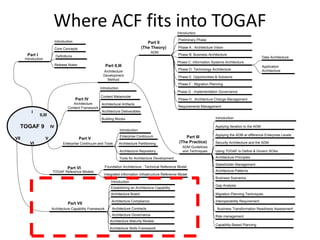
Where ACF fits into TOGAF
What is ACF?In order to successfully operate an architecture function within an enterprise, it is necessary to put  in place appropriate Organisation structuresProcessesRoles and ResponsibilitiesSkillsNot intended to be a comprehensive template for operating an enterprise architecture capability
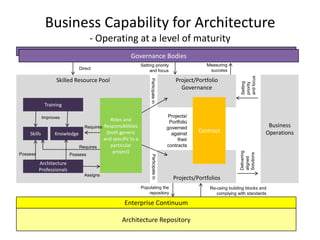
Business Capability for Architecture- Operating at a level of maturityGovernance BodiesMeasuring successSetting priority and focusDirectSetting priority and focusProject/Portfolio GovernanceSkilled Resource PoolBusiness OperationsParticipate in ContractRoles and Responsibilities(both generic and specific to a particular project)TrainingProjects/ Portfolio governed against their contractsImprovesRequiresSkillsKnowledgeRequiresDelivering aligned SolutionsPossessProjects/PortfoliosPossessParticipate in Architecture ProfessionalsAssignsPopulating the repositoryRe-using building blocks and complying with standardsEnterprise ContinuumArchitecture Repository
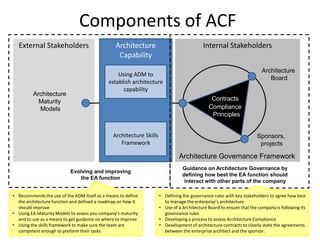
Components of ACFInternal StakeholdersArchitecture CapabilityExternal StakeholdersArchitecture BoardUsing ADM to establish architecture capabilityArchitecture Maturity ModelsContractsCompliancePrinciplesArchitecture Skills FrameworkSponsors, projectsArchitecture Governance FrameworkGuidance on Architecture Governance by defining how best the EA function should interact with other parts of the companyEvolving and improving the EA functionRecommends the use of the ADM itself as a means to define the architecture function and defined a roadmap on how it should improve
Using EA Maturity Models to assess you company’s maturity and to use as a means to get guidance on where to improve
Using the skills framework to make sure the team are competent enough to preform their tasks
Defining the governance rules with key stakeholders to agree how best to manage the enterprise’s architecture
Use of a Architecture Board to ensure that the company is following its governance rules
Developing a process to assess Architecture Compliance
Development of architecture contracts to clearly state the agreements between the enterprise architect and the sponsor.How to establish an Architecture CapabilityEstablishing a sustainable architecture practice within an organization can be achieved by adhering to the same approach that is used to establish any other capability — such as a business process management capability — within an organisation. The ADM is an ideal method to be used to architect and govern the implementation of such a capability. Applying the ADM with the specific Architecture Vision to establish an architecture practice within the organization would achieve this objectiveThis shouldn’t be seen as a phase of an architecture project, or a one-off project, but rather as an on-going practice that provides the context, environment, and resources to govern and enable architecture deliver y to the organisationUsing ADM to establish architecture capability
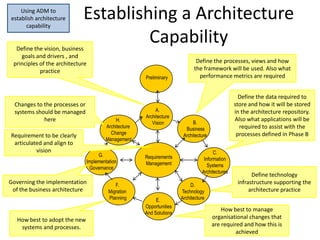
Using ADM to establish architecture capabilityEstablishing a Architecture CapabilityDefine the vision, business goals and drivers , and principles of the architecture practiceDefine the processes, views and how the framework will be used. Also what performance metrics are required PreliminaryDefine the data required to store and how it will be stored in the architecture repository. Also what applications will be required to assist with the processes defined in Phase BChanges to the processes or systems should be managed hereA. Architecture VisionH. Architecture ChangeManagementB. BusinessArchitecture Requirement to be clearly articulated and align to visionC. Information SystemsArchitectures G. ImplementationGovernanceRequirementsManagementDefine technology infrastructure supporting the architecture practiceGoverning the implementation of the business architectureD. TechnologyArchitecture F. Migration PlanningE. OpportunitiesAnd SolutionsHow best to manage organisational changes that are required and how this is achievedHow best to adopt the new systems and processes.
Using the Architecture Skills FrameworkProvides a view of the competency  levels required for specific roles. They define:The roles within a work areaThe skills required by each roleThe depth of knowledge required to fulfil the role successfullyWhy do we need itConfusion in industry over the competencies required makes recruitment difficult. Ensure a successful Enterprise Architecture practice needs staff with the relevant experience and skills in or to fulfil their roles. However these roles need to be well defined in the first place! This is what the skills framework tries to do.Having under-qualified personnel in the role of Enterprise Architecture will increase costs off re-hiring  and the quality of their work adversely impacting the company’s Enterprise Architecture.Architecture Skills Framework
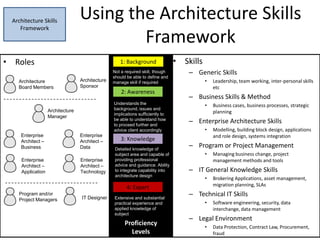
Using the Architecture Skills FrameworkArchitecture Skills FrameworkSkillsGeneric SkillsLeadership, team working, inter-personal skills etcBusiness Skills & MethodBusiness cases, business processes, strategic planningEnterprise Architecture SkillsModelling, building block design, applications and role design, systems integrationProgram or Project ManagementManaging business change, project management methods and toolsIT General Knowledge SkillsBrokering Applications, asset management, migration planning, SLAsTechnical IT SkillsSoftware engineering, security, data interchange, data managementLegal EnvironmentData Protection, Contract Law, Procurement, fraudProficiency LevelsRoles1: BackgroundNot a required skill, though should be able to define and manage skill if requiredArchitecture SponsorArchitecture Board Members2: AwarenessUnderstands the background, issues and implications sufficiently to be able to understand how to proceed further and advice client accordinglyArchitecture ManagerEnterprise Architect – DataEnterprise Architect – Business3: KnowledgeDetailed knowledge of subject area and capable of providing professional advice and guidance. Ability to integrate capability into architecture designEnterprise Architect – TechnologyEnterprise Architect – Application4: ExpertProgram and/or Project ManagersIT DesignerExtensive and substantial practical experience and applied knowledge of subject
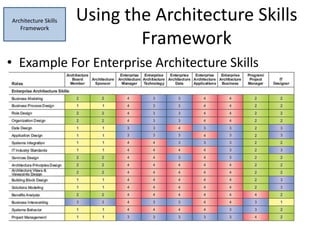
Using the Architecture Skills FrameworkArchitecture Skills FrameworkExample For Enterprise Architecture Skills
Using the Architecture Skills Framework – Role of Enterprise ArchitectArchitecture Skills FrameworkJOB DESCRIPTIONCity Planner rather than a Building Architect. Does not create a technical vision of the enterprise, rather develops professional relationships with executives of the enterprise to gather and articulate the technical vision based on the business plans of these executives. Needs to work closely within the Architecture Governance process to ensure that all design decisions are following both Business and IT strategy.Produces documentation of the architecture for application development teams or product implementation teams to execute.Manage and schedule the work of others segment or solution architects.KEY ACTIVITIESUnderstand and interpret requirements: Probe and listen for information, influence people, facilitate consensus building, synthesize and translate ideas into actionable requirements. Participates in the discovery and documentation of the customers business scenarios that are driving the solutionCreate a useful model: Take the requirements and develop well formulated models of the components. Show multiple views to communicate effectively. Ensure architecture integrity and vision and also needs to understand all the business components.Validate, refine, and expand the model: verify assumptions, bring in subject matter experts, to improve the model and further define it. Manage the architecture: Continuously monitor the models and update them as changes occur. KEY CHARACTERISTICSSkills and Experience in Producing DesignsExtensive Technical Breadth, Technical Depth in one or a few disciplinesMethod Driven approach to executionFull Project Scope ExperienceLeadershipPersonal and Professional SkillsSkills and Experience in One or More Industries
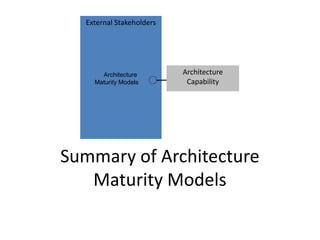
External StakeholdersArchitecture CapabilityArchitecture Maturity ModelsSummary of Architecture Maturity Models
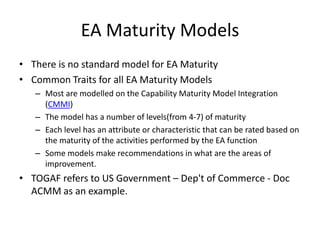
EA Maturity ModelsThere is no standard model for EA MaturityCommon Traits for all EA Maturity ModelsMost are modelled on the Capability Maturity Model Integration (CMMI)The model has a number of levels(from 4-7) of maturityEach level has an attribute or characteristic that can be rated based on the maturity of the activities performed by the EA functionSome models make recommendations in what are the areas of improvement.TOGAF refers to US Government – Dep't of Commerce - Doc ACMM as an example.
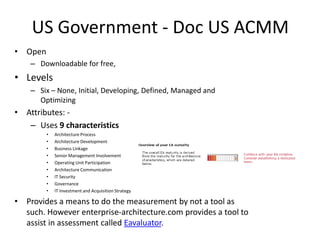
US Government - Doc US ACMMOpenDownloadable for free,LevelsSix – None, Initial, Developing, Defined, Managed and Optimizing Attributes: -Uses 9 characteristicsArchitecture ProcessArchitecture DevelopmentBusiness LinkageSenior Management InvolvementOperating Unit ParticipationArchitecture CommunicationIT SecurityGovernanceIT Investment and Acquisition StrategyProvides a means to do the measurement by not a tool as such. However enterprise-architecture.com provides a tool to assist in assessment called Eavaluator.
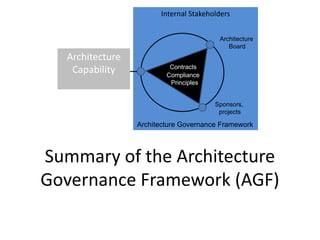
Internal StakeholdersArchitecture BoardArchitecture CapabilityContractsCompliancePrinciplesSponsors, projectsArchitecture Governance FrameworkSummary of the Architecture Governance Framework (AGF)
Definition of Governance A generic prospective to governanceEnsuring that business is conducted properly.Less about following overt control and strict adherence to rules, more about guidance and effective and equitable usage of resources to ensure sustainability of an organisation’s strategic objectivesPrinciples of Organisation for Economic Co-operation and Development (OECD)Focus on rights, roles and equitable treatment of shareholders Disclosure and transparency and responsibilities of the boardEnsures sound strategic guidance to organisation, effective monitoring and accountability for the companyCharacteristics of governanceDiscipline : All parties commit to adhering to governanceTransparency :  All actions and decisions are provided to allIndependence :  All processes , decisions  and mechanisms used will be established so as to minimised potential conflicts of interestAccountability : All identifiable groups involved are accountable for their actions Responsibility :  All parties to act responsibly to the organisation and stakeholdersFairness : All decisions taken and processes used will not be allowed to create unfair advantage to any one particular party
Definition of Architecture GovernanceArchitecture Governance is the practice and orientation by which enterprise architectures and other architectures are controlled and managed at an enterprise-wide level. It includes the followingImplementing a system of controls over the creation and monitoring of all architecture components and activities Implementing a system to ensure compliance with internal and external standards and regulatory obligationsEstablishing processes that support effective management of the above processes within agreed parameters
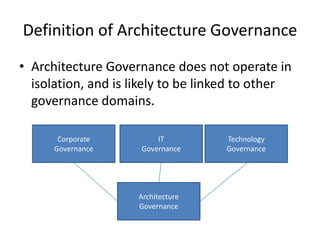
Definition of Architecture GovernanceArchitecture Governance does not operate in isolation, and is likely to be linked to other governance domains.Corporate GovernanceITGovernanceTechnologyGovernanceArchitectureGovernance
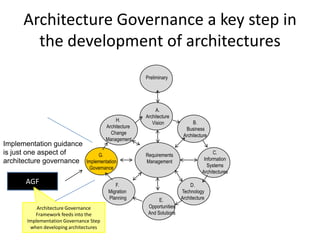
Architecture Governance a key step in the development of architecturesPreliminaryA. Architecture VisionH. Architecture ChangeManagementB. BusinessArchitecture Implementation guidance is just one aspect of architecture governanceC. Information SystemsArchitectures G. ImplementationGovernanceRequirementsManagementAGFD. TechnologyArchitecture F. Migration PlanningE. OpportunitiesAnd SolutionsArchitecture Governance Framework feeds into the Implementation Governance Step when developing architectures
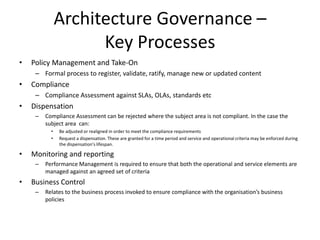
Architecture Governance – Key ProcessesPolicy Management and Take-OnFormal process to register, validate, ratify, manage new or updated contentComplianceCompliance Assessment against SLAs, OLAs, standards etcDispensationCompliance Assessment can be rejected where the subject area is not compliant. In the case the subject area  can:Be adjusted or realigned in order to meet the compliance requirementsRequest a dispensation. These are granted for a time period and service and operational criteria may be enforced during the dispensation’s lifespan.Monitoring and reportingPerformance Management is required to ensure that both the operational and service elements are managed against an agreed set of criteriaBusiness ControlRelates to the business process invoked to ensure compliance with the organisation’s business policies
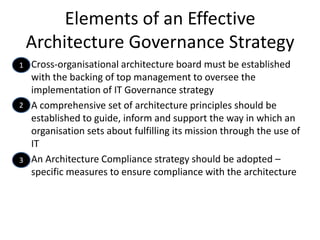
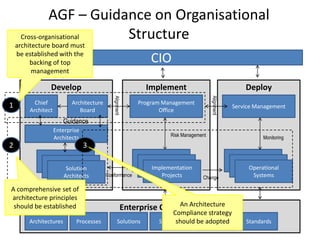
Elements of an Effective Architecture Governance Strategy Cross-organisational architecture board must be established with the backing of top management to oversee the implementation of IT Governance strategyA comprehensive set of architecture principles should be established to guide, inform and support the way in which an organisation sets about fulfilling its mission through the use of ITAn Architecture Compliance strategy should be adopted – specific measures to ensure compliance with the architecture123
AGF – Guidance on Organisational StructureCross-organisational architecture board must be established with the backing of top managementCIODevelopImplementDeployProgram Management OfficeService ManagementChiefArchitectArchitecture Board1AlignmentAlignmentGuidanceEnterprise ArchitectsRisk ManagementMonitoring23SolutionArchitectsSolutionArchitectsSolutionArchitectsSolutionArchitectsSolutionArchitectsSolutionArchitectsImplementation ProjectsOperational SystemsSolutionArchitectsConformanceChangeA comprehensive set of architecture principles should be establishedAn Architecture Compliance strategy should be adoptedEnterprise ContinuumArchitecturesProcessesSolutionsSLAs/OLARegulatory requirementsStandards
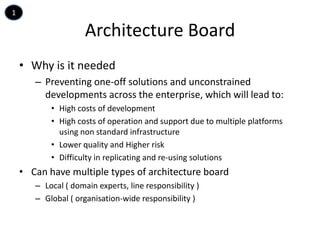
Architecture BoardWhy is it neededPreventing one-off solutions and unconstrained developments across the enterprise, which will lead to:High costs of developmentHigh costs of operation and support due to multiple platforms using non standard infrastructureLower quality and Higher riskDifficulty in replicating and re-using solutionsCan have multiple types of architecture boardLocal ( domain experts, line responsibility )Global ( organisation-wide responsibility )1
Architecture BoardResponsibilities includeEnsuring the effective and consistent management and implementation of the architecturesResolving ambiguities, issues or conflicts that have been escalatedProviding advice, guidance and informationEnsuring compliance with the architectures and granting dispensations that are keeping with the technology strategy and objectivesConsidering policy changesProviding a mechanism for the formal acceptance and approval of architecture through consensusEstablishing and maintaining the link the business strategy and objectives 1
Architecture BoardGuidance on the setting up of the Architecture BoardNeed Executive Sponsor from the highest level of the corporationSize of architecture board is a minimum of four or five and no more than 10 permanent members. Rotation is important Suggested AgendaRequests for ChangeDispensationsCompliance AssessmentsDispute ResolutionArchitecture Strategy and Direction1
Guidance on applying Enterprise Architecture PrinciplesThe  architecture board requires principles and guidance in order to help their decision making.The Chief architect and his team of architects  should provide these principles to the boardThe development of these principles need to be agreed across the enterprise2
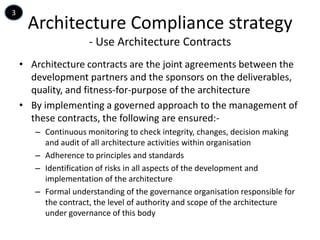
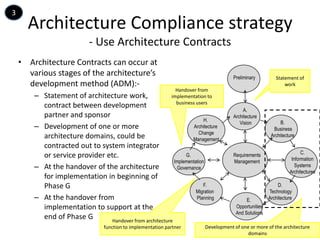
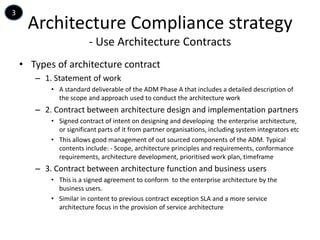
Architecture Compliance strategyConduct Architecture Compliance reviewEnsuring the compliance  of individual projects with the enterprise architecture is an essential aspect of architecture governance. An important process that should be formalised by the IT Governance is Architecture Compliance review process.Develop Architecture ContractsThe use of Architecture Contracts will help ensure the quality of the deliverables and fitness-for-purpose of the architecture3
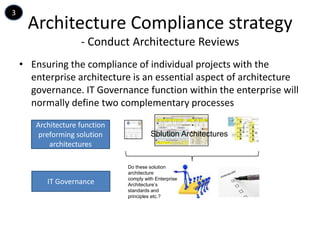
Architecture Compliance strategy- Conduct Architecture ReviewsEnsuring the compliance of individual projects with the enterprise architecture is an essential aspect of architecture governance. IT Governance function within the enterprise will normally define two complementary processes3Architecture function preforming solution architecturesSolution ArchitecturesDo these solution architecture comply with Enterprise Architecture’s standards and principles etc.? IT Governance
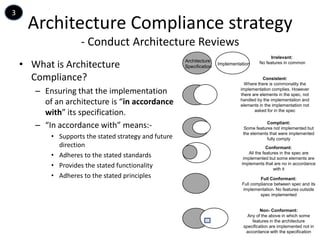
Architecture Compliance strategy- Conduct Architecture Reviews3Irrelevant: No features in commonWhat is Architecture Compliance?Ensuring that the implementation of an architecture is “in accordance with” its specification.“In accordance with” means:-Supports the stated strategy and future directionAdheres to the stated standardsProvides the stated functionalityAdheres to the stated principlesArchitecture SpecificationImplementationConsistent: Where there is commonality the implementation complies. However there are elements in the spec, not handled by the implementation and elements in the implementation not asked for in the spec Compliant: Some features not implemented but the elements that were implemented fully complyConformant: All the features in the spec are implemented but some elements are implements that are no in accordance with itFull Conformant: Full compliance between spec and its implementation. No features outside spec implementedNon- Conformant: Any of the above in which some features in the architecture specification are implemented not inaccordance with the specification
Architecture Compliance strategy- Conduct Architecture ReviewsGoals of Architecture ReviewCatch errors in project architecture early thus reducing the costs and risksEnsure that best practices are applied to architecture workOverview of compliance of an architecture to mandated enterprise standardsCommunicate to management the technical readiness of a projectIdentify key criteria for procurement activitiesMore political goalsKeep the Architecture Function involved in the projects to help their understanding of the systems that are and will be used by the businessAllow CIO to assist decision making in business projectsIncrease profile of Architecture function with business stakeholders.Management of System integrators3
Architecture Compliance strategy- Conduct Architecture ReviewsQ: When should Architecture Compliance reviews be done?A: As soon a practical, at a stage when there is still time to correct any major errors or shortcomings with the obvious proviso that there needs to have been some significant development on the architecture in order to have something to review. E.g.After the initial development of the architecture itself in a projectAfter the implementation of the developed architectureAfter any major design change in a project3
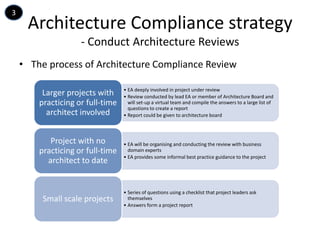
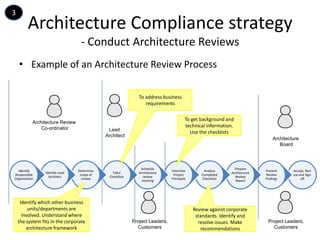
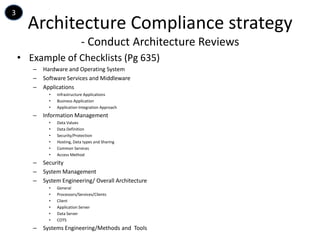
Architecture Compliance strategy- Conduct Architecture ReviewsThe process of Architecture Compliance Review3

A Summary of TOGAF's Architecture Capability Framework

  • 1.
    TOGAF – ASummaryArchitecture Capability Framework (ACF)
  • 2.
    Where ACF fitsinto TOGAF
  • 3.
    What is ACF?Inorder to successfully operate an architecture function within an enterprise, it is necessary to put in place appropriate Organisation structuresProcessesRoles and ResponsibilitiesSkillsNot intended to be a comprehensive template for operating an enterprise architecture capability
  • 4.
    Business Capability forArchitecture- Operating at a level of maturityGovernance BodiesMeasuring successSetting priority and focusDirectSetting priority and focusProject/Portfolio GovernanceSkilled Resource PoolBusiness OperationsParticipate in ContractRoles and Responsibilities(both generic and specific to a particular project)TrainingProjects/ Portfolio governed against their contractsImprovesRequiresSkillsKnowledgeRequiresDelivering aligned SolutionsPossessProjects/PortfoliosPossessParticipate in Architecture ProfessionalsAssignsPopulating the repositoryRe-using building blocks and complying with standardsEnterprise ContinuumArchitecture Repository
  • 5.
    Components of ACFInternalStakeholdersArchitecture CapabilityExternal StakeholdersArchitecture BoardUsing ADM to establish architecture capabilityArchitecture Maturity ModelsContractsCompliancePrinciplesArchitecture Skills FrameworkSponsors, projectsArchitecture Governance FrameworkGuidance on Architecture Governance by defining how best the EA function should interact with other parts of the companyEvolving and improving the EA functionRecommends the use of the ADM itself as a means to define the architecture function and defined a roadmap on how it should improve
  • 6.
    Using EA MaturityModels to assess you company’s maturity and to use as a means to get guidance on where to improve
  • 7.
    Using the skillsframework to make sure the team are competent enough to preform their tasks
  • 8.
    Defining the governancerules with key stakeholders to agree how best to manage the enterprise’s architecture
  • 9.
    Use of aArchitecture Board to ensure that the company is following its governance rules
  • 10.
    Developing a processto assess Architecture Compliance
  • 11.
    Development of architecturecontracts to clearly state the agreements between the enterprise architect and the sponsor.How to establish an Architecture CapabilityEstablishing a sustainable architecture practice within an organization can be achieved by adhering to the same approach that is used to establish any other capability — such as a business process management capability — within an organisation. The ADM is an ideal method to be used to architect and govern the implementation of such a capability. Applying the ADM with the specific Architecture Vision to establish an architecture practice within the organization would achieve this objectiveThis shouldn’t be seen as a phase of an architecture project, or a one-off project, but rather as an on-going practice that provides the context, environment, and resources to govern and enable architecture deliver y to the organisationUsing ADM to establish architecture capability
  • 12.
    Using ADM toestablish architecture capabilityEstablishing a Architecture CapabilityDefine the vision, business goals and drivers , and principles of the architecture practiceDefine the processes, views and how the framework will be used. Also what performance metrics are required PreliminaryDefine the data required to store and how it will be stored in the architecture repository. Also what applications will be required to assist with the processes defined in Phase BChanges to the processes or systems should be managed hereA. Architecture VisionH. Architecture ChangeManagementB. BusinessArchitecture Requirement to be clearly articulated and align to visionC. Information SystemsArchitectures G. ImplementationGovernanceRequirementsManagementDefine technology infrastructure supporting the architecture practiceGoverning the implementation of the business architectureD. TechnologyArchitecture F. Migration PlanningE. OpportunitiesAnd SolutionsHow best to manage organisational changes that are required and how this is achievedHow best to adopt the new systems and processes.
  • 13.
    Using the ArchitectureSkills FrameworkProvides a view of the competency levels required for specific roles. They define:The roles within a work areaThe skills required by each roleThe depth of knowledge required to fulfil the role successfullyWhy do we need itConfusion in industry over the competencies required makes recruitment difficult. Ensure a successful Enterprise Architecture practice needs staff with the relevant experience and skills in or to fulfil their roles. However these roles need to be well defined in the first place! This is what the skills framework tries to do.Having under-qualified personnel in the role of Enterprise Architecture will increase costs off re-hiring and the quality of their work adversely impacting the company’s Enterprise Architecture.Architecture Skills Framework
  • 14.
    Using the ArchitectureSkills FrameworkArchitecture Skills FrameworkSkillsGeneric SkillsLeadership, team working, inter-personal skills etcBusiness Skills & MethodBusiness cases, business processes, strategic planningEnterprise Architecture SkillsModelling, building block design, applications and role design, systems integrationProgram or Project ManagementManaging business change, project management methods and toolsIT General Knowledge SkillsBrokering Applications, asset management, migration planning, SLAsTechnical IT SkillsSoftware engineering, security, data interchange, data managementLegal EnvironmentData Protection, Contract Law, Procurement, fraudProficiency LevelsRoles1: BackgroundNot a required skill, though should be able to define and manage skill if requiredArchitecture SponsorArchitecture Board Members2: AwarenessUnderstands the background, issues and implications sufficiently to be able to understand how to proceed further and advice client accordinglyArchitecture ManagerEnterprise Architect – DataEnterprise Architect – Business3: KnowledgeDetailed knowledge of subject area and capable of providing professional advice and guidance. Ability to integrate capability into architecture designEnterprise Architect – TechnologyEnterprise Architect – Application4: ExpertProgram and/or Project ManagersIT DesignerExtensive and substantial practical experience and applied knowledge of subject
  • 15.
    Using the ArchitectureSkills FrameworkArchitecture Skills FrameworkExample For Enterprise Architecture Skills
  • 16.
    Using the ArchitectureSkills Framework – Role of Enterprise ArchitectArchitecture Skills FrameworkJOB DESCRIPTIONCity Planner rather than a Building Architect. Does not create a technical vision of the enterprise, rather develops professional relationships with executives of the enterprise to gather and articulate the technical vision based on the business plans of these executives. Needs to work closely within the Architecture Governance process to ensure that all design decisions are following both Business and IT strategy.Produces documentation of the architecture for application development teams or product implementation teams to execute.Manage and schedule the work of others segment or solution architects.KEY ACTIVITIESUnderstand and interpret requirements: Probe and listen for information, influence people, facilitate consensus building, synthesize and translate ideas into actionable requirements. Participates in the discovery and documentation of the customers business scenarios that are driving the solutionCreate a useful model: Take the requirements and develop well formulated models of the components. Show multiple views to communicate effectively. Ensure architecture integrity and vision and also needs to understand all the business components.Validate, refine, and expand the model: verify assumptions, bring in subject matter experts, to improve the model and further define it. Manage the architecture: Continuously monitor the models and update them as changes occur. KEY CHARACTERISTICSSkills and Experience in Producing DesignsExtensive Technical Breadth, Technical Depth in one or a few disciplinesMethod Driven approach to executionFull Project Scope ExperienceLeadershipPersonal and Professional SkillsSkills and Experience in One or More Industries
  • 17.
    External StakeholdersArchitecture CapabilityArchitectureMaturity ModelsSummary of Architecture Maturity Models
  • 18.
    EA Maturity ModelsThereis no standard model for EA MaturityCommon Traits for all EA Maturity ModelsMost are modelled on the Capability Maturity Model Integration (CMMI)The model has a number of levels(from 4-7) of maturityEach level has an attribute or characteristic that can be rated based on the maturity of the activities performed by the EA functionSome models make recommendations in what are the areas of improvement.TOGAF refers to US Government – Dep't of Commerce - Doc ACMM as an example.
  • 19.
    US Government -Doc US ACMMOpenDownloadable for free,LevelsSix – None, Initial, Developing, Defined, Managed and Optimizing Attributes: -Uses 9 characteristicsArchitecture ProcessArchitecture DevelopmentBusiness LinkageSenior Management InvolvementOperating Unit ParticipationArchitecture CommunicationIT SecurityGovernanceIT Investment and Acquisition StrategyProvides a means to do the measurement by not a tool as such. However enterprise-architecture.com provides a tool to assist in assessment called Eavaluator.
  • 20.
    Internal StakeholdersArchitecture BoardArchitectureCapabilityContractsCompliancePrinciplesSponsors, projectsArchitecture Governance FrameworkSummary of the Architecture Governance Framework (AGF)
  • 21.
    Definition of GovernanceA generic prospective to governanceEnsuring that business is conducted properly.Less about following overt control and strict adherence to rules, more about guidance and effective and equitable usage of resources to ensure sustainability of an organisation’s strategic objectivesPrinciples of Organisation for Economic Co-operation and Development (OECD)Focus on rights, roles and equitable treatment of shareholders Disclosure and transparency and responsibilities of the boardEnsures sound strategic guidance to organisation, effective monitoring and accountability for the companyCharacteristics of governanceDiscipline : All parties commit to adhering to governanceTransparency : All actions and decisions are provided to allIndependence : All processes , decisions and mechanisms used will be established so as to minimised potential conflicts of interestAccountability : All identifiable groups involved are accountable for their actions Responsibility : All parties to act responsibly to the organisation and stakeholdersFairness : All decisions taken and processes used will not be allowed to create unfair advantage to any one particular party
  • 22.
    Definition of ArchitectureGovernanceArchitecture Governance is the practice and orientation by which enterprise architectures and other architectures are controlled and managed at an enterprise-wide level. It includes the followingImplementing a system of controls over the creation and monitoring of all architecture components and activities Implementing a system to ensure compliance with internal and external standards and regulatory obligationsEstablishing processes that support effective management of the above processes within agreed parameters
  • 23.
    Definition of ArchitectureGovernanceArchitecture Governance does not operate in isolation, and is likely to be linked to other governance domains.Corporate GovernanceITGovernanceTechnologyGovernanceArchitectureGovernance
  • 24.
    Architecture Governance akey step in the development of architecturesPreliminaryA. Architecture VisionH. Architecture ChangeManagementB. BusinessArchitecture Implementation guidance is just one aspect of architecture governanceC. Information SystemsArchitectures G. ImplementationGovernanceRequirementsManagementAGFD. TechnologyArchitecture F. Migration PlanningE. OpportunitiesAnd SolutionsArchitecture Governance Framework feeds into the Implementation Governance Step when developing architectures
  • 25.
    Architecture Governance –Key ProcessesPolicy Management and Take-OnFormal process to register, validate, ratify, manage new or updated contentComplianceCompliance Assessment against SLAs, OLAs, standards etcDispensationCompliance Assessment can be rejected where the subject area is not compliant. In the case the subject area can:Be adjusted or realigned in order to meet the compliance requirementsRequest a dispensation. These are granted for a time period and service and operational criteria may be enforced during the dispensation’s lifespan.Monitoring and reportingPerformance Management is required to ensure that both the operational and service elements are managed against an agreed set of criteriaBusiness ControlRelates to the business process invoked to ensure compliance with the organisation’s business policies
  • 26.
    Elements of anEffective Architecture Governance Strategy Cross-organisational architecture board must be established with the backing of top management to oversee the implementation of IT Governance strategyA comprehensive set of architecture principles should be established to guide, inform and support the way in which an organisation sets about fulfilling its mission through the use of ITAn Architecture Compliance strategy should be adopted – specific measures to ensure compliance with the architecture123
  • 27.
    AGF – Guidanceon Organisational StructureCross-organisational architecture board must be established with the backing of top managementCIODevelopImplementDeployProgram Management OfficeService ManagementChiefArchitectArchitecture Board1AlignmentAlignmentGuidanceEnterprise ArchitectsRisk ManagementMonitoring23SolutionArchitectsSolutionArchitectsSolutionArchitectsSolutionArchitectsSolutionArchitectsSolutionArchitectsImplementation ProjectsOperational SystemsSolutionArchitectsConformanceChangeA comprehensive set of architecture principles should be establishedAn Architecture Compliance strategy should be adoptedEnterprise ContinuumArchitecturesProcessesSolutionsSLAs/OLARegulatory requirementsStandards
  • 28.
    Architecture BoardWhy isit neededPreventing one-off solutions and unconstrained developments across the enterprise, which will lead to:High costs of developmentHigh costs of operation and support due to multiple platforms using non standard infrastructureLower quality and Higher riskDifficulty in replicating and re-using solutionsCan have multiple types of architecture boardLocal ( domain experts, line responsibility )Global ( organisation-wide responsibility )1
  • 29.
    Architecture BoardResponsibilities includeEnsuringthe effective and consistent management and implementation of the architecturesResolving ambiguities, issues or conflicts that have been escalatedProviding advice, guidance and informationEnsuring compliance with the architectures and granting dispensations that are keeping with the technology strategy and objectivesConsidering policy changesProviding a mechanism for the formal acceptance and approval of architecture through consensusEstablishing and maintaining the link the business strategy and objectives 1
  • 30.
    Architecture BoardGuidance onthe setting up of the Architecture BoardNeed Executive Sponsor from the highest level of the corporationSize of architecture board is a minimum of four or five and no more than 10 permanent members. Rotation is important Suggested AgendaRequests for ChangeDispensationsCompliance AssessmentsDispute ResolutionArchitecture Strategy and Direction1
  • 31.
    Guidance on applyingEnterprise Architecture PrinciplesThe architecture board requires principles and guidance in order to help their decision making.The Chief architect and his team of architects should provide these principles to the boardThe development of these principles need to be agreed across the enterprise2
  • 32.
    Architecture Compliance strategyConductArchitecture Compliance reviewEnsuring the compliance of individual projects with the enterprise architecture is an essential aspect of architecture governance. An important process that should be formalised by the IT Governance is Architecture Compliance review process.Develop Architecture ContractsThe use of Architecture Contracts will help ensure the quality of the deliverables and fitness-for-purpose of the architecture3
  • 33.
    Architecture Compliance strategy-Conduct Architecture ReviewsEnsuring the compliance of individual projects with the enterprise architecture is an essential aspect of architecture governance. IT Governance function within the enterprise will normally define two complementary processes3Architecture function preforming solution architecturesSolution ArchitecturesDo these solution architecture comply with Enterprise Architecture’s standards and principles etc.? IT Governance
  • 34.
    Architecture Compliance strategy-Conduct Architecture Reviews3Irrelevant: No features in commonWhat is Architecture Compliance?Ensuring that the implementation of an architecture is “in accordance with” its specification.“In accordance with” means:-Supports the stated strategy and future directionAdheres to the stated standardsProvides the stated functionalityAdheres to the stated principlesArchitecture SpecificationImplementationConsistent: Where there is commonality the implementation complies. However there are elements in the spec, not handled by the implementation and elements in the implementation not asked for in the spec Compliant: Some features not implemented but the elements that were implemented fully complyConformant: All the features in the spec are implemented but some elements are implements that are no in accordance with itFull Conformant: Full compliance between spec and its implementation. No features outside spec implementedNon- Conformant: Any of the above in which some features in the architecture specification are implemented not inaccordance with the specification
  • 35.
    Architecture Compliance strategy-Conduct Architecture ReviewsGoals of Architecture ReviewCatch errors in project architecture early thus reducing the costs and risksEnsure that best practices are applied to architecture workOverview of compliance of an architecture to mandated enterprise standardsCommunicate to management the technical readiness of a projectIdentify key criteria for procurement activitiesMore political goalsKeep the Architecture Function involved in the projects to help their understanding of the systems that are and will be used by the businessAllow CIO to assist decision making in business projectsIncrease profile of Architecture function with business stakeholders.Management of System integrators3
  • 36.
    Architecture Compliance strategy-Conduct Architecture ReviewsQ: When should Architecture Compliance reviews be done?A: As soon a practical, at a stage when there is still time to correct any major errors or shortcomings with the obvious proviso that there needs to have been some significant development on the architecture in order to have something to review. E.g.After the initial development of the architecture itself in a projectAfter the implementation of the developed architectureAfter any major design change in a project3
  • 37.
    Architecture Compliance strategy-Conduct Architecture ReviewsThe process of Architecture Compliance Review3