Making sense
in the midst of uncertainty
- opportunity within and beyond the pandemic
Tom Graves, Tetradian
Peoplerise / Vulcano webinar, June 2020
About this webinar...
• Aim: Work better with disruption
• It’s about your experience and
knowledge, not mine
• Some exploration of principles,
but mostly about practice
A matter of etiquette...
• Feel free to interrupt if you need
• this is about your experience, not mine
• if my English is hard to follow, ask me to repeat!
• Switch between overview and practice
• practice sessions will be in trios/pairs, report back
• make space for others’ ideas and experiences
“We are each on
our own customer-journey
in the service called ‘Life’”
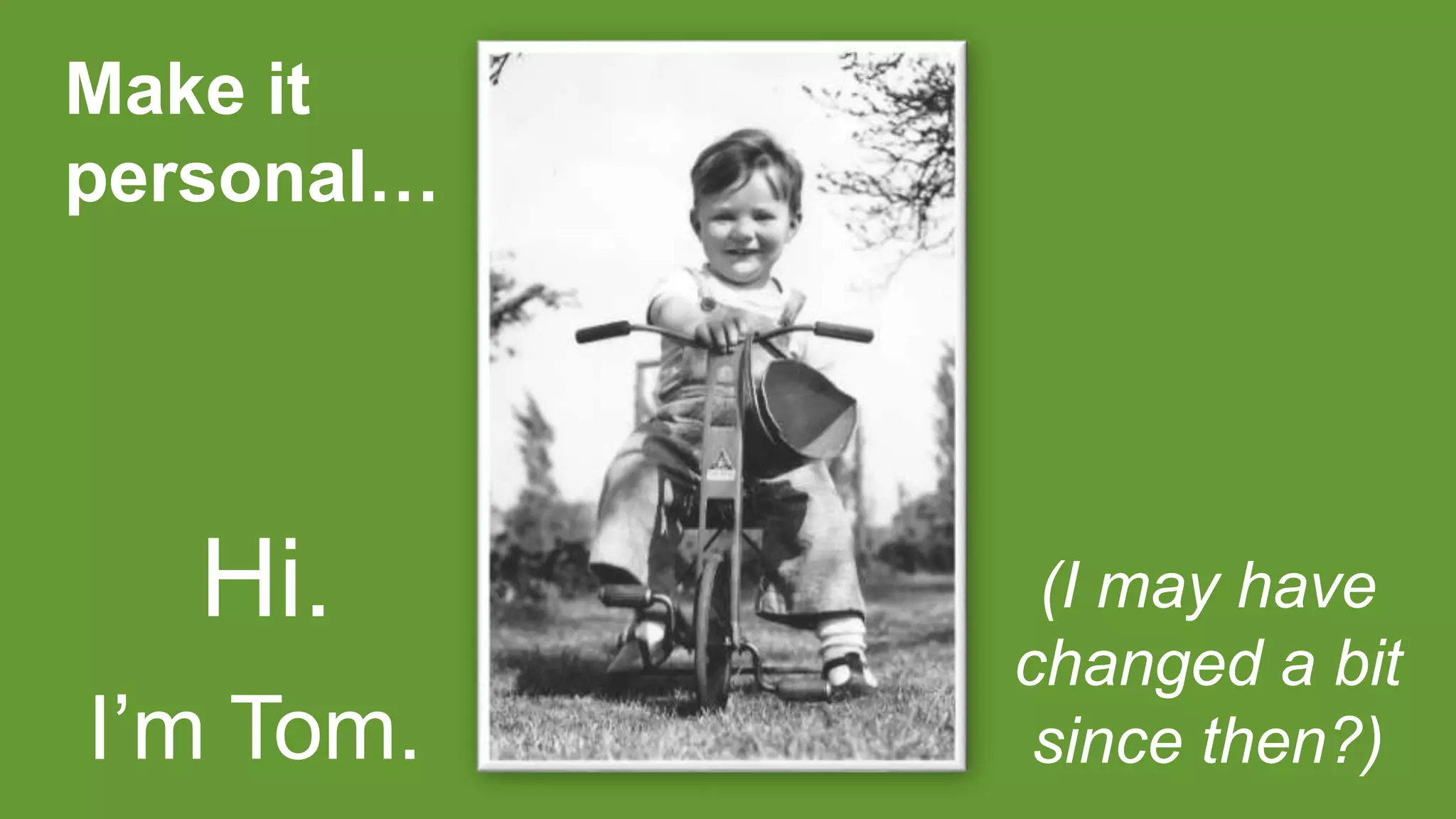
Make it personal…
Hi. (I may have
changed a bit
since then?)I’m Tom.
Make it
personal…
“The world breaks us all –
and afterward we are stronger
in the broken places...”
We learn from disruption…
– paraphrase from Ernest Hemingway
These days
I’d describe myself as
a maker of tools for change...
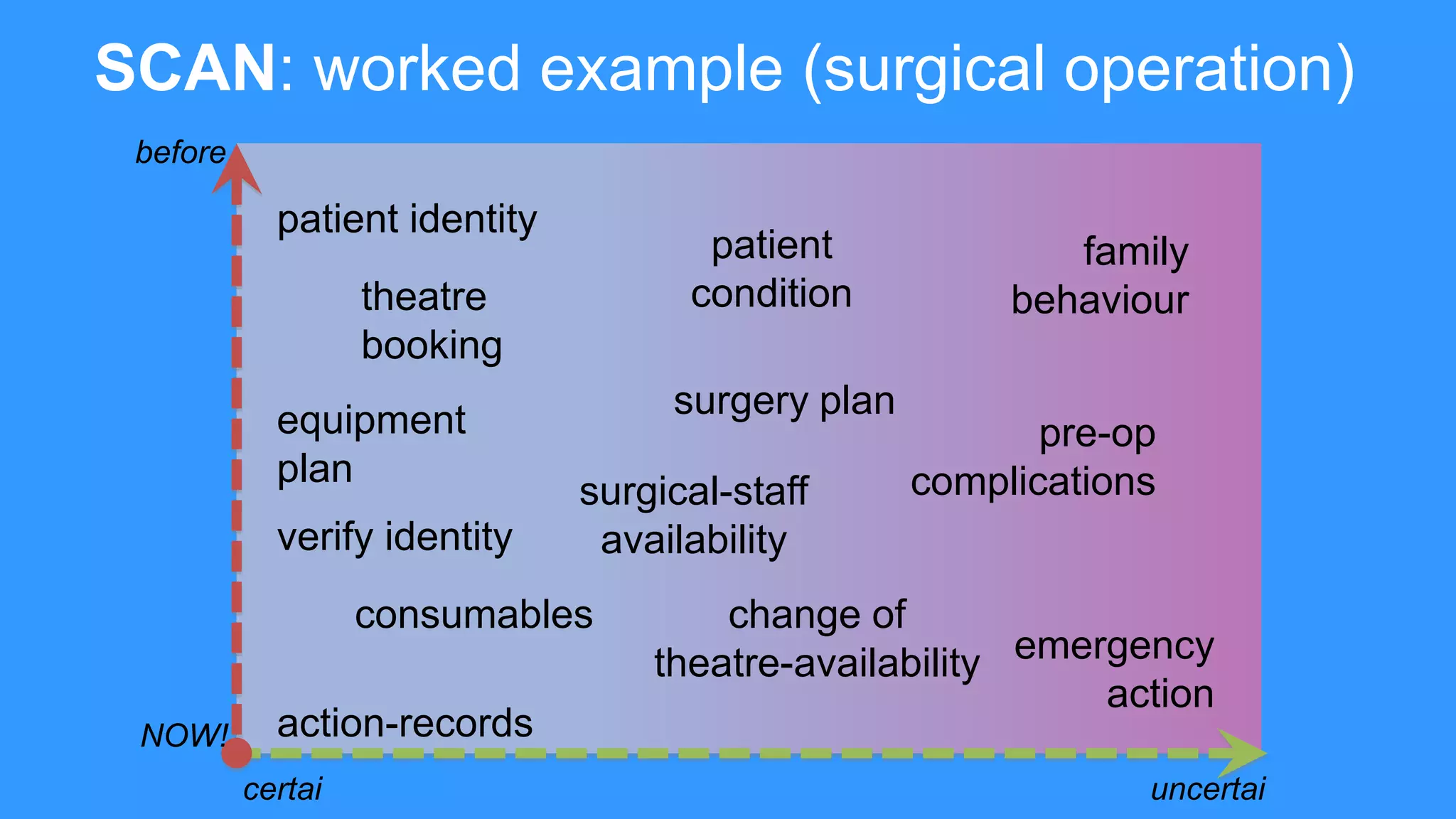
SCAN: complexity-mapping and tactics
Introduction https://youtu.be/qvgBIXItVYw , worked-example https://youtu.be/QrO9QZhrn1E
SCAN: worked example (surgical operation)
patient identity
surgery plan
emergency
action
theatre
booking
consumables
pre-op
complications
family
behaviour
surgical-staff
availability
change of
theatre-availability
action-records
equipment
plan
patient
condition
verify identity
NOW!
certai uncertai
before
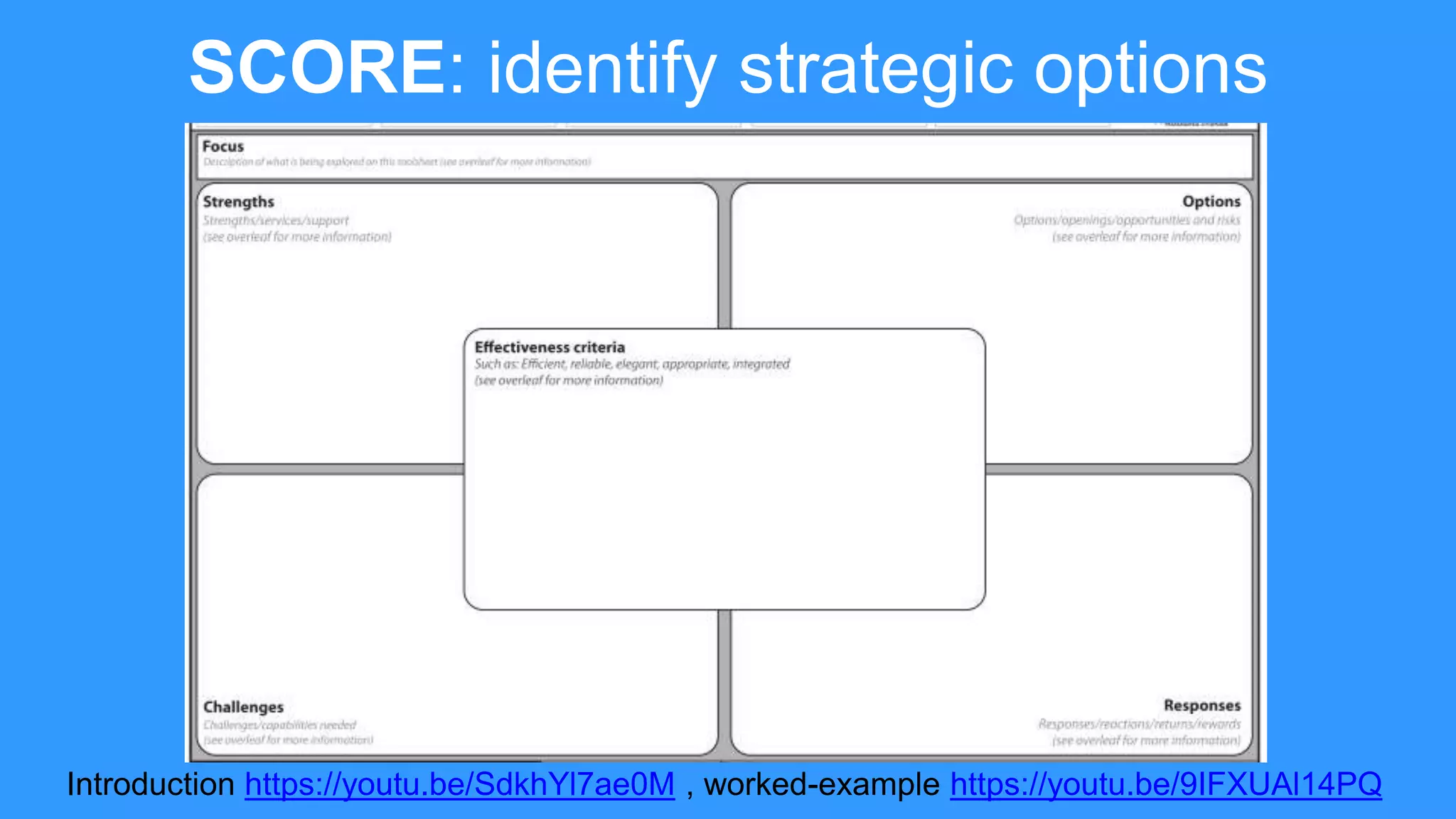
SCORE: identify strategic options
Introduction https://youtu.be/SdkhYl7ae0M , worked-example https://youtu.be/9IFXUAl14PQ
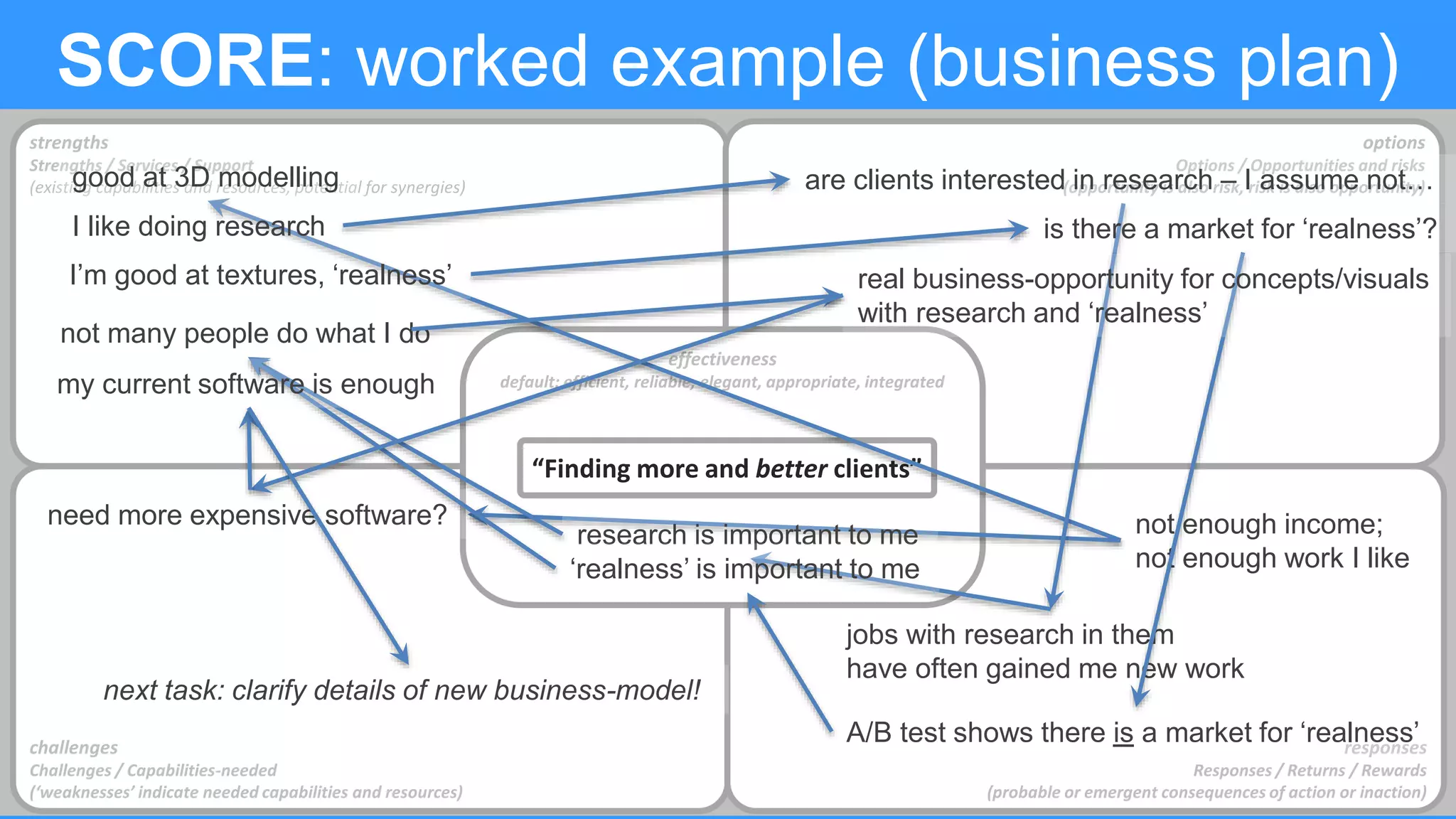
SCORE: worked example (business plan)
strengths
Strengths / Services / Support
(existing capabilities and resources, potential for synergies)
challenges
Challenges / Capabilities-needed
(‘weaknesses’ indicate needed capabilities and resources)
options
Options / Opportunities and risks
(opportunity is also risk, risk is also opportunity)
responses
Responses / Returns / Rewards
(probable or emergent consequences of action or inaction)
effectiveness
default: efficient, reliable, elegant, appropriate, integrated
“Finding more and better clients”
not enough income;
not enough work I like
good at 3D modelling
need more expensive software?
I like doing research
are clients interested in research – I assume not…
jobs with research in them
have often gained me new work
research is important to me
I’m good at textures, ‘realness’
is there a market for ‘realness’?
A/B test shows there is a market for ‘realness’
‘realness’ is important to me
not many people do what I do
real business-opportunity for concepts/visuals
with research and ‘realness’
my current software is enough
next task: clarify details of new business-model!
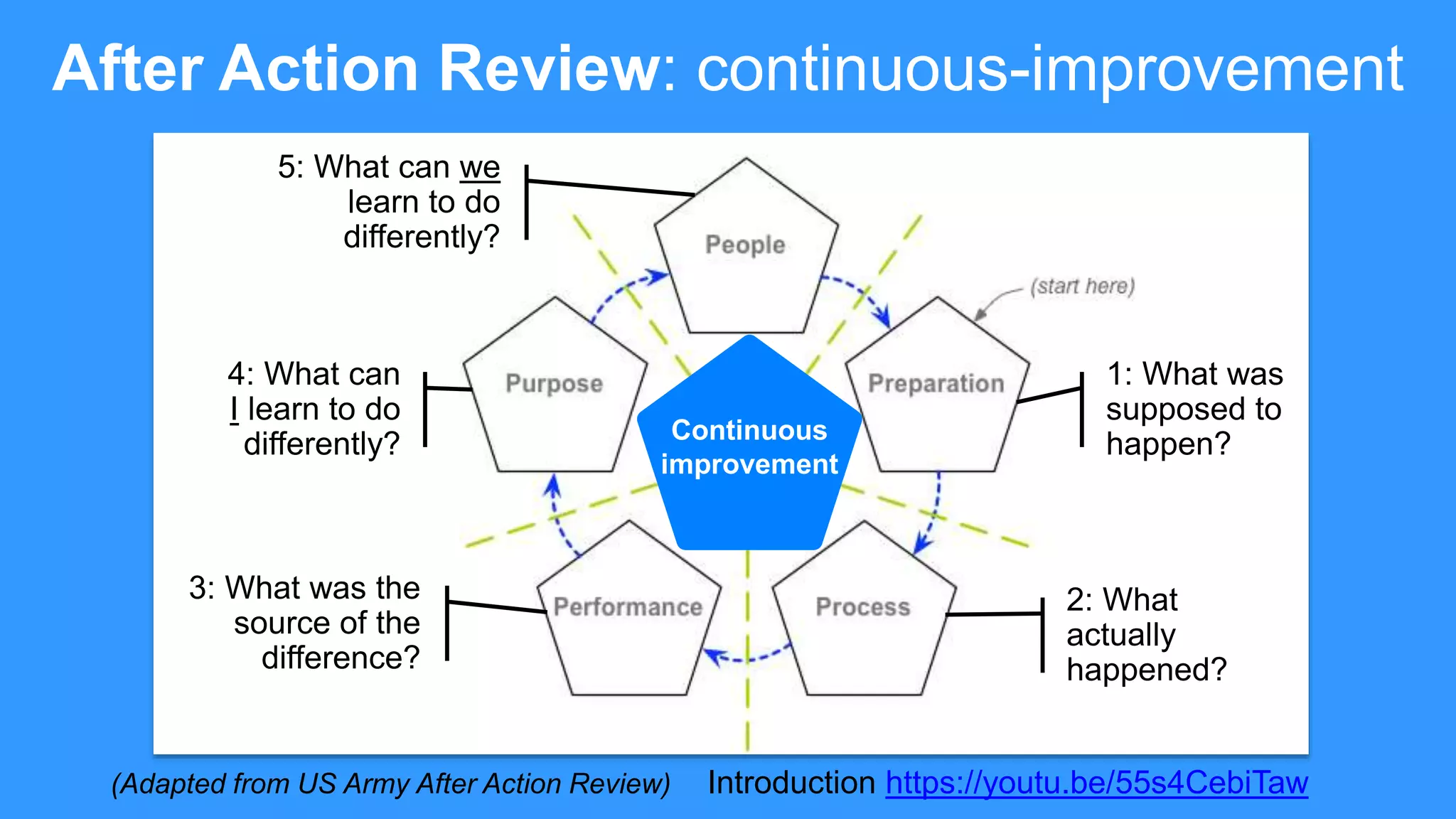
After Action Review: continuous-improvement
1: What was
supposed to
happen?
2: What
actually
happened?
3: What was the
source of the
difference?
4: What can
I learn to do
differently?
5: What can we
learn to do
differently?
Continuous
improvement
(Adapted from US Army After Action Review) Introduction https://youtu.be/55s4CebiTaw
That’s enough about me…
What brings you here?
What do you need from this?
Who are you?
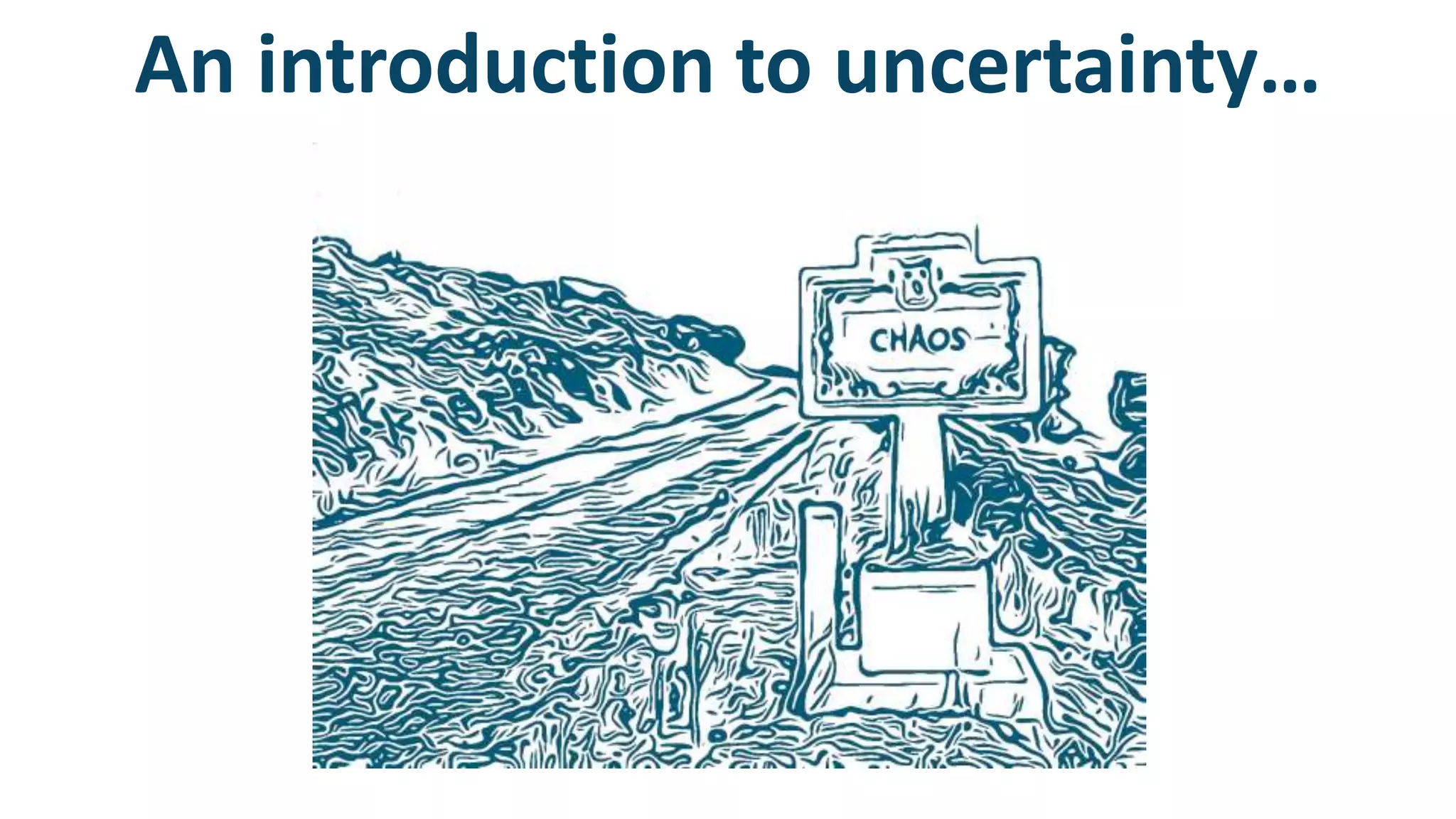
An introduction to uncertainty…
Key questions for this session…
What is
the structure of uncertainty?
And how do we work with it
to gain the best outcomes?
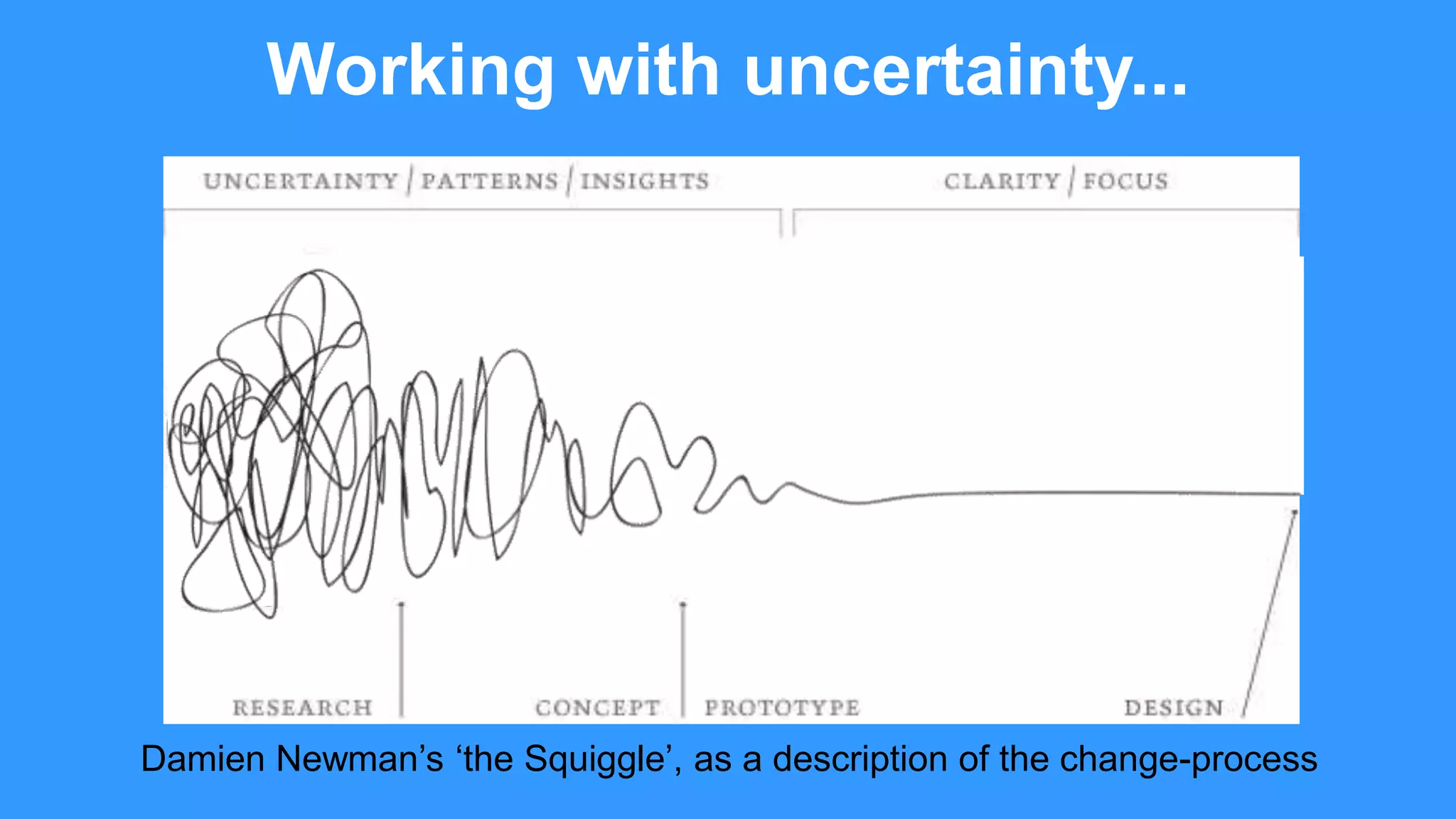
Working with uncertainty...
Damien Newman’s ‘the Squiggle’, as a description of the change-process
Context
(Purpose)
Scope
(People)
Plan
(Preparation)
Action
(Process)
Review
(Performance)
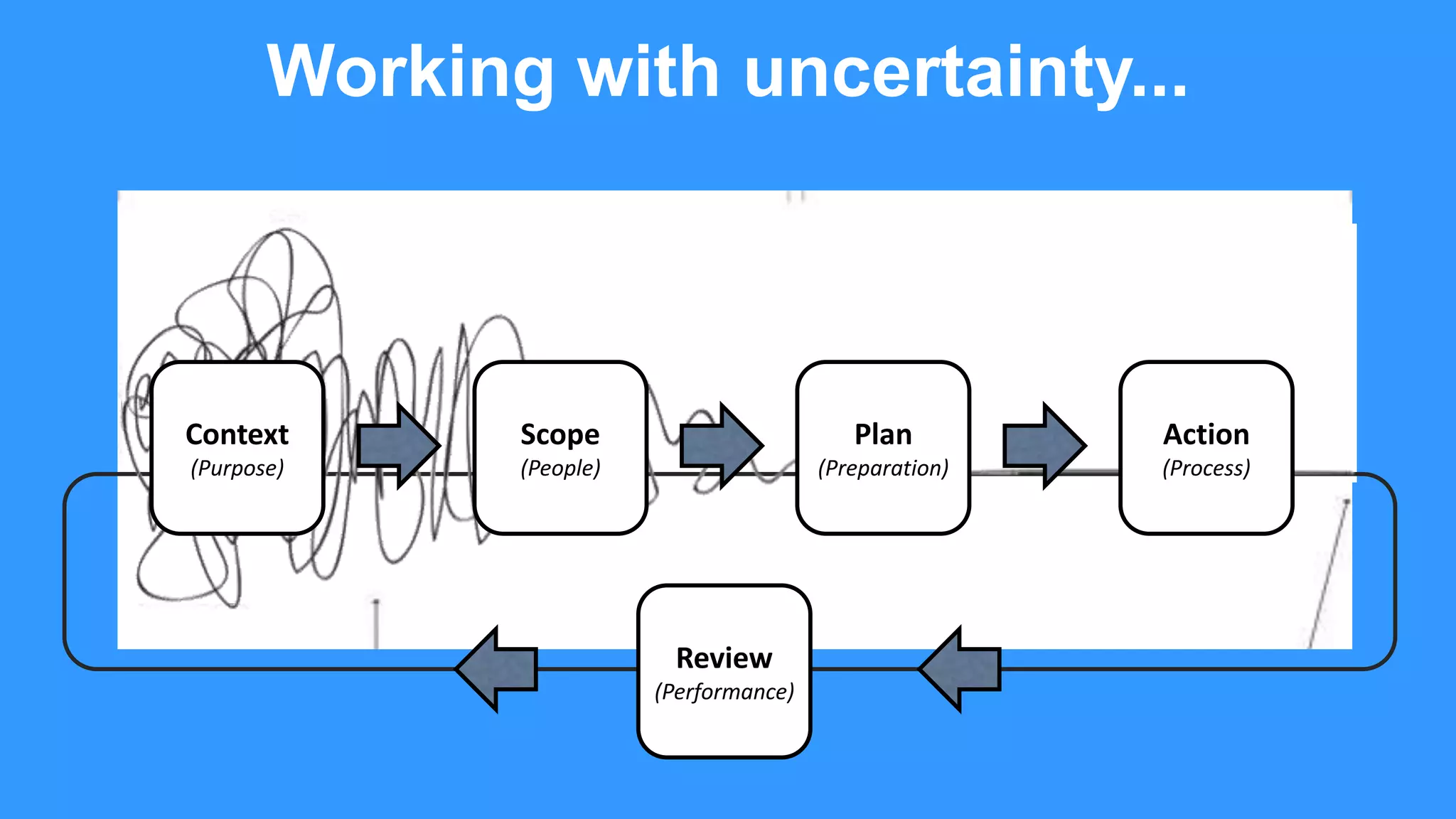
Working with uncertainty...
Context
(Purpose)
Scope
(People)
Plan
(Preparation)
Action
(Process)
Review
(Performance)
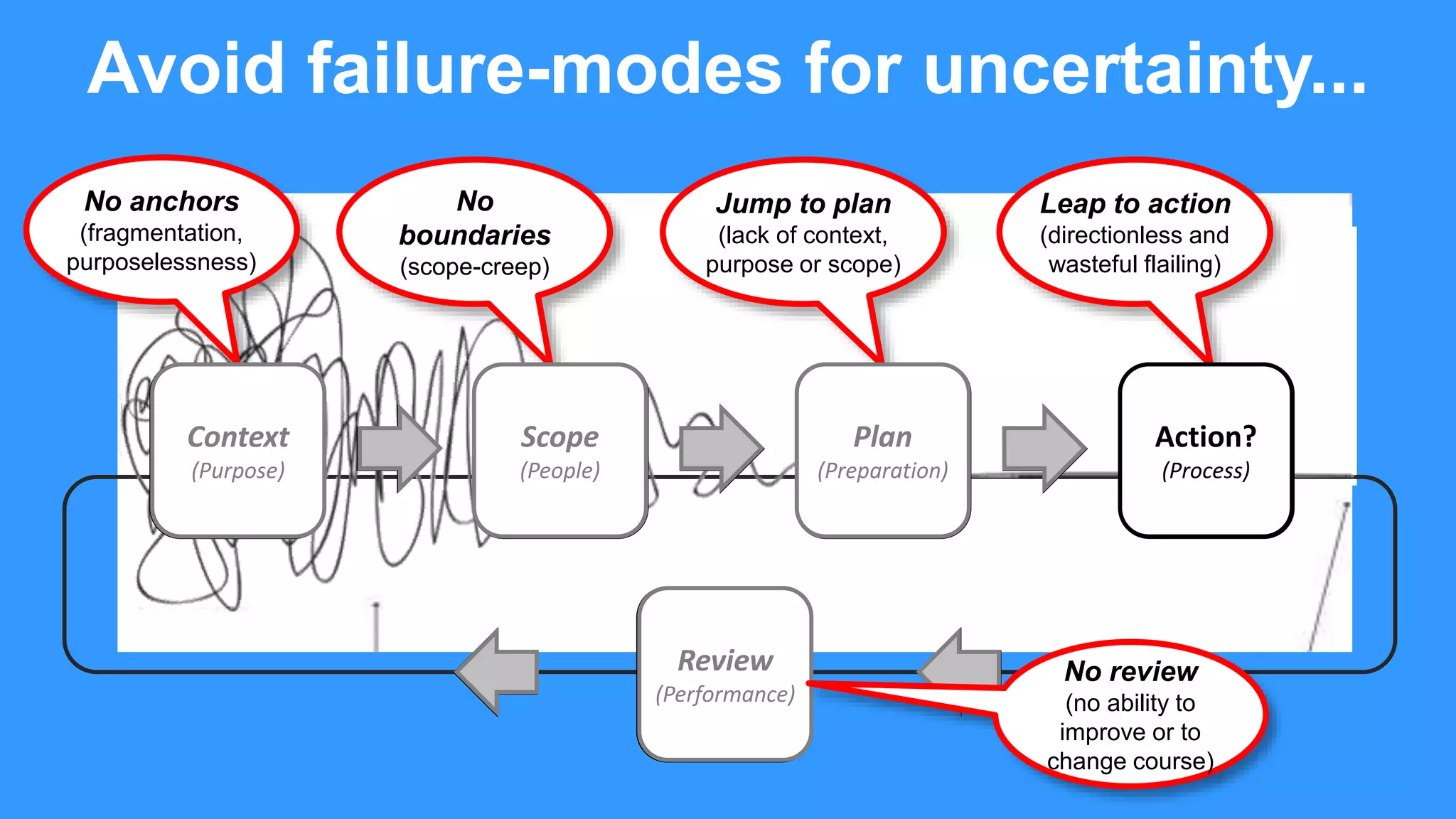
Avoid failure-modes for uncertainty...
No anchors
(fragmentation,
purposelessness)
Context
(Purpose)
No
boundaries
(scope-creep)
Scope
(People)
Jump to plan
(lack of context,
purpose or scope)
Plan
(Preparation)
Leap to action
(directionless and
wasteful flailing)
Action?
(Process)
Review
(Performance)
No review
(no ability to
improve or to
change course)
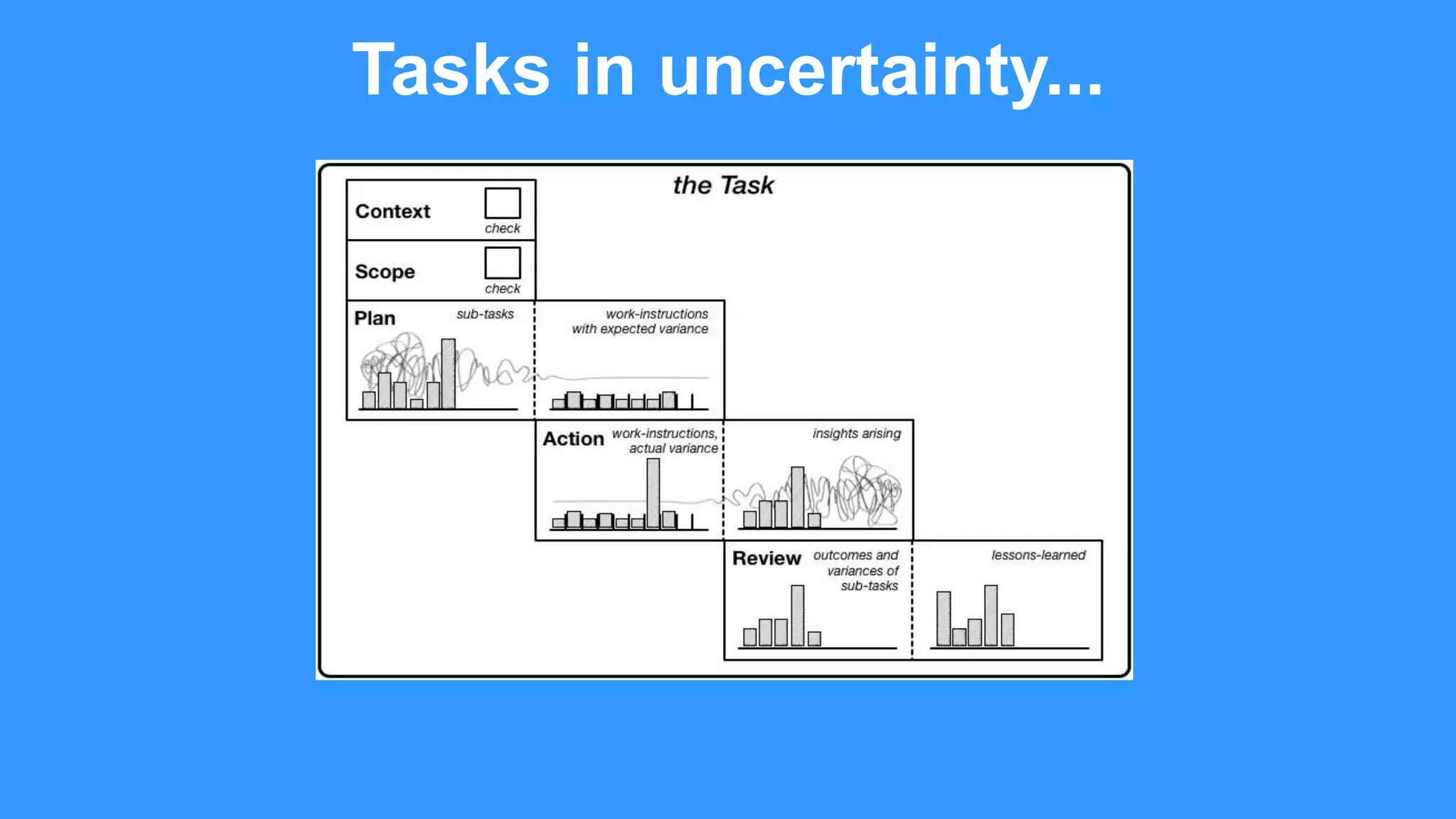
Tasks in uncertainty...
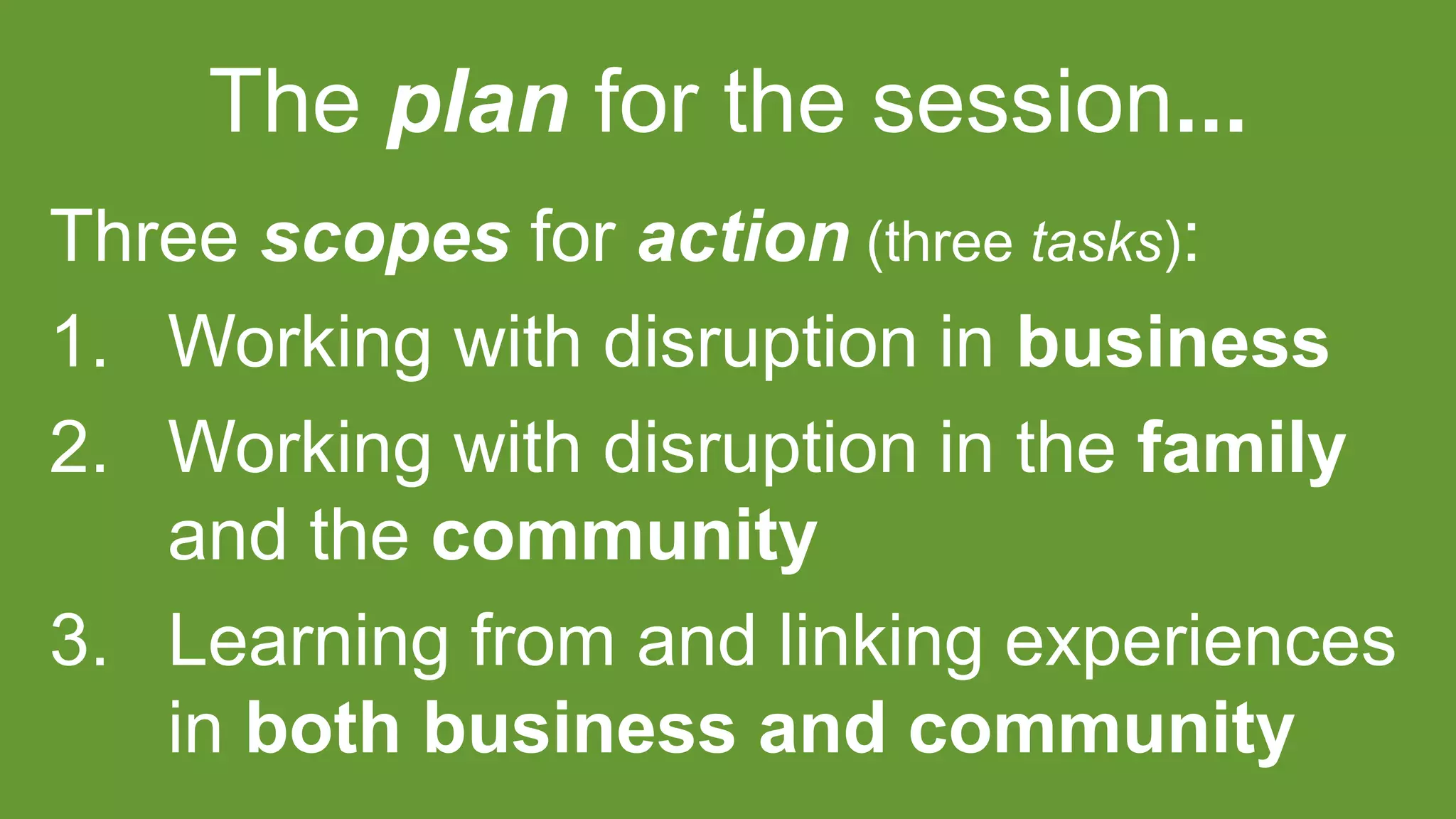
The plan for the session...
Three scopes for action (three tasks):
1. Working with disruption in business
2. Working with disruption in the family
and the community
3. Learning from and linking experiences
in both business and community
“No plan
survives first contact with
Reality Department...”
This webinar is a live example of ‘work with uncertainty’...
– when Reality Department forces the plan to change,
we use aims, values and principles to keep on track
Part 1: Disruption in business
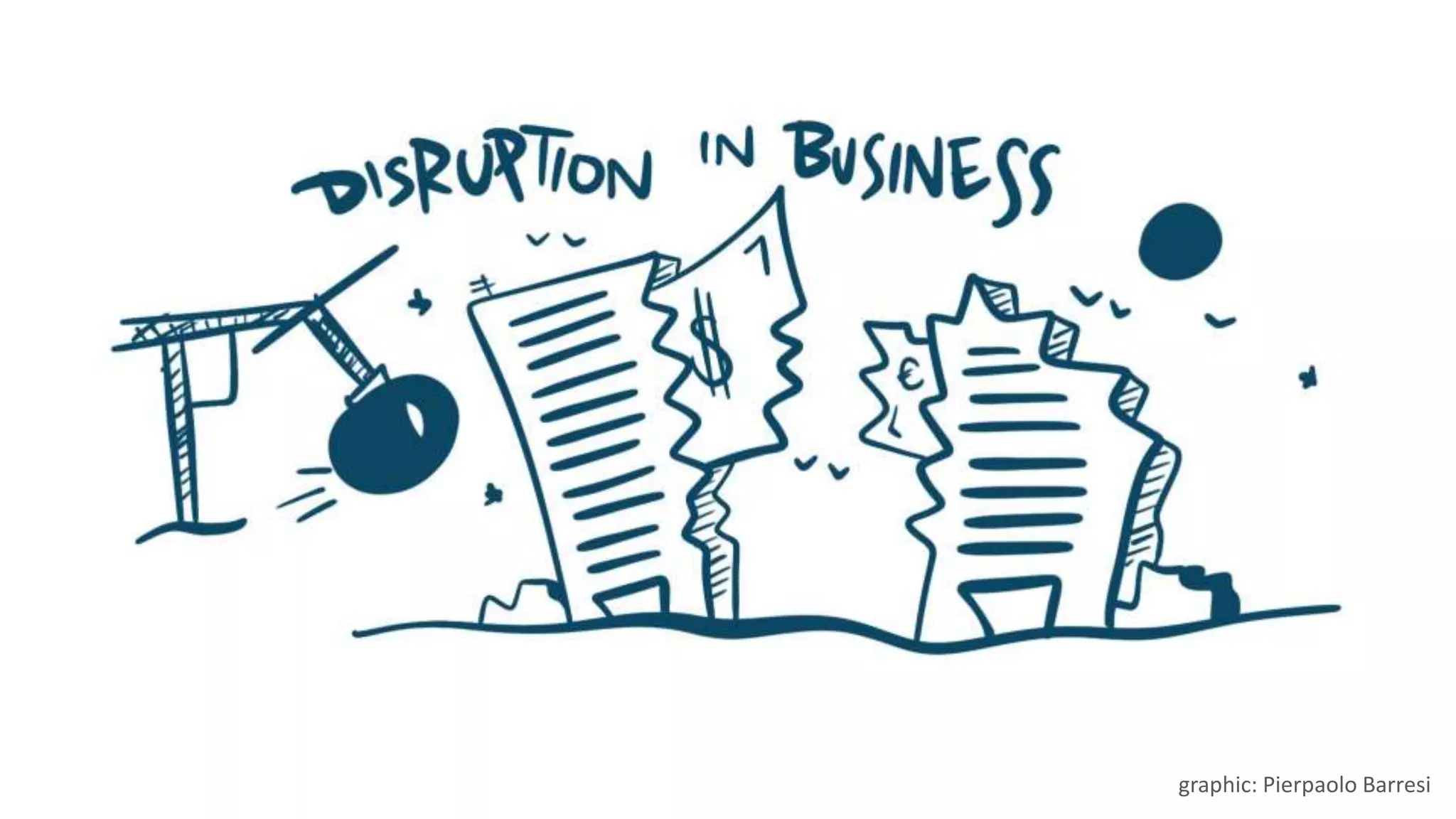
graphic: Pierpaolo Barresi
Disruption in business...
What disruption looks like:
‘Normal’ no longer works
the same way
or at all
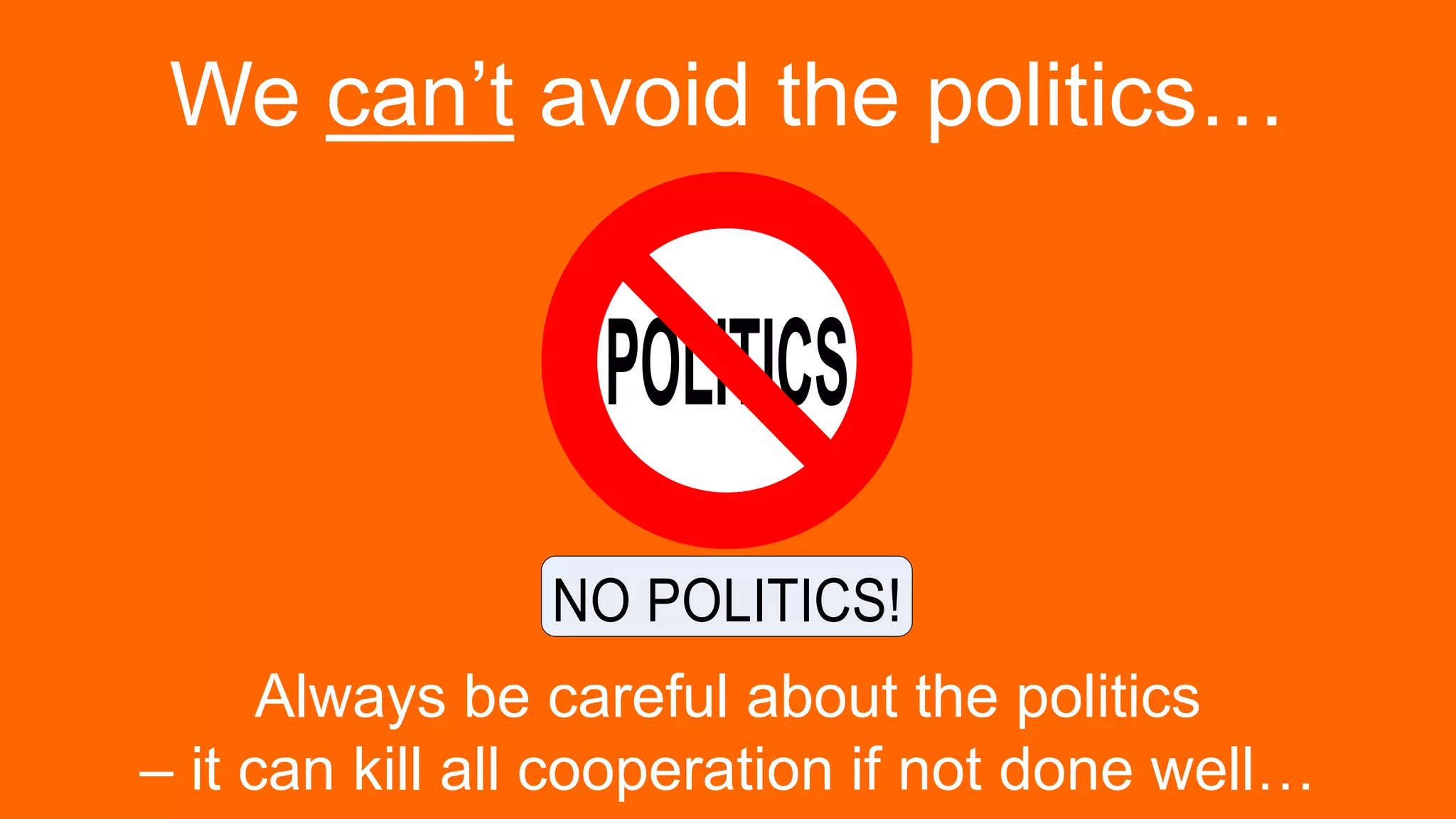
We can’t avoid the politics…
POLITICS
NO POLITICS!
Always be careful about the politics
– it can kill all cooperation if not done well…
Working with disruption...
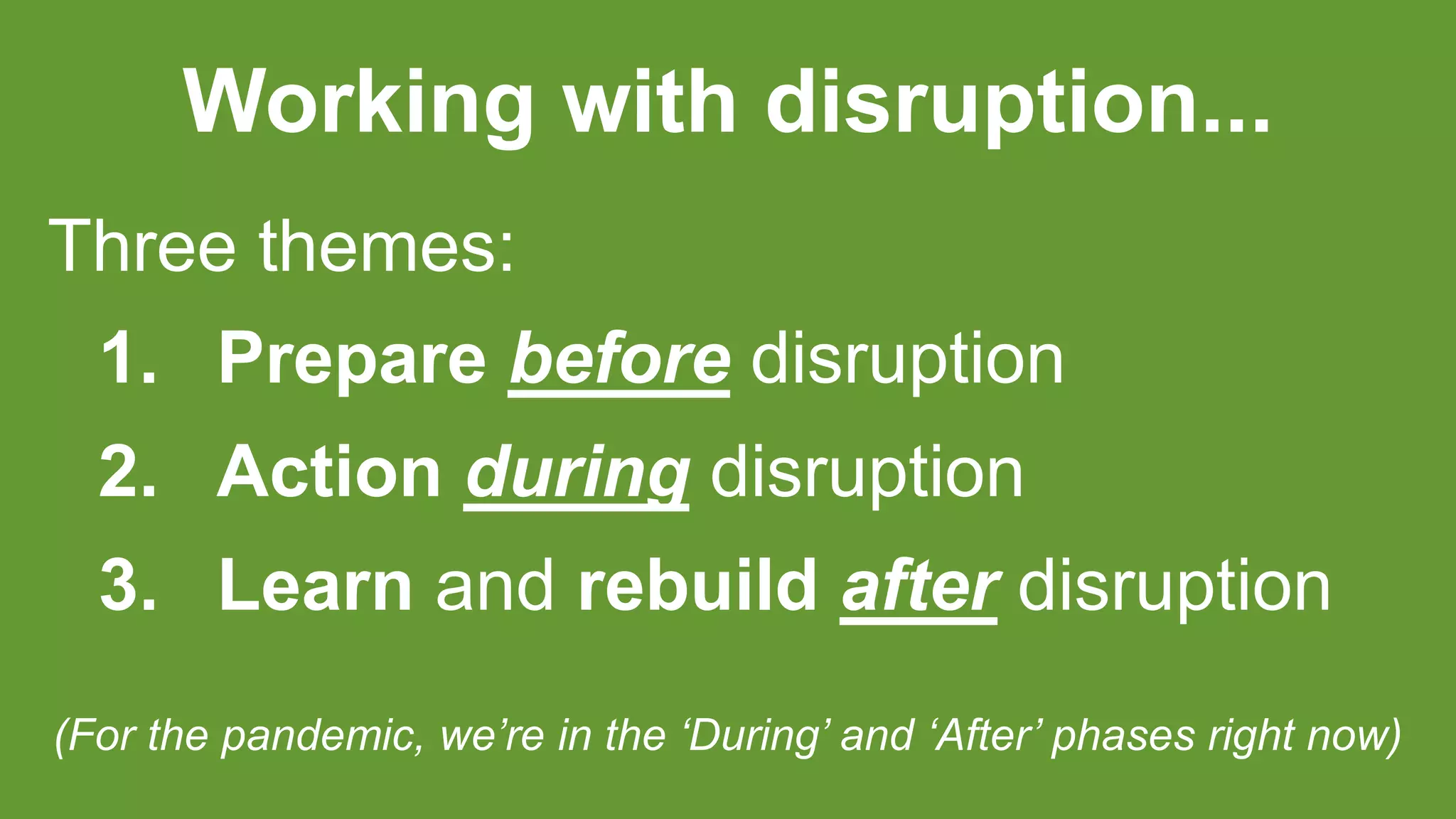
Three themes:
1. Prepare before disruption
2. Action during disruption
3. Learn and rebuild after disruption
(For the pandemic, we’re in the ‘During’ and ‘After’ phases right now)
Prepare before disruption...
• Build awareness of sources of disruption
– use tools from futures disciplines – e.g. scenarios
• Build capability to work with uncertainty
– be ready for emotional challenges of disruption
• Note: look for opportunity hidden in risk
– always work with opportunity and risk together
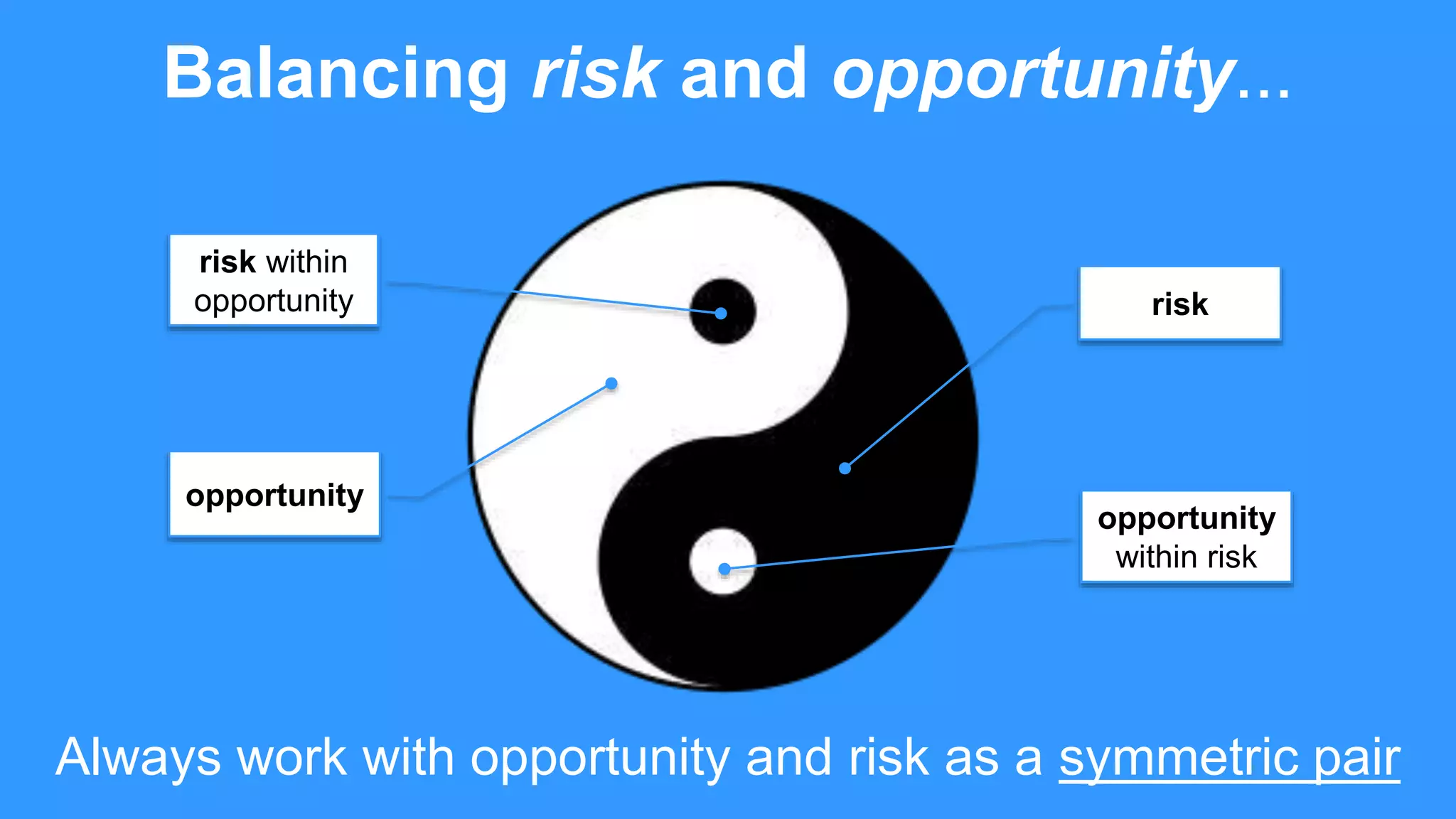
Balancing risk and opportunity...
opportunity
within risk
risk
opportunity
risk within
opportunity
Always work with opportunity and risk as a symmetric pair
Action during disruption...
• Remember what’s important
– use vision and values as anchors
• Manage the priorities (find these in Preparation stage)
– use real-time priority-techniques such as triage
• Keep the panic at bay (don’t let it overwhelm)
– focus on the Now – action now, grieve later!
Emotion and disruption...
• Disruption often triggers real fears
– fear of loss, failure, incompetence, guilt...
• Panic is real – mainly from overwhelm
– limit risk of panic by focus on immediate tasks
• ...but also space for positive emotions
– acknowledge pride, success, responsibility
Learn/rebuild after disruption...
• Identify any benefits-realised
– there are always some, if we know how to look
• Identify lessons-learned
– use techniques such as After Action Review
• Support iterative continuous-improvement
– use past to push towards future – e.g. Now-to-New
• What change is happening to your business?
• How prepared were you in your business?
• How do you adapt to change in your business?
• How do you stop panic from overwhelming you?
• What do you need to do, to be better prepared
for future disruption?
Discuss: Disruption in business
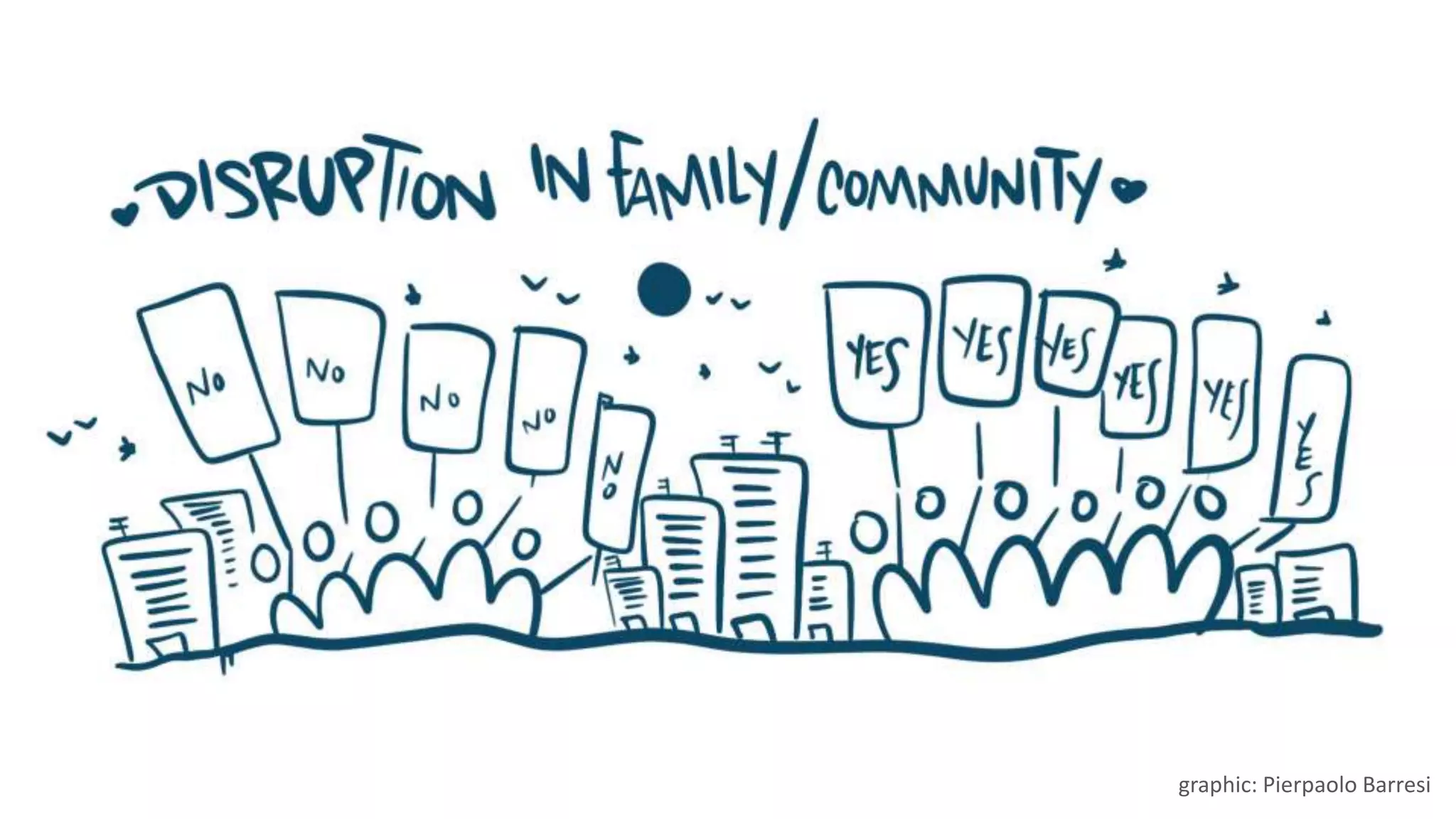
Part 2: Disruption in community and family
graphic: Pierpaolo Barresi
Disruption for self,
for family, for community...
What disruption looks like:
‘Normal’ no longer works
the same way
or at all
Disruption beyond business...
Three themes:
1. Prepare before disruption
2. Action during disruption
3. Learn and rebuild after disruption
(Bridging between self, family and community)
Prepare before disruption...
• Build awareness of sources of disruption
– use tools from futures disciplines – e.g. scenarios
• Build capability to work with uncertainty
– be ready for emotional challenges of disruption
– emotions may be more intense and personal,
especially in relation to family
• Note: look for opportunity hidden in risk
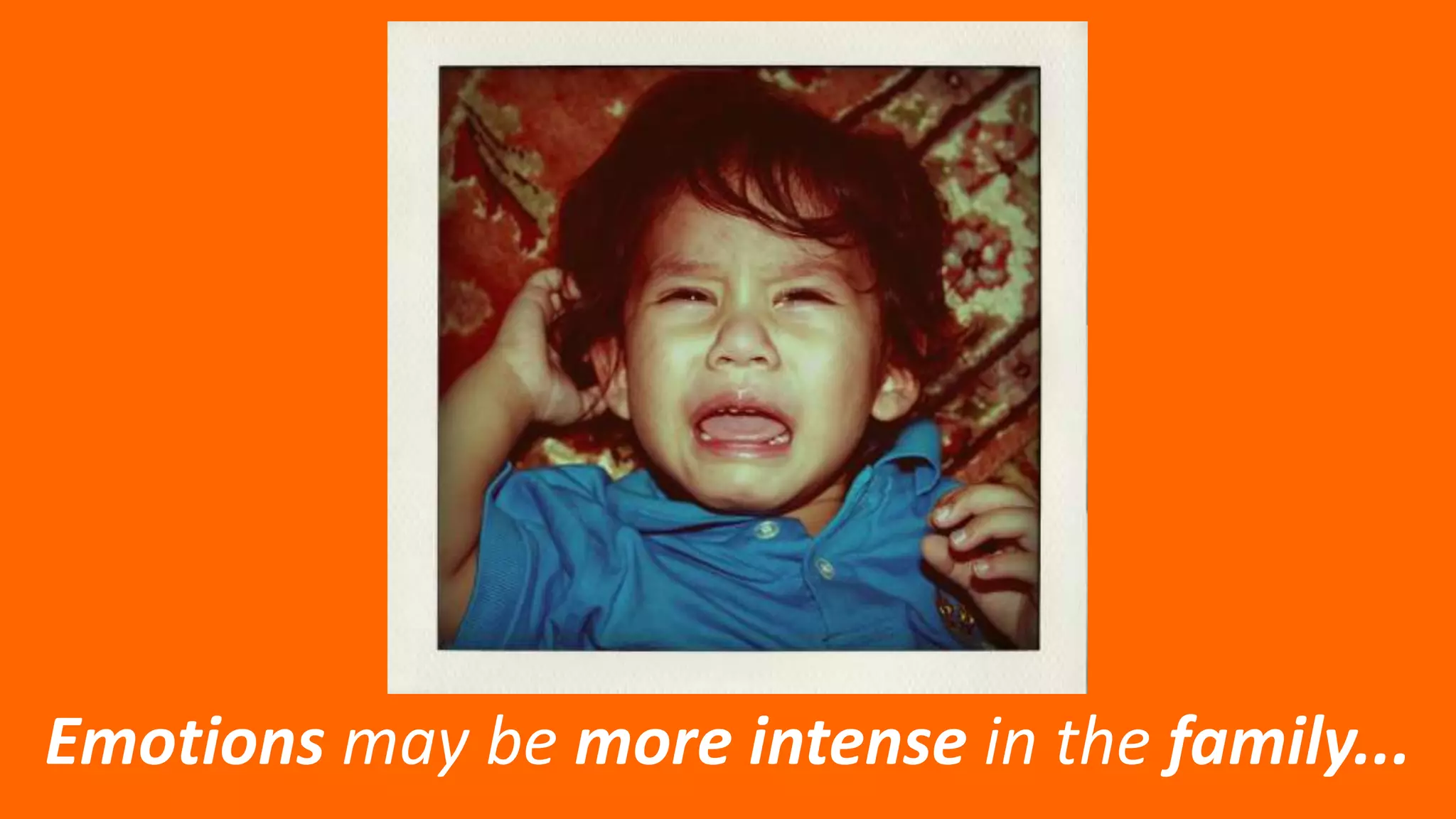
Emotions may be more intense in the family...
Action during disruption...
• Manage the priorities
– use real-time priority-techniques such as triage
• Manage relations with others
– balance Self and Other in family, community
– balance competition and cooperation
• Keep the panic at bay
– focus on the Now, use vision / values as anchors
Notice the real-time trade-offs...
• Choices: who to trust? who to serve?
– I, We, Us, Them: self, family, community, beyond
• Interdependence is key in surviving chaos
– different capabilities shared across the whole
– and fear of dependence, entrapment etc...
• In a crisis, yes, “we are all in this together”
– and acknowledge the limits of ‘response-ability’
Learn/rebuild after disruption...
• Identify any benefits-realised
– there are always some, if we know where to look
• Identify lessons-learned
– link I and We – self, family, community and more
• Support iterative continuous-improvement
– step-by-step: “we can always do it better”
• What is happening to your family and community?
• How do you adapt to change in family and
community?
• How do you stop panic from overwhelming you and
others?
• How prepared were you in your family and
community?
• What do you need, to be better prepared for future
disruption in family and community?
Discuss: Disruption in community
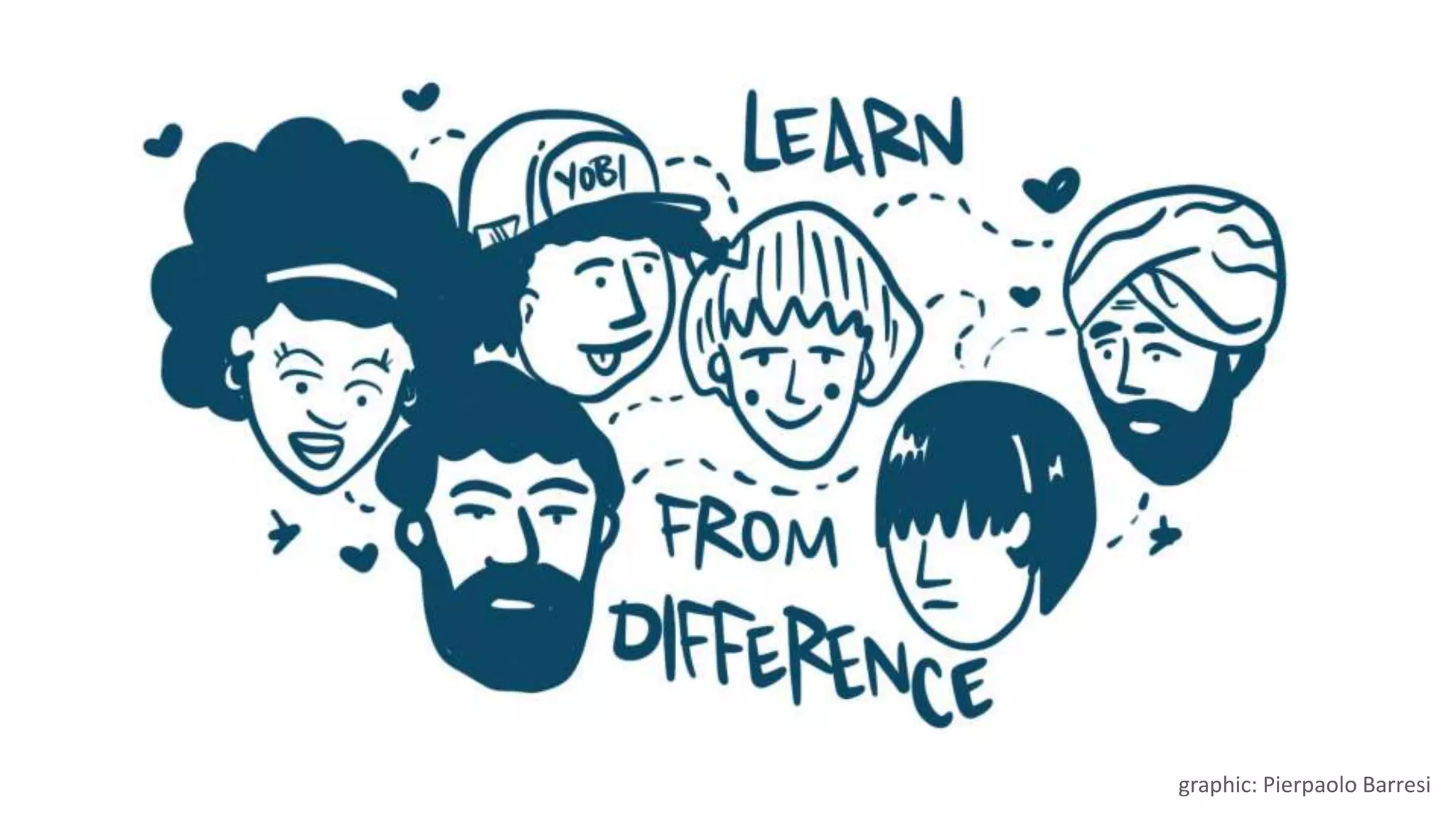
Part 3: Learn from difference
graphic: Pierpaolo Barresi
Disruption anywhere...
How does disruption vary
in different contexts?
What can we learn
from those differences?
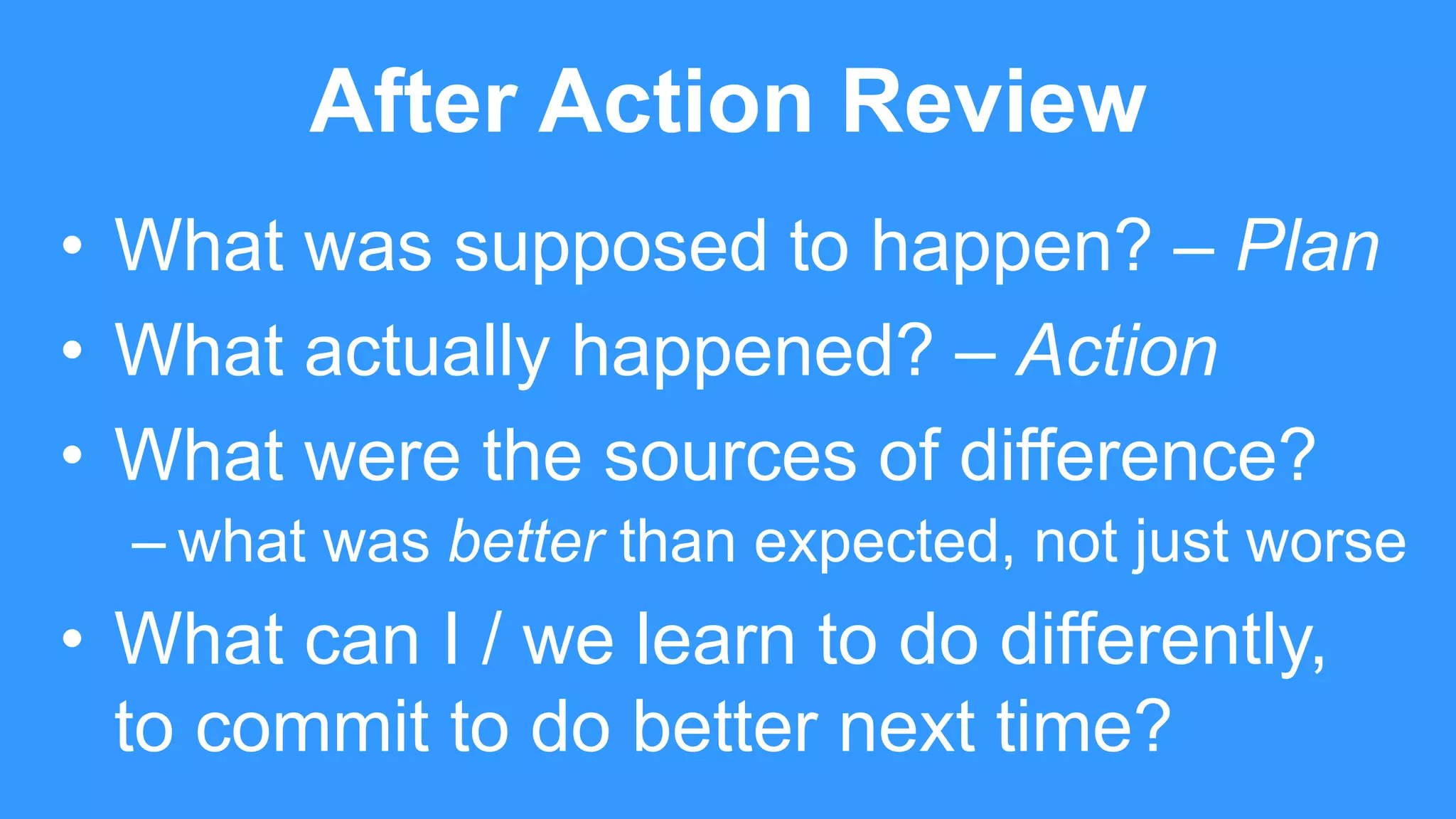
After Action Review
• What was supposed to happen? – Plan
• What actually happened? – Action
• What were the sources of difference?
– what was better than expected, not just worse
• What can I / we learn to do differently,
to commit to do better next time?
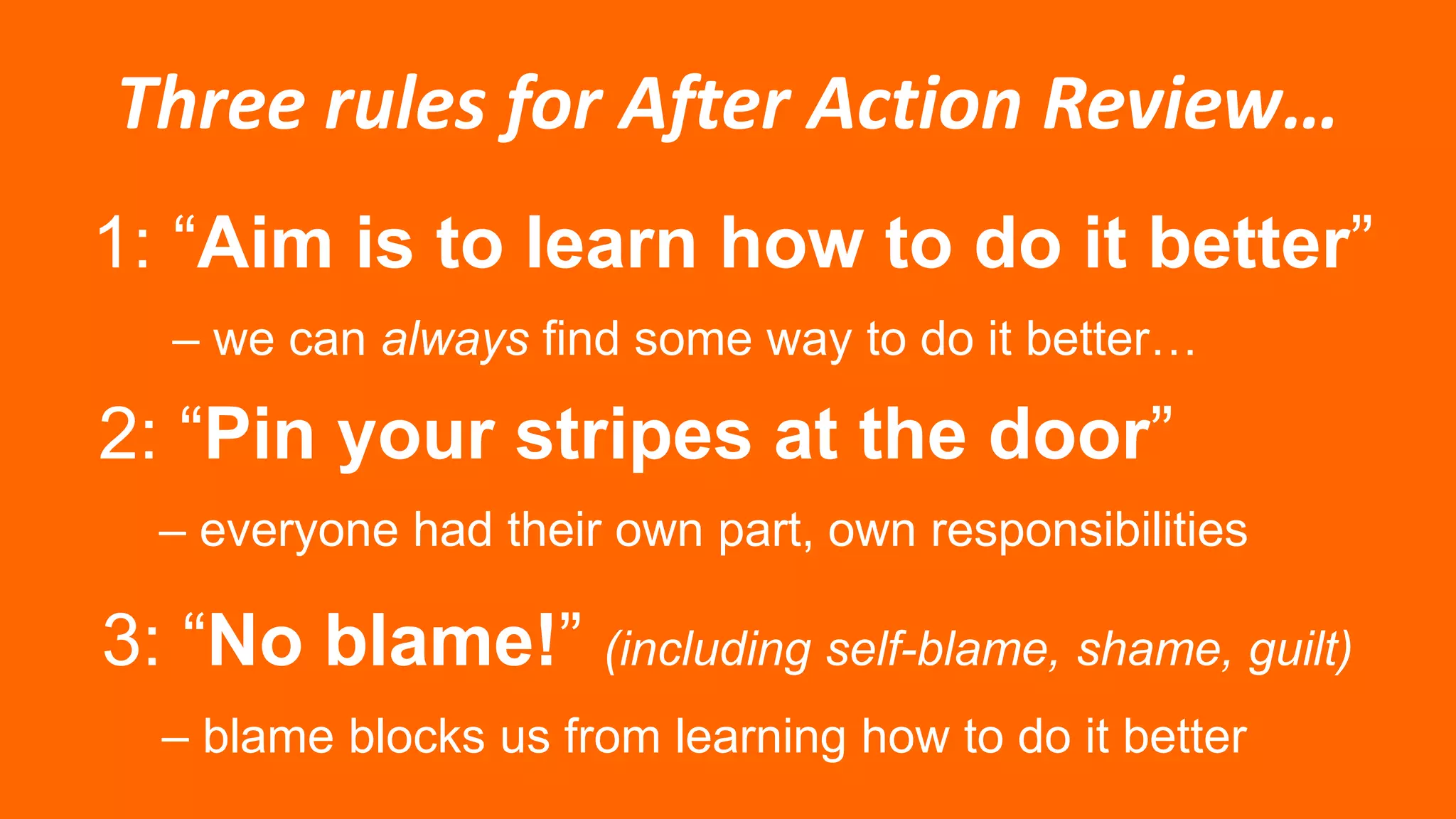
Three rules for After Action Review…
1: “Aim is to learn how to do it better”
– we can always find some way to do it better…
2: “Pin your stripes at the door”
– everyone had their own part, own responsibilities
3: “No blame!” (including self-blame, shame, guilt)
– blame blocks us from learning how to do it better
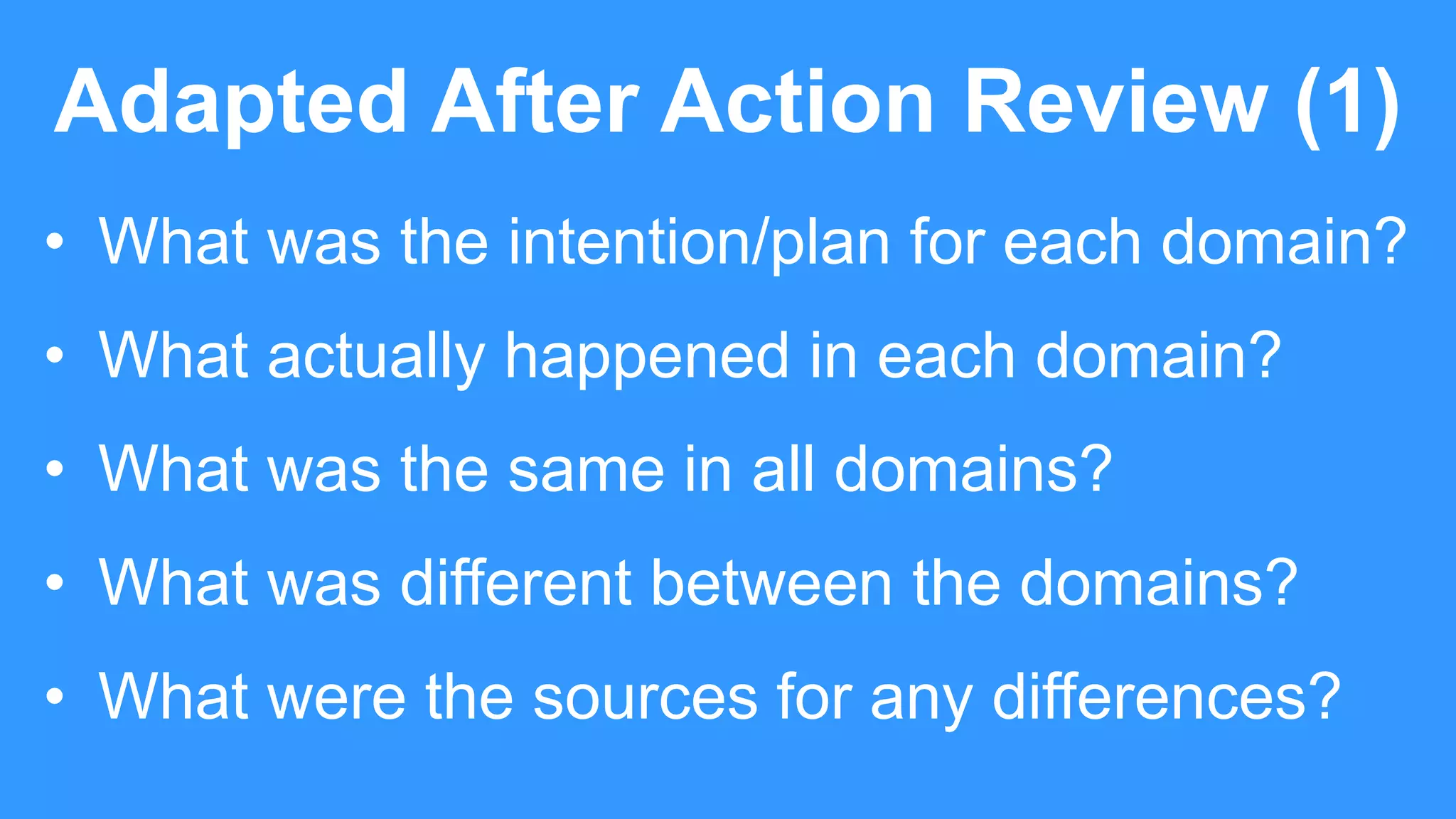
Adapted After Action Review (1)
• What was the intention/plan for each domain?
• What actually happened in each domain?
• What was the same in all domains?
• What was different between the domains?
• What were the sources for any differences?
Adapted After Action Review (2)
• What change-lessons can you apply from business
to family and/or community?
• What change-lessons can you apply from family
and/or community to business?
• What, personally, can you do differently in future,
to work better with disruption in any domain?
• What, collectively, can you do differently in future,
to work better with disruption in any domain?
• What was the same or different between domains?
• What were the sources for any differences?
• What can be learnt by comparing across domains?
• What, personally, can you do differently in future,
to work better with disruption in any domain?
• What, collectively, can you do differently in future,
to work better with disruption in any domain?
Discuss: Learn from difference
Wrapping up…
What have you learnt from this?
How will you apply that in
your business, family, community?
Questions to take away...
What services on this would assist
your business and your clients?
Thank you!

Making sense in the midst of uncertainty

  • 1.
    Making sense in themidst of uncertainty - opportunity within and beyond the pandemic Tom Graves, Tetradian Peoplerise / Vulcano webinar, June 2020
  • 2.
    About this webinar... •Aim: Work better with disruption • It’s about your experience and knowledge, not mine • Some exploration of principles, but mostly about practice
  • 3.
    A matter ofetiquette... • Feel free to interrupt if you need • this is about your experience, not mine • if my English is hard to follow, ask me to repeat! • Switch between overview and practice • practice sessions will be in trios/pairs, report back • make space for others’ ideas and experiences
  • 4.
    “We are eachon our own customer-journey in the service called ‘Life’” Make it personal…
  • 5.
    Hi. (I mayhave changed a bit since then?)I’m Tom. Make it personal…
  • 6.
    “The world breaksus all – and afterward we are stronger in the broken places...” We learn from disruption… – paraphrase from Ernest Hemingway
  • 7.
    These days I’d describemyself as a maker of tools for change...
  • 8.
    SCAN: complexity-mapping andtactics Introduction https://youtu.be/qvgBIXItVYw , worked-example https://youtu.be/QrO9QZhrn1E
  • 9.
    SCAN: worked example(surgical operation) patient identity surgery plan emergency action theatre booking consumables pre-op complications family behaviour surgical-staff availability change of theatre-availability action-records equipment plan patient condition verify identity NOW! certai uncertai before
  • 10.
    SCORE: identify strategicoptions Introduction https://youtu.be/SdkhYl7ae0M , worked-example https://youtu.be/9IFXUAl14PQ
  • 11.
    SCORE: worked example(business plan) strengths Strengths / Services / Support (existing capabilities and resources, potential for synergies) challenges Challenges / Capabilities-needed (‘weaknesses’ indicate needed capabilities and resources) options Options / Opportunities and risks (opportunity is also risk, risk is also opportunity) responses Responses / Returns / Rewards (probable or emergent consequences of action or inaction) effectiveness default: efficient, reliable, elegant, appropriate, integrated “Finding more and better clients” not enough income; not enough work I like good at 3D modelling need more expensive software? I like doing research are clients interested in research – I assume not… jobs with research in them have often gained me new work research is important to me I’m good at textures, ‘realness’ is there a market for ‘realness’? A/B test shows there is a market for ‘realness’ ‘realness’ is important to me not many people do what I do real business-opportunity for concepts/visuals with research and ‘realness’ my current software is enough next task: clarify details of new business-model!
  • 12.
    After Action Review:continuous-improvement 1: What was supposed to happen? 2: What actually happened? 3: What was the source of the difference? 4: What can I learn to do differently? 5: What can we learn to do differently? Continuous improvement (Adapted from US Army After Action Review) Introduction https://youtu.be/55s4CebiTaw
  • 13.
    That’s enough aboutme… What brings you here? What do you need from this? Who are you?
  • 14.
    An introduction touncertainty…
  • 15.
    Key questions forthis session… What is the structure of uncertainty? And how do we work with it to gain the best outcomes?
  • 16.
    Working with uncertainty... DamienNewman’s ‘the Squiggle’, as a description of the change-process
  • 17.
  • 18.
    Context (Purpose) Scope (People) Plan (Preparation) Action (Process) Review (Performance) Avoid failure-modes foruncertainty... No anchors (fragmentation, purposelessness) Context (Purpose) No boundaries (scope-creep) Scope (People) Jump to plan (lack of context, purpose or scope) Plan (Preparation) Leap to action (directionless and wasteful flailing) Action? (Process) Review (Performance) No review (no ability to improve or to change course)
  • 19.
  • 20.
    The plan forthe session... Three scopes for action (three tasks): 1. Working with disruption in business 2. Working with disruption in the family and the community 3. Learning from and linking experiences in both business and community
  • 21.
    “No plan survives firstcontact with Reality Department...” This webinar is a live example of ‘work with uncertainty’... – when Reality Department forces the plan to change, we use aims, values and principles to keep on track
  • 22.
    Part 1: Disruptionin business graphic: Pierpaolo Barresi
  • 23.
    Disruption in business... Whatdisruption looks like: ‘Normal’ no longer works the same way or at all
  • 24.
    We can’t avoidthe politics… POLITICS NO POLITICS! Always be careful about the politics – it can kill all cooperation if not done well…
  • 25.
    Working with disruption... Threethemes: 1. Prepare before disruption 2. Action during disruption 3. Learn and rebuild after disruption (For the pandemic, we’re in the ‘During’ and ‘After’ phases right now)
  • 26.
    Prepare before disruption... •Build awareness of sources of disruption – use tools from futures disciplines – e.g. scenarios • Build capability to work with uncertainty – be ready for emotional challenges of disruption • Note: look for opportunity hidden in risk – always work with opportunity and risk together
  • 27.
    Balancing risk andopportunity... opportunity within risk risk opportunity risk within opportunity Always work with opportunity and risk as a symmetric pair
  • 28.
    Action during disruption... •Remember what’s important – use vision and values as anchors • Manage the priorities (find these in Preparation stage) – use real-time priority-techniques such as triage • Keep the panic at bay (don’t let it overwhelm) – focus on the Now – action now, grieve later!
  • 29.
    Emotion and disruption... •Disruption often triggers real fears – fear of loss, failure, incompetence, guilt... • Panic is real – mainly from overwhelm – limit risk of panic by focus on immediate tasks • ...but also space for positive emotions – acknowledge pride, success, responsibility
  • 30.
    Learn/rebuild after disruption... •Identify any benefits-realised – there are always some, if we know how to look • Identify lessons-learned – use techniques such as After Action Review • Support iterative continuous-improvement – use past to push towards future – e.g. Now-to-New
  • 31.
    • What changeis happening to your business? • How prepared were you in your business? • How do you adapt to change in your business? • How do you stop panic from overwhelming you? • What do you need to do, to be better prepared for future disruption? Discuss: Disruption in business
  • 32.
    Part 2: Disruptionin community and family graphic: Pierpaolo Barresi
  • 33.
    Disruption for self, forfamily, for community... What disruption looks like: ‘Normal’ no longer works the same way or at all
  • 34.
    Disruption beyond business... Threethemes: 1. Prepare before disruption 2. Action during disruption 3. Learn and rebuild after disruption (Bridging between self, family and community)
  • 35.
    Prepare before disruption... •Build awareness of sources of disruption – use tools from futures disciplines – e.g. scenarios • Build capability to work with uncertainty – be ready for emotional challenges of disruption – emotions may be more intense and personal, especially in relation to family • Note: look for opportunity hidden in risk
  • 36.
    Emotions may bemore intense in the family...
  • 37.
    Action during disruption... •Manage the priorities – use real-time priority-techniques such as triage • Manage relations with others – balance Self and Other in family, community – balance competition and cooperation • Keep the panic at bay – focus on the Now, use vision / values as anchors
  • 38.
    Notice the real-timetrade-offs... • Choices: who to trust? who to serve? – I, We, Us, Them: self, family, community, beyond • Interdependence is key in surviving chaos – different capabilities shared across the whole – and fear of dependence, entrapment etc... • In a crisis, yes, “we are all in this together” – and acknowledge the limits of ‘response-ability’
  • 39.
    Learn/rebuild after disruption... •Identify any benefits-realised – there are always some, if we know where to look • Identify lessons-learned – link I and We – self, family, community and more • Support iterative continuous-improvement – step-by-step: “we can always do it better”
  • 40.
    • What ishappening to your family and community? • How do you adapt to change in family and community? • How do you stop panic from overwhelming you and others? • How prepared were you in your family and community? • What do you need, to be better prepared for future disruption in family and community? Discuss: Disruption in community
  • 41.
    Part 3: Learnfrom difference graphic: Pierpaolo Barresi
  • 42.
    Disruption anywhere... How doesdisruption vary in different contexts? What can we learn from those differences?
  • 43.
    After Action Review •What was supposed to happen? – Plan • What actually happened? – Action • What were the sources of difference? – what was better than expected, not just worse • What can I / we learn to do differently, to commit to do better next time?
  • 44.
    Three rules forAfter Action Review… 1: “Aim is to learn how to do it better” – we can always find some way to do it better… 2: “Pin your stripes at the door” – everyone had their own part, own responsibilities 3: “No blame!” (including self-blame, shame, guilt) – blame blocks us from learning how to do it better
  • 45.
    Adapted After ActionReview (1) • What was the intention/plan for each domain? • What actually happened in each domain? • What was the same in all domains? • What was different between the domains? • What were the sources for any differences?
  • 46.
    Adapted After ActionReview (2) • What change-lessons can you apply from business to family and/or community? • What change-lessons can you apply from family and/or community to business? • What, personally, can you do differently in future, to work better with disruption in any domain? • What, collectively, can you do differently in future, to work better with disruption in any domain?
  • 47.
    • What wasthe same or different between domains? • What were the sources for any differences? • What can be learnt by comparing across domains? • What, personally, can you do differently in future, to work better with disruption in any domain? • What, collectively, can you do differently in future, to work better with disruption in any domain? Discuss: Learn from difference
  • 48.
  • 49.
    What have youlearnt from this? How will you apply that in your business, family, community? Questions to take away... What services on this would assist your business and your clients?
  • 50.