Practical Enterprise Architect
Introducing CSVLOD EA Model
1
Prepared by:
Ashraf Fouad Ayoub
29-Apr-2023
Trademarks
• ArchiMate®, The Open Group®, TOGAF®, DPBoK™ are trademarks of
The Open Group.
• UML® and BPMN™ are Object Management Group, Inc. trademarks in
the United States and/or other countries.
• All other brands, company, and product names are used for
identification purposes only and may be trademarks that are the sole
property of their respective owners.
2
Disclaimer
• Infographics included in this presentation based on licensed version from Infograpia.
• Free logos & icons from website: SVG REPO
3
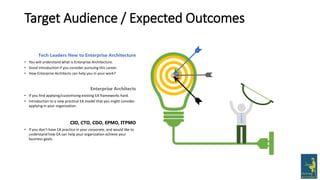
Tech Leaders New to Enterprise Architecture
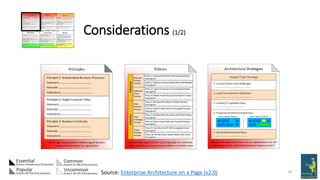
• You will understand what is Enterprise Architecture.
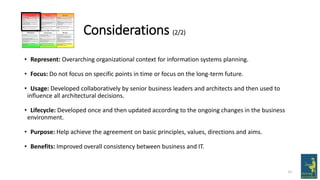
• Good introduction if you consider pursuing this career.
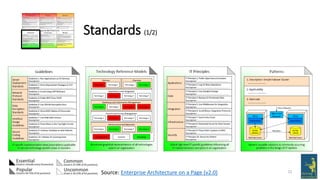
• How Enterprise Architects can help you in your work?
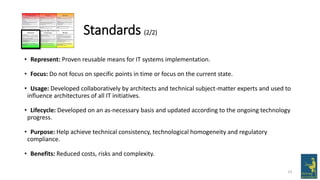
Enterprise Architects
• If you find applying/customizing existing EA frameworks hard.
• Introduction to a new practical EA model that you might consider
applying in your organization.
Target Audience / Expected Outcomes
CIO, CTO, CDO, EPMO, ITPMO
• If you don’t have EA practice in your corporate, and would like to
understand how EA can help your organization achieve your
business goals.
Svyatoslav Kotusev (Slava)
Enterprise Architecture Researcher
LinkedIn Profile
Official Website
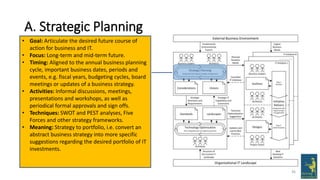
Book
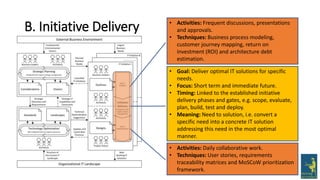
ebooks.com
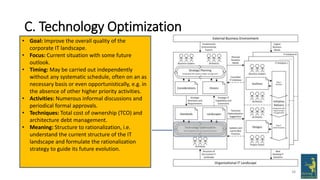
amazon.com (Rating: 4.6)
Book Review
ISBN: 978-0-6450825-2-4
Online Video Course
3 Courses in Udemy
Special Thanks
1
2
3
4
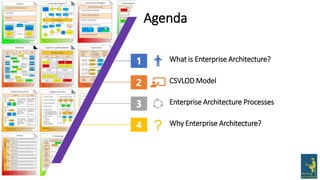
What is Enterprise Architecture?
CSVLOD Model
Enterprise Architecture Processes
Why Enterprise Architecture?
Agenda
7
1- What is Enterprise Architecture?
Enterprise Architecture is
Enterprise Architecture Capability Model
Enterprise vs Solution vs Technical Architect
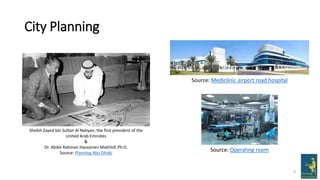
City Planning
What is an Enterprise?
8
• A Business Organization. The term
"enterprise" does not necessarily imply any
particular size, although it is often associated
with larger-scale organizations.
• Any collection of organizations that have
common goals. [11]
• For example, an enterprise could be:
• A whole corporation or a division of a corporation
• A government agency or a single government
department
• A chain of geographically distant organizations linked
together by common ownership
• Groups of countries, governments, or governmental
organizations (such as militaries) working together to
create common or shareable deliverables or
infrastructures
• Partnerships and alliances of businesses working
together, such as a consortium or supply chain
Company Bank Factory
Multinational retailer
Division / Department
Global organization
City Planning
9
Source: Mediclinic airport road hospital
Sheikh Zayed bin Sultan Al Nahyan, the first president of the
United Arab Emirates
&
Dr. Abdel Rahman Hassanien Makhlof, Ph.D.
Source: Planning Abu Dhabi
Source: Operating room
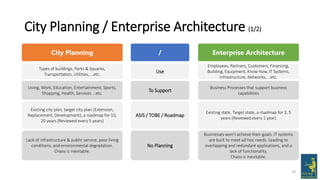
City Planning / Enterprise Architecture (1/2)
10
/
City Planning Enterprise Architecture
Use
To Support
ASIS / TOBE / Roadmap
No Planning
Types of buildings, Parks & Squares,
Transportation, Utilities, …etc.
Living, Work, Education, Entertainment, Sports,
Shopping, Health, Services …etc.
Existing city plan, target city plan (Extension,
Replacement, Development), a roadmap for 10,
20 years (Reviewed every 5 years)
Lack of infrastructure & public service, poor living
conditions, and environmental degradation.
Chaos is inevitable.
Employees, Partners, Customers, Financing,
Building, Equipment, Know-how, IT Systems,
Infrastructure, Networks, …etc.
Business Processes that support business
capabilities
Existing state, Target state, a roadmap for 3, 5
years (Reviewed every 1 year)
Businesses won’t achieve their goals. IT systems
are built to meet ad hoc needs. Leading to
overlapping and redundant applications, and a
lack of functionality.
Chaos is inevitable.
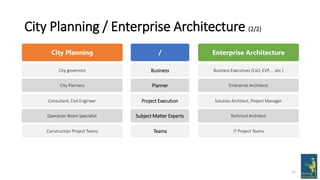
City Planning / Enterprise Architecture (2/2)
11
/
City Planning Enterprise Architecture
Business
Planner
City governors
City Planners
Business Executives (CxO, EVP, … etc.)
Enterprise Architects
Project Execution
Consultant, Civil Engineer Solution Architect, Project Manager
Subject Matter Experts
Operation Room Specialist Technical Architect
Teams
Construction Project Teams IT Project Teams
Enterprise vs Solution vs Technical Architect
• Enterprise Architects
• Focus on strategy, roadmap, and governance.
• Ensures the right business problem is solved in the
right way.
12
Technical Perspective
Business
Perspective Source: Inspired from [6], [7]
Enterprise Architect
Global Business
Perspective
Solution Architect
Bridging the gap
between planning &
implementation
Technical Architect
Dealing with
Engineering Issues
• Solution Architects
• Focus on End to End Solution Delivery.
• Solves business problems, defined by business or
user requirements.
• Technical Architects
• Focus on delivery for specific technology/product.
• Ensures specific products are delivered on time and
maintains operation.
Enterprise Architecture Capability Model
13
Decomposition of EA Capability Model
Source: The TOGAF® Leader’s Guide to Establishing and Evolving an EA
Capability
• Role of EA varies from
one organization to
another, it is mainly
based on the purpose of
having EA in the
organization.
• Also, based on the
purpose capabilities, the
hierarchy and reporting
manager (Alignment) of
EA is determined (Ref,
[1, Chapter 17]).
• The architects size with
respect to IT staff:
• 3% to 5% [1]
• 2% to 4% [10].
Enterprise Architecture is
• There are multiple definitions of Enterprise
Architecture TOGAF, Gartner, and Enterprise
Architecture Center of Excellence. The
common characteristic is:
• Business & IT alignment to achieve target
business goals.
• Enterprise architecture (EA) can be defined
as a collection of special documents
(artifacts) describing various aspects of an
organization from an integrated business
and IT perspective intended to bridge the
communication gap between business and
IT stakeholders, facilitate information
systems planning and thereby improve
business and IT alignment [1].
14
Source: Figure 145. EA Context, Based on Ross
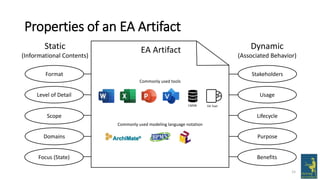
Properties of an EA Artifact
15
Commonly used modeling language notation
Format
Static
(Informational Contents)
Level of Detail
Scope
Domains
Focus (State)
EA Artifact
Stakeholders
Dynamic
(Associated Behavior)
Usage
Lifecycle
Purpose
Benefits
CMDB EA Tool
Commonly used tools
16
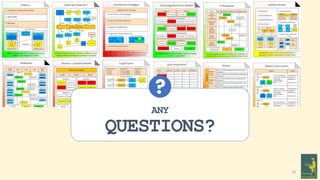
ANY
QUESTIONS?
17
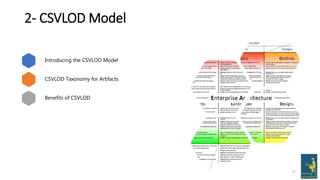
2- CSVLOD Model
Benefits of CSVLOD
CSVLOD Taxonomy for Artifacts
Introducing the CSVLOD Model
18
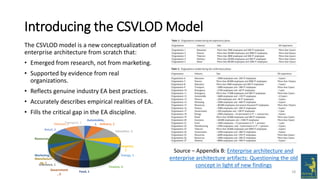
The CSVLOD model is a new conceptualization of
enterprise architecture from scratch that:
• Emerged from research, not from marketing.
• Supported by evidence from real
organizations.
• Reflects genuine industry EA best practices.
• Accurately describes empirical realities of EA.
• Fills the critical gap in the EA discipline.
Source – Appendix B: Enterprise architecture and
enterprise architecture artifacts: Questioning the old
concept in light of new findings
Automobile,
1 Delivery, 2
Education, 3
Emergency,
2
Energy, 1
Finance, 4
Food, 1
Government
, 2
Insurance, 1
Manufacturi
ng, 1
Marketing, 1
Resources, 3
Retail, 2
Telecom, 2
Transport, 1
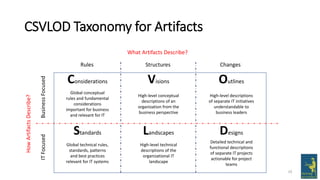
CSVLOD Taxonomy for Artifacts
19
Rules Structures Changes
Business
Focused
IT
Focused
What Artifacts Describe?
How
Artifacts
Describe?
Considerations Visions Outlines
Standards Landscapes Designs
Global conceptual
rules and fundamental
considerations
important for business
and relevant for IT
Global technical rules,
standards, patterns
and best practices
relevant for IT systems
High-level conceptual
descriptions of an
organization from the
business perspective
High-level technical
descriptions of the
organizational IT
landscape
High-level descriptions
of separate IT initiatives
understandable to
business leaders
Detailed technical and
functional descriptions
of separate IT projects
actionable for project
teams
20
Source: Enterprise Architecture on a Page (v2.0)
Considerations (1/2)
21
Considerations (2/2)
• Represent: Overarching organizational context for information systems planning.
• Focus: Do not focus on specific points in time or focus on the long-term future.
• Usage: Developed collaboratively by senior business leaders and architects and then used to
influence all architectural decisions.
• Lifecycle: Developed once and then updated according to the ongoing changes in the business
environment.
• Purpose: Help achieve the agreement on basic principles, values, directions and aims.
• Benefits: Improved overall consistency between business and IT.
22
Standards (1/2)
Source: Enterprise Architecture on a Page (v2.0)
23
Standards (2/2)
• Represent: Proven reusable means for IT systems implementation.
• Focus: Do not focus on specific points in time or focus on the current state.
• Usage: Developed collaboratively by architects and technical subject-matter experts and used to
influence architectures of all IT initiatives.
• Lifecycle: Developed on an as-necessary basis and updated according to the ongoing technology
progress.
• Purpose: Help achieve technical consistency, technological homogeneity and regulatory
compliance.
• Benefits: Reduced costs, risks and complexity.
24
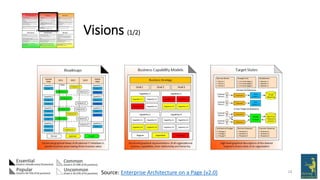
Visions (1/2)
Source: Enterprise Architecture on a Page (v2.0)
25
Visions (2/2)
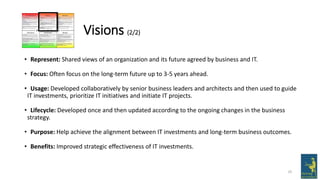
• Represent: Shared views of an organization and its future agreed by business and IT.
• Focus: Often focus on the long-term future up to 3-5 years ahead.
• Usage: Developed collaboratively by senior business leaders and architects and then used to guide
IT investments, prioritize IT initiatives and initiate IT projects.
• Lifecycle: Developed once and then updated according to the ongoing changes in the business
strategy.
• Purpose: Help achieve the alignment between IT investments and long-term business outcomes.
• Benefits: Improved strategic effectiveness of IT investments.
26
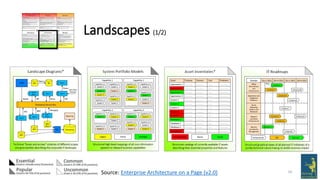
Landscapes (1/2)
Source: Enterprise Architecture on a Page (v2.0)
27
Landscapes (2/2)
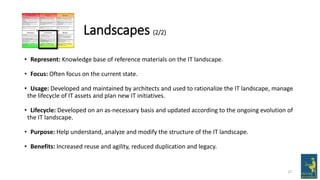
• Represent: Knowledge base of reference materials on the IT landscape.
• Focus: Often focus on the current state.
• Usage: Developed and maintained by architects and used to rationalize the IT landscape, manage
the lifecycle of IT assets and plan new IT initiatives.
• Lifecycle: Developed on an as-necessary basis and updated according to the ongoing evolution of
the IT landscape.
• Purpose: Help understand, analyze and modify the structure of the IT landscape.
• Benefits: Increased reuse and agility, reduced duplication and legacy.
28
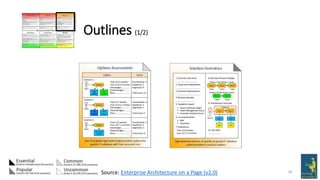
Outlines (1/2)
Source: Enterprise Architecture on a Page (v2.0)
29
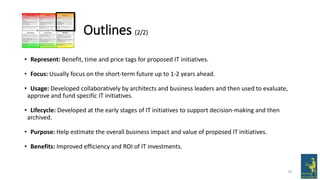
Outlines (2/2)
• Represent: Benefit, time and price tags for proposed IT initiatives.
• Focus: Usually focus on the short-term future up to 1-2 years ahead.
• Usage: Developed collaboratively by architects and business leaders and then used to evaluate,
approve and fund specific IT initiatives.
• Lifecycle: Developed at the early stages of IT initiatives to support decision-making and then
archived.
• Purpose: Help estimate the overall business impact and value of proposed IT initiatives.
• Benefits: Improved efficiency and ROI of IT investments.
30
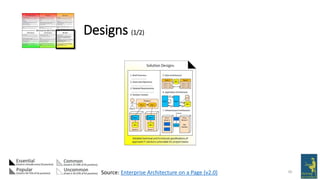
Designs (1/2)
Source: Enterprise Architecture on a Page (v2.0)
31
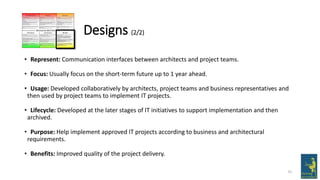
Designs (2/2)
• Represent: Communication interfaces between architects and project teams.
• Focus: Usually focus on the short-term future up to 1 year ahead.
• Usage: Developed collaboratively by architects, project teams and business representatives and
then used by project teams to implement IT projects.
• Lifecycle: Developed at the later stages of IT initiatives to support implementation and then
archived.
• Purpose: Help implement approved IT projects according to business and architectural
requirements.
• Benefits: Improved quality of the project delivery.
Benefits of the CSVLOD Model
32
The CSVLOD model of enterprise architecture has three major advantages over existing models:
• The CSVLOD model is realistic, evidence-based and reflects actual EA artifacts and related best
practices.
• The CSVLOD model is highly explanatory and describes many critical properties of EA artifacts
including their contents, formats, stakeholders, usage, lifecycles, purposes and benefits.
• The CSVLOD model helps understand how EA works.
33
ANY
QUESTIONS?
34
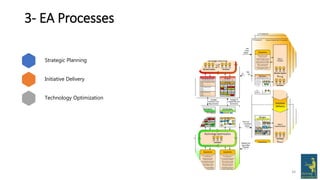
3- EA Processes
Technology Optimization
Initiative Delivery
Strategic Planning
Process View of EA Practice
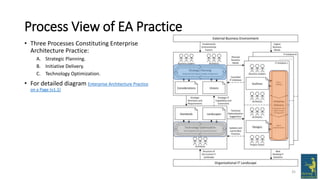
• Three Processes Constituting Enterprise
Architecture Practice:
A. Strategic Planning.
B. Initiative Delivery.
C. Technology Optimization.
• For detailed diagram Enterprise Architecture Practice
on a Page (v1.1)
35
A. Strategic Planning
36
• Goal: Articulate the desired future course of
action for business and IT.
• Focus: Long-term and mid-term future.
• Timing: Aligned to the annual business planning
cycle, important business dates, periods and
events, e.g. fiscal years, budgeting cycles, board
meetings or updates of a business strategy.
• Activities: Informal discussions, meetings,
presentations and workshops, as well as
periodical formal approvals and sign offs.
• Techniques: SWOT and PEST analyses, Five
Forces and other strategy frameworks.
• Meaning: Strategy to portfolio, i.e. convert an
abstract business strategy into more specific
suggestions regarding the desired portfolio of IT
investments.
B. Initiative Delivery
37
• Goal: Deliver optimal IT solutions for specific
needs.
• Focus: Short term and immediate future.
• Timing: Linked to the established initiative
delivery phases and gates, e.g. scope, evaluate,
plan, build, test and deploy.
• Meaning: Need to solution, i.e. convert a
specific need into a concrete IT solution
addressing this need in the most optimal
manner.
• Activities: Frequent discussions, presentations
and approvals.
• Techniques: Business process modeling,
customer journey mapping, return on
investment (ROI) and architecture debt
estimation.
• Activities: Daily collaborative work.
• Techniques: User stories, requirements
traceability matrices and MoSCoW prioritization
framework.
C. Technology Optimization
38
• Goal: Improve the overall quality of the
corporate IT landscape.
• Focus: Current situation with some future
outlook.
• Timing: May be carried out independently
without any systematic schedule, often on an as
necessary basis or even opportunistically, e.g. in
the absence of other higher priority activities.
• Activities: Numerous informal discussions and
periodical formal approvals.
• Techniques: Total cost of ownership (TCO) and
architecture debt management.
• Meaning: Structure to rationalization, i.e.
understand the current structure of the IT
landscape and formulate the rationalization
strategy to guide its future evolution.
39
ANY
QUESTIONS?
40
4- Why Enterprise Architecture?
Benefits of EA to the Business
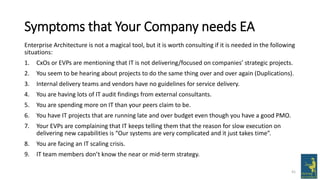
Symptoms that Your Company needs EA
41
Enterprise Architecture is not a magical tool, but it is worth consulting if it is needed in the following
situations:
1. CxOs or EVPs are mentioning that IT is not delivering/focused on companies’ strategic projects.
2. You seem to be hearing about projects to do the same thing over and over again (Duplications).
3. Internal delivery teams and vendors have no guidelines for service delivery.
4. You are having lots of IT audit findings from external consultants.
5. You are spending more on IT than your peers claim to be.
6. You have IT projects that are running late and over budget even though you have a good PMO.
7. Your EVPs are complaining that IT keeps telling them that the reason for slow execution on
delivering new capabilities is “Our systems are very complicated and it just takes time”.
8. You are facing an IT scaling crisis.
9. IT team members don’t know the near or mid-term strategy.
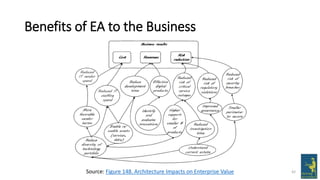
Benefits of EA to the Business
42
Source: Figure 148. Architecture Impacts on Enterprise Value
43
ANY
QUESTIONS?
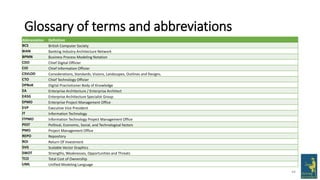
Glossary of terms and abbreviations
44
Abbreviation Definition
BCS British Computer Society
BIAN Banking Industry Architecture Network
BPMN Business Process Modeling Notation
CDO Chief Digital Officier
CIO Chief Information Officier
CSVLOD Considerations, Standards, Visions, Landscapes, Outlines and Designs.
CTO Chief Technology Officier
DPBoK Digital Practiotioner Body of Knowledge
EA Enterprise Architecture / Enterprise Architect
EASG Enterprise Architecture Specialist Group
EPMO Enterprise Project Management Office
EVP Executive Vice President
IT Information Technology
ITPMO Information Technology Project Management Office
PEST Political, Economic, Social, and Technological factors
PMO Project Management Office
REPO Repository
ROI Return Of Investment
SVG Scalable Vector Graphics
SWOT Strengths, Weaknesses, Opportunities and Threats
TCO Total Cost of Ownership
UML Unified Modeling Language
References (1/2)
[1] The Practice of Enterprise Architecture: A Modern Approach to Business and IT Alignment (2nd
Edition), Svyatoslav Kotusev, 15-Jan-2021.
[2] BCS EASG Webinar - A fresh look at Enterprise Architecture Artifacts, Svyatoslav Kotusev, 15-Dec-2017.
[3] The CSVLOD Model of Enterprise Architecture and Its Value for the EA Discipline, Svyatoslav Kotusev.
[4] City trip to Enterprise Architecture, Harald van der Weel, 20-Jan-2017
[5] BIAN 2nd Edition: A framework for the financial services industry, BIAN Association, July-2021
[6] Solution Architect: Processes, Role Description, Responsibilities, and Certifications, Altexsoft, 14-Apr-
2022
[7] WHO IS SOLUTION ARCHITECT: SALARY AND RESPONSIBILITIES, Yuri Musienko, 17-Nov-2021.
[8] Lesson151 - Software Architecture Roles and Titles, Mark Richards, 19-Dec-2022.
[9] Digital Design and Enterprise Architecture – what is it?, 17-Sep-2021
[10] Determining the Right Size for Your Enterprise Architecture Team, Gartner, 2-Apr-2012.
45
References (2/2)
[11] Digital Edition of the TOGAF Standard, The Open Group.
[12] What is enterprise architecture? A framework for transformation, CIO.com, 23-Nov-2022
[13] 6 Signs Your Company Needs An Enterprise Architect, Rob Wolfe, 23-Aug-2016
46
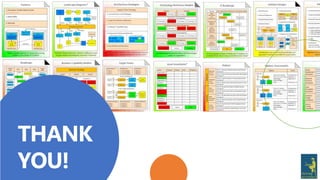
THANK
YOU!

Practical Enterprise Architecture - Introducing CSVLOD EA Model

  • 1.
    Practical Enterprise Architect IntroducingCSVLOD EA Model 1 Prepared by: Ashraf Fouad Ayoub 29-Apr-2023
  • 2.
    Trademarks • ArchiMate®, TheOpen Group®, TOGAF®, DPBoK™ are trademarks of The Open Group. • UML® and BPMN™ are Object Management Group, Inc. trademarks in the United States and/or other countries. • All other brands, company, and product names are used for identification purposes only and may be trademarks that are the sole property of their respective owners. 2
  • 3.
    Disclaimer • Infographics includedin this presentation based on licensed version from Infograpia. • Free logos & icons from website: SVG REPO 3
  • 4.
    Tech Leaders Newto Enterprise Architecture • You will understand what is Enterprise Architecture. • Good introduction if you consider pursuing this career. • How Enterprise Architects can help you in your work? Enterprise Architects • If you find applying/customizing existing EA frameworks hard. • Introduction to a new practical EA model that you might consider applying in your organization. Target Audience / Expected Outcomes CIO, CTO, CDO, EPMO, ITPMO • If you don’t have EA practice in your corporate, and would like to understand how EA can help your organization achieve your business goals.
  • 5.
    Svyatoslav Kotusev (Slava) EnterpriseArchitecture Researcher LinkedIn Profile Official Website Book ebooks.com amazon.com (Rating: 4.6) Book Review ISBN: 978-0-6450825-2-4 Online Video Course 3 Courses in Udemy Special Thanks
  • 6.
    1 2 3 4 What is EnterpriseArchitecture? CSVLOD Model Enterprise Architecture Processes Why Enterprise Architecture? Agenda
  • 7.
    7 1- What isEnterprise Architecture? Enterprise Architecture is Enterprise Architecture Capability Model Enterprise vs Solution vs Technical Architect City Planning What is an Enterprise?
  • 8.
    What is anEnterprise? 8 • A Business Organization. The term "enterprise" does not necessarily imply any particular size, although it is often associated with larger-scale organizations. • Any collection of organizations that have common goals. [11] • For example, an enterprise could be: • A whole corporation or a division of a corporation • A government agency or a single government department • A chain of geographically distant organizations linked together by common ownership • Groups of countries, governments, or governmental organizations (such as militaries) working together to create common or shareable deliverables or infrastructures • Partnerships and alliances of businesses working together, such as a consortium or supply chain Company Bank Factory Multinational retailer Division / Department Global organization
  • 9.
    City Planning 9 Source: Mediclinicairport road hospital Sheikh Zayed bin Sultan Al Nahyan, the first president of the United Arab Emirates & Dr. Abdel Rahman Hassanien Makhlof, Ph.D. Source: Planning Abu Dhabi Source: Operating room
  • 10.
    City Planning /Enterprise Architecture (1/2) 10 / City Planning Enterprise Architecture Use To Support ASIS / TOBE / Roadmap No Planning Types of buildings, Parks & Squares, Transportation, Utilities, …etc. Living, Work, Education, Entertainment, Sports, Shopping, Health, Services …etc. Existing city plan, target city plan (Extension, Replacement, Development), a roadmap for 10, 20 years (Reviewed every 5 years) Lack of infrastructure & public service, poor living conditions, and environmental degradation. Chaos is inevitable. Employees, Partners, Customers, Financing, Building, Equipment, Know-how, IT Systems, Infrastructure, Networks, …etc. Business Processes that support business capabilities Existing state, Target state, a roadmap for 3, 5 years (Reviewed every 1 year) Businesses won’t achieve their goals. IT systems are built to meet ad hoc needs. Leading to overlapping and redundant applications, and a lack of functionality. Chaos is inevitable.
  • 11.
    City Planning /Enterprise Architecture (2/2) 11 / City Planning Enterprise Architecture Business Planner City governors City Planners Business Executives (CxO, EVP, … etc.) Enterprise Architects Project Execution Consultant, Civil Engineer Solution Architect, Project Manager Subject Matter Experts Operation Room Specialist Technical Architect Teams Construction Project Teams IT Project Teams
  • 12.
    Enterprise vs Solutionvs Technical Architect • Enterprise Architects • Focus on strategy, roadmap, and governance. • Ensures the right business problem is solved in the right way. 12 Technical Perspective Business Perspective Source: Inspired from [6], [7] Enterprise Architect Global Business Perspective Solution Architect Bridging the gap between planning & implementation Technical Architect Dealing with Engineering Issues • Solution Architects • Focus on End to End Solution Delivery. • Solves business problems, defined by business or user requirements. • Technical Architects • Focus on delivery for specific technology/product. • Ensures specific products are delivered on time and maintains operation.
  • 13.
    Enterprise Architecture CapabilityModel 13 Decomposition of EA Capability Model Source: The TOGAF® Leader’s Guide to Establishing and Evolving an EA Capability • Role of EA varies from one organization to another, it is mainly based on the purpose of having EA in the organization. • Also, based on the purpose capabilities, the hierarchy and reporting manager (Alignment) of EA is determined (Ref, [1, Chapter 17]). • The architects size with respect to IT staff: • 3% to 5% [1] • 2% to 4% [10].
  • 14.
    Enterprise Architecture is •There are multiple definitions of Enterprise Architecture TOGAF, Gartner, and Enterprise Architecture Center of Excellence. The common characteristic is: • Business & IT alignment to achieve target business goals. • Enterprise architecture (EA) can be defined as a collection of special documents (artifacts) describing various aspects of an organization from an integrated business and IT perspective intended to bridge the communication gap between business and IT stakeholders, facilitate information systems planning and thereby improve business and IT alignment [1]. 14 Source: Figure 145. EA Context, Based on Ross
  • 15.
    Properties of anEA Artifact 15 Commonly used modeling language notation Format Static (Informational Contents) Level of Detail Scope Domains Focus (State) EA Artifact Stakeholders Dynamic (Associated Behavior) Usage Lifecycle Purpose Benefits CMDB EA Tool Commonly used tools
  • 16.
  • 17.
    17 2- CSVLOD Model Benefitsof CSVLOD CSVLOD Taxonomy for Artifacts Introducing the CSVLOD Model
  • 18.
    Introducing the CSVLODModel 18 The CSVLOD model is a new conceptualization of enterprise architecture from scratch that: • Emerged from research, not from marketing. • Supported by evidence from real organizations. • Reflects genuine industry EA best practices. • Accurately describes empirical realities of EA. • Fills the critical gap in the EA discipline. Source – Appendix B: Enterprise architecture and enterprise architecture artifacts: Questioning the old concept in light of new findings Automobile, 1 Delivery, 2 Education, 3 Emergency, 2 Energy, 1 Finance, 4 Food, 1 Government , 2 Insurance, 1 Manufacturi ng, 1 Marketing, 1 Resources, 3 Retail, 2 Telecom, 2 Transport, 1
  • 19.
    CSVLOD Taxonomy forArtifacts 19 Rules Structures Changes Business Focused IT Focused What Artifacts Describe? How Artifacts Describe? Considerations Visions Outlines Standards Landscapes Designs Global conceptual rules and fundamental considerations important for business and relevant for IT Global technical rules, standards, patterns and best practices relevant for IT systems High-level conceptual descriptions of an organization from the business perspective High-level technical descriptions of the organizational IT landscape High-level descriptions of separate IT initiatives understandable to business leaders Detailed technical and functional descriptions of separate IT projects actionable for project teams
  • 20.
    20 Source: Enterprise Architectureon a Page (v2.0) Considerations (1/2)
  • 21.
    21 Considerations (2/2) • Represent:Overarching organizational context for information systems planning. • Focus: Do not focus on specific points in time or focus on the long-term future. • Usage: Developed collaboratively by senior business leaders and architects and then used to influence all architectural decisions. • Lifecycle: Developed once and then updated according to the ongoing changes in the business environment. • Purpose: Help achieve the agreement on basic principles, values, directions and aims. • Benefits: Improved overall consistency between business and IT.
  • 22.
    22 Standards (1/2) Source: EnterpriseArchitecture on a Page (v2.0)
  • 23.
    23 Standards (2/2) • Represent:Proven reusable means for IT systems implementation. • Focus: Do not focus on specific points in time or focus on the current state. • Usage: Developed collaboratively by architects and technical subject-matter experts and used to influence architectures of all IT initiatives. • Lifecycle: Developed on an as-necessary basis and updated according to the ongoing technology progress. • Purpose: Help achieve technical consistency, technological homogeneity and regulatory compliance. • Benefits: Reduced costs, risks and complexity.
  • 24.
    24 Visions (1/2) Source: EnterpriseArchitecture on a Page (v2.0)
  • 25.
    25 Visions (2/2) • Represent:Shared views of an organization and its future agreed by business and IT. • Focus: Often focus on the long-term future up to 3-5 years ahead. • Usage: Developed collaboratively by senior business leaders and architects and then used to guide IT investments, prioritize IT initiatives and initiate IT projects. • Lifecycle: Developed once and then updated according to the ongoing changes in the business strategy. • Purpose: Help achieve the alignment between IT investments and long-term business outcomes. • Benefits: Improved strategic effectiveness of IT investments.
  • 26.
    26 Landscapes (1/2) Source: EnterpriseArchitecture on a Page (v2.0)
  • 27.
    27 Landscapes (2/2) • Represent:Knowledge base of reference materials on the IT landscape. • Focus: Often focus on the current state. • Usage: Developed and maintained by architects and used to rationalize the IT landscape, manage the lifecycle of IT assets and plan new IT initiatives. • Lifecycle: Developed on an as-necessary basis and updated according to the ongoing evolution of the IT landscape. • Purpose: Help understand, analyze and modify the structure of the IT landscape. • Benefits: Increased reuse and agility, reduced duplication and legacy.
  • 28.
    28 Outlines (1/2) Source: EnterpriseArchitecture on a Page (v2.0)
  • 29.
    29 Outlines (2/2) • Represent:Benefit, time and price tags for proposed IT initiatives. • Focus: Usually focus on the short-term future up to 1-2 years ahead. • Usage: Developed collaboratively by architects and business leaders and then used to evaluate, approve and fund specific IT initiatives. • Lifecycle: Developed at the early stages of IT initiatives to support decision-making and then archived. • Purpose: Help estimate the overall business impact and value of proposed IT initiatives. • Benefits: Improved efficiency and ROI of IT investments.
  • 30.
    30 Designs (1/2) Source: EnterpriseArchitecture on a Page (v2.0)
  • 31.
    31 Designs (2/2) • Represent:Communication interfaces between architects and project teams. • Focus: Usually focus on the short-term future up to 1 year ahead. • Usage: Developed collaboratively by architects, project teams and business representatives and then used by project teams to implement IT projects. • Lifecycle: Developed at the later stages of IT initiatives to support implementation and then archived. • Purpose: Help implement approved IT projects according to business and architectural requirements. • Benefits: Improved quality of the project delivery.
  • 32.
    Benefits of theCSVLOD Model 32 The CSVLOD model of enterprise architecture has three major advantages over existing models: • The CSVLOD model is realistic, evidence-based and reflects actual EA artifacts and related best practices. • The CSVLOD model is highly explanatory and describes many critical properties of EA artifacts including their contents, formats, stakeholders, usage, lifecycles, purposes and benefits. • The CSVLOD model helps understand how EA works.
  • 33.
  • 34.
    34 3- EA Processes TechnologyOptimization Initiative Delivery Strategic Planning
  • 35.
    Process View ofEA Practice • Three Processes Constituting Enterprise Architecture Practice: A. Strategic Planning. B. Initiative Delivery. C. Technology Optimization. • For detailed diagram Enterprise Architecture Practice on a Page (v1.1) 35
  • 36.
    A. Strategic Planning 36 •Goal: Articulate the desired future course of action for business and IT. • Focus: Long-term and mid-term future. • Timing: Aligned to the annual business planning cycle, important business dates, periods and events, e.g. fiscal years, budgeting cycles, board meetings or updates of a business strategy. • Activities: Informal discussions, meetings, presentations and workshops, as well as periodical formal approvals and sign offs. • Techniques: SWOT and PEST analyses, Five Forces and other strategy frameworks. • Meaning: Strategy to portfolio, i.e. convert an abstract business strategy into more specific suggestions regarding the desired portfolio of IT investments.
  • 37.
    B. Initiative Delivery 37 •Goal: Deliver optimal IT solutions for specific needs. • Focus: Short term and immediate future. • Timing: Linked to the established initiative delivery phases and gates, e.g. scope, evaluate, plan, build, test and deploy. • Meaning: Need to solution, i.e. convert a specific need into a concrete IT solution addressing this need in the most optimal manner. • Activities: Frequent discussions, presentations and approvals. • Techniques: Business process modeling, customer journey mapping, return on investment (ROI) and architecture debt estimation. • Activities: Daily collaborative work. • Techniques: User stories, requirements traceability matrices and MoSCoW prioritization framework.
  • 38.
    C. Technology Optimization 38 •Goal: Improve the overall quality of the corporate IT landscape. • Focus: Current situation with some future outlook. • Timing: May be carried out independently without any systematic schedule, often on an as necessary basis or even opportunistically, e.g. in the absence of other higher priority activities. • Activities: Numerous informal discussions and periodical formal approvals. • Techniques: Total cost of ownership (TCO) and architecture debt management. • Meaning: Structure to rationalization, i.e. understand the current structure of the IT landscape and formulate the rationalization strategy to guide its future evolution.
  • 39.
  • 40.
    40 4- Why EnterpriseArchitecture? Benefits of EA to the Business Symptoms that Your Company needs EA
  • 41.
    Symptoms that YourCompany needs EA 41 Enterprise Architecture is not a magical tool, but it is worth consulting if it is needed in the following situations: 1. CxOs or EVPs are mentioning that IT is not delivering/focused on companies’ strategic projects. 2. You seem to be hearing about projects to do the same thing over and over again (Duplications). 3. Internal delivery teams and vendors have no guidelines for service delivery. 4. You are having lots of IT audit findings from external consultants. 5. You are spending more on IT than your peers claim to be. 6. You have IT projects that are running late and over budget even though you have a good PMO. 7. Your EVPs are complaining that IT keeps telling them that the reason for slow execution on delivering new capabilities is “Our systems are very complicated and it just takes time”. 8. You are facing an IT scaling crisis. 9. IT team members don’t know the near or mid-term strategy.
  • 42.
    Benefits of EAto the Business 42 Source: Figure 148. Architecture Impacts on Enterprise Value
  • 43.
  • 44.
    Glossary of termsand abbreviations 44 Abbreviation Definition BCS British Computer Society BIAN Banking Industry Architecture Network BPMN Business Process Modeling Notation CDO Chief Digital Officier CIO Chief Information Officier CSVLOD Considerations, Standards, Visions, Landscapes, Outlines and Designs. CTO Chief Technology Officier DPBoK Digital Practiotioner Body of Knowledge EA Enterprise Architecture / Enterprise Architect EASG Enterprise Architecture Specialist Group EPMO Enterprise Project Management Office EVP Executive Vice President IT Information Technology ITPMO Information Technology Project Management Office PEST Political, Economic, Social, and Technological factors PMO Project Management Office REPO Repository ROI Return Of Investment SVG Scalable Vector Graphics SWOT Strengths, Weaknesses, Opportunities and Threats TCO Total Cost of Ownership UML Unified Modeling Language
  • 45.
    References (1/2) [1] ThePractice of Enterprise Architecture: A Modern Approach to Business and IT Alignment (2nd Edition), Svyatoslav Kotusev, 15-Jan-2021. [2] BCS EASG Webinar - A fresh look at Enterprise Architecture Artifacts, Svyatoslav Kotusev, 15-Dec-2017. [3] The CSVLOD Model of Enterprise Architecture and Its Value for the EA Discipline, Svyatoslav Kotusev. [4] City trip to Enterprise Architecture, Harald van der Weel, 20-Jan-2017 [5] BIAN 2nd Edition: A framework for the financial services industry, BIAN Association, July-2021 [6] Solution Architect: Processes, Role Description, Responsibilities, and Certifications, Altexsoft, 14-Apr- 2022 [7] WHO IS SOLUTION ARCHITECT: SALARY AND RESPONSIBILITIES, Yuri Musienko, 17-Nov-2021. [8] Lesson151 - Software Architecture Roles and Titles, Mark Richards, 19-Dec-2022. [9] Digital Design and Enterprise Architecture – what is it?, 17-Sep-2021 [10] Determining the Right Size for Your Enterprise Architecture Team, Gartner, 2-Apr-2012. 45
  • 46.
    References (2/2) [11] DigitalEdition of the TOGAF Standard, The Open Group. [12] What is enterprise architecture? A framework for transformation, CIO.com, 23-Nov-2022 [13] 6 Signs Your Company Needs An Enterprise Architect, Rob Wolfe, 23-Aug-2016 46
  • 47.