Staging the story
a people-oriented view of EA
Tom Graves, Tetradian Consulting
Unicom EA Conference, London, September 2013
the futures of business
Hi.
I’m Tom.
(That’s all of the PR stuff out of the way...)
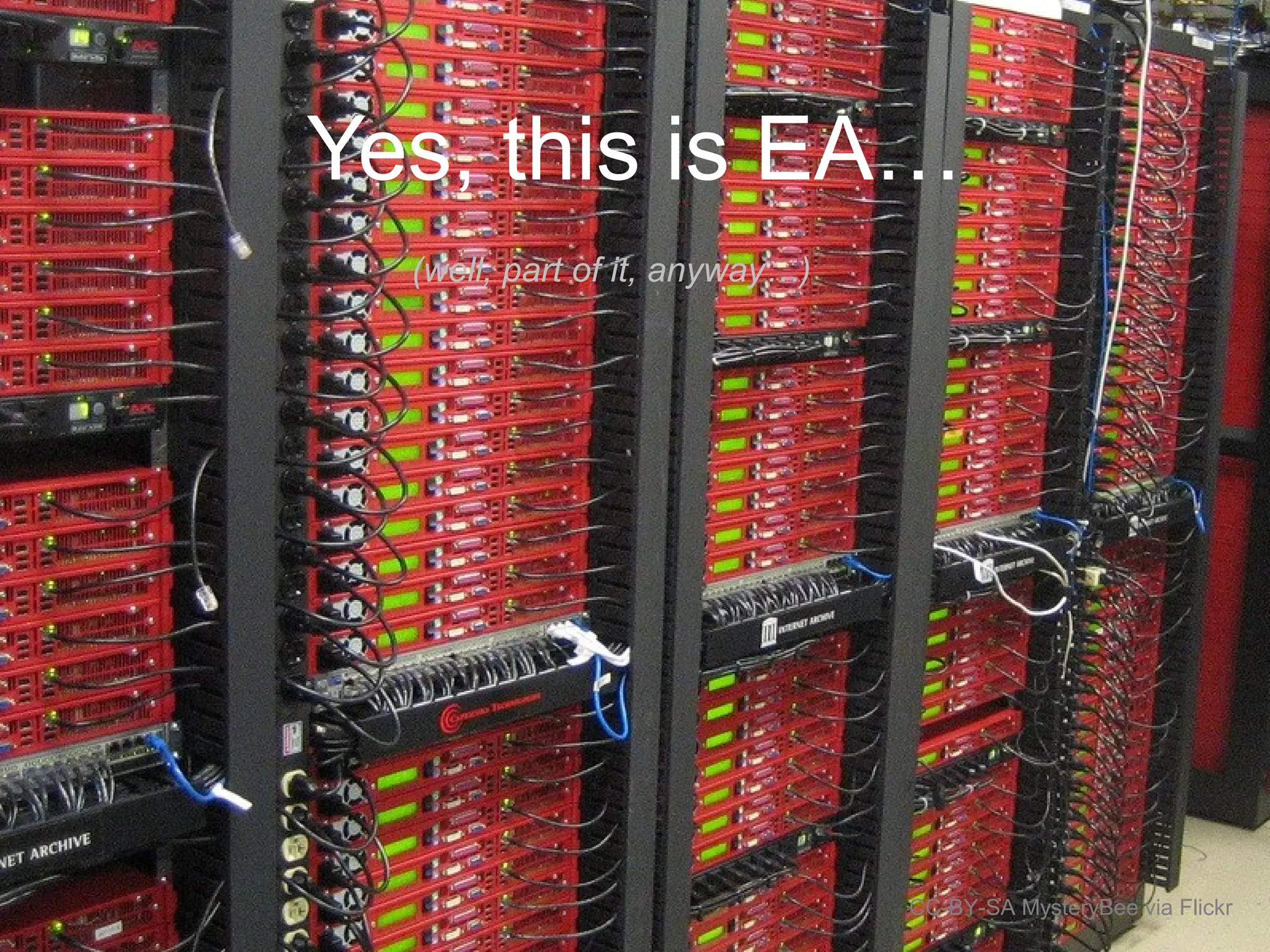
Yes, this is EA…
(well, part of it, anyway…)
CC-BY-SA MysteryBee via Flickr
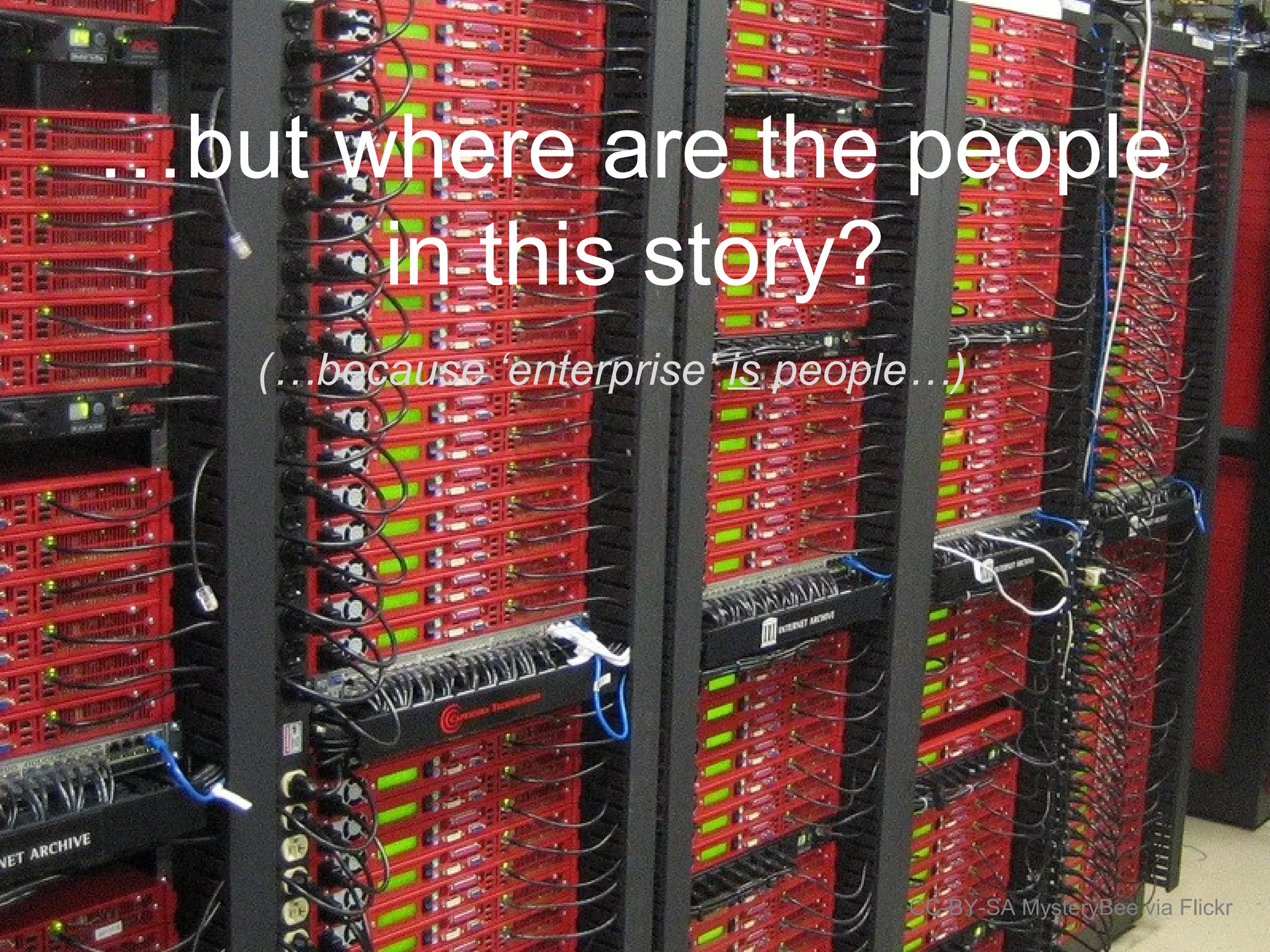
…but where are the people
in this story?
(…because ‘enterprise’ is people…)
CC-BY-SA MysteryBee via Flickr
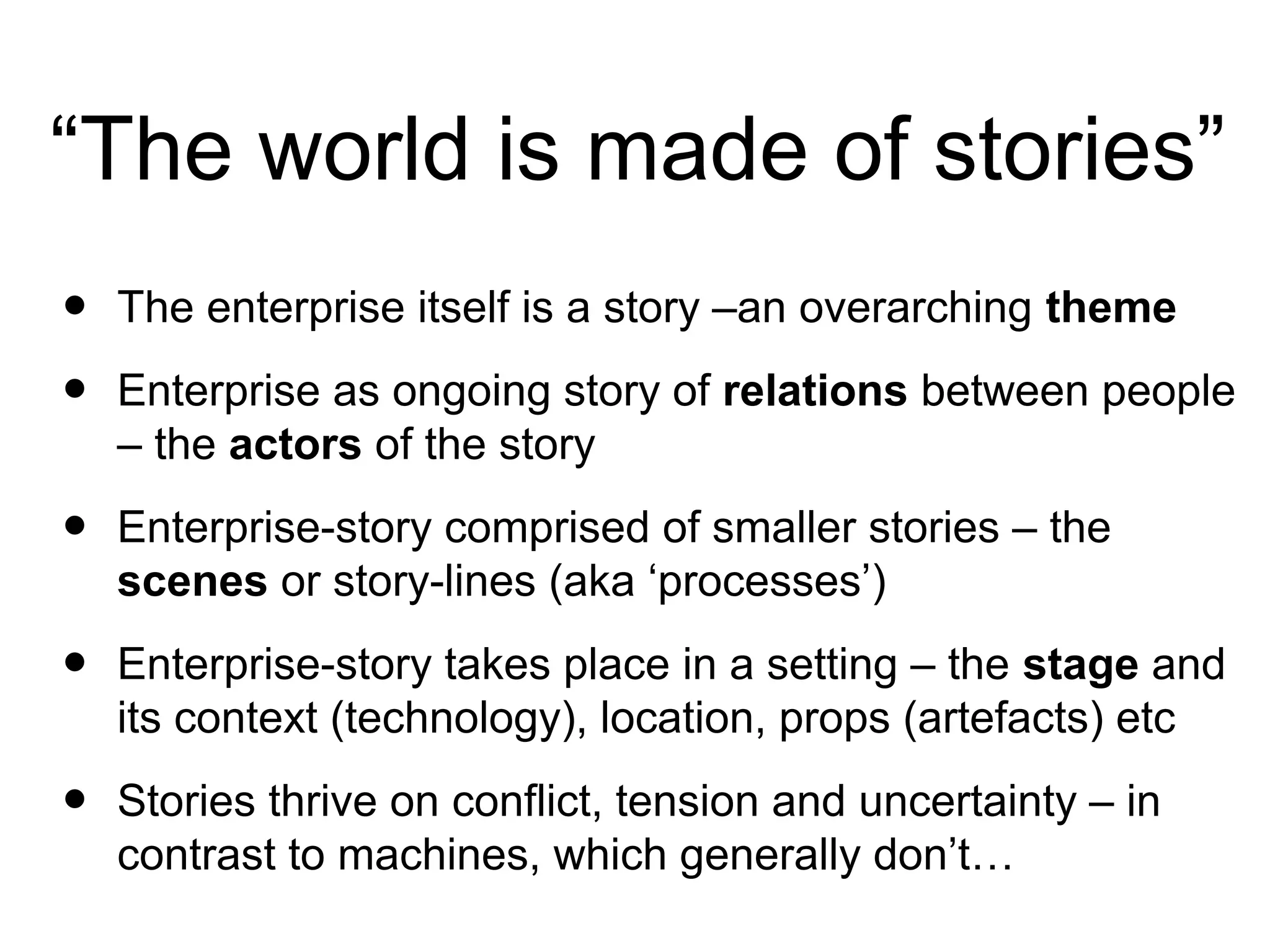
“The world is made of stories”
• The enterprise itself is a story –an overarching theme
• Enterprise as ongoing story of relations between people
– the actors of the story
• Enterprise-story comprised of smaller stories – the
scenes or story-lines (aka ‘processes’)
• Enterprise-story takes place in a setting – the stage and
its context (technology), location, props (artefacts) etc
• Stories thrive on conflict, tension and uncertainty – in
contrast to machines, which generally don’t…
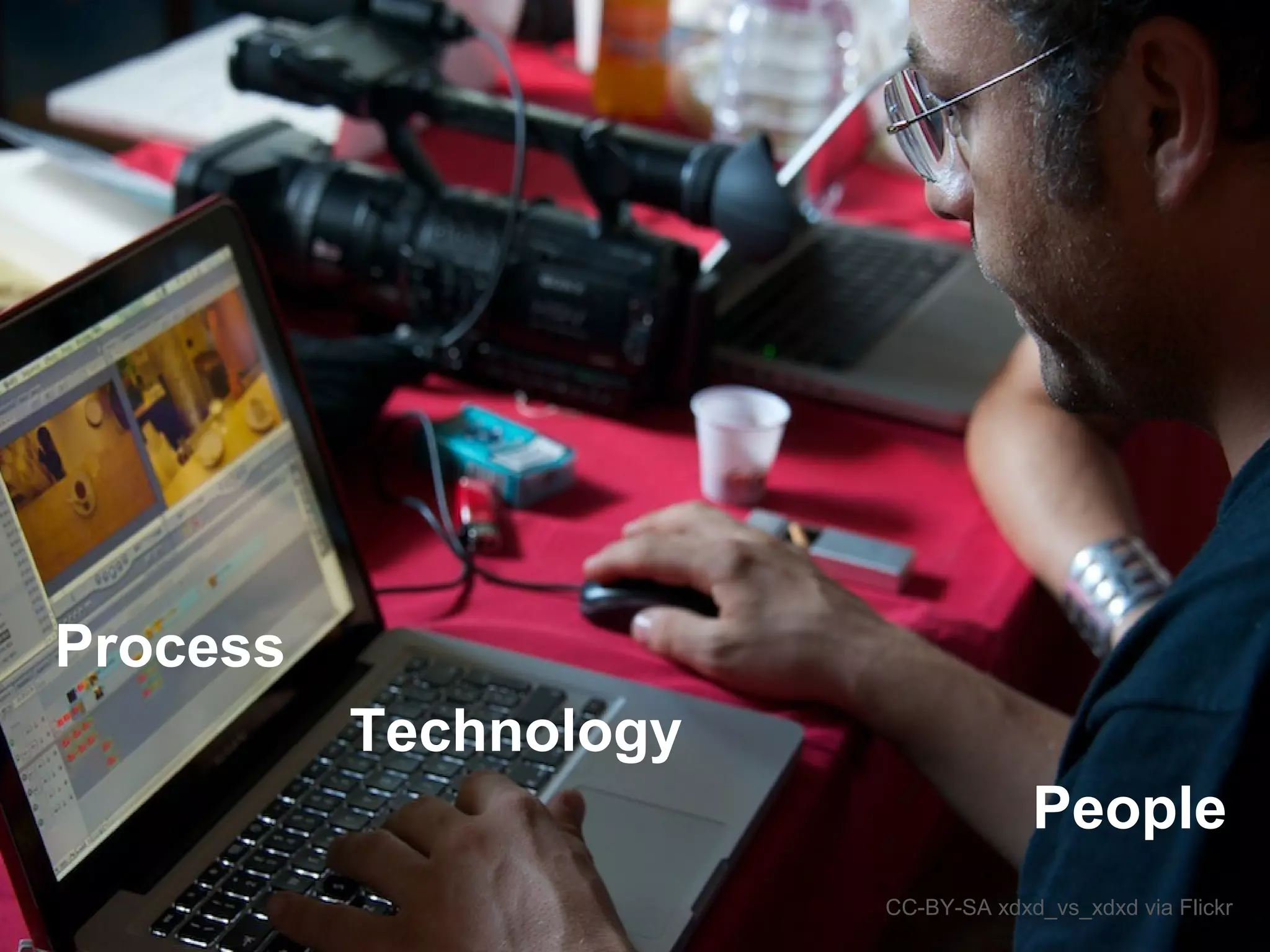
Technology
CC-BY-SA xdxd_vs_xdxd via Flickr
Process
People
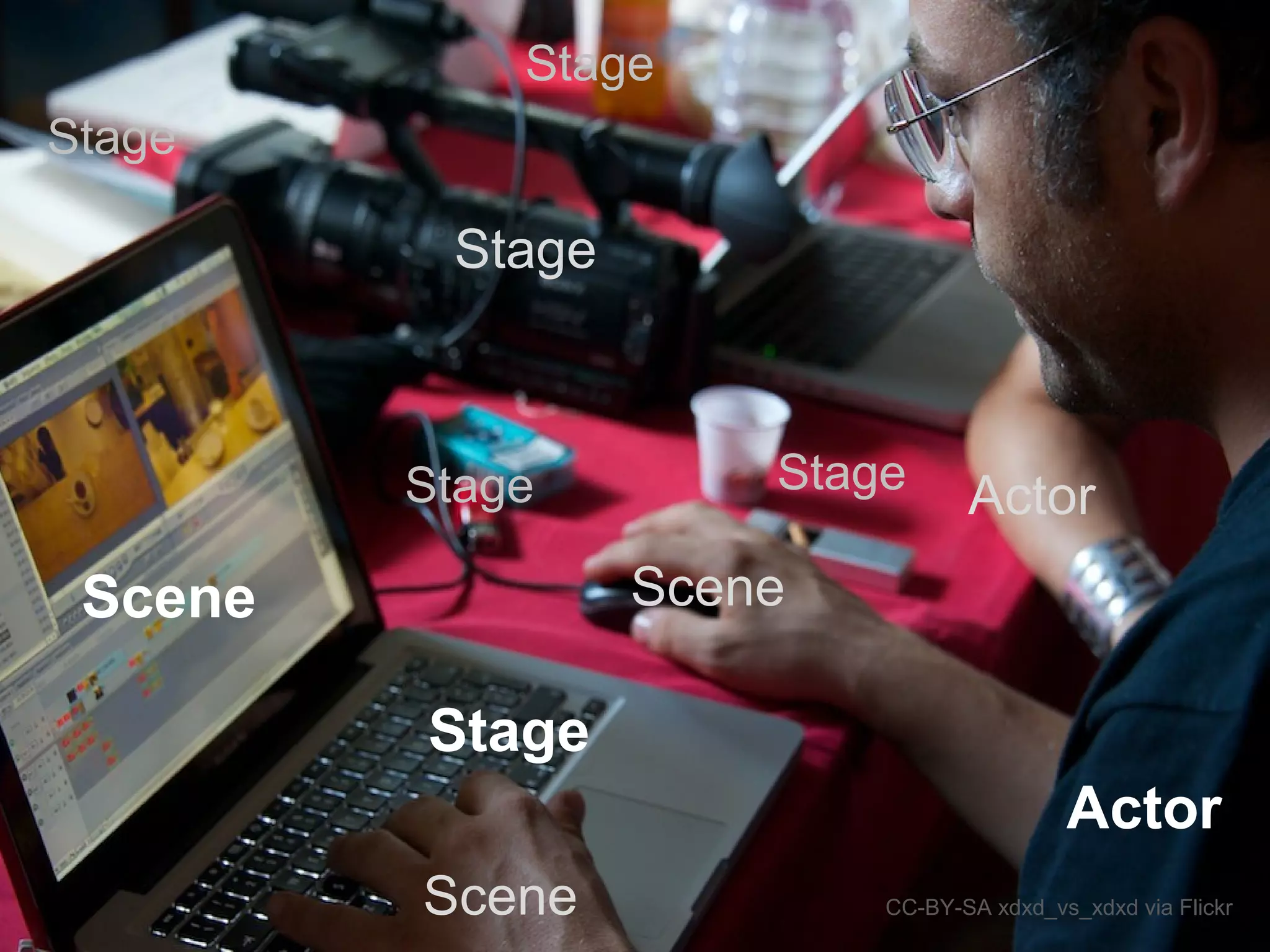
Stage
CC-BY-SA xdxd_vs_xdxd via Flickr
Scene
Actor
ActorStage
Stage
Stage
Stage
Stage
Scene
Scene
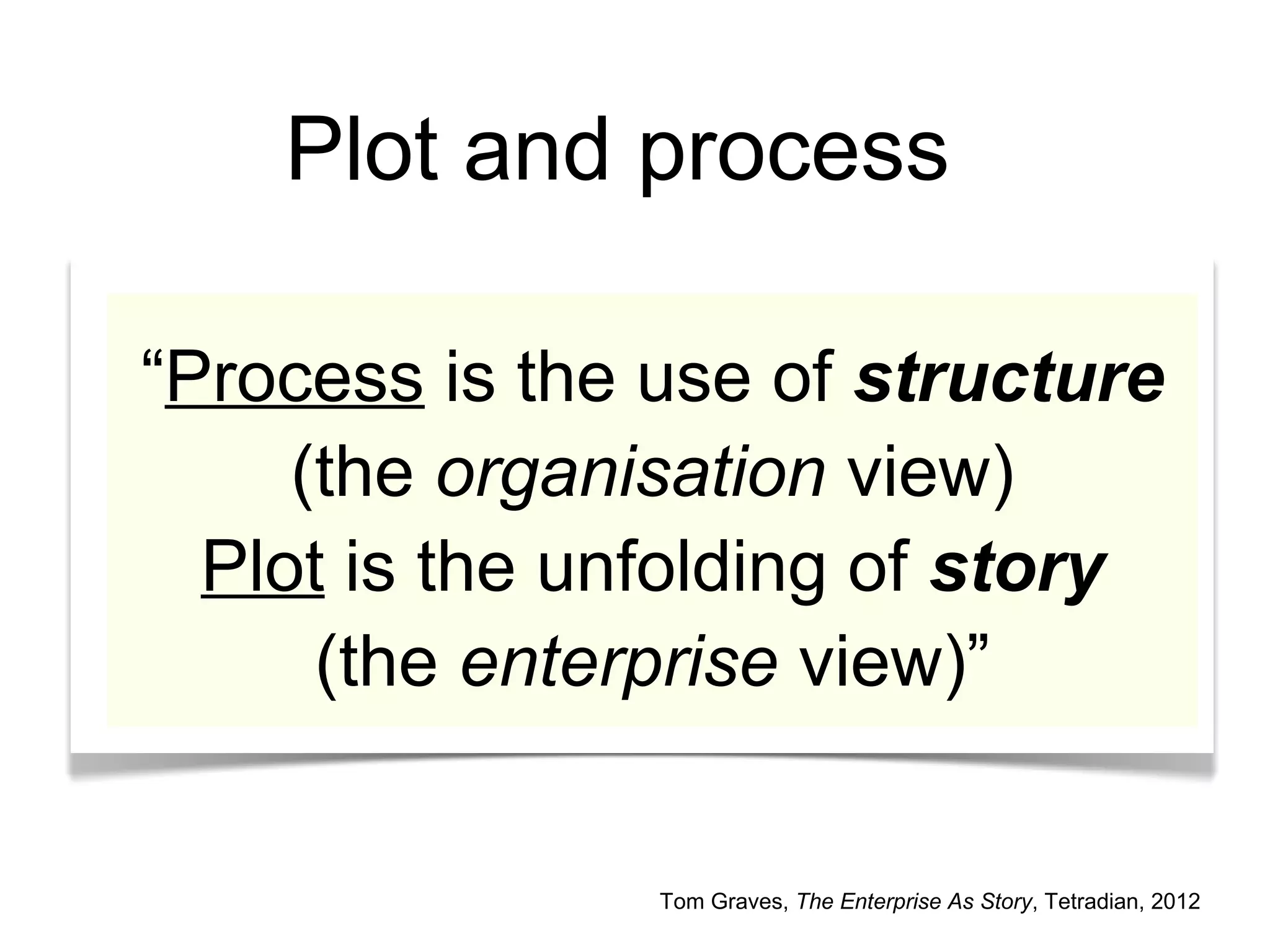
“Process is the use of structure
(the organisation view)
Plot is the unfolding of story
(the enterprise view)”
Tom Graves, The Enterprise As Story, Tetradian, 2012
Plot and process
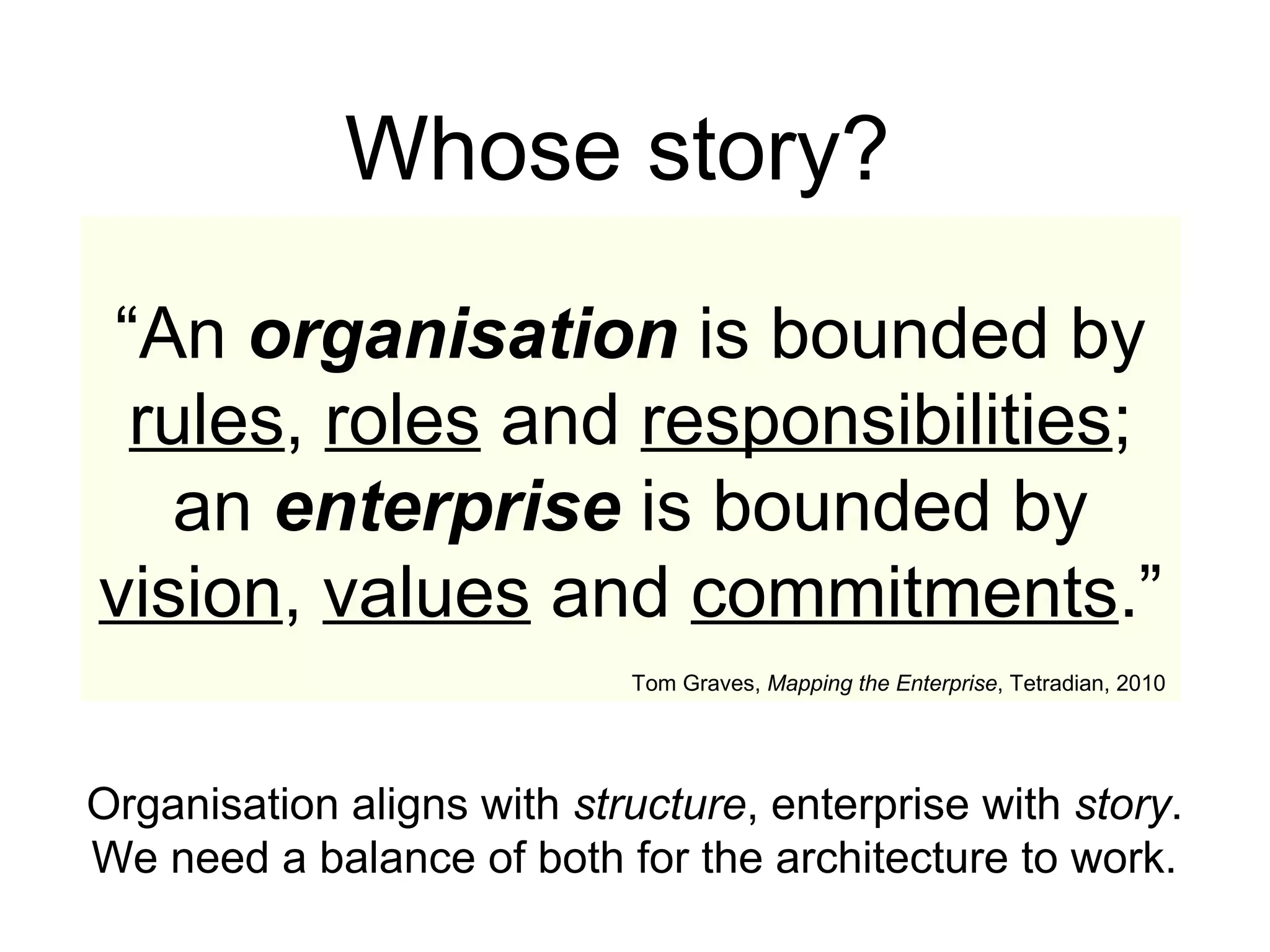
“An organisation is bounded by
rules, roles and responsibilities;
an enterprise is bounded by
vision, values and commitments.”
Tom Graves, Mapping the Enterprise, Tetradian, 2010
Whose story?
Organisation aligns with structure, enterprise with story.
We need a balance of both for the architecture to work.
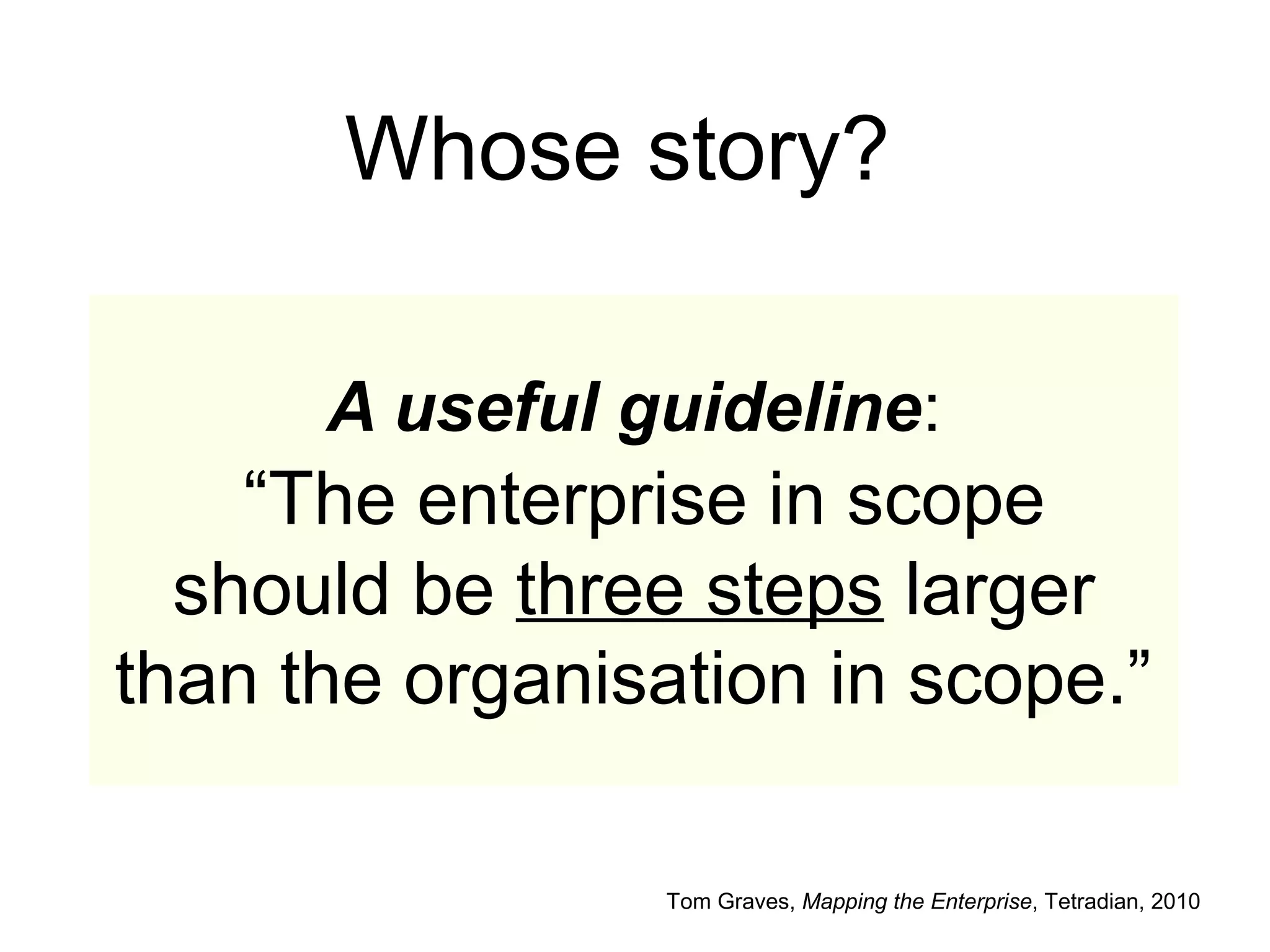
A useful guideline:
“The enterprise in scope
should be three steps larger
than the organisation in scope.”
Tom Graves, Mapping the Enterprise, Tetradian, 2010
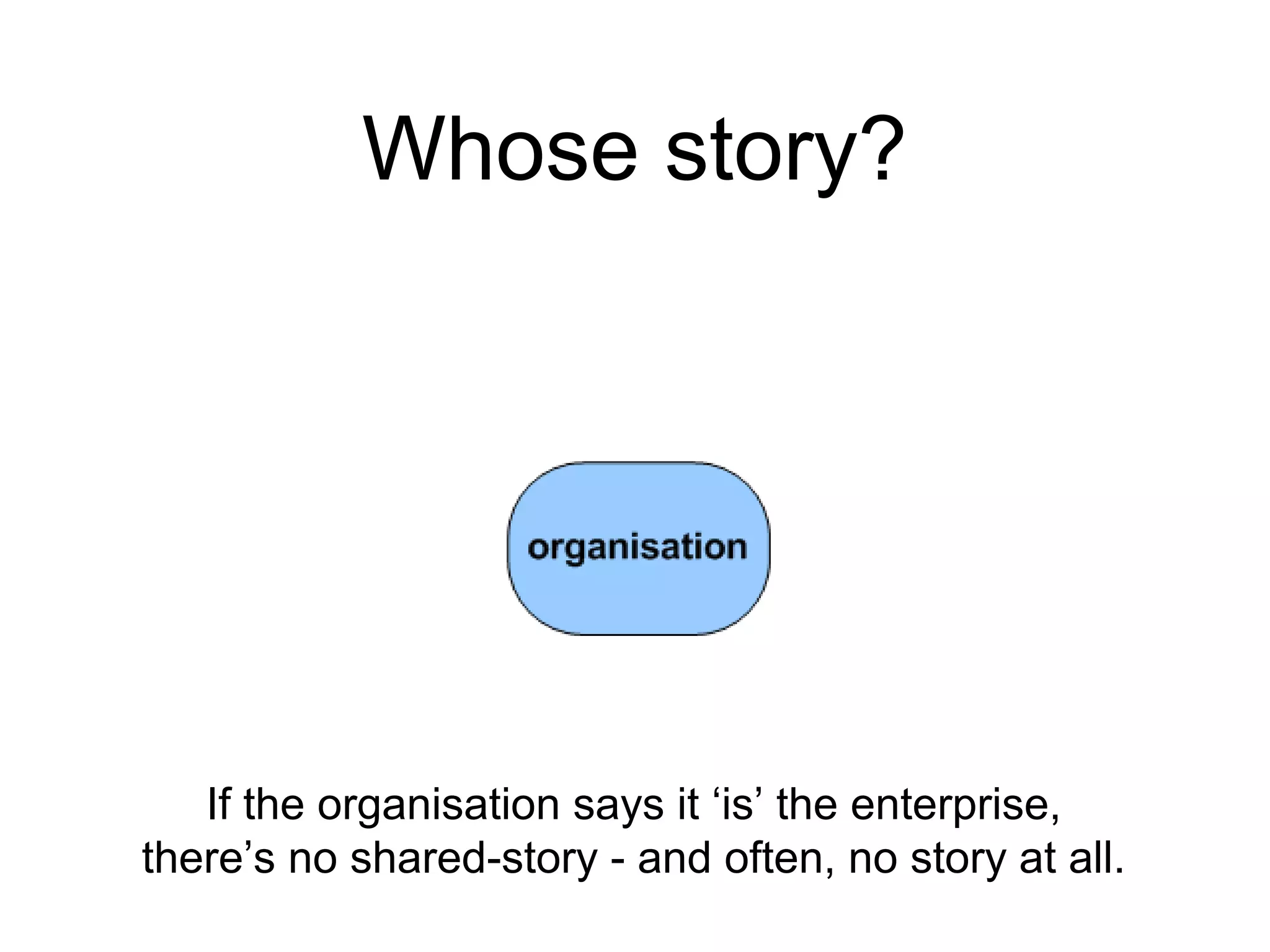
Whose story?
Whose story?
If the organisation says it ‘is’ the enterprise,
there’s no shared-story - and often, no story at all.
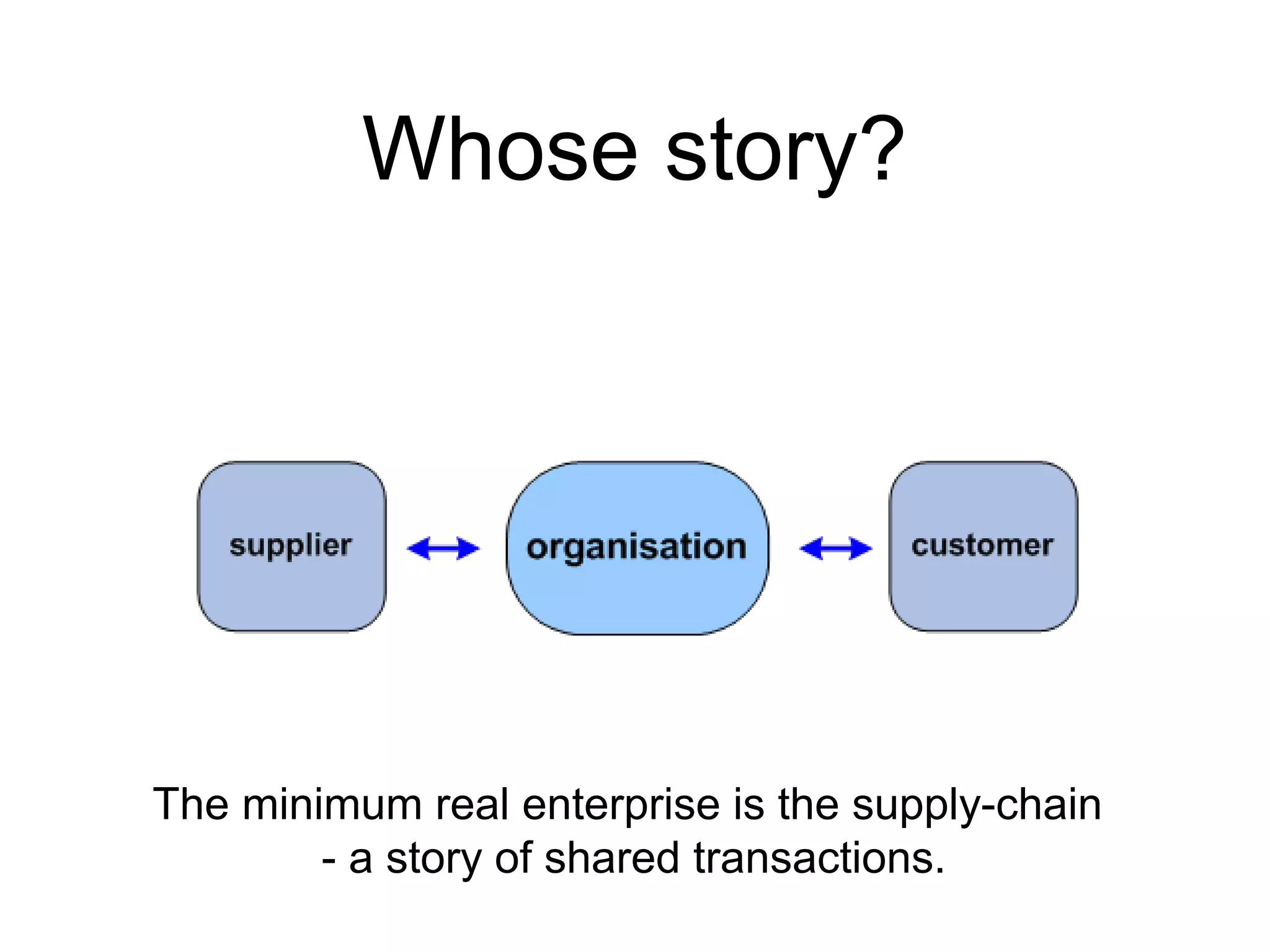
Whose story?
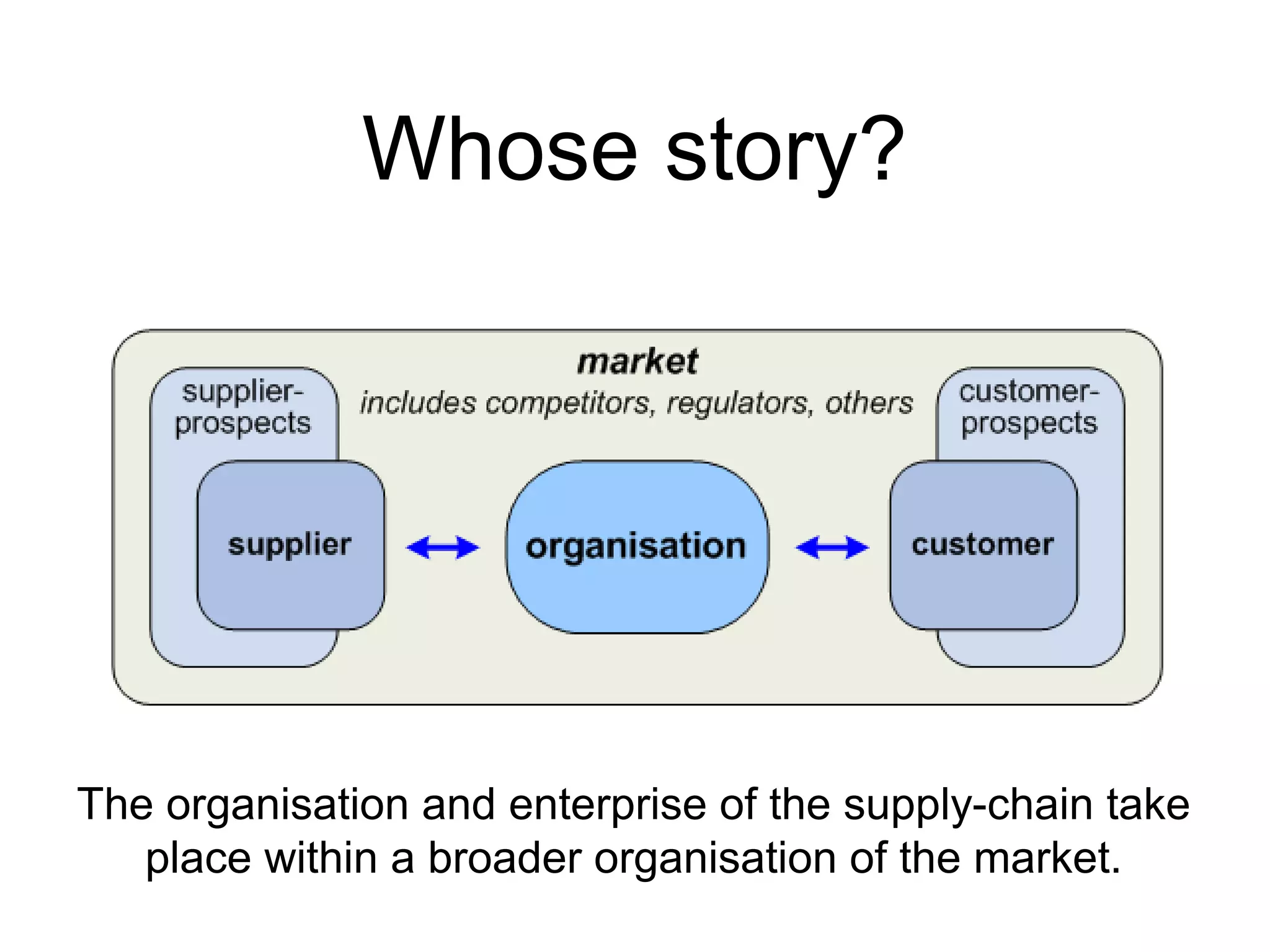
The minimum real enterprise is the supply-chain
- a story of shared transactions.
Whose story?
The organisation and enterprise of the supply-chain take
place within a broader organisation of the market.
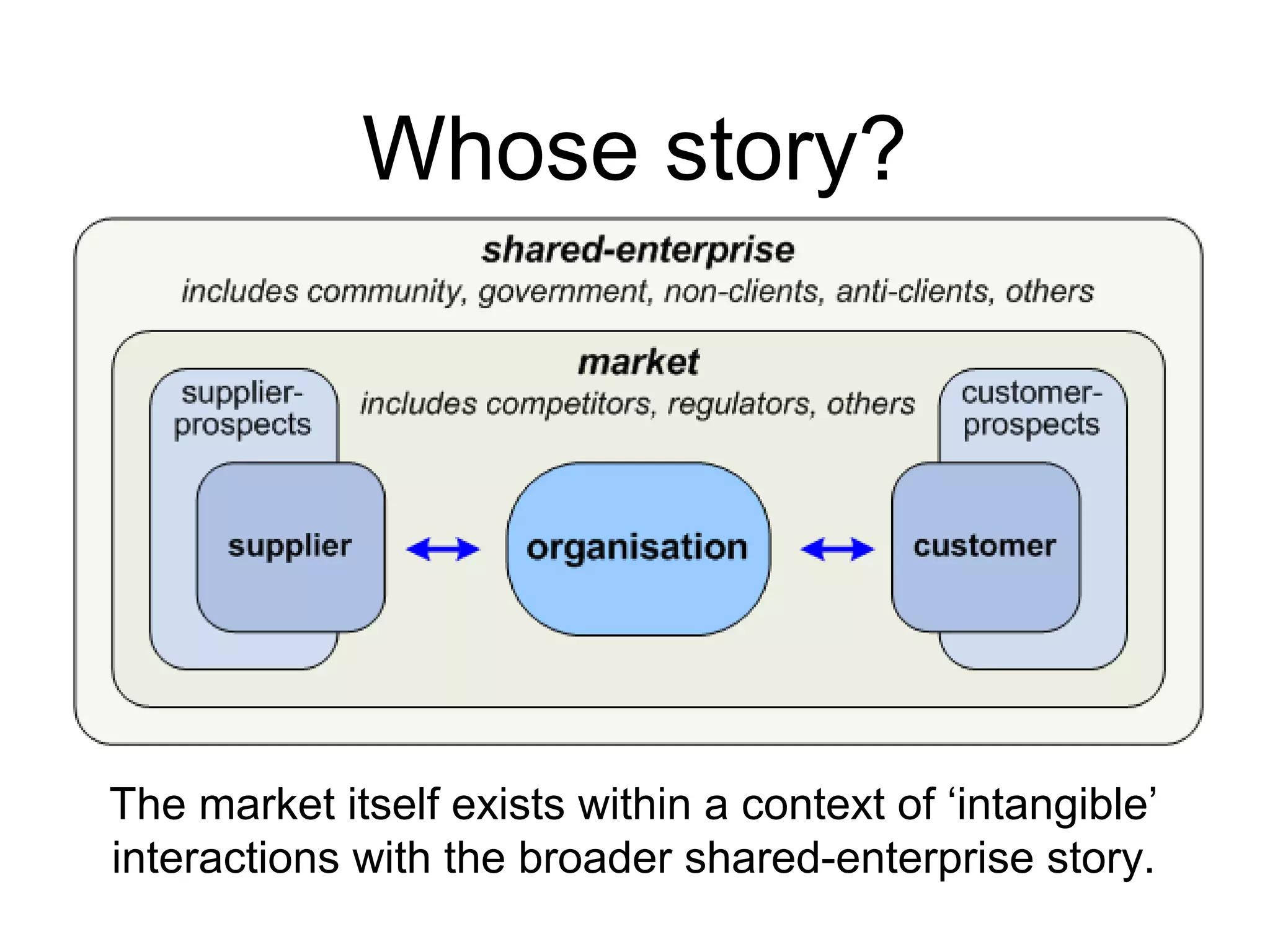
Whose story?
The market itself exists within a context of ‘intangible’
interactions with the broader shared-enterprise story.
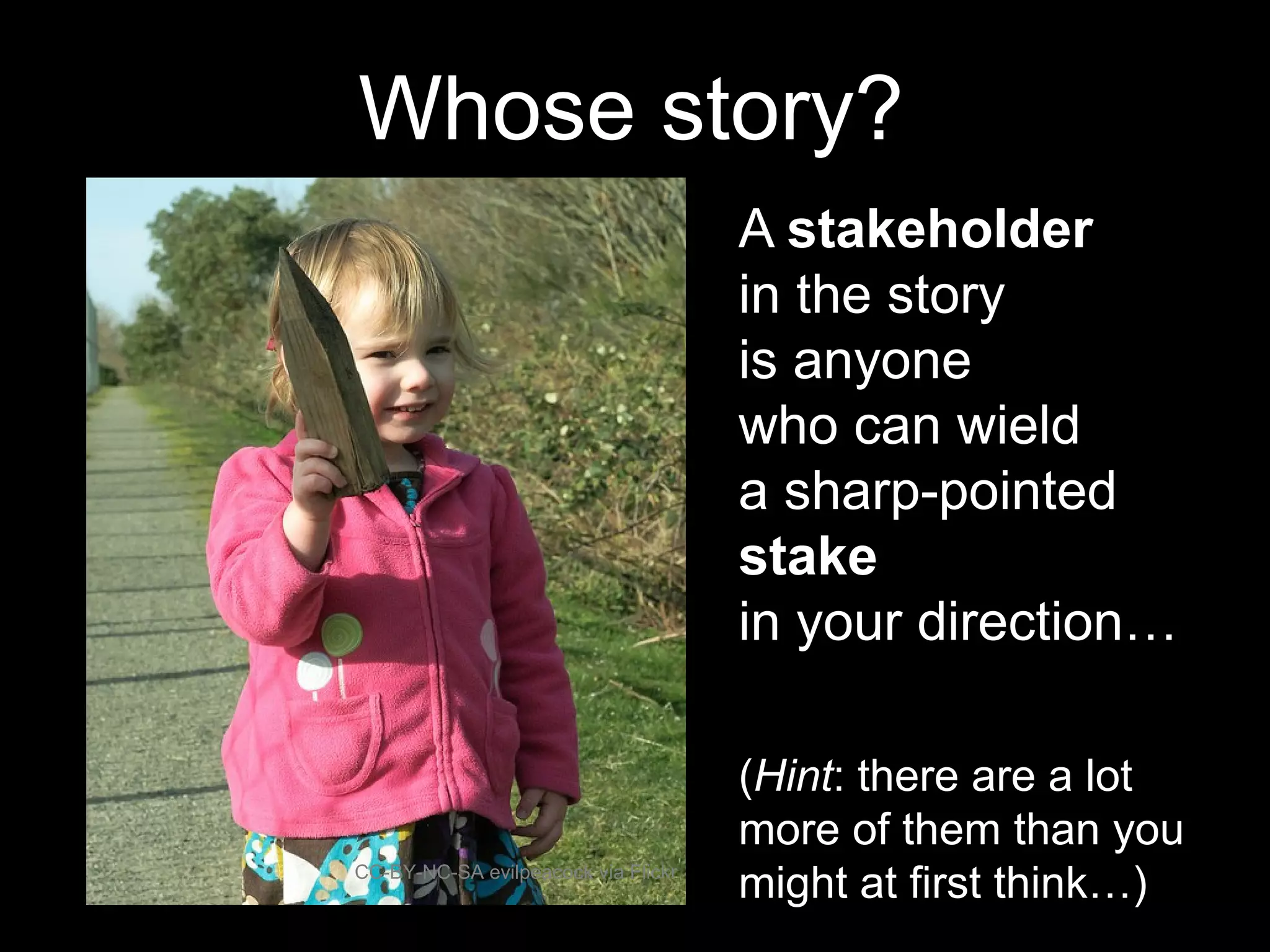
A stakeholder
in the story
is anyone
who can wield
a sharp-pointed
stake
in your direction…
CC-BY-NC-SA evilpeacock via Flickr
Whose story?
(Hint: there are a lot
more of them than you
might at first think…)
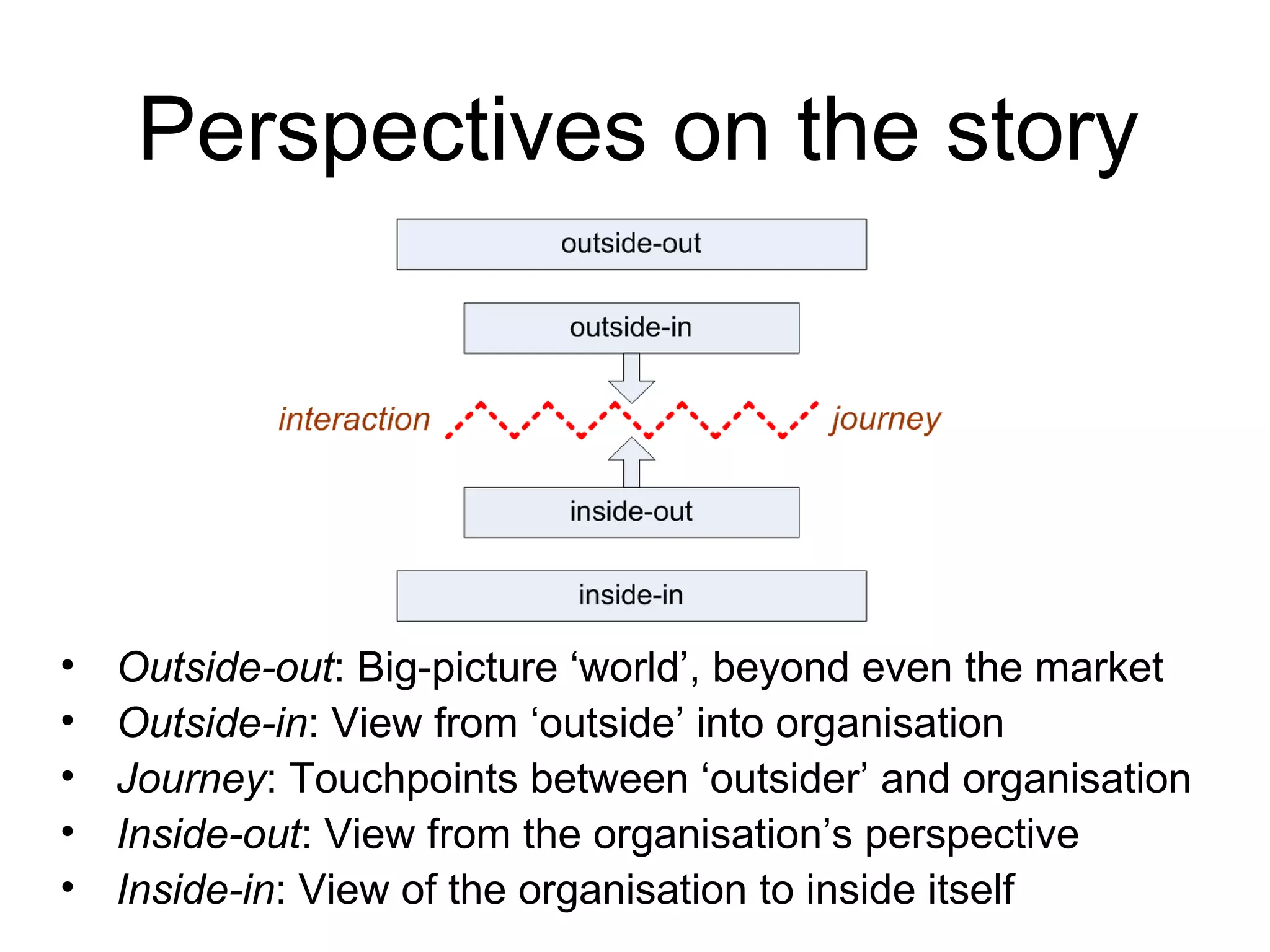
Perspectives on the story
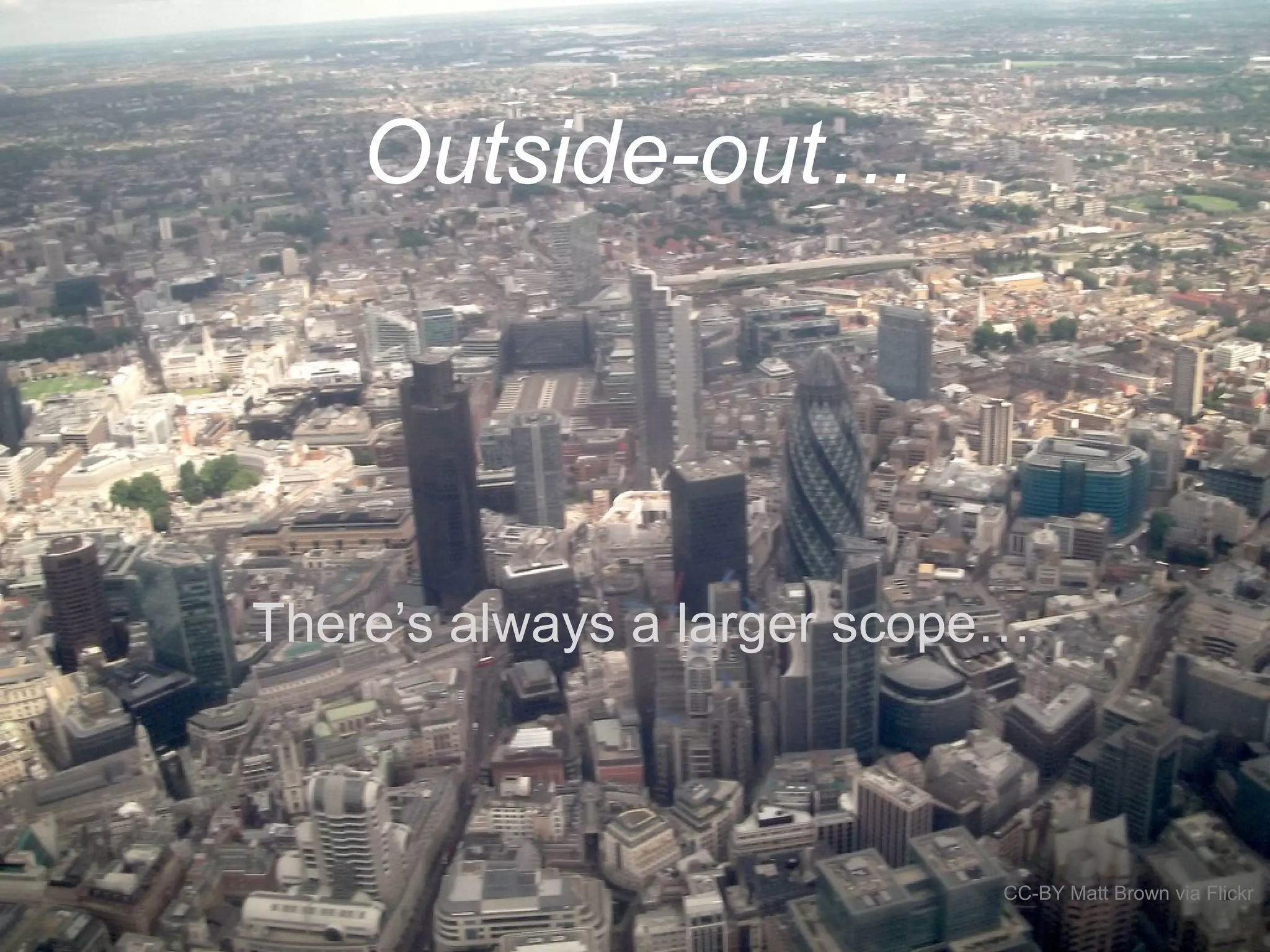
• Outside-out: Big-picture ‘world’, beyond even the market
• Outside-in: View from ‘outside’ into organisation
• Journey: Touchpoints between ‘outsider’ and organisation
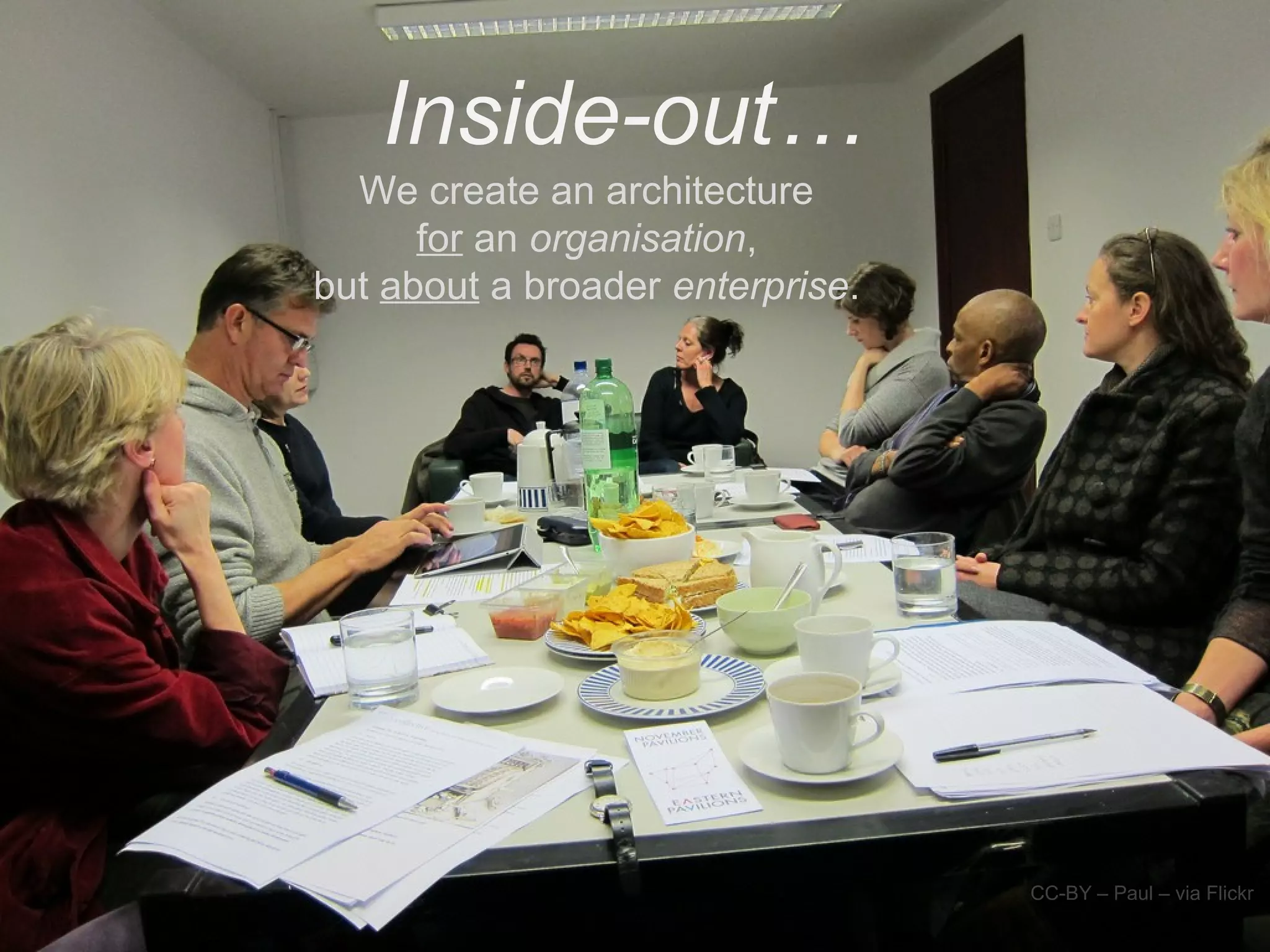
• Inside-out: View from the organisation’s perspective
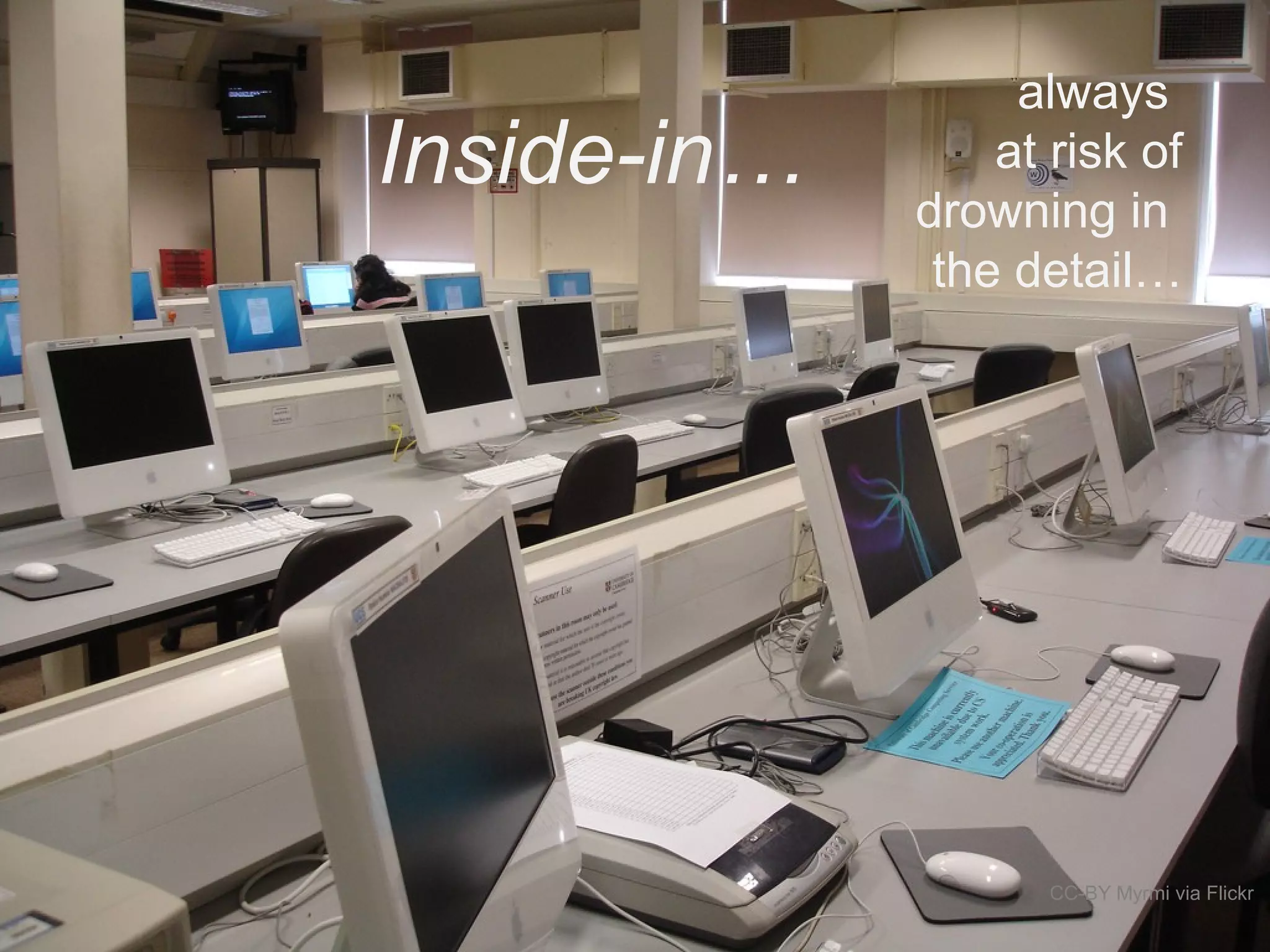
• Inside-in: View of the organisation to inside itself
Inside-in…
CC-BY Myrmi via Flickr
always
at risk of
drowning in
the detail…
Inside-out…
CC-BY – Paul – via Flickr
We create an architecture
for an organisation,
but about a broader enterprise.
Outside-in…
CC-BY Fretro via Flickr
“Customers
do not appear
in our processes,
we appear in
their experiences.”
Chris Potts, recrEAtion, Technics, 2010
CC-BY Matt Brown via Flickr
Outside-out…
There’s always a larger scope…
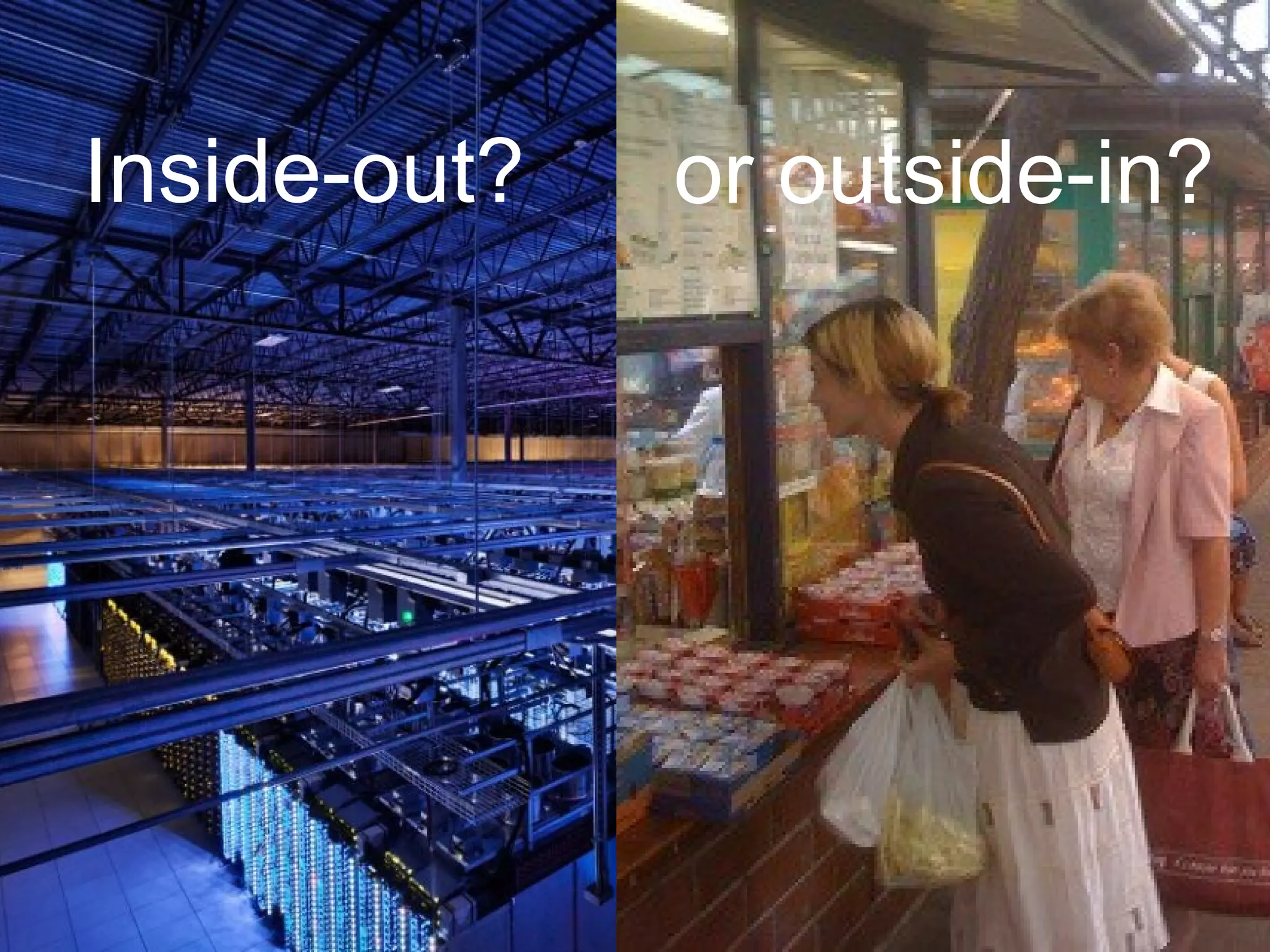
Inside-out? or outside-in?
“What’s the story?”
“A cast of thousands!”
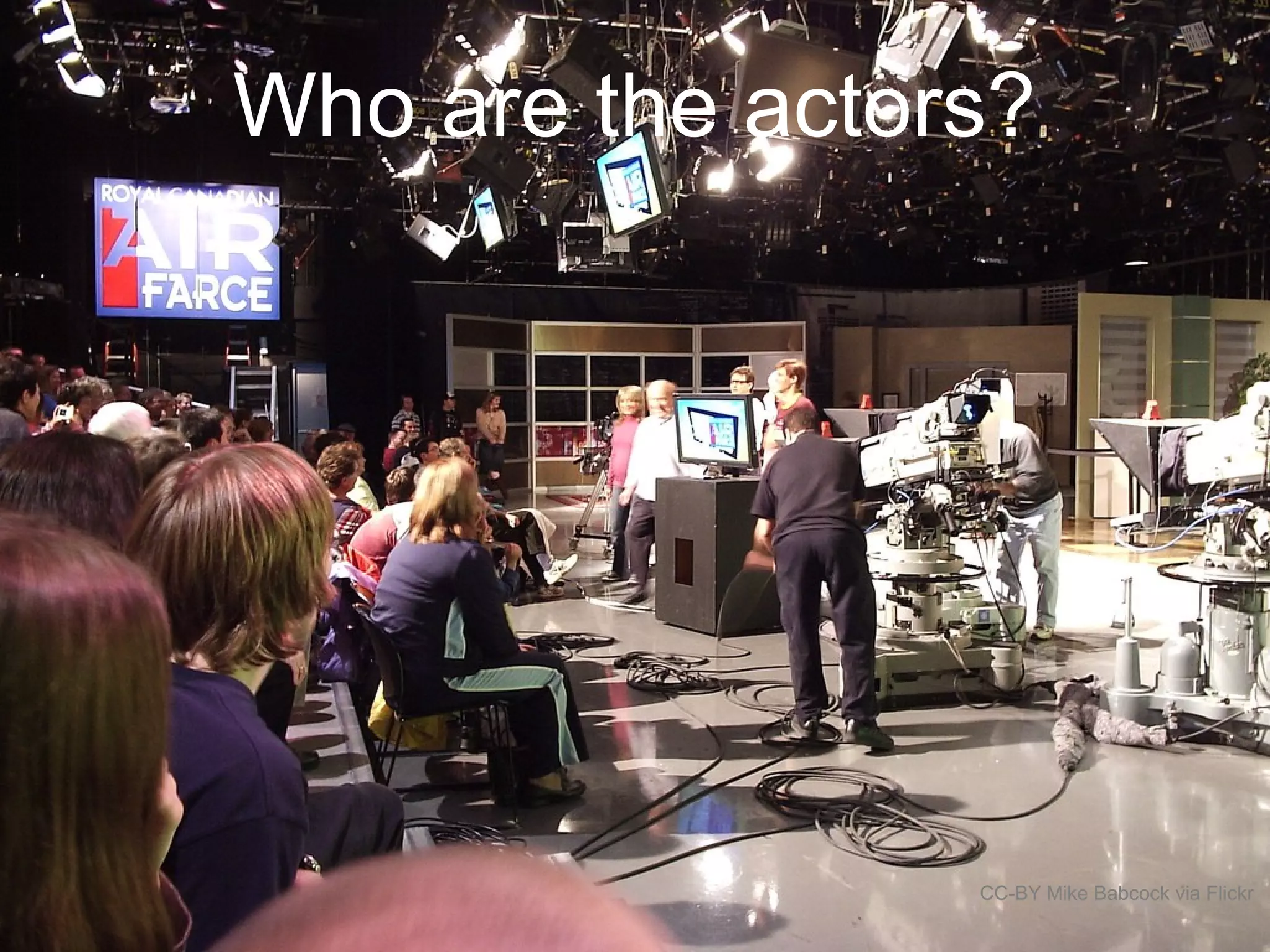
Who are the actors?
CC-BY Mike Babcock via Flickr
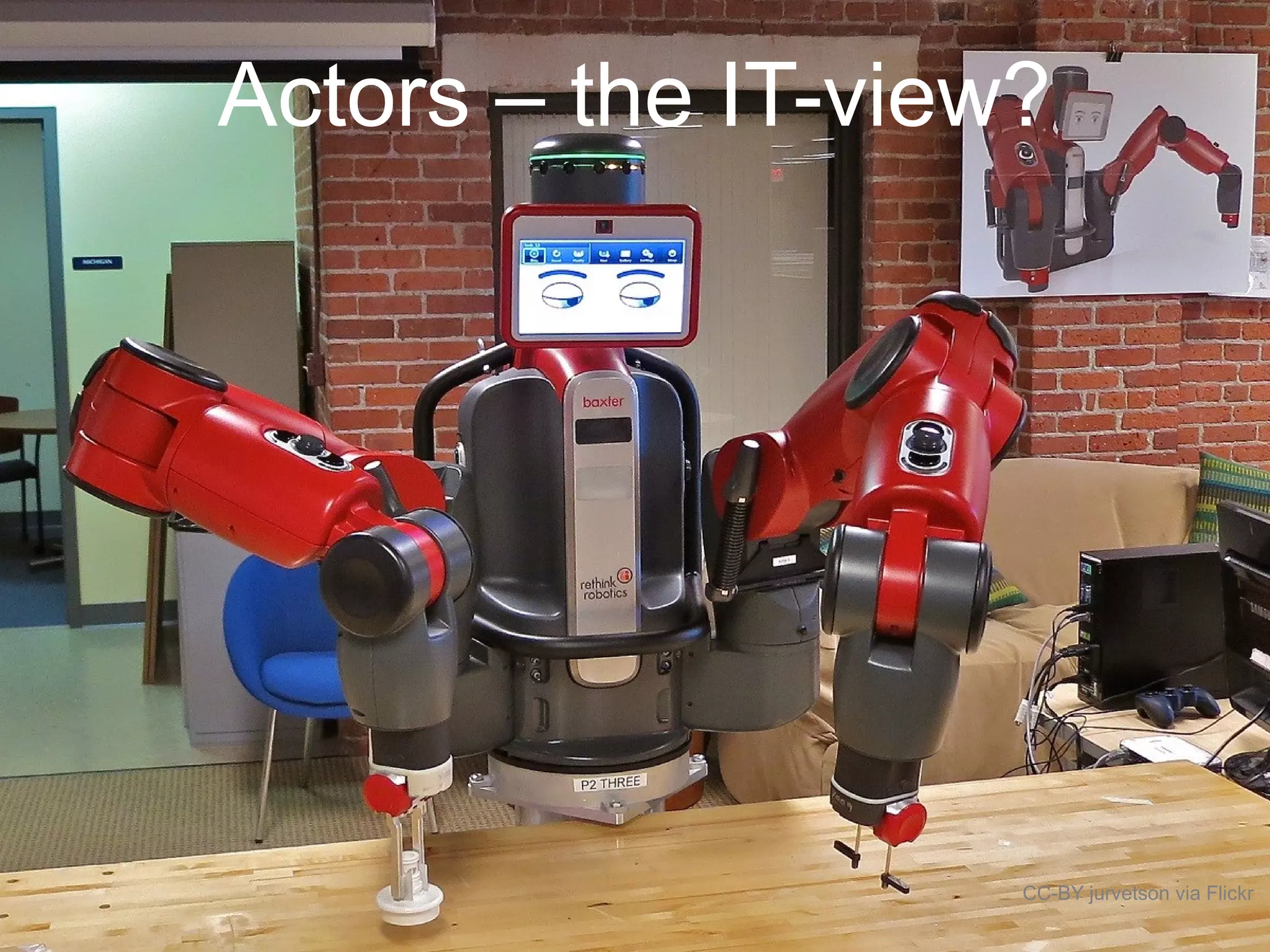
Actors – the IT-view?
CC-BY jurvetson via Flickr
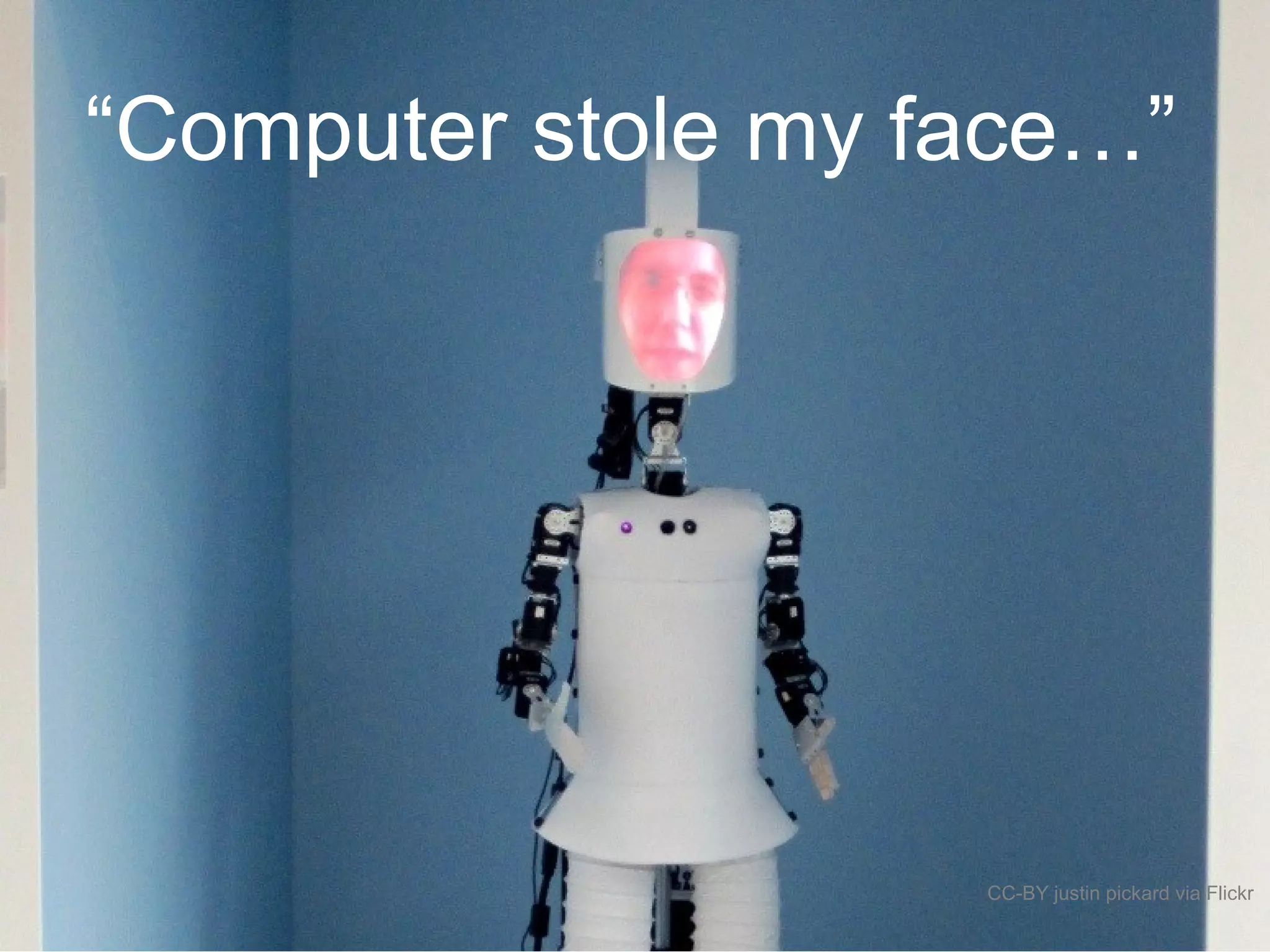
“Computer stole my face…”
CC-BY justin pickard via Flickr
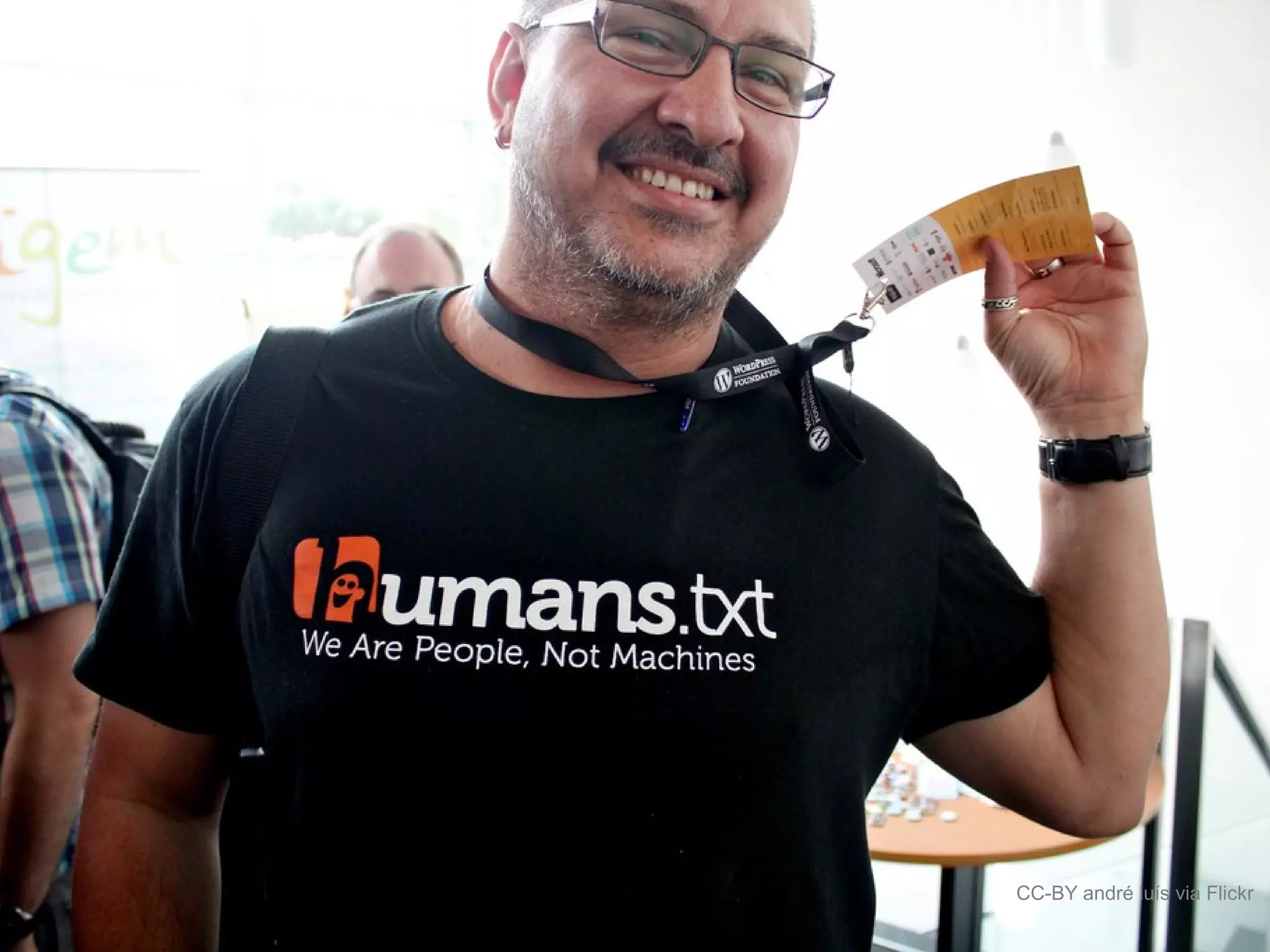
A human view
CC-BY andré luís via Flickr
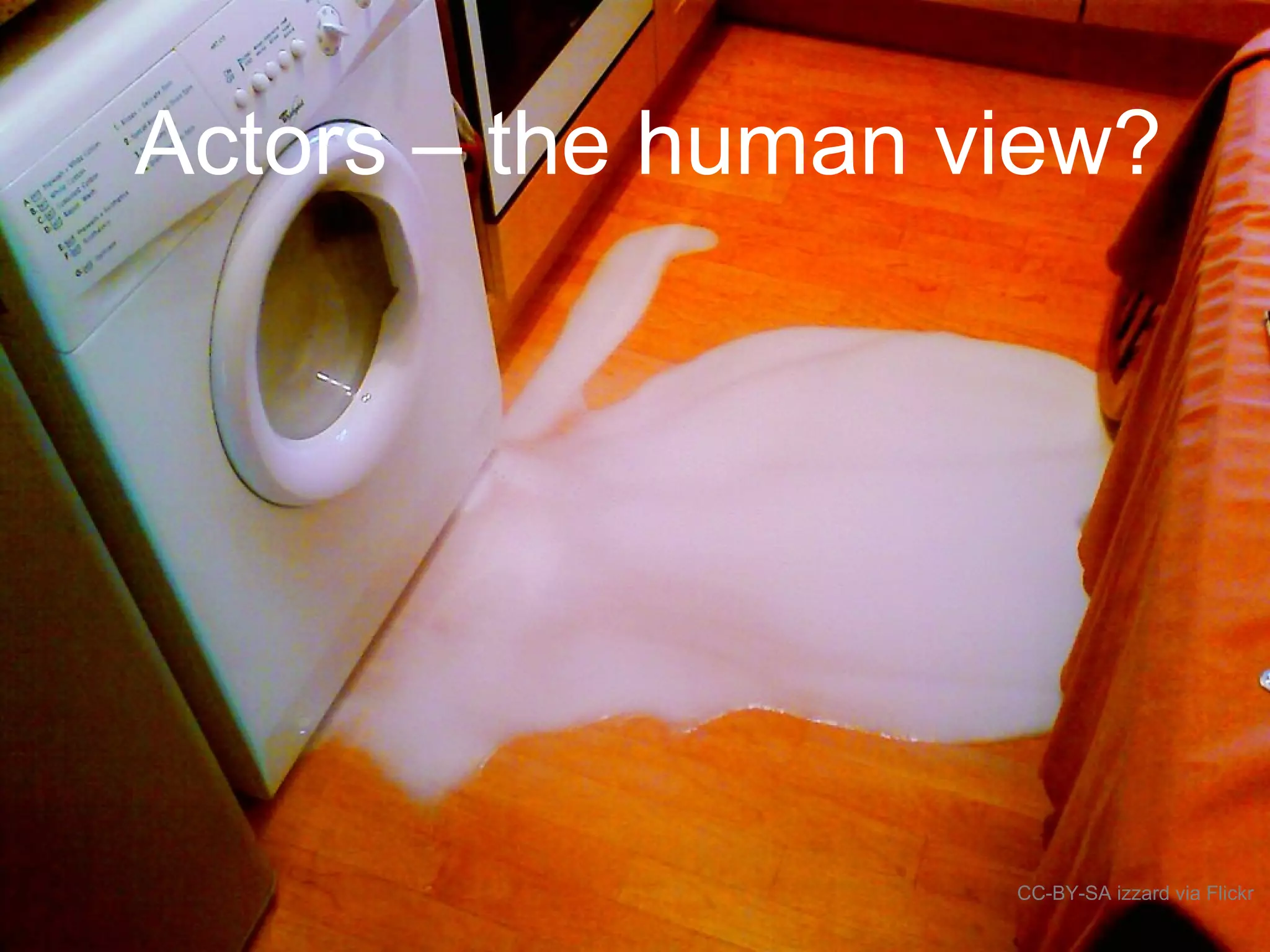
Actors – the human view?
CC-BY-SA izzard via Flickr
How we really think…
CC-BY Brett Jordan via Flickr
“What’s the story?”
“What’s the story?”
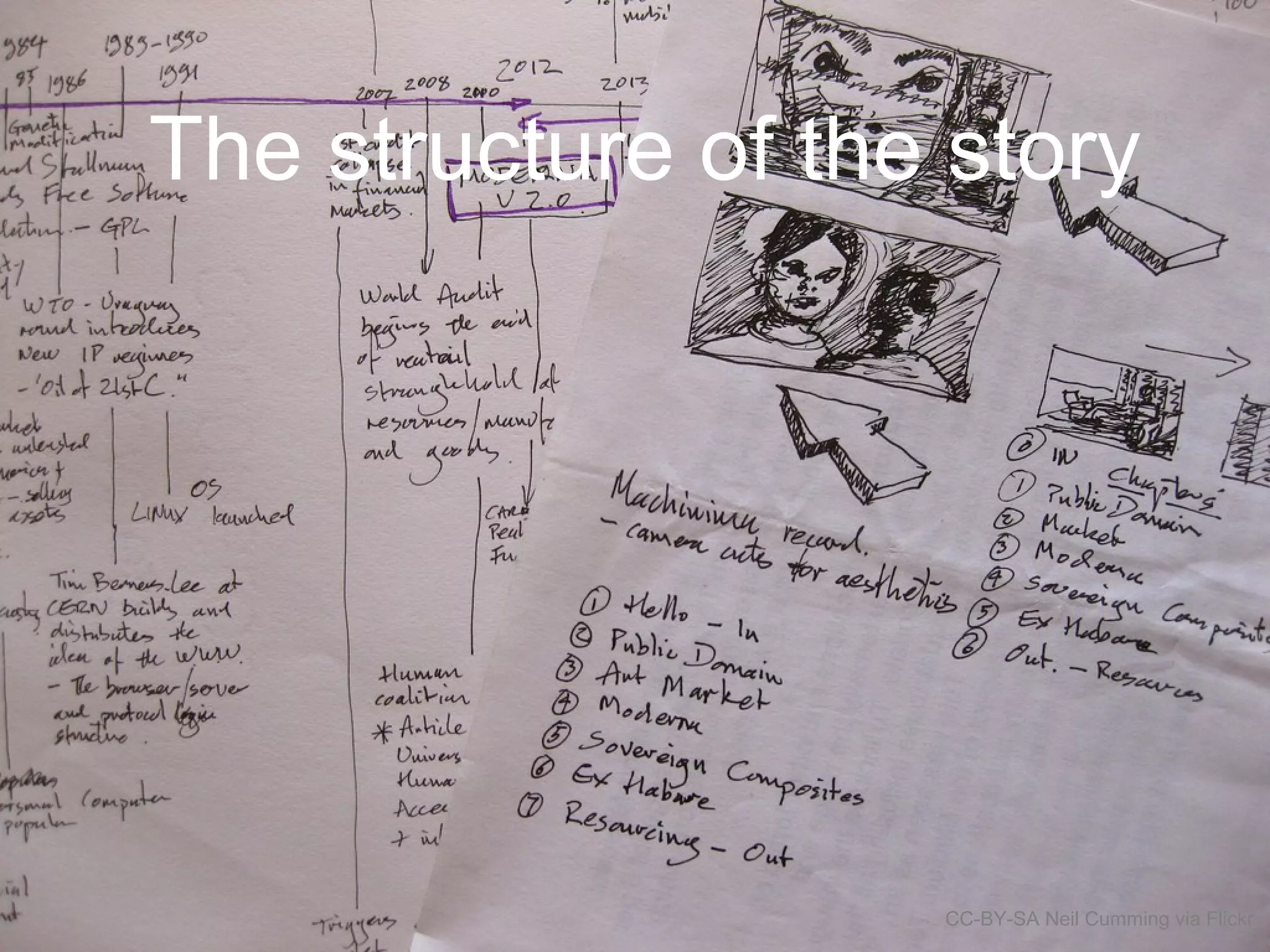
The structure of the story
CC-BY-SA Neil Cumming via Flickr
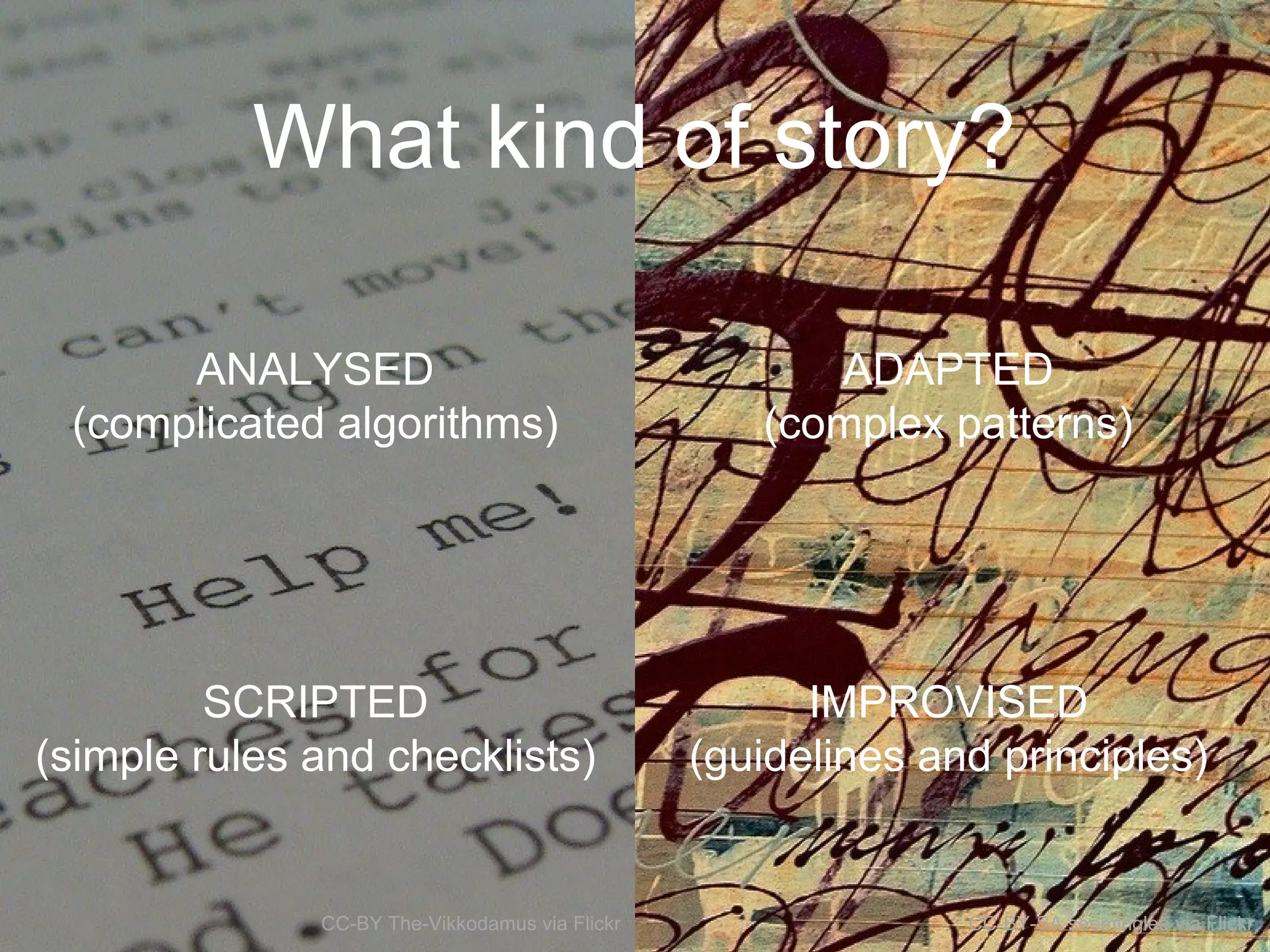
What kind of story?
SCRIPTED
(simple rules and checklists)
CC-BY The-Vikkodamus via Flickr CC-BY-SA seeminglee via Flickr
IMPROVISED
(guidelines and principles)
ANALYSED
(complicated algorithms)
ADAPTED
(complex patterns)
“Each traverse through
a business-process
is a self-contained story
with its own actors, actions
and events”
Tom Graves, The Enterprise As Story, Tetradian, 2012
Process as story
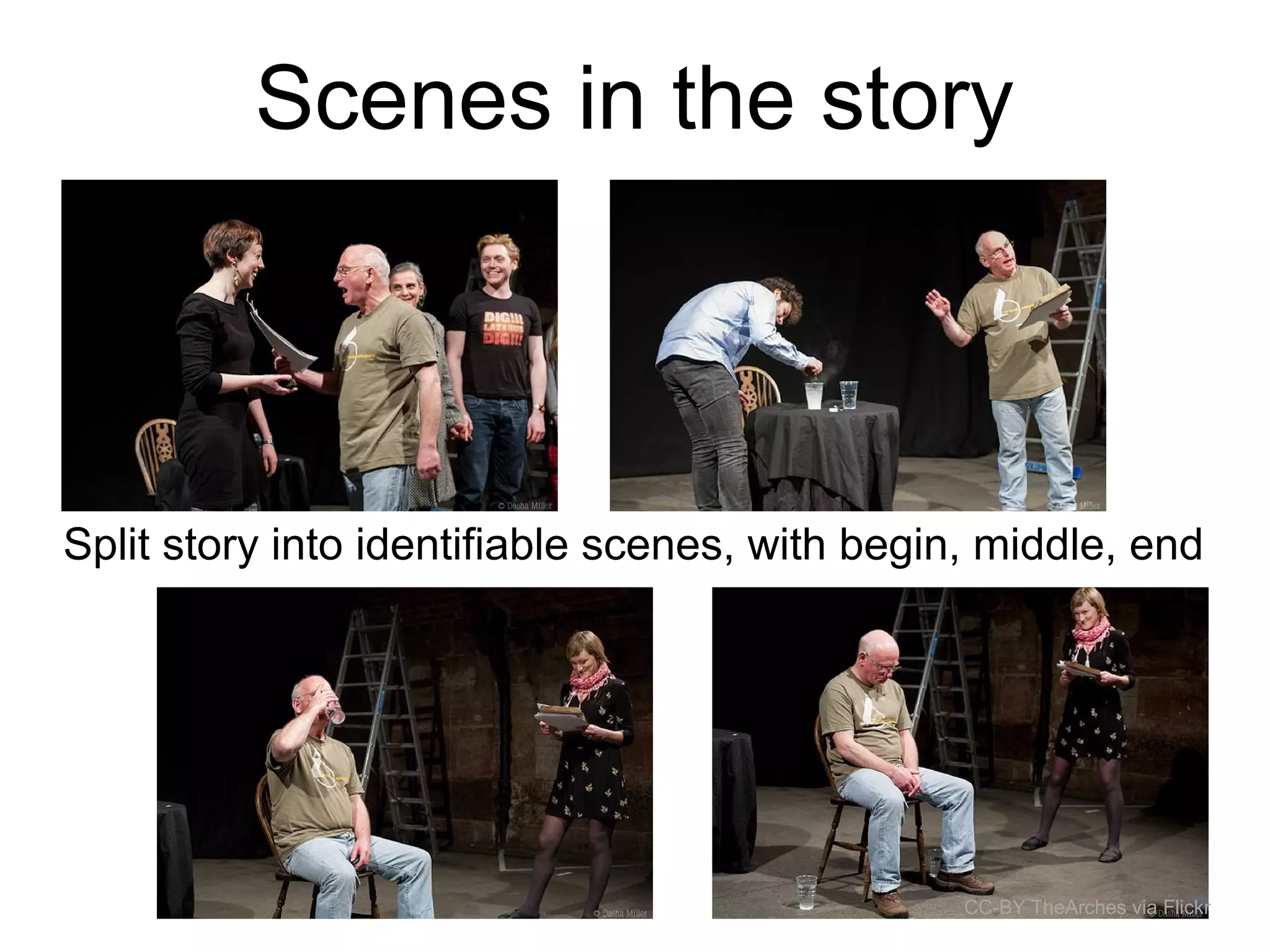
Scenes in the story
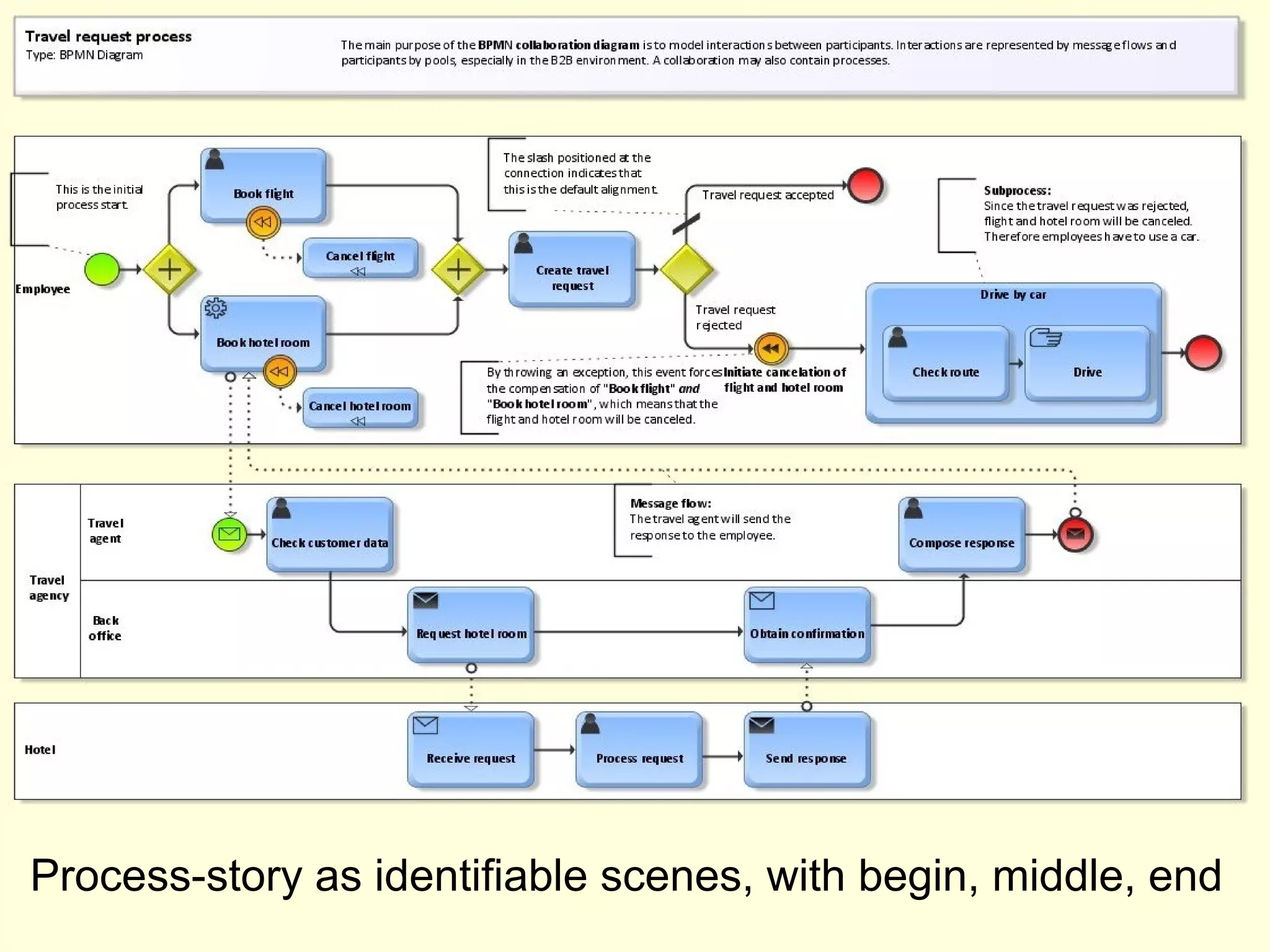
Split story into identifiable scenes, with begin, middle, end
CC-BY TheArches via Flickr
Scenes in the story
Process-story as identifiable scenes, with begin, middle, end
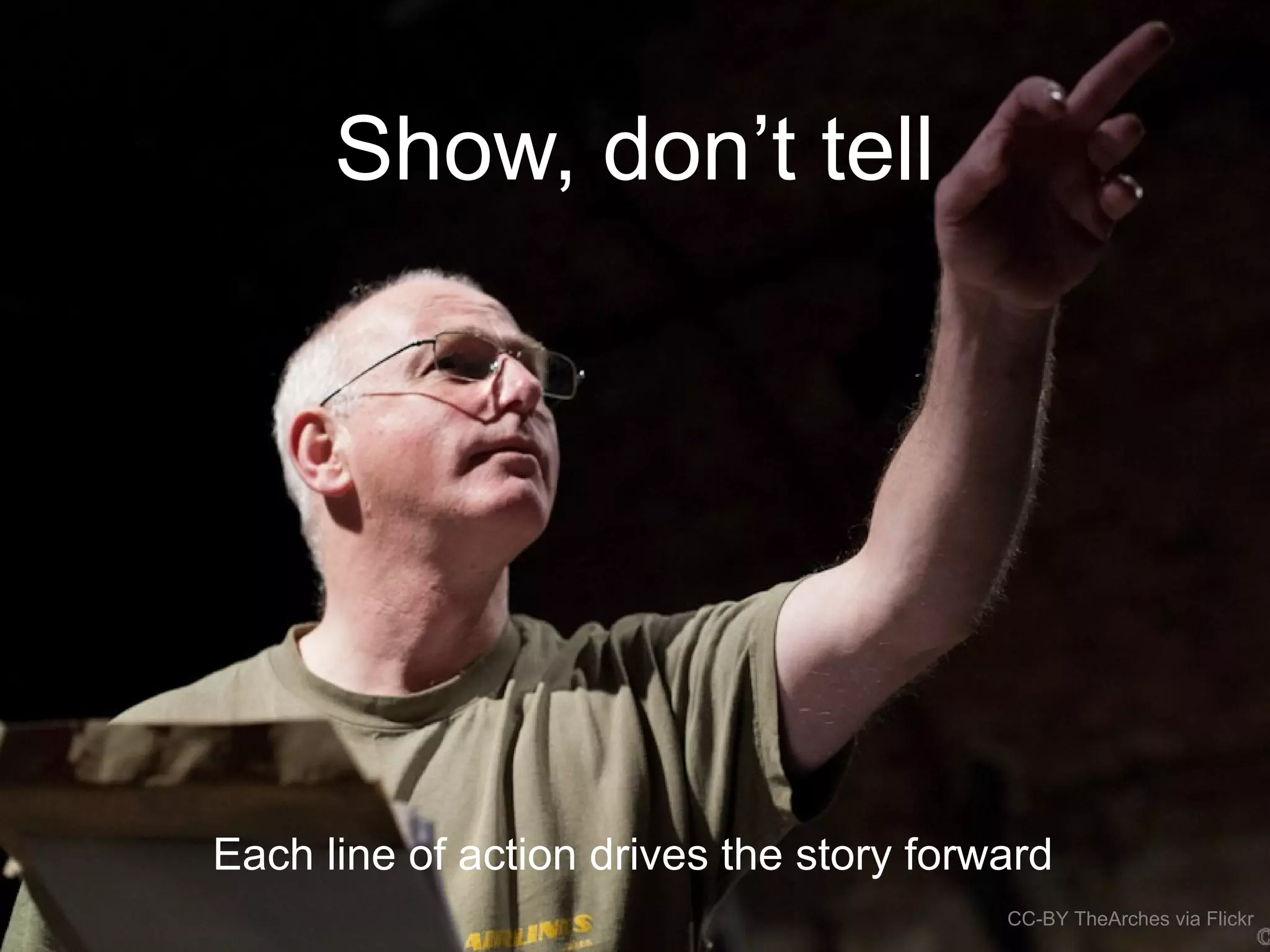
Show, don’t tell
Each line of action drives the story forward
CC-BY TheArches via Flickr
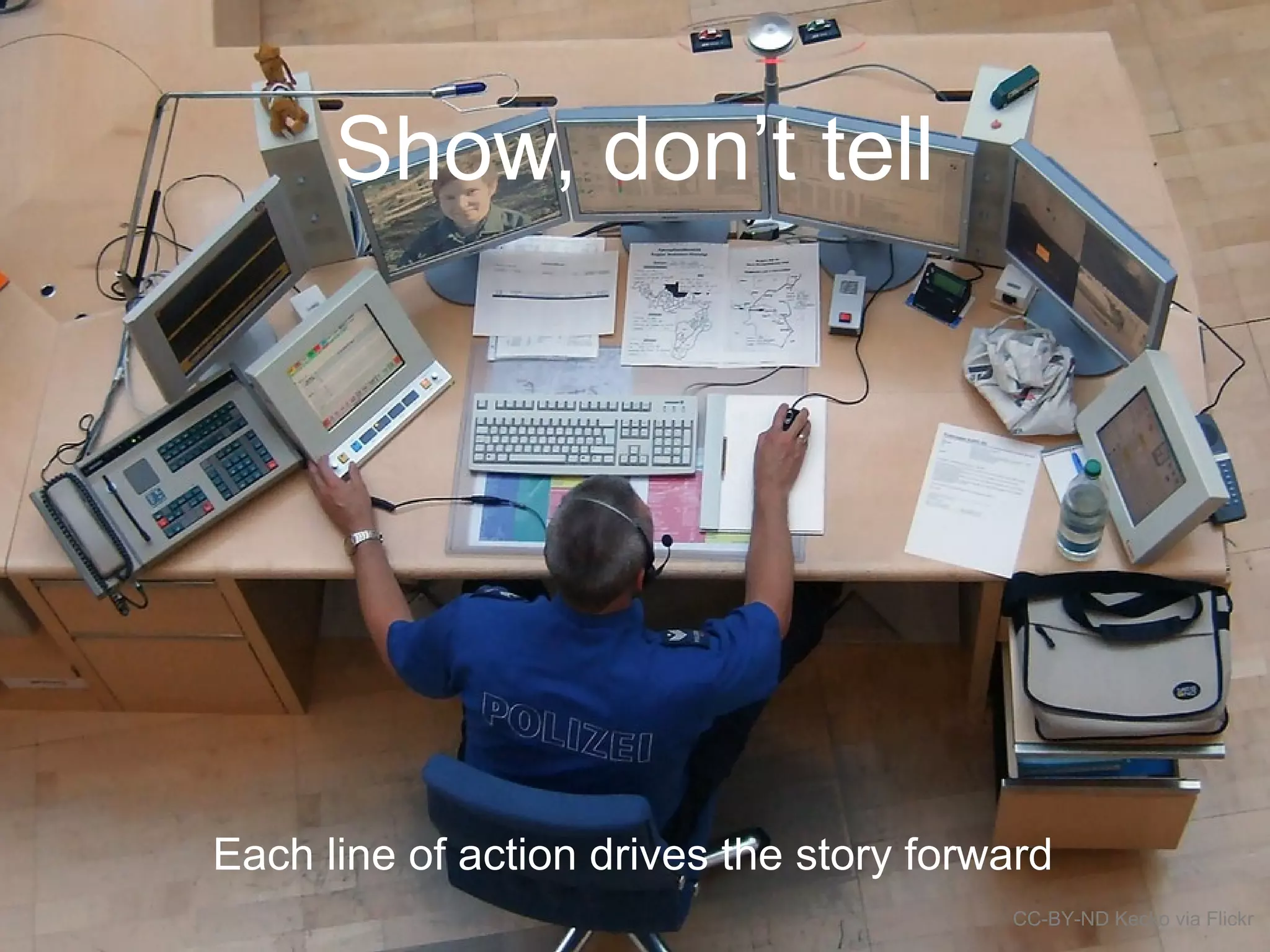
Show, don’t tell
Each line of action drives the story forward
CC-BY-ND Kecko via Flickr
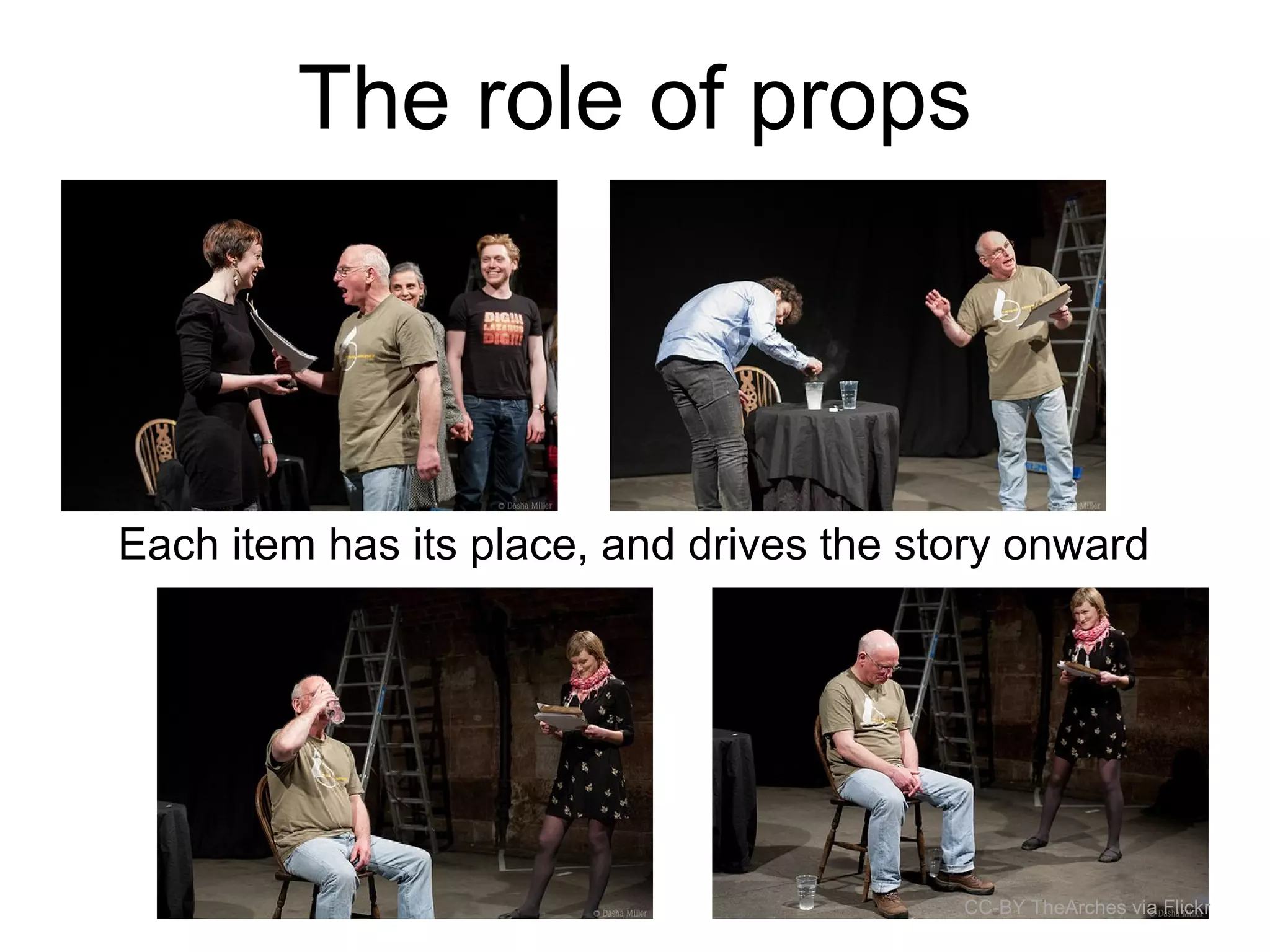
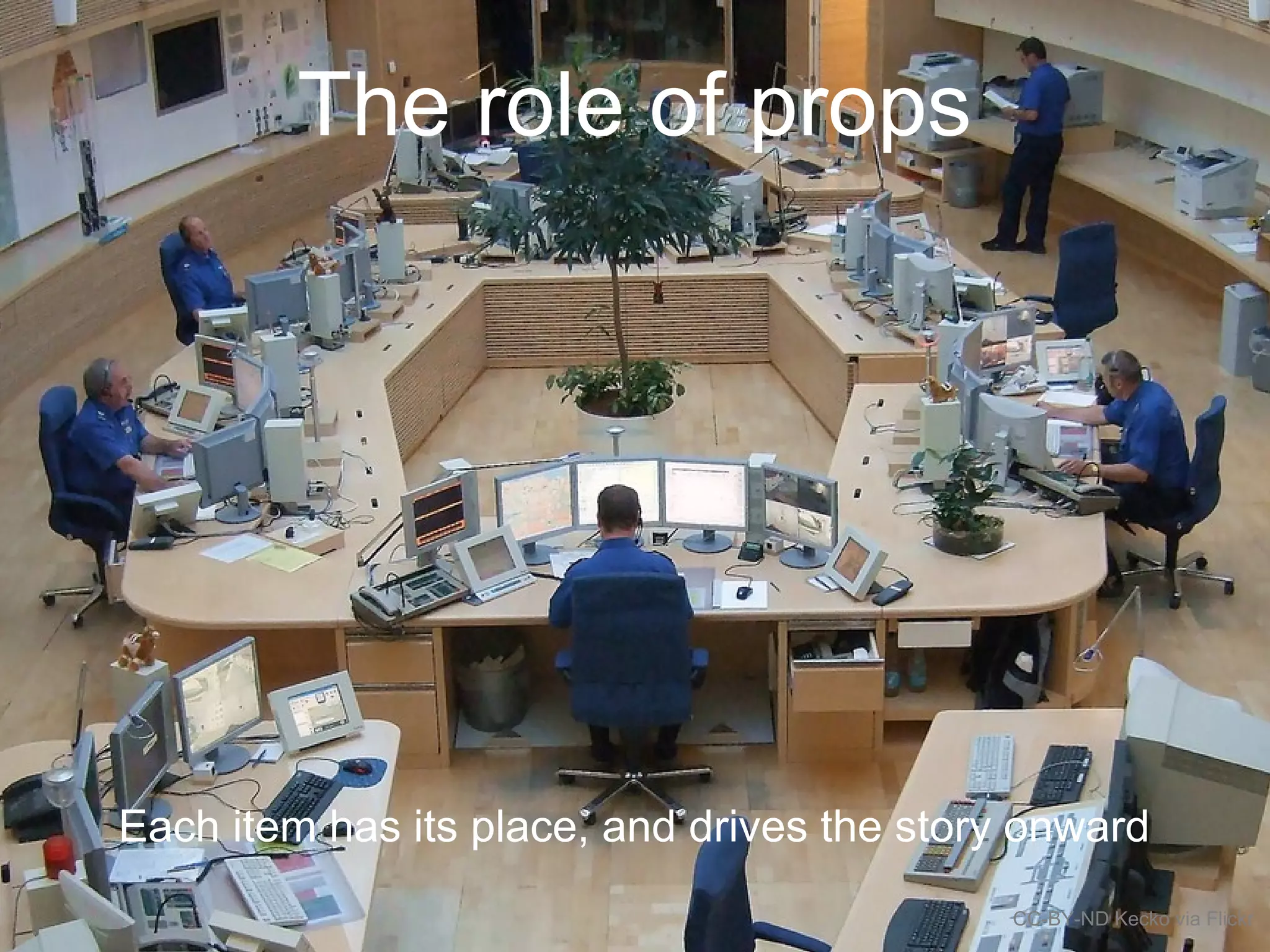
The role of props
Each item has its place, and drives the story onward
CC-BY TheArches via Flickr
Each item has its place, and drives the story onward
CC-BY-ND Kecko via Flickr
The role of props
“What’s the stage
for the story?”
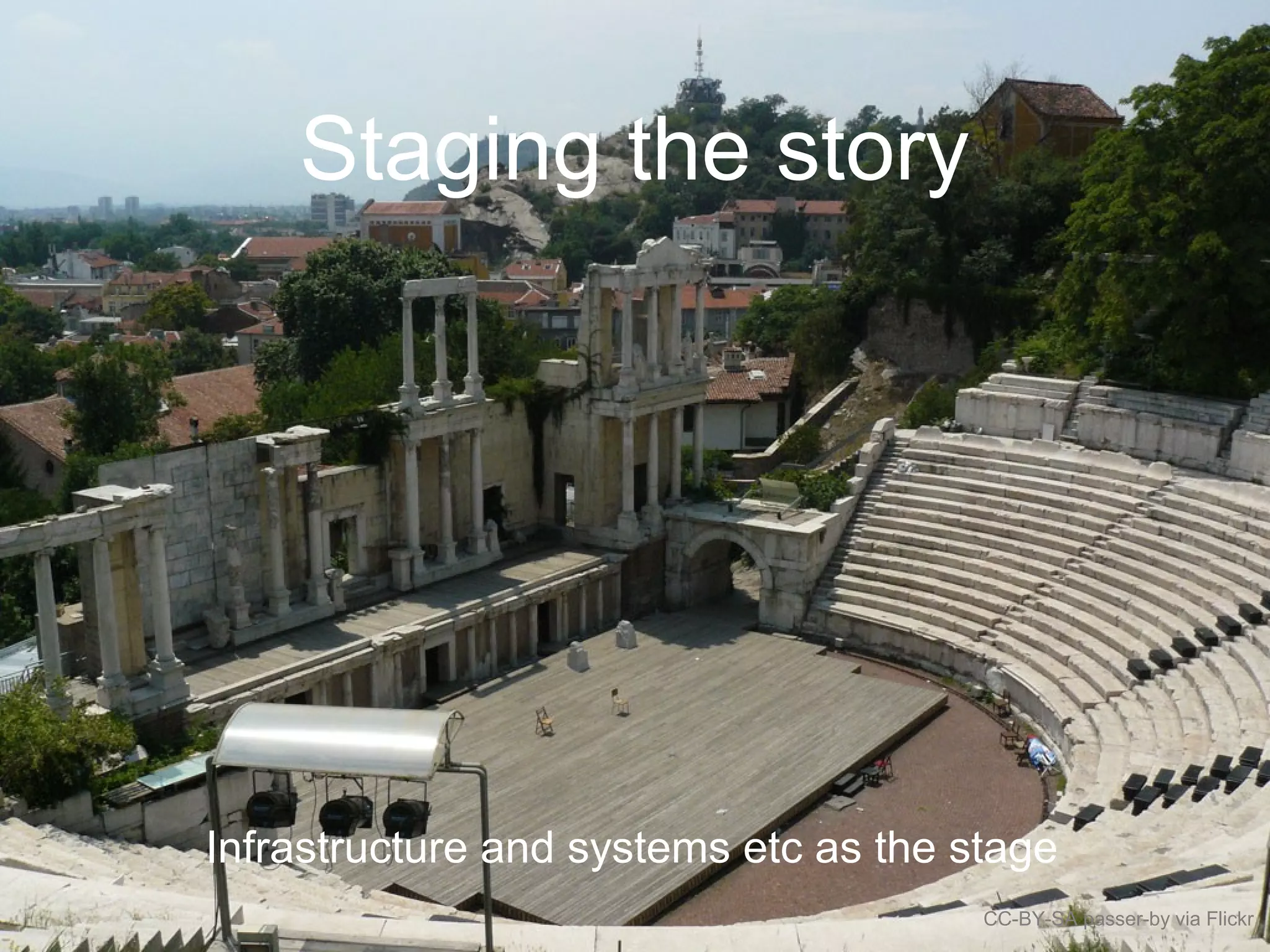
Staging the story
CC-BY-SA passer-by via Flickr
Infrastructure and systems etc as the stage
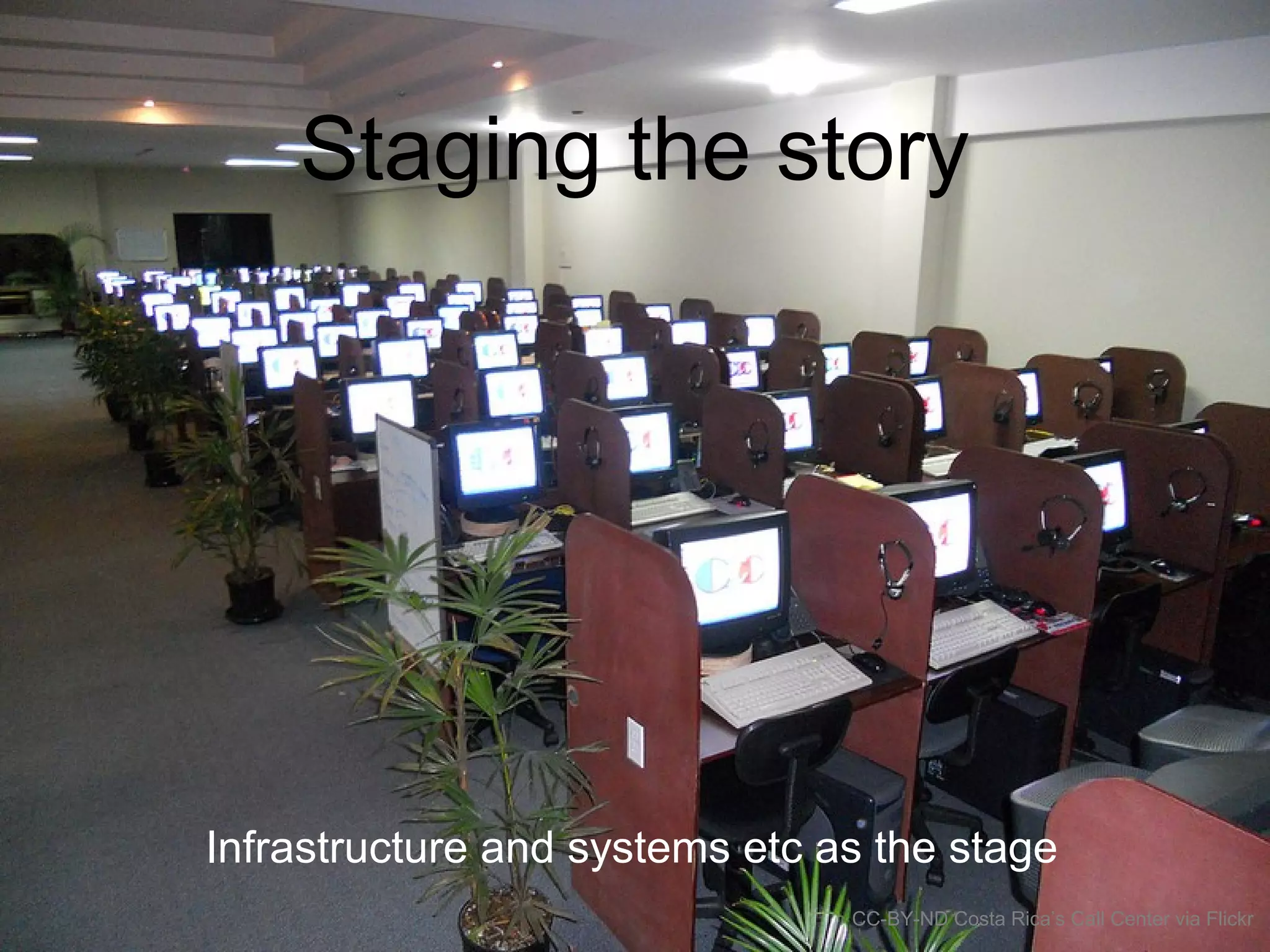
Staging the story
Infrastructure and systems etc as the stage
CC-BY-ND Costa Rica’s Call Center via Flickr
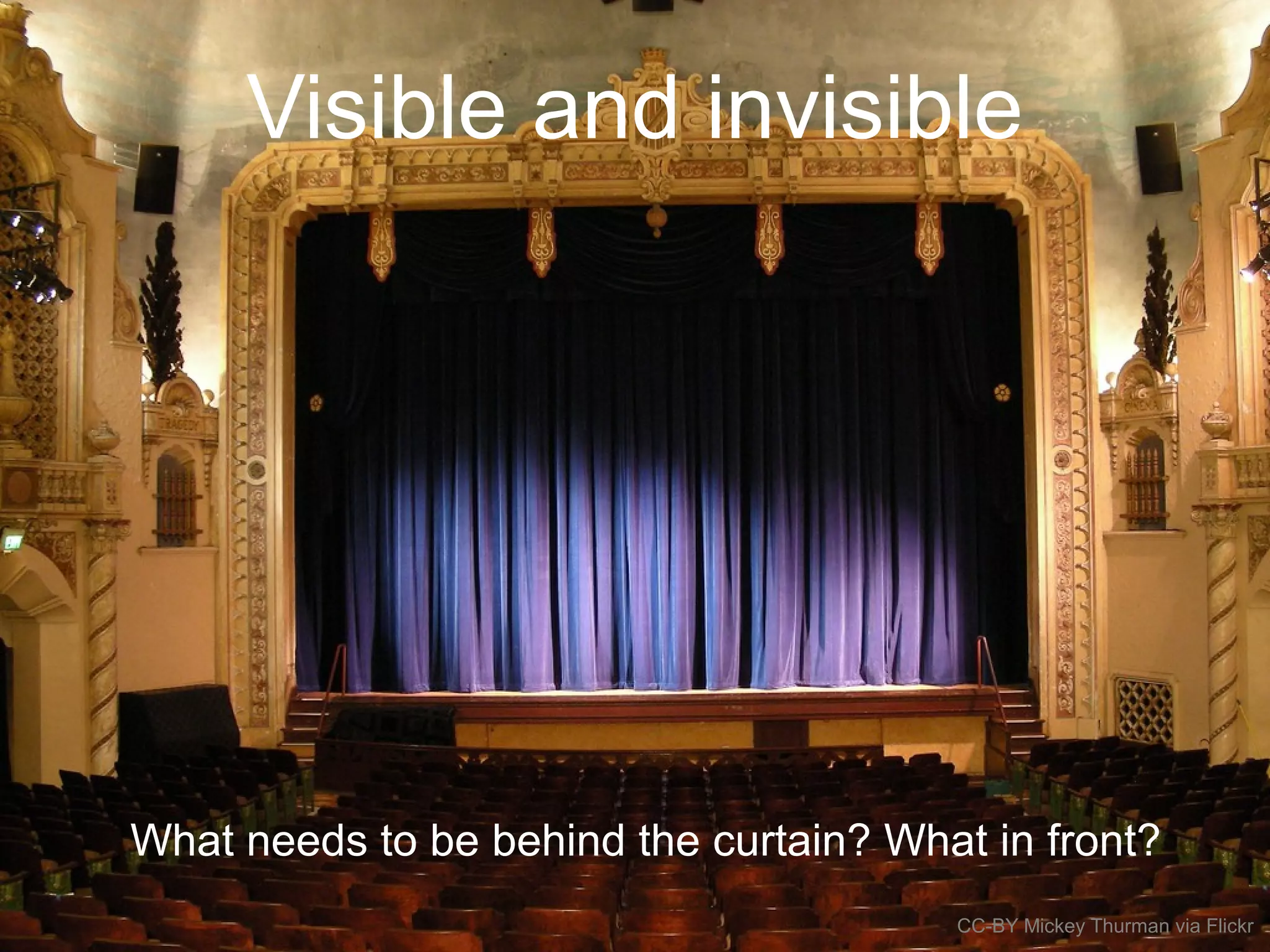
Visible and invisible
What needs to be behind the curtain? What in front?
CC-BY Mickey Thurman via Flickr
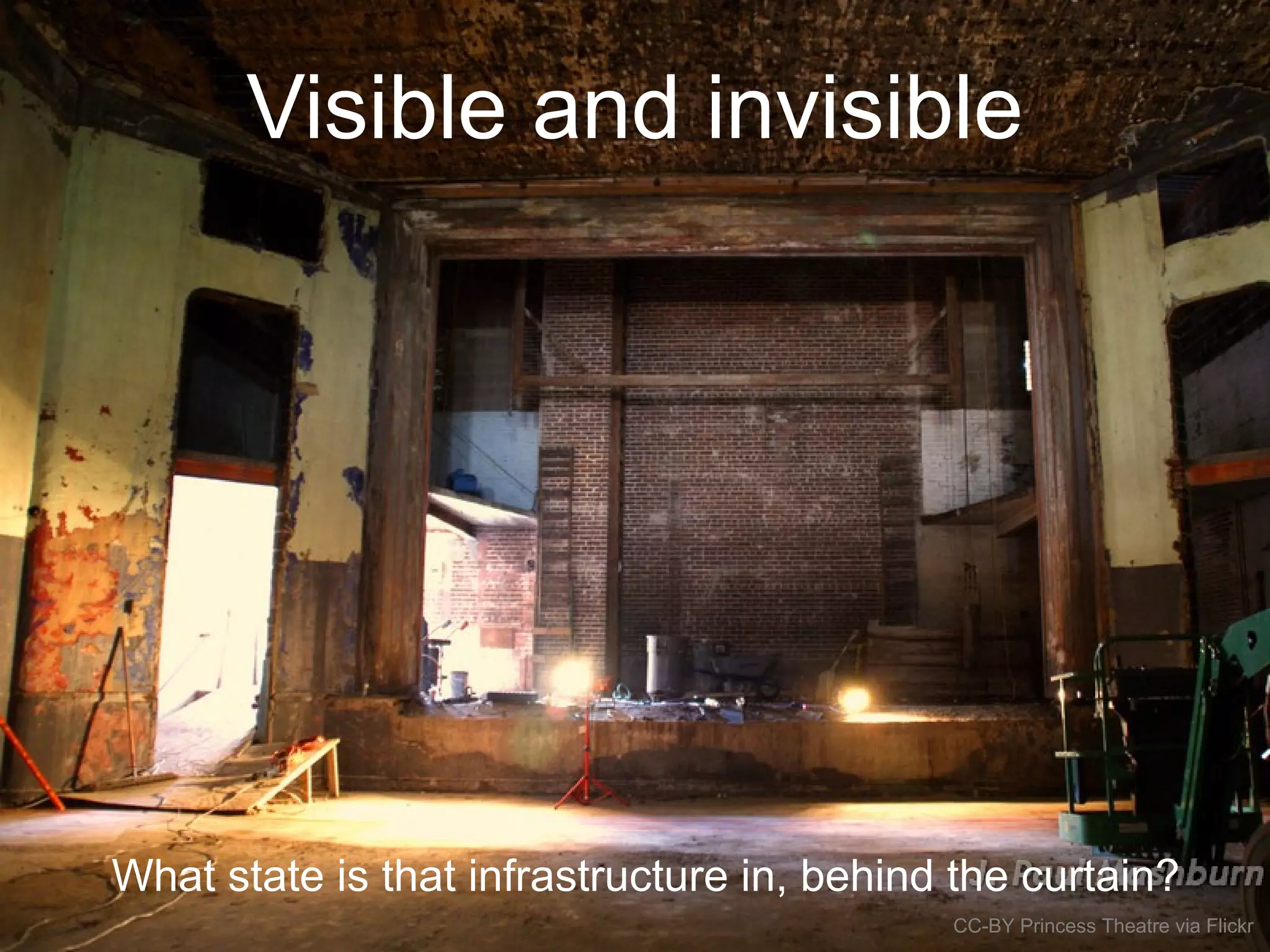
Visible and invisible
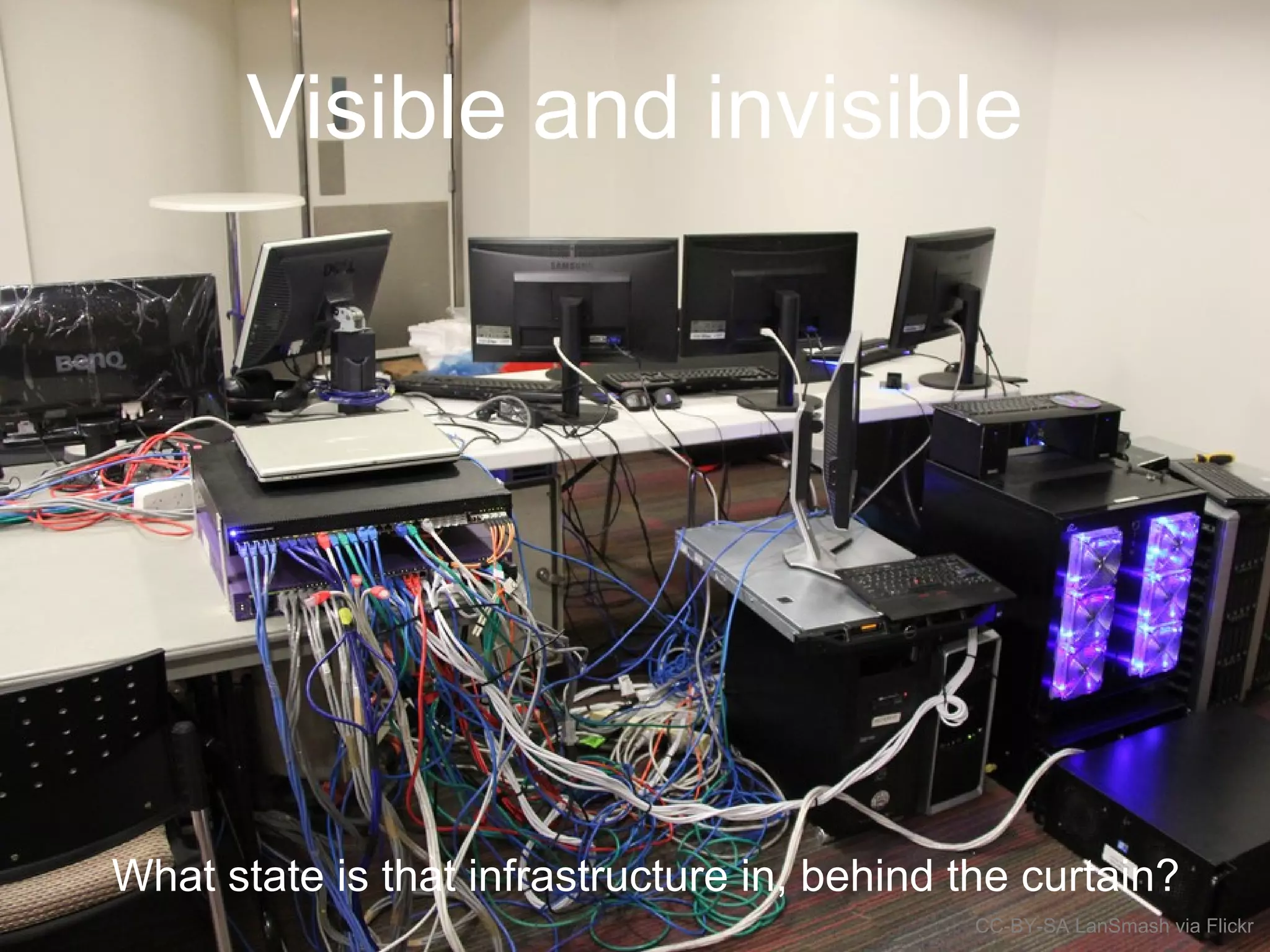
What state is that infrastructure in, behind the curtain?
CC-BY Princess Theatre via Flickr
Visible and invisible
What state is that infrastructure in, behind the curtain?
CC-BY-SA LanSmash via Flickr
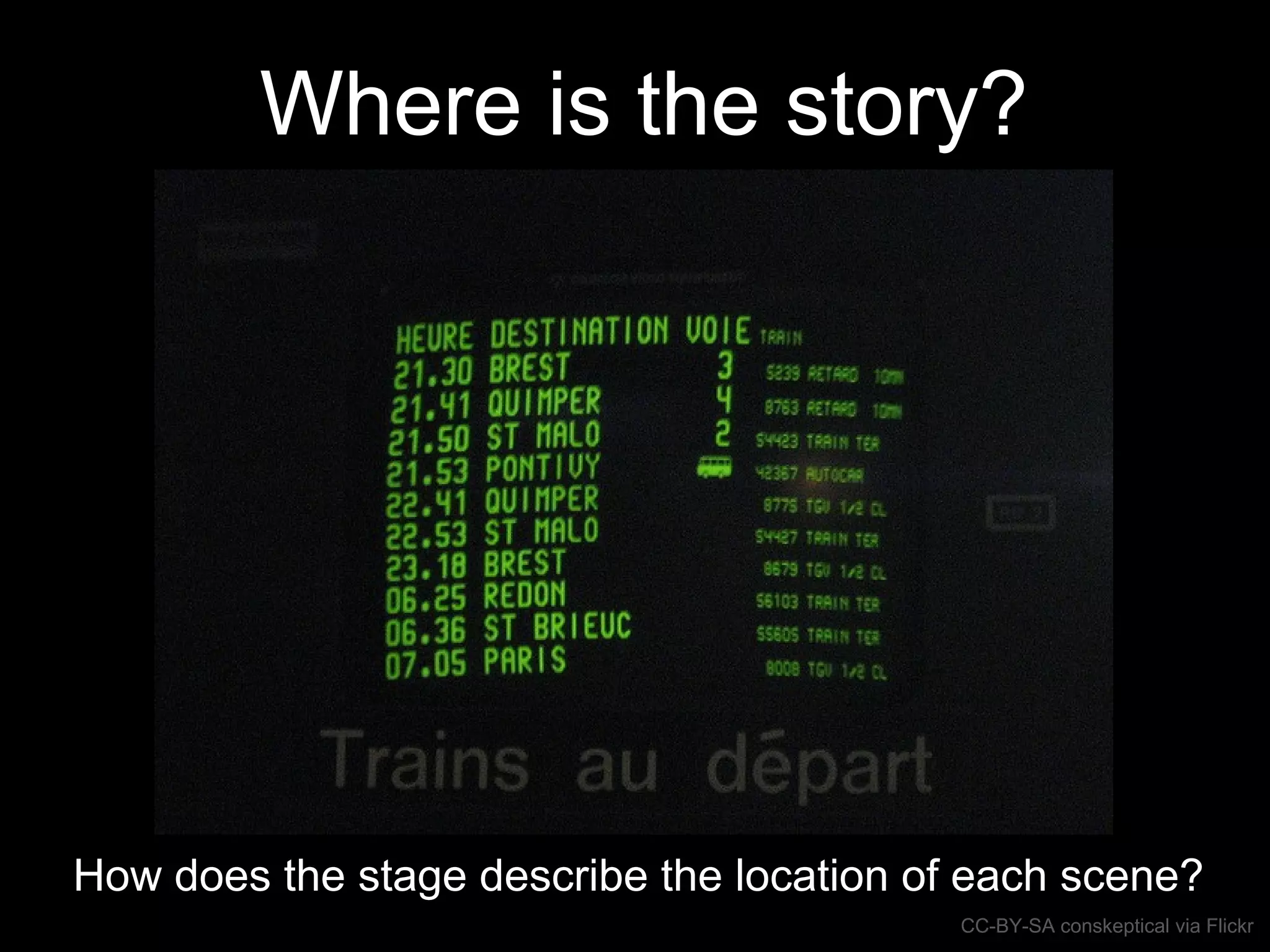
Where is the story?
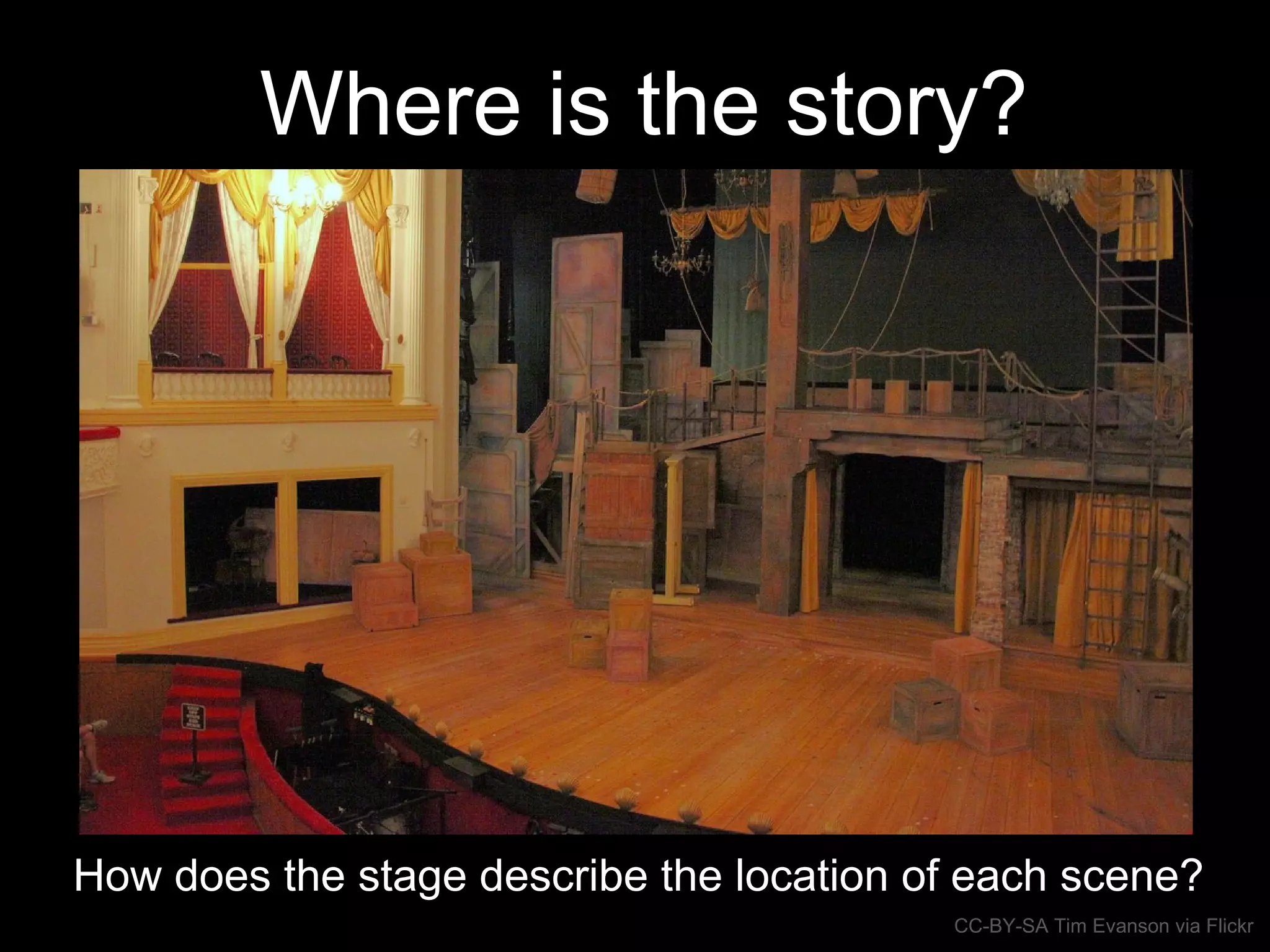
How does the stage describe the location of each scene?
CC-BY-SA Tim Evanson via Flickr
Where is the story?
How does the stage describe the location of each scene?
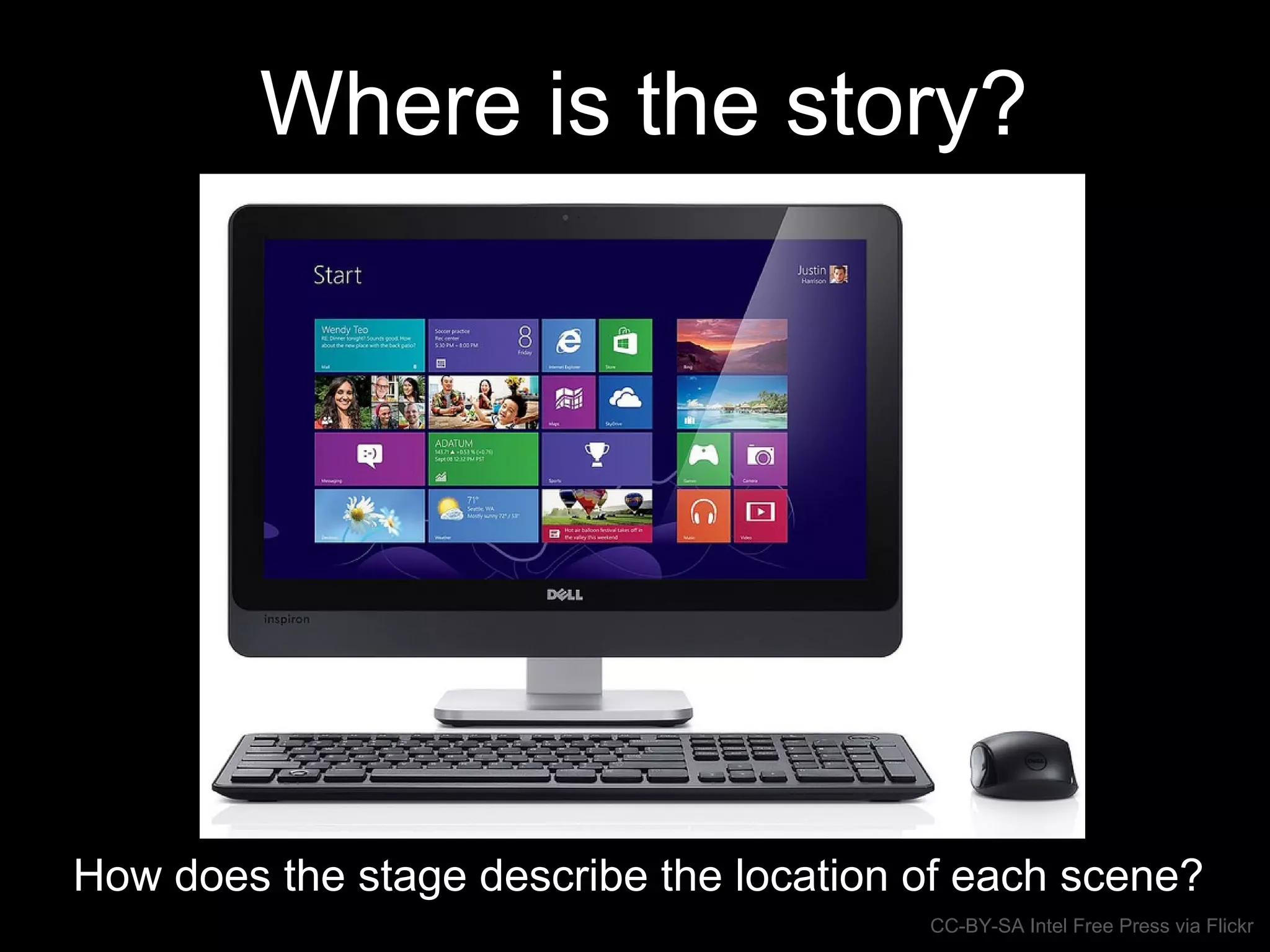
CC-BY-SA Intel Free Press via Flickr
Where is the story?
How does the stage describe the location of each scene?
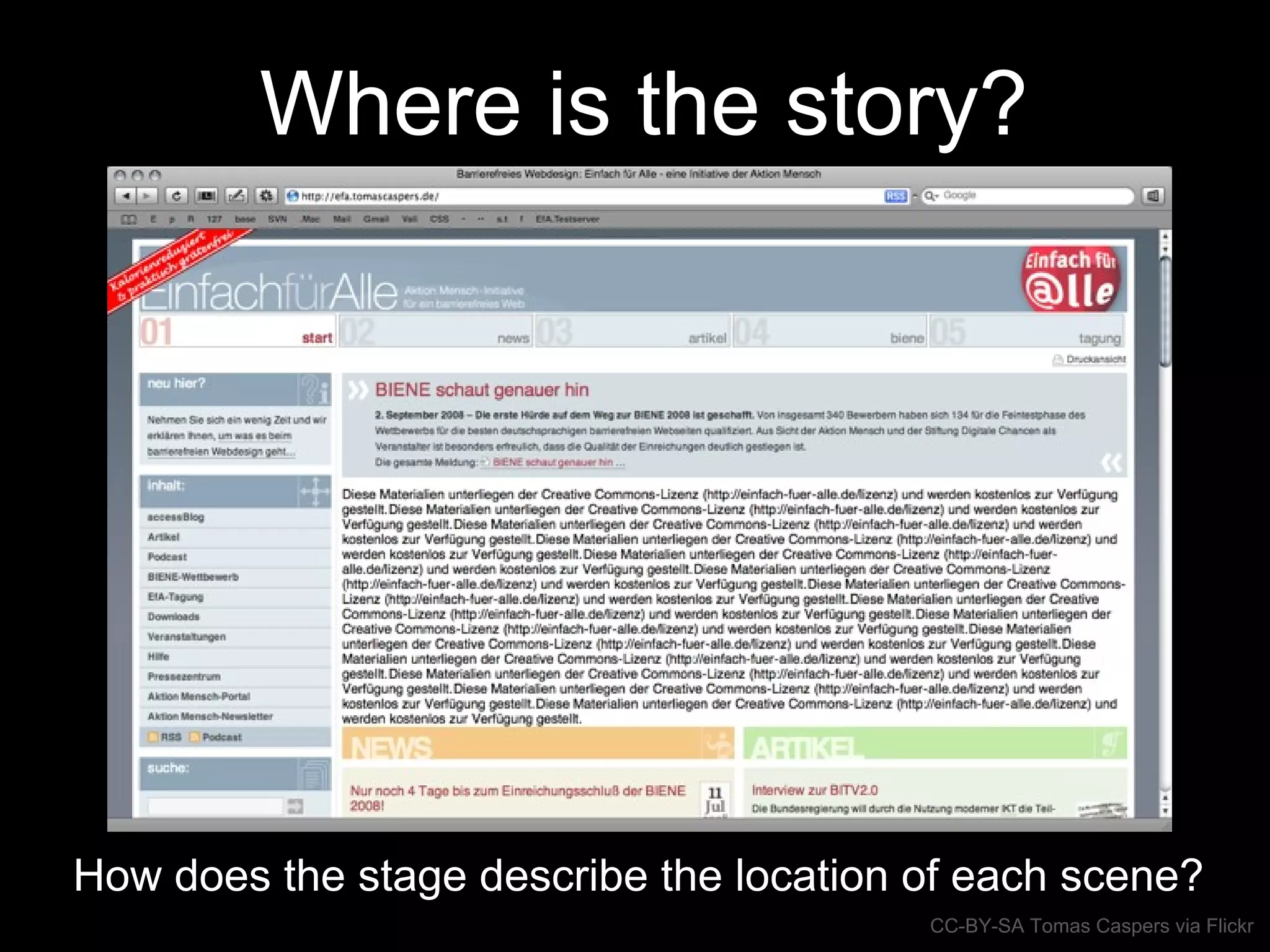
CC-BY-SA Tomas Caspers via Flickr
Where is the story?
How does the stage describe the location of each scene?
CC-BY-SA conskeptical via Flickr
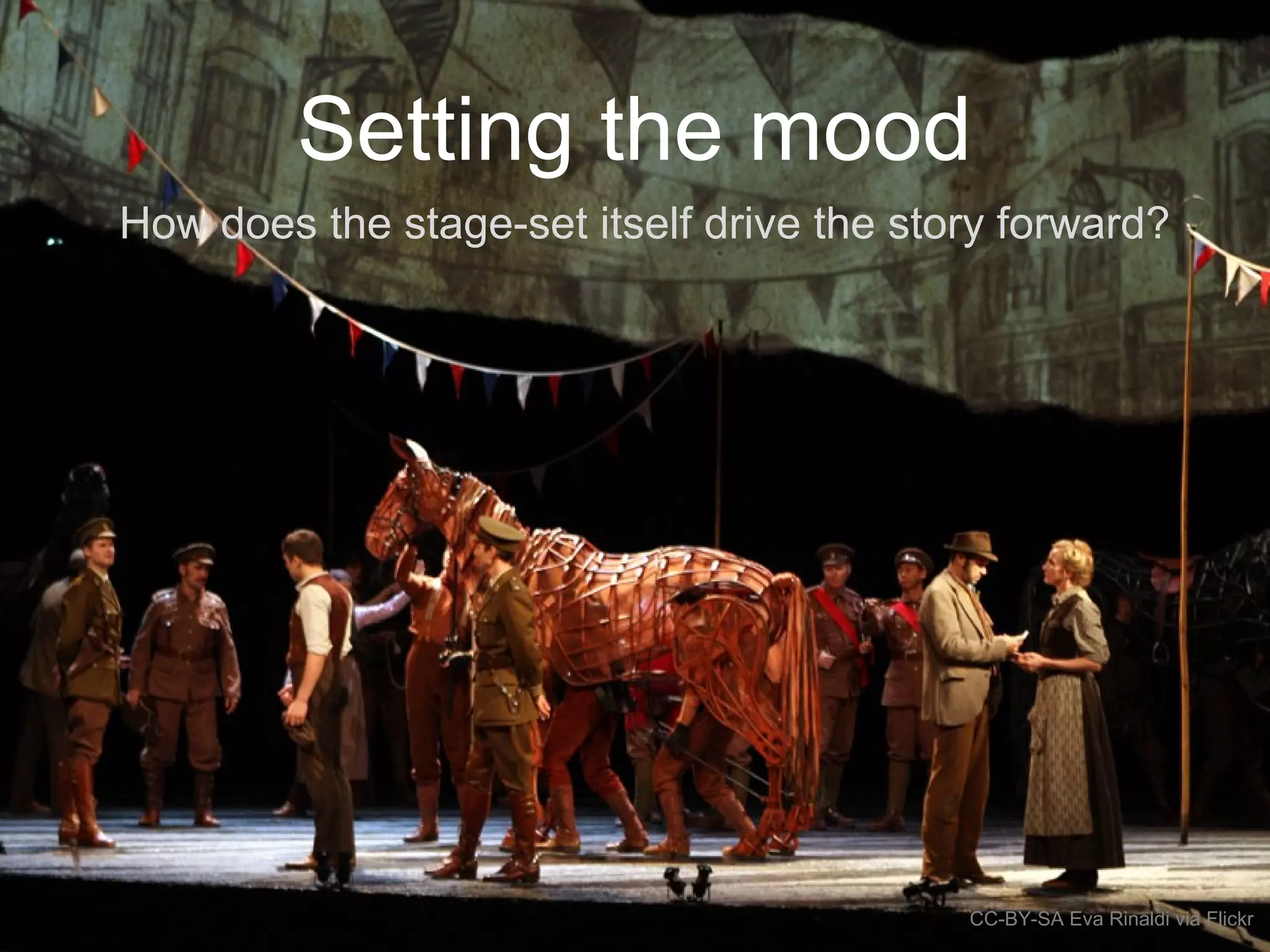
Setting the mood
How does the stage-set itself drive the story forward?
CC-BY-SA Eva Rinaldi via Flickr
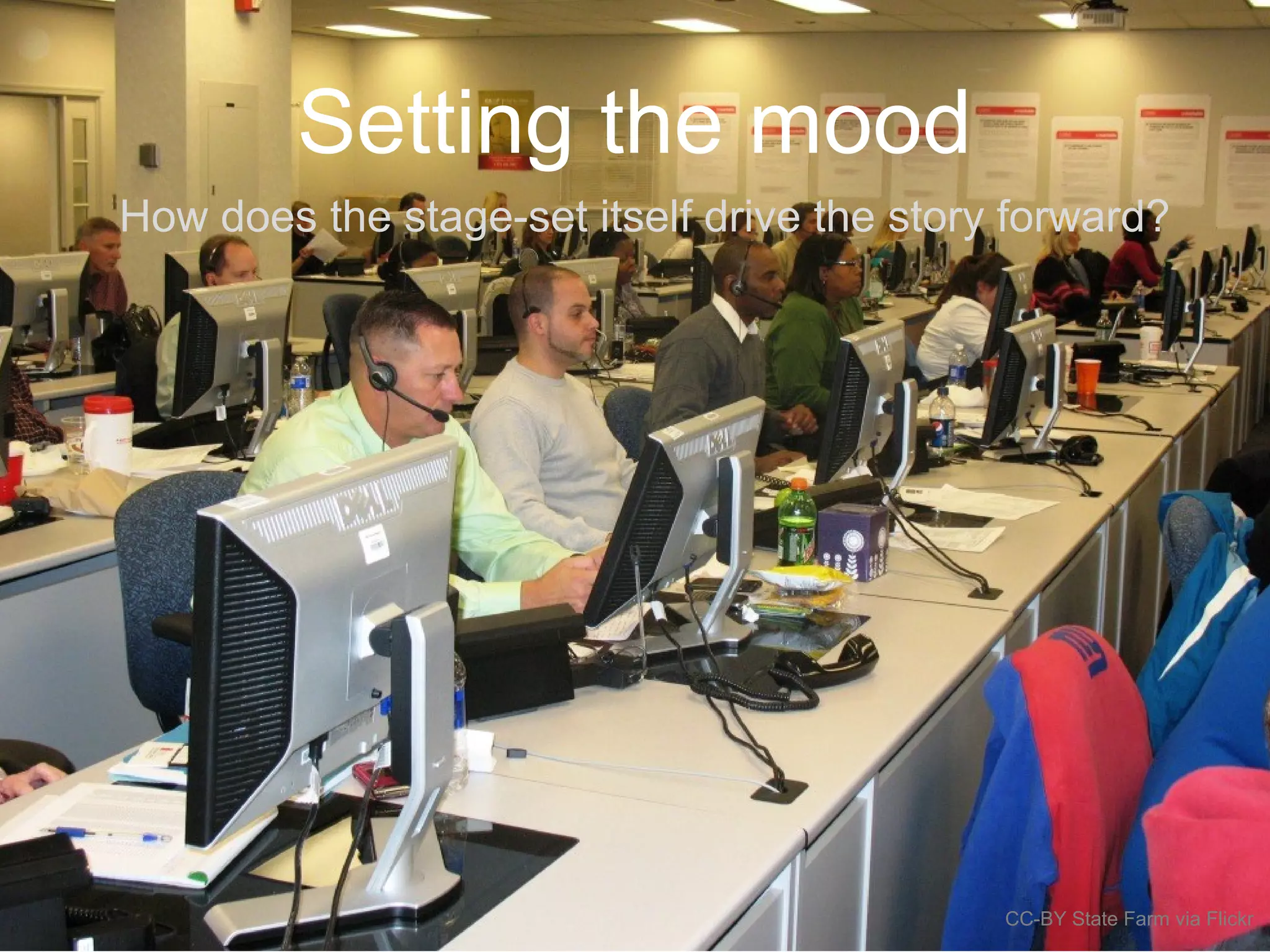
Setting the mood
How does the stage-set itself drive the story forward?
CC-BY State Farm via Flickr
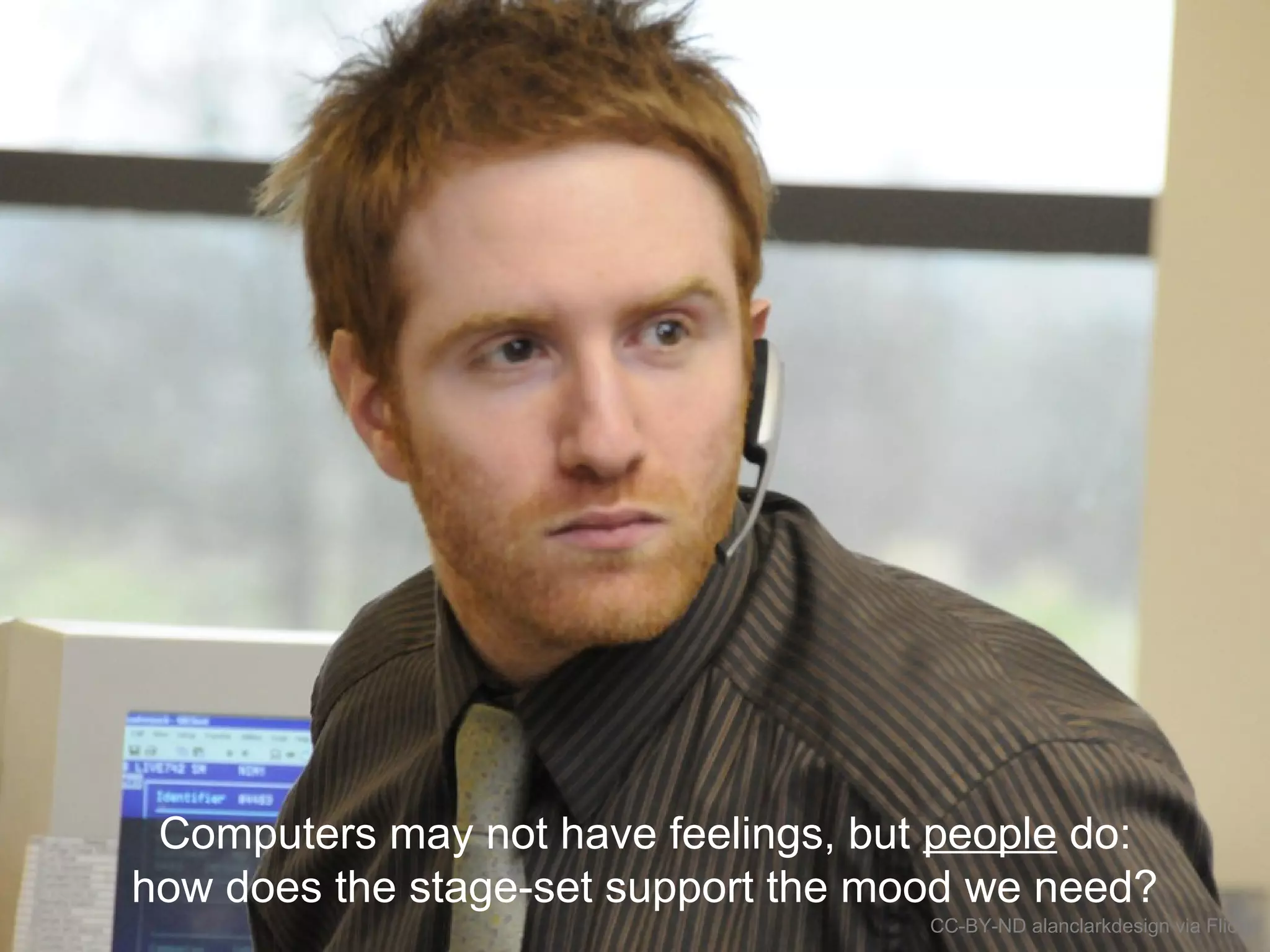
Maintain the mood
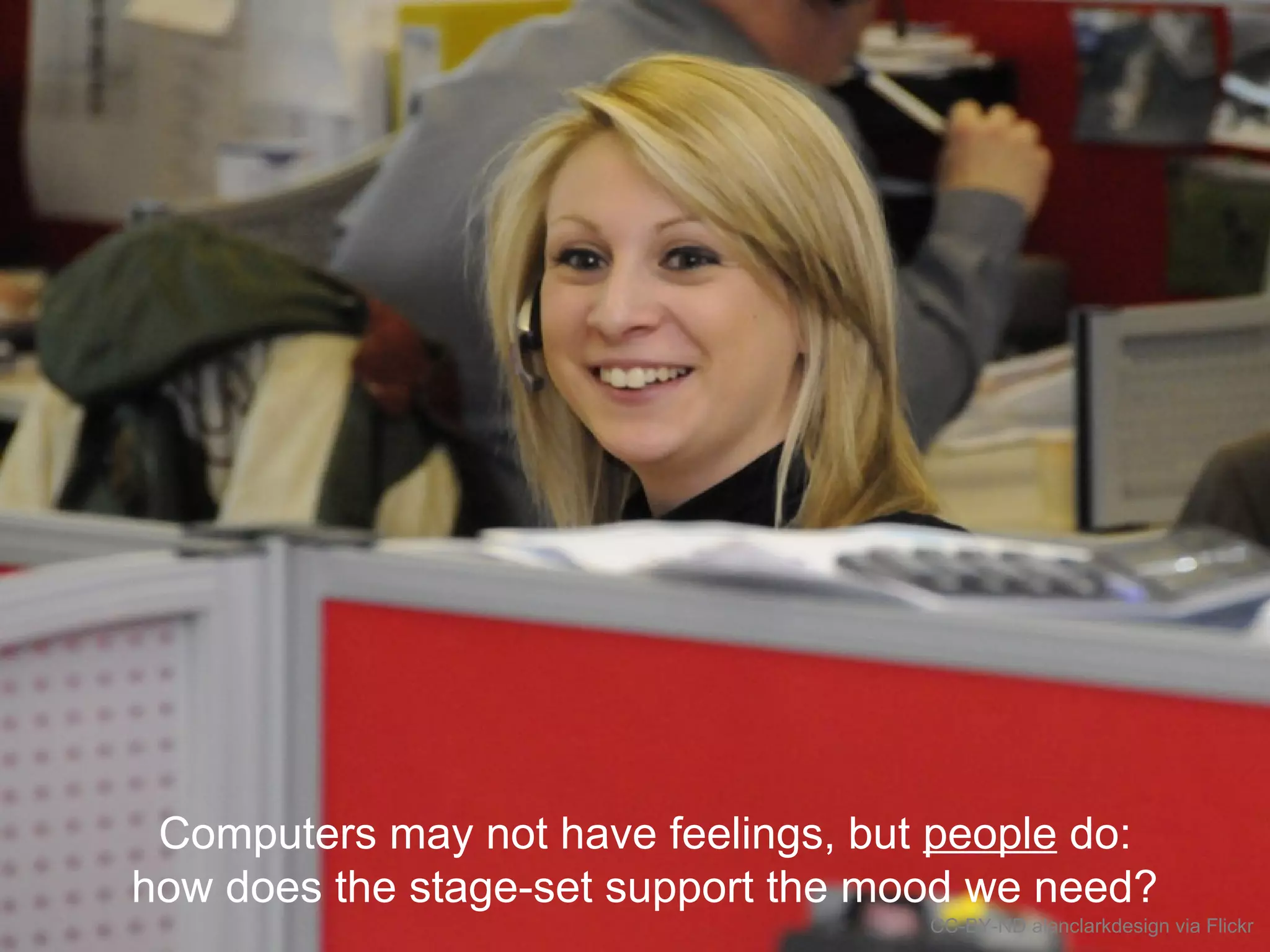
Computers may not have feelings, but people do:
how does the stage-set support the mood we need?
CC-BY-ND alanclarkdesign via Flickr
Maintain the mood
Computers may not have feelings, but people do:
how does the stage-set support the mood we need?
CC-BY-ND alanclarkdesign via Flickr
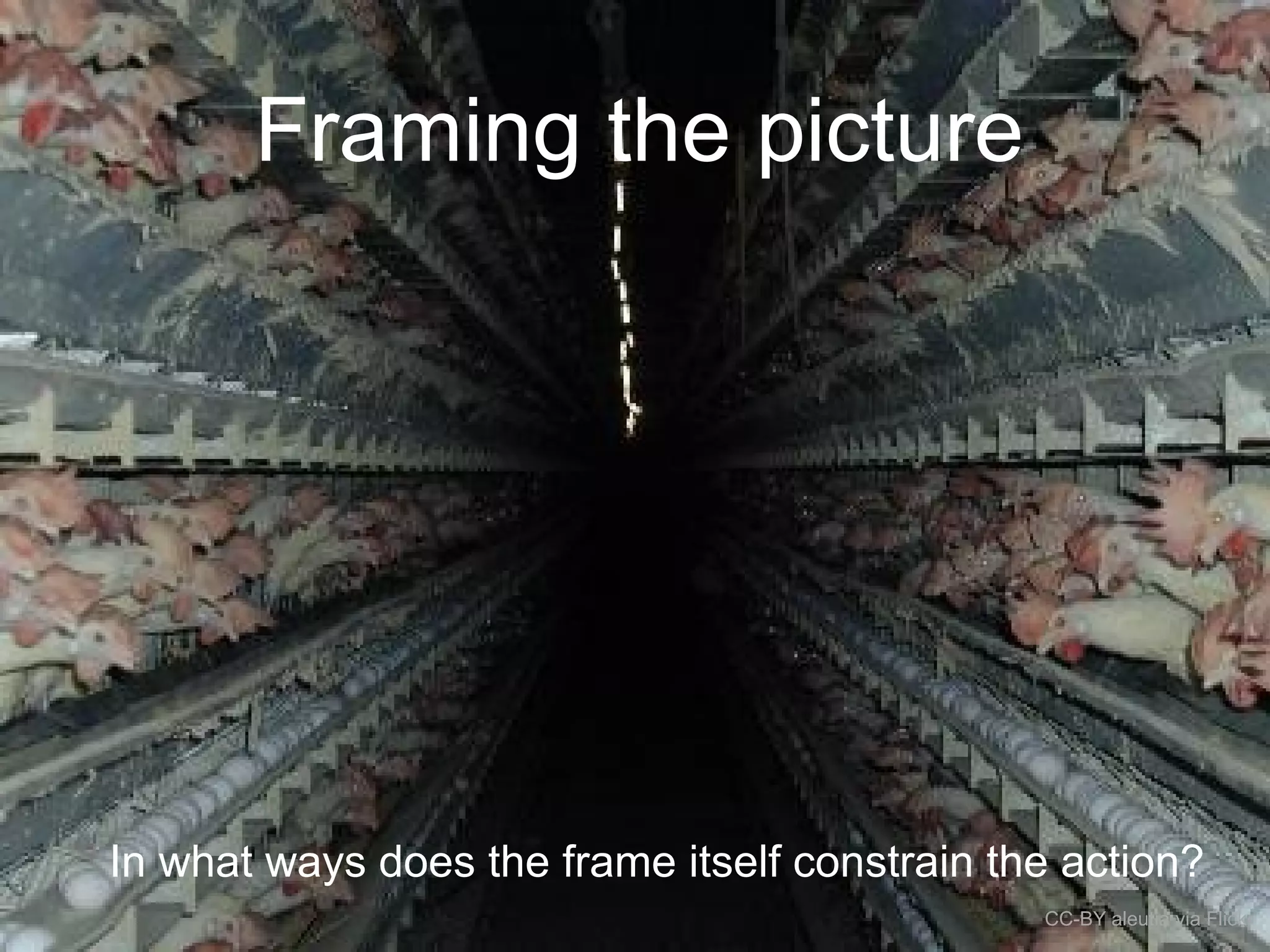
Framing the picture
In what ways does the frame itself constrain the action?
CC-BY aleutia via Flickr
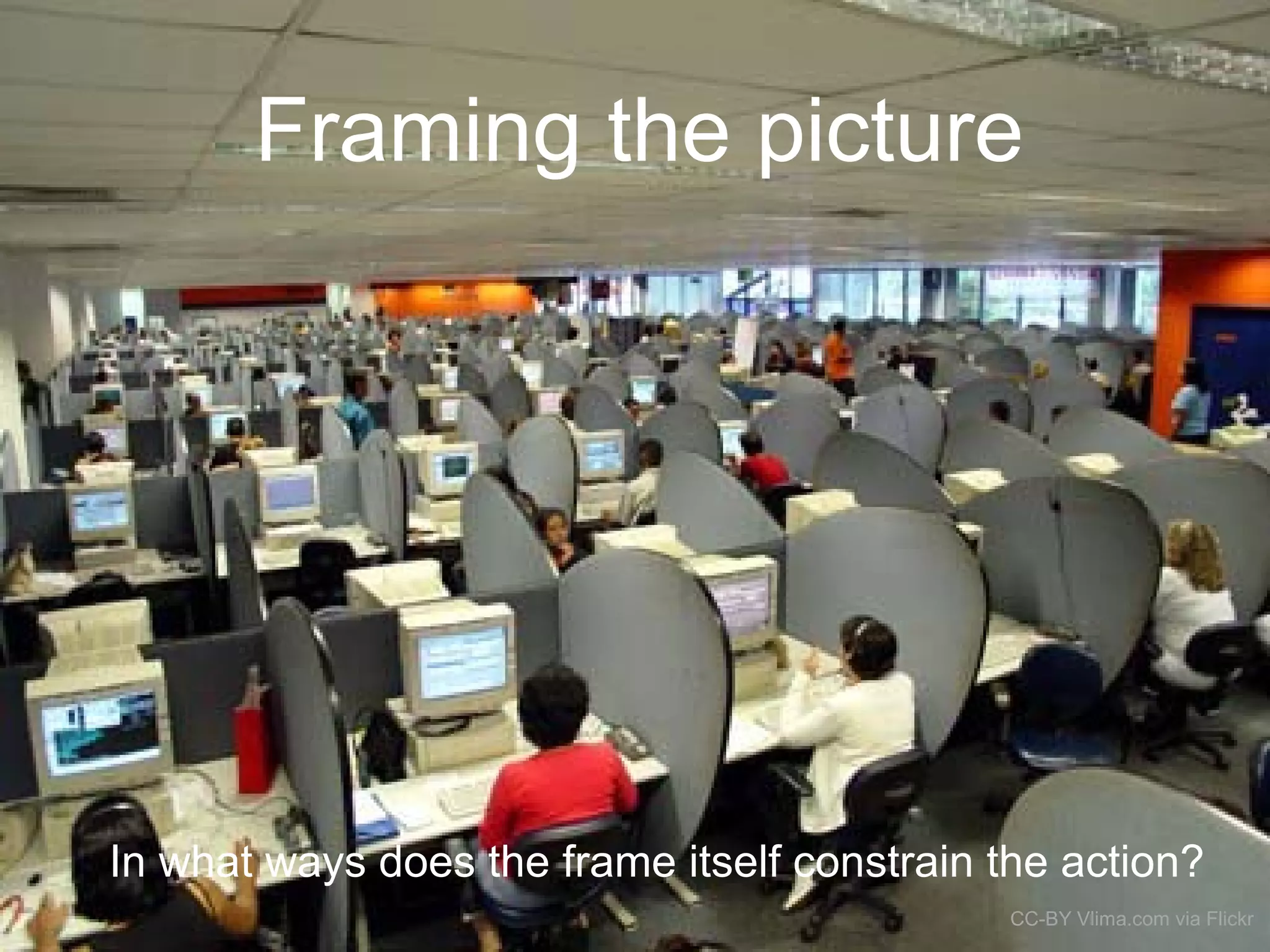
Framing the picture
CC-BY Vlima.com via Flickr
In what ways does the frame itself constrain the action?
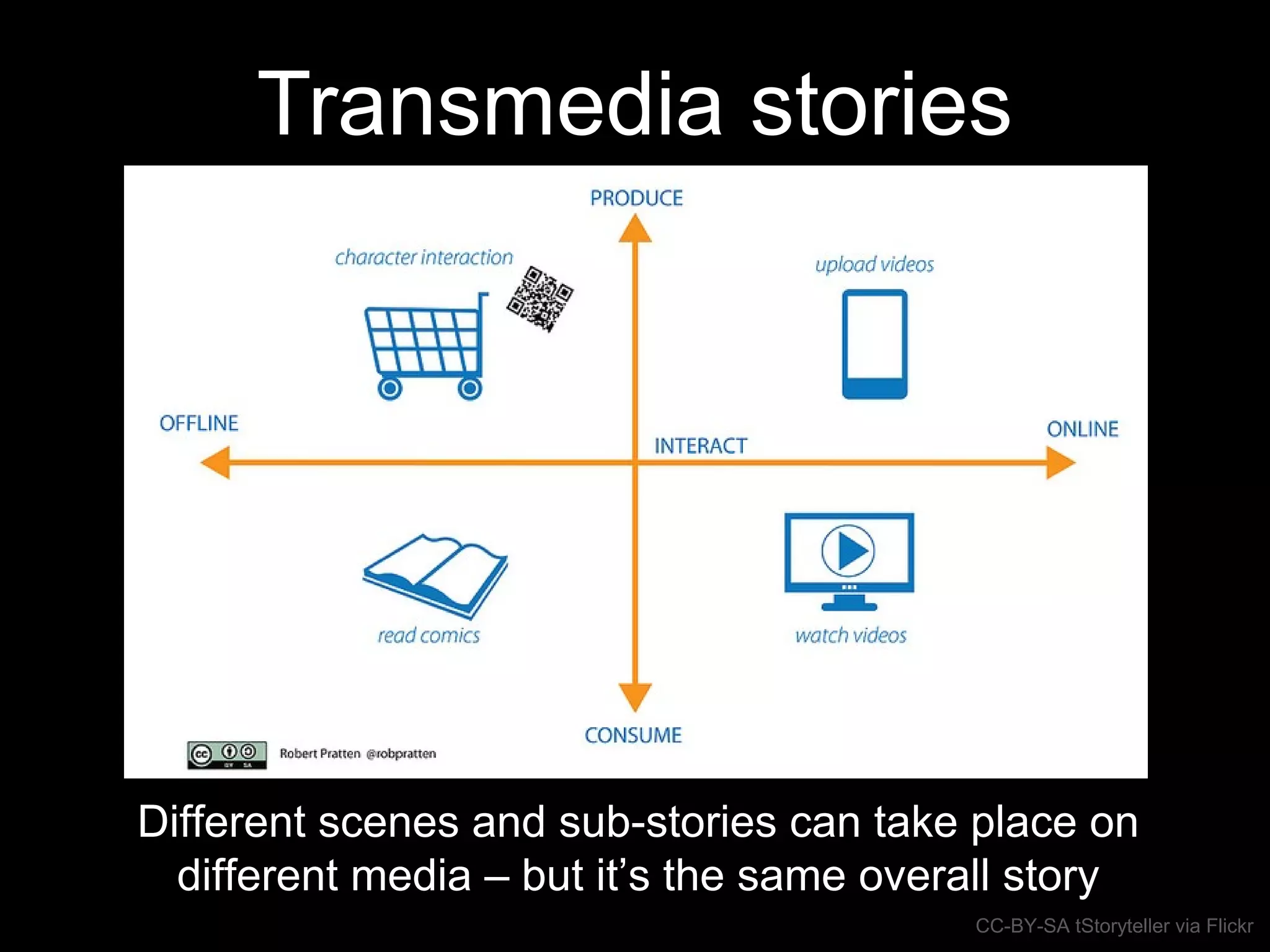
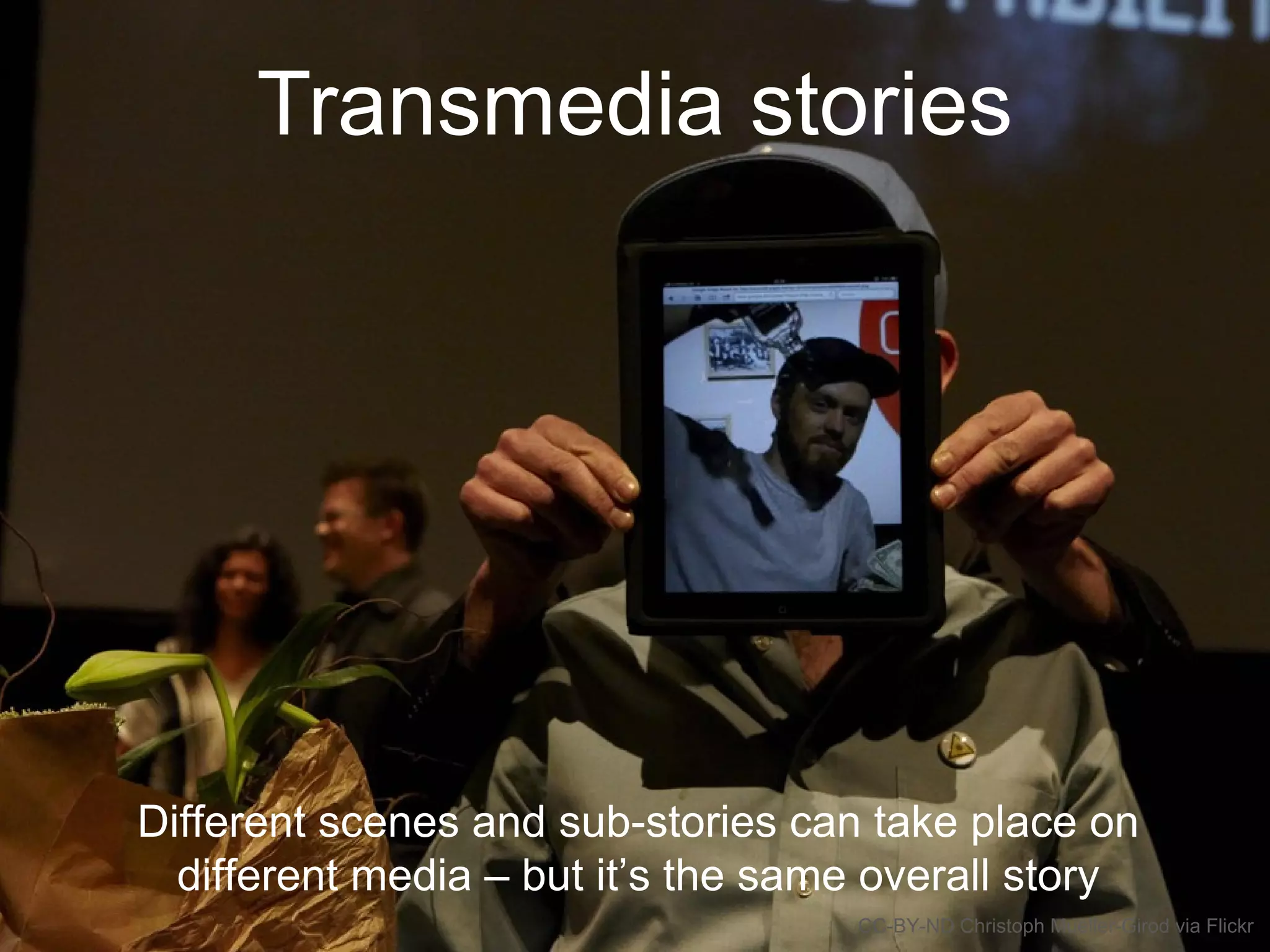
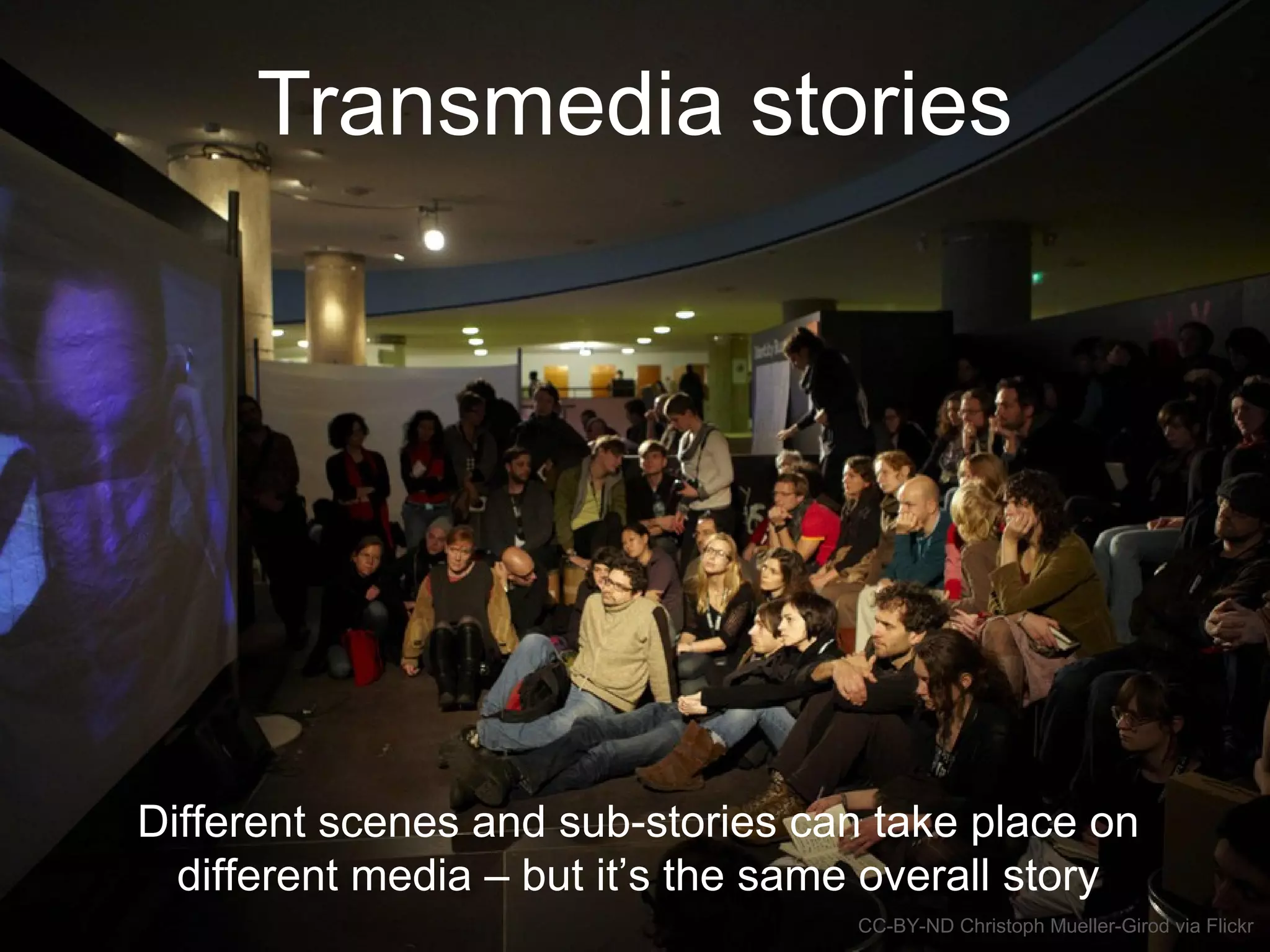
Transmedia stories
Different scenes and sub-stories can take place on
different media – but it’s the same overall story
CC-BY-SA tStoryteller via Flickr
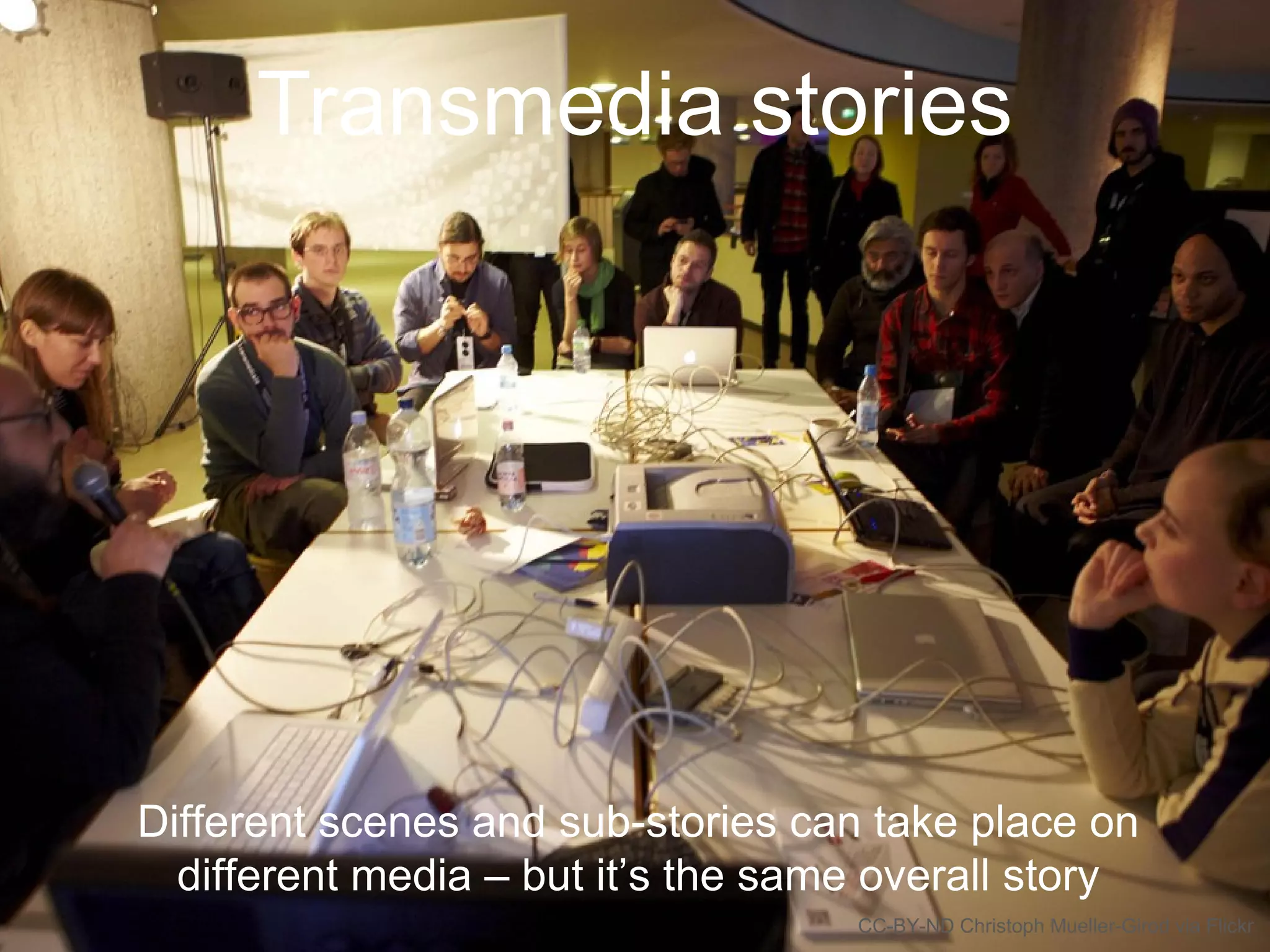
Transmedia stories
Different scenes and sub-stories can take place on
different media – but it’s the same overall story
CC-BY-ND Christoph Mueller-Girod via Flickr
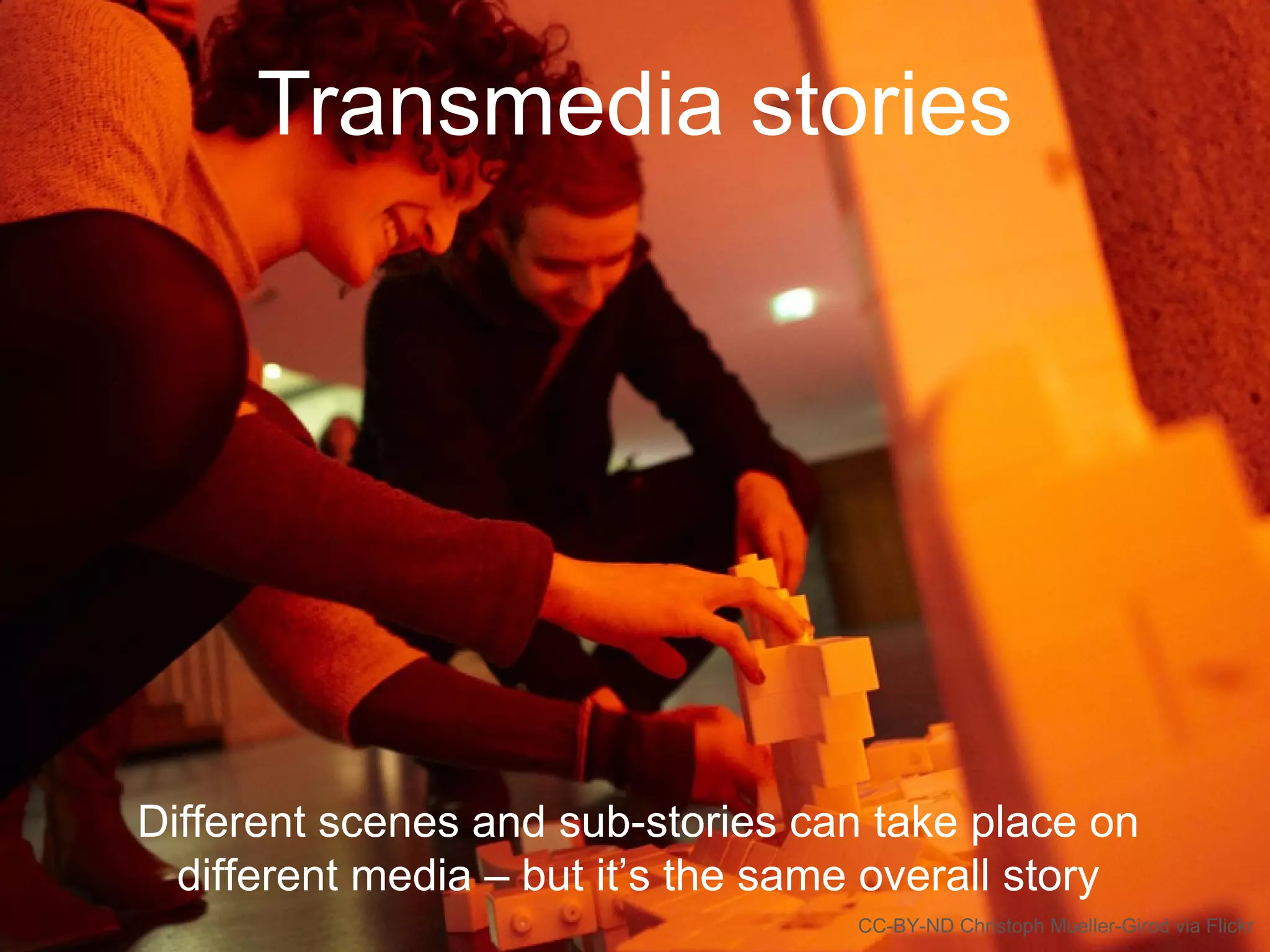
Transmedia stories
Different scenes and sub-stories can take place on
different media – but it’s the same overall story
CC-BY-ND Christoph Mueller-Girod via Flickr
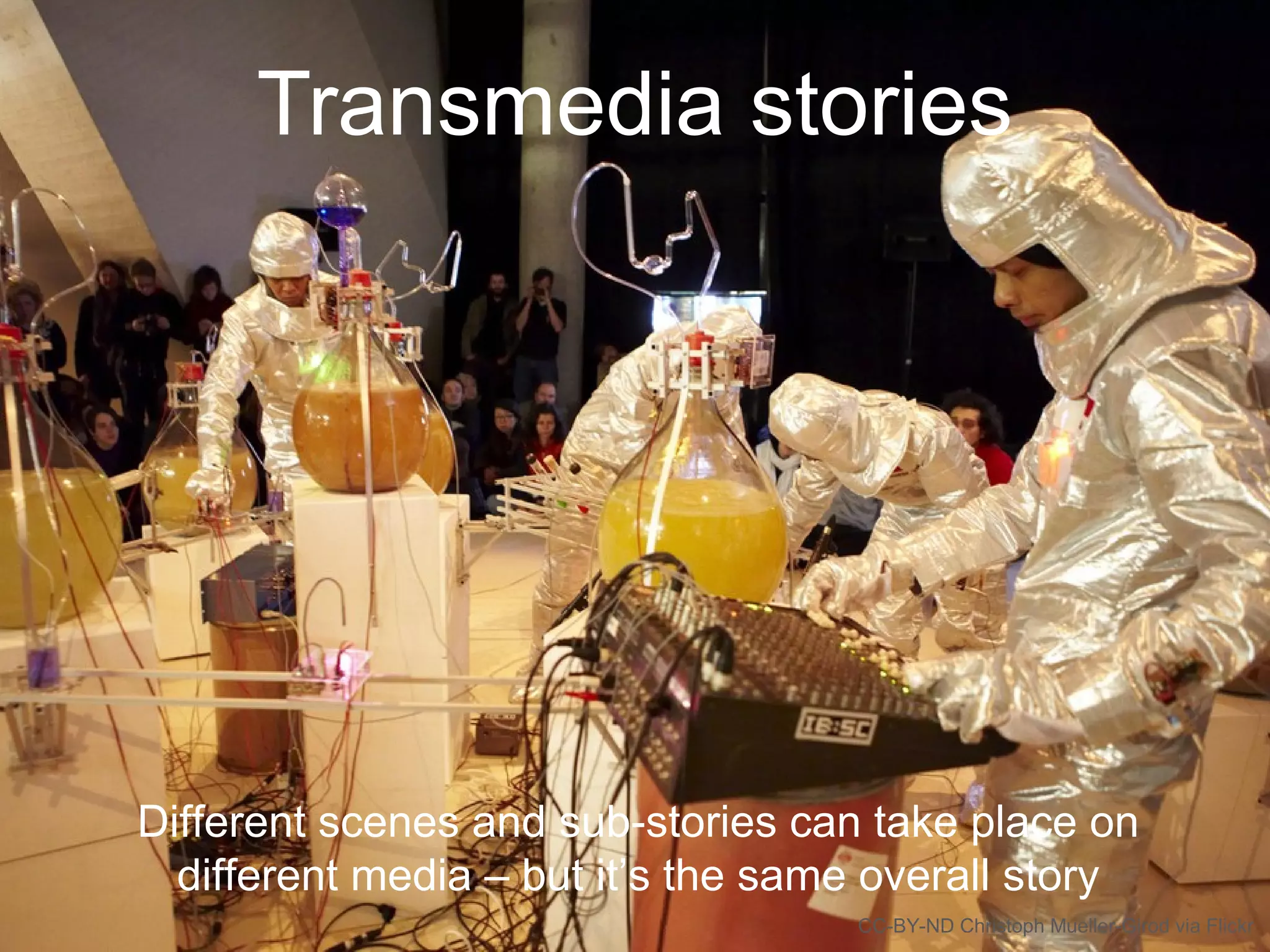
Transmedia stories
Different scenes and sub-stories can take place on
different media – but it’s the same overall story
CC-BY-ND Christoph Mueller-Girod via Flickr
Transmedia stories
Different scenes and sub-stories can take place on
different media – but it’s the same overall story
CC-BY-ND Christoph Mueller-Girod via Flickr
Transmedia stories
Different scenes and sub-stories can take place on
different media – but it’s the same overall story
CC-BY-ND Christoph Mueller-Girod via Flickr
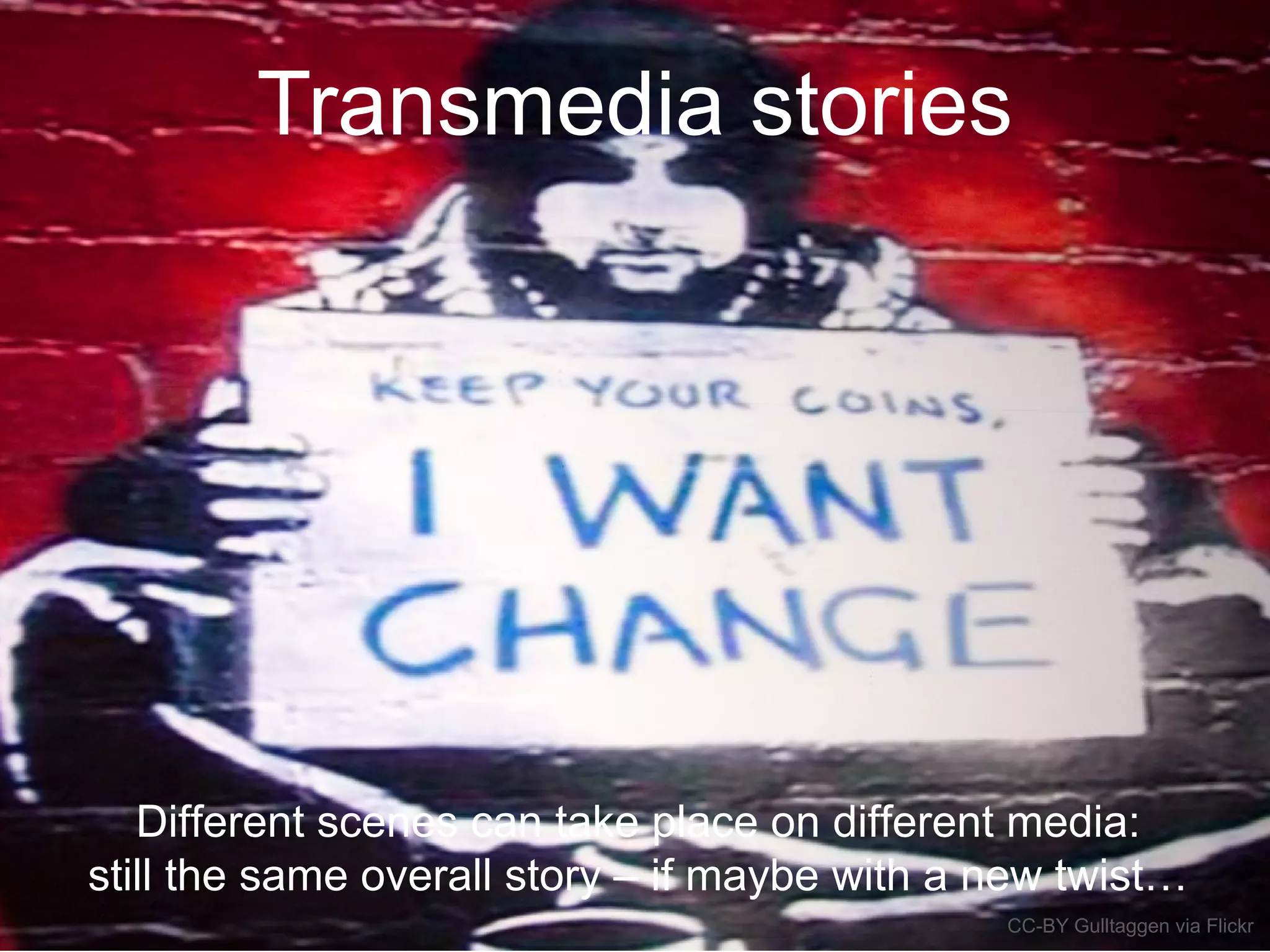
Transmedia stories
Different scenes can take place on different media:
still the same overall story – if maybe with a new twist…
CC-BY Gulltaggen via Flickr
A challenge of continuity
How is continuity maintained across all those different media?
CC-BY OpenPlaques via Flickr
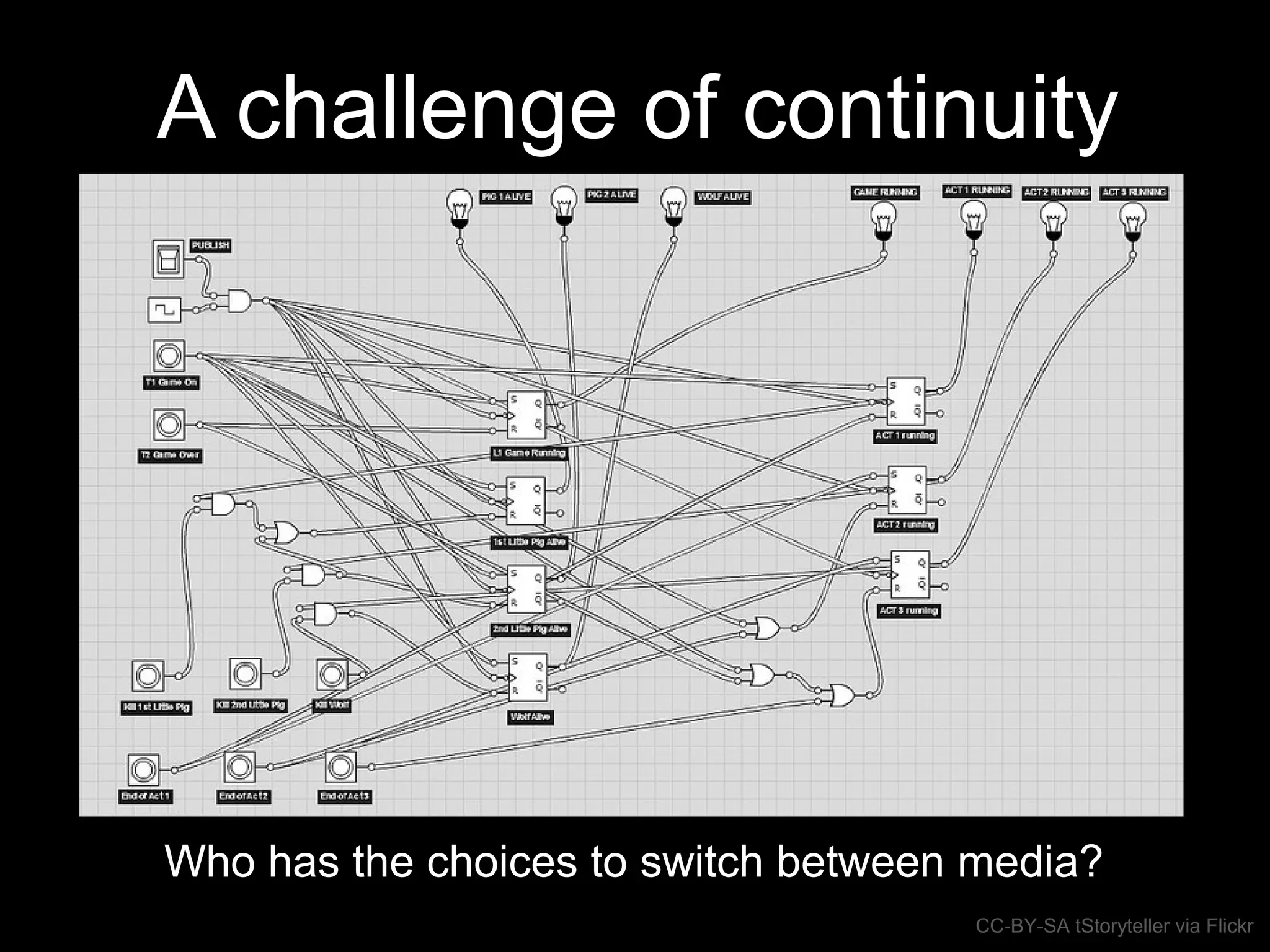
A challenge of continuity
Who has the choices to switch between media?
CC-BY-SA tStoryteller via Flickr
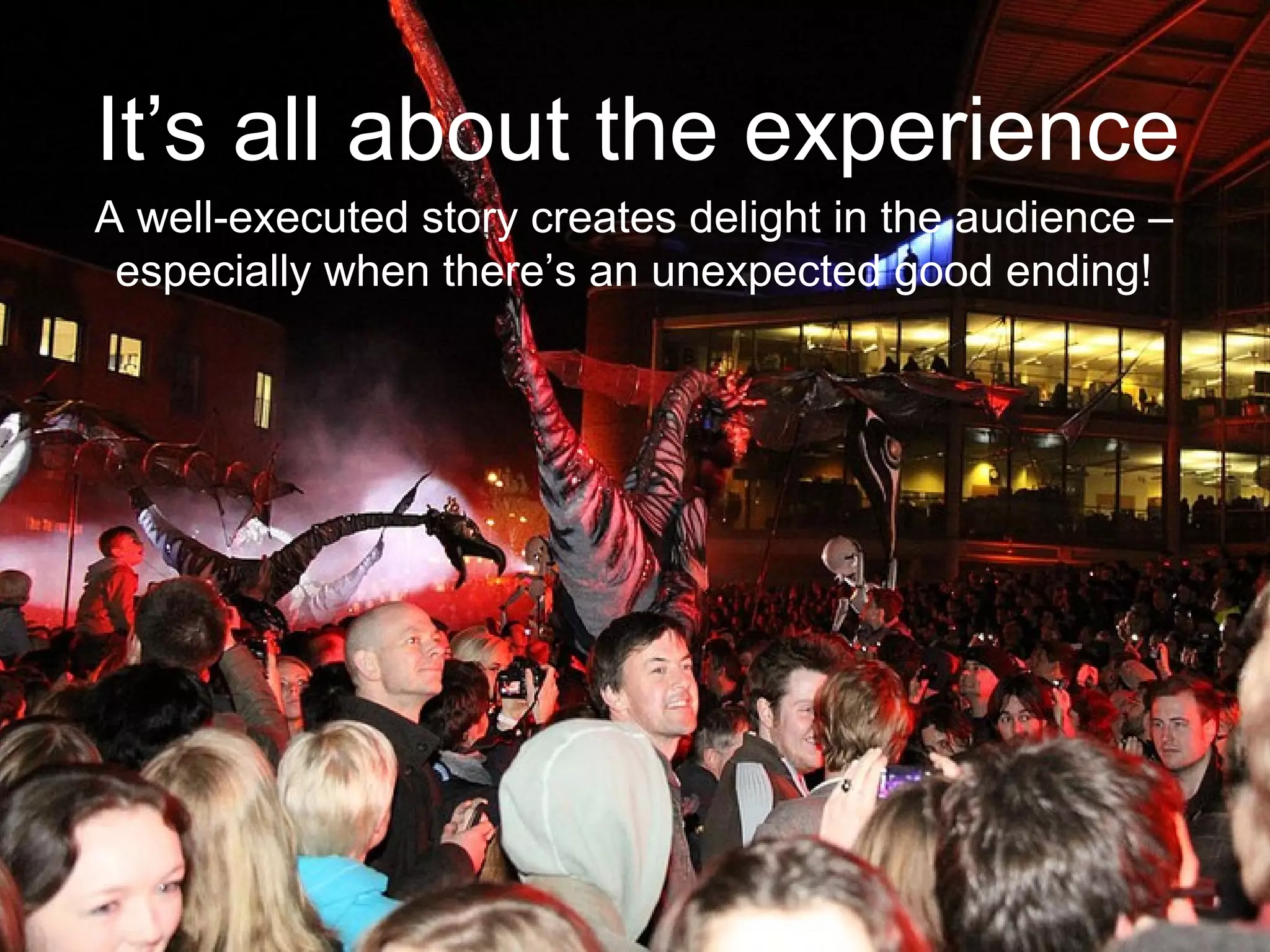
It’s all about the experience
A well-executed story creates delight in the audience –
especially when there’s an unexpected good ending!
“The world is made of stories”
• The enterprise itself is a story –an overarching theme
• Enterprise as ongoing story of relations between people
– the actors of the story
• Enterprise-story comprised of smaller stories – the
scenes or story-lines (aka ‘processes’)
• Enterprise-story takes place in a setting – the stage and
its context (technology), location, props (artefacts) etc
• Stories thrive on conflict, tension and uncertainty – in
contrast to machines, which generally don’t…
A final word…
It’s the ‘small stories’ that often help us
to highlight hidden assumptions
and expectations…
…the kind of assumptions and expectations
that can bring a system to a grinding halt…
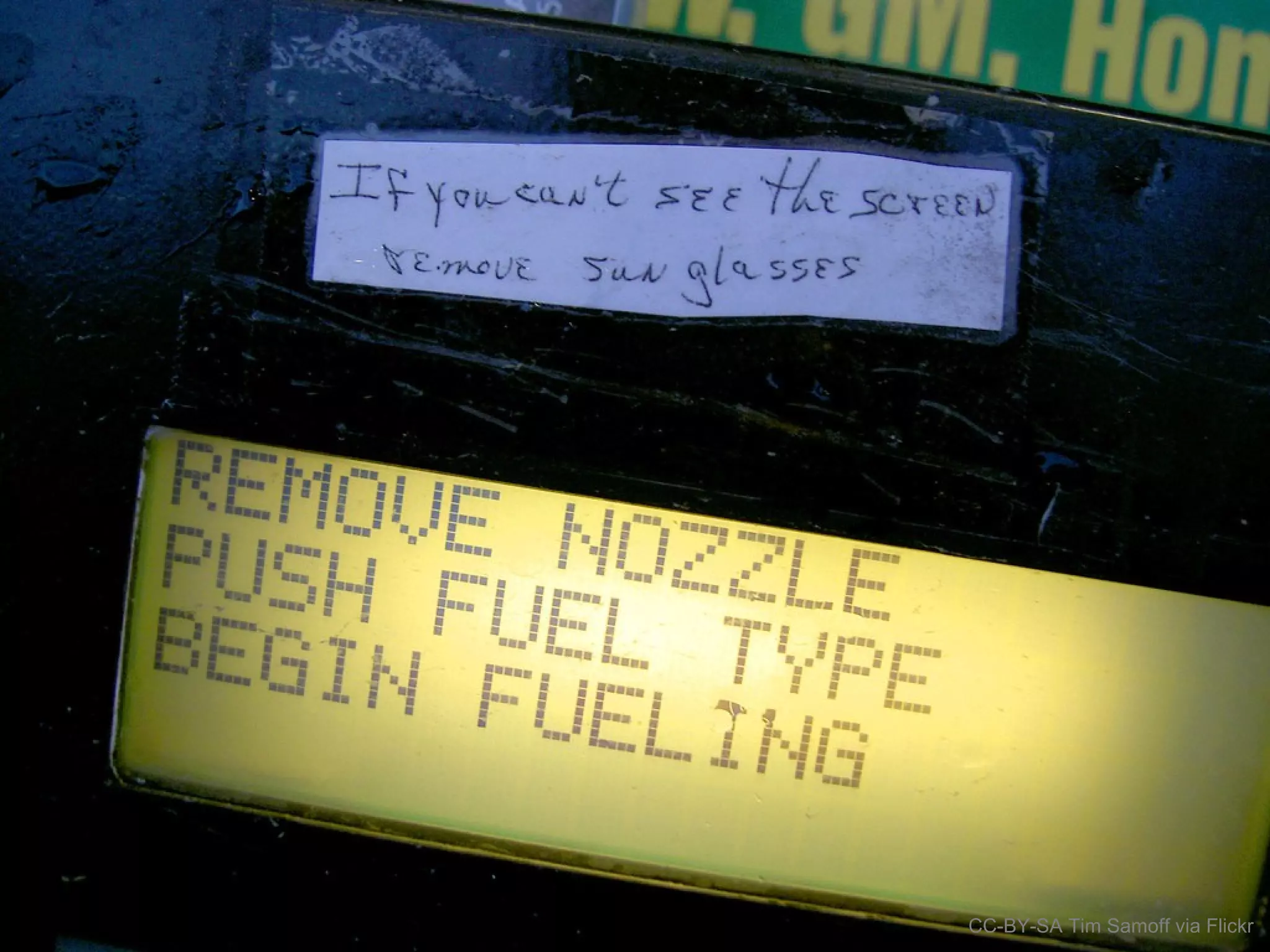
Wise advice…
CC-BY-SA Tim Samoff via Flickr
“What’s the story?”“What’s the story?”“What’s the story
for your enterprise?”
Contact: Tom Graves
Company: Tetradian Consulting
Email: tom@tetradian.com
Twitter: @tetradian ( http://twitter.com/tetradian )
Weblog: http://weblog.tetradian.com
Slidedecks: http://www.slideshare.net/tetradian
Publications: http://tetradianbooks.com
Books: • The enterprise as story: the role of narrative in enterprise-
architecture (2012)
• Mapping the enterprise: modelling the enterprise as services
with the Enterprise Canvas (2010)
• Everyday enterprise-architecture: sensemaking, strategy,
structures and solutions (2010)
• Doing enterprise-architecture: process and practice in the
real enterprise (2009)
Further information:

Staging the story: a people-oriented view of enterprise-architecture

  • 1.
    Staging the story apeople-oriented view of EA Tom Graves, Tetradian Consulting Unicom EA Conference, London, September 2013 the futures of business
  • 2.
    Hi. I’m Tom. (That’s allof the PR stuff out of the way...)
  • 3.
    Yes, this isEA… (well, part of it, anyway…) CC-BY-SA MysteryBee via Flickr
  • 4.
    …but where arethe people in this story? (…because ‘enterprise’ is people…) CC-BY-SA MysteryBee via Flickr
  • 5.
    “The world ismade of stories” • The enterprise itself is a story –an overarching theme • Enterprise as ongoing story of relations between people – the actors of the story • Enterprise-story comprised of smaller stories – the scenes or story-lines (aka ‘processes’) • Enterprise-story takes place in a setting – the stage and its context (technology), location, props (artefacts) etc • Stories thrive on conflict, tension and uncertainty – in contrast to machines, which generally don’t…
  • 6.
  • 7.
    Stage CC-BY-SA xdxd_vs_xdxd viaFlickr Scene Actor ActorStage Stage Stage Stage Stage Scene Scene
  • 8.
    “Process is theuse of structure (the organisation view) Plot is the unfolding of story (the enterprise view)” Tom Graves, The Enterprise As Story, Tetradian, 2012 Plot and process
  • 9.
    “An organisation isbounded by rules, roles and responsibilities; an enterprise is bounded by vision, values and commitments.” Tom Graves, Mapping the Enterprise, Tetradian, 2010 Whose story? Organisation aligns with structure, enterprise with story. We need a balance of both for the architecture to work.
  • 10.
    A useful guideline: “Theenterprise in scope should be three steps larger than the organisation in scope.” Tom Graves, Mapping the Enterprise, Tetradian, 2010 Whose story?
  • 11.
    Whose story? If theorganisation says it ‘is’ the enterprise, there’s no shared-story - and often, no story at all.
  • 12.
    Whose story? The minimumreal enterprise is the supply-chain - a story of shared transactions.
  • 13.
    Whose story? The organisationand enterprise of the supply-chain take place within a broader organisation of the market.
  • 14.
    Whose story? The marketitself exists within a context of ‘intangible’ interactions with the broader shared-enterprise story.
  • 15.
    A stakeholder in thestory is anyone who can wield a sharp-pointed stake in your direction… CC-BY-NC-SA evilpeacock via Flickr Whose story? (Hint: there are a lot more of them than you might at first think…)
  • 16.
    Perspectives on thestory • Outside-out: Big-picture ‘world’, beyond even the market • Outside-in: View from ‘outside’ into organisation • Journey: Touchpoints between ‘outsider’ and organisation • Inside-out: View from the organisation’s perspective • Inside-in: View of the organisation to inside itself
  • 17.
    Inside-in… CC-BY Myrmi viaFlickr always at risk of drowning in the detail…
  • 18.
    Inside-out… CC-BY – Paul– via Flickr We create an architecture for an organisation, but about a broader enterprise.
  • 19.
    Outside-in… CC-BY Fretro viaFlickr “Customers do not appear in our processes, we appear in their experiences.” Chris Potts, recrEAtion, Technics, 2010
  • 20.
    CC-BY Matt Brownvia Flickr Outside-out… There’s always a larger scope…
  • 21.
  • 22.
    “What’s the story?” “Acast of thousands!”
  • 23.
    Who are theactors? CC-BY Mike Babcock via Flickr
  • 24.
    Actors – theIT-view? CC-BY jurvetson via Flickr
  • 25.
    “Computer stole myface…” CC-BY justin pickard via Flickr
  • 26.
    A human view CC-BYandré luís via Flickr
  • 27.
    Actors – thehuman view? CC-BY-SA izzard via Flickr
  • 28.
    How we reallythink… CC-BY Brett Jordan via Flickr
  • 29.
  • 30.
    The structure ofthe story CC-BY-SA Neil Cumming via Flickr
  • 31.
    What kind ofstory? SCRIPTED (simple rules and checklists) CC-BY The-Vikkodamus via Flickr CC-BY-SA seeminglee via Flickr IMPROVISED (guidelines and principles) ANALYSED (complicated algorithms) ADAPTED (complex patterns)
  • 32.
    “Each traverse through abusiness-process is a self-contained story with its own actors, actions and events” Tom Graves, The Enterprise As Story, Tetradian, 2012 Process as story
  • 33.
    Scenes in thestory Split story into identifiable scenes, with begin, middle, end CC-BY TheArches via Flickr
  • 34.
    Scenes in thestory Process-story as identifiable scenes, with begin, middle, end
  • 35.
    Show, don’t tell Eachline of action drives the story forward CC-BY TheArches via Flickr
  • 36.
    Show, don’t tell Eachline of action drives the story forward CC-BY-ND Kecko via Flickr
  • 37.
    The role ofprops Each item has its place, and drives the story onward CC-BY TheArches via Flickr
  • 38.
    Each item hasits place, and drives the story onward CC-BY-ND Kecko via Flickr The role of props
  • 39.
  • 40.
    Staging the story CC-BY-SApasser-by via Flickr Infrastructure and systems etc as the stage
  • 41.
    Staging the story Infrastructureand systems etc as the stage CC-BY-ND Costa Rica’s Call Center via Flickr
  • 42.
    Visible and invisible Whatneeds to be behind the curtain? What in front? CC-BY Mickey Thurman via Flickr
  • 43.
    Visible and invisible Whatstate is that infrastructure in, behind the curtain? CC-BY Princess Theatre via Flickr
  • 44.
    Visible and invisible Whatstate is that infrastructure in, behind the curtain? CC-BY-SA LanSmash via Flickr
  • 45.
    Where is thestory? How does the stage describe the location of each scene? CC-BY-SA Tim Evanson via Flickr
  • 46.
    Where is thestory? How does the stage describe the location of each scene? CC-BY-SA Intel Free Press via Flickr
  • 47.
    Where is thestory? How does the stage describe the location of each scene? CC-BY-SA Tomas Caspers via Flickr
  • 48.
    Where is thestory? How does the stage describe the location of each scene? CC-BY-SA conskeptical via Flickr
  • 49.
    Setting the mood Howdoes the stage-set itself drive the story forward? CC-BY-SA Eva Rinaldi via Flickr
  • 50.
    Setting the mood Howdoes the stage-set itself drive the story forward? CC-BY State Farm via Flickr
  • 51.
    Maintain the mood Computersmay not have feelings, but people do: how does the stage-set support the mood we need? CC-BY-ND alanclarkdesign via Flickr
  • 52.
    Maintain the mood Computersmay not have feelings, but people do: how does the stage-set support the mood we need? CC-BY-ND alanclarkdesign via Flickr
  • 53.
    Framing the picture Inwhat ways does the frame itself constrain the action? CC-BY aleutia via Flickr
  • 54.
    Framing the picture CC-BYVlima.com via Flickr In what ways does the frame itself constrain the action?
  • 55.
    Transmedia stories Different scenesand sub-stories can take place on different media – but it’s the same overall story CC-BY-SA tStoryteller via Flickr
  • 56.
    Transmedia stories Different scenesand sub-stories can take place on different media – but it’s the same overall story CC-BY-ND Christoph Mueller-Girod via Flickr
  • 57.
    Transmedia stories Different scenesand sub-stories can take place on different media – but it’s the same overall story CC-BY-ND Christoph Mueller-Girod via Flickr
  • 58.
    Transmedia stories Different scenesand sub-stories can take place on different media – but it’s the same overall story CC-BY-ND Christoph Mueller-Girod via Flickr
  • 59.
    Transmedia stories Different scenesand sub-stories can take place on different media – but it’s the same overall story CC-BY-ND Christoph Mueller-Girod via Flickr
  • 60.
    Transmedia stories Different scenesand sub-stories can take place on different media – but it’s the same overall story CC-BY-ND Christoph Mueller-Girod via Flickr
  • 61.
    Transmedia stories Different scenescan take place on different media: still the same overall story – if maybe with a new twist… CC-BY Gulltaggen via Flickr
  • 62.
    A challenge ofcontinuity How is continuity maintained across all those different media? CC-BY OpenPlaques via Flickr
  • 63.
    A challenge ofcontinuity Who has the choices to switch between media? CC-BY-SA tStoryteller via Flickr
  • 64.
    It’s all aboutthe experience A well-executed story creates delight in the audience – especially when there’s an unexpected good ending!
  • 65.
    “The world ismade of stories” • The enterprise itself is a story –an overarching theme • Enterprise as ongoing story of relations between people – the actors of the story • Enterprise-story comprised of smaller stories – the scenes or story-lines (aka ‘processes’) • Enterprise-story takes place in a setting – the stage and its context (technology), location, props (artefacts) etc • Stories thrive on conflict, tension and uncertainty – in contrast to machines, which generally don’t…
  • 66.
    A final word… It’sthe ‘small stories’ that often help us to highlight hidden assumptions and expectations… …the kind of assumptions and expectations that can bring a system to a grinding halt…
  • 67.
    Wise advice… CC-BY-SA TimSamoff via Flickr
  • 68.
    “What’s the story?”“What’sthe story?”“What’s the story for your enterprise?”
  • 69.
    Contact: Tom Graves Company:Tetradian Consulting Email: tom@tetradian.com Twitter: @tetradian ( http://twitter.com/tetradian ) Weblog: http://weblog.tetradian.com Slidedecks: http://www.slideshare.net/tetradian Publications: http://tetradianbooks.com Books: • The enterprise as story: the role of narrative in enterprise- architecture (2012) • Mapping the enterprise: modelling the enterprise as services with the Enterprise Canvas (2010) • Everyday enterprise-architecture: sensemaking, strategy, structures and solutions (2010) • Doing enterprise-architecture: process and practice in the real enterprise (2009) Further information: