Workshop on
Applying a systems approach to money
(Tracking value in the enterprise)
Tom Graves, Tetradian Consulting
IASA, Dublin, June 2017
Hi.
I’m Tom Graves.
(don’t worry, I’m vaguely human…)
Let’s talk about
money.
Actually, let’s not talk
about money...
‘Making money’ is a side-effect
from being on-track to values.
Always start from
values,
not money.
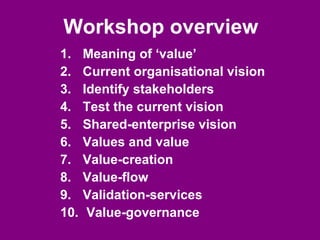
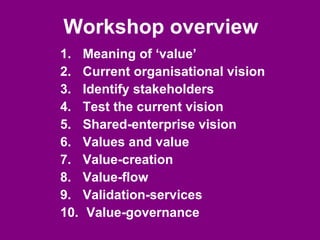
Workshop overview
1. Meaning of ‘value’
2. Current organisational vision
3. Identify stakeholders
4. Test the current vision
5. Shared-enterprise vision
6. Values and value
7. Value-creation
8. Value-flow
9. Validation-services
10. Value-governance
#1:
Meaning of ‘value’
What is ‘value’?
Is ‘value’ the same as ‘money’?
Can we measure every value
in terms of money?
This work is licensed under the Creative Commons Attribution-ShareAlike 4.0 International License (CC BY-SA 4.0).
To view a copy of this license, visit https://creativecommons.org/licenses/by-sa/4.0/
Tetradian www.tetradian.com
Project By Date
VersionWorksheet
Practical #1:
What, to you, is meant
by the term ‘Value’?
Use the standard worksheet
to note your understandings
[5 minutes]
To what extent are ‘Money’ and ‘Value’
regarded as synonyms in your enterprise?
#2:
Current vision
What is ‘vision’?
Does your organisation have
a distinct vision?
Is ‘mission’ the same
as ‘vision’?
This work is licensed under the Creative Commons Attribution-ShareAlike 4.0 International License (CC BY-SA 4.0).
To view a copy of this license, visit https://creativecommons.org/licenses/by-sa/4.0/
Tetradian www.tetradian.com
Project By Date
VersionWorksheet
Practical #2:
What is the current vision
for your organisation?
Use the standard worksheet
to note your understandings
[5 minutes]
Is there any vision? Do you know it?
Where is this described, for whom?
#3:
Stakeholders
Who are stakeholders?
How do you identify those
stakeholders?
How might each of these
affect your organisation?
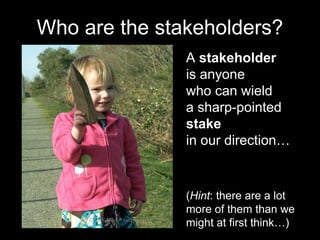
A stakeholder
is anyone
who can wield
a sharp-pointed
stake
in our direction…
CC-BY-NC-SA evilpeacock via Flickr
Who are the stakeholders?
(Hint: there are a lot
more of them than we
might at first think…)
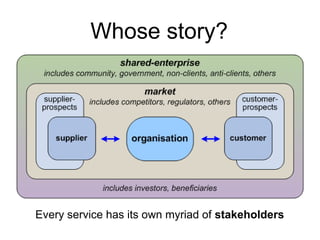
Every service has its own myriad of stakeholders
Whose story?
This work is licensed under the Creative Commons Attribution-ShareAlike 4.0 International License (CC BY-SA 4.0).
To view a copy of this license, visit https://creativecommons.org/licenses/by-sa/4.0/
Tetradian www.tetradian.com
Project By Date
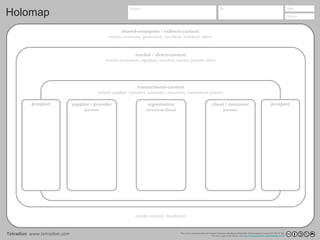
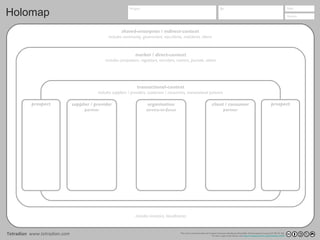
VersionHolomap
shared-enterprise / indirect-context
includes community, government, non-clients, anticlients, others
includes investors, beneficiaries
market / direct-context
includes competitors, regulators, recruiters, trainers, journals, others
transactional-context
includes suppliers / providers, customers / consumers, transactional partners
prospect prospectsupplier / provider
partner
client / consumer
partner
organisation
service-in-focus
Practical #3:
Who are the stakeholders
for your organisation?
Use the Holomap worksheet
to map your understandings
[10 minutes]
Are certain stakeholder-groups
assigned higher priority than others?
#4:
Test existing vision
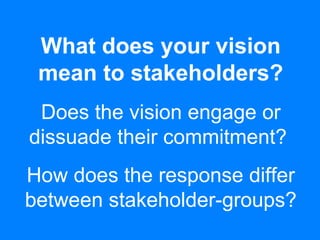
What does your vision
mean to stakeholders?
Does the vision engage or
dissuade their commitment?
How does the response differ
between stakeholder-groups?
…it’s not a wise idea…
Warning:
“the purpose of the system is
[expressed in] what it does”
Without shared-vision as anchor,
what we’d get is a random mix
of POSIWID:
This work is licensed under the Creative Commons Attribution-ShareAlike 4.0 International License (CC BY-SA 4.0).
To view a copy of this license, visit https://creativecommons.org/licenses/by-sa/4.0/
Tetradian www.tetradian.com
Project By Date
VersionHolomap
shared-enterprise / indirect-context
includes community, government, non-clients, anticlients, others
includes investors, beneficiaries
market / direct-context
includes competitors, regulators, recruiters, trainers, journals, others
transactional-context
includes suppliers / providers, customers / consumers, transactional partners
prospect prospectsupplier / provider
partner
client / consumer
partner
organisation
service-in-focus
Practical #4:
Test the current vision
for various stakeholder-groups
Use the same Holomap worksheet
to map your understandings
[5 minutes]
Identify the probable responses / opinions
of each respective stakeholder-group
#5:
Enterprise vision
How do we make the vision
meaningful?
What works best is a three-part ‘story’:
-shared-concern (‘What’)
-action (‘How’)
- qualifier (‘Why’)
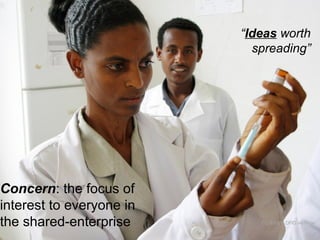
Concern: the focus of
interest to everyone in
the shared-enterprise
“Ideas worth
spreading”
CC-BY UK DFID via Flickr
“Ideas worth spreading”
Action: what is
being done to
or with or about
the concern
CC-BY US Army Africa via Flickr
“Ideas worth
spreading”
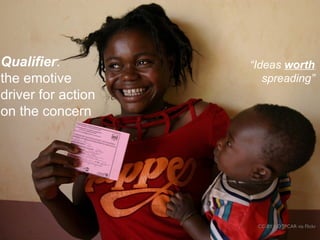
Qualifier:
the emotive
driver for action
on the concern
CC-BY HDTPCAR via Flickr
This vision-story is not about you
or your organisation – it’s about
the shared-enterprise as a whole.
Remember:
(It’s not a sales-pitch...)
This work is licensed under the Creative Commons Attribution-ShareAlike 4.0 International License (CC BY-SA 4.0).
To view a copy of this license, visit https://creativecommons.org/licenses/by-sa/4.0/
Tetradian www.tetradian.com
Project By Date
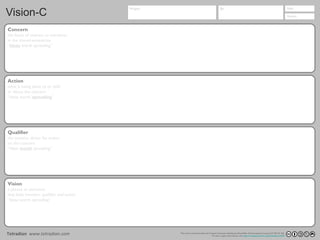
VersionVision-C
Concern
the focus of interest to everyone
in the shared-enterprise
“Ideas worth spreading”
Vision
a phrase or sentence
that links concern, qualifier and action
“Ideas worth spreading”
Qualifier
the emotive driver for action
on the concern
“Ideas worth spreading”
Action
what is being done to or with
or about the concern
“Ideas worth spreading”
Practical #5:
Craft and test three-part vision
for the whole shared-enterprise
Use the Vision worksheet,
test with same Holomap worksheet
[15 minutes]
Compare the responses by stakeholders
to the two different visions
#6:
Values and value
How do we make the vision
actionable?
What values and principles
devolve from this shared-vision?
What criteria would affirm
effectiveness for this vision?
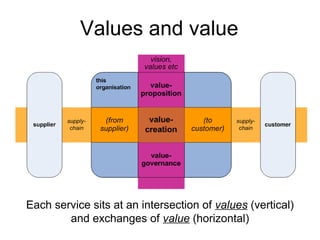
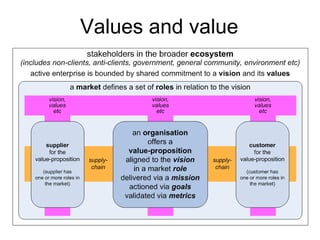
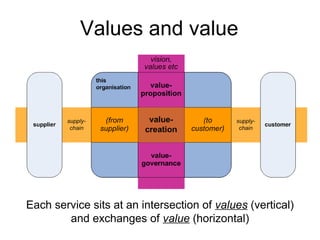
Each service sits at an intersection of values (vertical)
and exchanges of value (horizontal)
Values and value
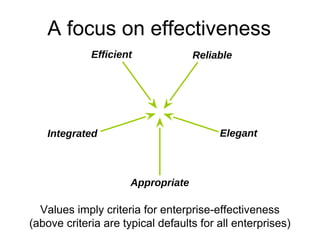
Values imply criteria for enterprise-effectiveness
(above criteria are typical defaults for all enterprises)
A focus on effectiveness
Efficient
Elegant
Appropriate
Integrated
Reliable
This work is licensed under the Creative Commons Attribution-ShareAlike 4.0 International License (CC BY-SA 4.0).
To view a copy of this license, visit https://creativecommons.org/licenses/by-sa/4.0/
Tetradian www.tetradian.com
Project By Date
VersionVision-VVPE
Vision
what phrase connects all stakeholders
in the story of the shared-enterprise?
[from Vision-C worksheet]
Effectiveness-criteria
what criteria do we need to track
to ensure we remain aligned to the vision?
suggested defaults:
- efficient
- reliable
- elegant
- appropriate
- integrated
Principles
what principles are needed to enact the values?
Values
what values underpin the vision?
Practical #6:
Derive values, principles,
effectiveness-criteria
Use the Vision-VVPE worksheet
to note your understandings
[5 minutes]
Identify what is needed to guide decisions
and make the vision actionable in practice
#7:
Value-creation
How do we create value,
for all our stakeholders?
What value-proposition do we
make to the shared-enterprise?
What forms does the value take
for each stakeholder-group?
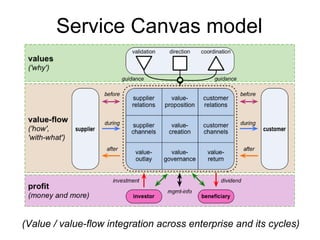
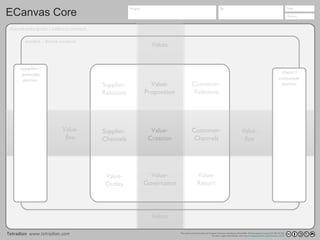
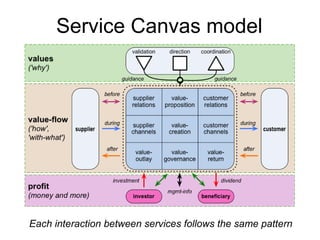
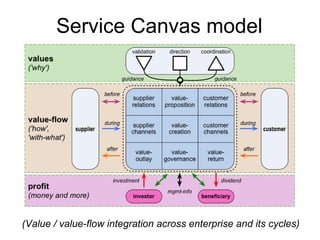
Service Canvas model
(Value / value-flow integration across enterprise and its cycles)
Values and value
This work is licensed under the Creative Commons Attribution-ShareAlike 4.0 International License (CC BY-SA 4.0).
To view a copy of this license, visit https://creativecommons.org/licenses/by-sa/4.0/
Tetradian www.tetradian.com
Project By Date
VersionECanvas Core
shared-enterprise / indirect-context
market / direct-context
Value-
Proposition
Value-
Creation
Value-
Governance
Values
Values
Value-
flow
Value-
flow
Supplier-
Relations
Supplier-
Channels
Value-
Outlay
Customer-
Relations
Customer-
Channels
Value-
Return
supplier /
provider
partner
client /
consumer
partner
Practical #7:
Identify how value is created
for the shared-enterprise
Use the ECanvas Core worksheet
to map your understandings
[15 minutes]
Identify how value-creation aligns to
the promise made in the value-proposition
#8:
Value-flow
How does value flow across
the shared-enterprise?
What drives value-transitions
and value-transforms?
How does each interaction help
to build and maintain trust?
Service Canvas model
Each interaction between services follows the same pattern
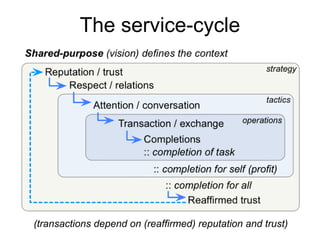
The service-cycle
(transactions depend on (reaffirmed) reputation and trust)
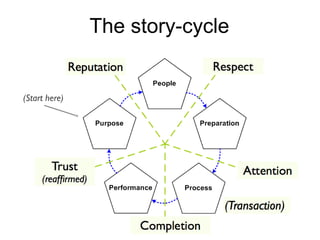
The story-cycle
(Start here)
BUT…
if we try to take short-cuts,
the cycles will break down…
(short-cuts give seemingly-better results in the short-
term, guaranteed failure in the longer-term…)
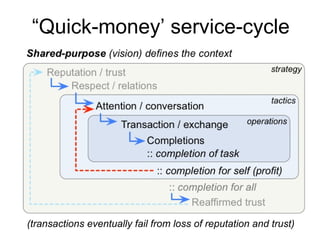
“Quick-money’ service-cycle
(transactions eventually fail from loss of reputation and trust)
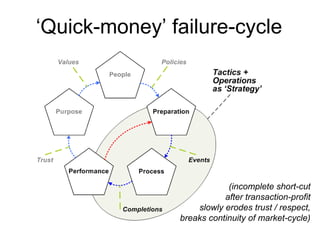
‘Quick-money’ failure-cycle
(incomplete short-cut
after transaction-profit
slowly erodes trust / respect,
breaks continuity of market-cycle)
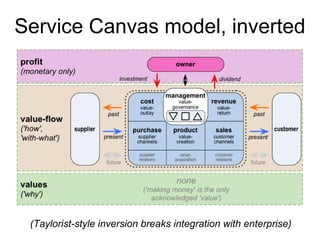
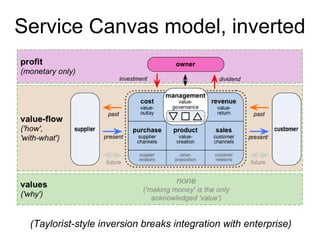
Service Canvas model, inverted
(Taylorist-style inversion breaks integration with enterprise)
This work is licensed under the Creative Commons Attribution-ShareAlike 4.0 International License (CC BY-SA 4.0).
To view a copy of this license, visit https://creativecommons.org/licenses/by-sa/4.0/
Tetradian www.tetradian.com
Project By Date
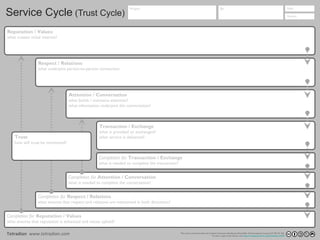
VersionService Cycle (Trust Cycle)
Reputation / Values
what creates initial interest?
Transaction / Exchange
what is provided or exchanged?
what service is delivered?
Attention / Conversation
what builds / maintains attention?
what information underpins the conversation?
Respect / Relations
what underpins person-to-person connection
Completion for Transaction / Exchange
what is needed to complete the transaction?
Completion for Reputation / Values
what ensures that reputation is enhanced and values upheld?
Completion for Respect / Relations
what ensures that respect and relations are maintained in both directions?
Completion for Attention / Conversation
what is needed to complete the conversation?
Trust
how will trust be monitored?
Practical #8:
Identify how value will flow
and build in each interaction
Use the Service Cycle worksheet
to map your understandings
[5 minutes]
Identify how each interaction will serve
to build and maintain mutual-trust
#9:
Validation-services
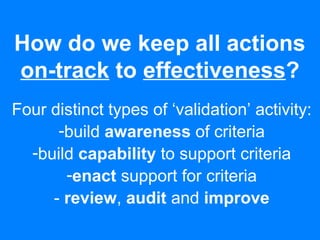
How do we keep all actions
on-track to effectiveness?
Four distinct types of ‘validation’ activity:
-build awareness of criteria
-build capability to support criteria
-enact support for criteria
- review, audit and improve
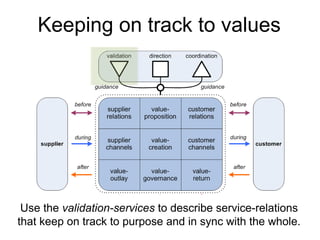
Use the validation-services to describe service-relations
that keep on track to purpose and in sync with the whole.
Keeping on track to values
This work is licensed under the Creative Commons Attribution-ShareAlike 4.0 International License (CC BY-SA 4.0).
To view a copy of this license, visit https://creativecommons.org/licenses/by-sa/4.0/
Tetradian www.tetradian.com
Project By Date
Version
Service Validation (Effectiveness)
Quality / Effectiveness criterion
what is the criterion to review?
[from Vision-VVPE worksheet]
Assess and improve
what reviews and actions are needed
to support validation of compliance
and continual-improvement
for this criterion?
[see 5E-Outcomes worksheet]
Build capability
what information and actions
(training and education)
will build capability
to support this criterion?
Build awareness
what information and actions
will build awareness that this criterion
is important to the enterprise?
Enact and record
what actions need to happen
to support this criterion
in run-time action?
what information must be gathered
to support assessment and review?
Practical #9:
Identify how effectiveness
will be supported in each action
Use the Service Validation worksheet
to map your understandings
[15 minutes]
Identify support for awareness, capability,
run-time action and continual-improvement
#10:
Value-governance
How do we satisfy
all of our stakeholders?
What inputs, transforms, outputs
of value would apply to each?
How do we maintain balance
across the shared-enterprise?
Each service sits at an intersection of values (vertical)
and exchanges of value (horizontal)
Values and value
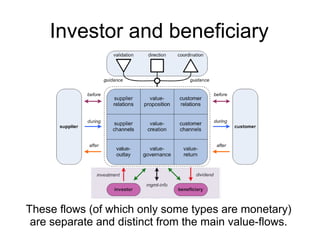
These flows (of which only some types are monetary)
are separate and distinct from the main value-flows.
Investor and beneficiary
Service Canvas model
(Value / value-flow integration across enterprise and its cycles)
Service Canvas model, inverted
(Taylorist-style inversion breaks integration with enterprise)
This work is licensed under the Creative Commons Attribution-ShareAlike 4.0 International License (CC BY-SA 4.0).
To view a copy of this license, visit https://creativecommons.org/licenses/by-sa/4.0/
Tetradian www.tetradian.com
Project By Date
Version
shared-enterprise
/ indirect-context
market
/ direct-context
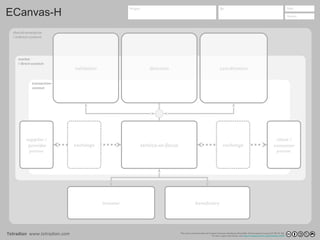
ECanvas-H
transaction-
context
service-in-focus
supplier /
provider
partner
client /
consumer
partner
validation coordinationdirection
investor beneficiary
exchange exchange
Practical #10:
Identify how investments and
benefits will flow and balance
Use the ECanvas-H worksheet
to map your understandings
[15 minutes]
Identify what is needed to balance the
relations and priorities of all stakeholders.
‘Making money’ is a side-effect
from being on-track to values.
Always start from
values,
not money.
If we focus on money,
we lose track of value.
If we focus on the ‘how’ of value,
we lose track of the ‘why’ of values.
Always start from the values.
(Not the money.)
Wrap-up
What have you learnt
from this?
Any comments or questions?
How will you apply this
in your work-context?
Workshop overview
1. Meaning of ‘value’
2. Current organisational vision
3. Identify stakeholders
4. Test the current vision
5. Shared-enterprise vision
6. Values and value
7. Value-creation
8. Value-flow
9. Validation-services
10. Value-governance
Thank you!
Contact: Tom Graves
Company: Tetradian Consulting
Email: tom@tetradian.com
Twitter: @tetradian ( http://twitter.com/tetradian )
Weblog: http://weblog.tetradian.com
Slidedecks: http://www.slideshare.net/tetradian
Publications: http://tetradianbooks.com and http://leanpub.com/u/tetradian
Books: • The enterprise as story: the role of narrative in enterprise-
architecture (2012)
• Mapping the enterprise: modelling the enterprise as
services with the Enterprise Canvas (2010)
• Everyday enterprise-architecture: sensemaking, strategy,
structures and solutions (2010)
• Doing enterprise-architecture: process and practice in the
real enterprise (2009)
Further information:
IASA / ICS Dublin workshop 'Tracking value in the enterprise'

IASA / ICS Dublin workshop 'Tracking value in the enterprise'

  • 1.
    Workshop on Applying asystems approach to money (Tracking value in the enterprise) Tom Graves, Tetradian Consulting IASA, Dublin, June 2017
  • 2.
    Hi. I’m Tom Graves. (don’tworry, I’m vaguely human…)
  • 3.
  • 4.
    Actually, let’s nottalk about money...
  • 5.
    ‘Making money’ isa side-effect from being on-track to values. Always start from values, not money.
  • 6.
    Workshop overview 1. Meaningof ‘value’ 2. Current organisational vision 3. Identify stakeholders 4. Test the current vision 5. Shared-enterprise vision 6. Values and value 7. Value-creation 8. Value-flow 9. Validation-services 10. Value-governance
  • 7.
  • 8.
    What is ‘value’? Is‘value’ the same as ‘money’? Can we measure every value in terms of money?
  • 9.
    This work islicensed under the Creative Commons Attribution-ShareAlike 4.0 International License (CC BY-SA 4.0). To view a copy of this license, visit https://creativecommons.org/licenses/by-sa/4.0/ Tetradian www.tetradian.com Project By Date VersionWorksheet
  • 10.
    Practical #1: What, toyou, is meant by the term ‘Value’? Use the standard worksheet to note your understandings [5 minutes] To what extent are ‘Money’ and ‘Value’ regarded as synonyms in your enterprise?
  • 11.
  • 12.
    What is ‘vision’? Doesyour organisation have a distinct vision? Is ‘mission’ the same as ‘vision’?
  • 13.
    This work islicensed under the Creative Commons Attribution-ShareAlike 4.0 International License (CC BY-SA 4.0). To view a copy of this license, visit https://creativecommons.org/licenses/by-sa/4.0/ Tetradian www.tetradian.com Project By Date VersionWorksheet
  • 14.
    Practical #2: What isthe current vision for your organisation? Use the standard worksheet to note your understandings [5 minutes] Is there any vision? Do you know it? Where is this described, for whom?
  • 15.
  • 16.
    Who are stakeholders? Howdo you identify those stakeholders? How might each of these affect your organisation?
  • 17.
    A stakeholder is anyone whocan wield a sharp-pointed stake in our direction… CC-BY-NC-SA evilpeacock via Flickr Who are the stakeholders? (Hint: there are a lot more of them than we might at first think…)
  • 18.
    Every service hasits own myriad of stakeholders Whose story?
  • 19.
    This work islicensed under the Creative Commons Attribution-ShareAlike 4.0 International License (CC BY-SA 4.0). To view a copy of this license, visit https://creativecommons.org/licenses/by-sa/4.0/ Tetradian www.tetradian.com Project By Date VersionHolomap shared-enterprise / indirect-context includes community, government, non-clients, anticlients, others includes investors, beneficiaries market / direct-context includes competitors, regulators, recruiters, trainers, journals, others transactional-context includes suppliers / providers, customers / consumers, transactional partners prospect prospectsupplier / provider partner client / consumer partner organisation service-in-focus
  • 20.
    Practical #3: Who arethe stakeholders for your organisation? Use the Holomap worksheet to map your understandings [10 minutes] Are certain stakeholder-groups assigned higher priority than others?
  • 21.
  • 22.
    What does yourvision mean to stakeholders? Does the vision engage or dissuade their commitment? How does the response differ between stakeholder-groups?
  • 23.
    …it’s not awise idea… Warning: “the purpose of the system is [expressed in] what it does” Without shared-vision as anchor, what we’d get is a random mix of POSIWID:
  • 24.
    This work islicensed under the Creative Commons Attribution-ShareAlike 4.0 International License (CC BY-SA 4.0). To view a copy of this license, visit https://creativecommons.org/licenses/by-sa/4.0/ Tetradian www.tetradian.com Project By Date VersionHolomap shared-enterprise / indirect-context includes community, government, non-clients, anticlients, others includes investors, beneficiaries market / direct-context includes competitors, regulators, recruiters, trainers, journals, others transactional-context includes suppliers / providers, customers / consumers, transactional partners prospect prospectsupplier / provider partner client / consumer partner organisation service-in-focus
  • 25.
    Practical #4: Test thecurrent vision for various stakeholder-groups Use the same Holomap worksheet to map your understandings [5 minutes] Identify the probable responses / opinions of each respective stakeholder-group
  • 26.
  • 27.
    How do wemake the vision meaningful? What works best is a three-part ‘story’: -shared-concern (‘What’) -action (‘How’) - qualifier (‘Why’)
  • 28.
    Concern: the focusof interest to everyone in the shared-enterprise “Ideas worth spreading” CC-BY UK DFID via Flickr
  • 29.
    “Ideas worth spreading” Action:what is being done to or with or about the concern CC-BY US Army Africa via Flickr
  • 30.
    “Ideas worth spreading” Qualifier: the emotive driverfor action on the concern CC-BY HDTPCAR via Flickr
  • 31.
    This vision-story isnot about you or your organisation – it’s about the shared-enterprise as a whole. Remember: (It’s not a sales-pitch...)
  • 32.
    This work islicensed under the Creative Commons Attribution-ShareAlike 4.0 International License (CC BY-SA 4.0). To view a copy of this license, visit https://creativecommons.org/licenses/by-sa/4.0/ Tetradian www.tetradian.com Project By Date VersionVision-C Concern the focus of interest to everyone in the shared-enterprise “Ideas worth spreading” Vision a phrase or sentence that links concern, qualifier and action “Ideas worth spreading” Qualifier the emotive driver for action on the concern “Ideas worth spreading” Action what is being done to or with or about the concern “Ideas worth spreading”
  • 33.
    Practical #5: Craft andtest three-part vision for the whole shared-enterprise Use the Vision worksheet, test with same Holomap worksheet [15 minutes] Compare the responses by stakeholders to the two different visions
  • 34.
  • 35.
    How do wemake the vision actionable? What values and principles devolve from this shared-vision? What criteria would affirm effectiveness for this vision?
  • 36.
    Each service sitsat an intersection of values (vertical) and exchanges of value (horizontal) Values and value
  • 37.
    Values imply criteriafor enterprise-effectiveness (above criteria are typical defaults for all enterprises) A focus on effectiveness Efficient Elegant Appropriate Integrated Reliable
  • 38.
    This work islicensed under the Creative Commons Attribution-ShareAlike 4.0 International License (CC BY-SA 4.0). To view a copy of this license, visit https://creativecommons.org/licenses/by-sa/4.0/ Tetradian www.tetradian.com Project By Date VersionVision-VVPE Vision what phrase connects all stakeholders in the story of the shared-enterprise? [from Vision-C worksheet] Effectiveness-criteria what criteria do we need to track to ensure we remain aligned to the vision? suggested defaults: - efficient - reliable - elegant - appropriate - integrated Principles what principles are needed to enact the values? Values what values underpin the vision?
  • 39.
    Practical #6: Derive values,principles, effectiveness-criteria Use the Vision-VVPE worksheet to note your understandings [5 minutes] Identify what is needed to guide decisions and make the vision actionable in practice
  • 40.
  • 41.
    How do wecreate value, for all our stakeholders? What value-proposition do we make to the shared-enterprise? What forms does the value take for each stakeholder-group?
  • 42.
    Service Canvas model (Value/ value-flow integration across enterprise and its cycles)
  • 43.
  • 44.
    This work islicensed under the Creative Commons Attribution-ShareAlike 4.0 International License (CC BY-SA 4.0). To view a copy of this license, visit https://creativecommons.org/licenses/by-sa/4.0/ Tetradian www.tetradian.com Project By Date VersionECanvas Core shared-enterprise / indirect-context market / direct-context Value- Proposition Value- Creation Value- Governance Values Values Value- flow Value- flow Supplier- Relations Supplier- Channels Value- Outlay Customer- Relations Customer- Channels Value- Return supplier / provider partner client / consumer partner
  • 45.
    Practical #7: Identify howvalue is created for the shared-enterprise Use the ECanvas Core worksheet to map your understandings [15 minutes] Identify how value-creation aligns to the promise made in the value-proposition
  • 46.
  • 47.
    How does valueflow across the shared-enterprise? What drives value-transitions and value-transforms? How does each interaction help to build and maintain trust?
  • 48.
    Service Canvas model Eachinteraction between services follows the same pattern
  • 49.
    The service-cycle (transactions dependon (reaffirmed) reputation and trust)
  • 50.
  • 51.
    BUT… if we tryto take short-cuts, the cycles will break down… (short-cuts give seemingly-better results in the short- term, guaranteed failure in the longer-term…)
  • 52.
    “Quick-money’ service-cycle (transactions eventuallyfail from loss of reputation and trust)
  • 53.
    ‘Quick-money’ failure-cycle (incomplete short-cut aftertransaction-profit slowly erodes trust / respect, breaks continuity of market-cycle)
  • 54.
    Service Canvas model,inverted (Taylorist-style inversion breaks integration with enterprise)
  • 55.
    This work islicensed under the Creative Commons Attribution-ShareAlike 4.0 International License (CC BY-SA 4.0). To view a copy of this license, visit https://creativecommons.org/licenses/by-sa/4.0/ Tetradian www.tetradian.com Project By Date VersionService Cycle (Trust Cycle) Reputation / Values what creates initial interest? Transaction / Exchange what is provided or exchanged? what service is delivered? Attention / Conversation what builds / maintains attention? what information underpins the conversation? Respect / Relations what underpins person-to-person connection Completion for Transaction / Exchange what is needed to complete the transaction? Completion for Reputation / Values what ensures that reputation is enhanced and values upheld? Completion for Respect / Relations what ensures that respect and relations are maintained in both directions? Completion for Attention / Conversation what is needed to complete the conversation? Trust how will trust be monitored?
  • 56.
    Practical #8: Identify howvalue will flow and build in each interaction Use the Service Cycle worksheet to map your understandings [5 minutes] Identify how each interaction will serve to build and maintain mutual-trust
  • 57.
  • 58.
    How do wekeep all actions on-track to effectiveness? Four distinct types of ‘validation’ activity: -build awareness of criteria -build capability to support criteria -enact support for criteria - review, audit and improve
  • 59.
    Use the validation-servicesto describe service-relations that keep on track to purpose and in sync with the whole. Keeping on track to values
  • 60.
    This work islicensed under the Creative Commons Attribution-ShareAlike 4.0 International License (CC BY-SA 4.0). To view a copy of this license, visit https://creativecommons.org/licenses/by-sa/4.0/ Tetradian www.tetradian.com Project By Date Version Service Validation (Effectiveness) Quality / Effectiveness criterion what is the criterion to review? [from Vision-VVPE worksheet] Assess and improve what reviews and actions are needed to support validation of compliance and continual-improvement for this criterion? [see 5E-Outcomes worksheet] Build capability what information and actions (training and education) will build capability to support this criterion? Build awareness what information and actions will build awareness that this criterion is important to the enterprise? Enact and record what actions need to happen to support this criterion in run-time action? what information must be gathered to support assessment and review?
  • 61.
    Practical #9: Identify howeffectiveness will be supported in each action Use the Service Validation worksheet to map your understandings [15 minutes] Identify support for awareness, capability, run-time action and continual-improvement
  • 62.
  • 63.
    How do wesatisfy all of our stakeholders? What inputs, transforms, outputs of value would apply to each? How do we maintain balance across the shared-enterprise?
  • 64.
    Each service sitsat an intersection of values (vertical) and exchanges of value (horizontal) Values and value
  • 65.
    These flows (ofwhich only some types are monetary) are separate and distinct from the main value-flows. Investor and beneficiary
  • 66.
    Service Canvas model (Value/ value-flow integration across enterprise and its cycles)
  • 67.
    Service Canvas model,inverted (Taylorist-style inversion breaks integration with enterprise)
  • 68.
    This work islicensed under the Creative Commons Attribution-ShareAlike 4.0 International License (CC BY-SA 4.0). To view a copy of this license, visit https://creativecommons.org/licenses/by-sa/4.0/ Tetradian www.tetradian.com Project By Date Version shared-enterprise / indirect-context market / direct-context ECanvas-H transaction- context service-in-focus supplier / provider partner client / consumer partner validation coordinationdirection investor beneficiary exchange exchange
  • 69.
    Practical #10: Identify howinvestments and benefits will flow and balance Use the ECanvas-H worksheet to map your understandings [15 minutes] Identify what is needed to balance the relations and priorities of all stakeholders.
  • 70.
    ‘Making money’ isa side-effect from being on-track to values. Always start from values, not money.
  • 71.
    If we focuson money, we lose track of value. If we focus on the ‘how’ of value, we lose track of the ‘why’ of values. Always start from the values. (Not the money.)
  • 72.
  • 73.
    What have youlearnt from this? Any comments or questions? How will you apply this in your work-context?
  • 74.
    Workshop overview 1. Meaningof ‘value’ 2. Current organisational vision 3. Identify stakeholders 4. Test the current vision 5. Shared-enterprise vision 6. Values and value 7. Value-creation 8. Value-flow 9. Validation-services 10. Value-governance
  • 75.
  • 76.
    Contact: Tom Graves Company:Tetradian Consulting Email: tom@tetradian.com Twitter: @tetradian ( http://twitter.com/tetradian ) Weblog: http://weblog.tetradian.com Slidedecks: http://www.slideshare.net/tetradian Publications: http://tetradianbooks.com and http://leanpub.com/u/tetradian Books: • The enterprise as story: the role of narrative in enterprise- architecture (2012) • Mapping the enterprise: modelling the enterprise as services with the Enterprise Canvas (2010) • Everyday enterprise-architecture: sensemaking, strategy, structures and solutions (2010) • Doing enterprise-architecture: process and practice in the real enterprise (2009) Further information: