How to build continuous-learning
into architecture practice
Tom Graves, Tetradian Consulting
BCS EASG Conference, London, 2017
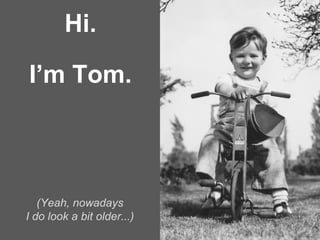
Hi.
(Yeah, nowadays
I do look a bit older...)
I’m Tom.
These days
I’d describe myself as
a maker of tools for change
(more on that in a moment...)
Sales-
pitch!
https://leanpub.com/tb-changes/
New
book!
Anyway, that’s enough intro
– let’s get on with the show...
If architecture
is a skill...
...how do we get better
at doing that skill?
A two-part answer:
...linked with
continuous review / learning
Practice, practice, practice!
Perhaps I can’t help much
on the fine-details of practice...
...but I can help
with the continuous learning
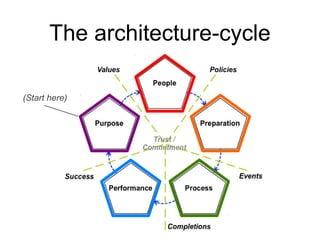
The architecture-cycle
(Start here)
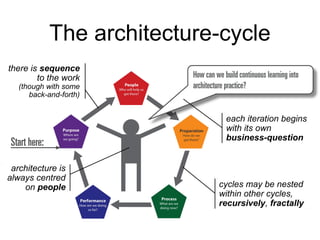
The architecture-cycle
architecture is
always centred
on people
there is sequence
to the work
(though with some
back-and-forth)
each iteration begins
with its own
business-question
cycles may be nested
within other cycles,
recursively, fractally
…closes the loop
from Performance back to Purpose
and onward to the next iteration
Continuous learning…
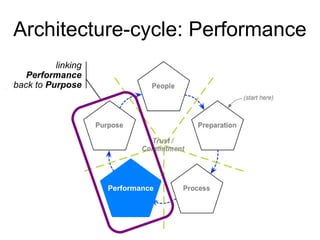
Architecture-cycle: Performance
linking
Performance
back to Purpose
Performance
…is on benefits-realised
and lessons-learned.
Focus for Performance phase…
We can do this via a practice based on
US Army After Action Review…
https://en.wikipedia.org/wiki/After-action_review
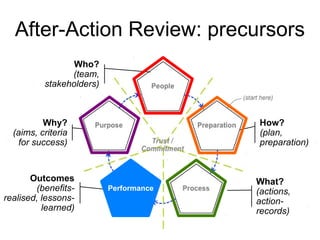
After-Action Review: precursors
How?
(plan,
preparation)
What?
(actions,
action-
records)
Outcomes
(benefits-
realised, lessons-
learned)
Why?
(aims, criteria
for success)
Who?
(team,
stakeholders)
Performance
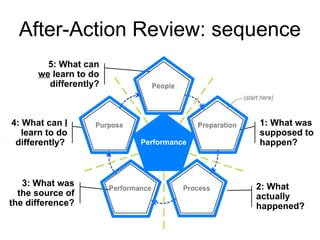
After-Action Review: sequence
1: What was
supposed to
happen?
2: What
actually
happened?
3: What was
the source of
the difference?
4: What can I
learn to do
differently?
5: What can
we learn to do
differently?
Performance
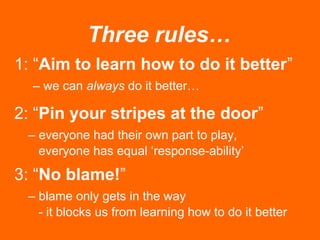
2: “Pin your stripes at the door”
– everyone had their own part to play,
everyone has equal ‘response-ability’
Three rules…
1: “Aim to learn how to do it better”
– we can always do it better…
3: “No blame!”
– blame only gets in the way
- it blocks us from learning how to do it better
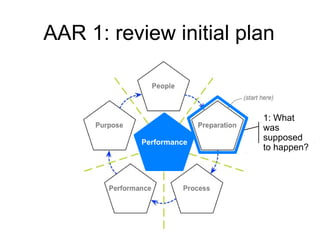
AAR 1: review initial plan
1: What
was
supposed
to happen?
Performance
“What was supposed to happen?”
Step 1…
Derive this from the Preparation stage
of the cycle
(should be ~10% of allotted time for review)
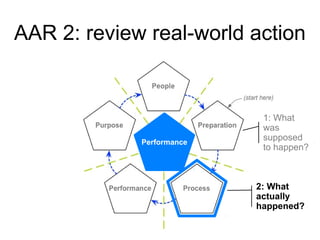
AAR 2: review real-world action
1: What
was
supposed
to happen?
2: What
actually
happened?
Performance
“What actually happened?”
Step 2…
Derive this from the Process stage
of the cycle
(should be ~10% of allotted review-time)
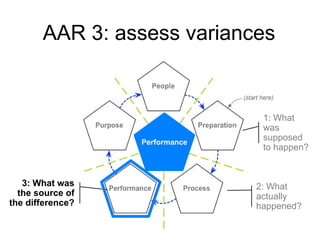
AAR 3: assess variances
1: What
was
supposed
to happen?
2: What
actually
happened?
3: What was
the source of
the difference?
Performance
“What caused the differences?”
Step 3…
Discuss the differences between plan
and actual outcomes – look for what
worked unexpectedly-well as much as
for what ‘went wrong’
(should be ~20% of allotted review-time)
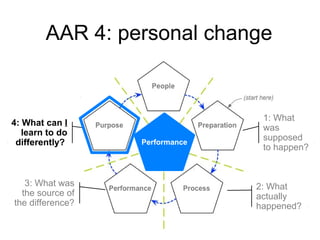
AAR 4: personal change
1: What
was
supposed
to happen?
2: What
actually
happened?
3: What was
the source of
the difference?
4: What can I
learn to do
differently? Performance
“What can I do differently?”
Step 4…
Discuss options to improve individuals’
skills, knowledge, experience and
engagement in shared-purpose – and
commitments to changes that would
be needed to implement those options
(should be ~20-30% of allotted review-time)
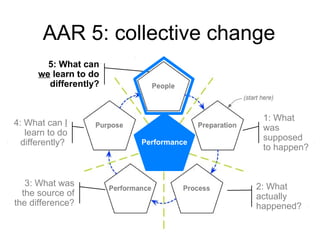
AAR 5: collective change
1: What
was
supposed
to happen?
2: What
actually
happened?
3: What was
the source of
the difference?
4: What can I
learn to do
differently?
5: What can
we learn to do
differently?
Performance
“What can we do differently?”
Step 5…
Discuss options to improve working
together as a team or collective – and
commitments to changes that would
be needed to implement those options
(should be ~20-30% of allotted review-time)
This work is licensed under the Creative Commons Attribution-ShareAlike 4.0 International License (CC BY-SA 4.0).
To view a copy of this license, visit https://creativecommons.org/licenses/by-sa/4.0/
Tetradian www.tetradian.com
Project By Date
Version
5E-Outcomes (Performance)
Core question and criteria for success
what is the core-question for this iteration? how will we know when we succeed?
[from 5E-Why worksheet]
Difference
what were the sources of difference
between Intent and Action?
[from 5E-AAR worksheet}
Action
what actually happened?
[from 5E-What worksheet]
Intent
what was supposed to happen?
[from 5E-How worksheet]
Actors and stakeholders
who are the key players for this iteration in this context?
[from 5E-Who worksheet]
Learnings and action - personal
what did we each learn from this?
what could we each do differently next time?
[from 5E-AAR worksheet}
Learnings and action - group
what did we learn from this, as a group?
what could we do differently as a group?
[from 5E-AAR worksheet}
This work is licensed under the Creative Commons Attribution-ShareAlike 4.0 International License (CC BY-SA 4.0).
To view a copy of this license, visit https://creativecommons.org/licenses/by-sa/4.0/
Tetradian www.tetradian.com
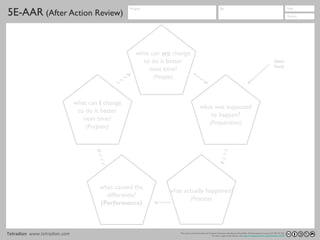
Project By Date
Version
what caused the
difference?
(Performance)
what can I change
to do it better
next time?
(Purpose)
what can we change
to do it better
next time?
(People)
what was supposed
to happen?
(Preparation)
what actually happened?
(Process)
5E-AAR (After Action Review)
(Start
here)
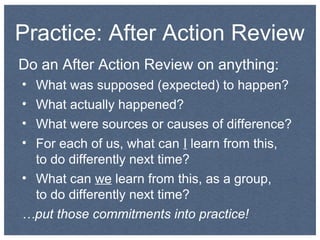
Practice: After Action Review
Do an After Action Review on anything:
• What was supposed (expected) to happen?
• What actually happened?
• What were sources or causes of difference?
• For each of us, what can I learn from this,
to do differently next time?
• What can we learn from this, as a group,
to do differently next time?
…put those commitments into practice!
What have you learnt
from this?
...what will you do differently
for continuous-learning
in your architecture-work?
Thank you!
Contact: Tom Graves
Company: Tetradian Consulting
Email: tom@tetradian.com
Twitter: @tetradian ( http://twitter.com/tetradian )
Weblog: http://weblog.tetradian.com
Slidedecks: http://www.slideshare.net/tetradian
Publications: http://tetradianbooks.com and http://leanpub.com/u/tetradian
Books: • The enterprise as story: the role of narrative in enterprise-
architecture (2012)
• Mapping the enterprise: modelling the enterprise as
services with the Enterprise Canvas (2010)
• Everyday enterprise-architecture: sensemaking, strategy,
structures and solutions (2010)
• Doing enterprise-architecture: process and practice in the
real enterprise (2009)
Further information:

How to build continuous-learning into architecture-practice

  • 1.
    How to buildcontinuous-learning into architecture practice Tom Graves, Tetradian Consulting BCS EASG Conference, London, 2017
  • 2.
    Hi. (Yeah, nowadays I dolook a bit older...) I’m Tom.
  • 3.
    These days I’d describemyself as a maker of tools for change (more on that in a moment...)
  • 4.
  • 5.
    Anyway, that’s enoughintro – let’s get on with the show...
  • 6.
    If architecture is askill... ...how do we get better at doing that skill?
  • 7.
    A two-part answer: ...linkedwith continuous review / learning Practice, practice, practice!
  • 8.
    Perhaps I can’thelp much on the fine-details of practice... ...but I can help with the continuous learning
  • 9.
  • 10.
    The architecture-cycle architecture is alwayscentred on people there is sequence to the work (though with some back-and-forth) each iteration begins with its own business-question cycles may be nested within other cycles, recursively, fractally
  • 11.
    …closes the loop fromPerformance back to Purpose and onward to the next iteration Continuous learning…
  • 12.
  • 13.
    …is on benefits-realised andlessons-learned. Focus for Performance phase… We can do this via a practice based on US Army After Action Review… https://en.wikipedia.org/wiki/After-action_review
  • 14.
    After-Action Review: precursors How? (plan, preparation) What? (actions, action- records) Outcomes (benefits- realised,lessons- learned) Why? (aims, criteria for success) Who? (team, stakeholders) Performance
  • 15.
    After-Action Review: sequence 1:What was supposed to happen? 2: What actually happened? 3: What was the source of the difference? 4: What can I learn to do differently? 5: What can we learn to do differently? Performance
  • 16.
    2: “Pin yourstripes at the door” – everyone had their own part to play, everyone has equal ‘response-ability’ Three rules… 1: “Aim to learn how to do it better” – we can always do it better… 3: “No blame!” – blame only gets in the way - it blocks us from learning how to do it better
  • 17.
    AAR 1: reviewinitial plan 1: What was supposed to happen? Performance
  • 18.
    “What was supposedto happen?” Step 1… Derive this from the Preparation stage of the cycle (should be ~10% of allotted time for review)
  • 19.
    AAR 2: reviewreal-world action 1: What was supposed to happen? 2: What actually happened? Performance
  • 20.
    “What actually happened?” Step2… Derive this from the Process stage of the cycle (should be ~10% of allotted review-time)
  • 21.
    AAR 3: assessvariances 1: What was supposed to happen? 2: What actually happened? 3: What was the source of the difference? Performance
  • 22.
    “What caused thedifferences?” Step 3… Discuss the differences between plan and actual outcomes – look for what worked unexpectedly-well as much as for what ‘went wrong’ (should be ~20% of allotted review-time)
  • 23.
    AAR 4: personalchange 1: What was supposed to happen? 2: What actually happened? 3: What was the source of the difference? 4: What can I learn to do differently? Performance
  • 24.
    “What can Ido differently?” Step 4… Discuss options to improve individuals’ skills, knowledge, experience and engagement in shared-purpose – and commitments to changes that would be needed to implement those options (should be ~20-30% of allotted review-time)
  • 25.
    AAR 5: collectivechange 1: What was supposed to happen? 2: What actually happened? 3: What was the source of the difference? 4: What can I learn to do differently? 5: What can we learn to do differently? Performance
  • 26.
    “What can wedo differently?” Step 5… Discuss options to improve working together as a team or collective – and commitments to changes that would be needed to implement those options (should be ~20-30% of allotted review-time)
  • 27.
    This work islicensed under the Creative Commons Attribution-ShareAlike 4.0 International License (CC BY-SA 4.0). To view a copy of this license, visit https://creativecommons.org/licenses/by-sa/4.0/ Tetradian www.tetradian.com Project By Date Version 5E-Outcomes (Performance) Core question and criteria for success what is the core-question for this iteration? how will we know when we succeed? [from 5E-Why worksheet] Difference what were the sources of difference between Intent and Action? [from 5E-AAR worksheet} Action what actually happened? [from 5E-What worksheet] Intent what was supposed to happen? [from 5E-How worksheet] Actors and stakeholders who are the key players for this iteration in this context? [from 5E-Who worksheet] Learnings and action - personal what did we each learn from this? what could we each do differently next time? [from 5E-AAR worksheet} Learnings and action - group what did we learn from this, as a group? what could we do differently as a group? [from 5E-AAR worksheet}
  • 28.
    This work islicensed under the Creative Commons Attribution-ShareAlike 4.0 International License (CC BY-SA 4.0). To view a copy of this license, visit https://creativecommons.org/licenses/by-sa/4.0/ Tetradian www.tetradian.com Project By Date Version what caused the difference? (Performance) what can I change to do it better next time? (Purpose) what can we change to do it better next time? (People) what was supposed to happen? (Preparation) what actually happened? (Process) 5E-AAR (After Action Review) (Start here)
  • 29.
    Practice: After ActionReview Do an After Action Review on anything: • What was supposed (expected) to happen? • What actually happened? • What were sources or causes of difference? • For each of us, what can I learn from this, to do differently next time? • What can we learn from this, as a group, to do differently next time? …put those commitments into practice!
  • 30.
    What have youlearnt from this? ...what will you do differently for continuous-learning in your architecture-work?
  • 31.
  • 32.
    Contact: Tom Graves Company:Tetradian Consulting Email: tom@tetradian.com Twitter: @tetradian ( http://twitter.com/tetradian ) Weblog: http://weblog.tetradian.com Slidedecks: http://www.slideshare.net/tetradian Publications: http://tetradianbooks.com and http://leanpub.com/u/tetradian Books: • The enterprise as story: the role of narrative in enterprise- architecture (2012) • Mapping the enterprise: modelling the enterprise as services with the Enterprise Canvas (2010) • Everyday enterprise-architecture: sensemaking, strategy, structures and solutions (2010) • Doing enterprise-architecture: process and practice in the real enterprise (2009) Further information: