






the futures of business

Same and different

architectures for mass-uniqueness
Tom Graves, Tetradian Consulting
Open Group London, October 2013
Hi.

(let’s not bother with the PR-stuff?)
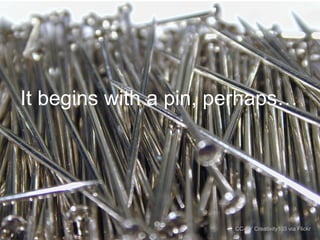
It begins with a pin, perhaps…

CC-BY Creativity103 via Flickr
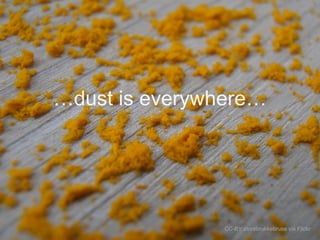
…or maybe some dust?

CC-BY storebrukkebruse via Flickr
But perhaps better start with
a much-argued question:

What is
enterprise-architecture?
Maybe more to the point –

why enterprise-architecture?
Why enterprise-architecture?
– it’s because

things work better
when they work together,
on purpose
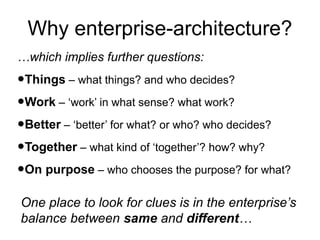
Why enterprise-architecture?
…which implies further questions:

•Things – what things? and who decides?
•Work – ‘work’ in what sense? what work?
•Better – ‘better’ for what? or who? who decides?
•Together – what kind of ‘together’? how? why?
•On purpose – who chooses the purpose? for what?
One place to look for clues is in the enterprise’s
balance between same and different…
Into practice…
(Each ‘Into practice…’ section
provides a brief moment to explore
implications of the preceding ideas.
Use the text on the slide to guide
a quick review of related design-themes
in your business-context.)
“What’s the story?”

A quest for productivity
Let’s go back to an earlier time…
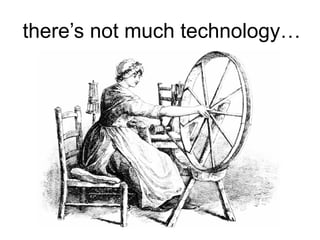
there’s not much technology…
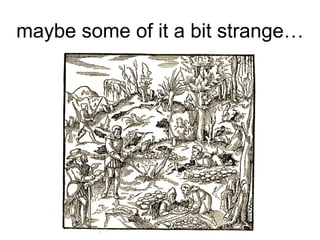
maybe some of it a bit strange…
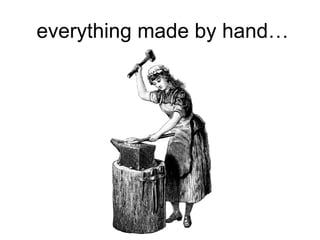
everything made by hand…
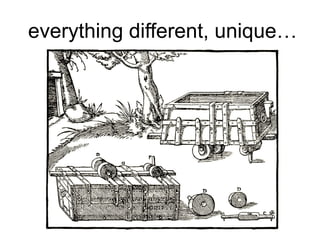
everything different, unique…
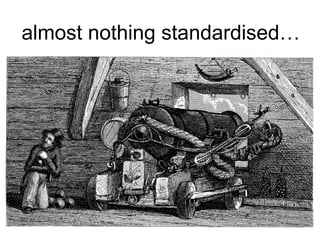
almost nothing standardised…
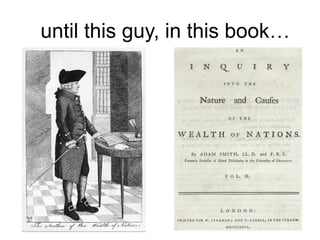
until this guy, in this book…
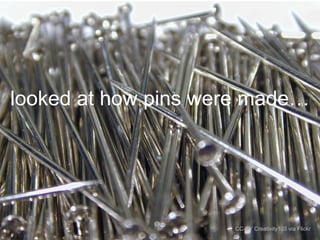
looked at how pins were made…

CC-BY Creativity103 via Flickr
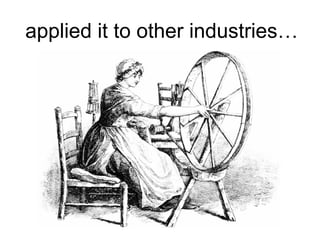
applied it to other industries…
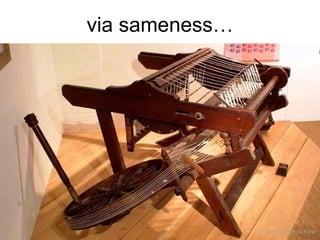
via sameness…

CC-BY toktokkie via Flickr
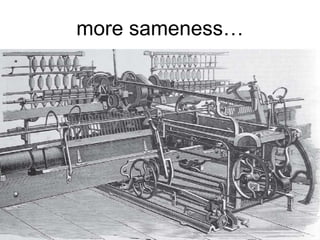
more sameness…
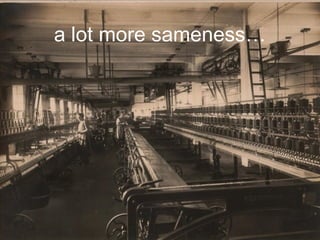
a lot more sameness…
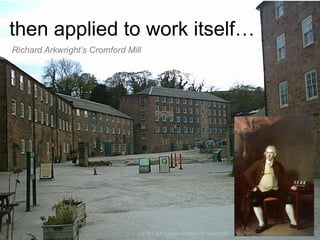
then applied to work itself…
Richard Arkwright’s Cromford Mill

CC-BY-SA CaptainScarlet via Wikimedia
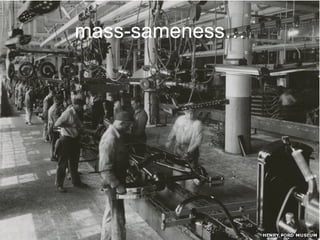
mass-sameness…
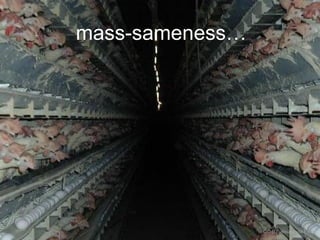
mass-sameness…

CC-BY aleutia via Flickr
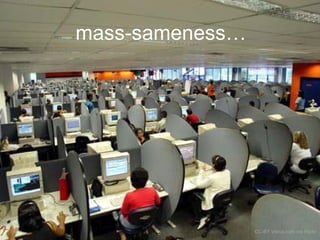
mass-sameness…

CC-BY Vlima.com via Flickr
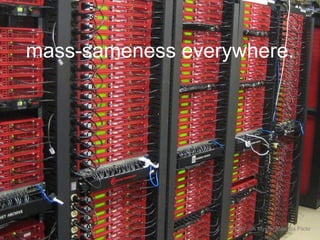
mass-sameness everywhere.

CC-BY-SA MysteryBee via Flickr
Why sameness?
the real value of sameness
is that it’s easy to scale
and easy to make efficient
- creating huge productivity
But there’s a catch…
the differences
never went away…
and if we pretend
that everything
is sameness…
we court disaster…
Into practice…
In what ways do your systems
depend on sameness?
What would happen
if the sameness wasn’t there
to depend on?
What happens with anything
that won’t fit those expectations?
“What’s the story?”
There’s always an
exception…
What name in your system?
Typical UK-style name-structure for database:

•Title (mandatory: select from picklist)
•Forename (mandatory: 30 characters max)
•Middle-name (optional: 30 characters max)
•Surname (mandatory: 30 characters max)
•Suffix (optional: select from picklist)
Easy, right? – well, let’s take a real example…
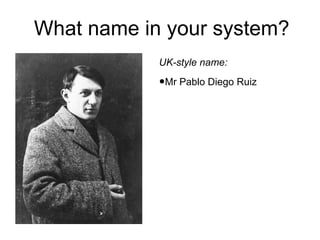
What name in your system?
UK-style name:

•Mr Pablo Diego Ruiz
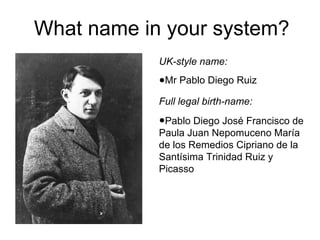
What name in your system?
UK-style name:

•Mr Pablo Diego Ruiz
Full legal birth-name:

•Pablo Diego José Francisco de
Paula Juan Nepomuceno María
de los Remedios Cipriano de la
Santísima Trinidad Ruiz y
Picasso
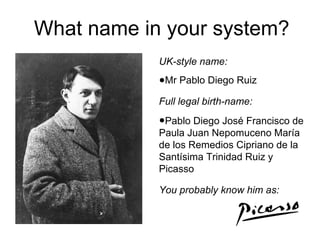
What name in your system?
UK-style name:

•Mr Pablo Diego Ruiz
Full legal birth-name:

•Pablo Diego José Francisco de
Paula Juan Nepomuceno María
de los Remedios Cipriano de la
Santísima Trinidad Ruiz y
Picasso
You probably know him as:
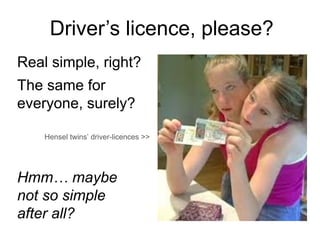
Driver’s licence, please?
Real simple, right?
The same for
everyone, surely?
Hensel twins’ driver-licences >>

Hmm… maybe
not so simple
after all?
Driver’s licence, please?
In the car: Two drivers behind
the wheel, each legally liable

On the flight: One ticket, one seat,
two passengers, two passports
What keeps executives awake at
night?

And here’s a real case
from my own consultancy-work
in enterprise-architecture…
Executive #1: PR
disasters
Government department
(in social-work sector)
Real (if unofficial) business metric:

Number of days
between bad headlines
in the newspaper
Executive #1: PR
disasters
Real newspaper headline:
Department fails again!
Ten life-critical incidents
in just one suburb
still not resolved
in 2½ months!
What actually happened?
Answer: architecture of the
enterprise
Executive #1: PR
disasters
Moral of this story:
Every automated system
needs an option for manual override
Into practice…
What exceptions are there
that could break
your current systems?
How do you find out about them
before they break your systems?
What workarounds would you need
to keep your systems going?
“What’sof theory
A bit the story?”
on uniqueness…
…dust is everywhere…

CC-BY storebrukkebruse via Flickr
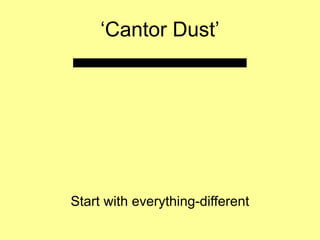
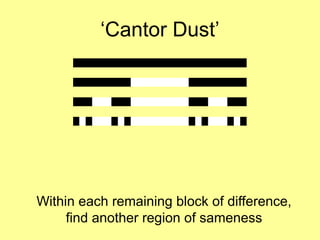
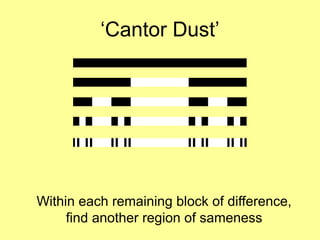
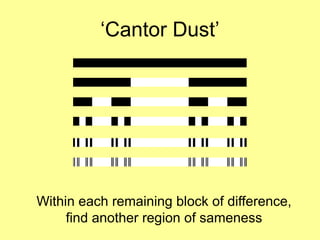
‘Cantor Dust’

Start with everything-different
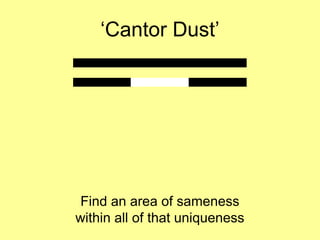
‘Cantor Dust’

Find an area of sameness
within all of that uniqueness
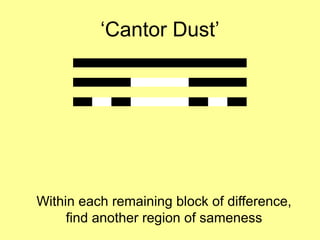
‘Cantor Dust’

Within each remaining block of difference,
find another region of sameness
‘Cantor Dust’

Within each remaining block of difference,
find another region of sameness
‘Cantor Dust’

Within each remaining block of difference,
find another region of sameness
‘Cantor Dust’

Within each remaining block of difference,
find another region of sameness
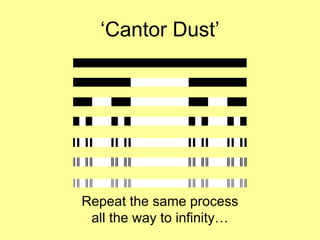
‘Cantor Dust’

Repeat the same process
all the way to infinity…
no matter how far down we go,
there will always be uniqueness…
…and every one of those
apparent ‘samenesses’ we found
is also different from every other…
- uniqueness in the sameness…
Into practice…
How much at present do you design
against uniqueness?
If uniqueness is a fact of nature,
is trying to design against it
even a viable option?
Should you design for uniqueness?
If so, how?
“What’s the story?”
Uniqueness
– how and why
What is mass-uniqueness?

Mass-uniqueness
is uniqueness at scale
– where difference
or uniqueness
is a central fact
of the work itself
Mass-uniqueness
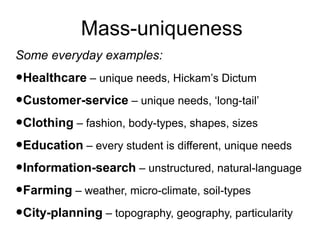
Some everyday examples:

•Healthcare – unique needs, Hickam’s Dictum
•Customer-service – unique needs, ‘long-tail’
•Clothing – fashion, body-types, shapes, sizes
•Education – every student is different, unique needs
•Information-search – unstructured, natural-language
•Farming – weather, micro-climate, soil-types
•City-planning – topography, geography, particularity
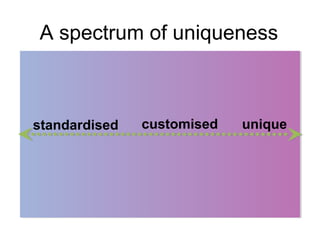
A spectrum of uniqueness

standardised

customised

unique
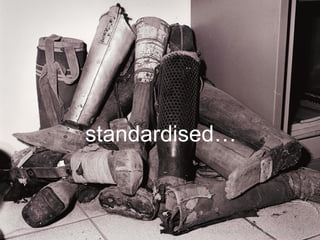
standardised…

CC-BY-NC-ND actiononarmedviolence via Flickr
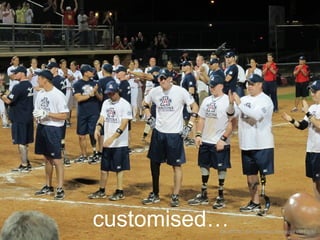
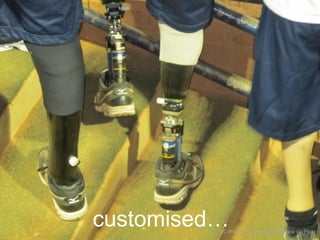
customised…

CC-BY-NC-SA Doctress Neutopia via Flickr
customised…

CC-BY-NC-SA Doctress Neutopia via Flickr
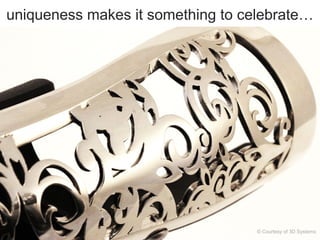
unique…
© Courtesy of 3D Systems
unique…

© Courtesy of 3D Systems
uniqueness…

© Courtesy of 3D Systems
uniqueness makes it something to celebrate…

© Courtesy of 3D Systems
Into practice…
How much mass-uniqueness
exists in your business-context?
How much do you already design
for that uniqueness?
How do you support
the required uniqueness at scale?
“What’s the story?”

A question of perspective
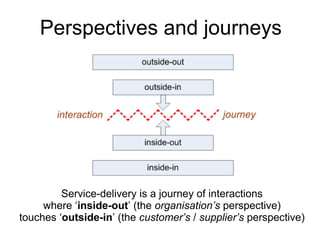
Perspectives and journeys

Service-delivery is a journey of interactions
where ‘inside-out’ (the organisation’s perspective)
touches ‘outside-in’ (the customer’s / supplier’s perspective)
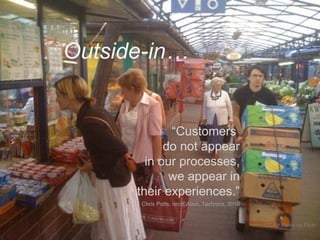
Outside-in…

“Customers
do not appear
in our processes,
we appear in
their experiences.”
Chris Potts, recrEAtion, Technics, 2010

CC-BY Fretro via Flickr
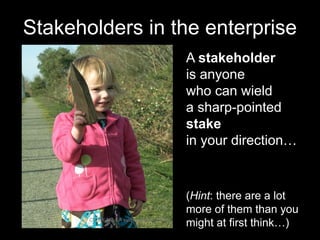
Stakeholders in the enterprise
A stakeholder
is anyone
who can wield
a sharp-pointed
stake
in your direction…

CC-BY-NC-SA evilpeacock via Flickr

(Hint: there are a lot
more of them than you
might at first think…)
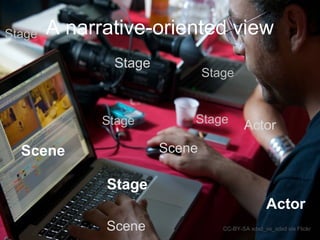
The role of narrative

Narrative and story
help us to identify
the exceptions
and uniquenesses…
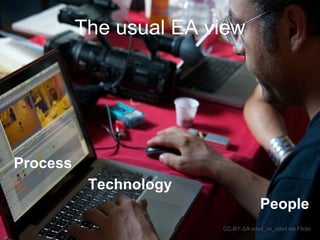
The usual EA view

Process
Technology
People
CC-BY-SA xdxd_vs_xdxd via Flickr
Stage

A narrative-oriented view
Stage

Stage

Stage

Stage

Actor

Scene

Scene
Stage

Actor
Scene

CC-BY-SA xdxd_vs_xdxd via Flickr
Into practice…
What changes
as you shift the perspective
from inside-out to outside-in?
What do the narratives tell you
about uniqueness in your business?
What do you need to change
to make best use of this?
“What’s the story?”
SCAN – making sense
of uniqueness
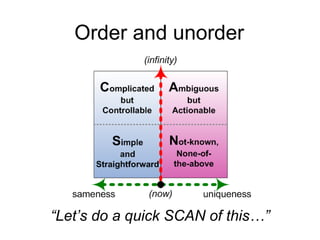
Order and unorder

“Let’s do a quick SCAN of this…”
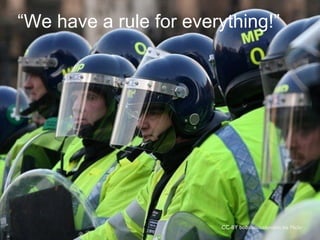
“We have a rule for everything!”

CC-BY bobaliciouslondon via Flickr
Hmm… let’s do a quick SCAN of this…

CC-BY bobaliciouslondon via Flickr
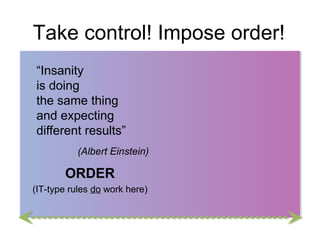
Take control! Impose order!
“Insanity
is doing
the same thing
and expecting
different results”
(Albert Einstein)

ORDER
(IT-type rules do work here)
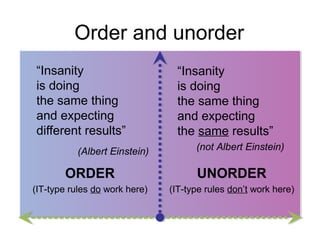
Order and unorder
“Insanity
is doing
the same thing
and expecting
different results”
(Albert Einstein)

“Insanity
is doing
the same thing
and expecting
the same results”
(not Albert Einstein)

ORDER

UNORDER

(IT-type rules do work here)

(IT-type rules don’t work here)
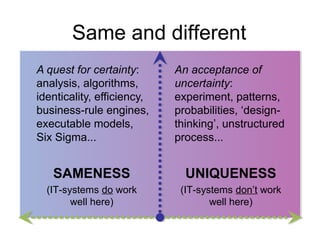
Same and different
A quest for certainty:
analysis, algorithms,
identicality, efficiency,
business-rule engines,
executable models,
Six Sigma...

An acceptance of
uncertainty:
experiment, patterns,
probabilities, ‘designthinking’, unstructured
process...

SAMENESS

UNIQUENESS

(IT-systems do work
well here)

(IT-systems don’t work
well here)
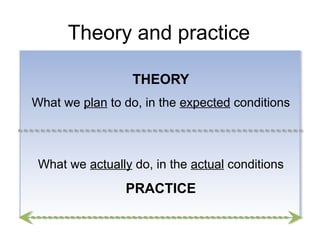
Theory and practice
THEORY
What we plan to do, in the expected conditions

What we actually do, in the actual conditions

PRACTICE
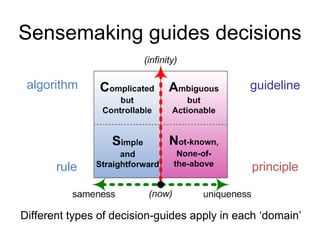
Sensemaking guides decisions
algorithm

guideline

rule

principle

Different types of decision-guides apply in each ‘domain’
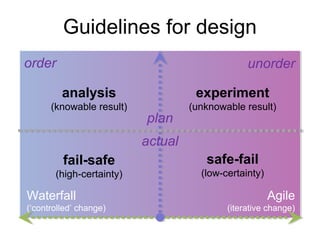
Guidelines for design
order

unorder
analysis

experiment

(knowable result)

(unknowable result)

plan
actual

fail-safe
(high-certainty)

Waterfall
(‘controlled’ change)

safe-fail
(low-certainty)

Agile
(iterative change)
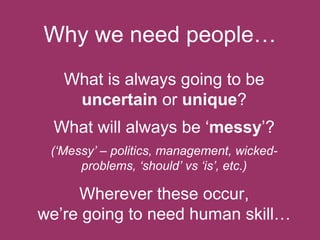
Why we need people…
What is always going to be
uncertain or unique?
What will always be ‘messy’?
(‘Messy’ – politics, management, wickedproblems, ‘should’ vs ‘is’, etc.)

Wherever these occur,
we’re going to need human skill…
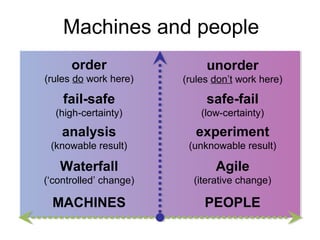
Machines and people
order

unorder

(rules do work here)

(rules don’t work here)

fail-safe

safe-fail

(high-certainty)

(low-certainty)

analysis

experiment

(knowable result)

(unknowable result)

Waterfall

Agile

(‘controlled’ change)

(iterative change)

MACHINES

PEOPLE
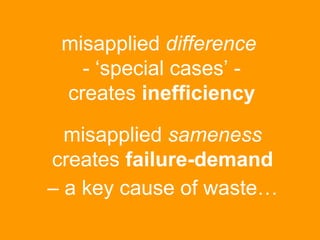
misapplied difference
- ‘special cases’ creates inefficiency
misapplied sameness
creates failure-demand
– a key cause of waste…
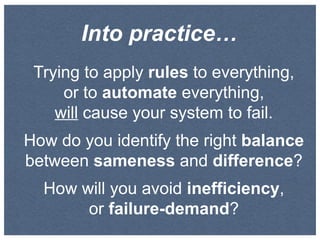
Into practice…
Trying to apply rules to everything,
or to automate everything,
will cause your system to fail.
How do you identify the right balance
between sameness and difference?
How will you avoid inefficiency,
or failure-demand?
“What’s the story?”
Balancing sameness
and uniqueness
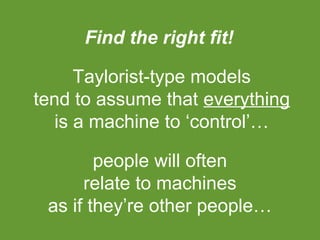
Find the right fit!
Taylorist-type models
tend to assume that everything
is a machine to ‘control’…
people will often
relate to machines
as if they’re other people…
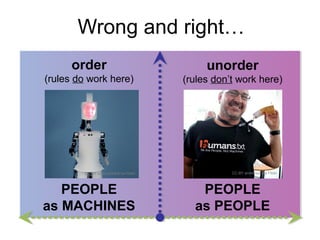
Wrong and right…
order

unorder

(rules do work here)

(rules don’t work here)

CC-BY justin pickard via Flickr

PEOPLE
as MACHINES

CC-BY andré luís via Flickr

PEOPLE
as PEOPLE
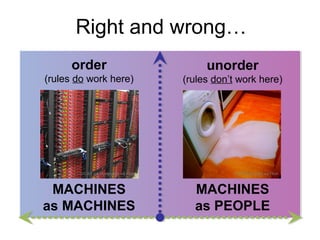
Right and wrong…
order

unorder

(rules do work here)

(rules don’t work here)

CC-BY-SA MysteryBee via Flickr

MACHINES
as MACHINES

CC-BY-SA izzard via Flickr

MACHINES
as PEOPLE
How we really think…

CC-BY Brett Jordan via Flickr
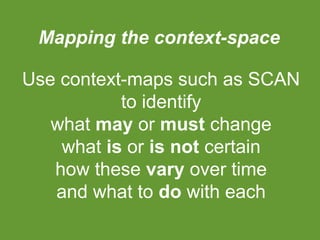
Mapping the context-space
Use context-maps such as SCAN
to identify
what may or must change
what is or is not certain
how these vary over time
and what to do with each
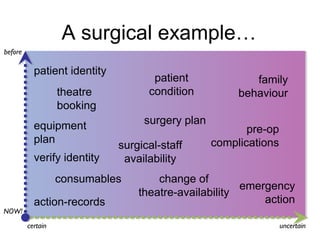
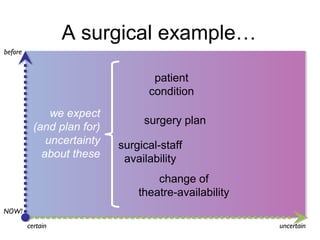
A surgical example…
before

patient identity

patient
condition

theatre
booking
equipment
plan
verify identity

surgery plan
surgical-staff
availability

consumables
NOW!

action-records
certain

family
behaviour
pre-op
complications

change of
emergency
theatre-availability
action
uncertain
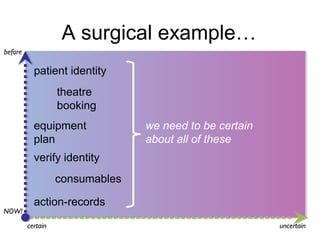
A surgical example…
before

patient identity
theatre
booking
equipment
plan

we need to be certain
about all of these

verify identity
consumables
NOW!

action-records
certain

uncertain
A surgical example…
before

patient
condition
we expect
(and plan for)
uncertainty
about these

surgery plan
surgical-staff
availability
change of
theatre-availability

NOW!
certain

uncertain
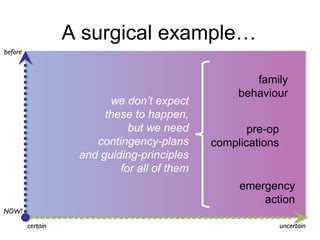
A surgical example…
before

we don’t expect
these to happen,
but we need
contingency-plans
and guiding-principles
for all of them

family
behaviour
pre-op
complications

emergency
action
NOW!
certain

uncertain
Into practice…
How would you map the right fit
for each type of context?
How would you ensure you don’t
treat people as machines
or machines as people?
How will you manage
the inherent uncertainties?
“What’s the story?”
Uniqueness, change
and governance
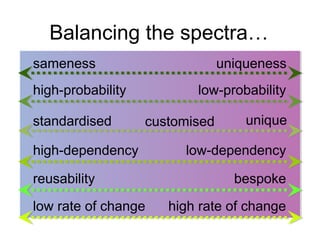
Balancing the spectra…
sameness

uniqueness

high-probability
standardised

low-probability
customised

high-dependency
reusability
low rate of change

unique

low-dependency
bespoke
high rate of change
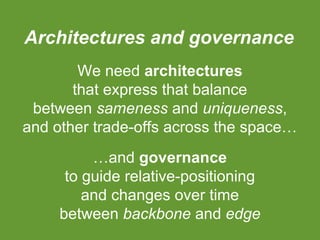
Architectures and governance
We need architectures
that express that balance
between sameness and uniqueness,
and other trade-offs across the space…
…and governance
to guide relative-positioning
and changes over time
between backbone and edge
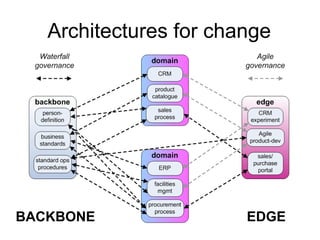
Architectures for change

BACKBONE

EDGE
Into practice…
What do you need, to balance
sameness and difference
certainty and uncertainty
across your whole business-context?
What architectures
do you need for this?
What governance do you need
to manage their changes over time?
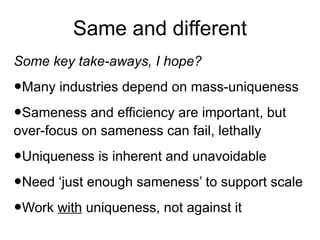
Same and different
Some key take-aways, I hope?

•Many industries depend on mass-uniqueness
•Sameness and efficiency are important, but
over-focus on sameness can fail, lethally

•Uniqueness is inherent and unavoidable
•Need ‘just enough sameness’ to support scale
•Work with uniqueness, not against it
“What’s the story?”
Thank you!
Further information:
Contact:

Tom Graves

Company:

Tetradian Consulting

Email:

tom@tetradian.com

Twitter:

@tetradian ( http://twitter.com/tetradian )

Weblog:

http://weblog.tetradian.com

Slidedecks:

http://www.slideshare.net/tetradian

Publications:

http://tetradianbooks.com

Books:

• The enterprise as story: the role of narrative in enterprisearchitecture (2012)
• Mapping the enterprise: modelling the enterprise as services with
the Enterprise Canvas (2010)
• Everyday enterprise-architecture: sensemaking, strategy, structures
and solutions (2010)
• Doing enterprise-architecture: process and practice in the real
enterprise (2009)

Image-credits: Slides 64-67 courtesy of 3D Systems:
http://www.bespokeinnovations.com/
Other photo-images via Flickr or Wikimedia, as shown on each slide

Same and different - architectures for mass-uniqueness