Buffer solutions
Buffer solution
It is the solution which can resist the change in pH even on addition of
small amount of acid or base. For example, blood is an example of
buffer and its pH remains almost constant to 7.4
Types of buffer solutions:
1. Acidic buffer
2. Basic buffer
Acidic buffer:
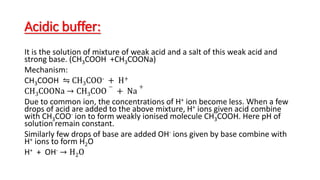
It is the solution of mixture of weak acid and a salt of this weak acid and
strong base. (CH3COOH +CH3COONa)
Mechanism:
CH3COOH ⇋ CH3COO- + H+
CH3COONa → CH3COO
−
+ Na
+
Due to common ion, the concentrations of H+ ion become less. When a few
drops of acid are added to the above mixture, H+ ions given acid combine
with CH3COO- ion to form weakly ionised molecule CH3COOH. Here pH of
solution remain constant.
Similarly few drops of base are added OH- ions given by base combine with
H+ ions to form H2O
H+ + OH- → H2O
Basic buffer:
It is the solution of mixture of weak base and a salt of weak base and strong
acid.(NH4OH + NH4Cl)
Mechanism:
NH4OH ⇋ NH4
+ + OH-
NH4Cl → NH4
+
+ Cl
−
When a few drops of base are added the OH- ions combine with NH4
+ ion to form
weakly ionised NH4OH
Thus pH of the solutions remain unaffected.
Similarly, when a small amount of acid is added, the H+ ion given by it combine with
OH- produced by NH4OH.
H+ + OH- → H2O
As the OH- is consumed. Hence pH of the solution remain constant

Buffer solutions

  • 1.
  • 2.
    Buffer solution It isthe solution which can resist the change in pH even on addition of small amount of acid or base. For example, blood is an example of buffer and its pH remains almost constant to 7.4
  • 3.
    Types of buffersolutions: 1. Acidic buffer 2. Basic buffer
  • 4.
    Acidic buffer: It isthe solution of mixture of weak acid and a salt of this weak acid and strong base. (CH3COOH +CH3COONa) Mechanism: CH3COOH ⇋ CH3COO- + H+ CH3COONa → CH3COO − + Na + Due to common ion, the concentrations of H+ ion become less. When a few drops of acid are added to the above mixture, H+ ions given acid combine with CH3COO- ion to form weakly ionised molecule CH3COOH. Here pH of solution remain constant. Similarly few drops of base are added OH- ions given by base combine with H+ ions to form H2O H+ + OH- → H2O
  • 5.
    Basic buffer: It isthe solution of mixture of weak base and a salt of weak base and strong acid.(NH4OH + NH4Cl) Mechanism: NH4OH ⇋ NH4 + + OH- NH4Cl → NH4 + + Cl − When a few drops of base are added the OH- ions combine with NH4 + ion to form weakly ionised NH4OH Thus pH of the solutions remain unaffected. Similarly, when a small amount of acid is added, the H+ ion given by it combine with OH- produced by NH4OH. H+ + OH- → H2O As the OH- is consumed. Hence pH of the solution remain constant