ACID BASE EQUILIBRIUM

       GROUP MEMBERS :
       NOOR AZURAH ABDUL RAZAK
            (D20101037502)
SITI NORHAFIZA HAFINAS MOHD ZANUDIN
           (D20101037503)
Ion Product constant
                    Kw=[H†][OH⁻]
                    =(1.0x10⁻⁷)(1.0x10⁻⁷)                       Theory
                    = 1.0x10⁻ˡ⁴                                Arheniuss
                                                             Bronsted-Lowry


  pH = -log[H†]
 pOH = -log[OH⁻]
                                     ACID BASE
hpH + pOH = 14.00
                                    EQUIL RIUM
                                         IB


                                                 Weak Acid              Weak Base
  Strong Acid   Strong Base
                                                 HCN,H2S                      NH3
    HCl, HBr        NaOH
                                                        H+   A−          BH +   OH − 
                                                  Ka =             Kb =              
  Ionize completely(100%) in                              [ HA ]                  [ B]
            water
                                                 Dissociate partially in water
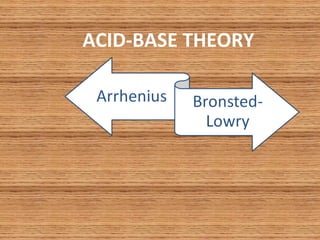
ACID-BASE THEORY
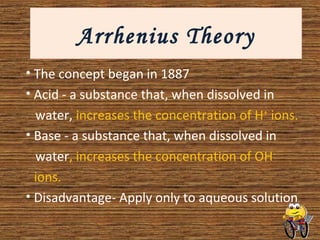
Arrhenius Theory
• The concept began in 1887
• Acid - a substance that, when dissolved in
  water, increases the concentration of H+ ions.
• Base - a substance that, when dissolved in
  water, increases the concentration of OH-
  ions.
• Disadvantage- Apply only to aqueous solution
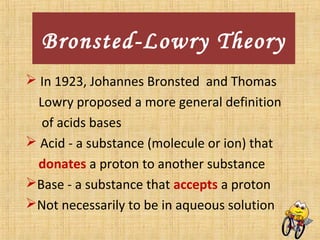
Bronsted-Lowry Theory
 In 1923, Johannes Bronsted and Thomas
 Lowry proposed a more general definition
  of acids bases
 Acid - a substance (molecule or ion) that
 donates a proton to another substance
Base - a substance that accepts a proton
Not necessarily to be in aqueous solution
ION PRODUCT OF WATER
 Ion-product of water refers to autoionization of water
      H₂O(l) ↔ H†(aq) + OH‾ (aq)
 The equilibrium constant for the autonization of water
is :
                     Kw =[H†][OH‾ ]


Kw is called ion-product constant, which is the product of
 the molar conentration of H† and OH‾ at a particular
 temperature
In pure water at 25⁰c, [H†]=[OH⁻]=1.0x10⁻⁷
           Kw =[H†][OH⁻]
               = (1.0x10⁻⁷)(1.0x10⁻⁷)
               = 1.0x10⁻ˡ⁴
pH SCALE
 Use to measure the concentration of H† in a solution
 Measuring the acidity of the solution
 pH : negative base-10 log of the concentration of hydrogen oin,
  [H†]
                           pH = -log[H†]

 pOH : negative base-10 log of the concentration of hydroxide oin,
  [OH⁻]
                         pOH = -log[OH⁻]


                         pH + pOH = 14.00
Example :
Given that the pH of hydrogen sulfide,H₂S
is 4.82. Find the concentration of
hydrogen ion, [H†]

Solution :
             pH = -log[H†]
             4.82 = -log[H†]
             [H†] = antilog (-4.82)
                   = 1.51 x 10⁻⁵
Strong
           acid


                    Weak
Weak
acid
       Acid &Base   base


          Strong
           base
Strong acid


                                     +                   −
HCl( aq ) + H 2O( l)     H 3O
                            →
                 100%ionization
                                         ( aq )   + Cl       ( aq )
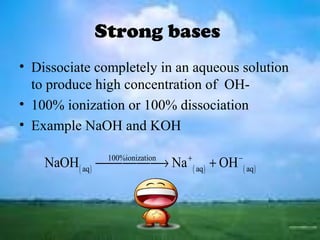
Strong bases
• Dissociate completely in an aqueous solution
  to produce high concentration of OH-
• 100% ionization or 100% dissociation
• Example NaOH and KOH

    NaOH( aq )     Na + ( aq ) + OH − ( aq )
                100%ionization
                               →
Weak acids


CH 3 COOH ( aq ) + H 2 O ( l ) ⇔ CH 3 COO − ( aq ) + H 3 O + ( aq )
Weak bases


                            +                   −
NH 3( aq ) + H 2 O ⇔ NH 4       ( aq )   + OH       ( aq )
ACIDS AND EQUILIBRIUM
• Equilibrium constant can be used for the ionization reaction to
  express the extent to which a weak acids ionizes.

                HA( aq ) + H 2O( l ) ⇔ H 3O + ( aq ) + A− ( aq )
                          HA( aq ) ⇔ H + ( aq ) + A− ( aq )


        Ka   =
               [ H O ][ A ]
                  3
                      +     −
                                           or            Ka   =
                                                                [ H ][ A ]
                                                                    +      −


                  [ HA]                                            [ HA]

• A smaller Ka value meaning the degree of the dissociation of
  the acid is low
BASES AND EQUILIBRIUM
• the base is a weak base (ionizes <100%), the
  equilibrium is dependent on the base
  equilibrium constant, Kb.
• A base equilibrium expression can only be
  written for weak bases.
      B( aq ) + H 2 O( l ) ⇔ BH + ( aq ) + OH − ( aq )

                    Kb   =
                           [ BH ][OH ]
                              +       −


                               [ B]

Acid base equilibrium

  • 1.
    ACID BASE EQUILIBRIUM GROUP MEMBERS : NOOR AZURAH ABDUL RAZAK (D20101037502) SITI NORHAFIZA HAFINAS MOHD ZANUDIN (D20101037503)
  • 2.
    Ion Product constant Kw=[H†][OH⁻] =(1.0x10⁻⁷)(1.0x10⁻⁷) Theory = 1.0x10⁻ˡ⁴ Arheniuss Bronsted-Lowry pH = -log[H†] pOH = -log[OH⁻] ACID BASE hpH + pOH = 14.00 EQUIL RIUM IB Weak Acid Weak Base Strong Acid Strong Base HCN,H2S NH3 HCl, HBr NaOH  H+   A−   BH +   OH −  Ka =     Kb =    Ionize completely(100%) in [ HA ] [ B] water Dissociate partially in water
  • 3.
  • 4.
    Arrhenius Theory • Theconcept began in 1887 • Acid - a substance that, when dissolved in water, increases the concentration of H+ ions. • Base - a substance that, when dissolved in water, increases the concentration of OH- ions. • Disadvantage- Apply only to aqueous solution
  • 5.
    Bronsted-Lowry Theory  In1923, Johannes Bronsted and Thomas Lowry proposed a more general definition of acids bases  Acid - a substance (molecule or ion) that donates a proton to another substance Base - a substance that accepts a proton Not necessarily to be in aqueous solution
  • 6.
    ION PRODUCT OFWATER  Ion-product of water refers to autoionization of water H₂O(l) ↔ H†(aq) + OH‾ (aq)  The equilibrium constant for the autonization of water is : Kw =[H†][OH‾ ] Kw is called ion-product constant, which is the product of the molar conentration of H† and OH‾ at a particular temperature
  • 7.
    In pure waterat 25⁰c, [H†]=[OH⁻]=1.0x10⁻⁷ Kw =[H†][OH⁻] = (1.0x10⁻⁷)(1.0x10⁻⁷) = 1.0x10⁻ˡ⁴
  • 8.
    pH SCALE  Useto measure the concentration of H† in a solution  Measuring the acidity of the solution  pH : negative base-10 log of the concentration of hydrogen oin, [H†] pH = -log[H†]  pOH : negative base-10 log of the concentration of hydroxide oin, [OH⁻] pOH = -log[OH⁻] pH + pOH = 14.00
  • 10.
    Example : Given thatthe pH of hydrogen sulfide,H₂S is 4.82. Find the concentration of hydrogen ion, [H†] Solution : pH = -log[H†] 4.82 = -log[H†] [H†] = antilog (-4.82) = 1.51 x 10⁻⁵
  • 11.
    Strong acid Weak Weak acid Acid &Base base Strong base
  • 12.
    Strong acid + − HCl( aq ) + H 2O( l)     H 3O → 100%ionization ( aq ) + Cl ( aq )
  • 13.
    Strong bases • Dissociatecompletely in an aqueous solution to produce high concentration of OH- • 100% ionization or 100% dissociation • Example NaOH and KOH NaOH( aq )     Na + ( aq ) + OH − ( aq ) 100%ionization →
  • 14.
    Weak acids CH 3COOH ( aq ) + H 2 O ( l ) ⇔ CH 3 COO − ( aq ) + H 3 O + ( aq )
  • 15.
    Weak bases + − NH 3( aq ) + H 2 O ⇔ NH 4 ( aq ) + OH ( aq )
  • 16.
    ACIDS AND EQUILIBRIUM •Equilibrium constant can be used for the ionization reaction to express the extent to which a weak acids ionizes. HA( aq ) + H 2O( l ) ⇔ H 3O + ( aq ) + A− ( aq ) HA( aq ) ⇔ H + ( aq ) + A− ( aq ) Ka = [ H O ][ A ] 3 + − or Ka = [ H ][ A ] + − [ HA] [ HA] • A smaller Ka value meaning the degree of the dissociation of the acid is low
  • 17.
    BASES AND EQUILIBRIUM •the base is a weak base (ionizes <100%), the equilibrium is dependent on the base equilibrium constant, Kb. • A base equilibrium expression can only be written for weak bases. B( aq ) + H 2 O( l ) ⇔ BH + ( aq ) + OH − ( aq ) Kb = [ BH ][OH ] + − [ B]