BUFFER SOLUTIONS
Objectives
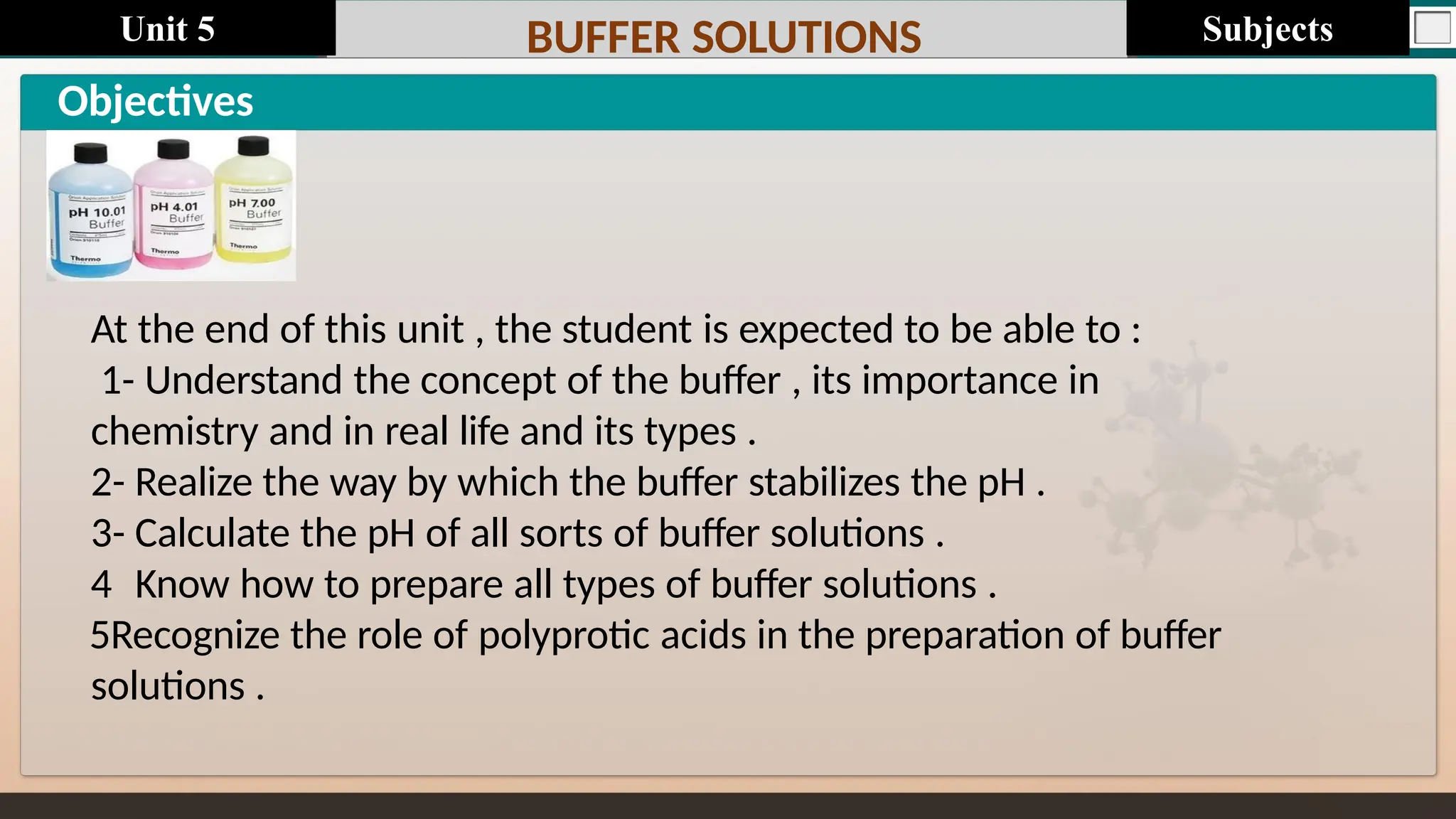
At theend of this unit , the student is expected to be able to :
1- Understand the concept of the buffer , its importance in
chemistry and in real life and its types .
2- Realize the way by which the buffer stabilizes the pH .
3- Calculate the pH of all sorts of buffer solutions .
4 Know how to prepare all types of buffer solutions .
5Recognize the role of polyprotic acids in the preparation of buffer
solutions .
Subjects
Unit 5
2.
Last update :1/1/2014 Page.N
o
BUFFER SOLUTIONS
Introduction
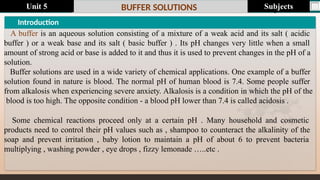
A buffer is an aqueous solution consisting of a mixture of a weak acid and its salt ( acidic
buffer ) or a weak base and its salt ( basic buffer ) . Its pH changes very little when a small
amount of strong acid or base is added to it and thus it is used to prevent changes in the pH of a
solution.
Buffer solutions are used in a wide variety of chemical applications. One example of a buffer
solution found in nature is blood. The normal pH of human blood is 7.4. Some people suffer
from alkalosis when experiencing severe anxiety. Alkalosis is a condition in which the pH of the
blood is too high. The opposite condition - a blood pH lower than 7.4 is called acidosis .
Some chemical reactions proceed only at a certain pH . Many household and cosmetic
products need to control their pH values such as , shampoo to counteract the alkalinity of the
soap and prevent irritation , baby lotion to maintain a pH of about 6 to prevent bacteria
multiplying , washing powder , eye drops , fizzy lemonade …..etc .
Subjects
Unit 5
3.
Last update :1/1/2014 Page.N
o
BUFFER SOLUTIONS
Types of Buffer Solutions
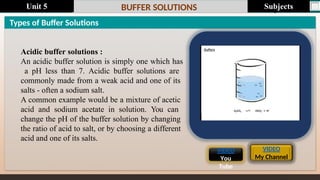
Acidic buffer solutions :
An acidic buffer solution is simply one which has
a pH less than 7. Acidic buffer solutions are
commonly made from a weak acid and one of its
salts - often a sodium salt.
A common example would be a mixture of acetic
acid and sodium acetate in solution. You can
change the pH of the buffer solution by changing
the ratio of acid to salt, or by choosing a different
acid and one of its salts.
VIDEO
You
Tube
VIDEO
My Channel
Subjects
Unit 5
4.
Last update :1/1/2014 Page.N
o
BUFFER SOLUTIONS
Types of Buffer Solutions
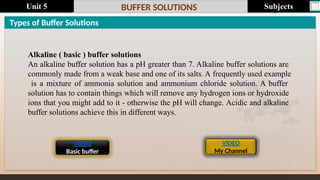
Alkaline ( basic ) buffer solutions
An alkaline buffer solution has a pH greater than 7. Alkaline buffer solutions are
commonly made from a weak base and one of its salts. A frequently used example
is a mixture of ammonia solution and ammonium chloride solution. A buffer
solution has to contain things which will remove any hydrogen ions or hydroxide
ions that you might add to it - otherwise the pH will change. Acidic and alkaline
buffer solutions achieve this in different ways.
VIDEO
Basic buffer
VIDEO
My Channel
Subjects
Unit 5
5.
Last update :1/1/2014 Page.N
o
BUFFER SOLUTIONS
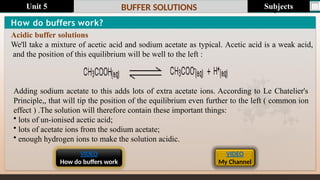
Adding sodium acetate to this adds lots of extra acetate ions. According to Le Chatelier's
Principle,, that will tip the position of the equilibrium even further to the left ( common ion
effect ) .The solution will therefore contain these important things:
• lots of un-ionised acetic acid;
• lots of acetate ions from the sodium acetate;
• enough hydrogen ions to make the solution acidic.
How do buffers work?
Acidic buffer solutions
We'll take a mixture of acetic acid and sodium acetate as typical. Acetic acid is a weak acid,
and the position of this equilibrium will be well to the left :
VIDEO
My Channel
VIDEO
How do buffers work
Subjects
Unit 5
6.
Last update :1/1/2014 Page.N
o
BUFFER SOLUTIONS
How do buffers work?
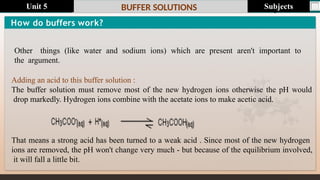
That means a strong acid has been turned to a weak acid . Since most of the new hydrogen
ions are removed, the pH won't change very much - but because of the equilibrium involved,
it will fall a little bit.
Other things (like water and sodium ions) which are present aren't important to
the argument.
Adding an acid to this buffer solution :
The buffer solution must remove most of the new hydrogen ions otherwise the pH would
drop markedly. Hydrogen ions combine with the acetate ions to make acetic acid.
Subjects
Unit 5
7.
Last update :1/1/2014 Page.N
o
BUFFER SOLUTIONS
How do buffer work?
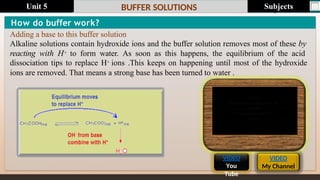
Adding a base to this buffer solution
Alkaline solutions contain hydroxide ions and the buffer solution removes most of these by
reacting with H+ to form water. As soon as this happens, the equilibrium of the acid
dissociation tips to replace H+ ions .This keeps on happening until most of the hydroxide
ions are removed. That means a strong base has been turned to water .
VIDEO
My Channel
VIDEO
You
Tube
Subjects
Unit 5
8.
Last update :1/1/2014 Page.N
o
BUFFER SOLUTIONS
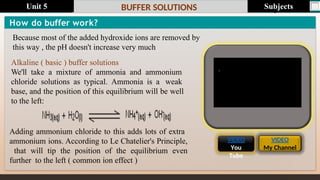
Adding ammonium chloride to this adds lots of extra
ammonium ions. According to Le Chatelier's Principle,
that will tip the position of the equilibrium even
further to the left ( common ion effect )
How do buffer work?
Because most of the added hydroxide ions are removed by
this way , the pH doesn't increase very much
Alkaline ( basic ) buffer solutions
We'll take a mixture of ammonia and ammonium
chloride solutions as typical. Ammonia is a weak
base, and the position of this equilibrium will be well
to the left:
VIDEO
You
Tube
VIDEO
My Channel
Subjects
Unit 5
9.
Last update :1/1/2014 Page.N
o
BUFFER SOLUTIONS
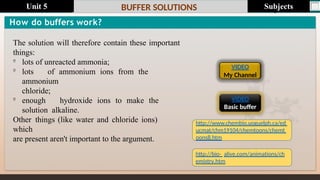
The solution will therefore contain these important
things:
lots of unreacted ammonia;
lots of ammonium ions from the
ammonium
chloride;
enough hydroxide ions to make the
solution alkaline.
Other things (like water and chloride ions)
which
are present aren't important to the argument.
How do buffers work?
VIDEO
My Channel
VIDEO
Basic buffer
http://www.chembio.uoguelph.ca/ed
ucmat/chm19104/chemtoons/chemt
oons8.htm
http://bio- alive.com/animations/ch
emistry.htm
Subjects
Unit 5
10.
Last update :1/1/2014 Page.N
o
BUFFER SOLUTIONS
How do buffers work?
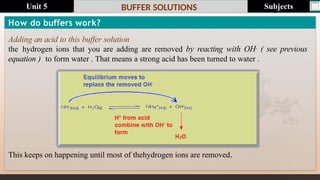
Adding an acid to this buffer solution
the hydrogen ions that you are adding are removed by reacting with OH- ( see previous
equation ) to form water . That means a strong acid has been turned to water .
This keeps on happening until most of thehydrogen ions are removed.
Subjects
Unit 5
11.
Last update :1/1/2014 Page.N
o
BUFFER SOLUTIONS
How do buffers work?
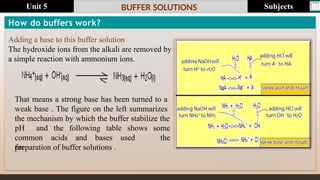
Adding a base to this buffer solution
The hydroxide ions from the alkali are removed by
a simple reaction with ammonium ions.
That means a strong base has been turned to a
weak base . The figure on the left summarizes
the mechanism by which the buffer stabilize the
common acids and bases used
for
pH and the following table shows some
the
preparation of buffer solutions .
Subjects
Unit 5
12.
Last update :1/1/2014 Page.N
o
BUFFER SOLUTIONS
How do buffers work?
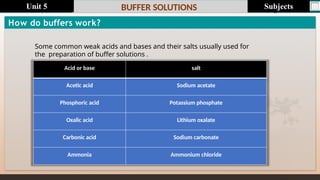
Acid or base salt
Acetic acid Sodium acetate
Phosphoric acid Potassium phosphate
Oxalic acid Lithium oxalate
Carbonic acid Sodium carbonate
Ammonia Ammonium chloride
Some common weak acids and bases and their salts usually used for
the preparation of buffer solutions .
Subjects
Unit 5
13.
Last update :1/1/2014 Page.N
o
BUFFER SOLUTIONS
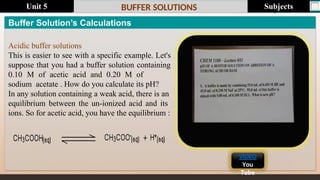
Buffer Solution’s Calculations
Acidic buffer solutions
This is easier to see with a specific example. Let's
suppose that you had a buffer solution containing
0.10 M of acetic acid and 0.20 M of
sodium acetate . How do you calculate its pH?
In any solution containing a weak acid, there is an
equilibrium between the un-ionized acid and its
ions. So for acetic acid, you have the equilibrium :
VIDEO
You
Tube
Subjects
Unit 5
14.
Last update :1/1/2014 Page.N
o
BUFFER SOLUTIONS
Buffer Solution’s Calculations
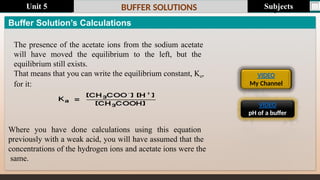
The presence of the acetate ions from the sodium acetate
will have moved the equilibrium to the left, but the
equilibrium still exists.
That means that you can write the equilibrium constant, Ka,
for it:
Where you have done calculations using this equation
previously with a weak acid, you will have assumed that the
concentrations of the hydrogen ions and acetate ions were the
same.
VIDEO
My Channel
VIDEO
pH of a buffer
Subjects
Unit 5
15.
Last update :1/1/2014 Page.N
o
BUFFER SOLUTIONS
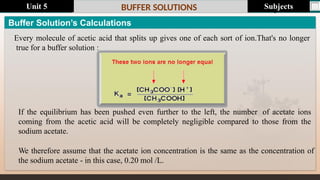
If the equilibrium has been pushed even further to the left, the number of acetate ions
coming from the acetic acid will be completely negligible compared to those from the
sodium acetate.
We therefore assume that the acetate ion concentration is the same as the concentration of
the sodium acetate - in this case, 0.20 mol /L.
Buffer Solution’s Calculations
Every molecule of acetic acid that splits up gives one of each sort of ion.That's no longer
true for a buffer solution :
Subjects
Unit 5
16.
Last update :1/1/2014 Page.N
o
BUFFER SOLUTIONS
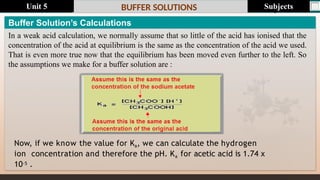
Now, if we know the value for Ka, we can calculate the hydrogen
ion concentration and therefore the pH. Ka for acetic acid is 1.74 x
10-5 .
Buffer Solution’s Calculations
In a weak acid calculation, we normally assume that so little of the acid has ionised that the
concentration of the acid at equilibrium is the same as the concentration of the acid we used.
That is even more true now that the equilibrium has been moved even further to the left. So
the assumptions we make for a buffer solution are :
Subjects
Unit 5
17.
Last update :1/1/2014 Page.N
o
BUFFER SOLUTIONS
Buffer Solution’s Calculations
Remember that we want to calculate the pH of a buffer solution containing 0.10 M
of acetic acid and 0.20 M of sodium acetate .
pH = -log10 [H+] = - log 8.7X10-6 = 5.1
Ka
0.20
0.10
0.10
0.2 X [H
]
5
[ CH COOH
][ H
]
8.7 X 10⁶
mole / L
Then all you have to do is to find the pH using the expression :
[H
] 1.74 X 105
X
1.74 X 10
3
[ CH3COOH ]
Subjects
Unit 5
18.
Last update :1/1/2014 Page.N
o
BUFFER SOLUTIONS
Buffer Solution’s Calculations
You could, of course, be asked to reverse this and calculate in what proportions you would
have to mix acetic acid and sodium acetate to get a buffer solution of some desired pH. It is
no more difficult than the calculation we have just looked at. Suppose you wanted a buffer
with a pH of 4.46 ( i.e [H+] = shift log – 4.46 = 3.47X10⁻⁵ M ) . Feed that into the
Ka expression :
3
3
0.50
5
5
3.47 X 10
[CH
COOH ]
[ CH COO
] 1.74 X 10 5
3
[CH 3COOH ]
[ CH COO
] X 3.47 X 10⁵
1.74 X 10
3
[CH 3COOH ]
[ CH COO
][ H
]
Ka
Subjects
Unit 5
19.
Last update :1/1/2014 Page.N
o
BUFFER SOLUTIONS
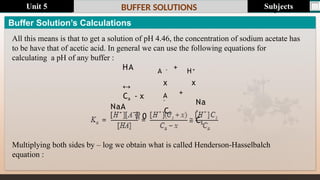
Buffer Solution’s Calculations
All this means is that to get a solution of pH 4.46, the concentration of sodium acetate has
to be have that of acetic acid. In general we can use the following equations for
calculating a pH of any buffer :
+
HA
↔
Ca - x
NaA
0
A -
x
A
-
CS
H+
x
+
Na
+
CS
Multiplying both sides by – log we obtain what is called Henderson-Hasselbalch
equation :
Subjects
Unit 5
20.
Last update :1/1/2014 Page.N
o
BUFFER SOLUTIONS
Buffer Solution’s Calculations
Where HA is the weak acid , Ca is its
initial concentration , NaA is the sodium
salt of the weak acid , Cs is the
concentration of the salt . Note that :
[A -] = Cs
+
x
VIDEO
My Channel
VIDEO
You
Tube
Subjects
Unit 5
21.
Last update :1/1/2014 Page.N
o
BUFFER SOLUTIONS
Buffer Solution’s Calculations
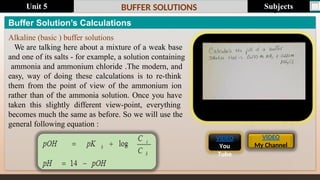
Alkaline (basic ) buffer solutions
We are talking here about a mixture of a weak base
and one of its salts - for example, a solution containing
ammonia and ammonium chloride .The modern, and
easy, way of doing these calculations is to re-think
them from the point of view of the ammonium ion
rather than of the ammonia solution. Once you have
taken this slightly different view-point, everything
becomes much the same as before. So we will use the
general following equation :
VIDEO
My Channel
VIDEO
You
Tube
Subjects
Unit 5
22.
Last update :1/1/2014 Page.N
o
BUFFER SOLUTIONS
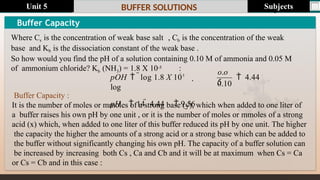
Buffer Capacity :
It is the number of moles or mmoles of a strong base (y), which when added to one liter of
a buffer raises his own pH by one unit , or it is the number of moles or mmoles of a strong
acid (x) which, when added to one liter of this buffer reduced its pH by one unit. The higher
the capacity the higher the amounts of a strong acid or a strong base which can be added to
the buffer without significantly changing his own pH. The capacity of a buffer solution can
be increased by increasing both Cs , Ca and Cb and it will be at maximum when Cs = Ca
or Cs = Cb and in this case :
0.10
4.44
o.o
5
pOH log 1.8 X 10⁵
log
pH 14 4.44 9.56
Buffer Capacity
Where Cs is the concentration of weak base salt , Cb is the concentration of the weak
base and Kb is the dissociation constant of the weak base .
So how would you find the pH of a solution containing 0.10 M of ammonia and 0.05 M
of ammonium chloride? Kb (NH3) = 1.8 X 10⁻⁵ :
Subjects
Unit 5
23.
Last update :1/1/2014 Page.N
o
BUFFER SOLUTIONS
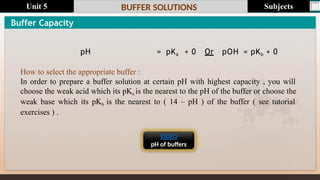
pH = pKa + 0 Or pOH = pKb + 0
How to select the appropriate buffer :
In order to prepare a buffer solution at certain pH with highest capacity , you will
choose the weak acid which its pKa is the nearest to the pH of the buffer or choose the
weak base which its pKb is the nearest to ( 14 – pH ) of the buffer ( see tutorial
exercises ) .
Buffer Capacity
VIDEO
pH of buffers
Subjects
Unit 5
24.
Last update :1/1/2014 Page.N
o
BUFFER SOLUTIONS
Buffer Capacity
Example : Calculate the buffer capacity of a buffer solution containing 0.2 M NH3 and 0.1
M NH4Cl [ pKb (NH3) = 4.76 ] ?
Solution : First : we calculate the pH of the buffer :
+ OH-
NH3 +
H2
NH4Cl
O ↔ NH4
+
↔ NH4
+ +
Cl-
Subjects
Unit 5
25.
Last update :1/1/2014 Page.N
o
BUFFER SOLUTIONS
Buffer Capacity
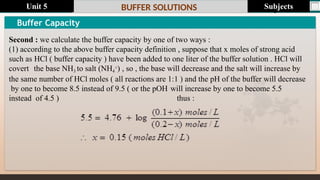
Second : we calculate the buffer capacity by one of two ways :
(1) according to the above buffer capacity definition , suppose that x moles of strong acid
such as HCl ( buffer capacity ) have been added to one liter of the buffer solution . HCl will
covert the base NH3 to salt (NH4
+) , so , the base will decrease and the salt will increase by
the same number of HCl moles ( all reactions are 1:1 ) and the pH of the buffer will decrease
by one to become 8.5 instead of 9.5 ( or the pOH will increase by one to become 5.5
instead of 4.5 ) thus :
Subjects
Unit 5
26.
Last update :1/1/2014 Page.N
o
BUFFER SOLUTIONS
Buffer Capacity
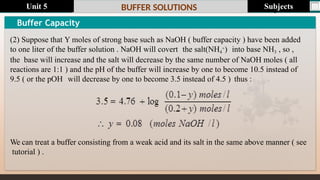
(2) Suppose that Y moles of strong base such as NaOH ( buffer capacity ) have been added
to one liter of the buffer solution . NaOH will covert the salt(NH4
+) into base NH3 , so ,
the base will increase and the salt will decrease by the same number of NaOH moles ( all
reactions are 1:1 ) and the pH of the buffer will increase by one to become 10.5 instead of
9.5 ( or the pOH will decrease by one to become 3.5 instead of 4.5 ) thus :
We can treat a buffer consisting from a weak acid and its salt in the same above manner ( see
tutorial ) .
Subjects
Unit 5
27.
Last update :1/1/2014 Page.N
o
BUFFER SOLUTIONS
Buffer Capacity
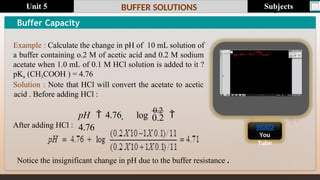
Example : Calculate the change in pH of 10 mL solution of
a buffer containing o.2 M of acetic acid and 0.2 M sodium
acetate when 1.0 mL of 0.1 M HCl solution is added to it ?
pKa (CH3COOH ) = 4.76
Solution : Note that HCl will convert the acetate to acetic
acid . Before adding HCl :
0.2
pH 4.76 log
0.2
4.76
After adding HCl :
Notice the insignificant change in pH due to the buffer resistance .
VIDEO
You
Tube
Subjects
Unit 5
28.
Last update :1/1/2014 Page.N
o
BUFFER SOLUTIONS
Preparation of Buffer’s Solution
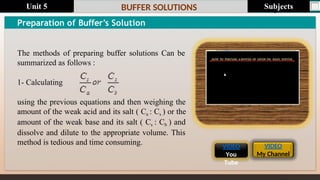
The methods of preparing buffer solutions Can be
summarized as follows :
1- Calculating
using the previous equations and then weighing the
amount of the weak acid and its salt ( Ca : Cs ) or the
amount of the weak base and its salt ( Cs : Cb ) and
dissolve and dilute to the appropriate volume. This
method is tedious and time consuming. VIDEO
My Channel
VIDEO
You
Tube
Subjects
Unit 5
29.
Last update :1/1/2014 Page.N
o
BUFFER SOLUTIONS
Preparation of Buffer’s Solution
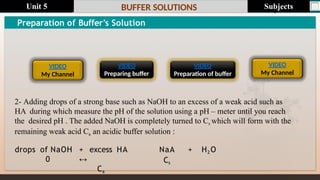
2- Adding drops of a strong base such as NaOH to an excess of a weak acid such as
HA during which measure the pH of the solution using a pH – meter until you reach
the desired pH . The added NaOH is completely turned to Cs which will form with the
remaining weak acid Ca an acidic buffer solution :
+ excess HA
↔
Ca
NaA + H2 O
Cs
drops of NaOH
0
VIDEO
My Channel
VIDEO
Preparation of buffer
VIDEO
Preparing buffer
Subjects
Unit 5
VIDEO
My Channel
30.
Last update :1/1/2014 Page.N
o
BUFFER SOLUTIONS
Preparation of Buffer’s Solution
VIDEO
My Channel
VIDEO
You
Tube
Subjects
Unit 5
31.
Last update :1/1/2014 Page.N
o
BUFFER SOLUTIONS
Preparation of Buffer’s Solution
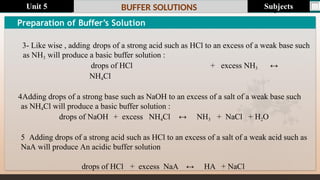
3- Like wise , adding drops of a strong acid such as HCl to an excess of a weak base such
as NH3 will produce a basic buffer solution :
drops of HCl + excess NH3 ↔
NH4Cl
4Adding drops of a strong base such as NaOH to an excess of a salt of a weak base such
as NH4Cl will produce a basic buffer solution :
drops of NaOH + excess NH4Cl ↔ NH3 + NaCl + H2O
5 Adding drops of a strong acid such as HCl to an excess of a salt of a weak acid such as
NaA will produce An acidic buffer solution
drops of HCl + excess NaA ↔ HA + NaCl
Subjects
Unit 5
32.
Last update :1/1/2014 Page.N
o
BUFFER SOLUTIONS
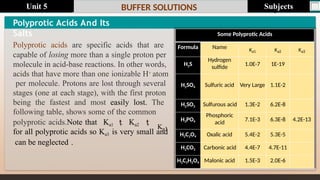
Polyprotic Acids And Its
Salts
Polyprotic acids are specific acids that are
capable of losing more than a single proton per
molecule in acid-base reactions. In other words,
acids that have more than one ionizable H+ atom
per molecule. Protons are lost through several
stages (one at each stage), with the first proton
being the fastest and most easily lost. The
following table, shows some of the common
polyprotic acids.Note that Ka1 Ka2
Ka3
for all polyprotic acids so Ka3 is very small and
can be neglected .
Some Polyprotic Acids
Formula Name Ka1 Ka2 Ka3
H2S
Hydrogen
sulfide 1.0E-7 1E-19
H2SO4 Sulfuric acid Very Large 1.1E-2
H2SO3 Sulfurous acid 1.3E-2 6.2E-8
H3PO4
Phosphoric
acid 7.1E-3 6.3E-8 4.2E-13
H2C2O4 Oxalic acid 5.4E-2 5.3E-5
H2CO3 Carbonic acid 4.4E-7 4.7E-11
H2C3H2O4 Malonic acid 1.5E-3 2.0E-6
Subjects
Unit 5
33.
Last update :1/1/2014 Page.N
o
BUFFER SOLUTIONS
Polyprotic Acids And Its Salts
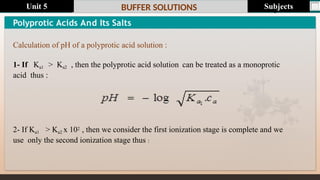
Calculation of pH of a polyprotic acid solution :
1- If Ka1 > Ka2 , then the polyprotic acid solution can be treated as a monoprotic
acid thus :
2- If Ka1 > Ka2 x 102 , then we consider the first ionization stage is complete and we
use only the second ionization stage thus :
Subjects
Unit 5
34.
Last update :1/1/2014 Page.N
o
BUFFER SOLUTIONS
Polyprotic Acids And Its
Salts
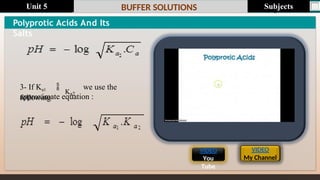
Ka2
3- If Ka1 we use the
following
approximate equation :
VIDEO
My Channel
VIDEO
You
Tube
Subjects
Unit 5
35.
Last update :1/1/2014 Page.N
o
BUFFER SOLUTIONS
Polyprotic Acids And Its Salts
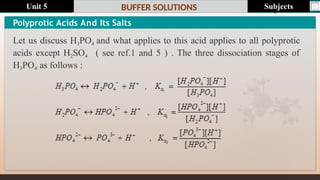
Let us discuss H3PO4 and what applies to this acid applies to all polyprotic
acids except H2SO4 ( see ref.1 and 5 ) . The three dissociation stages of
H3PO4 as follows :
Subjects
Unit 5
36.
Last update :1/1/2014 Page.N
o
BUFFER SOLUTIONS
Polyprotic Acids And Its Salts
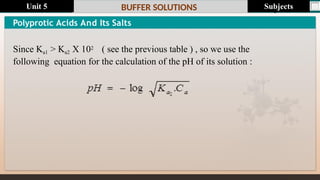
Since Ka1 > Ka2 X 102 ( see the previous table ) , so we use the
following equation for the calculation of the pH of its solution :
Subjects
Unit 5
37.
Last update :1/1/2014 Page.N
o
BUFFER SOLUTIONS
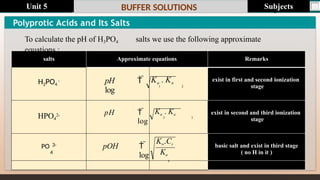
salts Approximate equations Remarks
H2PO4
- pH
log
Ka . Ka
1 2
exist in first and second ionization
stage
HPO4
2- pH
log
Ka . Ka
2 3
exist in second and third ionization
stage
PO 3-
4
pOH
log
Kw.Cs
Ka
basic salt and exist in third stage
( no H in it )
3
Polyprotic Acids and Its Salts
To calculate the pH of H3PO4 salts we use the following approximate
equations :
Subjects
Unit 5
38.
Last update :1/1/2014 Page.N
o
BUFFER SOLUTIONS
H3PO4 + H2PO4
-
p H p K l o g
[ H 2
P O 4 ]
a 1
[ H
P O
]
3 4
buffer and both exist in first
ionization stage
H2PO4
- + HPO 2-
4
[ H P O 2
]
p H p K a log 4
2
[ H
P O
]
2 4
Buffer and both exist in second
ionization stage
Polyprotic Acids And Its
Salts
Continues to previous table
Note that other polyprotic acids and its salts can be treated in the same maner as H3PO4 .
Subjects
Unit 5
39.
Page.N
o
Polyprotic Acids AndIts
Salts Solution
Example
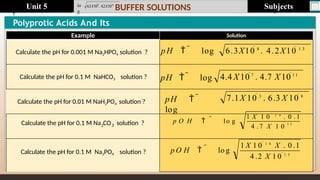
Calculate the pH for 0.001 M Na2HPO4 solution ?
Calculate the pH for 0.1 M NaHCO3 solution ?
Calculate the pH for 0.01 M NaH2PO4 solution ?
Calculate the pH for 0.1 M Na CO
2 3 solution ?
Calculate the pH for 0.1 M Na3PO4 solution ?
6.3X10 8
. 4.2X10 1 3
4.4 X 10⁷
. 4.7 X 101 1
7.1X 10 3
. 6.3 X 10 8
pH log
pH log
pH
log
1 1
lo g
4 . 7 X 1 0
1 X 1 0 1 4
. 0 . 1
p O H
lo g
1 X 1 0 1 4
X . 0 .1
4 .2 X 1 0 1 3
p O H
lo
g
Last update : 1/1/2014
6.3X10⁸
. 4.2X10¹³
BUFFER SOLUTIONS Subjects
Unit 5
40.
Last update :1/1/2014 Page.N
o
BUFFER SOLUTIONS
Summary
In this unit , the concept of the buffer , it’s importance in chemistry and in real life
and it’s types have been investigated . We also discussed the way by which
the buffer stabilizes the pH . The calculations of the pH of all sorts of buffer solutions
are the main core of this unit . We make sure that the student Knows how to prepare
all types of buffer solutions and recognize the role of
polyprotic acids in the preparation of buffer solutions .
Subjects
Unit 5
41.
Last update :1/1/2016 BUFFER SOLUTIONS
Our answer
next slide
Tutorial
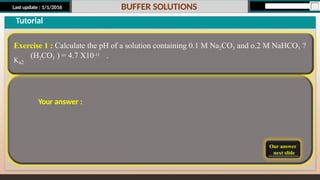
Exercise 1 : Calculate the pH of a solution containing 0.1 M Na2CO3 and o.2 M NaHCO3 ?
Ka2
(H2CO3 ) = 4.7 X10⁻¹¹ .
Your answer :
BUFFER SOLUTIONS
Our answer
nextslide
Tutorial
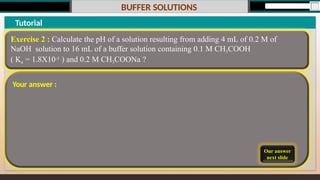
Exercise 2 : Calculate the pH of a solution resulting from adding 4 mL of 0.2 M of
NaOH solution to 16 mL of a buffer solution containing 0.1 M CH3COOH
( Ka = 1.8X10⁻⁵ ) and 0.2 M CH3COONa ?
Your answer :
44.
BUFFER SOLUTIONS
Tutorial
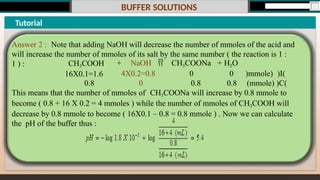
Answer 2: Note that adding NaOH will decrease the number of mmoles of the acid and
will increase the number of mmoles of its salt by the same number ( the reaction is 1 :
1 ) :
)mmole) )I(
(mmole) )C(
0
0.8
+ NaOH CH3COONa + H2O
0
0.8
4X0.2=0.8
0
CH3COOH
16X0.1=1.6
0.8
This means that the number of mmoles of CH3COONa will increase by 0.8 mmole to
become ( 0.8 + 16 X 0.2 = 4 mmoles ) while the number of mmoles of CH3COOH will
decrease by 0.8 mmole to become ( 16X0.1 – 0.8 = 0.8 mmole ) . Now we can calculate
the pH of the buffer thus :
BUFFER SOLUTIONS
Our answer
nextslide
Tutorial
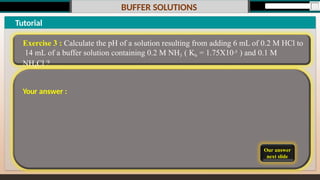
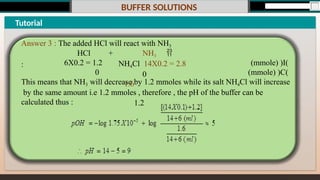
Exercise 3 : Calculate the pH of a solution resulting from adding 6 mL of 0.2 M HCl to
14 mL of a buffer solution containing 0.2 M NH3 ( Kb = 1.75X10⁻⁵ ) and 0.1 M
NH4Cl ?
Your answer :
47.
BUFFER SOLUTIONS
Tutorial
Answer 3: The added HCl will react with NH3
: (mmole) )I(
(mmole) )C(
+ NH3
NH4Cl 14X0.2 = 2.8
0
1.6
1.2
HCl
6X0.2 = 1.2
0
This means that NH3 will decrease by 1.2 mmoles while its salt NH4Cl will increase
by the same amount i.e 1.2 mmoles , therefore , the pH of the buffer can be
calculated thus :
48.
BUFFER SOLUTIONS
VIDEO
You
Tube
VIDEO
Library
Our answer
nextslide
Tutorial
Exercise 4 : Calculate the change in pH of 250 mL
of a buffer solution containing 0.2 M CH3COOH (
Ka = 1.8X10⁻⁵ ) and 0.2 M CH3COONa upon
adding 1.0 g of NaOH to it ? This video will help .
Your answer :
BUFFER SOLUTIONS
Tutorial
Answer 4: NaOH will react with CH3COOH, therefore, the number of mmoles of
CH3COOH will decrease by [ (1.0 g / 40 ) X 103 = 25 mmoles ] to become ( 250 X 0.2 –
25 = 25 mmoles ) while the number of mmoles of the salt CH3COONa will increase by
25 mmoles to become ( 250 X 0.2 + 25 = 75 mmoles ) . Now we can calculate the pH :
51.
BUFFER SOLUTIONS
Our answer
nextslide
Tutorial
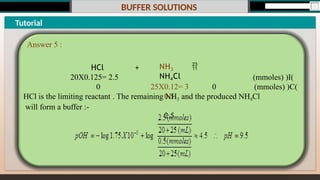
Exercise 5 : Calculate the pH of a solution resulting from adding 20 mL 0.125 M
HCl
to 25 mL 0.12 M NH3 ( Kb = 1.75X10⁻⁵ ) ?
Your answer :
52.
BUFFER SOLUTIONS
+
(mmoles) )I(
(mmoles))C(
NH3
NH4Cl
25X0.12= 3 0
0.5
2.5
HCl
20X0.125= 2.5
0
HCl is the limiting reactant . The remaining NH3 and the produced NH4Cl
will form a buffer :-
Tutorial
Answer 5 :
53.
BUFFER SOLUTIONS
Our answer
nextslide
Tutorial
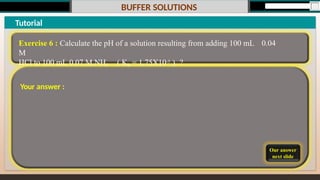
Exercise 6 : Calculate the pH of a solution resulting from adding 100 mL 0.04
M
HCl to 100 mL 0.07 M NH3 ( Kb = 1.75X10⁻⁵ ) ?
Your answer :
54.
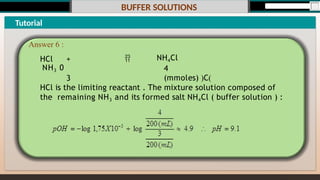
BUFFER SOLUTIONS
Tutorial
NH4Cl
4
(mmoles))C(
HCl is the limiting reactant . The mixture solution composed of
the remaining NH3 and its formed salt NH4Cl ( buffer solution ) :
Answer 6 :
HCl +
NH3 0
3
55.
BUFFER SOLUTIONS
Our answer
nextslide
Tutorial
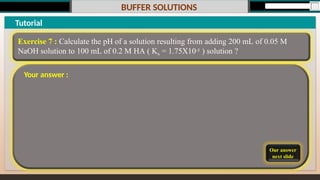
Exercise 7 : Calculate the pH of a solution resulting from adding 200 mL of 0.05 M
NaOH solution to 100 mL of 0.2 M HA ( Ka = 1.75X10⁻⁵ ) solution ?
Your answer :
56.
BUFFER SOLUTIONS
Tutorial
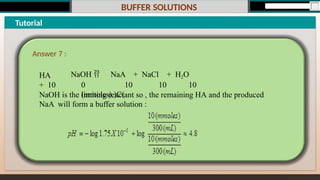
NaOH NaA + NaCl + H2O
0 10 10 10
(mmoles) )C(
HA
+ 10
NaOH is the limiting reactant so , the remaining HA and the produced
NaA will form a buffer solution :
Answer 7 :
57.
BUFFER SOLUTIONS
Our answer
nextslide
Tutorial
Exercise 8 : Calculate the pH of a solution resulting from adding 50 mL of 0.1
M NaOH solution to 50 mL of 0.2 M NH4Cl [ Kb (NH3 ) = 1.75X10⁻⁵ ]
solution ?
Your answer :
58.
BUFFER SOLUTIONS
Tutorial
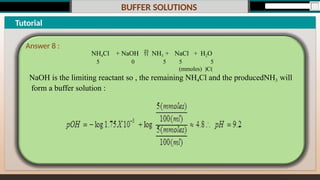
NaCl +H2O
5 5
(mmoles) )C(
NH4Cl + NaOH NH3 +
5 0 5
NaOH is the limiting reactant so , the remaining NH4Cl and the producedNH3 will
form a buffer solution :
Answer 8 :
59.
BUFFER SOLUTIONS
Our answer
nextslide
Tutorial
Exercise 9 : Calculate the pH of a solution resulting from adding 100 mL of 0.1 M HCl
solution to 100 mL of 0.5 M NaA [ Ka (HA ) = 1.75X10⁻⁵ ] solution ?
Your answer :
60.
BUFFER SOLUTIONS
Tutorial
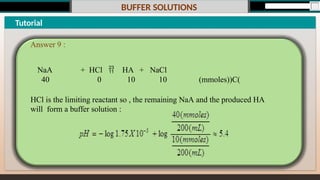
Answer 9:
NaA + HCl HA + NaCl
40 0 10 10 (mmoles))C(
HCl is the limiting reactant so , the remaining NaA and the produced HA
will form a buffer solution :
61.
BUFFER SOLUTIONS
Our answer
nextslide
Tutorial
Exercise 10 : Calculate the capacity of a buffer solution containing 0.1 M CH3COONa
and 0.2 M CH3COOH ( pKa = 4.76 ) ?
Your answer :
62.
BUFFER SOLUTIONS
Tutorial
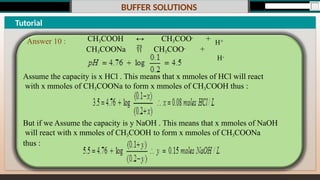
Answer 10: CH3COOH
CH3COONa
↔ CH3COO- +
CH3COO- +
H+
H+
Assume the capacity is x HCl . This means that x mmoles of HCl will react
with x mmoles of CH3COONa to form x mmoles of CH3COOH thus :
But if we Assume the capacity is y NaOH . This means that x mmoles of NaOH
will react with x mmoles of CH3COOH to form x mmoles of CH3COONa
thus :
63.
BUFFER SOLUTIONS
Our answer
nextslide
Tutorial
Exercise 11 : Calculate the pH of a buffer solution that is prepared by adding 25 mL 0.05
M H2SO4 solution to 50 mL 0.1 M NH3 solution ?
Your answer :
64.
BUFFER SOLUTIONS
Tutorial
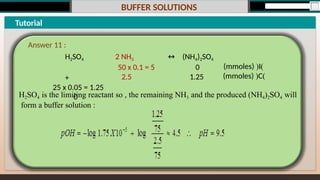
(mmoles) )I(
(mmoles))C(
↔ (NH4)2SO4
0
1.25
2 NH3
50 x 0.1 = 5
2.5
H2SO4 is the limiting reactant so , the remaining NH3 and the produced (NH4)2SO4 will
form a buffer solution :
Answer 11 :
H2SO4
+
25 x 0.05 = 1.25
0
65.
BUFFER SOLUTIONS
Our answer
nextslide
Tutorial
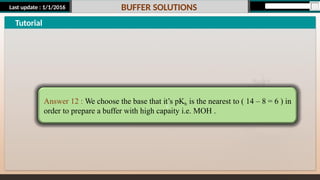
Exercise 12 : Which one of the following weak bases would you choose to prepare
a buffer solution of pH = 8 and why ?
MOH ( Kb = 1X 10⁻⁵ ) , NOH ( Kb = 1X10⁻⁸ ) , DOH ( Kb = 1X10-
10 )
Your answer :
66.
Last update :1/1/2016 BUFFER SOLUTIONS
Tutorial
c
Answer 12 : We choose the base that it’s pKb is the nearest to ( 14 – 8 = 6 ) in
order to prepare a buffer with high capaity i.e. MOH .

![Last update : 1/1/2014 Page.N
o
BUFFER SOLUTIONS
Buffer Solution’s Calculations
Remember that we want to calculate the pH of a buffer solution containing 0.10 M
of acetic acid and 0.20 M of sodium acetate .
pH = -log10 [H+] = - log 8.7X10-6 = 5.1
Ka
0.20
0.10
0.10
0.2 X [H
]
5
[ CH COOH
][ H
]
8.7 X 10⁶
mole / L
Then all you have to do is to find the pH using the expression :
[H
] 1.74 X 105
X
1.74 X 10
3
[ CH3COOH ]
Subjects
Unit 5](https://image.slidesharecdn.com/unit5-buffersolutins-subjects11-250519210658-32b23ce3/85/buffer-solution-generality-and-benefits-17-320.jpg)
![Last update : 1/1/2014 Page.N
o
BUFFER SOLUTIONS
Buffer Solution’s Calculations
You could, of course, be asked to reverse this and calculate in what proportions you would
have to mix acetic acid and sodium acetate to get a buffer solution of some desired pH. It is
no more difficult than the calculation we have just looked at. Suppose you wanted a buffer
with a pH of 4.46 ( i.e [H+] = shift log – 4.46 = 3.47X10⁻⁵ M ) . Feed that into the
Ka expression :
3
3
0.50
5
5
3.47 X 10
[CH
COOH ]
[ CH COO
] 1.74 X 10 5
3
[CH 3COOH ]
[ CH COO
] X 3.47 X 10⁵
1.74 X 10
3
[CH 3COOH ]
[ CH COO
][ H
]
Ka
Subjects
Unit 5](https://image.slidesharecdn.com/unit5-buffersolutins-subjects11-250519210658-32b23ce3/85/buffer-solution-generality-and-benefits-18-320.jpg)
![Last update : 1/1/2014 Page.N
o
BUFFER SOLUTIONS
Buffer Solution’s Calculations
Where HA is the weak acid , Ca is its
initial concentration , NaA is the sodium
salt of the weak acid , Cs is the
concentration of the salt . Note that :
[A -] = Cs
+
x
VIDEO
My Channel
VIDEO
You
Tube
Subjects
Unit 5](https://image.slidesharecdn.com/unit5-buffersolutins-subjects11-250519210658-32b23ce3/85/buffer-solution-generality-and-benefits-20-320.jpg)
![Last update : 1/1/2014 Page.N
o
BUFFER SOLUTIONS
Buffer Capacity
Example : Calculate the buffer capacity of a buffer solution containing 0.2 M NH3 and 0.1
M NH4Cl [ pKb (NH3) = 4.76 ] ?
Solution : First : we calculate the pH of the buffer :
+ OH-
NH3 +
H2
NH4Cl
O ↔ NH4
+
↔ NH4
+ +
Cl-
Subjects
Unit 5](https://image.slidesharecdn.com/unit5-buffersolutins-subjects11-250519210658-32b23ce3/85/buffer-solution-generality-and-benefits-24-320.jpg)

![Last update : 1/1/2014 Page.N
o
BUFFER SOLUTIONS
H3PO4 + H2PO4
-
p H p K l o g
[ H 2
P O 4 ]
a 1
[ H
P O
]
3 4
buffer and both exist in first
ionization stage
H2PO4
- + HPO 2-
4
[ H P O 2
]
p H p K a log 4
2
[ H
P O
]
2 4
Buffer and both exist in second
ionization stage
Polyprotic Acids And Its
Salts
Continues to previous table
Note that other polyprotic acids and its salts can be treated in the same maner as H3PO4 .
Subjects
Unit 5](https://image.slidesharecdn.com/unit5-buffersolutins-subjects11-250519210658-32b23ce3/85/buffer-solution-generality-and-benefits-38-320.jpg)
![BUFFER SOLUTIONS
Tutorial
Answer 4 : NaOH will react with CH3COOH, therefore, the number of mmoles of
CH3COOH will decrease by [ (1.0 g / 40 ) X 103 = 25 mmoles ] to become ( 250 X 0.2 –
25 = 25 mmoles ) while the number of mmoles of the salt CH3COONa will increase by
25 mmoles to become ( 250 X 0.2 + 25 = 75 mmoles ) . Now we can calculate the pH :](https://image.slidesharecdn.com/unit5-buffersolutins-subjects11-250519210658-32b23ce3/85/buffer-solution-generality-and-benefits-50-320.jpg)
![BUFFER SOLUTIONS
Our answer
next slide
Tutorial
Exercise 8 : Calculate the pH of a solution resulting from adding 50 mL of 0.1
M NaOH solution to 50 mL of 0.2 M NH4Cl [ Kb (NH3 ) = 1.75X10⁻⁵ ]
solution ?
Your answer :](https://image.slidesharecdn.com/unit5-buffersolutins-subjects11-250519210658-32b23ce3/85/buffer-solution-generality-and-benefits-57-320.jpg)
![BUFFER SOLUTIONS
Our answer
next slide
Tutorial
Exercise 9 : Calculate the pH of a solution resulting from adding 100 mL of 0.1 M HCl
solution to 100 mL of 0.5 M NaA [ Ka (HA ) = 1.75X10⁻⁵ ] solution ?
Your answer :](https://image.slidesharecdn.com/unit5-buffersolutins-subjects11-250519210658-32b23ce3/85/buffer-solution-generality-and-benefits-59-320.jpg)


![Polymer [ बहुलक ] Chemistry Notes PDF - Irfanullah Mehar - JJ Sir Chemistry.pdf](https://cdn.slidesharecdn.com/ss_thumbnails/polymerchemistrynotespdf-irfanullahmehar-jjsirchemistry-260210172118-3f9b37f7-thumbnail.jpg?width=640&height=640&fit=bounds)


