A buffersolution is a chemical system that prevents sudden pH
changes.
It contains a weak acid/base & its salt that balance added acids
or bases.
Buffers protect reactions, biological systems, and industrial
processes.
Definition of Buffer Solution
3.
• MaintainpH stability in chemical reactions.
• Prevent damage to biological cells.
• Ensure accurate laboratory experiments.
• Improve shelf-life of medicines.
• Stabilize food products and beverages.
Importance of Buffers
4.
1. AcidicBuffers – weak acid + its salt.
2. Basic Buffers – weak base + its salt.
3. Amphoteric Buffers – contain species that act as both acid &
base.
4. Biological Buffers – natural pH regulating systems.
5. Industrial Buffers – used in manufacturing & processing.
Types of Buffers
5.
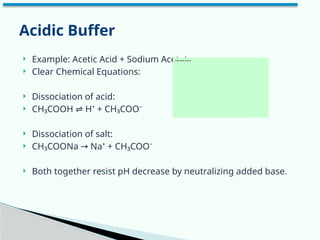
Example: AceticAcid + Sodium Acetate
Clear Chemical Equations:
Dissociation of acid:
CH₃COOH H⁺ + CH₃COO⁻
⇌
Dissociation of salt:
CH₃COONa Na⁺ + CH₃COO⁻
→
Both together resist pH decrease by neutralizing added base.
Acidic Buffer
6.
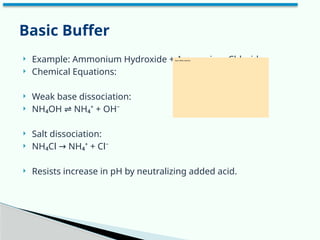
Example: AmmoniumHydroxide + Ammonium Chloride
Chemical Equations:
Weak base dissociation:
NH₄OH NH₄⁺ + OH⁻
⇌
Salt dissociation:
NH₄Cl NH₄⁺ + Cl⁻
→
Resists increase in pH by neutralizing added acid.
Basic Buffer
7.
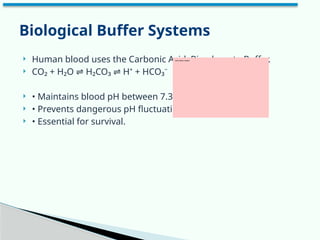
Human blooduses the Carbonic Acid–Bicarbonate Buffer.
CO₂ + H₂O H₂CO₃ H⁺ + HCO₃⁻
⇌ ⇌
• Maintains blood pH between 7.35–7.45
• Prevents dangerous pH fluctuations
• Essential for survival.
Biological Buffer Systems
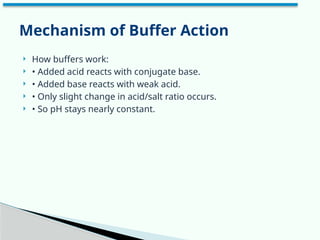
How bufferswork:
• Added acid reacts with conjugate base.
• Added base reacts with weak acid.
• Only slight change in acid/salt ratio occurs.
• So pH stays nearly constant.
Mechanism of Buffer Action
10.
For AcidicBuffer:
pH = pKa + log([Salt] / [Acid])
For Basic Buffer:
pOH = pKb + log([Salt] / [Base])
Used to calculate buffer pH with precision.
Henderson–Hasselbalch Formula
11.
Buffer capacity= the strength of a buffer to resist pH changes.
• Increases with concentration.
• High salt/acid ratio improves efficiency.
• Important in industry & medical formulations.
Buffer Capacity
12.
• Cannotneutralize large amounts of strong acids/bases.
• Work only in specific pH range.
• Temperature affects buffer stability.
• Dilution reduces effectiveness.
Limitations of Buffers
13.
Steps:
1.Choose required pH.
2. Select weak acid/base pair.
3. Mix with correct salt ratio.
4. Add water & adjust volume.
5. Verify with pH meter for accuracy.
Preparation of Buffer
14.
Buffers areessential in chemical, biological, and industrial
systems.
They maintain pH balance, ensure safe reactions, and protect
living cells.
Understanding buffers helps control processes accurately and
effectively.
Conclusion


![ For Acidic Buffer:
pH = pKa + log([Salt] / [Acid])
For Basic Buffer:
pOH = pKb + log([Salt] / [Base])
Used to calculate buffer pH with precision.
Henderson–Hasselbalch Formula](https://image.slidesharecdn.com/buffersolutionpremiumfinalnewcontent-251210000445-2fe87ed0/85/Buffer_Solution_Premium_Final_NewContent-pptx-10-320.jpg)