MUHAMMAD JAWAD
ZAUQ ABBAS
IMDADULLAH
BUFFER SOLUTIONS
1/5/2020 1
BUFFERS SOLUTION:
1/5/2020 2
• “Buffers are compounds or mixtures of
compounds that by their presence in the
solution resist changes in the pH upon the
addition of small quantities of acid or alkali
or base.”
NECESSITY OF A BUFFER SYSTEM:
1/5/2020 3
• Sometimes it is necessary that a solution of definite pH be
prepared and stored. The preservation of such a solution is
even more difficult than its preparation. If solution comes in
contact with air, it will absorb CO2 and becomes acidic. On the
other hand, if solution is stored in a glass bottle, alkaline
impurities from the glass may alter its pH. Due to these reasons
, pharmaceutical solutions are buffered as the buffer solutions
are capable of maintaining pH at some fairly constant value
when even small amounts of acid or base are added.
TYPES OF BUFFERS:
1/5/2020 4
• Generally buffers are of two types;
• Acidic buffers
• Basic buffers
ACIDIC BUFFERS:
1/5/2020 5
• An acidic buffer is a combination of weak acid and its
salt with a strong base.
• i.e. Weak acid & salt with a strong base(conjugate base)
• EXAMPLES:
• CH3COOH / CH3COONa
• H2CO3 / NaHCO3
• H3PO4 / NaH2PO4
• HCOOH / HCOONa
BASIC BUFFERS
1/5/2020 6
• A basic buffer is a combination of weak base and its
salt with a strong acid.
• i.e. Weak base & salt with strong acid (conjugate base)
• EXAMPLES:
• NH4OH / NH4Cl
• NH3 / NH4Cl
• NH3 / (NH4)2CO3
1/5/2020 7
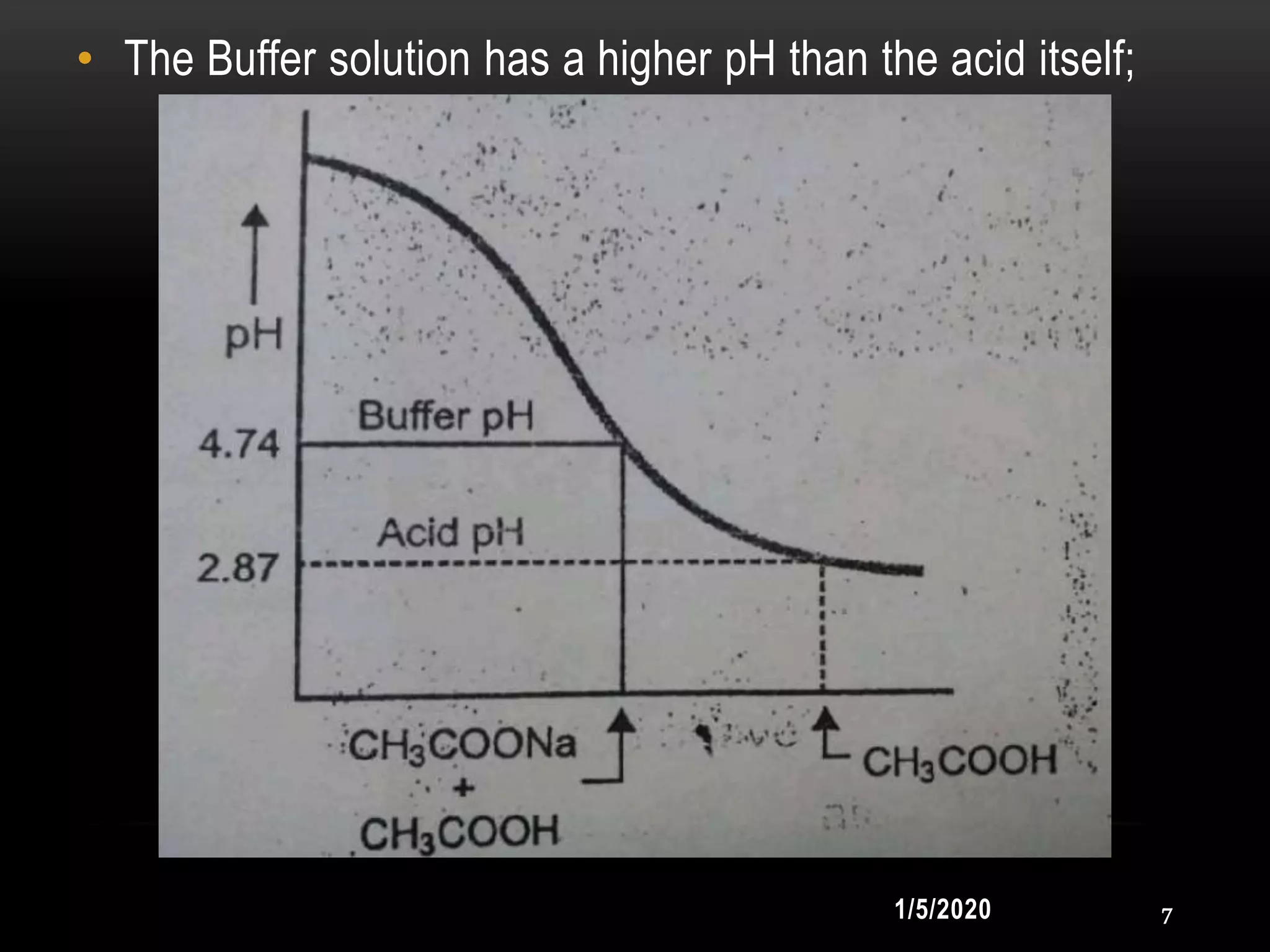
• The Buffer solution has a higher pH than the acid itself;
1/5/2020 8
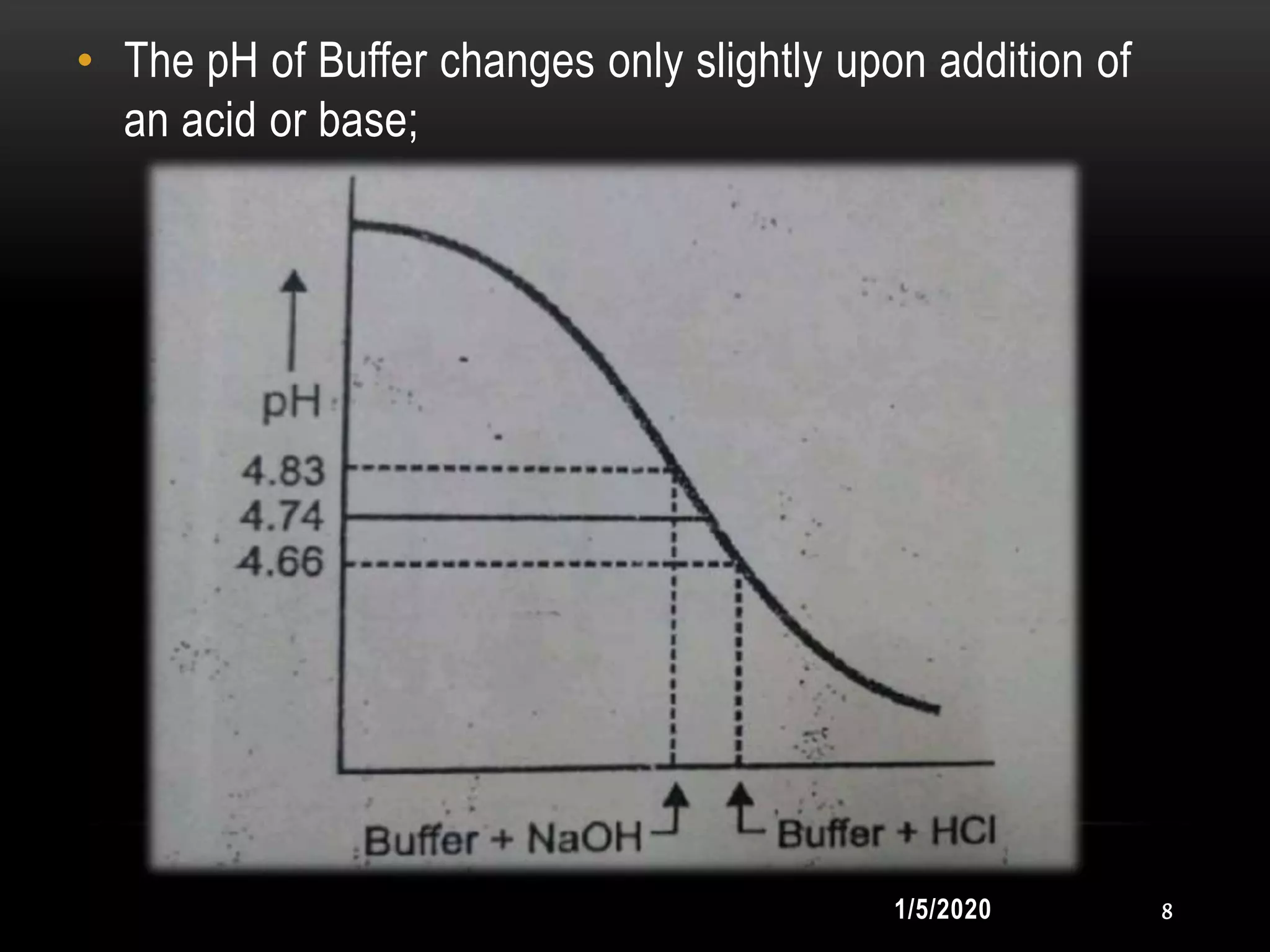
• The pH of Buffer changes only slightly upon addition of
an acid or base;
PHOSPHATE BUFFERS (DOUBLE SALT
BUFFERS):
1/5/2020 9
• Besides the two general types of buffers (i.e. acidic &
basic), a third appears to exist. This is buffer system
composed of two salts:
• Monobasic potassium phosphate (KH2PO4)
• Dibasic potassium phosphate (K2HPO4).
BUFFER ACTION
The resistance of a buffer solution to a change in pH is
known as buffer action.
1/5/2020 10
MECHANISM OF ACTION OF ACIDIC
BUFFERS:
1/5/2020 11
• Consider a buffer system of CH3COOH (Weak
electrolyte) and CH3COONa (Strong electrolyte). There
will be a large concentration Na+ ions, CH3COONa-
ions, and undissociated CH3COOH molecules.
• When an acid is added
• If a strong acid (HCl) is added in CH3COOH /
CH3COONa buffer, the changes that will occur may be
represented as:
1/5/2020 12
• The hydrogen ions yielded by the HCl are quickly
removed as unionized acetic acid, and the hydrogen
ion concentration is therefore only slightly affected (
because acetic acid produced is very weak as
compared to HCl added).
1/5/2020 13
• When a base is added
• If a strong base (NaOH) is added in CH3COOH /
CH3COONa buffer, the changes that will occur may be
represented as:
• The hydroxyl ions yielded by the NaOH are therefore
removed as water. The supply of hydrogen ions needed
for this purpose being constantly provided by the
dissociation of acetic acid.
MECHANISM OF ACTION OF BASIC
BUFFERS:
1/5/2020 14
• Consider a buffer system of NH4OH (Weak electrolyte) and
NH4Cl (Strong electrolyte). There will be a large concentration
of NH4
- ions, Cl- ions, and undissociated NH4Cl molecules.
• When an acid is added
• If a strong acid (HCl) is added in NH4OH / NH4Cl buffer, the
changes that will occur may be represented as:
1/5/2020 15
• The hydrogen ions yielded by the HCl are therefore
removed as water. The supply of OH- ions needed for
this is constantly provided by the ammonium hydride
1/5/2020 16
• When a base is added
• If a strong base (NaOH) is added in NH4Cl / NH4OH buffer, the
changes that will occur may be represented as:
NH4Cl Cl- + NH4
- OH- + Na+ NaOH
NH4OH
The hydroxyl ions yielded by the NaOH are therefore quickly removed
as unionized ammonium hydroxide and the pH of solution is only
slightly affected
MECHANISM OF ACTION OF
PHOSPHATE BUFFERS:
1/5/2020 17
• In KH2PO4 / K2HPO4 buffer system, H2PO4- serve as weak acid
and HPO4
-2 serves as conjugate base.
• When hydronium ions are added, then
HPO4
-2 + H3O-  H2PO4
- + H2O
When hydroxyl ions are added to this buffer, the following reaction
takes place;
H2PO4
- + OH-  HPO4
-2 + H2O

Buffer solutions

  • 1.
  • 2.
    BUFFERS SOLUTION: 1/5/2020 2 •“Buffers are compounds or mixtures of compounds that by their presence in the solution resist changes in the pH upon the addition of small quantities of acid or alkali or base.”
  • 3.
    NECESSITY OF ABUFFER SYSTEM: 1/5/2020 3 • Sometimes it is necessary that a solution of definite pH be prepared and stored. The preservation of such a solution is even more difficult than its preparation. If solution comes in contact with air, it will absorb CO2 and becomes acidic. On the other hand, if solution is stored in a glass bottle, alkaline impurities from the glass may alter its pH. Due to these reasons , pharmaceutical solutions are buffered as the buffer solutions are capable of maintaining pH at some fairly constant value when even small amounts of acid or base are added.
  • 4.
    TYPES OF BUFFERS: 1/5/20204 • Generally buffers are of two types; • Acidic buffers • Basic buffers
  • 5.
    ACIDIC BUFFERS: 1/5/2020 5 •An acidic buffer is a combination of weak acid and its salt with a strong base. • i.e. Weak acid & salt with a strong base(conjugate base) • EXAMPLES: • CH3COOH / CH3COONa • H2CO3 / NaHCO3 • H3PO4 / NaH2PO4 • HCOOH / HCOONa
  • 6.
    BASIC BUFFERS 1/5/2020 6 •A basic buffer is a combination of weak base and its salt with a strong acid. • i.e. Weak base & salt with strong acid (conjugate base) • EXAMPLES: • NH4OH / NH4Cl • NH3 / NH4Cl • NH3 / (NH4)2CO3
  • 7.
    1/5/2020 7 • TheBuffer solution has a higher pH than the acid itself;
  • 8.
    1/5/2020 8 • ThepH of Buffer changes only slightly upon addition of an acid or base;
  • 9.
    PHOSPHATE BUFFERS (DOUBLESALT BUFFERS): 1/5/2020 9 • Besides the two general types of buffers (i.e. acidic & basic), a third appears to exist. This is buffer system composed of two salts: • Monobasic potassium phosphate (KH2PO4) • Dibasic potassium phosphate (K2HPO4).
  • 10.
    BUFFER ACTION The resistanceof a buffer solution to a change in pH is known as buffer action. 1/5/2020 10
  • 11.
    MECHANISM OF ACTIONOF ACIDIC BUFFERS: 1/5/2020 11 • Consider a buffer system of CH3COOH (Weak electrolyte) and CH3COONa (Strong electrolyte). There will be a large concentration Na+ ions, CH3COONa- ions, and undissociated CH3COOH molecules. • When an acid is added • If a strong acid (HCl) is added in CH3COOH / CH3COONa buffer, the changes that will occur may be represented as:
  • 12.
    1/5/2020 12 • Thehydrogen ions yielded by the HCl are quickly removed as unionized acetic acid, and the hydrogen ion concentration is therefore only slightly affected ( because acetic acid produced is very weak as compared to HCl added).
  • 13.
    1/5/2020 13 • Whena base is added • If a strong base (NaOH) is added in CH3COOH / CH3COONa buffer, the changes that will occur may be represented as: • The hydroxyl ions yielded by the NaOH are therefore removed as water. The supply of hydrogen ions needed for this purpose being constantly provided by the dissociation of acetic acid.
  • 14.
    MECHANISM OF ACTIONOF BASIC BUFFERS: 1/5/2020 14 • Consider a buffer system of NH4OH (Weak electrolyte) and NH4Cl (Strong electrolyte). There will be a large concentration of NH4 - ions, Cl- ions, and undissociated NH4Cl molecules. • When an acid is added • If a strong acid (HCl) is added in NH4OH / NH4Cl buffer, the changes that will occur may be represented as:
  • 15.
    1/5/2020 15 • Thehydrogen ions yielded by the HCl are therefore removed as water. The supply of OH- ions needed for this is constantly provided by the ammonium hydride
  • 16.
    1/5/2020 16 • Whena base is added • If a strong base (NaOH) is added in NH4Cl / NH4OH buffer, the changes that will occur may be represented as: NH4Cl Cl- + NH4 - OH- + Na+ NaOH NH4OH The hydroxyl ions yielded by the NaOH are therefore quickly removed as unionized ammonium hydroxide and the pH of solution is only slightly affected
  • 17.
    MECHANISM OF ACTIONOF PHOSPHATE BUFFERS: 1/5/2020 17 • In KH2PO4 / K2HPO4 buffer system, H2PO4- serve as weak acid and HPO4 -2 serves as conjugate base. • When hydronium ions are added, then HPO4 -2 + H3O-  H2PO4 - + H2O When hydroxyl ions are added to this buffer, the following reaction takes place; H2PO4 - + OH-  HPO4 -2 + H2O