Physiological acid base balance
• Mrs. Kulkarni Dipali M.
• Assistant Professor,
• Yash Institute of Pharmacy,
• Aurangabad
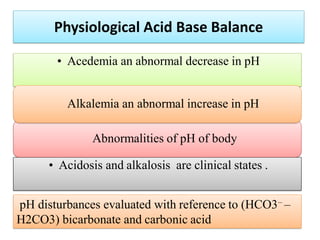
pH disturbances evaluated with reference to (HCO3– –
H2CO3) bicarbonate and carbonic acid
Physiological Acid Base Balance
Abnormalities of pH of body
• Acedemia an abnormal decrease in pH
Alkalemia an abnormal increase in pH
• Acidosis and alkalosis are clinical states .
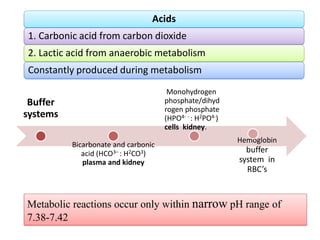
Buffer
systems
Bicarbonate and carbonic
acid (HCO3– : H2CO3)
plasma and kidney
Monohydrogen
phosphate/dihyd
rogen phosphate
(HPO4- - : H2PO4-)
cells kidney.
Hemoglobin
buffer
system in
RBC’s
Acids
1. Carbonic acid from carbon dioxide
2. Lactic acid from anaerobic metabolism
Constantly produced during metabolism
Metabolic reactions occur only within narrow pH range of
7.38-7.42
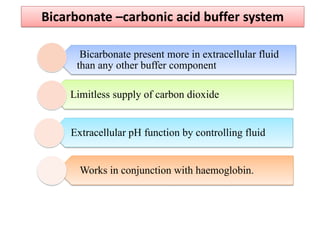
Bicarbonate –carbonic acid buffer system
Bicarbonate present more in extracellular fluid
than any other buffer component
Limitless supply of carbon dioxide
Extracellular pH function by controlling fluid
Works in conjunction with haemoglobin.
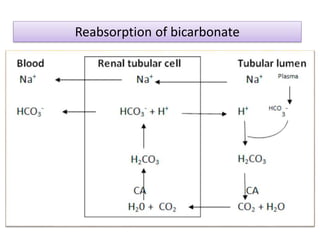
Reabsorption of bicarbonate
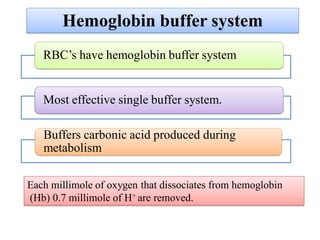
Each millimole of oxygen that dissociates from hemoglobin
(Hb) 0.7 millimole of H+ are removed.
Hemoglobin buffer system
RBC’s have hemoglobin buffer system
Most effective single buffer system.
Buffers carbonic acid produced during
metabolism
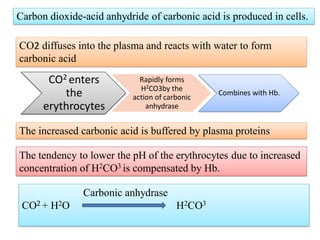
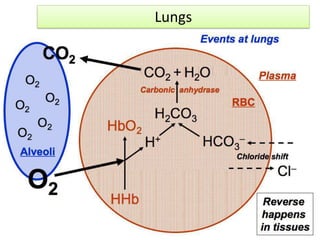
CO2 enters
the
erythrocytes
Rapidly forms
H2CO3by the
action of carbonic
anhydrase
Combines with Hb.
Carbonic anhydrase
CO2 + H2O H2CO3
Carbon dioxide-acid anhydride of carbonic acid is produced in cells.
CO2 diffuses into the plasma and reacts with water to form
carbonic acid
The increased carbonic acid is buffered by plasma proteins
The tendency to lower the pH of the erythrocytes due to increased
concentration of H2CO3 is compensated by Hb.
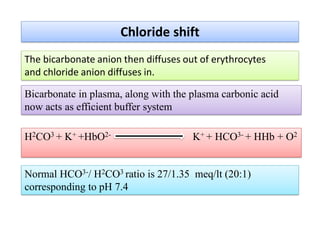
Bicarbonate in plasma, along with the plasma carbonic acid
now acts as efficient buffer system
Chloride shift
The bicarbonate anion then diffuses out of erythrocytes
and chloride anion diffuses in.
H2CO3 + K+ +HbO2- K+ + HCO3- + HHb + O2
Normal HCO3-/ H2CO3 ratio is 27/1.35 meq/lt (20:1)
corresponding to pH 7.4
Lungs
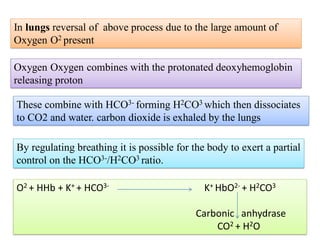
By regulating breathing it is possible for the body to exert a partial
control on the HCO3-/H2CO3 ratio.
In lungs reversal of above process due to the large amount of
Oxygen O2 present
Oxygen Oxygen combines with the protonated deoxyhemoglobin
releasing proton
These combine with HCO3- forming H2CO3 which then dissociates
to CO2 and water. carbon dioxide is exhaled by the lungs
O2 + HHb + K+ + HCO3- K+ HbO2- + H2CO3
Carbonic anhydrase
CO2 + H2O
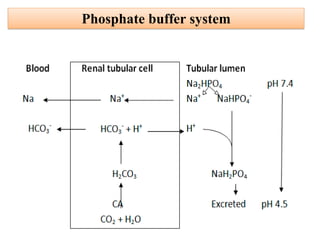
Phosphate buffer system
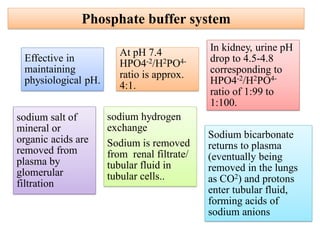
Effective in
maintaining
physiological pH.
At pH 7.4
HPO4-2/H2PO4-
ratio is approx.
4:1.
In kidney, urine pH
drop to 4.5-4.8
corresponding to
HPO4-2/H2PO4-
ratio of 1:99 to
1:100.
sodium salt of
mineral or
organic acids are
removed from
plasma by
glomerular
filtration
sodium hydrogen
exchange
Sodium is removed
from renal filtrate/
tubular fluid in
tubular cells..
Sodium bicarbonate
returns to plasma
(eventually being
removed in the lungs
as CO2) and protons
enter tubular fluid,
forming acids of
sodium anions
Phosphate buffer system
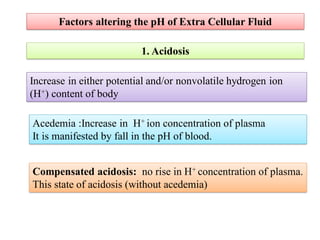
Factors altering the pH of Extra Cellular Fluid
1. Acidosis
Increase in either potential and/or nonvolatile hydrogen ion
(H+) content of body
Acedemia :Increase in H+ ion concentration of plasma
It is manifested by fall in the pH of blood.
Compensated acidosis: no rise in H+ concentration of plasma.
This state of acidosis (without acedemia)
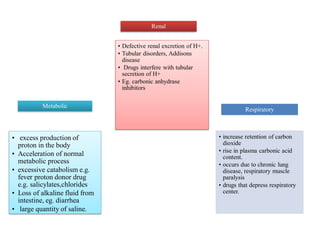
Metabolic
• excess production of
proton in the body
• Acceleration of normal
metabolic process
• excessive catabolism e.g.
fever proton donor drug
e.g. salicylates,chlorides
• Loss of alkaline fluid from
intestine, eg. diarrhea
• large quantity of saline.
Renal
• Defective renal excretion of H+.
• Tubular disorders, Addisons
disease
• Drugs interfere with tubular
secretion of H+
• Eg. carbonic anhydrase
inhibitors
Respiratory
• increase retention of carbon
dioxide
• rise in plasma carbonic acid
content.
• occurs due to chronic lung
disease, respiratory muscle
paralysis
• drugs that depress respiratory
center.
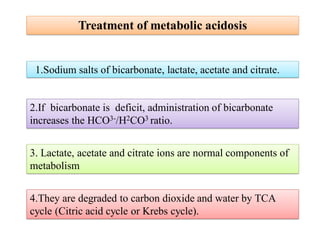
1.Sodium salts of bicarbonate, lactate, acetate and citrate.
4.They are degraded to carbon dioxide and water by TCA
cycle (Citric acid cycle or Krebs cycle).
3. Lactate, acetate and citrate ions are normal components of
metabolism
2.If bicarbonate is deficit, administration of bicarbonate
increases the HCO3-/H2CO3 ratio.
Treatment of metabolic acidosis
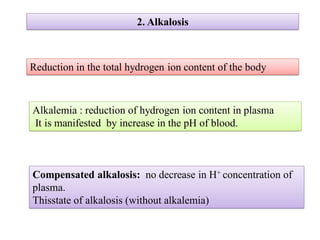
2. Alkalosis
Reduction in the total hydrogen ion content of the body
Alkalemia : reduction of hydrogen ion content in plasma
It is manifested by increase in the pH of blood.
Compensated alkalosis: no decrease in H+ concentration of
plasma.
Thisstate of alkalosis (without alkalemia)
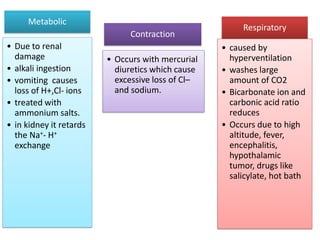
Metabolic
• Due to renal
damage
• alkali ingestion
• vomiting causes
loss of H+,Cl- ions
• treated with
ammonium salts.
• in kidney it retards
the Na+- H+
exchange
Contraction
• Occurs with mercurial
diuretics which cause
excessive loss of Cl–
and sodium.
Respiratory
• caused by
hyperventilation
• washes large
amount of CO2
• Bicarbonate ion and
carbonic acid ratio
reduces
• Occurs due to high
altitude, fever,
encephalitis,
hypothalamic
tumor, drugs like
salicylate, hot bath
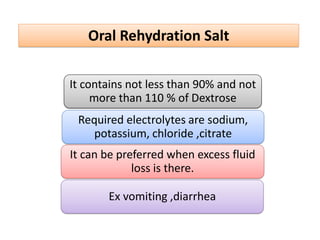
Oral Rehydration Salt
It contains not less than 90% and not
more than 110 % of Dextrose
Required electrolytes are sodium,
potassium, chloride ,citrate
It can be preferred when excess fluid
loss is there.
Ex vomiting ,diarrhea
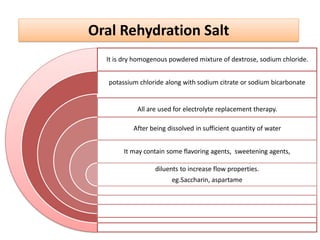
It is dry homogenous powdered mixture of dextrose, sodium chloride.
potassium chloride along with sodium citrate or sodium bicarbonate
All are used for electrolyte replacement therapy.
After being dissolved in sufficient quantity of water
It may contain some flavoring agents, sweetening agents,
diluents to increase flow properties.
eg.Saccharin, aspartame
Oral Rehydration Salt
Thank you

Physiological acid base balance

  • 1.
    Physiological acid basebalance • Mrs. Kulkarni Dipali M. • Assistant Professor, • Yash Institute of Pharmacy, • Aurangabad
  • 2.
    pH disturbances evaluatedwith reference to (HCO3– – H2CO3) bicarbonate and carbonic acid Physiological Acid Base Balance Abnormalities of pH of body • Acedemia an abnormal decrease in pH Alkalemia an abnormal increase in pH • Acidosis and alkalosis are clinical states .
  • 3.
    Buffer systems Bicarbonate and carbonic acid(HCO3– : H2CO3) plasma and kidney Monohydrogen phosphate/dihyd rogen phosphate (HPO4- - : H2PO4-) cells kidney. Hemoglobin buffer system in RBC’s Acids 1. Carbonic acid from carbon dioxide 2. Lactic acid from anaerobic metabolism Constantly produced during metabolism Metabolic reactions occur only within narrow pH range of 7.38-7.42
  • 5.
    Bicarbonate –carbonic acidbuffer system Bicarbonate present more in extracellular fluid than any other buffer component Limitless supply of carbon dioxide Extracellular pH function by controlling fluid Works in conjunction with haemoglobin.
  • 6.
  • 7.
    Each millimole ofoxygen that dissociates from hemoglobin (Hb) 0.7 millimole of H+ are removed. Hemoglobin buffer system RBC’s have hemoglobin buffer system Most effective single buffer system. Buffers carbonic acid produced during metabolism
  • 8.
    CO2 enters the erythrocytes Rapidly forms H2CO3bythe action of carbonic anhydrase Combines with Hb. Carbonic anhydrase CO2 + H2O H2CO3 Carbon dioxide-acid anhydride of carbonic acid is produced in cells. CO2 diffuses into the plasma and reacts with water to form carbonic acid The increased carbonic acid is buffered by plasma proteins The tendency to lower the pH of the erythrocytes due to increased concentration of H2CO3 is compensated by Hb.
  • 9.
    Bicarbonate in plasma,along with the plasma carbonic acid now acts as efficient buffer system Chloride shift The bicarbonate anion then diffuses out of erythrocytes and chloride anion diffuses in. H2CO3 + K+ +HbO2- K+ + HCO3- + HHb + O2 Normal HCO3-/ H2CO3 ratio is 27/1.35 meq/lt (20:1) corresponding to pH 7.4
  • 10.
  • 11.
    By regulating breathingit is possible for the body to exert a partial control on the HCO3-/H2CO3 ratio. In lungs reversal of above process due to the large amount of Oxygen O2 present Oxygen Oxygen combines with the protonated deoxyhemoglobin releasing proton These combine with HCO3- forming H2CO3 which then dissociates to CO2 and water. carbon dioxide is exhaled by the lungs O2 + HHb + K+ + HCO3- K+ HbO2- + H2CO3 Carbonic anhydrase CO2 + H2O
  • 12.
    Phosphate buffer system Effectivein maintaining physiological pH. At pH 7.4 HPO4-2/H2PO4- ratio is approx. 4:1. In kidney, urine pH drop to 4.5-4.8 corresponding to HPO4-2/H2PO4- ratio of 1:99 to 1:100. sodium salt of mineral or organic acids are removed from plasma by glomerular filtration sodium hydrogen exchange Sodium is removed from renal filtrate/ tubular fluid in tubular cells.. Sodium bicarbonate returns to plasma (eventually being removed in the lungs as CO2) and protons enter tubular fluid, forming acids of sodium anions
  • 13.
  • 14.
    Factors altering thepH of Extra Cellular Fluid 1. Acidosis Increase in either potential and/or nonvolatile hydrogen ion (H+) content of body Acedemia :Increase in H+ ion concentration of plasma It is manifested by fall in the pH of blood. Compensated acidosis: no rise in H+ concentration of plasma. This state of acidosis (without acedemia)
  • 15.
    Metabolic • excess productionof proton in the body • Acceleration of normal metabolic process • excessive catabolism e.g. fever proton donor drug e.g. salicylates,chlorides • Loss of alkaline fluid from intestine, eg. diarrhea • large quantity of saline. Renal • Defective renal excretion of H+. • Tubular disorders, Addisons disease • Drugs interfere with tubular secretion of H+ • Eg. carbonic anhydrase inhibitors Respiratory • increase retention of carbon dioxide • rise in plasma carbonic acid content. • occurs due to chronic lung disease, respiratory muscle paralysis • drugs that depress respiratory center.
  • 16.
    1.Sodium salts ofbicarbonate, lactate, acetate and citrate. 4.They are degraded to carbon dioxide and water by TCA cycle (Citric acid cycle or Krebs cycle). 3. Lactate, acetate and citrate ions are normal components of metabolism 2.If bicarbonate is deficit, administration of bicarbonate increases the HCO3-/H2CO3 ratio. Treatment of metabolic acidosis
  • 17.
    2. Alkalosis Reduction inthe total hydrogen ion content of the body Alkalemia : reduction of hydrogen ion content in plasma It is manifested by increase in the pH of blood. Compensated alkalosis: no decrease in H+ concentration of plasma. Thisstate of alkalosis (without alkalemia)
  • 18.
    Metabolic • Due torenal damage • alkali ingestion • vomiting causes loss of H+,Cl- ions • treated with ammonium salts. • in kidney it retards the Na+- H+ exchange Contraction • Occurs with mercurial diuretics which cause excessive loss of Cl– and sodium. Respiratory • caused by hyperventilation • washes large amount of CO2 • Bicarbonate ion and carbonic acid ratio reduces • Occurs due to high altitude, fever, encephalitis, hypothalamic tumor, drugs like salicylate, hot bath
  • 19.
    Oral Rehydration Salt Itcontains not less than 90% and not more than 110 % of Dextrose Required electrolytes are sodium, potassium, chloride ,citrate It can be preferred when excess fluid loss is there. Ex vomiting ,diarrhea
  • 20.
    It is dryhomogenous powdered mixture of dextrose, sodium chloride. potassium chloride along with sodium citrate or sodium bicarbonate All are used for electrolyte replacement therapy. After being dissolved in sufficient quantity of water It may contain some flavoring agents, sweetening agents, diluents to increase flow properties. eg.Saccharin, aspartame Oral Rehydration Salt
  • 21.