BUFFER SYSTEM AND
ISOTONIC SOLUTIONS
Physical Pharmacy
Presented By: De La Cruz, Galvez, Koraim, Macawile, Malayao, Padrique
Objectives:
1. Buffer equation
2. Factors influencing the pH of buffer solutions
3. Buffer capacity
4. Buffer in pharmaceutical systems and biologic system
5. Influence of buffer capacity and pH on tissue, pH and
solubility
6. Buffered isotonic solutions
7. Measurement of tonicity
Buffer Equation
Karen Joy Padrique
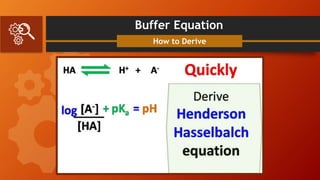
Buffer Equation
How to Derive
Buffer Equation
Problem Solving
A mixture of 0.20 M acetic acid
and 0.30 M sodium acetate is
given. Calculate the pH of the
medium if the pKa of the acetic
is 4.76.
𝑝𝐻 = 𝑝𝐾𝑎 + 𝑙𝑜𝑔
[𝑃𝑟𝑜𝑡𝑜𝑛 𝐴𝑐𝑐𝑒𝑝𝑡𝑜𝑟]
[𝑃𝑟𝑜𝑡𝑜𝑛 𝐷𝑜𝑛𝑜𝑟]
𝑝𝐻 = 4.76 + log
0.30
0.20
𝑝𝐻 = 4.76 + log 1.5
𝑝𝐻 = 4.76 + 0.18
4.94 = 4.76 + 0.18
Problem Solving
Answer: The pH of the given
solution is 4.94
Factors influencing the pH of buffer solutions
Sheryl Galvez
Factors Influencing pH
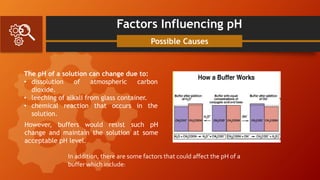
The pH of a solution can change due to:
• dissolution of atmospheric carbon
dioxide.
• leeching of alkali from glass container.
• chemical reaction that occurs in the
solution.
However, buffers would resist such pH
change and maintain the solution at some
acceptable pH level.
In addition, there are some factors that could affect the pH of a
buffer which include:
Possible Causes
Factors Influencing pH
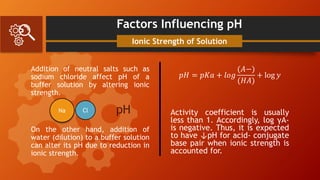
Addition of neutral salts such as
sodium chloride affect pH of a
buffer solution by altering ionic
strength.
𝑝𝐻 = 𝑝𝐾𝑎 + 𝑙𝑜𝑔
(𝐴−)
(𝐻𝐴)
+ log 𝑦
Ionic Strength of Solution
On the other hand, addition of
water (dilution) to a buffer solution
can alter its pH due to reduction in
ionic strength.
Activity coefficient is usually
less than 1. Accordingly, log γA-
is negative. Thus, it is expected
to have ↓pH for acid- conjugate
base pair when ionic strength is
accounted for.
Na Cl pH
Factors Influencing pH
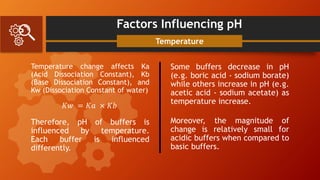
Temperature change affects Ka
(Acid Dissociation Constant), Kb
(Base Dissociation Constant), and
Kw (Dissociation Constant of water)
𝐾𝑤 = 𝐾𝑎 × 𝐾𝑏
Temperature
Therefore, pH of buffers is
influenced by temperature.
Each buffer is influenced
differently.
Some buffers decrease in pH
(e.g. boric acid - sodium borate)
while others increase in pH (e.g.
acetic acid - sodium acetate) as
temperature increase.
Moreover, the magnitude of
change is relatively small for
acidic buffers when compared to
basic buffers.
Buffer Capacity
Eriez Malayao
Buffer Capacity
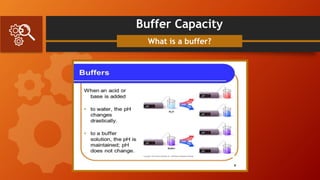
What is a buffer?
Buffer Capacity
Buffer Capacity – The amount of
acid of base a buffer can take
without having a significant
change in pH.
What is Buffer Capacity?
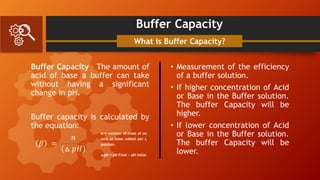
Buffer capacity is calculated by
the equation:
• Measurement of the efficiency
of a buffer solution.
• If higher concentration of Acid
or Base in the Buffer solution.
The buffer Capacity will be
higher.
• If lower concentration of Acid
or Base in the Buffer solution.
The buffer Capacity will be
lower.
𝛽 =
𝑛
△ 𝑝𝐻
n = number of mols of an
acid or base added per L
solution.
△pH = pH Final – pH initial
Buffer in Pharmaceutical Systems and
Biologic System
Mark Luiz De La Cruz
Buffer in Pharmaceutical Systems and Biologic System
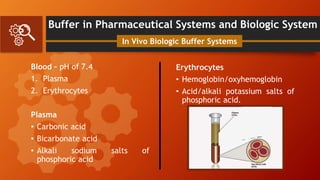
Blood – pH of 7.4
1. Plasma
2. Erythrocytes
In Vivo Biologic Buffer Systems
Plasma
• Carbonic acid
• Bicarbonate acid
• Alkali sodium salts of
phosphoric acid
Erythrocytes
• Hemoglobin/oxyhemoglobin
• Acid/alkali potassium salts of
phosphoric acid.
Buffer in Pharmaceutical Systems and Biologic System
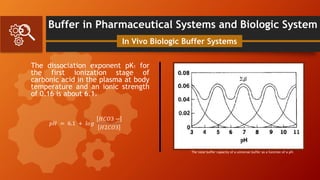
The dissociation exponent pK1 for
the first ionization stage of
carbonic acid in the plasma at body
temperature and an ionic strength
of 0.16 is about 6.1.
In Vivo Biologic Buffer Systems
𝑝𝐻 = 6.1 + 𝑙𝑜𝑔
𝐻𝐶𝑂3 −
𝐻2𝐶𝑂3
The total buffer capacity of a universal buffer as a function of a pH.
Buffer in Pharmaceutical Systems and Biologic System
At a pH of 7.4, the ratio of bicarbonate
to carbonic acid (Represents CO2) in
normal blood plasma is
log [HCO3-]/[H2CO3]= 7.4 - 6.1 = 1.3
In Vivo Biologic Buffer Systems
[HCO3-]/[H2CO3] = 20/1
or
Actual Concentration:
0.025 M and 0.00125 M, respectively.
Buffer Capacity of Blood: pH 7.0 to 7.8
Peters and Van Slyke
• Hemoglobin and other constituents = 0.028 g
• Bicarbonate = 0.003 g
Salenius
• Blood = 0.0318 ± 0.0035 g
Ellison et al.
• 0.039 (0.031 cells + 0.008 plasma)
Important Note: It is usually life-threatening
for the pH of the blood to go below 6.9 or
above 7.8. The pH of the blood in diabetic
coma is as low as about 6.8.
Buffer in Pharmaceutical Systems and Biologic System
Tears/Lacrimal Fluid
• Has a great degree of buffer
capacity.
• Bates, 1:15 dilution value.
• pH is about 7.4, ranging from 7-8 or
higher.
• Pure conjunctival fluid is probably
more acidic than the tear fluid
commonly used in pH measurements.
In Vivo Biologic Buffer Systems
However, discomfort and a flow of tears
will occur below pH 6.6 and above pH 9.0.
Urine
• normal adult has a pH averaging
about 6.0 units; it can be as low as
4.5 or as high as 7.8.
When the pH of the urine is:
• ↓ normal values, hydrogen ions are
excreted by kidneys.
• ↑ pH 7.4, hydrogen ions are retained
by action of the kidneys in order to
return the pH to its normal range of
values.
Buffer in Pharmaceutical Systems and Biologic System
Pharmaceutical Buffer Solutions:
• Ophthalmic Solutions.
• Colorimetric Determination of pH.
• Research Studies.
Gifford (Two Stock Solutions)
• Boric acid
• Monohydrated sodium carbonate
which, when mixed in various proportions,
yield buffer solutions with pH values from
about 5 to 9.
Ophthalmic Solutions
S’orensen
• Salts of sodium phosphate for buffer
solutions of pH 6 to 8.
Note: Sodium chloride is + to buffer
mixture to make it isotonic.
Palitzsch (Modified by Hind and Govan)
• Boric acid
• Sodium borate
• Sufficient sodium chloride
Most of this is used for ophthalmic solutions
in the pH range of 7 to 9.
Buffer in Pharmaceutical Systems and Biologic System
The Clark–Lubs mixtures and their
corresponding pH ranges are as
follows:
(a) HCl and KCl, pH 1.2 to 2.2
(b) HCl and potassium hydrogen phthalate, pH
2.2 to 4.0
(c) NaOH and potassium hydrogen phthalate, pH
4.2 to 5.8
(d) NaOH and KH2PO4, pH 5.8 to 8.0
(e) H3BO3, NaOH, and KCl, pH 8.0 to 10.0
Ophthalmic Solutions
The role of the KCl in the Clark–Lubs
buffer is sometimes erroneously
interpreted as:
• A salt of the buffer acid, HCl,
corresponding to the part played by
sodium acetate as the salt of the weak
buffer acid, HAc.
• Potassium chloride is added to (e), the
borate buffer, to produce an ionic
strength comparable to that of (d), the
phosphate buffer, where the pH of the
two buffer series overlaps.
Between pH 3 and 11, the older values were about
0.04 unit lower than the values now assigned, and at
the ends of the scale, the differences were greater.
Buffer in Pharmaceutical Systems and Biologic System
Conventionally, the nasal route has been
used for delivery of drugs for treatment of
local diseases such as nasal allergy, nasal
congestion, and nasal infections.
Small molecular weight polar drugs,
peptides and proteins that are not easily
administered via other routes.
Rapid onset of action is required.
Nasal Delivery
Influence of buffer capacity and pH on tissue,
pH and solubility
Mark Luiz De La Cruz
Influence of buffer capacity and pH on tissue, pH and solubility
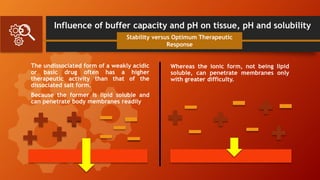
The undissociated form of a weakly acidic
or basic drug often has a higher
therapeutic activity than that of the
dissociated salt form.
Because the former is lipid soluble and
can penetrate body membranes readily
Stability versus Optimum Therapeutic
Response
Whereas the ionic form, not being lipid
soluble, can penetrate membranes only
with greater difficulty.
Influence of buffer capacity and pH on tissue, pH and solubility
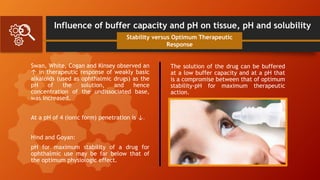
Swan, White, Cogan and Kinsey observed an
↑ in therapeutic response of weakly basic
alkaloids (used as ophthalmic drugs) as the
pH of the solution, and hence
concentration of the undissociated base,
was increased.
At a pH of 4 (ionic form) penetration is ↓.
Hind and Goyan:
pH for maximum stability of a drug for
ophthalmic use may be far below that of
the optimum physiologic effect.
Stability versus Optimum Therapeutic
Response
The solution of the drug can be buffered
at a low buffer capacity and at a pH that
is a compromise between that of optimum
stability-pH for maximum therapeutic
action.
Influence of buffer capacity and pH on tissue, pH and solubility
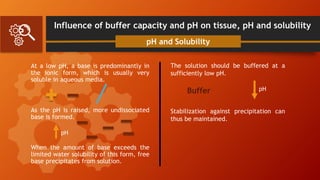
At a low pH, a base is predominantly in
the ionic form, which is usually very
soluble in aqueous media.
As the pH is raised, more undissociated
base is formed.
When the amount of base exceeds the
limited water solubility of this form, free
base precipitates from solution.
pH and Solubility
The solution should be buffered at a
sufficiently low pH.
Stabilization against precipitation can
thus be maintained.
pH
Buffer pH
Buffered Isotonic Solutions
Lourence John Macawile
Buffered Isotonic Solutions
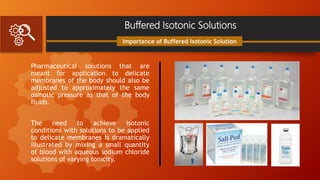
Pharmaceutical solutions that are
meant for application to delicate
membranes of the body should also be
adjusted to approximately the same
osmotic pressure as that of the body
fluids.
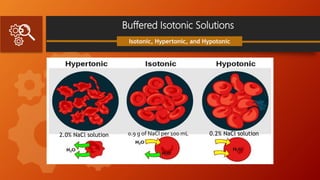
The need to achieve isotonic
conditions with solutions to be applied
to delicate membranes is dramatically
illustrated by mixing a small quantity
of blood with aqueous sodium chloride
solutions of varying tonicity.
Importance of Buffered Isotonic Solution
Buffered Isotonic Solutions
Isotonic, Hypertonic, and Hypotonic
0.9 g of NaCl per 100 mL
2.0% NaCl solution 0.2% NaCl solution
Buffered Isotonic Solutions
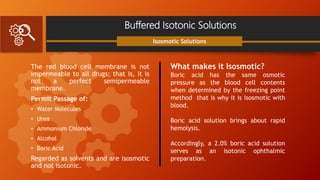
The red blood cell membrane is not
impermeable to all drugs; that is, it is
not a perfect semipermeable
membrane.
Permit Passage of:
• Water Molecules
• Urea
• Ammonium Chloride
• Alcohol
• Boric Acid
Regarded as solvents and are isosmotic
and not isotonic.
Isosmotic Solutions
What makes it Isosmotic?
Boric acid has the same osmotic
pressure as the blood cell contents
when determined by the freezing point
method that is why it is isosmotic with
blood.
Boric acid solution brings about rapid
hemolysis.
Accordingly, a 2.0% boric acid solution
serves as an isotonic ophthalmic
preparation.
Buffered Isotonic Solutions
Osmolality and Osmolarity:
Colligative Properties that measure
concentration of solutes independently
of their ability to cross cell membrane.
Tonicity:
Concentration of only solutes unable to
cross the membrane. Exerts osmotic
pressure on membrane.
Tonicity
Tonicity is not the difference between
the two osmolarities on opposing
sides of the membrane.
A solution containing a quantity of
drug calculated to be isosmotic with
blood is isotonic only when the
blood cells are impermeable to the
solute (drug) molecules and
permeable to the solvent, water.
Measurement of Tonicity
Albaraa Mahmoud Ahmed Karim
Measurement of Tonicity
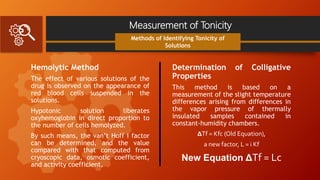
Hemolytic Method
The effect of various solutions of the
drug is observed on the appearance of
red blood cells suspended in the
solutions.
Hypotonic solution liberates
oxyhemoglobin in direct proportion to
the number of cells hemolyzed.
By such means, the van’t Hoff i factor
can be determined, and the value
compared with that computed from
cryoscopic data, osmotic coefficient,
and activity coefficient.
Methods of Identifying Tonicity of
Solutions
Determination of Colligative
Properties
This method is based on a
measurement of the slight temperature
differences arising from differences in
the vapor pressure of thermally
insulated samples contained in
constant-humidity chambers.
ΔTf = Kfc (Old Equation),
a new factor, L = i Kf
New Equation ΔTf = Lc
Measurement of Tonicity
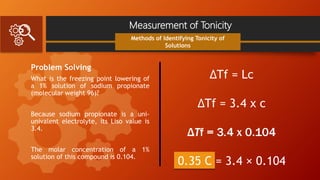
Problem Solving
What is the freezing point lowering of
a 1% solution of sodium propionate
(molecular weight 96)?
Because sodium propionate is a uni-
univalent electrolyte, its Liso value is
3.4.
The molar concentration of a 1%
solution of this compound is 0.104.
Methods of Identifying Tonicity of
Solutions
ΔTf = Lc
ΔTf = 3.4 x c
ΔTf = 3.4 x 0.104
0.35 C = 3.4 × 0.104
Measurement of Tonicity
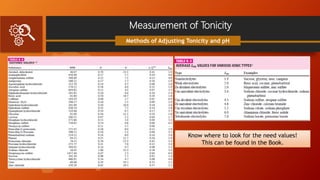
Methods of Adjusting Tonicity and pH
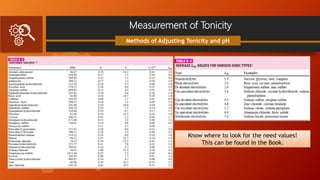
Know where to look for the need values!
This can be found in the Book.
Measurement of Tonicity
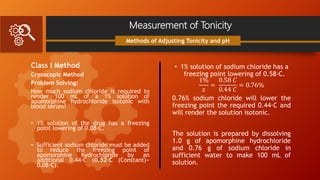
Class I Method
Cryoscopic Method
Problem Solving:
How much sodium chloride is required to
render 100 mL of a 1% solution of
apomorphine hydrochloride isotonic with
blood serum?
• 1% solution of the drug has a freezing
point lowering of 0.08◦C.
• Sufficient sodium chloride must be added
to reduce the freezing point of
apomorphine hydrochloride by an
additional 0.44◦C (0.52◦C (Constant)−
0.08◦C).
Methods of Adjusting Tonicity and pH
• 1% solution of sodium chloride has a
freezing point lowering of 0.58◦C.
1%
𝑥
=
0.58 𝐶
0.44 𝐶
= 0.76%
0.76% sodium chloride will lower the
freezing point the required 0.44◦C and
will render the solution isotonic.
The solution is prepared by dissolving
1.0 g of apomorphine hydrochloride
and 0.76 g of sodium chloride in
sufficient water to make 100 mL of
solution.
Measurement of Tonicity
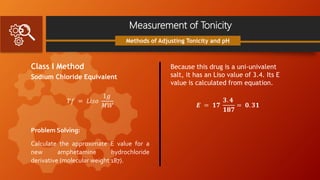
Class I Method
Sodium Chloride Equivalent
𝑇𝑓 = 𝐿𝑖𝑠𝑜
1𝑔
𝑀𝑊
Problem Solving:
Calculate the approximate E value for a
new amphetamine hydrochloride
derivative (molecular weight 187).
Methods of Adjusting Tonicity and pH
Because this drug is a uni-univalent
salt, it has an Liso value of 3.4. Its E
value is calculated from equation.
𝑬 = 𝟏𝟕
𝟑. 𝟒
𝟏𝟖𝟕
= 𝟎. 𝟑𝟏
Measurement of Tonicity
Class II Method
White Vincent Method
involve the addition of water to the drugs
to make an isotonic solution, followed by
the addition of an isotonic or isotonic-
buffered.
Diluting vehicle to bring the solution to the
final volume.
V = w × E × 111.1
Methods of Adjusting Tonicity and pH
Problem Solving:
Make the following solution isotonic with
respect to an ideal membrane:
Phenacaine Hydrochloride 0.06 g
Boric Acid 0.30 g
Sterilized Distilled Water, enough to make 100 mL.
Based again on the table:
V = [(0.06×0.20)+(0.3×0.50)]×111.1
V = 18mL
The drugs are mixed with water to make 18 mL of
an isotonic solution, and the preparation is
brought to a volume of 100 mL by adding an
isotonic diluting solution.
Measurement of Tonicity
Methods of Adjusting Tonicity and pH
Know where to look for the need values!
This can be found in the Book.
Measurement of Tonicity
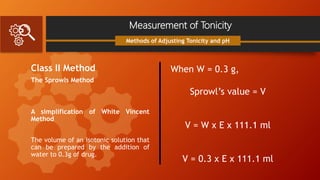
Class II Method
The Sprowls Method
A simplification of White Vincent
Method
The volume of an isotonic solution that
can be prepared by the addition of
water to 0.3g of drug.
Methods of Adjusting Tonicity and pH
When W = 0.3 g,
Sprowl’s value = V
V = W x E x 111.1 ml
V = 0.3 x E x 111.1 ml
Thank you for
Listening!

Buffer System and Isotonic Solutions

  • 1.
    BUFFER SYSTEM AND ISOTONICSOLUTIONS Physical Pharmacy Presented By: De La Cruz, Galvez, Koraim, Macawile, Malayao, Padrique
  • 2.
    Objectives: 1. Buffer equation 2.Factors influencing the pH of buffer solutions 3. Buffer capacity 4. Buffer in pharmaceutical systems and biologic system 5. Influence of buffer capacity and pH on tissue, pH and solubility 6. Buffered isotonic solutions 7. Measurement of tonicity
  • 3.
  • 4.
  • 5.
    Buffer Equation Problem Solving Amixture of 0.20 M acetic acid and 0.30 M sodium acetate is given. Calculate the pH of the medium if the pKa of the acetic is 4.76. 𝑝𝐻 = 𝑝𝐾𝑎 + 𝑙𝑜𝑔 [𝑃𝑟𝑜𝑡𝑜𝑛 𝐴𝑐𝑐𝑒𝑝𝑡𝑜𝑟] [𝑃𝑟𝑜𝑡𝑜𝑛 𝐷𝑜𝑛𝑜𝑟] 𝑝𝐻 = 4.76 + log 0.30 0.20 𝑝𝐻 = 4.76 + log 1.5 𝑝𝐻 = 4.76 + 0.18 4.94 = 4.76 + 0.18 Problem Solving Answer: The pH of the given solution is 4.94
  • 6.
    Factors influencing thepH of buffer solutions Sheryl Galvez
  • 7.
    Factors Influencing pH ThepH of a solution can change due to: • dissolution of atmospheric carbon dioxide. • leeching of alkali from glass container. • chemical reaction that occurs in the solution. However, buffers would resist such pH change and maintain the solution at some acceptable pH level. In addition, there are some factors that could affect the pH of a buffer which include: Possible Causes
  • 8.
    Factors Influencing pH Additionof neutral salts such as sodium chloride affect pH of a buffer solution by altering ionic strength. 𝑝𝐻 = 𝑝𝐾𝑎 + 𝑙𝑜𝑔 (𝐴−) (𝐻𝐴) + log 𝑦 Ionic Strength of Solution On the other hand, addition of water (dilution) to a buffer solution can alter its pH due to reduction in ionic strength. Activity coefficient is usually less than 1. Accordingly, log γA- is negative. Thus, it is expected to have ↓pH for acid- conjugate base pair when ionic strength is accounted for. Na Cl pH
  • 9.
    Factors Influencing pH Temperaturechange affects Ka (Acid Dissociation Constant), Kb (Base Dissociation Constant), and Kw (Dissociation Constant of water) 𝐾𝑤 = 𝐾𝑎 × 𝐾𝑏 Temperature Therefore, pH of buffers is influenced by temperature. Each buffer is influenced differently. Some buffers decrease in pH (e.g. boric acid - sodium borate) while others increase in pH (e.g. acetic acid - sodium acetate) as temperature increase. Moreover, the magnitude of change is relatively small for acidic buffers when compared to basic buffers.
  • 10.
  • 11.
  • 12.
    Buffer Capacity Buffer Capacity– The amount of acid of base a buffer can take without having a significant change in pH. What is Buffer Capacity? Buffer capacity is calculated by the equation: • Measurement of the efficiency of a buffer solution. • If higher concentration of Acid or Base in the Buffer solution. The buffer Capacity will be higher. • If lower concentration of Acid or Base in the Buffer solution. The buffer Capacity will be lower. 𝛽 = 𝑛 △ 𝑝𝐻 n = number of mols of an acid or base added per L solution. △pH = pH Final – pH initial
  • 13.
    Buffer in PharmaceuticalSystems and Biologic System Mark Luiz De La Cruz
  • 14.
    Buffer in PharmaceuticalSystems and Biologic System Blood – pH of 7.4 1. Plasma 2. Erythrocytes In Vivo Biologic Buffer Systems Plasma • Carbonic acid • Bicarbonate acid • Alkali sodium salts of phosphoric acid Erythrocytes • Hemoglobin/oxyhemoglobin • Acid/alkali potassium salts of phosphoric acid.
  • 15.
    Buffer in PharmaceuticalSystems and Biologic System The dissociation exponent pK1 for the first ionization stage of carbonic acid in the plasma at body temperature and an ionic strength of 0.16 is about 6.1. In Vivo Biologic Buffer Systems 𝑝𝐻 = 6.1 + 𝑙𝑜𝑔 𝐻𝐶𝑂3 − 𝐻2𝐶𝑂3 The total buffer capacity of a universal buffer as a function of a pH.
  • 16.
    Buffer in PharmaceuticalSystems and Biologic System At a pH of 7.4, the ratio of bicarbonate to carbonic acid (Represents CO2) in normal blood plasma is log [HCO3-]/[H2CO3]= 7.4 - 6.1 = 1.3 In Vivo Biologic Buffer Systems [HCO3-]/[H2CO3] = 20/1 or Actual Concentration: 0.025 M and 0.00125 M, respectively. Buffer Capacity of Blood: pH 7.0 to 7.8 Peters and Van Slyke • Hemoglobin and other constituents = 0.028 g • Bicarbonate = 0.003 g Salenius • Blood = 0.0318 ± 0.0035 g Ellison et al. • 0.039 (0.031 cells + 0.008 plasma) Important Note: It is usually life-threatening for the pH of the blood to go below 6.9 or above 7.8. The pH of the blood in diabetic coma is as low as about 6.8.
  • 17.
    Buffer in PharmaceuticalSystems and Biologic System Tears/Lacrimal Fluid • Has a great degree of buffer capacity. • Bates, 1:15 dilution value. • pH is about 7.4, ranging from 7-8 or higher. • Pure conjunctival fluid is probably more acidic than the tear fluid commonly used in pH measurements. In Vivo Biologic Buffer Systems However, discomfort and a flow of tears will occur below pH 6.6 and above pH 9.0. Urine • normal adult has a pH averaging about 6.0 units; it can be as low as 4.5 or as high as 7.8. When the pH of the urine is: • ↓ normal values, hydrogen ions are excreted by kidneys. • ↑ pH 7.4, hydrogen ions are retained by action of the kidneys in order to return the pH to its normal range of values.
  • 18.
    Buffer in PharmaceuticalSystems and Biologic System Pharmaceutical Buffer Solutions: • Ophthalmic Solutions. • Colorimetric Determination of pH. • Research Studies. Gifford (Two Stock Solutions) • Boric acid • Monohydrated sodium carbonate which, when mixed in various proportions, yield buffer solutions with pH values from about 5 to 9. Ophthalmic Solutions S’orensen • Salts of sodium phosphate for buffer solutions of pH 6 to 8. Note: Sodium chloride is + to buffer mixture to make it isotonic. Palitzsch (Modified by Hind and Govan) • Boric acid • Sodium borate • Sufficient sodium chloride Most of this is used for ophthalmic solutions in the pH range of 7 to 9.
  • 19.
    Buffer in PharmaceuticalSystems and Biologic System The Clark–Lubs mixtures and their corresponding pH ranges are as follows: (a) HCl and KCl, pH 1.2 to 2.2 (b) HCl and potassium hydrogen phthalate, pH 2.2 to 4.0 (c) NaOH and potassium hydrogen phthalate, pH 4.2 to 5.8 (d) NaOH and KH2PO4, pH 5.8 to 8.0 (e) H3BO3, NaOH, and KCl, pH 8.0 to 10.0 Ophthalmic Solutions The role of the KCl in the Clark–Lubs buffer is sometimes erroneously interpreted as: • A salt of the buffer acid, HCl, corresponding to the part played by sodium acetate as the salt of the weak buffer acid, HAc. • Potassium chloride is added to (e), the borate buffer, to produce an ionic strength comparable to that of (d), the phosphate buffer, where the pH of the two buffer series overlaps. Between pH 3 and 11, the older values were about 0.04 unit lower than the values now assigned, and at the ends of the scale, the differences were greater.
  • 20.
    Buffer in PharmaceuticalSystems and Biologic System Conventionally, the nasal route has been used for delivery of drugs for treatment of local diseases such as nasal allergy, nasal congestion, and nasal infections. Small molecular weight polar drugs, peptides and proteins that are not easily administered via other routes. Rapid onset of action is required. Nasal Delivery
  • 21.
    Influence of buffercapacity and pH on tissue, pH and solubility Mark Luiz De La Cruz
  • 22.
    Influence of buffercapacity and pH on tissue, pH and solubility The undissociated form of a weakly acidic or basic drug often has a higher therapeutic activity than that of the dissociated salt form. Because the former is lipid soluble and can penetrate body membranes readily Stability versus Optimum Therapeutic Response Whereas the ionic form, not being lipid soluble, can penetrate membranes only with greater difficulty.
  • 23.
    Influence of buffercapacity and pH on tissue, pH and solubility Swan, White, Cogan and Kinsey observed an ↑ in therapeutic response of weakly basic alkaloids (used as ophthalmic drugs) as the pH of the solution, and hence concentration of the undissociated base, was increased. At a pH of 4 (ionic form) penetration is ↓. Hind and Goyan: pH for maximum stability of a drug for ophthalmic use may be far below that of the optimum physiologic effect. Stability versus Optimum Therapeutic Response The solution of the drug can be buffered at a low buffer capacity and at a pH that is a compromise between that of optimum stability-pH for maximum therapeutic action.
  • 24.
    Influence of buffercapacity and pH on tissue, pH and solubility At a low pH, a base is predominantly in the ionic form, which is usually very soluble in aqueous media. As the pH is raised, more undissociated base is formed. When the amount of base exceeds the limited water solubility of this form, free base precipitates from solution. pH and Solubility The solution should be buffered at a sufficiently low pH. Stabilization against precipitation can thus be maintained. pH Buffer pH
  • 25.
  • 26.
    Buffered Isotonic Solutions Pharmaceuticalsolutions that are meant for application to delicate membranes of the body should also be adjusted to approximately the same osmotic pressure as that of the body fluids. The need to achieve isotonic conditions with solutions to be applied to delicate membranes is dramatically illustrated by mixing a small quantity of blood with aqueous sodium chloride solutions of varying tonicity. Importance of Buffered Isotonic Solution
  • 27.
    Buffered Isotonic Solutions Isotonic,Hypertonic, and Hypotonic 0.9 g of NaCl per 100 mL 2.0% NaCl solution 0.2% NaCl solution
  • 28.
    Buffered Isotonic Solutions Thered blood cell membrane is not impermeable to all drugs; that is, it is not a perfect semipermeable membrane. Permit Passage of: • Water Molecules • Urea • Ammonium Chloride • Alcohol • Boric Acid Regarded as solvents and are isosmotic and not isotonic. Isosmotic Solutions What makes it Isosmotic? Boric acid has the same osmotic pressure as the blood cell contents when determined by the freezing point method that is why it is isosmotic with blood. Boric acid solution brings about rapid hemolysis. Accordingly, a 2.0% boric acid solution serves as an isotonic ophthalmic preparation.
  • 29.
    Buffered Isotonic Solutions Osmolalityand Osmolarity: Colligative Properties that measure concentration of solutes independently of their ability to cross cell membrane. Tonicity: Concentration of only solutes unable to cross the membrane. Exerts osmotic pressure on membrane. Tonicity Tonicity is not the difference between the two osmolarities on opposing sides of the membrane. A solution containing a quantity of drug calculated to be isosmotic with blood is isotonic only when the blood cells are impermeable to the solute (drug) molecules and permeable to the solvent, water.
  • 30.
  • 31.
    Measurement of Tonicity HemolyticMethod The effect of various solutions of the drug is observed on the appearance of red blood cells suspended in the solutions. Hypotonic solution liberates oxyhemoglobin in direct proportion to the number of cells hemolyzed. By such means, the van’t Hoff i factor can be determined, and the value compared with that computed from cryoscopic data, osmotic coefficient, and activity coefficient. Methods of Identifying Tonicity of Solutions Determination of Colligative Properties This method is based on a measurement of the slight temperature differences arising from differences in the vapor pressure of thermally insulated samples contained in constant-humidity chambers. ΔTf = Kfc (Old Equation), a new factor, L = i Kf New Equation ΔTf = Lc
  • 32.
    Measurement of Tonicity ProblemSolving What is the freezing point lowering of a 1% solution of sodium propionate (molecular weight 96)? Because sodium propionate is a uni- univalent electrolyte, its Liso value is 3.4. The molar concentration of a 1% solution of this compound is 0.104. Methods of Identifying Tonicity of Solutions ΔTf = Lc ΔTf = 3.4 x c ΔTf = 3.4 x 0.104 0.35 C = 3.4 × 0.104
  • 33.
    Measurement of Tonicity Methodsof Adjusting Tonicity and pH Know where to look for the need values! This can be found in the Book.
  • 34.
    Measurement of Tonicity ClassI Method Cryoscopic Method Problem Solving: How much sodium chloride is required to render 100 mL of a 1% solution of apomorphine hydrochloride isotonic with blood serum? • 1% solution of the drug has a freezing point lowering of 0.08◦C. • Sufficient sodium chloride must be added to reduce the freezing point of apomorphine hydrochloride by an additional 0.44◦C (0.52◦C (Constant)− 0.08◦C). Methods of Adjusting Tonicity and pH • 1% solution of sodium chloride has a freezing point lowering of 0.58◦C. 1% 𝑥 = 0.58 𝐶 0.44 𝐶 = 0.76% 0.76% sodium chloride will lower the freezing point the required 0.44◦C and will render the solution isotonic. The solution is prepared by dissolving 1.0 g of apomorphine hydrochloride and 0.76 g of sodium chloride in sufficient water to make 100 mL of solution.
  • 35.
    Measurement of Tonicity ClassI Method Sodium Chloride Equivalent 𝑇𝑓 = 𝐿𝑖𝑠𝑜 1𝑔 𝑀𝑊 Problem Solving: Calculate the approximate E value for a new amphetamine hydrochloride derivative (molecular weight 187). Methods of Adjusting Tonicity and pH Because this drug is a uni-univalent salt, it has an Liso value of 3.4. Its E value is calculated from equation. 𝑬 = 𝟏𝟕 𝟑. 𝟒 𝟏𝟖𝟕 = 𝟎. 𝟑𝟏
  • 36.
    Measurement of Tonicity ClassII Method White Vincent Method involve the addition of water to the drugs to make an isotonic solution, followed by the addition of an isotonic or isotonic- buffered. Diluting vehicle to bring the solution to the final volume. V = w × E × 111.1 Methods of Adjusting Tonicity and pH Problem Solving: Make the following solution isotonic with respect to an ideal membrane: Phenacaine Hydrochloride 0.06 g Boric Acid 0.30 g Sterilized Distilled Water, enough to make 100 mL. Based again on the table: V = [(0.06×0.20)+(0.3×0.50)]×111.1 V = 18mL The drugs are mixed with water to make 18 mL of an isotonic solution, and the preparation is brought to a volume of 100 mL by adding an isotonic diluting solution.
  • 37.
    Measurement of Tonicity Methodsof Adjusting Tonicity and pH Know where to look for the need values! This can be found in the Book.
  • 38.
    Measurement of Tonicity ClassII Method The Sprowls Method A simplification of White Vincent Method The volume of an isotonic solution that can be prepared by the addition of water to 0.3g of drug. Methods of Adjusting Tonicity and pH When W = 0.3 g, Sprowl’s value = V V = W x E x 111.1 ml V = 0.3 x E x 111.1 ml
  • 39.

Editor's Notes

  • #4 Notes to presenter: What is your purpose for sharing this reflection? Is it at the end of a unit or project? Are you sharing this reflection, at the attainment of a learning goal you set for yourself? Is it at the end of a course? State your purpose for the reflection or even the purpose of the learning experience or learning goal. Be clear and be specific in stating your purpose.
  • #5 Notes to presenter: Description of what you learned in your own words on one side. Include information about the topic Details about the topic will also be helpful here. Tell the story of your learning experience. Just like a story there should always be a beginning, middle and an end. On the other side, you can add a graphic that provides evidence of what you learned. Feel free to use more than one slide to reflect upon your process. It also helps to add some video of your process.
  • #6 Notes to presenter: Description of what you learned in your own words on one side. Include information about the topic Details about the topic will also be helpful here. Tell the story of your learning experience. Just like a story there should always be a beginning, middle and an end. On the other side, you can add a graphic that provides evidence of what you learned. Feel free to use more than one slide to reflect upon your process. It also helps to add some video of your process.
  • #7 Notes to presenter: What is your purpose for sharing this reflection? Is it at the end of a unit or project? Are you sharing this reflection, at the attainment of a learning goal you set for yourself? Is it at the end of a course? State your purpose for the reflection or even the purpose of the learning experience or learning goal. Be clear and be specific in stating your purpose.
  • #8 Notes to presenter: Description of what you learned in your own words on one side. Include information about the topic Details about the topic will also be helpful here. Tell the story of your learning experience. Just like a story there should always be a beginning, middle and an end. On the other side, you can add a graphic that provides evidence of what you learned. Feel free to use more than one slide to reflect upon your process. It also helps to add some video of your process.
  • #9 Notes to presenter: Description of what you learned in your own words on one side. Include information about the topic Details about the topic will also be helpful here. Tell the story of your learning experience. Just like a story there should always be a beginning, middle and an end. On the other side, you can add a graphic that provides evidence of what you learned. Feel free to use more than one slide to reflect upon your process. It also helps to add some video of your process.
  • #10 Notes to presenter: Description of what you learned in your own words on one side. Include information about the topic Details about the topic will also be helpful here. Tell the story of your learning experience. Just like a story there should always be a beginning, middle and an end. On the other side, you can add a graphic that provides evidence of what you learned. Feel free to use more than one slide to reflect upon your process. It also helps to add some video of your process.
  • #11 Notes to presenter: What is your purpose for sharing this reflection? Is it at the end of a unit or project? Are you sharing this reflection, at the attainment of a learning goal you set for yourself? Is it at the end of a course? State your purpose for the reflection or even the purpose of the learning experience or learning goal. Be clear and be specific in stating your purpose.
  • #12 Notes to presenter: Description of what you learned in your own words on one side. Include information about the topic Details about the topic will also be helpful here. Tell the story of your learning experience. Just like a story there should always be a beginning, middle and an end. On the other side, you can add a graphic that provides evidence of what you learned. Feel free to use more than one slide to reflect upon your process. It also helps to add some video of your process.
  • #13 Notes to presenter: Description of what you learned in your own words on one side. Include information about the topic Details about the topic will also be helpful here. Tell the story of your learning experience. Just like a story there should always be a beginning, middle and an end. On the other side, you can add a graphic that provides evidence of what you learned. Feel free to use more than one slide to reflect upon your process. It also helps to add some video of your process.
  • #14 Notes to presenter: What is your purpose for sharing this reflection? Is it at the end of a unit or project? Are you sharing this reflection, at the attainment of a learning goal you set for yourself? Is it at the end of a course? State your purpose for the reflection or even the purpose of the learning experience or learning goal. Be clear and be specific in stating your purpose.
  • #15 Notes to presenter: Description of what you learned in your own words on one side. Include information about the topic Details about the topic will also be helpful here. Tell the story of your learning experience. Just like a story there should always be a beginning, middle and an end. On the other side, you can add a graphic that provides evidence of what you learned. Feel free to use more than one slide to reflect upon your process. It also helps to add some video of your process.
  • #16 Notes to presenter: Description of what you learned in your own words on one side. Include information about the topic Details about the topic will also be helpful here. Tell the story of your learning experience. Just like a story there should always be a beginning, middle and an end. On the other side, you can add a graphic that provides evidence of what you learned. Feel free to use more than one slide to reflect upon your process. It also helps to add some video of your process.
  • #17 Notes to presenter: Description of what you learned in your own words on one side. Include information about the topic Details about the topic will also be helpful here. Tell the story of your learning experience. Just like a story there should always be a beginning, middle and an end. On the other side, you can add a graphic that provides evidence of what you learned. Feel free to use more than one slide to reflect upon your process. It also helps to add some video of your process.
  • #18 Notes to presenter: Description of what you learned in your own words on one side. Include information about the topic Details about the topic will also be helpful here. Tell the story of your learning experience. Just like a story there should always be a beginning, middle and an end. On the other side, you can add a graphic that provides evidence of what you learned. Feel free to use more than one slide to reflect upon your process. It also helps to add some video of your process.
  • #19 Notes to presenter: Description of what you learned in your own words on one side. Include information about the topic Details about the topic will also be helpful here. Tell the story of your learning experience. Just like a story there should always be a beginning, middle and an end. On the other side, you can add a graphic that provides evidence of what you learned. Feel free to use more than one slide to reflect upon your process. It also helps to add some video of your process.
  • #20 Notes to presenter: Description of what you learned in your own words on one side. Include information about the topic Details about the topic will also be helpful here. Tell the story of your learning experience. Just like a story there should always be a beginning, middle and an end. On the other side, you can add a graphic that provides evidence of what you learned. Feel free to use more than one slide to reflect upon your process. It also helps to add some video of your process.
  • #21 Notes to presenter: Description of what you learned in your own words on one side. Include information about the topic Details about the topic will also be helpful here. Tell the story of your learning experience. Just like a story there should always be a beginning, middle and an end. On the other side, you can add a graphic that provides evidence of what you learned. Feel free to use more than one slide to reflect upon your process. It also helps to add some video of your process.
  • #22 Notes to presenter: What is your purpose for sharing this reflection? Is it at the end of a unit or project? Are you sharing this reflection, at the attainment of a learning goal you set for yourself? Is it at the end of a course? State your purpose for the reflection or even the purpose of the learning experience or learning goal. Be clear and be specific in stating your purpose.
  • #23 Notes to presenter: Description of what you learned in your own words on one side. Include information about the topic Details about the topic will also be helpful here. Tell the story of your learning experience. Just like a story there should always be a beginning, middle and an end. On the other side, you can add a graphic that provides evidence of what you learned. Feel free to use more than one slide to reflect upon your process. It also helps to add some video of your process.
  • #24 Notes to presenter: Description of what you learned in your own words on one side. Include information about the topic Details about the topic will also be helpful here. Tell the story of your learning experience. Just like a story there should always be a beginning, middle and an end. On the other side, you can add a graphic that provides evidence of what you learned. Feel free to use more than one slide to reflect upon your process. It also helps to add some video of your process.
  • #25 Notes to presenter: Description of what you learned in your own words on one side. Include information about the topic Details about the topic will also be helpful here. Tell the story of your learning experience. Just like a story there should always be a beginning, middle and an end. On the other side, you can add a graphic that provides evidence of what you learned. Feel free to use more than one slide to reflect upon your process. It also helps to add some video of your process.
  • #26 Notes to presenter: What is your purpose for sharing this reflection? Is it at the end of a unit or project? Are you sharing this reflection, at the attainment of a learning goal you set for yourself? Is it at the end of a course? State your purpose for the reflection or even the purpose of the learning experience or learning goal. Be clear and be specific in stating your purpose.
  • #27 Notes to presenter: Description of what you learned in your own words on one side. Include information about the topic Details about the topic will also be helpful here. Tell the story of your learning experience. Just like a story there should always be a beginning, middle and an end. On the other side, you can add a graphic that provides evidence of what you learned. Feel free to use more than one slide to reflect upon your process. It also helps to add some video of your process.
  • #28 Notes to presenter: Description of what you learned in your own words on one side. Include information about the topic Details about the topic will also be helpful here. Tell the story of your learning experience. Just like a story there should always be a beginning, middle and an end. On the other side, you can add a graphic that provides evidence of what you learned. Feel free to use more than one slide to reflect upon your process. It also helps to add some video of your process.
  • #29 Notes to presenter: Description of what you learned in your own words on one side. Include information about the topic Details about the topic will also be helpful here. Tell the story of your learning experience. Just like a story there should always be a beginning, middle and an end. On the other side, you can add a graphic that provides evidence of what you learned. Feel free to use more than one slide to reflect upon your process. It also helps to add some video of your process.
  • #30 Notes to presenter: Description of what you learned in your own words on one side. Include information about the topic Details about the topic will also be helpful here. Tell the story of your learning experience. Just like a story there should always be a beginning, middle and an end. On the other side, you can add a graphic that provides evidence of what you learned. Feel free to use more than one slide to reflect upon your process. It also helps to add some video of your process.
  • #31 Notes to presenter: What is your purpose for sharing this reflection? Is it at the end of a unit or project? Are you sharing this reflection, at the attainment of a learning goal you set for yourself? Is it at the end of a course? State your purpose for the reflection or even the purpose of the learning experience or learning goal. Be clear and be specific in stating your purpose.
  • #32 Notes to presenter: Description of what you learned in your own words on one side. Include information about the topic Details about the topic will also be helpful here. Tell the story of your learning experience. Just like a story there should always be a beginning, middle and an end. On the other side, you can add a graphic that provides evidence of what you learned. Feel free to use more than one slide to reflect upon your process. It also helps to add some video of your process.
  • #33 Notes to presenter: Description of what you learned in your own words on one side. Include information about the topic Details about the topic will also be helpful here. Tell the story of your learning experience. Just like a story there should always be a beginning, middle and an end. On the other side, you can add a graphic that provides evidence of what you learned. Feel free to use more than one slide to reflect upon your process. It also helps to add some video of your process.
  • #34 Notes to presenter: Description of what you learned in your own words on one side. Include information about the topic Details about the topic will also be helpful here. Tell the story of your learning experience. Just like a story there should always be a beginning, middle and an end. On the other side, you can add a graphic that provides evidence of what you learned. Feel free to use more than one slide to reflect upon your process. It also helps to add some video of your process.
  • #35 Notes to presenter: Description of what you learned in your own words on one side. Include information about the topic Details about the topic will also be helpful here. Tell the story of your learning experience. Just like a story there should always be a beginning, middle and an end. On the other side, you can add a graphic that provides evidence of what you learned. Feel free to use more than one slide to reflect upon your process. It also helps to add some video of your process.
  • #36 Notes to presenter: Description of what you learned in your own words on one side. Include information about the topic Details about the topic will also be helpful here. Tell the story of your learning experience. Just like a story there should always be a beginning, middle and an end. On the other side, you can add a graphic that provides evidence of what you learned. Feel free to use more than one slide to reflect upon your process. It also helps to add some video of your process.
  • #37 Notes to presenter: Description of what you learned in your own words on one side. Include information about the topic Details about the topic will also be helpful here. Tell the story of your learning experience. Just like a story there should always be a beginning, middle and an end. On the other side, you can add a graphic that provides evidence of what you learned. Feel free to use more than one slide to reflect upon your process. It also helps to add some video of your process.
  • #38 Notes to presenter: Description of what you learned in your own words on one side. Include information about the topic Details about the topic will also be helpful here. Tell the story of your learning experience. Just like a story there should always be a beginning, middle and an end. On the other side, you can add a graphic that provides evidence of what you learned. Feel free to use more than one slide to reflect upon your process. It also helps to add some video of your process.
  • #39 Notes to presenter: Description of what you learned in your own words on one side. Include information about the topic Details about the topic will also be helpful here. Tell the story of your learning experience. Just like a story there should always be a beginning, middle and an end. On the other side, you can add a graphic that provides evidence of what you learned. Feel free to use more than one slide to reflect upon your process. It also helps to add some video of your process.
  • #40 Notes to presenter: Description of what you learned in your own words on one side. Include information about the topic Details about the topic will also be helpful here. Tell the story of your learning experience. Just like a story there should always be a beginning, middle and an end. On the other side, you can add a graphic that provides evidence of what you learned. Feel free to use more than one slide to reflect upon your process. It also helps to add some video of your process.