NPTEL – Physics – Mathematical Physics - 1
Module 1
Quantities
Definition of physical quantities:
The quantities that can be measured are called as physical quantities. Common examples of
physical quantities are-
(a)Mass of a body
(b)Position of a particle
(c)Temperature of a gas
(d)Volume of a cube
(e)Magnetic field due to a current carrying wire
Scalar and vector
Some of these physical quantities are scalar and some others are vectors.
Those physical quantities which have only magnitude and no direction in space are termed as
scalar quantities. The examples are (a), (c) and (d).
The other quantities which have both magnitude and some fixed direction in space are called as vectors.
(b) and (e) are examples of such quantities. Thus, in a three-dimensional (3D) space, vectors are
represented by three real numbers corresponding to each direction of space.
Now the question is: does a set of 3 real numbers would always represent a vector? Does a vector need to
have a special property so as to be qualified as a vector? This is true in the light of the example below.
Suppose a zoo has n1 tigers, n2 elephants and n3 crocodiles, the set of numbers formed by (n1, n2, n3) does not
constitute a vector. Thus a sharper definition of vectors is needed.
Definition of a vector
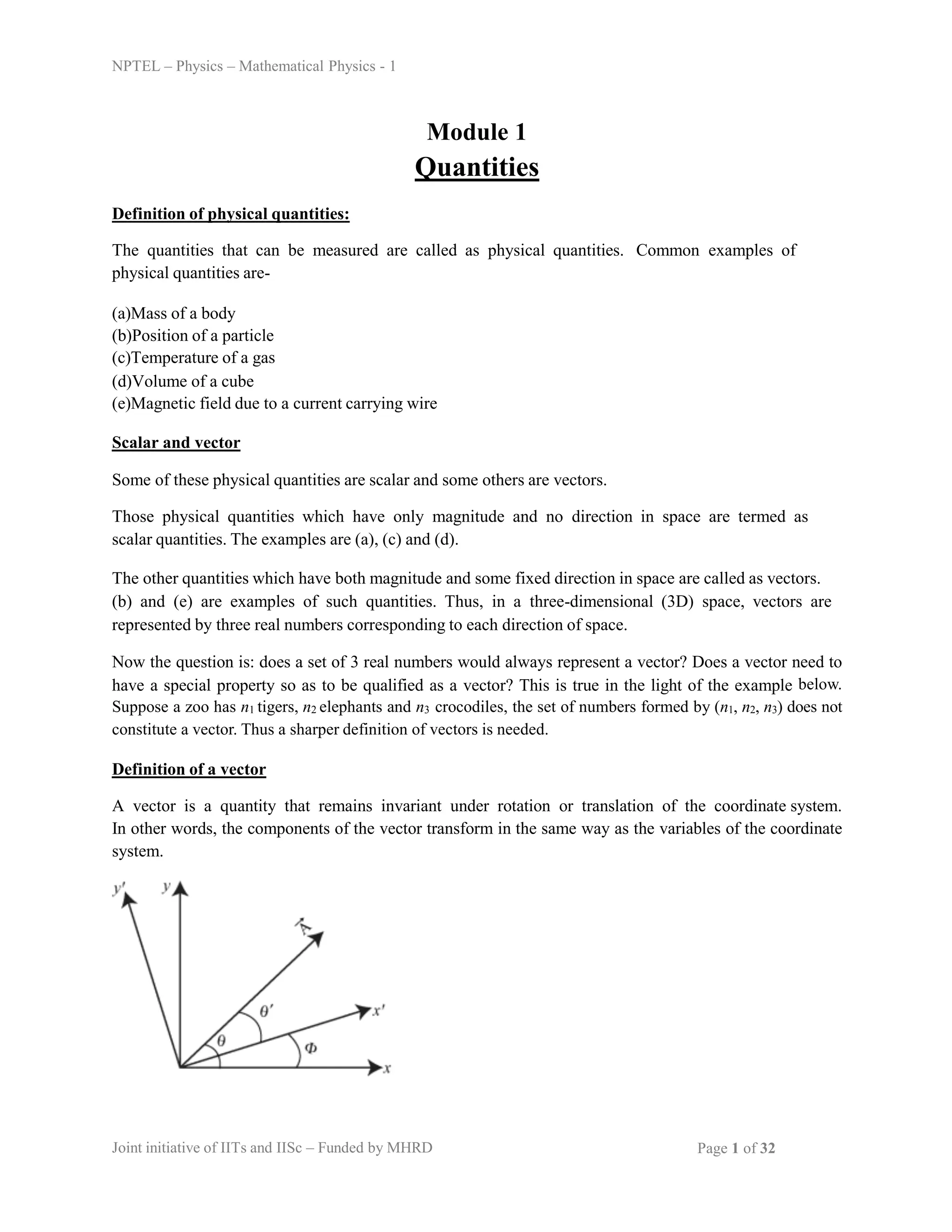
A vector is a quantity that remains invariant under rotation or translation of the coordinate system.
In other words, the components of the vector transform in the same way as the variables of the coordinate
system.
Joint initiative of IITs and IISc – Funded by MHRD Page 1 of 32
NPTEL – Physics – Mathematical Physics - 1
Let us start by writing down the components of a vector 𝐴⃗ (in 2D, just for convenience) in x - y
coordinate system and also in a rotated 𝑥′ − 𝑦′coordinate system. Let the components of the vector 𝐴⃗ be
(𝐴𝑥 , 𝐴𝑦) and (𝐴𝑥 , 𝐴𝑦) in the two coordinate systems.
′ ′
We can write,
𝐴𝑥 = Acos 𝜃, 𝐴𝑦 = Asin 𝜃 in x - y system where A (=|𝐴⃗|) is the magnitude (length) of the vector 𝐴
⃗. Likewise, in the 𝑥′ − 𝑦′ system,
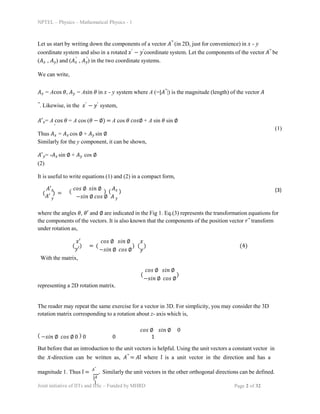
𝐴′𝑥= A cos 𝜃 = A cos (𝜃 − ∅) = A cos 𝜃 𝑐𝑜𝑠∅ + A sin 𝜃 sin ∅
Thus 𝐴𝑥 = 𝐴𝑥 cos ∅ + 𝐴𝑦 sin ∅
′
(1)
Similarly for the y component, it can be shown,
𝐴′𝑦= -𝐴𝑥 sin ∅ + 𝐴𝑦 cos ∅
(2)
It is useful to write equations (1) and (2) in a compact form,
(
𝐴′
) =
𝐴′𝑥 𝑐𝑜𝑠 ∅ 𝑠𝑖𝑛 ∅ 𝐴𝑥
𝑦 𝑦
( ) ( )
−𝑠𝑖𝑛 ∅ 𝑐𝑜𝑠 ∅ 𝐴
where the angles 𝜃, 𝜃′ and ∅ are indicated in the Fig 1. Eq.(3) represents the transformation equations for
the components of the vectors. It is also known that the components of the position vector 𝑟⃗ transform
under rotation as,
(
𝑦′
) = (
𝑥′ 𝑐𝑜𝑠 ∅ 𝑠𝑖𝑛 ∅ 𝑥
−𝑠𝑖𝑛 ∅ 𝑐𝑜𝑠 ∅ 𝑦
) ( ) (4)
With the matrix,
(
𝑐𝑜𝑠 ∅ 𝑠𝑖𝑛 ∅
−𝑠𝑖𝑛 ∅ 𝑐𝑜𝑠 ∅
)
representing a 2D rotation matrix.
The reader may repeat the same exercise for a vector in 3D. For simplicity, you may consider the 3D
rotation matrix corresponding to a rotation about z- axis which is,
𝑐𝑜𝑠 ∅ 𝑠𝑖𝑛 ∅ 0
( −𝑠𝑖𝑛 ∅ 𝑐𝑜𝑠 ∅ 0 ) 0 0 1
But before that an introduction to the unit vectors is helpful. Using the unit vectors a constant vector in
the x-direction can be written as, 𝐴⃗ = 𝐴𝑖̂ where 𝑖̂ is a unit vector in the direction and has a
magnitude 1. Thus 𝑖̂ = 𝐴⃗
. Similarly the unit vectors in the other orthogonal directions can be defined.
Joint initiative of IITs and IISc – Funded by MHRD Page 2 of 32
|𝐴
⃗|
(3)
NPTEL – Physics – Mathematical Physics - 1
The unit vectors in the three orthogonal directions are perpendicular to each other. These set of
unit vectors are determined locally using the surfaces of constant coordinates at the point of intersection.
We can illustrate the concept via a specific example. The function f = z denotes a set of planes
in the z- direction for different values of z. The unit vector 𝑧̂ is perpendicular to all these planes and
points in the direction of the planes with increasing of the planes with increasing values of z.
During the course of lectures, we shall denote the unit vectors along the Cartesian coordinate axes as 𝑥̂, 𝑦̂,
𝑧̂ or 𝑖̂, 𝑗̂, 𝑘̂.
Vector operations
The different vector operations that we are going to discuss are---
(a)Addition
(b)Subtraction
(c)Multiplication
Let us discuss them one by one
(a) Addition of vectors
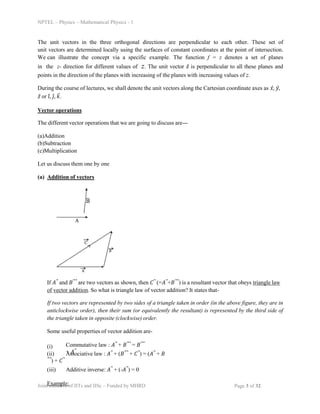
If 𝐴⃗ and 𝐵⃗⃗ are two vectors as shown, then 𝐶⃗ (=𝐴⃗+𝐵⃗⃗) is a resultant vector that obeys triangle law
of vector addition. So what is triangle law of vector addition? It states that-
If two vectors are represented by two sides of a triangle taken in order (in the above figure, they are in
anticlockwise order), then their sum (or equivalently the resultant) is represented by the third side of
the triangle taken in opposite (clockwise) order.
Some useful properties of vector addition are-
(i) Commutative law : 𝐴⃗ + 𝐵⃗⃗ = 𝐵⃗⃗
+ 𝐴⃗
(ii) Associative law : 𝐴⃗ + (𝐵⃗⃗ + 𝐶⃗) = (𝐴⃗ + 𝐵
⃗⃗) + 𝐶⃗
(iii) Additive inverse: 𝐴⃗ + (-𝐴⃗) = 0
Example:
Joint initiative of IITs and IISc – Funded by MHRD Page 3 of 32
NPTEL – Physics – Mathematical Physics - 1
If 𝐴⃗ = Ax iˆ + 𝐴𝑦
ˆj + 𝐴𝑧
kˆ and 𝐵⃗⃗ = 𝐵𝑥 iˆ + 𝐵𝑦
ˆj +
𝐵𝑧 kˆ
} i
ˆ, ĵ,k̂ are unit vectors along x,y,z
direction
𝐴⃗ + 𝐵⃗⃗ = (𝐴𝑥 + 𝐵𝑥) iˆ + (𝐴𝑦 + 𝐵𝑦) ˆj + (𝐴𝑧 + 𝐵𝑧) kˆ
Addition of two vectors implies addition of their components along different directions.
Subtraction of vectors
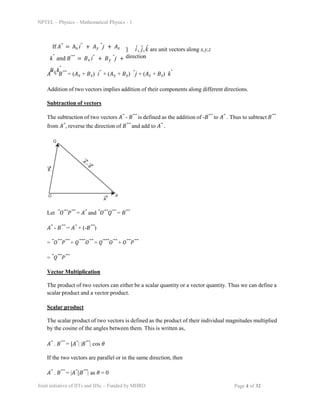
The subtraction of two vectors 𝐴⃗ - 𝐵⃗⃗ is defined as the addition of -𝐵⃗⃗ to 𝐴⃗ . Thus to subtract 𝐵⃗⃗
from 𝐴⃗, reverse the direction of 𝐵⃗⃗ and add to 𝐴⃗ .
Let ⃗𝑂⃗⃗𝑃⃗⃗ = 𝐴⃗ and ⃗𝑂⃗⃗𝑄⃗⃗ = 𝐵⃗⃗
𝐴⃗ - 𝐵⃗⃗ = 𝐴⃗ + (-𝐵⃗⃗)
= ⃗𝑂⃗⃗𝑃⃗⃗ + 𝑄⃗⃗⃗𝑂⃗⃗ = 𝑄⃗⃗⃗𝑂⃗⃗ + 𝑂⃗⃗𝑃⃗⃗
= ⃗𝑄⃗⃗𝑃⃗⃗
Vector Multiplication
The product of two vectors can either be a scalar quantity or a vector quantity. Thus we can define a
scalar product and a vector product.
Scalar product
The scalar product of two vectors is defined as the product of their individual magnitudes multiplied
by the cosine of the angles between them. This is written as,
𝐴⃗ . 𝐵⃗⃗ = |𝐴⃗| |𝐵⃗⃗| cos 𝜃
If the two vectors are parallel or in the same direction, then
𝐴⃗ . 𝐵⃗⃗ = |𝐴⃗||𝐵⃗⃗| as 𝜃 = 0
Joint initiative of IITs and IISc – Funded by MHRD Page 4 of 32
NPTEL – Physics – Mathematical Physics - 1
If the vectors are perpendicular, then
𝐴⃗ . 𝐵⃗⃗ = 0 as 𝜃 (angle between 𝐴⃗ and 𝐵⃗⃗ ) is 900 .
Vector product
The magnitude of the vector products of two vectors is,
|𝐴⃗ x 𝐵⃗⃗| = |𝐴⃗| |𝐵⃗⃗| sin 𝜃.
How to find the direction of the resultant vector 𝐶⃗ (= 𝐴⃗ x 𝐵⃗⃗) ? Keep your right hand palm along the
first vector (here, 𝐴⃗), curl your fingers toward the second vector (𝐵⃗⃗), the thumb points towards the
resultant (𝐶⃗).
Unlike scalar products, vector products are non commutative and non-associative.(see properties (i) and
(ii)).
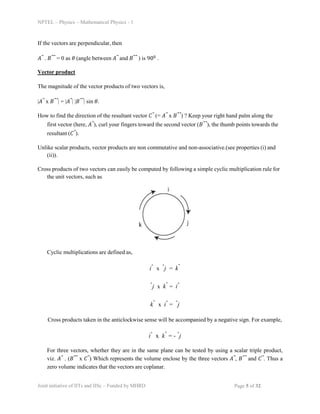
Cross products of two vectors can easily be computed by following a simple cyclic multiplication rule for
the unit vectors, such as
Cyclic multiplications are defined as,
iˆ x ˆj = kˆ
ˆj x kˆ = iˆ
kˆ x iˆ = ˆj
Cross products taken in the anticlockwise sense will be accompanied by a negative sign. For example,
iˆ x kˆ = - ˆj
For three vectors, whether they are in the same plane can be tested by using a scalar triple product,
viz. 𝐴⃗ . (𝐵⃗⃗ x 𝐶⃗) Which represents the volume enclose by the three vectors 𝐴⃗, 𝐵⃗⃗ and 𝐶⃗. Thus a
zero volume indicates that the vectors are coplanar.
Joint initiative of IITs and IISc – Funded by MHRD Page 5 of 32
NPTEL – Physics – Mathematical Physics - 1
Derivative of a vector
Any vector in general, depends on space and time, that is 𝐴⃗ (𝑟⃗, t). Derivative of a vector with respect to
the space coordinates are going to be more prominent features of our discussion. However, in
several physical situations, it becomes important to compute time derivative of a vector.
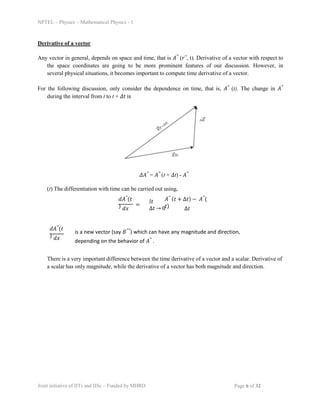
For the following discussion, only consider the dependence on time, that is, 𝐴⃗ (t). The change in 𝐴⃗
during the interval from t to t + 𝛥𝑡 is
𝛥𝐴⃗ = 𝐴⃗ (t + 𝛥t) - 𝐴⃗
(t) The differentiation with time can be carried out using,
𝑑𝐴⃗(𝑡
) 𝑑𝑥
=
𝑙𝑡
∆𝑡 → 0
𝐴⃗ (𝑡 + ∆𝑡) − 𝐴⃗(
𝑡) ∆𝑡
𝑑𝐴⃗(𝑡
) 𝑑𝑥
There is a very important difference between the time derivative of a vector and a scalar. Derivative of
a scalar has only magnitude, while the derivative of a vector has both magnitude and direction.
is a new vector (say 𝐵⃗⃗) which can have any magnitude and direction,
depending on the behavior of 𝐴⃗ .
Joint initiative of IITs and IISc – Funded by MHRD Page 6 of 32
NPTEL – Physics – Mathematical Physics - 1
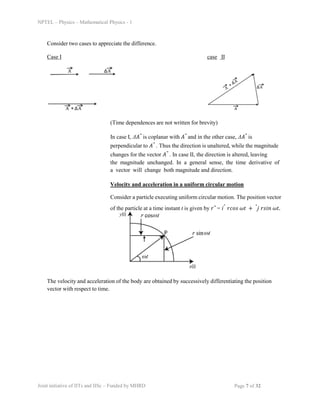
Consider two cases to appreciate the difference.
Case I case II
(Time dependences are not written for brevity)
In case I, Δ𝐴⃗ is coplanar with 𝐴⃗ and in the other case, Δ𝐴⃗ is
perpendicular to 𝐴⃗ . Thus the direction is unaltered, while the magnitude
changes for the vector 𝐴⃗ . In case II, the direction is altered, leaving
the magnitude unchanged. In a general sense, the time derivative of
a vector will change both magnitude and direction.
Velocity and acceleration in a uniform circular motion
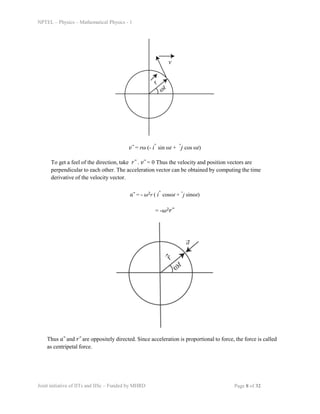
Consider a particle executing uniform circular motion. The position vector
of the particle at a time instant t is given by 𝑟⃗ = iˆ 𝑟𝑐𝑜𝑠 𝜔𝑡 + ˆj 𝑟𝑠𝑖𝑛 𝜔𝑡.
The velocity and acceleration of the body are obtained by successively differentiating the position
vector with respect to time.
Joint initiative of IITs and IISc – Funded by MHRD Page 7 of 32
NPTEL – Physics – Mathematical Physics - 1
𝑣⃗ = rω (- iˆ sin ωt + ˆj cos ωt)
To get a feel of the direction, take 𝑟⃗ . 𝑣⃗ = 0 Thus the velocity and position vectors are
perpendicular to each other. The acceleration vector can be obtained by computing the time
derivative of the velocity vector.
𝑎⃗ = - 𝜔2r ( iˆ cosωt + ˆj sinωt)
= -𝜔2𝑟⃗
Thus 𝑎⃗ and 𝑟⃗ are oppositely directed. Since acceleration is proportional to force, the force is called
as centripetal force.
Joint initiative of IITs and IISc – Funded by MHRD Page 8 of 32
NPTEL – Physics – Mathematical Physics - 1
Example problems
1. Prove that (𝐴⃗x𝐵⃗⃗) . (𝐴⃗x𝐵⃗⃗) = 𝐴2 𝐵2- (𝐴⃗. 𝐵⃗⃗)2
Solution
(𝐴⃗ × 𝐵⃗⃗)2 = 𝐴2𝐵2𝑠𝑖𝑛2(𝐴⃗, 𝐵⃗⃗)
Where sin (𝐴⃗, 𝐵⃗⃗) is the angle between vectors 𝐴⃗ and 𝐵⃗⃗
Thus (𝐴⃗ × 𝐵⃗⃗)2 = 𝐴2𝐵2 [1- 𝑐𝑜𝑠2(𝐴⃗, 𝐵
⃗⃗)]
= 𝐴2𝐵2 - 𝐴2𝐵2 𝑐𝑜𝑠2 (𝐴⃗, 𝐵⃗⃗)
=𝐴2𝐵2 - (𝐴⃗. 𝐵⃗⃗)2
(proved)
2. Derive the law of sines, i.e. prove
𝐴 𝐵
𝑠𝑖𝑛 𝛼 𝑠𝑖𝑛 𝛽 𝑠𝑖𝑛
𝛾
= =
𝐶
where the angles 𝛼, 𝛽 and 𝛾 are defined as follows
Solution:
𝐵⃗⃗ = 𝐶⃗ -
𝐴⃗ Thus 𝐵⃗⃗ x (𝐶⃗ - 𝐴⃗)
= 0
(cross products of two equal vectors is zero)
So 𝐵⃗⃗x𝐶⃗ = 𝐵
⃗⃗x𝐴⃗
BC sin 𝛼 = AB sin (𝜋-𝛾) = AB sin 𝛾
Thus
𝐴 𝐶
𝑠𝑖𝑛 𝛼 𝑠𝑖𝑛
𝛾
= similarly
𝐴
𝑠𝑖𝑛 𝛼 𝑠𝑖𝑛
𝛽
=
𝐵
(proved)
Joint initiative of IITs and IISc – Funded by MHRD Page 9 of 32
NPTEL – Physics – Mathematical Physics - 1
Rules of vector differentiation
1)
𝑑
𝑑𝑡
(𝐴⃗ + 𝐵⃗⃗) = +
𝑑𝐴
⃗
𝑑𝑡 𝑑𝑡
𝑑𝐵
⃗⃗
2)
𝑑
𝑑𝑡 𝑑𝑡
(𝜑 𝐴⃗) = 𝐴⃗ +
𝜑
𝑑𝜑 𝑑𝐴
⃗
𝑑𝑡
(𝜑: a scalar, 𝐴⃗ and 𝐵⃗⃗ are
vectors)
3)
𝑑
𝑑𝑡
(𝐴⃗ . 𝐵⃗⃗) = . 𝐵⃗⃗ +
𝐴⃗ .
𝑑𝐴
⃗
𝑑𝑡
𝑑𝐵
⃗⃗
𝑑𝑡
4)
𝑑
𝑑𝑡
(𝐴⃗ x 𝐵⃗⃗) = x 𝐵⃗⃗ + 𝐴
⃗ x
𝑑𝐴
⃗
𝑑𝑡
𝑑𝐵
⃗⃗
𝑑𝑡
5)
𝑑
𝑑𝑡
(𝐴⃗ . 𝐴⃗) = 2
𝐴⃗ .
𝑑𝐴
⃗
𝑑𝑡
Differential Calculus
Vector derivatives
An important ingredient of studying electromagnetics is learning vector derivatives. The operations that
are most frequently required are gradient, divergence and curl which yield vector and scalar derivatives of
scalar and vector fields.
Suppose we talk about a function which is of one variable, say 𝑥, that is 𝑓(𝑥). Let us talk about the
𝑑𝑓
derivative which will provide an estimate of how rapidly the function 𝑓(𝑥) varies as 𝑥 is changed by
𝑑𝑥
a small amount. This is written as,
𝑑𝑓 = ( 𝑑𝑓
)𝑑𝑥
𝑑𝑥
Thus if one changes 𝑥 by a small 𝑑𝑥, then 𝑓 changes by 𝑑𝑓 and
𝑑𝑓
is the proportionality constant for a
𝑑𝑥
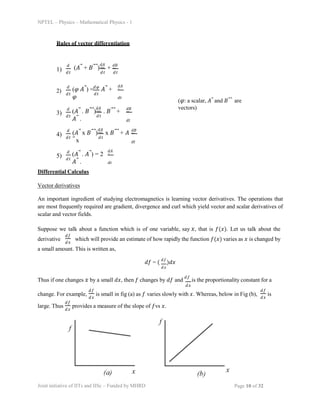
change. For example, is small in fig (a) as 𝑓 varies slowly with 𝑥. Whereas, below in Fig (b), is
𝑑𝑓 𝑑𝑓
𝑑𝑥 𝑑𝑥
large. Thus provides a measure of the slope of 𝑓vs 𝑥.
𝑑𝑓
𝑑𝑥
Joint initiative of IITs and IISc – Funded by MHRD Page 10 of 32
Joint initiative of IITs and IISc – Funded by MHRD Page 11 of 32
NPTEL – Physics – Mathematical Physics - 1
However, things are not as simple for a function that depends on three variables, i.e. 𝑓(𝑥, 𝑦, 𝑧). To
measure how 𝑓(𝑥, 𝑦, 𝑧) vary as x, y and z are changed by a small amount dx, dy and dz . If you choose one
direction to compute this change, the result could be very different than if one chooses another direction to
compute this change. Thus there are infinitely large numbers of results possible corresponding to each
direction.
However things may not be as bad as it looks, if we ask a specific question, that is, in which
direction, the function vary the fastest and how rapidly does it vary in this direction? The answer
is provided by the ‘gradient’ operation.
For vectors, the differentiation procedure involves a scalar derivative, called as ‘divergence’ and a vector
derivative, called as ‘curl’. In the next section, we shall see the physical significance of gradient,
divergence and curl.

lec1.ppt

  • 1.
    NPTEL – Physics– Mathematical Physics - 1 Module 1 Quantities Definition of physical quantities: The quantities that can be measured are called as physical quantities. Common examples of physical quantities are- (a)Mass of a body (b)Position of a particle (c)Temperature of a gas (d)Volume of a cube (e)Magnetic field due to a current carrying wire Scalar and vector Some of these physical quantities are scalar and some others are vectors. Those physical quantities which have only magnitude and no direction in space are termed as scalar quantities. The examples are (a), (c) and (d). The other quantities which have both magnitude and some fixed direction in space are called as vectors. (b) and (e) are examples of such quantities. Thus, in a three-dimensional (3D) space, vectors are represented by three real numbers corresponding to each direction of space. Now the question is: does a set of 3 real numbers would always represent a vector? Does a vector need to have a special property so as to be qualified as a vector? This is true in the light of the example below. Suppose a zoo has n1 tigers, n2 elephants and n3 crocodiles, the set of numbers formed by (n1, n2, n3) does not constitute a vector. Thus a sharper definition of vectors is needed. Definition of a vector A vector is a quantity that remains invariant under rotation or translation of the coordinate system. In other words, the components of the vector transform in the same way as the variables of the coordinate system. Joint initiative of IITs and IISc – Funded by MHRD Page 1 of 32
  • 2.
    NPTEL – Physics– Mathematical Physics - 1 Let us start by writing down the components of a vector 𝐴⃗ (in 2D, just for convenience) in x - y coordinate system and also in a rotated 𝑥′ − 𝑦′coordinate system. Let the components of the vector 𝐴⃗ be (𝐴𝑥 , 𝐴𝑦) and (𝐴𝑥 , 𝐴𝑦) in the two coordinate systems. ′ ′ We can write, 𝐴𝑥 = Acos 𝜃, 𝐴𝑦 = Asin 𝜃 in x - y system where A (=|𝐴⃗|) is the magnitude (length) of the vector 𝐴 ⃗. Likewise, in the 𝑥′ − 𝑦′ system, 𝐴′𝑥= A cos 𝜃 = A cos (𝜃 − ∅) = A cos 𝜃 𝑐𝑜𝑠∅ + A sin 𝜃 sin ∅ Thus 𝐴𝑥 = 𝐴𝑥 cos ∅ + 𝐴𝑦 sin ∅ ′ (1) Similarly for the y component, it can be shown, 𝐴′𝑦= -𝐴𝑥 sin ∅ + 𝐴𝑦 cos ∅ (2) It is useful to write equations (1) and (2) in a compact form, ( 𝐴′ ) = 𝐴′𝑥 𝑐𝑜𝑠 ∅ 𝑠𝑖𝑛 ∅ 𝐴𝑥 𝑦 𝑦 ( ) ( ) −𝑠𝑖𝑛 ∅ 𝑐𝑜𝑠 ∅ 𝐴 where the angles 𝜃, 𝜃′ and ∅ are indicated in the Fig 1. Eq.(3) represents the transformation equations for the components of the vectors. It is also known that the components of the position vector 𝑟⃗ transform under rotation as, ( 𝑦′ ) = ( 𝑥′ 𝑐𝑜𝑠 ∅ 𝑠𝑖𝑛 ∅ 𝑥 −𝑠𝑖𝑛 ∅ 𝑐𝑜𝑠 ∅ 𝑦 ) ( ) (4) With the matrix, ( 𝑐𝑜𝑠 ∅ 𝑠𝑖𝑛 ∅ −𝑠𝑖𝑛 ∅ 𝑐𝑜𝑠 ∅ ) representing a 2D rotation matrix. The reader may repeat the same exercise for a vector in 3D. For simplicity, you may consider the 3D rotation matrix corresponding to a rotation about z- axis which is, 𝑐𝑜𝑠 ∅ 𝑠𝑖𝑛 ∅ 0 ( −𝑠𝑖𝑛 ∅ 𝑐𝑜𝑠 ∅ 0 ) 0 0 1 But before that an introduction to the unit vectors is helpful. Using the unit vectors a constant vector in the x-direction can be written as, 𝐴⃗ = 𝐴𝑖̂ where 𝑖̂ is a unit vector in the direction and has a magnitude 1. Thus 𝑖̂ = 𝐴⃗ . Similarly the unit vectors in the other orthogonal directions can be defined. Joint initiative of IITs and IISc – Funded by MHRD Page 2 of 32 |𝐴 ⃗| (3)
  • 3.
    NPTEL – Physics– Mathematical Physics - 1 The unit vectors in the three orthogonal directions are perpendicular to each other. These set of unit vectors are determined locally using the surfaces of constant coordinates at the point of intersection. We can illustrate the concept via a specific example. The function f = z denotes a set of planes in the z- direction for different values of z. The unit vector 𝑧̂ is perpendicular to all these planes and points in the direction of the planes with increasing of the planes with increasing values of z. During the course of lectures, we shall denote the unit vectors along the Cartesian coordinate axes as 𝑥̂, 𝑦̂, 𝑧̂ or 𝑖̂, 𝑗̂, 𝑘̂. Vector operations The different vector operations that we are going to discuss are--- (a)Addition (b)Subtraction (c)Multiplication Let us discuss them one by one (a) Addition of vectors If 𝐴⃗ and 𝐵⃗⃗ are two vectors as shown, then 𝐶⃗ (=𝐴⃗+𝐵⃗⃗) is a resultant vector that obeys triangle law of vector addition. So what is triangle law of vector addition? It states that- If two vectors are represented by two sides of a triangle taken in order (in the above figure, they are in anticlockwise order), then their sum (or equivalently the resultant) is represented by the third side of the triangle taken in opposite (clockwise) order. Some useful properties of vector addition are- (i) Commutative law : 𝐴⃗ + 𝐵⃗⃗ = 𝐵⃗⃗ + 𝐴⃗ (ii) Associative law : 𝐴⃗ + (𝐵⃗⃗ + 𝐶⃗) = (𝐴⃗ + 𝐵 ⃗⃗) + 𝐶⃗ (iii) Additive inverse: 𝐴⃗ + (-𝐴⃗) = 0 Example: Joint initiative of IITs and IISc – Funded by MHRD Page 3 of 32
  • 4.
    NPTEL – Physics– Mathematical Physics - 1 If 𝐴⃗ = Ax iˆ + 𝐴𝑦 ˆj + 𝐴𝑧 kˆ and 𝐵⃗⃗ = 𝐵𝑥 iˆ + 𝐵𝑦 ˆj + 𝐵𝑧 kˆ } i ˆ, ĵ,k̂ are unit vectors along x,y,z direction 𝐴⃗ + 𝐵⃗⃗ = (𝐴𝑥 + 𝐵𝑥) iˆ + (𝐴𝑦 + 𝐵𝑦) ˆj + (𝐴𝑧 + 𝐵𝑧) kˆ Addition of two vectors implies addition of their components along different directions. Subtraction of vectors The subtraction of two vectors 𝐴⃗ - 𝐵⃗⃗ is defined as the addition of -𝐵⃗⃗ to 𝐴⃗ . Thus to subtract 𝐵⃗⃗ from 𝐴⃗, reverse the direction of 𝐵⃗⃗ and add to 𝐴⃗ . Let ⃗𝑂⃗⃗𝑃⃗⃗ = 𝐴⃗ and ⃗𝑂⃗⃗𝑄⃗⃗ = 𝐵⃗⃗ 𝐴⃗ - 𝐵⃗⃗ = 𝐴⃗ + (-𝐵⃗⃗) = ⃗𝑂⃗⃗𝑃⃗⃗ + 𝑄⃗⃗⃗𝑂⃗⃗ = 𝑄⃗⃗⃗𝑂⃗⃗ + 𝑂⃗⃗𝑃⃗⃗ = ⃗𝑄⃗⃗𝑃⃗⃗ Vector Multiplication The product of two vectors can either be a scalar quantity or a vector quantity. Thus we can define a scalar product and a vector product. Scalar product The scalar product of two vectors is defined as the product of their individual magnitudes multiplied by the cosine of the angles between them. This is written as, 𝐴⃗ . 𝐵⃗⃗ = |𝐴⃗| |𝐵⃗⃗| cos 𝜃 If the two vectors are parallel or in the same direction, then 𝐴⃗ . 𝐵⃗⃗ = |𝐴⃗||𝐵⃗⃗| as 𝜃 = 0 Joint initiative of IITs and IISc – Funded by MHRD Page 4 of 32
  • 5.
    NPTEL – Physics– Mathematical Physics - 1 If the vectors are perpendicular, then 𝐴⃗ . 𝐵⃗⃗ = 0 as 𝜃 (angle between 𝐴⃗ and 𝐵⃗⃗ ) is 900 . Vector product The magnitude of the vector products of two vectors is, |𝐴⃗ x 𝐵⃗⃗| = |𝐴⃗| |𝐵⃗⃗| sin 𝜃. How to find the direction of the resultant vector 𝐶⃗ (= 𝐴⃗ x 𝐵⃗⃗) ? Keep your right hand palm along the first vector (here, 𝐴⃗), curl your fingers toward the second vector (𝐵⃗⃗), the thumb points towards the resultant (𝐶⃗). Unlike scalar products, vector products are non commutative and non-associative.(see properties (i) and (ii)). Cross products of two vectors can easily be computed by following a simple cyclic multiplication rule for the unit vectors, such as Cyclic multiplications are defined as, iˆ x ˆj = kˆ ˆj x kˆ = iˆ kˆ x iˆ = ˆj Cross products taken in the anticlockwise sense will be accompanied by a negative sign. For example, iˆ x kˆ = - ˆj For three vectors, whether they are in the same plane can be tested by using a scalar triple product, viz. 𝐴⃗ . (𝐵⃗⃗ x 𝐶⃗) Which represents the volume enclose by the three vectors 𝐴⃗, 𝐵⃗⃗ and 𝐶⃗. Thus a zero volume indicates that the vectors are coplanar. Joint initiative of IITs and IISc – Funded by MHRD Page 5 of 32
  • 6.
    NPTEL – Physics– Mathematical Physics - 1 Derivative of a vector Any vector in general, depends on space and time, that is 𝐴⃗ (𝑟⃗, t). Derivative of a vector with respect to the space coordinates are going to be more prominent features of our discussion. However, in several physical situations, it becomes important to compute time derivative of a vector. For the following discussion, only consider the dependence on time, that is, 𝐴⃗ (t). The change in 𝐴⃗ during the interval from t to t + 𝛥𝑡 is 𝛥𝐴⃗ = 𝐴⃗ (t + 𝛥t) - 𝐴⃗ (t) The differentiation with time can be carried out using, 𝑑𝐴⃗(𝑡 ) 𝑑𝑥 = 𝑙𝑡 ∆𝑡 → 0 𝐴⃗ (𝑡 + ∆𝑡) − 𝐴⃗( 𝑡) ∆𝑡 𝑑𝐴⃗(𝑡 ) 𝑑𝑥 There is a very important difference between the time derivative of a vector and a scalar. Derivative of a scalar has only magnitude, while the derivative of a vector has both magnitude and direction. is a new vector (say 𝐵⃗⃗) which can have any magnitude and direction, depending on the behavior of 𝐴⃗ . Joint initiative of IITs and IISc – Funded by MHRD Page 6 of 32
  • 7.
    NPTEL – Physics– Mathematical Physics - 1 Consider two cases to appreciate the difference. Case I case II (Time dependences are not written for brevity) In case I, Δ𝐴⃗ is coplanar with 𝐴⃗ and in the other case, Δ𝐴⃗ is perpendicular to 𝐴⃗ . Thus the direction is unaltered, while the magnitude changes for the vector 𝐴⃗ . In case II, the direction is altered, leaving the magnitude unchanged. In a general sense, the time derivative of a vector will change both magnitude and direction. Velocity and acceleration in a uniform circular motion Consider a particle executing uniform circular motion. The position vector of the particle at a time instant t is given by 𝑟⃗ = iˆ 𝑟𝑐𝑜𝑠 𝜔𝑡 + ˆj 𝑟𝑠𝑖𝑛 𝜔𝑡. The velocity and acceleration of the body are obtained by successively differentiating the position vector with respect to time. Joint initiative of IITs and IISc – Funded by MHRD Page 7 of 32
  • 8.
    NPTEL – Physics– Mathematical Physics - 1 𝑣⃗ = rω (- iˆ sin ωt + ˆj cos ωt) To get a feel of the direction, take 𝑟⃗ . 𝑣⃗ = 0 Thus the velocity and position vectors are perpendicular to each other. The acceleration vector can be obtained by computing the time derivative of the velocity vector. 𝑎⃗ = - 𝜔2r ( iˆ cosωt + ˆj sinωt) = -𝜔2𝑟⃗ Thus 𝑎⃗ and 𝑟⃗ are oppositely directed. Since acceleration is proportional to force, the force is called as centripetal force. Joint initiative of IITs and IISc – Funded by MHRD Page 8 of 32
  • 9.
    NPTEL – Physics– Mathematical Physics - 1 Example problems 1. Prove that (𝐴⃗x𝐵⃗⃗) . (𝐴⃗x𝐵⃗⃗) = 𝐴2 𝐵2- (𝐴⃗. 𝐵⃗⃗)2 Solution (𝐴⃗ × 𝐵⃗⃗)2 = 𝐴2𝐵2𝑠𝑖𝑛2(𝐴⃗, 𝐵⃗⃗) Where sin (𝐴⃗, 𝐵⃗⃗) is the angle between vectors 𝐴⃗ and 𝐵⃗⃗ Thus (𝐴⃗ × 𝐵⃗⃗)2 = 𝐴2𝐵2 [1- 𝑐𝑜𝑠2(𝐴⃗, 𝐵 ⃗⃗)] = 𝐴2𝐵2 - 𝐴2𝐵2 𝑐𝑜𝑠2 (𝐴⃗, 𝐵⃗⃗) =𝐴2𝐵2 - (𝐴⃗. 𝐵⃗⃗)2 (proved) 2. Derive the law of sines, i.e. prove 𝐴 𝐵 𝑠𝑖𝑛 𝛼 𝑠𝑖𝑛 𝛽 𝑠𝑖𝑛 𝛾 = = 𝐶 where the angles 𝛼, 𝛽 and 𝛾 are defined as follows Solution: 𝐵⃗⃗ = 𝐶⃗ - 𝐴⃗ Thus 𝐵⃗⃗ x (𝐶⃗ - 𝐴⃗) = 0 (cross products of two equal vectors is zero) So 𝐵⃗⃗x𝐶⃗ = 𝐵 ⃗⃗x𝐴⃗ BC sin 𝛼 = AB sin (𝜋-𝛾) = AB sin 𝛾 Thus 𝐴 𝐶 𝑠𝑖𝑛 𝛼 𝑠𝑖𝑛 𝛾 = similarly 𝐴 𝑠𝑖𝑛 𝛼 𝑠𝑖𝑛 𝛽 = 𝐵 (proved) Joint initiative of IITs and IISc – Funded by MHRD Page 9 of 32
  • 10.
    NPTEL – Physics– Mathematical Physics - 1 Rules of vector differentiation 1) 𝑑 𝑑𝑡 (𝐴⃗ + 𝐵⃗⃗) = + 𝑑𝐴 ⃗ 𝑑𝑡 𝑑𝑡 𝑑𝐵 ⃗⃗ 2) 𝑑 𝑑𝑡 𝑑𝑡 (𝜑 𝐴⃗) = 𝐴⃗ + 𝜑 𝑑𝜑 𝑑𝐴 ⃗ 𝑑𝑡 (𝜑: a scalar, 𝐴⃗ and 𝐵⃗⃗ are vectors) 3) 𝑑 𝑑𝑡 (𝐴⃗ . 𝐵⃗⃗) = . 𝐵⃗⃗ + 𝐴⃗ . 𝑑𝐴 ⃗ 𝑑𝑡 𝑑𝐵 ⃗⃗ 𝑑𝑡 4) 𝑑 𝑑𝑡 (𝐴⃗ x 𝐵⃗⃗) = x 𝐵⃗⃗ + 𝐴 ⃗ x 𝑑𝐴 ⃗ 𝑑𝑡 𝑑𝐵 ⃗⃗ 𝑑𝑡 5) 𝑑 𝑑𝑡 (𝐴⃗ . 𝐴⃗) = 2 𝐴⃗ . 𝑑𝐴 ⃗ 𝑑𝑡 Differential Calculus Vector derivatives An important ingredient of studying electromagnetics is learning vector derivatives. The operations that are most frequently required are gradient, divergence and curl which yield vector and scalar derivatives of scalar and vector fields. Suppose we talk about a function which is of one variable, say 𝑥, that is 𝑓(𝑥). Let us talk about the 𝑑𝑓 derivative which will provide an estimate of how rapidly the function 𝑓(𝑥) varies as 𝑥 is changed by 𝑑𝑥 a small amount. This is written as, 𝑑𝑓 = ( 𝑑𝑓 )𝑑𝑥 𝑑𝑥 Thus if one changes 𝑥 by a small 𝑑𝑥, then 𝑓 changes by 𝑑𝑓 and 𝑑𝑓 is the proportionality constant for a 𝑑𝑥 change. For example, is small in fig (a) as 𝑓 varies slowly with 𝑥. Whereas, below in Fig (b), is 𝑑𝑓 𝑑𝑓 𝑑𝑥 𝑑𝑥 large. Thus provides a measure of the slope of 𝑓vs 𝑥. 𝑑𝑓 𝑑𝑥 Joint initiative of IITs and IISc – Funded by MHRD Page 10 of 32
  • 11.
    Joint initiative ofIITs and IISc – Funded by MHRD Page 11 of 32 NPTEL – Physics – Mathematical Physics - 1 However, things are not as simple for a function that depends on three variables, i.e. 𝑓(𝑥, 𝑦, 𝑧). To measure how 𝑓(𝑥, 𝑦, 𝑧) vary as x, y and z are changed by a small amount dx, dy and dz . If you choose one direction to compute this change, the result could be very different than if one chooses another direction to compute this change. Thus there are infinitely large numbers of results possible corresponding to each direction. However things may not be as bad as it looks, if we ask a specific question, that is, in which direction, the function vary the fastest and how rapidly does it vary in this direction? The answer is provided by the ‘gradient’ operation. For vectors, the differentiation procedure involves a scalar derivative, called as ‘divergence’ and a vector derivative, called as ‘curl’. In the next section, we shall see the physical significance of gradient, divergence and curl.