The document discusses the concept of brain-machine interfaces (BMIs), which enable direct communication between the human brain and machines through thought-based control, primarily aimed at aiding individuals with disabilities. It covers various components of BMIs, including neural implants, signal processing, and EEG technology, highlighting their potential to enhance learning and interaction with external devices. The advancements in neurotechnology signify a shift towards integrating human cognitive functions with artificial intelligence, promising a future where knowledge can be directly implanted into the brain.
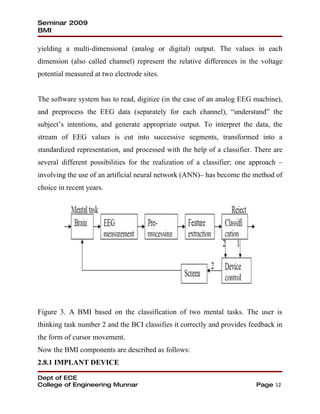
![Seminar 2009
BMI
Frequency information is particularly significant since the basic frequency of the
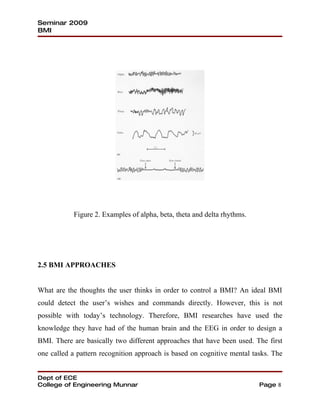
EEG range is classified into five bands for purposes of EEG analysis. These bands
are called brain rhythms and are named after Greek letters.
Five brain rhythms are displayed in Table.2. Most of the brain research is
concentrated in these channels and especially alpha and beta bands are important
for BCI research. The reason why the bands do not follow the greek letter
magnitudely (alpha is not the lowest band) is that this is the order in which they
were discovered.
Band Frequency
[Hz]
Delta 0.5- 4
Theta 4- 8
Alpha 8- 13
Beta 13- 22
Gamma 22-30
Table.2.Common EEG frequency ranges
The alpha rhythm is one of the principal components of the EEG and is an
indicator of the state of alertness of the brain.
Dept of ECE
College of Engineering Munnar Page 7](https://image.slidesharecdn.com/1-091001084123-phpapp01/85/brain-machin-interfacing-7-320.jpg)