cka
DR. SURESH BISHOKARMA
MS, MCH (Neurosurgery)
Department of Neurosurgery,
Upendra Devkota Memorial National Institute of Neurological and Allied
Sciences
Bansbari, Kathmandu, Nepal
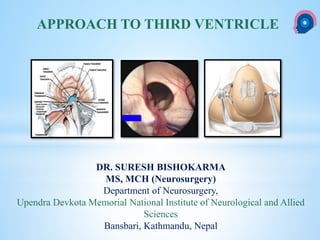
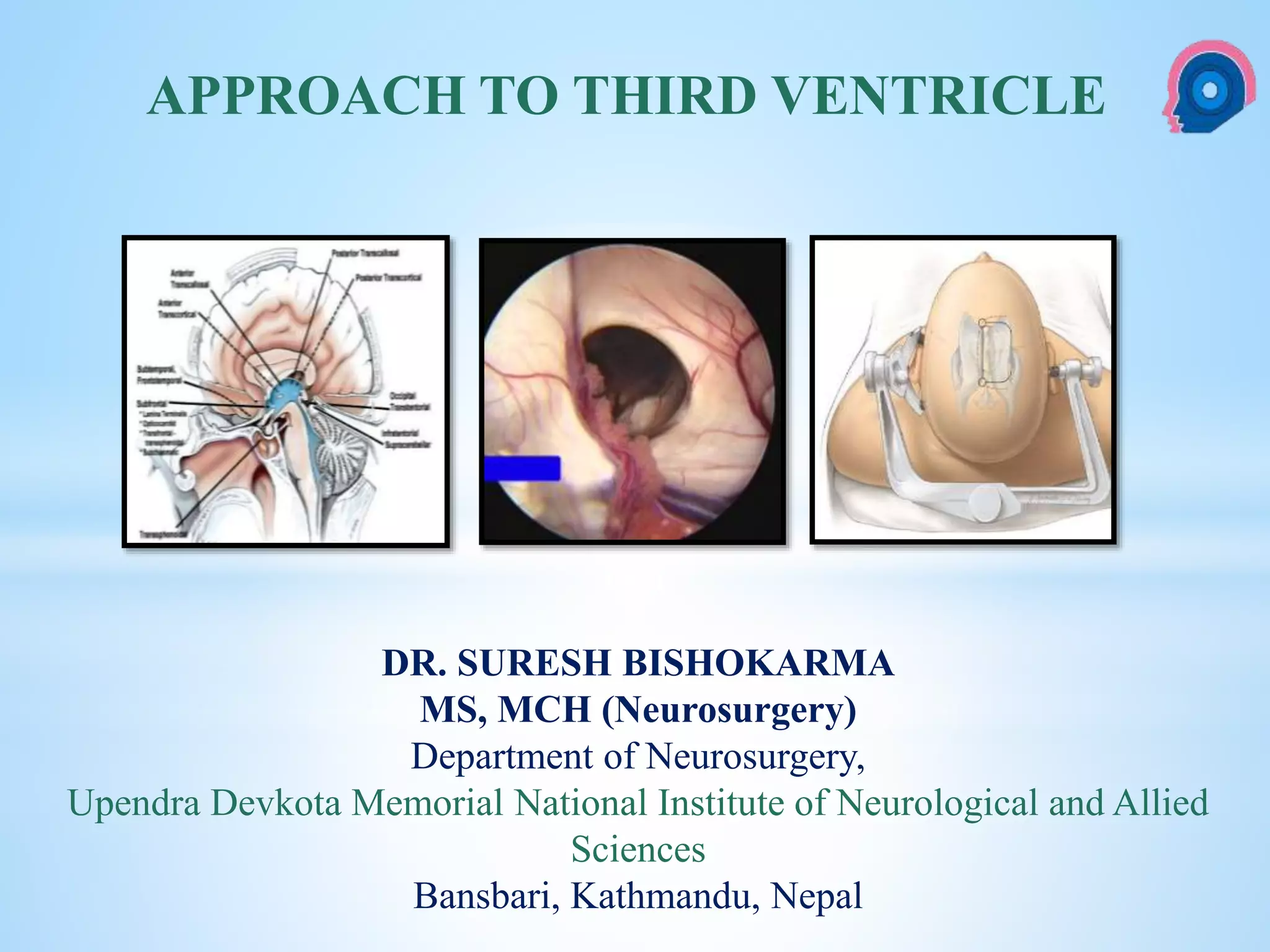
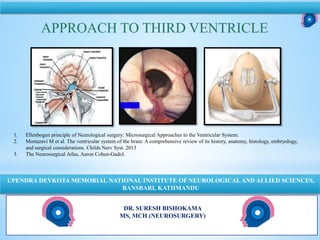
APPROACH TO THIRD VENTRICLE
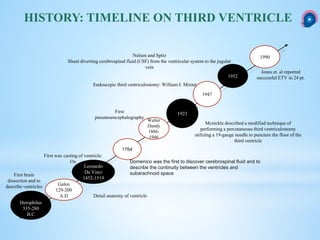
HISTORY: TIMELINE ON THIRD VENTRICLE
First brain
dissection and to
describe ventricles Galen
129-200
A.D
Walter
Dandy
1886-
1946
1923
Detail anatomy of ventricle
First
pneumoencephalography
Endoscopic third ventriculostomy: William J. Mixter
1952
1947
Mcnickle described a modified technique of
performing a percutaneous third ventriculostomy
utilizing a 19-gauge needle to puncture the floor of the
third ventricle
Herophilus
335-280
B.C
1990
Jones et. al reported
successful ETV in 24 pt.
Leonardo
Da Vinci
1452-1519
First wax casting of ventricle:
Ox
Nulsen and Spitz
Shunt diverting cerebrospinal fluid (CSF) from the ventricular system to the jugular
vein
Domenico was the first to discover cerebrospinal fluid and to
describe the continuity between the ventricles and
subarachnoid space
1764
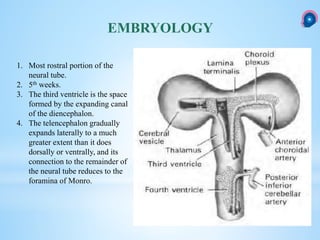
EMBRYOLOGY
1. Most rostral portion of the
neural tube.
2. 5th weeks.
3. The third ventricle is the space
formed by the expanding canal
of the diencephalon.
4. The telencephalon gradually
expands laterally to a much
greater extent than it does
dorsally or ventrally, and its
connection to the remainder of
the neural tube reduces to the
foramina of Monro.
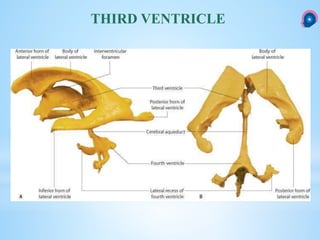
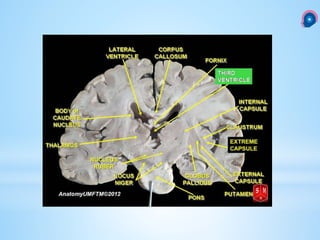
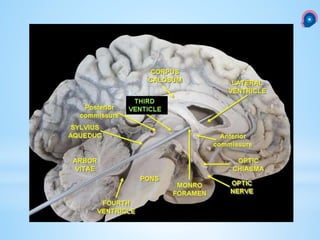
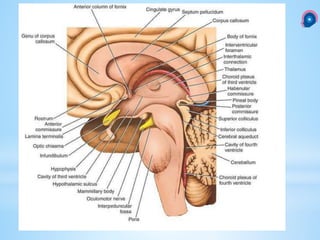
THIRD VENTRICLE
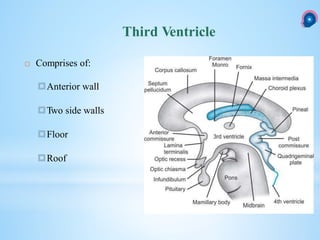
Third Ventricle
 Comprises of:
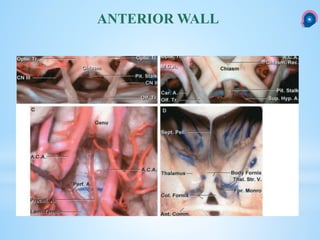
Anterior wall
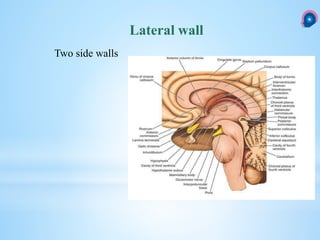
Two side walls
Floor
Roof
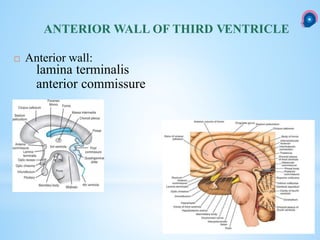
 Anterior wall:
lamina terminalis
anterior commissure
ANTERIOR WALL OF THIRD VENTRICLE
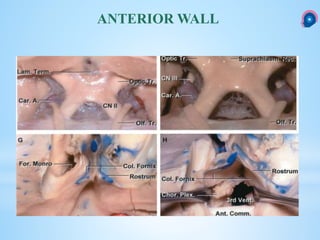
ANTERIOR WALL
ANTERIOR WALL
Lateral wall
Two side walls
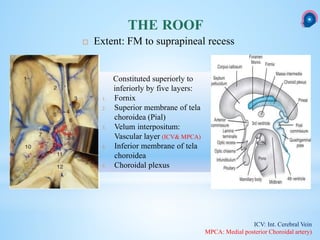
THE ROOF
 Extent: FM to suprapineal recess
ICV: Int. Cerebral Vein
MPCA: Medial posterior Choroidal artery)
Constituted superiorly to
inferiorly by five layers:
1. Fornix
2. Superior membrane of tela
choroidea (Pial)
3. Velum interpositum:
Vascular layer (ICV& MPCA)
4. Inferior membrane of tela
choroidea
5. Choroidal plexus
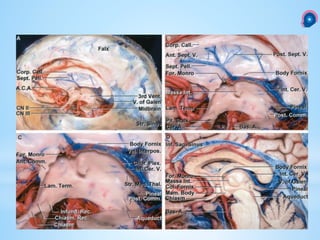
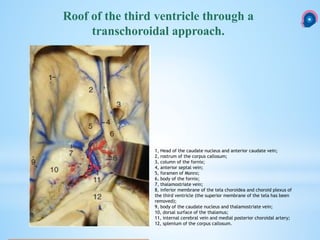
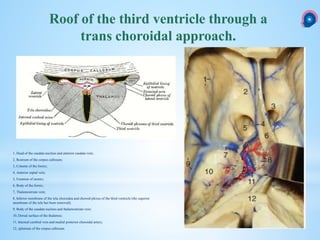
Roof of the third ventricle through a
transchoroidal approach.
1, Head of the caudate nucleus and anterior caudate vein;
2, rostrum of the corpus callosum;
3, column of the fornix;
4, anterior septal vein;
5, foramen of Monro;
6, body of the fornix;
7, thalamostriate vein;
8, inferior membrane of the tela choroidea and choroid plexus of
the third ventricle (the superior membrane of the tela has been
removed);
9, body of the caudate nucleus and thalamostriate vein;
10, dorsal surface of the thalamus;
11, internal cerebral vein and medial posterior choroidal artery;
12, splenium of the corpus callosum.
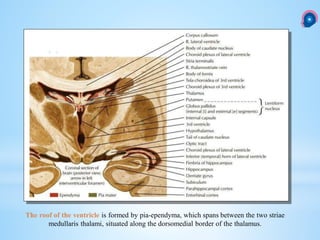
The roof of the ventricle is formed by pia-ependyma, which spans between the two striae
medullaris thalami, situated along the dorsomedial border of the thalamus.
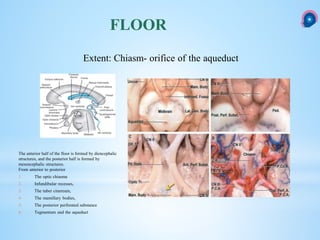
FLOOR
Extent: Chiasm- orifice of the aqueduct
The anterior half of the floor is formed by diencephalic
structures, and the posterior half is formed by
mesencephalic structures.
From anterior to posterior
1. The optic chiasma
2. Infundibular recesses,
3. The tuber cinereum,
4. The mamillary bodies,
5. The posterior perforated substance
6. Tegmentum and the aqueduct
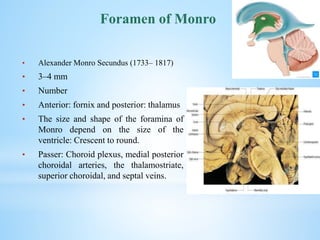
• Alexander Monro Secundus (1733– 1817)
• 3–4 mm
• Number
• Anterior: fornix and posterior: thalamus
• The size and shape of the foramina of
Monro depend on the size of the
ventricle: Crescent to round.
• Passer: Choroid plexus, medial posterior
choroidal arteries, the thalamostriate,
superior choroidal, and septal veins.
Foramen of Monro
CHOROIDAL FISSURE
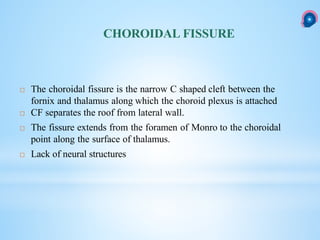
 The choroidal fissure is the narrow C shaped cleft between the
fornix and thalamus along which the choroid plexus is attached
 CF separates the roof from lateral wall.
 The fissure extends from the foramen of Monro to the choroidal
point along the surface of thalamus.
 Lack of neural structures
 Choroid plexus continues as two parallel strands of plexus in
the roof of third ventricle
 Choroidal arteries arise from internal carotid and posterior
cerebral arteries and enter the ventricles through the choroidal
fissure
 Choroid plexus is divided into body, atrial and temporal parts
CHOROID PLEXUS
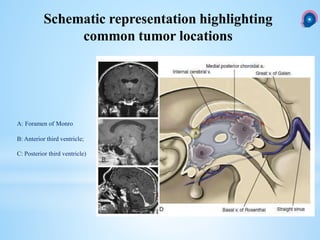
A: Foramen of Monro
B: Anterior third ventricle;
C: Posterior third ventricle)
Schematic representation highlighting
common tumor locations
Approach to third ventricle
Access
Deep
Neural incision
Vascular
Pituitary stalk
Fornix
Hypothalamus
LESIONS WITHIN THIRD VENTRICLE
Anterior third ventricle
1. Colloid cyst
2. Sellar mass
3. Sarcoidosis
4. Aneurysm
5. Hypothalamic glioma
6. Histiocytosis
7. Meningioma
8. Optic glioma
Posterior third ventricle
1. Pinealoma
(dysgerminoma)
2. Meningioma
3. Arachnoid cyst
4. Vein of Galen aneurysm
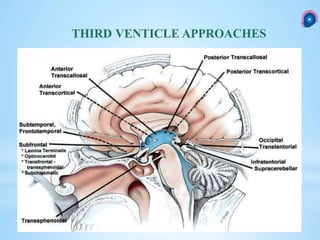
THIRD VENTICLE APPROACHES
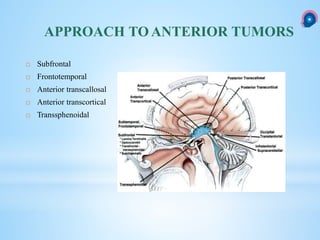
APPROACH TO ANTERIOR TUMORS
 Subfrontal
 Frontotemporal
 Anterior transcallosal
 Anterior transcortical
 Transsphenoidal
SUBFRONTAL APPROACH
 Supine position with head extension
 Coronal flap incision
 Quadrangular craniotomy flush with orbital margins
 Frontal sinus exteriorized and packed
 Olfactory nerve divided if necessary
FRONTOTEMPORAL OR SUBTEMPORAL
APPROACH
 Frontotemporal craniotomy
 Dura reflected on sphenoid ridge
 Tumor approached through corridor between third nerve and carotid.
 Temporal pole can be elevated or resected.
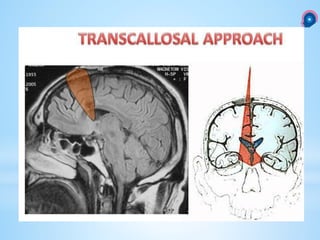
ANTERIOR TRANSCALLOSAL
APPROACH
Advantages
 –Short trajectory to third ventricle
 –Can access posterior and basal TV
 –Bilateral exposure of foramina of monro
 –No requirement of ventriculomegaly
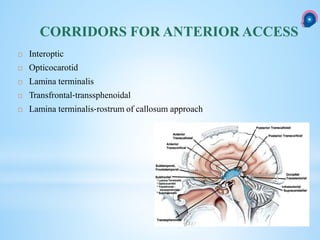
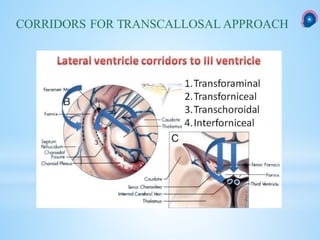
CORRIDORS FOR ANTERIOR ACCESS
 Interoptic
 Opticocarotid
 Lamina terminalis
 Transfrontal‐transsphenoidal
 Lamina terminalis‐rostrum of callosum approach
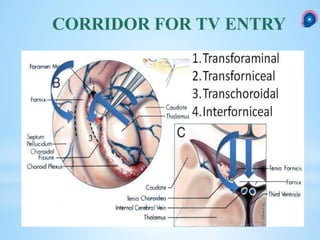
CORRIDOR FOR TV ENTRY
Indication:
1. Anterior portion of third ventricle
2. Parasellar cistern involvement
TRANS LAMINA TERMINALIS
CORRIDOR
Pros
No neural incision
Third ventriculostomy
Lesser forniceal involvement
Cons:
Lateral ventricle involvement
Middle and posterior portion of III ventricle
 Gives access to anterior TV
 Foramen of monro identified
 Initial dilatation can be tried
 Incision is made through one column of fornix at anteriosuperior edge.
TRANSFORAMINAL
TRANSCHOROIDAL
• Entry into the middle of TV Opening through the velum interpositum
• Two approaches:
• Supra-choroidal
 Incision in taenia fornicia
• Sub-choroidal
 Incision in taenia choroidea
Retracting the Choroid Plexus medially and opening the corridor
between the CP and the thalamus is known as the sub-choroidal
approach.
1, Head of the caudate nucleus and anterior caudate vein;
2, Rostrum of the corpus callosum;
3, Column of the fornix;
4, Anterior septal vein;
5, Foramen of monro;
6, Body of the fornix;
7, Thalamostriate vein;
8, Inferior membrane of the tela choroidea and choroid plexus of the third ventricle (the superior
membrane of the tela has been removed);
9, Body of the caudate nucleus and thalamostriate vein;
10, Dorsal surface of the thalamus;
11, Internal cerebral vein and medial posterior choroidal artery;
12, splenium of the corpus callosum.
Roof of the third ventricle through a
trans choroidal approach.
TRANSFORNICIAL
 Identify the septum pellucidum
 Develop a plane between septa.
 Incision is given in the body of fornix not exceeding 2 cm behind the
FM.
TRANSVENTRICULAR APPROACH
CORRIDORS FOR TRANSCALLOSAL APPROACH
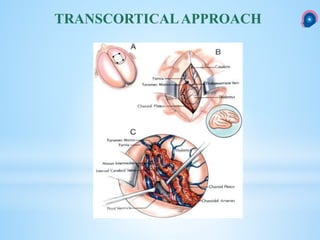
TRANSCORTICALAPPROACH
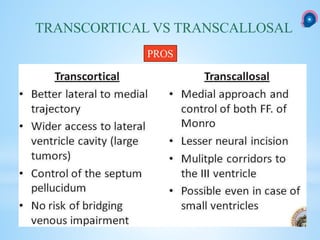
TRANSCORTICAL VS TRANSCALLOSAL
PROS
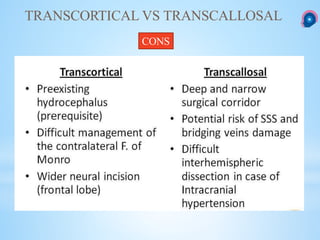
TRANSCORTICAL VS TRANSCALLOSAL
CONS
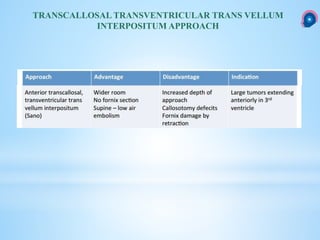
TRANSCALLOSAL TRANSVENTRICULAR TRANS VELLUM
INTERPOSITUM APPROACH
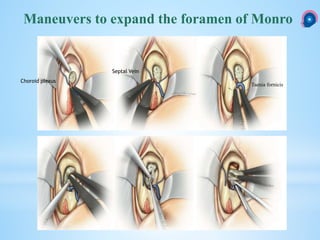
Maneuvers to expand the foramen of Monro
Choroid plexus
Septal Vein
Taenia fornicis
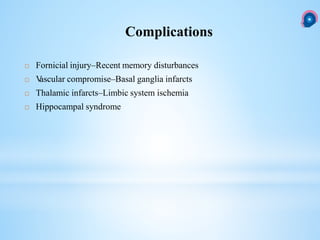
Complications
 Fornicial injury–Recent memory disturbances
 Vascular compromise–Basal ganglia infarcts
 Thalamic infarcts–Limbic system ischemia
 Hippocampal syndrome
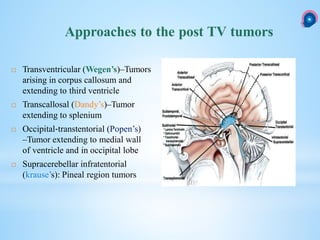
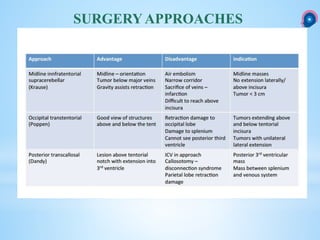
Approaches to the post TV tumors
 Transventricular (Wegen’s)–Tumors
arising in corpus callosum and
extending to third ventricle
 Transcallosal (Dandy’s)–Tumor
extending to splenium
 Occipital‐transtentorial (Popen’s)
–Tumor extending to medial wall
of ventricle and in occipital lobe
 Supracerebellar infratentorial
(krause’s): Pineal region tumors
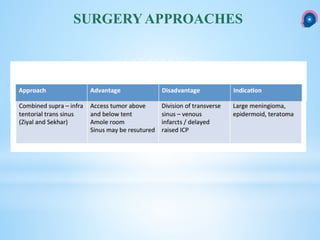
SURGERY APPROACHES
SURGERY APPROACHES
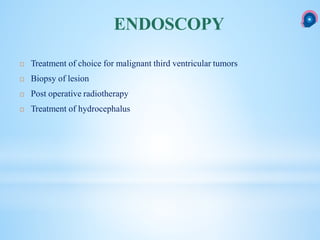
 Treatment of choice for malignant third ventricular tumors
 Biopsy of lesion
 Post operative radiotherapy
 Treatment of hydrocephalus
ENDOSCOPY
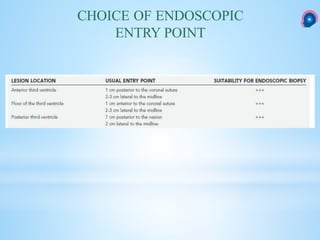
CHOICE OF ENDOSCOPIC
ENTRY POINT
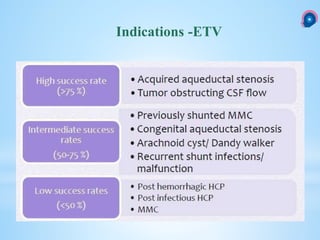
Indications -ETV
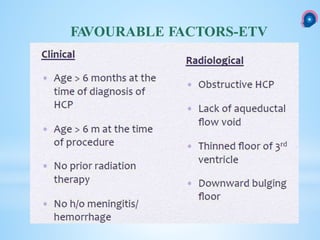
FAVOURABLE FACTORS-ETV
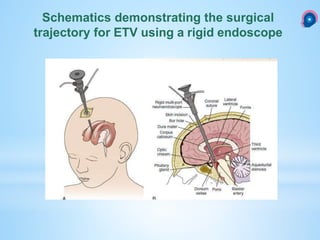
Schematics demonstrating the surgical
trajectory for ETV using a rigid endoscope
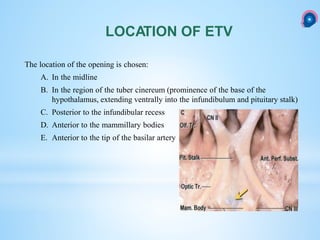
LOCATION OF ETV
The location of the opening is chosen:
A. In the midline
B. In the region of the tuber cinereum (prominence of the base of the
hypothalamus, extending ventrally into the infundibulum and pituitary stalk)
C. Posterior to the infundibular recess
D. Anterior to the mammillary bodies
E. Anterior to the tip of the basilar artery
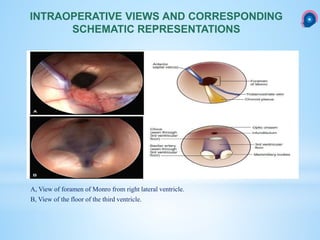
A, View of foramen of Monro from right lateral ventricle.
B, View of the floor of the third ventricle.
INTRAOPERATIVE VIEWS AND CORRESPONDING
SCHEMATIC REPRESENTATIONS
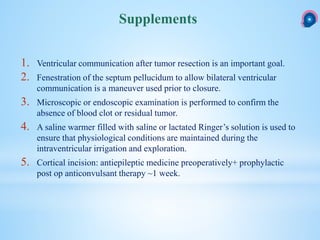
1. Ventricular communication after tumor resection is an important goal.
2. Fenestration of the septum pellucidum to allow bilateral ventricular
communication is a maneuver used prior to closure.
3. Microscopic or endoscopic examination is performed to confirm the
absence of blood clot or residual tumor.
4. A saline warmer filled with saline or lactated Ringer’s solution is used to
ensure that physiological conditions are maintained during the
intraventricular irrigation and exploration.
5. Cortical incision: antiepileptic medicine preoperatively+ prophylactic
post op anticonvulsant therapy ~1 week.
Supplements
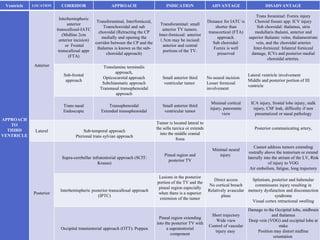
Ventricle LOCATION CORRIDOR APPROACH INDICATION ADVANTAGE DISADVANTAGE
APPROACH
TO
THIRD
VENTRICLE
Anterior
Interhemispheric
anterior
transcallosal-IATC
(Midline 2cm
anterior incision)
or Frontal
transcallosal appr
(FTA)
Transforaminal, Interforniceal,
Transchoroidal and sub
choroidal (Retracting the CP
medially and opening the
corridor between the CP and the
thalamus is known as the sub-
choroidal approach)
Transforaminal: small
anterior TV tumors.
Inter-forniceal: anterior
1.5cm may be incised:
anterior and central
portions of the TV.
Distance for IATC is
shorter than
transcortical (FTA)
approach.
Sub choroidal:
Fornix is well
preserved
Trans foraminal: Fornix injury
Choroid fissure app: ICV injury
Sub choroidal: thalamus, stria
medullaris thalami, anterior and
superior thalamic veins, thalamostriate
vein, and the choroidal arteries
Inter-forniceal: bilateral forniceal
damage, ICVs and posterior medial
choroidal arteries.
Sub-frontal
approach
Translamina terminalis
approach,
Opticocarotid approach
Subchiasmatic approach
Transnasal transsphenoidal
approach
Small anterior third
ventricular tumor
No neural incision
Lesser forniceal
involvement
Lateral ventricle involvement
Middle and posterior portion of III
ventricle
Trans nasal
Endoscopic
Transsphenoidal
Extended transsphenoidal
Small anterior third
ventricular tumor
Minimal cortical
injury, panoramic
view
ICA injury, frontal lobe injury, stalk
injury, CSF leak, difficulty if non
pneumatized or nasal pathology
Lateral Sub-temporal approach
Pterional trans sylvian approach
Tumor is located lateral to
the sella turcica or extends
into the middle cranial
fossa
Posterior communicating artery,
Posterior
Supra-cerebellar infratentorial approach (SCIT:
Krause)
Pineal region and
posterior TV
Minimal neural
injury
Cannot address tumors extending
rostrally above the tentorium or extend
laterally into the atrium of the LV, Risk
of injury to VOG
Air embolism, fatigue, long trajectory
Interhemispheric posterior transcallosal approach
(IPTC)
Lesions in the posterior
portion of the TV and the
pineal region especially
when there is a superior
extension of the tumor
Direct access
No cortical breach
Relatively avascular
plane
Splenium, posterior and habenular
commissures injury resulting in
memory dysfunction and disconnection
syndrome
Visual cortex retractional swelling
Occipital transtentorial approach (OTT): Poppen
Pineal region extending
into the posterior TV with
a supratentorial
component
Short trajectory
Wide view
Control of vascular
injury easy
Damage to the Occipital lobe, midbrain
and thalamus
Deep vein (VOG) and occipital lobe at
stake
Position may distort midline
orientation
DR. SURESH BISHOKAMA
MS, MCH (NEUROSURGERY)
NATIONAL INSTITUTE OF NEUROLOGICAL AND ALLIED SCIENCES, BANSBARI, KATHMANDUUPENDRA DEVKOTA MEMORIAL NATIONAL INSTITUTE OF NEUROLOGICALAND ALLIED SCIENCES,
BANSBARI, KATHMANDU
APPROACH TO THIRD VENTRICLE
1. Ellenbogen principle of Neurological surgery: Microsurgical Approaches to the Ventricular System.
2. Mortazavi M et al. The ventricular system of the brain: A comprehensive review of its history, anatomy, histology, embryology,
and surgical considerations. Childs Nerv Syst. 2013
3. The Neurosurgical Atlas, Aaron Cohen-Gadol.

Third ventricular surgical approaches

  • 1.
    cka DR. SURESH BISHOKARMA MS,MCH (Neurosurgery) Department of Neurosurgery, Upendra Devkota Memorial National Institute of Neurological and Allied Sciences Bansbari, Kathmandu, Nepal APPROACH TO THIRD VENTRICLE
  • 2.
    HISTORY: TIMELINE ONTHIRD VENTRICLE First brain dissection and to describe ventricles Galen 129-200 A.D Walter Dandy 1886- 1946 1923 Detail anatomy of ventricle First pneumoencephalography Endoscopic third ventriculostomy: William J. Mixter 1952 1947 Mcnickle described a modified technique of performing a percutaneous third ventriculostomy utilizing a 19-gauge needle to puncture the floor of the third ventricle Herophilus 335-280 B.C 1990 Jones et. al reported successful ETV in 24 pt. Leonardo Da Vinci 1452-1519 First wax casting of ventricle: Ox Nulsen and Spitz Shunt diverting cerebrospinal fluid (CSF) from the ventricular system to the jugular vein Domenico was the first to discover cerebrospinal fluid and to describe the continuity between the ventricles and subarachnoid space 1764
  • 3.
    EMBRYOLOGY 1. Most rostralportion of the neural tube. 2. 5th weeks. 3. The third ventricle is the space formed by the expanding canal of the diencephalon. 4. The telencephalon gradually expands laterally to a much greater extent than it does dorsally or ventrally, and its connection to the remainder of the neural tube reduces to the foramina of Monro.
  • 4.
  • 7.
    Third Ventricle  Comprisesof: Anterior wall Two side walls Floor Roof
  • 10.
     Anterior wall: laminaterminalis anterior commissure ANTERIOR WALL OF THIRD VENTRICLE
  • 11.
  • 12.
  • 13.
  • 14.
    THE ROOF  Extent:FM to suprapineal recess ICV: Int. Cerebral Vein MPCA: Medial posterior Choroidal artery) Constituted superiorly to inferiorly by five layers: 1. Fornix 2. Superior membrane of tela choroidea (Pial) 3. Velum interpositum: Vascular layer (ICV& MPCA) 4. Inferior membrane of tela choroidea 5. Choroidal plexus
  • 15.
    Roof of thethird ventricle through a transchoroidal approach. 1, Head of the caudate nucleus and anterior caudate vein; 2, rostrum of the corpus callosum; 3, column of the fornix; 4, anterior septal vein; 5, foramen of Monro; 6, body of the fornix; 7, thalamostriate vein; 8, inferior membrane of the tela choroidea and choroid plexus of the third ventricle (the superior membrane of the tela has been removed); 9, body of the caudate nucleus and thalamostriate vein; 10, dorsal surface of the thalamus; 11, internal cerebral vein and medial posterior choroidal artery; 12, splenium of the corpus callosum.
  • 16.
    The roof ofthe ventricle is formed by pia-ependyma, which spans between the two striae medullaris thalami, situated along the dorsomedial border of the thalamus.
  • 17.
    FLOOR Extent: Chiasm- orificeof the aqueduct The anterior half of the floor is formed by diencephalic structures, and the posterior half is formed by mesencephalic structures. From anterior to posterior 1. The optic chiasma 2. Infundibular recesses, 3. The tuber cinereum, 4. The mamillary bodies, 5. The posterior perforated substance 6. Tegmentum and the aqueduct
  • 18.
    • Alexander MonroSecundus (1733– 1817) • 3–4 mm • Number • Anterior: fornix and posterior: thalamus • The size and shape of the foramina of Monro depend on the size of the ventricle: Crescent to round. • Passer: Choroid plexus, medial posterior choroidal arteries, the thalamostriate, superior choroidal, and septal veins. Foramen of Monro
  • 19.
    CHOROIDAL FISSURE  Thechoroidal fissure is the narrow C shaped cleft between the fornix and thalamus along which the choroid plexus is attached  CF separates the roof from lateral wall.  The fissure extends from the foramen of Monro to the choroidal point along the surface of thalamus.  Lack of neural structures
  • 20.
     Choroid plexuscontinues as two parallel strands of plexus in the roof of third ventricle  Choroidal arteries arise from internal carotid and posterior cerebral arteries and enter the ventricles through the choroidal fissure  Choroid plexus is divided into body, atrial and temporal parts CHOROID PLEXUS
  • 21.
    A: Foramen ofMonro B: Anterior third ventricle; C: Posterior third ventricle) Schematic representation highlighting common tumor locations
  • 22.
    Approach to thirdventricle Access Deep Neural incision Vascular Pituitary stalk Fornix Hypothalamus
  • 23.
    LESIONS WITHIN THIRDVENTRICLE Anterior third ventricle 1. Colloid cyst 2. Sellar mass 3. Sarcoidosis 4. Aneurysm 5. Hypothalamic glioma 6. Histiocytosis 7. Meningioma 8. Optic glioma Posterior third ventricle 1. Pinealoma (dysgerminoma) 2. Meningioma 3. Arachnoid cyst 4. Vein of Galen aneurysm
  • 24.
  • 25.
    APPROACH TO ANTERIORTUMORS  Subfrontal  Frontotemporal  Anterior transcallosal  Anterior transcortical  Transsphenoidal
  • 26.
    SUBFRONTAL APPROACH  Supineposition with head extension  Coronal flap incision  Quadrangular craniotomy flush with orbital margins  Frontal sinus exteriorized and packed  Olfactory nerve divided if necessary
  • 27.
    FRONTOTEMPORAL OR SUBTEMPORAL APPROACH Frontotemporal craniotomy  Dura reflected on sphenoid ridge  Tumor approached through corridor between third nerve and carotid.  Temporal pole can be elevated or resected.
  • 28.
    ANTERIOR TRANSCALLOSAL APPROACH Advantages  –Shorttrajectory to third ventricle  –Can access posterior and basal TV  –Bilateral exposure of foramina of monro  –No requirement of ventriculomegaly
  • 29.
    CORRIDORS FOR ANTERIORACCESS  Interoptic  Opticocarotid  Lamina terminalis  Transfrontal‐transsphenoidal  Lamina terminalis‐rostrum of callosum approach
  • 30.
  • 31.
    Indication: 1. Anterior portionof third ventricle 2. Parasellar cistern involvement TRANS LAMINA TERMINALIS CORRIDOR Pros No neural incision Third ventriculostomy Lesser forniceal involvement Cons: Lateral ventricle involvement Middle and posterior portion of III ventricle
  • 32.
     Gives accessto anterior TV  Foramen of monro identified  Initial dilatation can be tried  Incision is made through one column of fornix at anteriosuperior edge. TRANSFORAMINAL
  • 33.
    TRANSCHOROIDAL • Entry intothe middle of TV Opening through the velum interpositum • Two approaches: • Supra-choroidal  Incision in taenia fornicia • Sub-choroidal  Incision in taenia choroidea Retracting the Choroid Plexus medially and opening the corridor between the CP and the thalamus is known as the sub-choroidal approach.
  • 34.
    1, Head ofthe caudate nucleus and anterior caudate vein; 2, Rostrum of the corpus callosum; 3, Column of the fornix; 4, Anterior septal vein; 5, Foramen of monro; 6, Body of the fornix; 7, Thalamostriate vein; 8, Inferior membrane of the tela choroidea and choroid plexus of the third ventricle (the superior membrane of the tela has been removed); 9, Body of the caudate nucleus and thalamostriate vein; 10, Dorsal surface of the thalamus; 11, Internal cerebral vein and medial posterior choroidal artery; 12, splenium of the corpus callosum. Roof of the third ventricle through a trans choroidal approach.
  • 35.
    TRANSFORNICIAL  Identify theseptum pellucidum  Develop a plane between septa.  Incision is given in the body of fornix not exceeding 2 cm behind the FM.
  • 36.
  • 38.
  • 39.
  • 40.
  • 41.
  • 42.
    TRANSCALLOSAL TRANSVENTRICULAR TRANSVELLUM INTERPOSITUM APPROACH
  • 43.
    Maneuvers to expandthe foramen of Monro Choroid plexus Septal Vein Taenia fornicis
  • 44.
    Complications  Fornicial injury–Recentmemory disturbances  Vascular compromise–Basal ganglia infarcts  Thalamic infarcts–Limbic system ischemia  Hippocampal syndrome
  • 45.
    Approaches to thepost TV tumors  Transventricular (Wegen’s)–Tumors arising in corpus callosum and extending to third ventricle  Transcallosal (Dandy’s)–Tumor extending to splenium  Occipital‐transtentorial (Popen’s) –Tumor extending to medial wall of ventricle and in occipital lobe  Supracerebellar infratentorial (krause’s): Pineal region tumors
  • 46.
  • 47.
  • 48.
     Treatment ofchoice for malignant third ventricular tumors  Biopsy of lesion  Post operative radiotherapy  Treatment of hydrocephalus ENDOSCOPY
  • 49.
  • 50.
  • 51.
  • 53.
    Schematics demonstrating thesurgical trajectory for ETV using a rigid endoscope
  • 54.
    LOCATION OF ETV Thelocation of the opening is chosen: A. In the midline B. In the region of the tuber cinereum (prominence of the base of the hypothalamus, extending ventrally into the infundibulum and pituitary stalk) C. Posterior to the infundibular recess D. Anterior to the mammillary bodies E. Anterior to the tip of the basilar artery
  • 55.
    A, View offoramen of Monro from right lateral ventricle. B, View of the floor of the third ventricle. INTRAOPERATIVE VIEWS AND CORRESPONDING SCHEMATIC REPRESENTATIONS
  • 56.
    1. Ventricular communicationafter tumor resection is an important goal. 2. Fenestration of the septum pellucidum to allow bilateral ventricular communication is a maneuver used prior to closure. 3. Microscopic or endoscopic examination is performed to confirm the absence of blood clot or residual tumor. 4. A saline warmer filled with saline or lactated Ringer’s solution is used to ensure that physiological conditions are maintained during the intraventricular irrigation and exploration. 5. Cortical incision: antiepileptic medicine preoperatively+ prophylactic post op anticonvulsant therapy ~1 week. Supplements
  • 57.
    Ventricle LOCATION CORRIDORAPPROACH INDICATION ADVANTAGE DISADVANTAGE APPROACH TO THIRD VENTRICLE Anterior Interhemispheric anterior transcallosal-IATC (Midline 2cm anterior incision) or Frontal transcallosal appr (FTA) Transforaminal, Interforniceal, Transchoroidal and sub choroidal (Retracting the CP medially and opening the corridor between the CP and the thalamus is known as the sub- choroidal approach) Transforaminal: small anterior TV tumors. Inter-forniceal: anterior 1.5cm may be incised: anterior and central portions of the TV. Distance for IATC is shorter than transcortical (FTA) approach. Sub choroidal: Fornix is well preserved Trans foraminal: Fornix injury Choroid fissure app: ICV injury Sub choroidal: thalamus, stria medullaris thalami, anterior and superior thalamic veins, thalamostriate vein, and the choroidal arteries Inter-forniceal: bilateral forniceal damage, ICVs and posterior medial choroidal arteries. Sub-frontal approach Translamina terminalis approach, Opticocarotid approach Subchiasmatic approach Transnasal transsphenoidal approach Small anterior third ventricular tumor No neural incision Lesser forniceal involvement Lateral ventricle involvement Middle and posterior portion of III ventricle Trans nasal Endoscopic Transsphenoidal Extended transsphenoidal Small anterior third ventricular tumor Minimal cortical injury, panoramic view ICA injury, frontal lobe injury, stalk injury, CSF leak, difficulty if non pneumatized or nasal pathology Lateral Sub-temporal approach Pterional trans sylvian approach Tumor is located lateral to the sella turcica or extends into the middle cranial fossa Posterior communicating artery, Posterior Supra-cerebellar infratentorial approach (SCIT: Krause) Pineal region and posterior TV Minimal neural injury Cannot address tumors extending rostrally above the tentorium or extend laterally into the atrium of the LV, Risk of injury to VOG Air embolism, fatigue, long trajectory Interhemispheric posterior transcallosal approach (IPTC) Lesions in the posterior portion of the TV and the pineal region especially when there is a superior extension of the tumor Direct access No cortical breach Relatively avascular plane Splenium, posterior and habenular commissures injury resulting in memory dysfunction and disconnection syndrome Visual cortex retractional swelling Occipital transtentorial approach (OTT): Poppen Pineal region extending into the posterior TV with a supratentorial component Short trajectory Wide view Control of vascular injury easy Damage to the Occipital lobe, midbrain and thalamus Deep vein (VOG) and occipital lobe at stake Position may distort midline orientation
  • 58.
    DR. SURESH BISHOKAMA MS,MCH (NEUROSURGERY) NATIONAL INSTITUTE OF NEUROLOGICAL AND ALLIED SCIENCES, BANSBARI, KATHMANDUUPENDRA DEVKOTA MEMORIAL NATIONAL INSTITUTE OF NEUROLOGICALAND ALLIED SCIENCES, BANSBARI, KATHMANDU APPROACH TO THIRD VENTRICLE 1. Ellenbogen principle of Neurological surgery: Microsurgical Approaches to the Ventricular System. 2. Mortazavi M et al. The ventricular system of the brain: A comprehensive review of its history, anatomy, histology, embryology, and surgical considerations. Childs Nerv Syst. 2013 3. The Neurosurgical Atlas, Aaron Cohen-Gadol.