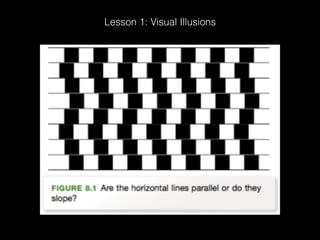
Lesson 1: Visual Illusions
Question from last lesson
Suggest a possible explanation of the difference between
taste and flavour (2marks).
Answer:
Taste refers to the primary underlying sensations derived from food;
whether the substance has the basic characteristics of sweet, salty,
sour, bitter or umami. (1 mark)
Flavour imparts more complex and subtle differences in the
perception, providing more detailed information such as chocolatey,
smoky, tangy etc. Flavour gives taste its descriptive characteristics. (1
mark)
Learning Intentions (What you need to know and be
able to do)
• Explain distortions of visual perception by illusions,
including Muller Lyer and Ames room
• Describe the structural features (design) of the Ames
room and explain why the illusion of changing size is
brought about by varying distance
• Evaluate explanations of the Muller-Lyer illusion
including biological, psychological and social
perspective
A perceptual distortion involves an inconsistency, or ‘mismatch’,
between a perceptual experience and physical reality.

Visual illusions are NOT
• Ambiguous figures, which are images which can be
perceived in two different ways due to a shift in attention.
• Delusions, which are false beliefs
• Hallucinations, which are perceptions that do not actually exist
These are hundreds of visual illusions, which can be fun and
interesting to look at. For the purposes of VCE psychology you
need to know in detail about two of the most widely studies
illusions called the Muller-Lyer illusion and the Ames room
illusion
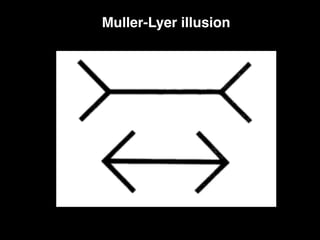
Muller-Lyer illusion
Explanations from the Biological perspective
Eye Movement theory - Rejected
It may be the case that we have an inborn tendency to
misperceive simple geometric patterns when they are viewed in
a two-dimensional form.
Or put more simply - we are born to perceive in 3D not 2D
Psychological perspective
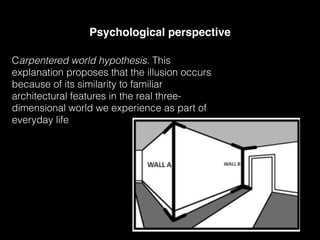
Carpentered world hypothesis. This
explanation proposes that the illusion occurs
because of its similarity to familiar
architectural features in the real three-
dimensional world we experience as part of
everyday life
Social Perspective
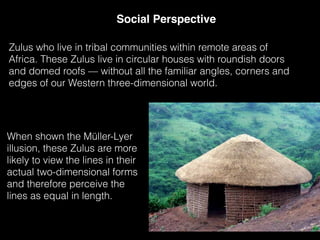
When shown the Müller-Lyer
illusion, these Zulus are more
likely to view the lines in their
actual two-dimensional forms
and therefore perceive the
lines as equal in length.
Zulus who live in tribal communities within remote areas of
Africa. These Zulus live in circular houses with roundish doors

and domed roofs — without all the familiar angles, corners and
edges of our Western three-dimensional world.
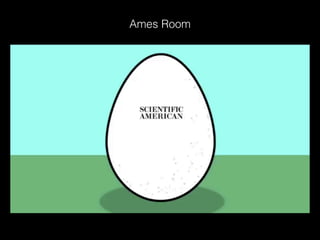
Ames Room

Lesson 1 visual illusion

  • 1.
  • 2.
    Question from lastlesson Suggest a possible explanation of the difference between taste and flavour (2marks).
  • 3.
    Answer: Taste refers tothe primary underlying sensations derived from food; whether the substance has the basic characteristics of sweet, salty, sour, bitter or umami. (1 mark) Flavour imparts more complex and subtle differences in the perception, providing more detailed information such as chocolatey, smoky, tangy etc. Flavour gives taste its descriptive characteristics. (1 mark)
  • 4.
    Learning Intentions (Whatyou need to know and be able to do) • Explain distortions of visual perception by illusions, including Muller Lyer and Ames room • Describe the structural features (design) of the Ames room and explain why the illusion of changing size is brought about by varying distance • Evaluate explanations of the Muller-Lyer illusion including biological, psychological and social perspective
  • 5.
    A perceptual distortioninvolves an inconsistency, or ‘mismatch’, between a perceptual experience and physical reality.

  • 6.
    Visual illusions areNOT • Ambiguous figures, which are images which can be perceived in two different ways due to a shift in attention. • Delusions, which are false beliefs • Hallucinations, which are perceptions that do not actually exist These are hundreds of visual illusions, which can be fun and interesting to look at. For the purposes of VCE psychology you need to know in detail about two of the most widely studies illusions called the Muller-Lyer illusion and the Ames room illusion
  • 7.
  • 8.
    Explanations from theBiological perspective Eye Movement theory - Rejected It may be the case that we have an inborn tendency to misperceive simple geometric patterns when they are viewed in a two-dimensional form. Or put more simply - we are born to perceive in 3D not 2D
  • 9.
    Psychological perspective Carpentered worldhypothesis. This explanation proposes that the illusion occurs because of its similarity to familiar architectural features in the real three- dimensional world we experience as part of everyday life
  • 10.
    Social Perspective When shownthe Müller-Lyer illusion, these Zulus are more likely to view the lines in their actual two-dimensional forms and therefore perceive the lines as equal in length. Zulus who live in tribal communities within remote areas of Africa. These Zulus live in circular houses with roundish doors
 and domed roofs — without all the familiar angles, corners and edges of our Western three-dimensional world.
  • 11.