NON-INVASIVE BRAIN COMPUTER
INTERFACE FOR AUGMENTATIVE AND
ALTERNATIVE COMMUNICATION
TITLE DEFINITION: BCI-BASED-AAC
NON-INVASIVE : Relating to a technique that does not
involve puncturing the skin or entering a body cavity.
AUGMENTATIVE: increasing or having the power to
increase especially in size or amount or degree
ABSTRACT
• Brain-computer interface is the study of neuro-
engineering to explore and show how the brain
can use external devices. In this presentation I
explain and review the rules and principles of this
human brain-computer communication. BCI
enhance the integration between human brain
and external devices and non-invasive neuro-
modulation process to improve mind-body
interaction to perform the interaction and
performance. Brain-computer interface is the
connection of external man-made devices with
the natural brain
INTRODUCTION
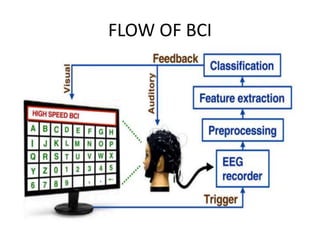
• The BCI means to provide the interface of
computer with physical brain. It is also called
brain machine interface (BMI) The The
Advanced Research Projects Agency (ARPA)
becomes interested in technologies that
develop a bionic application that
communicate between computer and human
brain. BCI use EEG and NEUROSKY MIND
WAVES
FLOW OF BCI
KEYWORDS
• Brain-computer interface (BCI); Brain-machine
interface (BMI);
• Electroencephalography (EEG); Motor imagery
(MI); Sensory motor rhythm (SMR)
TYPES OF BCI BASED AAC.
• Actually, BCI is helped with the following two
types of AAC.
• UNAIDED SYSTEM
• An unaided system is the process of body
thoughts and feeling that translate to other
environments. That means it includes gestures
body, facial expressions and signed languages.
• AIDED SYSTEM
• That includes the hardware type microelectrodes
and other devices like the BCI project.
HOW BCI WORKS
• MOTER-IMAGERY BCI
• Visual based BCI (event-related potentials and
steady-state visual evoked potentials)
• Motor-imagery based BCI means that a machine
that performed an action that are based some
movements of motor such as limbs. Some other
BCI system is like inactive BCI, reactive BCI and
affective BCI. All these BCI are used to control
devices and applications by inner movement of
user brain.
BCI’S FEATURE TRANSLATION AND
EFFECTOR
• By feature, the translation technique means that
what are the algorithms that translate the goal
of mind as an input variable into Machine
control commands for achieving the user’s
intent. Common this algorithm capture the intent
of the user form the brain and then convert them
into machine learning accurately and reliably. This
algorithm works spontaneously and encourages
and facilitates the user’s acquisition of better
control.
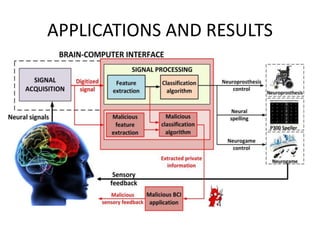
APPLICATIONS AND RESULTS
CONCLUSION AND REMARKS.
• BCI provide independence to individuals and
improve the quality of comfortable life. Basic
limitation of BCI system is signal process when
received from brain and prone to BCI system.
• Now a day BCI is mostly used non-invasively in
the environment. This process is used mental
and brain signals. Wearable sensors like BCI
electrodes are used for communications.
QUERY AND THANKS !

Bci my muhammad sharif presentations

  • 1.
    NON-INVASIVE BRAIN COMPUTER INTERFACEFOR AUGMENTATIVE AND ALTERNATIVE COMMUNICATION TITLE DEFINITION: BCI-BASED-AAC NON-INVASIVE : Relating to a technique that does not involve puncturing the skin or entering a body cavity. AUGMENTATIVE: increasing or having the power to increase especially in size or amount or degree
  • 2.
    ABSTRACT • Brain-computer interfaceis the study of neuro- engineering to explore and show how the brain can use external devices. In this presentation I explain and review the rules and principles of this human brain-computer communication. BCI enhance the integration between human brain and external devices and non-invasive neuro- modulation process to improve mind-body interaction to perform the interaction and performance. Brain-computer interface is the connection of external man-made devices with the natural brain
  • 3.
    INTRODUCTION • The BCImeans to provide the interface of computer with physical brain. It is also called brain machine interface (BMI) The The Advanced Research Projects Agency (ARPA) becomes interested in technologies that develop a bionic application that communicate between computer and human brain. BCI use EEG and NEUROSKY MIND WAVES
  • 4.
  • 5.
    KEYWORDS • Brain-computer interface(BCI); Brain-machine interface (BMI); • Electroencephalography (EEG); Motor imagery (MI); Sensory motor rhythm (SMR)
  • 6.
    TYPES OF BCIBASED AAC. • Actually, BCI is helped with the following two types of AAC. • UNAIDED SYSTEM • An unaided system is the process of body thoughts and feeling that translate to other environments. That means it includes gestures body, facial expressions and signed languages. • AIDED SYSTEM • That includes the hardware type microelectrodes and other devices like the BCI project.
  • 7.
    HOW BCI WORKS •MOTER-IMAGERY BCI • Visual based BCI (event-related potentials and steady-state visual evoked potentials) • Motor-imagery based BCI means that a machine that performed an action that are based some movements of motor such as limbs. Some other BCI system is like inactive BCI, reactive BCI and affective BCI. All these BCI are used to control devices and applications by inner movement of user brain.
  • 8.
    BCI’S FEATURE TRANSLATIONAND EFFECTOR • By feature, the translation technique means that what are the algorithms that translate the goal of mind as an input variable into Machine control commands for achieving the user’s intent. Common this algorithm capture the intent of the user form the brain and then convert them into machine learning accurately and reliably. This algorithm works spontaneously and encourages and facilitates the user’s acquisition of better control.
  • 9.
  • 10.
    CONCLUSION AND REMARKS. •BCI provide independence to individuals and improve the quality of comfortable life. Basic limitation of BCI system is signal process when received from brain and prone to BCI system. • Now a day BCI is mostly used non-invasively in the environment. This process is used mental and brain signals. Wearable sensors like BCI electrodes are used for communications.
  • 11.