Equilibrioception: Sense of balancePresented by: SuhasDeshpandeEE 506 Theory & Practice Biomedical InstrumentationDr. Christopher Druzgalski
outlineImportanceBalance as a senseVestibular systemSensory factors affecting balanceBalance disordersPostural diagnosisPostural balance indicatorResearch and applicationsReferences
Importance Dizziness is a common symptom affecting about 30% of people over the age of 65Difficulty in performing one or more activities of daily livingMay have serious outcomes even deathFalls are the leading cause of fatal and non-fatal injuries for old age person 
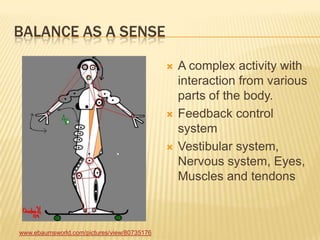
Balance as a senseA complex activity with interaction from various parts of the body.Feedback control systemVestibular system, Nervous system, Eyes, Muscles and tendonswww.ebaumsworld.com/pictures/view/80735176
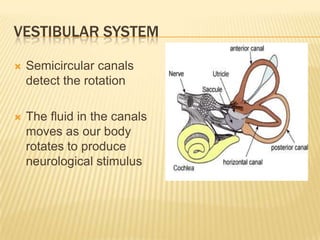
Vestibular systemSemicircular canals detect the rotationThe fluid in the canals moves as our body rotates to produce neurological stimulus
Vestibular systemOtolith organs: Saccule and Utricle to detect linear accelerationMovement of hair cells in the utricle and sacule innervate the neurons during the  motion
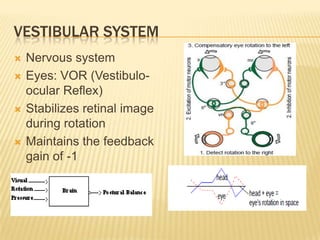
Vestibular systemNervous systemEyes: VOR (Vestibulo-ocular Reflex) Stabilizes retinal image during rotationMaintains the feedback gain of -1
Sensory factors affecting balanceVisionProvides necessary information for effective navigationProvides input to the nervous system about the real world
Sensory factors affecting balanceVisionVestibular senseHelps in positioning the headVOR helps in maintaining the visual fixation
Sensory factors affecting balanceVisionVestibular senseProprioceptionSensory information from muscles,  tendons provide feedback of joint position, movement and touch.Lower limbs input contributes to standing balance.
Sensory factors affecting balanceVisionVestibular senseProprioceptionCentral Nervous system Receives feedback from other organsSends motor response to other organs
Balance disordersRelated to EarBPPV (Benign Paroxysmal Positional Vertigo)Meniere’s diseaseLabyrinthitis (inner ear infection)Related to brainTraumatic Brain InjuryDisorders of CNSDiseqillibrium
Postural DiagnosisRotation TestsENG(Electronystagmography)CDP(Computerized Dynamic Posturography)MRICT Scan
Postural DiagnosisPosturography Non-invasive specialized techniqueStudy the contributions of vestibular inputs, visual inputs, somatosensory inputs, central integrating mechanisms and muscular system outputs for postural and balance control
Postural DiagnosisPosturographyPatient stands still in a set of conditions with eyes open/closed in fixed and sway referenced surface conditionsThree kinds of tests: Sensory Organization Test (SOT), Motor Control Test (MCT) and Adaptation Test (ADT)
Postural DiagnosisENGElectrodes placed around the eyeDetects the occurrence of a nystagmus (involuntary eye movement)Ears flushed with warm and then cold water.Amount of nystagmus measured.
Postural diagnosisRotation testsPatient is seated on a rotary chairChair rotates/moves in specific mannerThe eye movements are monitored to diagnose the problem
Postural balance indicatorTwo level sensors: fluid filled tubesPhoto-resistor and an LED coupled detect the off balance positionSignal sent to respective vibrators (left or right or both)The patient senses the vibrations to regain equillibrium(1)
Research and applicationApplication of human postural balance mechanism to humanoid robotsStudy of the zero gravity condition and role of and effect on the human body for astronauts.
ReferencesP. Ingerson, "Postural balance indicator and associated feedback compensation system," Annual International Conference of the IEEE Engineering in Medicine and Biology - Proceedings, vol. 26, pp. 2484, 2004.V. Panzer, "Biomechanical changes in postural control concurrent with aging," J. Biomech., vol. 22, pp. 1067, 1989F.Horak, "Clinical assessment of balance disorders", Gait & Posture, Volume 6, Issue 1, Pages 76-84L. Kodde, "An application of mathematical models in posturography," J. Biomed. Eng., vol. 4, pp. 44, 1982Hyon. "Integration of multi-level postural balancing on humanoid robots",2009 IEEE International Conference on Robotics and Automation, pp. 1549, 1556http://www.physpharm.fmd.uwo.ca/undergrad/sensesweb/L10Balance/L10Balance.pdfhttp://vestibular.org/index.phphttp://www.nidcd.nih.gov/health/balance/balance_disorders.asphttp://www.dizziness-and-balance.com/index.htmlhttp://resourcesonbalance.comhttp://spaceline.nasaprs.com/pdf/Astronaut_Study.pdf

Equilibrioception

  • 1.
    Equilibrioception: Senseof balancePresented by: SuhasDeshpandeEE 506 Theory & Practice Biomedical InstrumentationDr. Christopher Druzgalski
  • 2.
    outlineImportanceBalance as asenseVestibular systemSensory factors affecting balanceBalance disordersPostural diagnosisPostural balance indicatorResearch and applicationsReferences
  • 3.
    Importance Dizziness isa common symptom affecting about 30% of people over the age of 65Difficulty in performing one or more activities of daily livingMay have serious outcomes even deathFalls are the leading cause of fatal and non-fatal injuries for old age person 
  • 4.
    Balance as asenseA complex activity with interaction from various parts of the body.Feedback control systemVestibular system, Nervous system, Eyes, Muscles and tendonswww.ebaumsworld.com/pictures/view/80735176
  • 5.
    Vestibular systemSemicircular canalsdetect the rotationThe fluid in the canals moves as our body rotates to produce neurological stimulus
  • 6.
    Vestibular systemOtolith organs:Saccule and Utricle to detect linear accelerationMovement of hair cells in the utricle and sacule innervate the neurons during the motion
  • 7.
    Vestibular systemNervous systemEyes:VOR (Vestibulo-ocular Reflex) Stabilizes retinal image during rotationMaintains the feedback gain of -1
  • 8.
    Sensory factors affectingbalanceVisionProvides necessary information for effective navigationProvides input to the nervous system about the real world
  • 9.
    Sensory factors affectingbalanceVisionVestibular senseHelps in positioning the headVOR helps in maintaining the visual fixation
  • 10.
    Sensory factors affectingbalanceVisionVestibular senseProprioceptionSensory information from muscles, tendons provide feedback of joint position, movement and touch.Lower limbs input contributes to standing balance.
  • 11.
    Sensory factors affectingbalanceVisionVestibular senseProprioceptionCentral Nervous system Receives feedback from other organsSends motor response to other organs
  • 12.
    Balance disordersRelated toEarBPPV (Benign Paroxysmal Positional Vertigo)Meniere’s diseaseLabyrinthitis (inner ear infection)Related to brainTraumatic Brain InjuryDisorders of CNSDiseqillibrium
  • 13.
  • 14.
    Postural DiagnosisPosturography Non-invasive specialized techniqueStudythe contributions of vestibular inputs, visual inputs, somatosensory inputs, central integrating mechanisms and muscular system outputs for postural and balance control
  • 15.
    Postural DiagnosisPosturographyPatient standsstill in a set of conditions with eyes open/closed in fixed and sway referenced surface conditionsThree kinds of tests: Sensory Organization Test (SOT), Motor Control Test (MCT) and Adaptation Test (ADT)
  • 16.
    Postural DiagnosisENGElectrodes placedaround the eyeDetects the occurrence of a nystagmus (involuntary eye movement)Ears flushed with warm and then cold water.Amount of nystagmus measured.
  • 17.
    Postural diagnosisRotation testsPatientis seated on a rotary chairChair rotates/moves in specific mannerThe eye movements are monitored to diagnose the problem
  • 18.
    Postural balance indicatorTwolevel sensors: fluid filled tubesPhoto-resistor and an LED coupled detect the off balance positionSignal sent to respective vibrators (left or right or both)The patient senses the vibrations to regain equillibrium(1)
  • 19.
    Research and applicationApplicationof human postural balance mechanism to humanoid robotsStudy of the zero gravity condition and role of and effect on the human body for astronauts.
  • 20.
    ReferencesP. Ingerson, "Posturalbalance indicator and associated feedback compensation system," Annual International Conference of the IEEE Engineering in Medicine and Biology - Proceedings, vol. 26, pp. 2484, 2004.V. Panzer, "Biomechanical changes in postural control concurrent with aging," J. Biomech., vol. 22, pp. 1067, 1989F.Horak, "Clinical assessment of balance disorders", Gait & Posture, Volume 6, Issue 1, Pages 76-84L. Kodde, "An application of mathematical models in posturography," J. Biomed. Eng., vol. 4, pp. 44, 1982Hyon. "Integration of multi-level postural balancing on humanoid robots",2009 IEEE International Conference on Robotics and Automation, pp. 1549, 1556http://www.physpharm.fmd.uwo.ca/undergrad/sensesweb/L10Balance/L10Balance.pdfhttp://vestibular.org/index.phphttp://www.nidcd.nih.gov/health/balance/balance_disorders.asphttp://www.dizziness-and-balance.com/index.htmlhttp://resourcesonbalance.comhttp://spaceline.nasaprs.com/pdf/Astronaut_Study.pdf

Editor's Notes

  • #6 Three semicircular canals arrangedorthonormally to each other in three planes. Two set of these, one in each ear help in detecting the rotary motion of the head. Stabilizes the body system wrt the outer world.
  • #17 http://www.nidcd.nih.gov/health/balance
  • #19 Patient awareness system> Continual feedback> Compensators/indicators(Liquid Tubes); Programs;Output (Vibrators); and related circuitry.