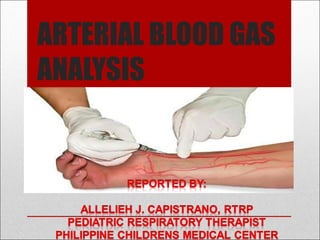
ARTERIAL BLOOD GAS 
ANALYSIS
Objective 
I. Arterial Oxygenation 
A. Hemoglobin 
B. Bohr and Haldane Effects 
C. Hemoglobin Dissociation Curve 
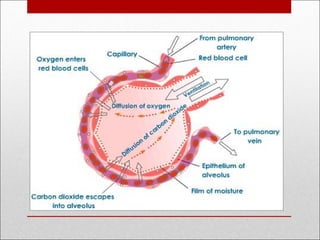
D. Physiology of Arterial Oxygenation 
E. Pathophysiologic Mechanisms of Hypoxemia 
F. Cardiopulmonary Compensation for Hypoxemia
Objective 
II. Reference Ranges and Interpretative Guidelines 
III. Clinical Approach to Interpretation 
IV. Hypoxemia and Oxygen Therapy 
V. Obtaining Blood Gas Sample 
VI. Blood Gas Analyzers 
VII. Quality Assurance in Blood Gas Analysis
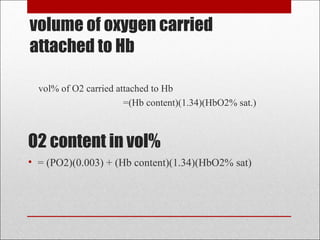
volume of oxygen carried 
attached to Hb 
vol% of O2 carried attached to Hb 
=(Hb content)(1.34)(HbO2% sat.) 
O2 content in vol% 
• = (PO2)(0.003) + (Hb content)(1.34)(HbO2% sat)
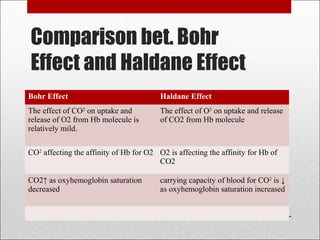
Comparison bet. Bohr 
Effect and Haldane Effect 
Bohr Effect Haldane Effect 
The effect of CO2 on uptake and 
release of O2 from Hb molecule is 
relatively mild. 
The effect of O2 on uptake and release 
of CO2 from Hb molecule 
CO2 affecting the affinity of Hb for O2 O2 is affecting the affinity for Hb of 
CO2 
CO2↑ as oxyhemoglobin saturation 
decreased 
carrying capacity of blood for CO2 is ↓ 
as oxyhemoglobin saturation increased
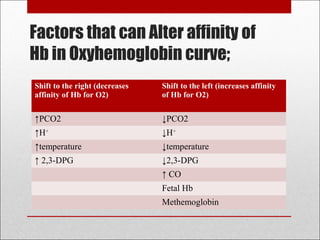
Factors that can Alter affinity of 
Hb in Oxyhemoglobin curve; 
Shift to the right (decreases 
affinity of Hb for O2) 
Shift to the left (increases affinity 
of Hb for O2) 
↑PCO2 ↓PCO2 
↑H+ ↓H+ 
↑temperature ↓temperature 
↑ 2,3-DPG ↓2,3-DPG 
↑ CO 
Fetal Hb 
Methemoglobin
pH compensation 
• The levels of HCO3 and CO2 always change to keep the 
pH within normal range.
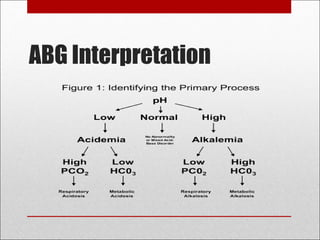
ABG Interpretation
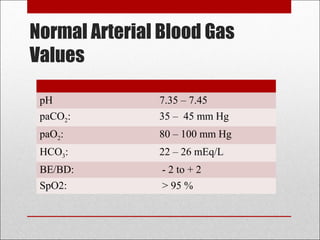
Normal Arterial Blood Gas 
Values 
pH 7.35 – 7.45 
paCO2: 35 – 45 mm Hg 
paO2: 80 – 100 mm Hg 
HCO3: 22 – 26 mEq/L 
BE/BD: - 2 to + 2 
SpO2: > 95 %
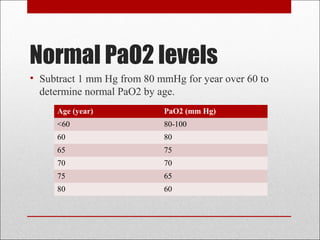
Normal PaO2 levels 
• Subtract 1 mm Hg from 80 mmHg for year over 60 to 
determine normal PaO2 by age. 
Age (year) PaO2 (mm Hg) 
<60 80-100 
60 80 
65 75 
70 70 
75 65 
80 60
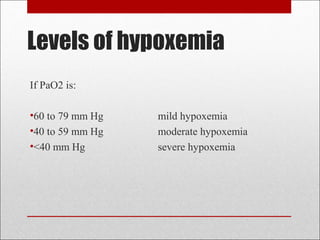
Levels of hypoxemia 
If PaO2 is: 
•60 to 79 mm Hg mild hypoxemia 
•40 to 59 mm Hg moderate hypoxemia 
•<40 mm Hg severe hypoxemia
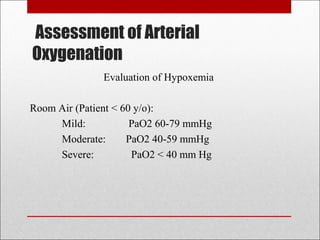
Assessment of Arterial 
Oxygenation 
Evaluation of Hypoxemia 
Room Air (Patient < 60 y/o): 
Mild: PaO2 60-79 mmHg 
Moderate: PaO2 40-59 mmHg 
Severe: PaO2 < 40 mm Hg
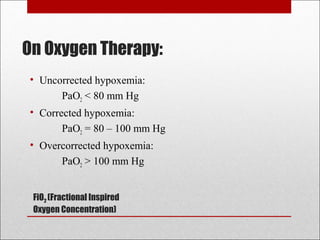
On Oxygen Therapy: 
• Uncorrected hypoxemia: 
PaO2 < 80 mm Hg 
• Corrected hypoxemia: 
PaO2 = 80 – 100 mm Hg 
• Overcorrected hypoxemia: 
PaO2 > 100 mm Hg 
FiO2 (Fractional Inspired 
Oxygen Concentration)
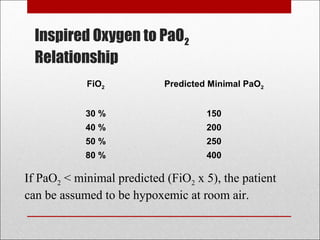
Inspired Oxygen to PaO2 
Relationship 
FiO2 Predicted Minimal PaO2 
30 % 150 
40 % 200 
50 % 250 
80 % 400 
If PaO2 < minimal predicted (FiO2 x 5), the patient 
can be assumed to be hypoxemic at room air.
Clinically Assess: 
• Cardiac status 
• Peripheral perfusion 
• Blood oxygen transport mechanism 
Assess 1 and 2 by the vital signs and PE. 
If 1 and 2 are adequate, then only 3 can be 
interfering with proper tissue oxygenation.
Indications for ABG 
• Sudden dyspnea 
• Cyanosis 
• Abnormal breath sounds 
• Sudden or unexplained tachypnea 
• Heavy use of accessory muscles 
• Change in ventilator setting 
• CPR 
• Diffuse infiltrates in c xray
Criteria for choosing site and 
Technique for obtaining ABG samples 
must be based on: 
• Safety 
• Accessibility 
• Patient Comfort
Site for ABG 
• Brachial Artery 
• Radial Artery 
• Dorsalis pedis 
• Femoral Artery
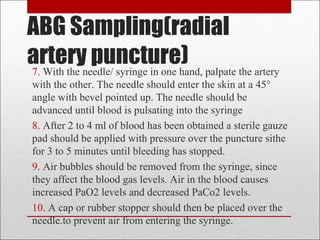
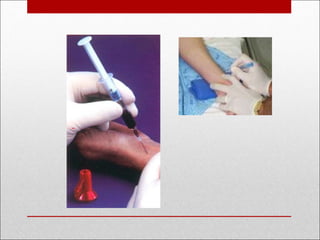
ABG Sampling(radial 
artery puncture) 
1. Explain the procedure to the patient 
2. Perform a modified allen’s test 
3. Place a folded towel under the patients wrist to keep the 
wrist hyperextended 
4. Clean the puncture site with isopropyl alcohol (70%) 
5. The practitioner must wear gloves for this procedure 
6. Aspirate 0.5ml of 1:1000 solution of heparin into the 
syringe using gauge needle. Pull the plunger of the 
syringe back and forth so that the entire portion of the 
syringe is exposed to the heparin
ABG Sampling(radial 
artery puncture) 7. With the needle/ syringe in one hand, palpate the artery 
with the other. The needle should enter the skin at a 45° 
angle with bevel pointed up. The needle should be 
advanced until blood is pulsating into the syringe 
8. After 2 to 4 ml of blood has been obtained a sterile gauze 
pad should be applied with pressure over the puncture sithe 
for 3 to 5 minutes until bleeding has stopped. 
9. Air bubbles should be removed from the syringe, since 
they affect the blood gas levels. Air in the blood causes 
increased PaO2 levels and decreased PaCo2 levels. 
10. A cap or rubber stopper should then be placed over the 
needle.to prevent air from entering the syringe.
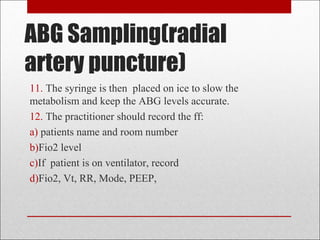
ABG Sampling(radial 
artery puncture) 
11. The syringe is then placed on ice to slow the 
metabolism and keep the ABG levels accurate. 
12. The practitioner should record the ff: 
a) patients name and room number 
b)Fio2 level 
c)If patient is on ventilator, record 
d)Fio2, Vt, RR, Mode, PEEP,
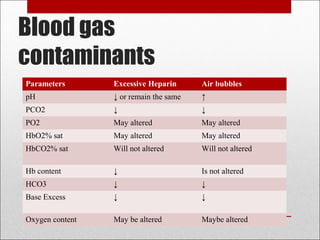
Blood gas 
contaminants 
Parameters Excessive Heparin Air bubbles 
pH ↓ or remain the same ↑ 
PCO2 ↓ ↓ 
PO2 May altered May altered 
HbO2% sat May altered May altered 
HbCO2% sat Will not altered Will not altered 
Hb content ↓ Is not altered 
HCO3 ↓ ↓ 
Base Excess ↓ ↓ 
Oxygen content May be altered Maybe altered
Blood gas 
contaminants 
*If insufficient heparin levels are used; 
• Machine clotting is very likely; 
• Results are questionable 
*Saline and other IV solutions alter blood gas values in a 
manner similar to that of heparin except that the pH may 
also increase.
Significant Problems 
• Arteriospasm 
• Air or clotted blood emboli 
• Anaphylaxis 
• Patient or sampler contamination 
• Hematoma 
• Hemorrhage 
• Trauma to the vessel 
• Arterial occlusion 
• Vasovagal response 
• Pain
Recommended Equipment for 
Percutaneous Arterial Blood 
Sampling 
• Standard precautions barrier protection (gloves, safety goggles) 
• Anticoagulant(liquid sodium, lithium heparin, or dry lyophilized 
heparin) 
• Sterile glass or low-diffusibility plastic syringe(1 to 5 mL) 
• Short-bevel 20 to 22-gauge needle with a clear hub(23 to 25 
gauge for children and infants) 
• Patient/sample label
• Isopropyl alcohol (70%) or providone-iodine (Betadine) 
swabs (check patients for iodine sensitivity) 
• Sterile gauze squares, tape, bandages 
• Puncture-resistant container 
• Ice slush (if specimen will not be analyzed within 15 
minutes) 
• Towels 
• Sharps container 
• Local anesthetic (0.5% lidocaine)* 
• Hypodermic needle(25 to 26 gauge) 
• Needle capping device
Blood gas analyzers 
I. Oxygen Analyzers 
• Analyzers that use the thermal conductiity of oxygen 
• Analyzers that use Pauling’s principle of paramagnetic 
susceptability of oxygen (Beckman D-2) 
• Analyzers operating on the polarographic principle 
(Clark electrode) 
• Analyzers using galvanic cell
Blood gas analyzers 
II. pH (Sanz) electrode 
III. PCO2 (Severinghaus Electrode) 
IV. Transcutaneous PO2 (TCPO2) and PCO” (TCPCO2) 
monitoring 
V. Spectrophotometric Analyzers
Blood gas analyzers 
Type of units commonly used Spectrophotometric analyzers 
are ; 
• pulse oximeters 
• CO oximeter 
• Flame Photometer 
• Capnography (end-tidal CO2 monitoring)
Blood gas analyzers 
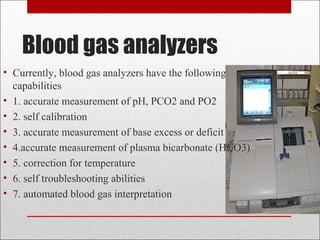
• Currently, blood gas analyzers have the following 
capabilities 
• 1. accurate measurement of pH, PCO2 and PO2 
• 2. self calibration 
• 3. accurate measurement of base excess or deficit 
• 4.accurate measurement of plasma bicarbonate (HCO3) 
• 5. correction for temperature 
• 6. self troubleshooting abilities 
• 7. automated blood gas interpretation
references • Egan’s fundamentals of respiratory care 9th edition, 
Mosby, 2009 
• The essentials of respiratory care third edition, 
kackmarek9
THE END…

RT ARTERIAL BLOOD GAS .ppt

  • 1.
  • 2.
    Objective I. ArterialOxygenation A. Hemoglobin B. Bohr and Haldane Effects C. Hemoglobin Dissociation Curve D. Physiology of Arterial Oxygenation E. Pathophysiologic Mechanisms of Hypoxemia F. Cardiopulmonary Compensation for Hypoxemia
  • 3.
    Objective II. ReferenceRanges and Interpretative Guidelines III. Clinical Approach to Interpretation IV. Hypoxemia and Oxygen Therapy V. Obtaining Blood Gas Sample VI. Blood Gas Analyzers VII. Quality Assurance in Blood Gas Analysis
  • 6.
    volume of oxygencarried attached to Hb vol% of O2 carried attached to Hb =(Hb content)(1.34)(HbO2% sat.) O2 content in vol% • = (PO2)(0.003) + (Hb content)(1.34)(HbO2% sat)
  • 7.
    Comparison bet. Bohr Effect and Haldane Effect Bohr Effect Haldane Effect The effect of CO2 on uptake and release of O2 from Hb molecule is relatively mild. The effect of O2 on uptake and release of CO2 from Hb molecule CO2 affecting the affinity of Hb for O2 O2 is affecting the affinity for Hb of CO2 CO2↑ as oxyhemoglobin saturation decreased carrying capacity of blood for CO2 is ↓ as oxyhemoglobin saturation increased
  • 8.
    Factors that canAlter affinity of Hb in Oxyhemoglobin curve; Shift to the right (decreases affinity of Hb for O2) Shift to the left (increases affinity of Hb for O2) ↑PCO2 ↓PCO2 ↑H+ ↓H+ ↑temperature ↓temperature ↑ 2,3-DPG ↓2,3-DPG ↑ CO Fetal Hb Methemoglobin
  • 9.
    pH compensation •The levels of HCO3 and CO2 always change to keep the pH within normal range.
  • 10.
  • 11.
    Normal Arterial BloodGas Values pH 7.35 – 7.45 paCO2: 35 – 45 mm Hg paO2: 80 – 100 mm Hg HCO3: 22 – 26 mEq/L BE/BD: - 2 to + 2 SpO2: > 95 %
  • 12.
    Normal PaO2 levels • Subtract 1 mm Hg from 80 mmHg for year over 60 to determine normal PaO2 by age. Age (year) PaO2 (mm Hg) <60 80-100 60 80 65 75 70 70 75 65 80 60
  • 13.
    Levels of hypoxemia If PaO2 is: •60 to 79 mm Hg mild hypoxemia •40 to 59 mm Hg moderate hypoxemia •<40 mm Hg severe hypoxemia
  • 14.
    Assessment of Arterial Oxygenation Evaluation of Hypoxemia Room Air (Patient < 60 y/o): Mild: PaO2 60-79 mmHg Moderate: PaO2 40-59 mmHg Severe: PaO2 < 40 mm Hg
  • 15.
    On Oxygen Therapy: • Uncorrected hypoxemia: PaO2 < 80 mm Hg • Corrected hypoxemia: PaO2 = 80 – 100 mm Hg • Overcorrected hypoxemia: PaO2 > 100 mm Hg FiO2 (Fractional Inspired Oxygen Concentration)
  • 16.
    Inspired Oxygen toPaO2 Relationship FiO2 Predicted Minimal PaO2 30 % 150 40 % 200 50 % 250 80 % 400 If PaO2 < minimal predicted (FiO2 x 5), the patient can be assumed to be hypoxemic at room air.
  • 17.
    Clinically Assess: •Cardiac status • Peripheral perfusion • Blood oxygen transport mechanism Assess 1 and 2 by the vital signs and PE. If 1 and 2 are adequate, then only 3 can be interfering with proper tissue oxygenation.
  • 18.
    Indications for ABG • Sudden dyspnea • Cyanosis • Abnormal breath sounds • Sudden or unexplained tachypnea • Heavy use of accessory muscles • Change in ventilator setting • CPR • Diffuse infiltrates in c xray
  • 19.
    Criteria for choosingsite and Technique for obtaining ABG samples must be based on: • Safety • Accessibility • Patient Comfort
  • 20.
    Site for ABG • Brachial Artery • Radial Artery • Dorsalis pedis • Femoral Artery
  • 21.
    ABG Sampling(radial arterypuncture) 1. Explain the procedure to the patient 2. Perform a modified allen’s test 3. Place a folded towel under the patients wrist to keep the wrist hyperextended 4. Clean the puncture site with isopropyl alcohol (70%) 5. The practitioner must wear gloves for this procedure 6. Aspirate 0.5ml of 1:1000 solution of heparin into the syringe using gauge needle. Pull the plunger of the syringe back and forth so that the entire portion of the syringe is exposed to the heparin
  • 22.
    ABG Sampling(radial arterypuncture) 7. With the needle/ syringe in one hand, palpate the artery with the other. The needle should enter the skin at a 45° angle with bevel pointed up. The needle should be advanced until blood is pulsating into the syringe 8. After 2 to 4 ml of blood has been obtained a sterile gauze pad should be applied with pressure over the puncture sithe for 3 to 5 minutes until bleeding has stopped. 9. Air bubbles should be removed from the syringe, since they affect the blood gas levels. Air in the blood causes increased PaO2 levels and decreased PaCo2 levels. 10. A cap or rubber stopper should then be placed over the needle.to prevent air from entering the syringe.
  • 23.
    ABG Sampling(radial arterypuncture) 11. The syringe is then placed on ice to slow the metabolism and keep the ABG levels accurate. 12. The practitioner should record the ff: a) patients name and room number b)Fio2 level c)If patient is on ventilator, record d)Fio2, Vt, RR, Mode, PEEP,
  • 25.
    Blood gas contaminants Parameters Excessive Heparin Air bubbles pH ↓ or remain the same ↑ PCO2 ↓ ↓ PO2 May altered May altered HbO2% sat May altered May altered HbCO2% sat Will not altered Will not altered Hb content ↓ Is not altered HCO3 ↓ ↓ Base Excess ↓ ↓ Oxygen content May be altered Maybe altered
  • 26.
    Blood gas contaminants *If insufficient heparin levels are used; • Machine clotting is very likely; • Results are questionable *Saline and other IV solutions alter blood gas values in a manner similar to that of heparin except that the pH may also increase.
  • 27.
    Significant Problems •Arteriospasm • Air or clotted blood emboli • Anaphylaxis • Patient or sampler contamination • Hematoma • Hemorrhage • Trauma to the vessel • Arterial occlusion • Vasovagal response • Pain
  • 29.
    Recommended Equipment for Percutaneous Arterial Blood Sampling • Standard precautions barrier protection (gloves, safety goggles) • Anticoagulant(liquid sodium, lithium heparin, or dry lyophilized heparin) • Sterile glass or low-diffusibility plastic syringe(1 to 5 mL) • Short-bevel 20 to 22-gauge needle with a clear hub(23 to 25 gauge for children and infants) • Patient/sample label
  • 30.
    • Isopropyl alcohol(70%) or providone-iodine (Betadine) swabs (check patients for iodine sensitivity) • Sterile gauze squares, tape, bandages • Puncture-resistant container • Ice slush (if specimen will not be analyzed within 15 minutes) • Towels • Sharps container • Local anesthetic (0.5% lidocaine)* • Hypodermic needle(25 to 26 gauge) • Needle capping device
  • 31.
    Blood gas analyzers I. Oxygen Analyzers • Analyzers that use the thermal conductiity of oxygen • Analyzers that use Pauling’s principle of paramagnetic susceptability of oxygen (Beckman D-2) • Analyzers operating on the polarographic principle (Clark electrode) • Analyzers using galvanic cell
  • 32.
    Blood gas analyzers II. pH (Sanz) electrode III. PCO2 (Severinghaus Electrode) IV. Transcutaneous PO2 (TCPO2) and PCO” (TCPCO2) monitoring V. Spectrophotometric Analyzers
  • 33.
    Blood gas analyzers Type of units commonly used Spectrophotometric analyzers are ; • pulse oximeters • CO oximeter • Flame Photometer • Capnography (end-tidal CO2 monitoring)
  • 34.
    Blood gas analyzers • Currently, blood gas analyzers have the following capabilities • 1. accurate measurement of pH, PCO2 and PO2 • 2. self calibration • 3. accurate measurement of base excess or deficit • 4.accurate measurement of plasma bicarbonate (HCO3) • 5. correction for temperature • 6. self troubleshooting abilities • 7. automated blood gas interpretation
  • 35.
    references • Egan’sfundamentals of respiratory care 9th edition, Mosby, 2009 • The essentials of respiratory care third edition, kackmarek9
  • 36.