Introduction:
• A pHmeter is an electronic instrument used
for measuring the pH (acidity or alkalinity) of
a liquid (though special probes are
sometimes used to measure the pH of semi-
solid substances).
• The first commercial pH meter was built
around 1936 by Radiometer in
Denmark and by Arnold Orville
Beckman in the United States
3.
Principle:
pH is definedas the negative logarithm of hydrogen
ion concentration.
pH= - log [ H+ ]
p = power
H = hydrogen
[H+ ] = hydrogen ion concentration
• The pH scale corresponds to the concentration of
hydrogen ions.
• For example pure water H+ ion concentration is
1 x 10⁻⁷ M, therefore the pH would be 7.
• The pH of a solution can be measured by the pH
meter.
4.
pH value
• pHis a unit of measure which describes
the degree of acidity or alkalinity (basic) of
a solution.
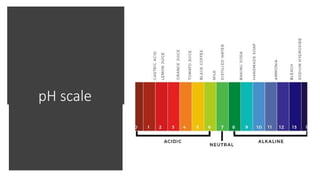
• It is measured on a scale of 0 to 14.
• The pH value of a substance is directly related
to the ratio of the hydrogen ion and hydroxyl
ion concentrations.
• If the H+ concentration is higher than OH-
the material is acidic.
• If the OH- concentration is higher than H+
the material is basic.
• 7 is neutral, <7 is acidic, >7 is basic
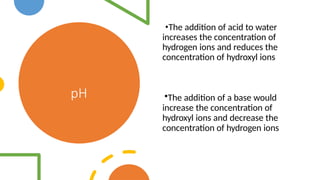
pH
•The addition ofacid to water
increases the concentration of
hydrogen ions and reduces the
concentration of hydroxyl ions
•The addition of a base would
increase the concentration of
hydroxyl ions and decrease the
concentration of hydrogen ions
7.
Acids and
Bases
• Anacid can be defined as a proton donor, a
chemical that increases the concentration of
hydrogen ions in solution
• A base can be defined as a proton acceptor,
a chemical that reduces the concentration
of hydrogen ions in solution.
8.
pH measurement
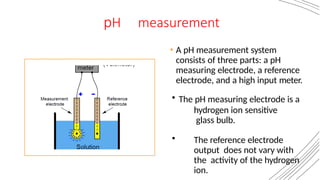
• ApH measurement system
consists of three parts: a pH
measuring electrode, a reference
electrode, and a high input meter.
• The pH measuring electrode is a
hydrogen ion sensitive
glass bulb.
• The reference electrode
output does not vary with
the activity of the hydrogen
ion.
9.
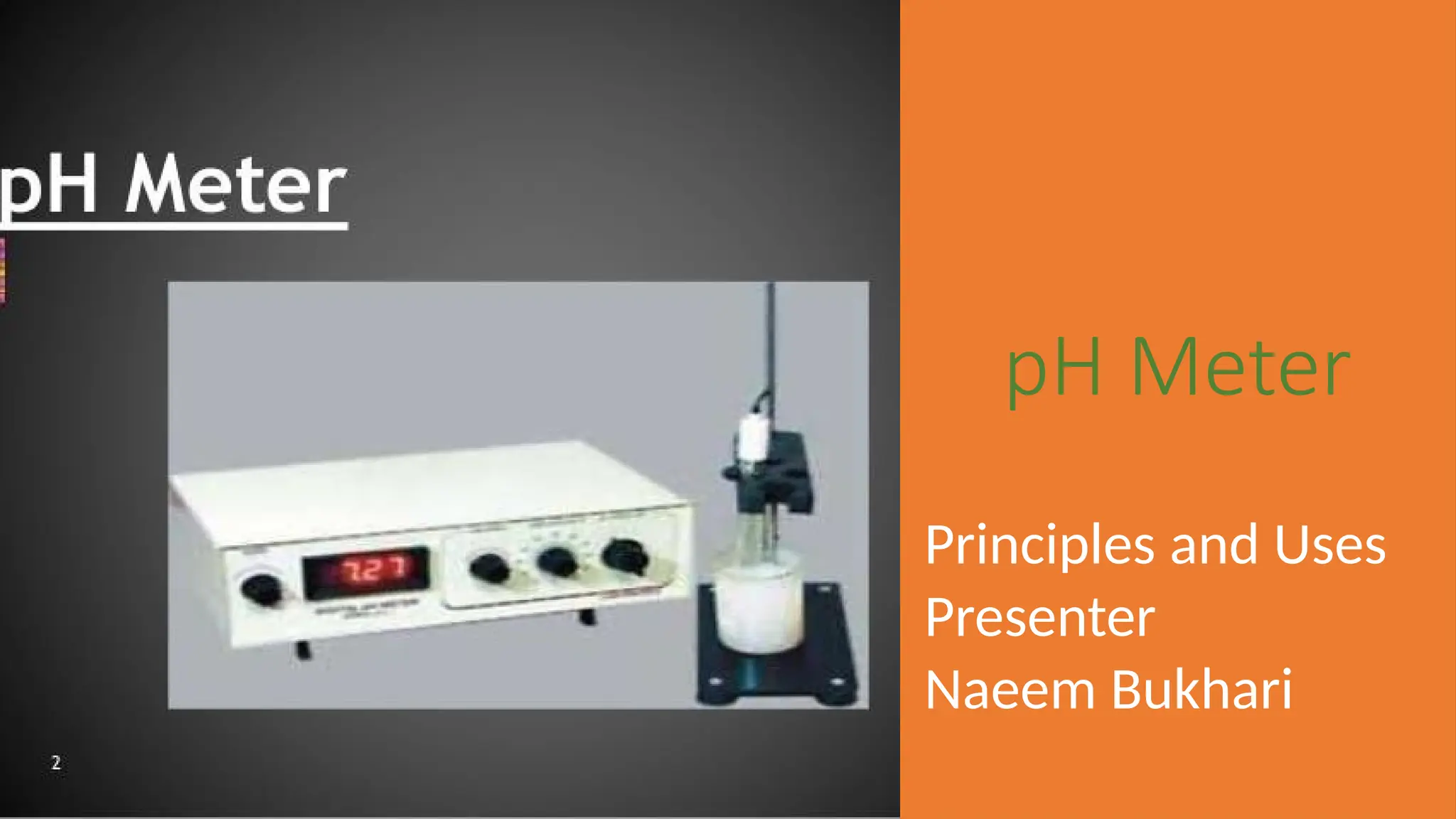
pH Meter
• Asample is placed in a cup and the
glass probe at the end of the
retractable arm is placed in it.
• The probe is connected to the
main
box.
• There are two electrodes inside
the
probe that measure voltage.
• One is contained in liquid with
fixed
pH.
• The other measures the acidity of
the sample through the amount of
10.
pH Meter
• Avoltmeter in the probe measures
the difference between the
voltages of the two electrodes.
• The meter then translates the
voltage difference into pH and
displays it on the screen.
• Before taking a pH measurement
the meter must be calibrated
using a solution of known pH.
11.
• Temperature compensationis
contained within the instrument
because pH electrodes are
temperature sensitive.
• Temperature compensation only
corrects for the change in the
output of the electrode, not for
the change in the actual solution.
• Buffers are solutions that have
constant pH values and the
ability to resist changes in pH.
• They are used to calibrate the pH
meter.
Temperatur
e and
Buffers
Measuremen
t of pH
•The zero of the dial is set mechanically.
• The knob for temperature compensation is
fixed for the temperature of the solution.
• The electrodes are dipped into a standard
buffer solution of known pH.
• Adjustment is made so that the dial reads
the value of the buffer solution.
• The electrodes are removed and
washed well with distilled water.
• The electrodes are dipped into the sample
solutions.
• The dial shows the pH value of the sample
solution.
14.
Applications
of pH
meter
• Forthe diagnosis of various disorders in
human body
• Agriculture
• Brewing
• Corrosion Prevention
• Dyeing
• Jam and Jelly Manufacturing
• Printing
• Pharmaceuticals

![Principle:
pH is defined as the negative logarithm of hydrogen
ion concentration.
pH= - log [ H+ ]
p = power
H = hydrogen
[H+ ] = hydrogen ion concentration
• The pH scale corresponds to the concentration of
hydrogen ions.
• For example pure water H+ ion concentration is
1 x 10⁻⁷ M, therefore the pH would be 7.
• The pH of a solution can be measured by the pH
meter.](https://image.slidesharecdn.com/phmeter1-250419105913-9ad6d294/85/PH-Meter-1-pptx-PH-Meter-1-pptx-PH-Meter-1-pptx-3-320.jpg)