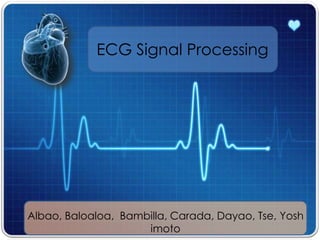
ECG Signal Processing
Albao, Baloaloa, Bambilla, Carada, Dayao, Tse, Yosh
imoto
Introduction
What is Electrocardiogram?
• diagnostic tool that graphically
measures and records the
electrical activity of the heart
in detail.
How does it differ from EKG?
• Derived from the German word
Elektrokardiogramma
• First invented in the early 1900s
• used in the extraction of vital
characteristic parameters.
How signal processing important in ECG?
• When an electrical potential is
generated in a section of the
heart, an electrical current is
conducted to the body
surface in a specific area.
How ECG operates?
1. P wave
2. QRS Complex
3. T wave
Three pulses that completes the ECG wave
Matlab Functionality in ECG
• Fast Fourier Transform (FFTs)
- detection of R-peaks.
• Filter
- extraction of relevant signal.
• Stem graphs
Different types of Artefacts
1. Power line interference
2. motion artefacts
3. base line drift
4 instrumental noise
The major sources of noise
1. Power line interference
2. Muscle contractions
3. Electrode contact noise
4. Motion Artifacts
5. Baseline wandering
6. Noise generated by electronic devices
used in signal processing circuits
7. Electrical interference external to the
subject and recording system
8. High-frequency noises in the ECG
9. Breath, lung, or bowel sounds
contaminating the heart sounds (PCG).
Objectives of the Study:
1. To explore ECG signal processing and
procedure
2. To be able to perform R-peak detection of
ECG signals through the use of MATLAB
3. To be able to perform filtering of
interference in ECG signals using narrow
band and notch filters using MATLAB
Methods of Research:
1. Fast Fourier Transform (FFTs)
2. Filter
3. Stem Graphs
Interference Filtering
- Same method in MATLAB
Scope and Limitations of the Study:
1. limited to the processing of the ECG signal
by R-peak detection.
2. Processing of other points is an ECG signal is
beyond the scope of this study.
3. This study focuses on using band and notch
filters.
4. Processes involving interpretation of ECG
signals is beyond the objectives of this
study.
The ECG
Review of Related Literature
1.
http://www.sciencedirect.com/science/article/pii/S10512004050
01703#
2.
http://www.sciencedirect.com/science/article/pii/S0010482509000195
3. www.intechopen.com/download/pdf/27022
4. diec.cps.unizar.es/~laguna/personal/publicaciones/libroWiley.pdf
1950s
 accomplish electrical stimulated heart
signals
by placing electrodes in and around the
heart muscle.
How ECG works.
 An ECG signal is due to ionic current flow
causing the cardiac fibers to contract
and relax, subsequently, generating a
time variant periodic signal
 the potential difference between two
electrodes placed on the skin surface is
considered as an input to the ECG
plotter
Scope for improvement
 susceptibility to noise
 lack of universal connectivity
 off-line processing
Solution (Prototype)
 includes an analog system and a FM
transceiver pair interfaced through
sound port of the computer
 viewed and filtered using MATLAB
software
 captures the bio-signal faithfully in real
time wireless mode with minimum noise
and has universal connectivity
The signal processing algorithms
(denoising)
 provide optimal performance
 eliminate the high frequency noise
However:
 attenuate the peaks of characteristics
wave of the ECG signal.
Mother Wavelet
 applied for denoising of the ECG signal
 retains the signal peaks close to their full
amplitude
Wavelet Theory
 signal compression
 feature extraction
 small extent in denoising
Noise Solutions
Wavelet Based Processing (advantages)
 coefficient compaction
 dilution of noise
 removal of redundancy
Mother Wavelet Filter
 lead maximization of coefficient values
 best characterization of frequency
content
Wavelet Thresholding
 small wavelet coefficient to zero
 retaining or shrinking the coefficients
corresponding to desired signal
 assume that small coefficients are due to
noise and can be set to zero
 signal is stored in a few large coefficients
Computer based wireless system for online
acquisition, monitoring and digital
processing of ECG waveforms
 front- end amplifier
 wireless transceiver
 interface with output display de- vice
 digital filters for noise removal
ECG signals originate largely from:
 Artefacts
 i.e. muscle generated electric signals
 Actual ECG generator
ECG Signal Processing aims
 artefact reduction
 ECG signals cleaner
 better interpretable
 at revealing aspects not immediately
observable
 at diagnostics decision support and
automated ECG signal interpretation
Noise Sources
 50Hz (in India) power line interference
 low frequency baseline (0.5Hz)
 Disturbances due to electronic
components
Application of DSP in biomedical
engineering
 Filters
o FIR
o IIR
o ZPBPF
Body surface ECG signal processing aims
at enhancing ECG based diagnostics
Independent component analysis (ICA)
 All signals are assumed to be sampled
at the same time instances
 realized by an iterative numerical
algorithm, several of which exist.
Use of Filters
 removes baseline wander and power
line interference
 Removal of noise
Filtering techniques
 used for pre-processing of the signal
NOTE:
 filtering of the ECG is contextual
 should be performed only when the
desired information remains undistorted
Methodology
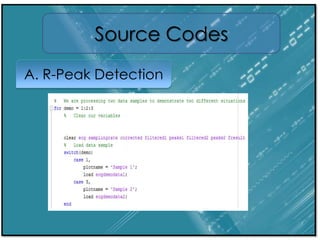
A. R-Peak Detection
B. Notch Filter Design for
Power Line Interference
A. R-Peak Detection
Problems suitable for R-Peak Detection:
irregular distance between peaks
irregular peak form
presence of low-frequency
component in ECG
 stages should be placed after the
input ECG signal to process it and
reduce the influence of such factors.
Having a Digital Signal:
input ECG signal is uneven
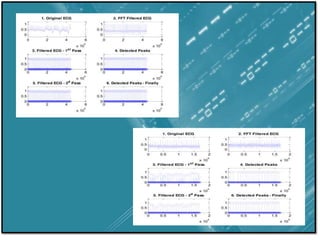
 1st Step: Straightening.
Using FFT and inverse FFT
 2nd Step: Find local maxima.
Using Windowed Filter
 3rd Step: Removal of Small Values.
 4th Step: Filter for the second time.
all the peaks have been obtained
 5th Step: Get the peaks of the wave.
B. Notch Filter Design for
Power Line Interference
Problems suitable for notch filter design:
Power line interference
Baseline wander
Common mode noise
High frequency noise
Low Level of Distortion
Narrow suspension band of the Notch Filter
Preserve the Pulse like form signal
notch filter should have a linear phase frequency
response
A Zolotarev polynomial
STEPS
 1st Step:
Calculate the Jacobi elliptic modulus k for the
auxiliary values phi1 and phi2
 2nd Step:
Calculate the rational values p=n and q=n
 3rd Step:
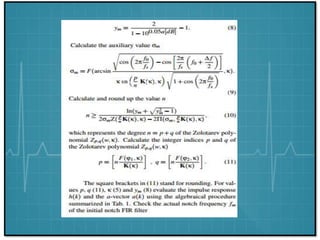
Determine the maximizer ym
OVERVIEW:
(7)- The incomplete elliptic integral
(9)- evaluated by the arithmetic-geometric mean [10].
Elliptic integral of the third kind P(x;y;k) in (10)
-evaluated by a fast procedure proposed in [7]
NOTE:
 no tool for the algebraic design of optimal
notch FIR filters
form of a Matlab function firnotch in Tab. 3
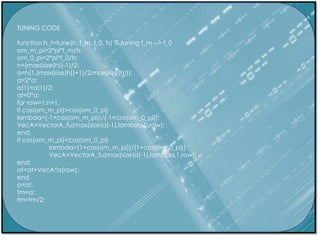
Purpose of tuning
 adjust the actual notch frequency (fm to f0)
simplified version of the procedure introduced in [8]
Function Tune accepts:
 impulse response h(k)
 notch frequency fm[Hz] (initial filter)
 desired notch frequency f0[Hz]
 sampling frequency fs[Hz]
Function Tune returns:
impulse response ht(k) (tuned filter)
NOTE:
Butterworth filters can also be used
however not efficient and matlab
can’t provide the codes for this
filter.
CONCLUSION
R-peak filters:
High pass filter
Straighten the signal
Remove the low frequencies
 Fast fourier transform
 Inverse fast fourier transform
Windowed filter
Maximum value in each window
Threshold filter
Discard the small values present in the
output of the windowed filter.
Notch Filter Design for Power
Line Interference
suitable for signals with too much
noise.
Undistorted signal
- narrow suspension band
 Preserve the pulse like wave
- linear frequency response
Advantages of this method:
Speed
Robustness
 Why Butterworth Filter not practical
 Efficiency
 Coding
Source Codes
A. R-Peak Detection
B. Notch Filter Design for
Power Line Interference
function [n, h, f_m, adB_pass, adB_m]=firnotch(f_0, delta_f, fs, adB) %
Design
om_0_pi=2*pi*f_0/fs;
delom=2*pi*delta_f/fs;
om_0=om_0_pi/pi;
ym_s=-1+2/(1-10ˆ(0.05*adB));
omp=om_0_pi-delom/2; oms=om_0_pi+delom/2;
ws=cos(oms);
wp=cos(omp);
w_0=cos(om_0_pi);
fip=(pi-omp)/2;
fis=oms/2;
const=1/(tan(fis)*tan(fip));
k=sqrt(1-const*const);
quar=ellipke(k*k);
Ffis=ielli_fu(fis,k);
Ffip=ielli_fu(fip,k);
pn=Ffis/quar;
qn=Ffip/quar;
if fip==fis pn=0.5;
qn=0.5;
end
n=degreez_fu(ym_s,pn,k,w_0,ws);
n=ceil(n);
p=round(pn*n);
q=round(qn*n);
[alph,wm]=zol_fu(p,q,k);
tm=alph;
tm=tm/2;
tm(1)=2*tm(1);
tp=fliplr(tm);
hn=[tp(1,1:max(size(tp))-1) tm];
om_m_pi=acos(wm);
om_m=om_m_pi/pi;
mazer=mag_fu(hn,[om_m_pi]);
if mazer<ym_s n=n+1;
p=round(pn*n);
q=round(qn*n);
[alph,wm]=zol_fu(p,q,k);
tm=alph;
tm=tm/2;
tm(1)=2*tm(1);
tp=fliplr(tm);
hn=[tp(1,1:max(size(tp))-1) tm];
om_m_pi=acos(wm);
om_m=om_m_pi/pi;
mazer=mag_fu(hn,[om_m_pi]);
end;
adB_pass=20*log10(1-2/(mazer+1));
tm=alph;
tm=tm/2;
tm(1)=2*tm(1);
tp=fliplr(tm);
hn=[tp(1,1:max(size(tp))-1) tm];
hn=-hn;
hn(1,1+floor(max(size(hn))/2))=mazer+hn(1,1+floor(max(size(hn))/2));
hn=hn/(1+mazer);
adB_m=20*log10(abs((mag_fu(hn,[om_m_pi]))));
f_m=om_m*fs/2;
h=hn; function y=Jacobi_Zeta_AGM_fu(u,k) % Jacobi Zeta function using AGM
sma=1e-12;
kc=sqrt(1-k*k);
a(1)=1;
b(1)=kc;
c(1)=k;
n=1;
while(c(n)>sma) n=n+1;
a(n)=0.5*(a(n-1)+b(n-1));
b(n)=sqrt(a(n-1)*b(n-1));
c(n)=0.5*(a(n-1)-b(n-1));
end;
fi(n)=(2ˆ(n-1))*a(n)*u; y=0;
for m = n:-1:2 cor=c(m)/a(m)*sin(fi(m));
fi(m-1)=0.5*(fi(m)+asin(cor));
y=y+c(m)*sin(fi(m));
end
function y=ielli_fu(fi,k) % Incomplete Elliptic Integral of the First Kind using AGM
delta=1e-16;
kc=sqrt(1-k*k);
a0=1;
b0=kc;
c0=k;
fi0=fi;
akm1=a0;
bkm1=b0;
ckm1=c0;
km1=1;
fikm1=fi0;
n=0;
while(ckm1>delta) n=n+1;
ak=(akm1+bkm1)/2;
bk=sqrt(akm1*bkm1);
ck=(akm1-bkm1)/2;
el=floor((1+2*fikm1/pi)/2);
fik=fikm1+atan2(bkm1*tan(fikm1),akm1)+el*pi;
fikm1=fik;
akm1=ak;
bkm1=bk;
ckm1=ck;
end;
y=fik/(ak*2ˆn);
function y=ielli_fu(fi,k) % Incomplete Elliptic Integral of the First Kind using AGM
delta=1e-16;
kc=sqrt(1-k*k);
a0=1;
b0=kc;
c0=k;
fi0=fi;
akm1=a0;
bkm1=b0;
ckm1=c0;
km1=1;
fikm1=fi0;
n=0;
while(ckm1>delta) n=n+1;
ak=(akm1+bkm1)/2;
bk=sqrt(akm1*bkm1);
ck=(akm1-bkm1)/2;
el=floor((1+2*fikm1/pi)/2);
fik=fikm1+atan2(bkm1*tan(fikm1),akm1)+el*pi;
fikm1=fik;
akm1=ak;
bkm1=bk;
ckm1=ck;
end;
y=fik/(ak*2ˆn);
function y=ellipi_fu(u,n,k) % Jacobi elliptic integral of third kind PI
quarter=ellipke(k*k);
si=ellipj(u,k*k);
s=ellipj((1:n)*quarter/n,k*k);
su=ellipj((1:n)*quarter/n+u,k*k);
sup=ellipj((1:n)*quarter/n-u,k*k);
v=u*k*k*s(1)*s(n-(1:n-1)).*s(n+1-(1:n-1));
num=1-k*k*s(1)*si*s(n-(1:n-1)).*sup(n+1-(1:n-1));
den=1+k*k*s(1)*si*s(n-(1:n-1)).*su(n+1-(1:n-1));
r=log(num./den)/2 + v;
a=diag(n-1:-1:1)*ones(n-1);
b=ones(n-1)-tril(ones(n-1));
y=flipud(1/n*(a-n*b)*r’);
function y=degreez_fu(ym,pn,k,wm,ws) % Degree of Zolotarev polynomial
cit=sqrt((wm-ws)/(wm+1));
quar=ellipke(k*k);
[sn,cn,dn]=ellipj(pn*quar,k*k);
jme=k*sn;
argu=asin(cit/jme);
sigmam=ielli_fu(argu,k);
pe=round(pn*1000);
eli3=ellipi_fu(sigmam,1000,k)’;
Pii=eli3(pe);
cit=log(ym+sqrt(ym*ym-1));
jme=2*sigmam*Jacobi_Zeta_AGM_fu(pn*quar,k)-2*Pii;
y=cit/jme;
function [a,wm]=zol_fu(p,q,km) % Zolotarev polynomial
n=p+q;
quarter=ellipke(km*km);
up=p*quarter/n;
[sn,cn,dn]=ellipj(up,km*km);
wp=2*(cn./dn)ˆ2-1;
ws=2*cnˆ2-1;
wm=ws+2*sn*cn/dn*Jacobi_Zeta_AGM_fu(up,km);
wq=(wp+ws)/2;
alfa=zeros(1,n+6);
alfa(n+1)=1;
for m=n+2:-1:3
c7=(n*n-(m-3)*(m-3))/8;
c6=((2*m-5)*(m-2)*(wm-wq)+3*wm*(n*n-(m-2)*(m- 2)))/4;
c5=3/8*(n*n-(m-1)*(m-1))+3/2*wm*(n*n*wm-(m-1)*(m- 1)*wq)-1/2*(m-
1)*(m-2)*(wp*ws-wm*wq);
c4=3/2*(n*n-m*m)*wm+m*m*(wm-wq)+wm*(n*n*wm*wm- m*m*wp*ws);
c3=3/8*(n*n-(m+1)*(m+1))+3/2*wm*(n*n*wm- (m+1)*(m+1)*wq)-
1/2*(m+1)*(m+2)*(wp*ws-wm*wq);
c2=((2*m+5)*(m+2)*(wm-wq)+3*wm*(n*n- (m+2)*(m+2)))/4; c1=(n*n-
(m+3)*(m+3))/8;
alfa(m-2)=(c6*alfa(m-1)-c5*alfa(m)+c4*alfa(m+1)- c3*alfa(m+2)+c2*alfa(m+3)-
c1*alfa(m+4))/c7;
end
alfa=[alfa(1)/2, alfa(2:n+1)];
suma=alfa(1);
for m=1:n
suma=suma+alfa(m+1);
end;
a=(-1)ˆp*alfa/suma;
function y=mag_fu(hn,om) % Magnitude of odd length FIR filter
nn=(max(size(hn))-1)/2;
y = hn(1+nn)*ones(max(size(om)),1);
for m=1:nn
y = y + 2*hn(nn+m+1)*cos(m*om);
end
TUNING CODE
function h_t=tune(h, f_m, f_0, fs) % tuning f_m --> f_0
om_m_pi=2*pi*f_m/fs;
om_0_pi=2*pi*f_0/fs;
n=(max(size(h))-1)/2;
a=h(1,(max(size(h))+1)/2:max(size(h)));
a=2*a;
a(1)=a(1)/2;
at=0*a;
for row=1:n+1,
if cos(om_m_pi)>cos(om_0_pi)
lambda=(-1+cos(om_m_pi))/(-1+cos(om_0_pi));
VecA=VectorA_fu(max(size(a)-1),lambda,0,row);
end;
if cos(om_m_pi)<cos(om_0_pi)
lambda=(1+cos(om_m_pi))/(1+cos(om_0_pi));
VecA=VectorA_fu(max(size(a)-1),lambda,1,row);
end;
at=at+VecA*a(row);
end
a=at;
tm=a;
tm=tm/2;
tm(1)=2*tm(1);
tp=fliplr(tm);
h_t=[tp(1,1:max(size(tp))-1) tm];
function A_row=VectorA_fu(n,lambda,dir,row)
A_row=zeros(1,n+1);
if dir == 0 A_row(1:row)=tposun_fu(row-1,lambda, 1-lambda,-1);
elseif dir == 1 A_row(1:row)=tposun_fu(row-1,lambda, 1-lambda,1);
else A_row(1:row)=tposun_fu(row-1,1, 0, 1);
size(A_row);
end
function A=MatrixA_fu(n,lambda,dir)
for i=1:n+1
row=zeros(1,n+1);
A(i,:)=row;
end
if dir == 0 for i=1:n+1, aplus=tposun_fu(i-1,lambda, 1-lambda,-1);
A(i,1:i)=aplus;
end
elseif dir == 1 for i=1:n+1, aminus=tposun_fu(i-1,lambda,1-lambda,1);
A(i,1:i)=aminus;
end
else for i=1:n+1, aminus=tposun_fu(i-1,1,0,1);
A(i,1:i)=aminus;
end
end
function alfa=tposun_fu(n,lambda,lambdac,s)
if n==0, alfa(1)=1;
else alfa=zeros(1,n+4);
alfa(n+1)=lambdaˆn;
for k=1:1:n d1=k*(2*n-k);
d2=2*s*((k-1)*(2*n+1-k)-lambdac/lambda*(n+1-k)*(2*n+1-2*k));
d3=4*lambdac/lambda*(n+2-k);
d4=-2*s*((k-3)*(2*n+3-k)-lambdac/lambda*(n+3-k)*(2*n+7-2*k));
d5=(k-4)*(2*n+4-k);
alfa(n+1-k)=(alfa(n+2-k)*d2+alfa(n+3-k)*d3+alfa(n+4-k)*d4+alfa(n+5-k)*d5)/d1;
end
alfa=[alfa(1)/2 alfa(2:n+1)];
end
Ecg Signal Processing

Ecg Signal Processing

  • 1.
    ECG Signal Processing Albao,Baloaloa, Bambilla, Carada, Dayao, Tse, Yosh imoto
  • 2.
    Introduction What is Electrocardiogram? •diagnostic tool that graphically measures and records the electrical activity of the heart in detail. How does it differ from EKG? • Derived from the German word Elektrokardiogramma • First invented in the early 1900s
  • 3.
    • used inthe extraction of vital characteristic parameters. How signal processing important in ECG? • When an electrical potential is generated in a section of the heart, an electrical current is conducted to the body surface in a specific area. How ECG operates? 1. P wave 2. QRS Complex 3. T wave Three pulses that completes the ECG wave
  • 4.
    Matlab Functionality inECG • Fast Fourier Transform (FFTs) - detection of R-peaks. • Filter - extraction of relevant signal. • Stem graphs Different types of Artefacts 1. Power line interference 2. motion artefacts 3. base line drift 4 instrumental noise
  • 5.
    The major sourcesof noise 1. Power line interference 2. Muscle contractions 3. Electrode contact noise 4. Motion Artifacts 5. Baseline wandering 6. Noise generated by electronic devices used in signal processing circuits 7. Electrical interference external to the subject and recording system 8. High-frequency noises in the ECG 9. Breath, lung, or bowel sounds contaminating the heart sounds (PCG).
  • 6.
    Objectives of theStudy: 1. To explore ECG signal processing and procedure 2. To be able to perform R-peak detection of ECG signals through the use of MATLAB 3. To be able to perform filtering of interference in ECG signals using narrow band and notch filters using MATLAB
  • 7.
    Methods of Research: 1.Fast Fourier Transform (FFTs) 2. Filter 3. Stem Graphs Interference Filtering - Same method in MATLAB
  • 8.
    Scope and Limitationsof the Study: 1. limited to the processing of the ECG signal by R-peak detection. 2. Processing of other points is an ECG signal is beyond the scope of this study. 3. This study focuses on using band and notch filters. 4. Processes involving interpretation of ECG signals is beyond the objectives of this study.
  • 9.
  • 10.
    Review of RelatedLiterature 1. http://www.sciencedirect.com/science/article/pii/S10512004050 01703# 2. http://www.sciencedirect.com/science/article/pii/S0010482509000195 3. www.intechopen.com/download/pdf/27022 4. diec.cps.unizar.es/~laguna/personal/publicaciones/libroWiley.pdf
  • 11.
    1950s  accomplish electricalstimulated heart signals by placing electrodes in and around the heart muscle. How ECG works.  An ECG signal is due to ionic current flow causing the cardiac fibers to contract and relax, subsequently, generating a time variant periodic signal  the potential difference between two electrodes placed on the skin surface is considered as an input to the ECG plotter
  • 12.
    Scope for improvement susceptibility to noise  lack of universal connectivity  off-line processing Solution (Prototype)  includes an analog system and a FM transceiver pair interfaced through sound port of the computer  viewed and filtered using MATLAB software  captures the bio-signal faithfully in real time wireless mode with minimum noise and has universal connectivity
  • 13.
    The signal processingalgorithms (denoising)  provide optimal performance  eliminate the high frequency noise However:  attenuate the peaks of characteristics wave of the ECG signal.
  • 14.
    Mother Wavelet  appliedfor denoising of the ECG signal  retains the signal peaks close to their full amplitude Wavelet Theory  signal compression  feature extraction  small extent in denoising Noise Solutions
  • 15.
    Wavelet Based Processing(advantages)  coefficient compaction  dilution of noise  removal of redundancy Mother Wavelet Filter  lead maximization of coefficient values  best characterization of frequency content Wavelet Thresholding  small wavelet coefficient to zero  retaining or shrinking the coefficients corresponding to desired signal
  • 16.
     assume thatsmall coefficients are due to noise and can be set to zero  signal is stored in a few large coefficients Computer based wireless system for online acquisition, monitoring and digital processing of ECG waveforms  front- end amplifier  wireless transceiver  interface with output display de- vice  digital filters for noise removal
  • 17.
    ECG signals originatelargely from:  Artefacts  i.e. muscle generated electric signals  Actual ECG generator ECG Signal Processing aims  artefact reduction  ECG signals cleaner  better interpretable  at revealing aspects not immediately observable  at diagnostics decision support and automated ECG signal interpretation
  • 18.
    Noise Sources  50Hz(in India) power line interference  low frequency baseline (0.5Hz)  Disturbances due to electronic components Application of DSP in biomedical engineering  Filters o FIR o IIR o ZPBPF
  • 19.
    Body surface ECGsignal processing aims at enhancing ECG based diagnostics Independent component analysis (ICA)  All signals are assumed to be sampled at the same time instances  realized by an iterative numerical algorithm, several of which exist. Use of Filters  removes baseline wander and power line interference  Removal of noise
  • 20.
    Filtering techniques  usedfor pre-processing of the signal NOTE:  filtering of the ECG is contextual  should be performed only when the desired information remains undistorted
  • 21.
    Methodology A. R-Peak Detection B.Notch Filter Design for Power Line Interference
  • 22.
    A. R-Peak Detection Problemssuitable for R-Peak Detection: irregular distance between peaks irregular peak form presence of low-frequency component in ECG  stages should be placed after the input ECG signal to process it and reduce the influence of such factors.
  • 23.
    Having a DigitalSignal: input ECG signal is uneven  1st Step: Straightening. Using FFT and inverse FFT
  • 24.
     2nd Step:Find local maxima. Using Windowed Filter  3rd Step: Removal of Small Values.
  • 25.
     4th Step:Filter for the second time. all the peaks have been obtained  5th Step: Get the peaks of the wave.
  • 26.
    B. Notch FilterDesign for Power Line Interference Problems suitable for notch filter design: Power line interference Baseline wander Common mode noise High frequency noise
  • 27.
    Low Level ofDistortion Narrow suspension band of the Notch Filter Preserve the Pulse like form signal notch filter should have a linear phase frequency response A Zolotarev polynomial
  • 28.
    STEPS  1st Step: Calculatethe Jacobi elliptic modulus k for the auxiliary values phi1 and phi2  2nd Step: Calculate the rational values p=n and q=n
  • 30.
     3rd Step: Determinethe maximizer ym OVERVIEW: (7)- The incomplete elliptic integral (9)- evaluated by the arithmetic-geometric mean [10]. Elliptic integral of the third kind P(x;y;k) in (10) -evaluated by a fast procedure proposed in [7]
  • 31.
    NOTE:  no toolfor the algebraic design of optimal notch FIR filters form of a Matlab function firnotch in Tab. 3 Purpose of tuning  adjust the actual notch frequency (fm to f0) simplified version of the procedure introduced in [8] Function Tune accepts:  impulse response h(k)  notch frequency fm[Hz] (initial filter)  desired notch frequency f0[Hz]  sampling frequency fs[Hz]
  • 32.
    Function Tune returns: impulseresponse ht(k) (tuned filter) NOTE: Butterworth filters can also be used however not efficient and matlab can’t provide the codes for this filter.
  • 33.
    CONCLUSION R-peak filters: High passfilter Straighten the signal Remove the low frequencies  Fast fourier transform  Inverse fast fourier transform Windowed filter Maximum value in each window Threshold filter Discard the small values present in the output of the windowed filter.
  • 34.
    Notch Filter Designfor Power Line Interference suitable for signals with too much noise. Undistorted signal - narrow suspension band  Preserve the pulse like wave - linear frequency response
  • 35.
    Advantages of thismethod: Speed Robustness  Why Butterworth Filter not practical  Efficiency  Coding
  • 36.
  • 40.
    B. Notch FilterDesign for Power Line Interference
  • 41.
    function [n, h,f_m, adB_pass, adB_m]=firnotch(f_0, delta_f, fs, adB) % Design om_0_pi=2*pi*f_0/fs; delom=2*pi*delta_f/fs; om_0=om_0_pi/pi; ym_s=-1+2/(1-10ˆ(0.05*adB)); omp=om_0_pi-delom/2; oms=om_0_pi+delom/2; ws=cos(oms); wp=cos(omp); w_0=cos(om_0_pi); fip=(pi-omp)/2; fis=oms/2; const=1/(tan(fis)*tan(fip)); k=sqrt(1-const*const); quar=ellipke(k*k); Ffis=ielli_fu(fis,k); Ffip=ielli_fu(fip,k); pn=Ffis/quar; qn=Ffip/quar; if fip==fis pn=0.5; qn=0.5; end
  • 42.
    n=degreez_fu(ym_s,pn,k,w_0,ws); n=ceil(n); p=round(pn*n); q=round(qn*n); [alph,wm]=zol_fu(p,q,k); tm=alph; tm=tm/2; tm(1)=2*tm(1); tp=fliplr(tm); hn=[tp(1,1:max(size(tp))-1) tm]; om_m_pi=acos(wm); om_m=om_m_pi/pi; mazer=mag_fu(hn,[om_m_pi]); if mazer<ym_sn=n+1; p=round(pn*n); q=round(qn*n); [alph,wm]=zol_fu(p,q,k); tm=alph; tm=tm/2; tm(1)=2*tm(1); tp=fliplr(tm); hn=[tp(1,1:max(size(tp))-1) tm]; om_m_pi=acos(wm); om_m=om_m_pi/pi; mazer=mag_fu(hn,[om_m_pi]); end;
  • 43.
    adB_pass=20*log10(1-2/(mazer+1)); tm=alph; tm=tm/2; tm(1)=2*tm(1); tp=fliplr(tm); hn=[tp(1,1:max(size(tp))-1) tm]; hn=-hn; hn(1,1+floor(max(size(hn))/2))=mazer+hn(1,1+floor(max(size(hn))/2)); hn=hn/(1+mazer); adB_m=20*log10(abs((mag_fu(hn,[om_m_pi])))); f_m=om_m*fs/2; h=hn; functiony=Jacobi_Zeta_AGM_fu(u,k) % Jacobi Zeta function using AGM sma=1e-12; kc=sqrt(1-k*k); a(1)=1; b(1)=kc; c(1)=k; n=1; while(c(n)>sma) n=n+1; a(n)=0.5*(a(n-1)+b(n-1)); b(n)=sqrt(a(n-1)*b(n-1)); c(n)=0.5*(a(n-1)-b(n-1)); end; fi(n)=(2ˆ(n-1))*a(n)*u; y=0; for m = n:-1:2 cor=c(m)/a(m)*sin(fi(m)); fi(m-1)=0.5*(fi(m)+asin(cor)); y=y+c(m)*sin(fi(m)); end
  • 44.
    function y=ielli_fu(fi,k) %Incomplete Elliptic Integral of the First Kind using AGM delta=1e-16; kc=sqrt(1-k*k); a0=1; b0=kc; c0=k; fi0=fi; akm1=a0; bkm1=b0; ckm1=c0; km1=1; fikm1=fi0; n=0; while(ckm1>delta) n=n+1; ak=(akm1+bkm1)/2; bk=sqrt(akm1*bkm1); ck=(akm1-bkm1)/2; el=floor((1+2*fikm1/pi)/2); fik=fikm1+atan2(bkm1*tan(fikm1),akm1)+el*pi; fikm1=fik; akm1=ak; bkm1=bk; ckm1=ck; end; y=fik/(ak*2ˆn);
  • 45.
    function y=ielli_fu(fi,k) %Incomplete Elliptic Integral of the First Kind using AGM delta=1e-16; kc=sqrt(1-k*k); a0=1; b0=kc; c0=k; fi0=fi; akm1=a0; bkm1=b0; ckm1=c0; km1=1; fikm1=fi0; n=0; while(ckm1>delta) n=n+1; ak=(akm1+bkm1)/2; bk=sqrt(akm1*bkm1); ck=(akm1-bkm1)/2; el=floor((1+2*fikm1/pi)/2); fik=fikm1+atan2(bkm1*tan(fikm1),akm1)+el*pi; fikm1=fik; akm1=ak; bkm1=bk; ckm1=ck; end; y=fik/(ak*2ˆn);
  • 46.
    function y=ellipi_fu(u,n,k) %Jacobi elliptic integral of third kind PI quarter=ellipke(k*k); si=ellipj(u,k*k); s=ellipj((1:n)*quarter/n,k*k); su=ellipj((1:n)*quarter/n+u,k*k); sup=ellipj((1:n)*quarter/n-u,k*k); v=u*k*k*s(1)*s(n-(1:n-1)).*s(n+1-(1:n-1)); num=1-k*k*s(1)*si*s(n-(1:n-1)).*sup(n+1-(1:n-1)); den=1+k*k*s(1)*si*s(n-(1:n-1)).*su(n+1-(1:n-1)); r=log(num./den)/2 + v; a=diag(n-1:-1:1)*ones(n-1); b=ones(n-1)-tril(ones(n-1)); y=flipud(1/n*(a-n*b)*r’); function y=degreez_fu(ym,pn,k,wm,ws) % Degree of Zolotarev polynomial cit=sqrt((wm-ws)/(wm+1)); quar=ellipke(k*k); [sn,cn,dn]=ellipj(pn*quar,k*k); jme=k*sn; argu=asin(cit/jme); sigmam=ielli_fu(argu,k); pe=round(pn*1000); eli3=ellipi_fu(sigmam,1000,k)’; Pii=eli3(pe); cit=log(ym+sqrt(ym*ym-1)); jme=2*sigmam*Jacobi_Zeta_AGM_fu(pn*quar,k)-2*Pii; y=cit/jme;
  • 47.
    function [a,wm]=zol_fu(p,q,km) %Zolotarev polynomial n=p+q; quarter=ellipke(km*km); up=p*quarter/n; [sn,cn,dn]=ellipj(up,km*km); wp=2*(cn./dn)ˆ2-1; ws=2*cnˆ2-1; wm=ws+2*sn*cn/dn*Jacobi_Zeta_AGM_fu(up,km); wq=(wp+ws)/2; alfa=zeros(1,n+6); alfa(n+1)=1; for m=n+2:-1:3 c7=(n*n-(m-3)*(m-3))/8; c6=((2*m-5)*(m-2)*(wm-wq)+3*wm*(n*n-(m-2)*(m- 2)))/4; c5=3/8*(n*n-(m-1)*(m-1))+3/2*wm*(n*n*wm-(m-1)*(m- 1)*wq)-1/2*(m- 1)*(m-2)*(wp*ws-wm*wq); c4=3/2*(n*n-m*m)*wm+m*m*(wm-wq)+wm*(n*n*wm*wm- m*m*wp*ws); c3=3/8*(n*n-(m+1)*(m+1))+3/2*wm*(n*n*wm- (m+1)*(m+1)*wq)- 1/2*(m+1)*(m+2)*(wp*ws-wm*wq); c2=((2*m+5)*(m+2)*(wm-wq)+3*wm*(n*n- (m+2)*(m+2)))/4; c1=(n*n- (m+3)*(m+3))/8;
  • 48.
    alfa(m-2)=(c6*alfa(m-1)-c5*alfa(m)+c4*alfa(m+1)- c3*alfa(m+2)+c2*alfa(m+3)- c1*alfa(m+4))/c7; end alfa=[alfa(1)/2, alfa(2:n+1)]; suma=alfa(1); form=1:n suma=suma+alfa(m+1); end; a=(-1)ˆp*alfa/suma; function y=mag_fu(hn,om) % Magnitude of odd length FIR filter nn=(max(size(hn))-1)/2; y = hn(1+nn)*ones(max(size(om)),1); for m=1:nn y = y + 2*hn(nn+m+1)*cos(m*om); end
  • 49.
    TUNING CODE function h_t=tune(h,f_m, f_0, fs) % tuning f_m --> f_0 om_m_pi=2*pi*f_m/fs; om_0_pi=2*pi*f_0/fs; n=(max(size(h))-1)/2; a=h(1,(max(size(h))+1)/2:max(size(h))); a=2*a; a(1)=a(1)/2; at=0*a; for row=1:n+1, if cos(om_m_pi)>cos(om_0_pi) lambda=(-1+cos(om_m_pi))/(-1+cos(om_0_pi)); VecA=VectorA_fu(max(size(a)-1),lambda,0,row); end; if cos(om_m_pi)<cos(om_0_pi) lambda=(1+cos(om_m_pi))/(1+cos(om_0_pi)); VecA=VectorA_fu(max(size(a)-1),lambda,1,row); end; at=at+VecA*a(row); end a=at; tm=a; tm=tm/2;
  • 50.
    tm(1)=2*tm(1); tp=fliplr(tm); h_t=[tp(1,1:max(size(tp))-1) tm]; function A_row=VectorA_fu(n,lambda,dir,row) A_row=zeros(1,n+1); ifdir == 0 A_row(1:row)=tposun_fu(row-1,lambda, 1-lambda,-1); elseif dir == 1 A_row(1:row)=tposun_fu(row-1,lambda, 1-lambda,1); else A_row(1:row)=tposun_fu(row-1,1, 0, 1); size(A_row); end function A=MatrixA_fu(n,lambda,dir) for i=1:n+1 row=zeros(1,n+1); A(i,:)=row; end if dir == 0 for i=1:n+1, aplus=tposun_fu(i-1,lambda, 1-lambda,-1); A(i,1:i)=aplus; end elseif dir == 1 for i=1:n+1, aminus=tposun_fu(i-1,lambda,1-lambda,1); A(i,1:i)=aminus; end else for i=1:n+1, aminus=tposun_fu(i-1,1,0,1); A(i,1:i)=aminus; end end
  • 51.
    function alfa=tposun_fu(n,lambda,lambdac,s) if n==0,alfa(1)=1; else alfa=zeros(1,n+4); alfa(n+1)=lambdaˆn; for k=1:1:n d1=k*(2*n-k); d2=2*s*((k-1)*(2*n+1-k)-lambdac/lambda*(n+1-k)*(2*n+1-2*k)); d3=4*lambdac/lambda*(n+2-k); d4=-2*s*((k-3)*(2*n+3-k)-lambdac/lambda*(n+3-k)*(2*n+7-2*k)); d5=(k-4)*(2*n+4-k); alfa(n+1-k)=(alfa(n+2-k)*d2+alfa(n+3-k)*d3+alfa(n+4-k)*d4+alfa(n+5-k)*d5)/d1; end alfa=[alfa(1)/2 alfa(2:n+1)]; end