Blood Cell Counter
Temperature Measurement
S.Vijayakumar
AP, Ramco Institute of Technology
Blood Cell Types
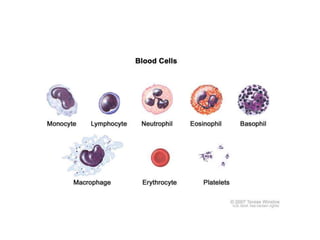
 Red blood cells (RBC) / Erythrocytes
 White blood cells (WBC) / Leucocytes
 Blood Platelets / Thrombocytes
Counting Methods:
 Microscopic method
 Automatic Optical method
 Electrical Conductivity method
• determination of the number and size of blood
cells per unit volume often provides valuable
information for accurate diagnosis.
• The blood constitutes 5–10% of the total body
weight and in an average adult it amounts to 5–6
litres.
• Blood consists of corpuscles suspended in fluid
called plasma in the proportion of 45 parts of
corpuscles (cells) to 55 parts of plasma
• The percentage of cells in the blood is called
the haematocrit value or packed cell volume
(PCV).
• The majority of the corpuscles in blood are
red blood cells (erythrocytes), others being
white blood cells (leucocytes) and platelets
(thrombocytes).
Blood Cell Types:
• Erythrocytes (Red Blood Cells):
• RBC is round disks, indented in the centre, with a
diameter of about 8µm.
• In the whole body, there are about 25 billion
erythrocytes and they are constantly being destroyed
and replaced at a rate of about 9000 million per hour.
• The normal red cell lasts approximately 120 days
before it is destroyed.
• The erythrocytes have no nucleus. They are
responsible for carrying oxygen from the lungs to the
tissues and carbon dioxide from the tissues to the
lungs.
• Leucocytes (White Blood Cells):
• Its average diameter 10µm.
• Leucocytes are spherical cells having a
nucleus. There are normally 5000–10,000
white cells per cubic mm of blood.
• They live for 7 to 14 days and there is a rapid
turnover, with constant destruction and
replacement.
• Leucocytes form the defence mechanism of the
body against infection.
• They are of two main types: the neutrophils and
the lymphocytes.
• Neutrophils ingest bacteria: Neutrophils are
nearly twice as big as the red cells and contain
both a nucleus divided into several lobes and
granules in their protoplasm
• Lymphocytes: Lymphocytes are of the same size
as the red cells but contain a large density
staining nucleus and no granules
• Thrombocytes (Platelets):
• Platelets are usually tiny, round, oblong or
irregularly shaped cells of the blood with an
average diameter of approximately 2 - 4μm.
They play an important role in the blood
coagulation process. There are usually
250,000–750,000 platelets in every cubic mm
of blood.
METHODS OF CELL COUNTING:
• Microscopic Method
• the microscopic method in which the diluted
sample is visually examined and the cells counted
• drawbacks such as rapid tiring of the person
making the examination and poor reproducibility
of results
• data gathered by this measurement is not directly
suitable for storage or for further processing and
evaluation
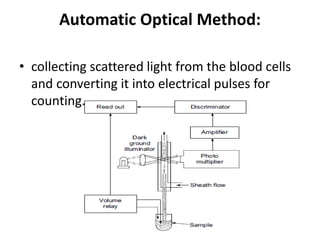
Automatic Optical Method:
• collecting scattered light from the blood cells
and converting it into electrical pulses for
counting.
• Instruments based on this technique take
about 30 s for completing the count.
• An accuracy of 2% is attainable. The
instruments require about 1 ml of blood
sample.
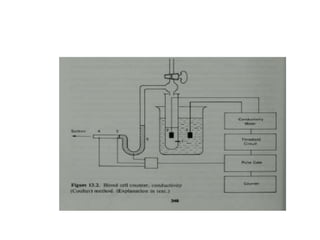
Electrical Conductivity Method
• Blood cell counters, operating on the principle
of conductivity change, which occurs each
time a cell passes through an orifice, are
generally known as Coulter Counters.
• The technique is extremely useful for
determining the number and size of the
particles suspended in an electrically
conductive liquid
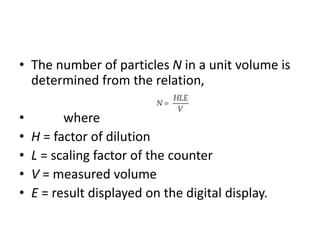
• The number of particles N in a unit volume is
determined from the relation,
• where
• H = factor of dilution
• L = scaling factor of the counter
• V = measured volume
• E = result displayed on the digital display.
• In particular, it provides information regarding
– relative cell size,
– relative cell size distribution,
– settings of the threshold level control, and
– Means to check the performance of the
instrument for reliability of counts.
Errors in Electronic counters
 Aperture clogging
 Uncertainty of Discriminator Threshold
 Coincidence Error
 Settling Error
 Error in Sample Volume
 Error due to Temperature Variation
 Biological Factors
 Dilution Errors
 Error due to External Disturbance
Temperature measurement
• Body temperature is one of the older known
indicators of the general well-being of a
person.
• Two basic types of temperature measurement
can be obtained from the body:
i. Systemic measurement
ii. Skin surface measurement
Systemic temperature:
• The temperature of internal regions of the
body.
• Temperature is maintained through a carefully
controlled balance between the heat
generated by the active tissues of the body,
mainly the muscles and the liver and the heat
lost by the body to the environment.
• devices placed in mouth, under the armpits,
or in the rectum.
• The normal oral temperature of a healthy
person is 37o C (98.6oF).
• The systemic body temperature can be
measured most accurately at the tympanic
membrane in the ear
• The temperature control center for the body is
located deep within the brain.
• Here the temperature of the blood is
monitored and its control functions are
coordinated.
Skin or surface temperature:
• Balance is between the heat supplied by blood
circulation in a local area and cooling of that
area by conduction, radiation, convection and
evaporation.
• Skin temperature is a function of the surface
circulation, environmental temperature, air
circulation around the area from which the
measurement is to be taken
Measurement of systemic body
temperature:
• Where continuous recording of temperature is
not required, the mercury thermometer is still
the standard method of measurement.
• Devices are inexpensive, easy to use and
sufficiently accurate.
• Electronic thermometers are available as
replacement for mercury thermometers.
• Two types of electronic temperature sensing
devices are found in bio-medical applications.
• They are
• i. Thermocouple- a junction of two
dissimilar metals that produces an output
voltage nearly proportional to the
temperature
• ii. Thermistor – a semiconductor element
whose resistance varies with temperature
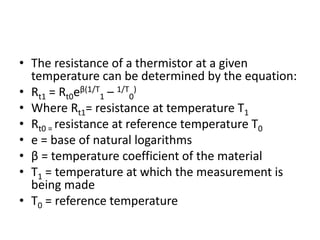
• The resistance of a thermistor at a given
temperature can be determined by the equation:
• Rt1 = Rt0eβ(1/T
1 – 1/T
0
)
• Where Rt1= resistance at temperature T1
• Rt0 = resistance at reference temperature T0
• e = base of natural logarithms
• β = temperature coefficient of the material
• T1 = temperature at which the measurement is
being made
• T0 = reference temperature
• The most important characteristics to consider
in selecting a thermistor probe for a specific
biomedical application are the following
• The physical configuration of the thermistor
probe
• Sensitivity
• The absolute temperature range
• Resistance range of the probe
Skin temperature measurements
• Although the systemic temperature remains
very constant throughout the body, skin
temperatures can vary several degrees from
one point to another.
• Range is usually from about 30 to 35oC (85 to
95oF).
• flat thermistor probes taped to the skin
• Infrared thermometer- a device sensitive to
infrared radiation can accurately read the
surface temperature.
• i. Used to detect breast cancers.
• ii. Used to detect areas of poor
circulation
• An extension of this method of skin
temperature measurement is the
thermograph. This device is an infrared
thermometer incorporated into a scanner so
that the entire surface of the body or some
portion of the body is scanned at a slower rate

Blood cell counter

  • 1.
    Blood Cell Counter TemperatureMeasurement S.Vijayakumar AP, Ramco Institute of Technology
  • 2.
    Blood Cell Types Red blood cells (RBC) / Erythrocytes  White blood cells (WBC) / Leucocytes  Blood Platelets / Thrombocytes Counting Methods:  Microscopic method  Automatic Optical method  Electrical Conductivity method
  • 3.
    • determination ofthe number and size of blood cells per unit volume often provides valuable information for accurate diagnosis. • The blood constitutes 5–10% of the total body weight and in an average adult it amounts to 5–6 litres. • Blood consists of corpuscles suspended in fluid called plasma in the proportion of 45 parts of corpuscles (cells) to 55 parts of plasma
  • 4.
    • The percentageof cells in the blood is called the haematocrit value or packed cell volume (PCV). • The majority of the corpuscles in blood are red blood cells (erythrocytes), others being white blood cells (leucocytes) and platelets (thrombocytes).
  • 5.
    Blood Cell Types: •Erythrocytes (Red Blood Cells): • RBC is round disks, indented in the centre, with a diameter of about 8µm. • In the whole body, there are about 25 billion erythrocytes and they are constantly being destroyed and replaced at a rate of about 9000 million per hour. • The normal red cell lasts approximately 120 days before it is destroyed. • The erythrocytes have no nucleus. They are responsible for carrying oxygen from the lungs to the tissues and carbon dioxide from the tissues to the lungs.
  • 6.
    • Leucocytes (WhiteBlood Cells): • Its average diameter 10µm. • Leucocytes are spherical cells having a nucleus. There are normally 5000–10,000 white cells per cubic mm of blood. • They live for 7 to 14 days and there is a rapid turnover, with constant destruction and replacement.
  • 7.
    • Leucocytes formthe defence mechanism of the body against infection. • They are of two main types: the neutrophils and the lymphocytes. • Neutrophils ingest bacteria: Neutrophils are nearly twice as big as the red cells and contain both a nucleus divided into several lobes and granules in their protoplasm • Lymphocytes: Lymphocytes are of the same size as the red cells but contain a large density staining nucleus and no granules
  • 8.
    • Thrombocytes (Platelets): •Platelets are usually tiny, round, oblong or irregularly shaped cells of the blood with an average diameter of approximately 2 - 4μm. They play an important role in the blood coagulation process. There are usually 250,000–750,000 platelets in every cubic mm of blood.
  • 10.
    METHODS OF CELLCOUNTING: • Microscopic Method • the microscopic method in which the diluted sample is visually examined and the cells counted • drawbacks such as rapid tiring of the person making the examination and poor reproducibility of results • data gathered by this measurement is not directly suitable for storage or for further processing and evaluation
  • 11.
    Automatic Optical Method: •collecting scattered light from the blood cells and converting it into electrical pulses for counting.
  • 12.
    • Instruments basedon this technique take about 30 s for completing the count. • An accuracy of 2% is attainable. The instruments require about 1 ml of blood sample.
  • 13.
    Electrical Conductivity Method •Blood cell counters, operating on the principle of conductivity change, which occurs each time a cell passes through an orifice, are generally known as Coulter Counters. • The technique is extremely useful for determining the number and size of the particles suspended in an electrically conductive liquid
  • 15.
    • The numberof particles N in a unit volume is determined from the relation, • where • H = factor of dilution • L = scaling factor of the counter • V = measured volume • E = result displayed on the digital display.
  • 16.
    • In particular,it provides information regarding – relative cell size, – relative cell size distribution, – settings of the threshold level control, and – Means to check the performance of the instrument for reliability of counts.
  • 17.
    Errors in Electroniccounters  Aperture clogging  Uncertainty of Discriminator Threshold  Coincidence Error  Settling Error  Error in Sample Volume  Error due to Temperature Variation  Biological Factors  Dilution Errors  Error due to External Disturbance
  • 18.
    Temperature measurement • Bodytemperature is one of the older known indicators of the general well-being of a person. • Two basic types of temperature measurement can be obtained from the body: i. Systemic measurement ii. Skin surface measurement
  • 19.
    Systemic temperature: • Thetemperature of internal regions of the body. • Temperature is maintained through a carefully controlled balance between the heat generated by the active tissues of the body, mainly the muscles and the liver and the heat lost by the body to the environment.
  • 20.
    • devices placedin mouth, under the armpits, or in the rectum. • The normal oral temperature of a healthy person is 37o C (98.6oF). • The systemic body temperature can be measured most accurately at the tympanic membrane in the ear
  • 21.
    • The temperaturecontrol center for the body is located deep within the brain. • Here the temperature of the blood is monitored and its control functions are coordinated.
  • 22.
    Skin or surfacetemperature: • Balance is between the heat supplied by blood circulation in a local area and cooling of that area by conduction, radiation, convection and evaporation. • Skin temperature is a function of the surface circulation, environmental temperature, air circulation around the area from which the measurement is to be taken
  • 23.
    Measurement of systemicbody temperature: • Where continuous recording of temperature is not required, the mercury thermometer is still the standard method of measurement. • Devices are inexpensive, easy to use and sufficiently accurate. • Electronic thermometers are available as replacement for mercury thermometers.
  • 24.
    • Two typesof electronic temperature sensing devices are found in bio-medical applications. • They are • i. Thermocouple- a junction of two dissimilar metals that produces an output voltage nearly proportional to the temperature • ii. Thermistor – a semiconductor element whose resistance varies with temperature
  • 25.
    • The resistanceof a thermistor at a given temperature can be determined by the equation: • Rt1 = Rt0eβ(1/T 1 – 1/T 0 ) • Where Rt1= resistance at temperature T1 • Rt0 = resistance at reference temperature T0 • e = base of natural logarithms • β = temperature coefficient of the material • T1 = temperature at which the measurement is being made • T0 = reference temperature
  • 26.
    • The mostimportant characteristics to consider in selecting a thermistor probe for a specific biomedical application are the following • The physical configuration of the thermistor probe • Sensitivity • The absolute temperature range • Resistance range of the probe
  • 27.
    Skin temperature measurements •Although the systemic temperature remains very constant throughout the body, skin temperatures can vary several degrees from one point to another. • Range is usually from about 30 to 35oC (85 to 95oF). • flat thermistor probes taped to the skin
  • 28.
    • Infrared thermometer-a device sensitive to infrared radiation can accurately read the surface temperature. • i. Used to detect breast cancers. • ii. Used to detect areas of poor circulation
  • 29.
    • An extensionof this method of skin temperature measurement is the thermograph. This device is an infrared thermometer incorporated into a scanner so that the entire surface of the body or some portion of the body is scanned at a slower rate