Dr. Nawsherwan Sadiq
      Department of
 Pathology/Haematology
Hawler Medical University
   College of Medicine
ABO SYSTEM
• There are four main blood groups: A, B, AB
  and O.
• In the British Caucasian population, the
  frequency of group A is 42%, B 9%, AB 3%, and
  O 46%
• there is racial variation in these frequencies.[6]
  The epitopes of ABO antigens are determined
  by carbohydrates (sugars), which are linked
  either to polypeptides (forming glycoproteins)
  or to lipids (glycolipids).
In Caucasians the most frequent
ABO phenotype is the O followed
by A, B and least is AB.

Three genes on Chromosome 9
determine the ABO phenotype
namely A, B and O gene.
• The A and B genes do not code for A or B
  antigens, but they code for specific enzymes
  “Glycosyl transferases” which add sugars to
  a basic precursor substance.

• The expression of the A and B antigens
  requires the presence of an independently
  inherited H gene.
• The immunodominant sugar added to
  produce the


• A antigen is : N-acetylgalactoseamine
• B antigen is : D-galactose
• H antigen is : L-Fucose.
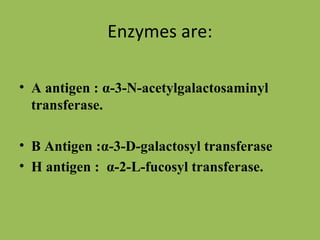
Enzymes are:

• A antigen : α-3-N-acetylgalactosaminyl
  transferase.

• B Antigen :α-3-D-galactosyl transferase
• H antigen : α-2-L-fucosyl transferase.
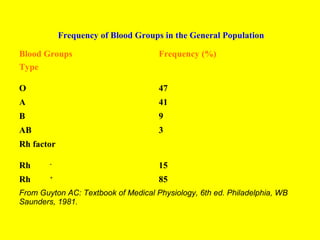
Frequency of Blood Groups in the General Population

Blood Groups                         Frequency (%)
Type

O                                    47
A                                    41
B                                    9 
AB                                   3 
Rh factor

Rh   -                               15
Rh   +                               85
From Guyton AC: Textbook of Medical Physiology, 6th ed. Philadelphia, WB
Saunders, 1981.
In the extremely rare Oh Bombay phenotype, the
individual is homozygous for the h allele of FUT1
and hence cannot form the H precursor of the A
and B antigen.

Their red cells type as group O, but their plasma
contains anti-H, in addition to anti-A, anti-B, and
anti-A,B, which are all active at 37°C.

As a consequence, individuals with an Oh Bombay
phenotype can only be safely transfused with other
Oh red cells
• Subjects with H Antigen should either be
  HH or Hh,
• if he/she is hh, then no L-Fucose is added, so
  no H, A or B antigens could be produced.
  called Bombay blood Group.
• The H gene is seen in 99.99% of subjects
  (either Hh, or HH),
• the hh is very rare seen in 0.01%.
• Two common subgroups of the A antigen.
  Approximately 20% of group A and group AB
  individuals belong to group A2 and group A2B.
• The remainder belonging to group A1 and
  group A1B.
• These subgroups arise as a result of
  inheritance of either the A1 or A2 alleles.
• A2 red cells have fewer A antigen sites than A1
  cells and the plasma of group A2 and group A2B
  individuals may also contain anti-A1.
• The distinction between these subgroups can
  be made using the lectin Dolichos biflorus,
  which only reacts with A1 cells
• The H antigen content of red cells depends on
  the ABO group.
• The strength of reaction tends to be graded O
  > A2 > A2B > B > A1 > A1B.
• Other subgroups of A are occasionally found
  (e.g., A3, Ax) that result from mutant forms of
  the glycosyltransferases produced by the A
  gene
• A phenotype : the Genotype maybe either
  AA or AO.
• B phenotype : The Genotype maybe either
  BB or BO.
• AB phenotype : The Genotype is AB.
• O phenotype : The Genotype is OO.
• ABH antigens develop as early as 37 days
  fetal life.
 Weakly expressed throughout fetal life.
• In newborn the ABO Ag sites are about 25-
  50% strength of those in adults.
• The number of antigen sites reaches “adult”
  level at around 1 year of age and remains
  constant until old age, when a slight
  reduction may occur..
Secretors and Nonsecretors
• The ability to secrete A, B, and H substances in
  water-soluble form is controlled by FUT2
  (dominant allele Se).
• In a Caucasian population, about 80% are
  secretors (genotype SeSe or Sese) and 20% are
  nonsecretors (genotype sese).
• Secretors have H substance in the saliva and
  other body fluids together with A substances,
  B substances, or both, depending on their
  blood group.
• Only traces of these substances are present in
  the secretions of nonsecretors, although the
  antigens are expressed normally on their red
  cells and other tissues.

• An individual's secretor status can be
  determined by testing for ABH substance in
  saliva
ABO Antigens and Disease
• Group A individuals rarely may acquire a B
  antigen from a bacterial infection that results
  in the release of a deacetylase enzyme.
• This converts N-acetyl-D-galactosamine into
  α-galactosamine, which is similar to galactose,
  the immunodominant sugar of group B.
• Thereby sometimes causing the red cells to
  appear to be group AB.
• Case reports attest to the danger of
  individuals with an acquired B antigen being
  transfused with AB red cells, resulting in a
  fatal haemolytic transfusion reaction following
  the production of hyperimmune anti-B.
• Group A individuals have 1.2 times the risk of
  developing carcinoma of the stomach than
  group O or B;
• Group O individuals have 1.4 times more risk
  of developing peptic ulcer than non-group O
  individuals.
• Nonsecretors of ABH have 1.5 times the risk of
  developing peptic ulcer than secretors.
• The ABO group also affects plasma von
  Willebrand factor (vWF) and factor VIII levels;
  group O healthy individuals have levels
  around 25% lower than those of other ABO
  groups.

• ABH antigens are also frequently more weakly
  expressed on the red cells of persons with
  leukaemia.
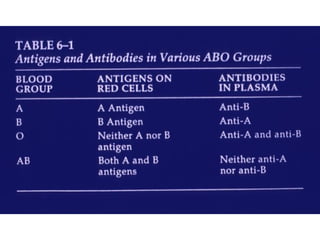
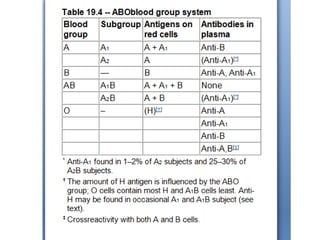
• Regarding the ABO group, all normal
  healthy individuals consistently have
  present in their sera, antibodies to antigens
  they lack on their red cells.
• This is not true regarding other blood
  groups.
ABO Abs
• Naturally occurring
• Bacteria, pollen seeds, diet, or other substances
  present in nature have been implicated in
  stimulating Antibody development..
• Starts at first few months after birth.
• Detectable titres of Abs by 3-6 months.
• Peaks at 5-10 yrs.
• Declines progressively with advanced age.
• 0.01% healthy individuals may not have natural
  occurring antibodies.
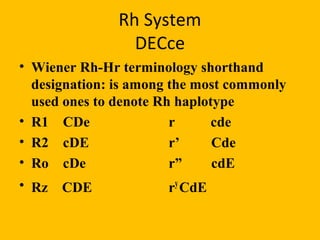
Rh System
                 DECce
• Wiener Rh-Hr terminology shorthand
  designation: is among the most commonly
  used ones to denote Rh haplotype
• R1 CDe                r     cde
• R2 cDE                r’     Cde
• Ro cDe                r”     cdE
• Rz   CDE            ry CdE
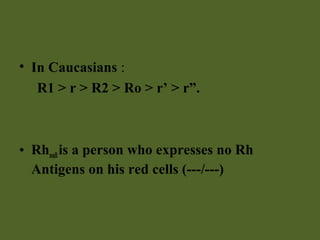
• In Caucasians :
   R1 > r > R2 > Ro > r’ > r”.


• Rhnull is a person who expresses no Rh
  Antigens on his red cells (---/---)
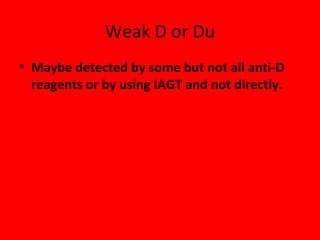
Weak D or Du
• Maybe detected by some but not all anti-D
  reagents or by using IAGT and not directly.
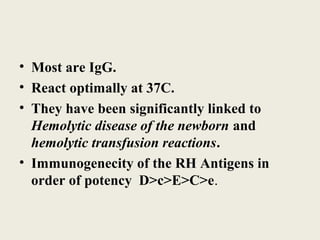
• Most are IgG.
• React optimally at 37C.
• They have been significantly linked to
  Hemolytic disease of the newborn and
  hemolytic transfusion reactions.
• Immunogenecity of the RH Antigens in
  order of potency D>c>E>C>e.
Lewis
• Lewis antigens are not synthesized by the red cells
• Lewis Antigens are made up by tissue cells and
  secreted into the fluids and plasma.
• They are then absorbed onto the RBC membrane.
• Lewis antigens in secretions are glycoproteins, on
  cell membranes glycolipids.
• There antibodies are rarely reactive at 37 C,
  therefore they are not significant.
Kell System
• Found only on RBC
• Well developed at birth.
• It is next to D in immunogenecity.
• Anti-K is an immune IgG antibody
  detectable by IAGT .
• Anti-K is implicated in HDN and HTR.
Duffy blood group
• Fya and Fyb are well developed at birth .
• Fy (a-b-) prevalent in blacks and linked
  with resistance to malaria.
• Anti Fya and Fyb are IgG immune
  antibodies.
• They are reactive by IAGT.
• They are important causes of HDN and
  HTR.
KIDD System
• Jka and Jkb antigens are well developed at
  birth.
• Anti Jka and Jkb are immune IgG antibodies.
• These antibodies unlike duffy’s are
  enhanced by enzymes.
• Common causes of severe delayed
  transfusion reactions and HDN.
Other Blood Group systems
•   P system
•   Lutheran.
•   MNSs system.
•   Ii system.

• Less important than those before
  mentioned.

Blood group

  • 1.
    Dr. Nawsherwan Sadiq Department of Pathology/Haematology Hawler Medical University College of Medicine
  • 2.
    ABO SYSTEM • Thereare four main blood groups: A, B, AB and O. • In the British Caucasian population, the frequency of group A is 42%, B 9%, AB 3%, and O 46% • there is racial variation in these frequencies.[6] The epitopes of ABO antigens are determined by carbohydrates (sugars), which are linked either to polypeptides (forming glycoproteins) or to lipids (glycolipids).
  • 3.
    In Caucasians themost frequent ABO phenotype is the O followed by A, B and least is AB. Three genes on Chromosome 9 determine the ABO phenotype namely A, B and O gene.
  • 4.
    • The Aand B genes do not code for A or B antigens, but they code for specific enzymes “Glycosyl transferases” which add sugars to a basic precursor substance. • The expression of the A and B antigens requires the presence of an independently inherited H gene.
  • 5.
    • The immunodominantsugar added to produce the • A antigen is : N-acetylgalactoseamine • B antigen is : D-galactose • H antigen is : L-Fucose.
  • 6.
    Enzymes are: • Aantigen : α-3-N-acetylgalactosaminyl transferase. • B Antigen :α-3-D-galactosyl transferase • H antigen : α-2-L-fucosyl transferase.
  • 8.
    Frequency of BloodGroups in the General Population Blood Groups Frequency (%) Type O   47 A   41 B   9  AB   3  Rh factor Rh   - 15 Rh   + 85 From Guyton AC: Textbook of Medical Physiology, 6th ed. Philadelphia, WB Saunders, 1981.
  • 10.
    In the extremelyrare Oh Bombay phenotype, the individual is homozygous for the h allele of FUT1 and hence cannot form the H precursor of the A and B antigen. Their red cells type as group O, but their plasma contains anti-H, in addition to anti-A, anti-B, and anti-A,B, which are all active at 37°C. As a consequence, individuals with an Oh Bombay phenotype can only be safely transfused with other Oh red cells
  • 11.
    • Subjects withH Antigen should either be HH or Hh, • if he/she is hh, then no L-Fucose is added, so no H, A or B antigens could be produced. called Bombay blood Group. • The H gene is seen in 99.99% of subjects (either Hh, or HH), • the hh is very rare seen in 0.01%.
  • 12.
    • Two commonsubgroups of the A antigen. Approximately 20% of group A and group AB individuals belong to group A2 and group A2B. • The remainder belonging to group A1 and group A1B. • These subgroups arise as a result of inheritance of either the A1 or A2 alleles.
  • 13.
    • A2 redcells have fewer A antigen sites than A1 cells and the plasma of group A2 and group A2B individuals may also contain anti-A1. • The distinction between these subgroups can be made using the lectin Dolichos biflorus, which only reacts with A1 cells
  • 14.
    • The Hantigen content of red cells depends on the ABO group. • The strength of reaction tends to be graded O > A2 > A2B > B > A1 > A1B. • Other subgroups of A are occasionally found (e.g., A3, Ax) that result from mutant forms of the glycosyltransferases produced by the A gene
  • 15.
    • A phenotype: the Genotype maybe either AA or AO. • B phenotype : The Genotype maybe either BB or BO. • AB phenotype : The Genotype is AB. • O phenotype : The Genotype is OO.
  • 16.
    • ABH antigensdevelop as early as 37 days fetal life. Weakly expressed throughout fetal life. • In newborn the ABO Ag sites are about 25- 50% strength of those in adults. • The number of antigen sites reaches “adult” level at around 1 year of age and remains constant until old age, when a slight reduction may occur..
  • 17.
    Secretors and Nonsecretors •The ability to secrete A, B, and H substances in water-soluble form is controlled by FUT2 (dominant allele Se). • In a Caucasian population, about 80% are secretors (genotype SeSe or Sese) and 20% are nonsecretors (genotype sese). • Secretors have H substance in the saliva and other body fluids together with A substances, B substances, or both, depending on their blood group.
  • 18.
    • Only tracesof these substances are present in the secretions of nonsecretors, although the antigens are expressed normally on their red cells and other tissues. • An individual's secretor status can be determined by testing for ABH substance in saliva
  • 19.
    ABO Antigens andDisease • Group A individuals rarely may acquire a B antigen from a bacterial infection that results in the release of a deacetylase enzyme. • This converts N-acetyl-D-galactosamine into α-galactosamine, which is similar to galactose, the immunodominant sugar of group B. • Thereby sometimes causing the red cells to appear to be group AB.
  • 20.
    • Case reportsattest to the danger of individuals with an acquired B antigen being transfused with AB red cells, resulting in a fatal haemolytic transfusion reaction following the production of hyperimmune anti-B.
  • 21.
    • Group Aindividuals have 1.2 times the risk of developing carcinoma of the stomach than group O or B; • Group O individuals have 1.4 times more risk of developing peptic ulcer than non-group O individuals. • Nonsecretors of ABH have 1.5 times the risk of developing peptic ulcer than secretors.
  • 22.
    • The ABOgroup also affects plasma von Willebrand factor (vWF) and factor VIII levels; group O healthy individuals have levels around 25% lower than those of other ABO groups. • ABH antigens are also frequently more weakly expressed on the red cells of persons with leukaemia.
  • 23.
    • Regarding theABO group, all normal healthy individuals consistently have present in their sera, antibodies to antigens they lack on their red cells. • This is not true regarding other blood groups.
  • 24.
    ABO Abs • Naturallyoccurring • Bacteria, pollen seeds, diet, or other substances present in nature have been implicated in stimulating Antibody development.. • Starts at first few months after birth. • Detectable titres of Abs by 3-6 months. • Peaks at 5-10 yrs. • Declines progressively with advanced age. • 0.01% healthy individuals may not have natural occurring antibodies.
  • 26.
    Rh System DECce • Wiener Rh-Hr terminology shorthand designation: is among the most commonly used ones to denote Rh haplotype • R1 CDe r cde • R2 cDE r’ Cde • Ro cDe r” cdE • Rz CDE ry CdE
  • 27.
    • In Caucasians: R1 > r > R2 > Ro > r’ > r”. • Rhnull is a person who expresses no Rh Antigens on his red cells (---/---)
  • 28.
    Weak D orDu • Maybe detected by some but not all anti-D reagents or by using IAGT and not directly.
  • 29.
    • Most areIgG. • React optimally at 37C. • They have been significantly linked to Hemolytic disease of the newborn and hemolytic transfusion reactions. • Immunogenecity of the RH Antigens in order of potency D>c>E>C>e.
  • 30.
    Lewis • Lewis antigensare not synthesized by the red cells • Lewis Antigens are made up by tissue cells and secreted into the fluids and plasma. • They are then absorbed onto the RBC membrane. • Lewis antigens in secretions are glycoproteins, on cell membranes glycolipids. • There antibodies are rarely reactive at 37 C, therefore they are not significant.
  • 31.
    Kell System • Foundonly on RBC • Well developed at birth. • It is next to D in immunogenecity. • Anti-K is an immune IgG antibody detectable by IAGT . • Anti-K is implicated in HDN and HTR.
  • 32.
    Duffy blood group •Fya and Fyb are well developed at birth . • Fy (a-b-) prevalent in blacks and linked with resistance to malaria. • Anti Fya and Fyb are IgG immune antibodies. • They are reactive by IAGT. • They are important causes of HDN and HTR.
  • 33.
    KIDD System • Jkaand Jkb antigens are well developed at birth. • Anti Jka and Jkb are immune IgG antibodies. • These antibodies unlike duffy’s are enhanced by enzymes. • Common causes of severe delayed transfusion reactions and HDN.
  • 34.
    Other Blood Groupsystems • P system • Lutheran. • MNSs system. • Ii system. • Less important than those before mentioned.