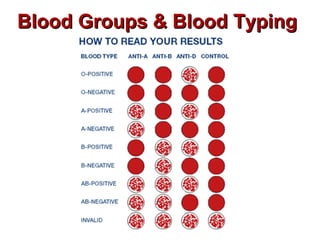
Blood Groups & Blood TypingBlood Groups & Blood Typing
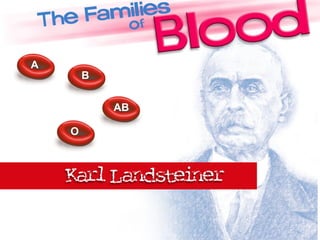
Discovery of Blood Groups
• Experiments with blood transfusions have been
carried out for hundreds of years. Many patients
have died and it was not until 1901, when the
Austrian Karl Landsteiner discovered human
blood groups, that blood transfusions became
safer.
• Mixing blood from two individuals can lead to blood
clumping or agglutination. The clumped red cells
can crack and cause toxic reactions. This can have
fatal consequences. Karl Landsteiner discovered
that blood clumping was an immunological reaction
which occurs when the receiver of a blood
transfusion has antibodies against the donor blood
cells.
Blood Groups & Blood TypingBlood Groups & Blood Typing
Discovery of Blood Groups
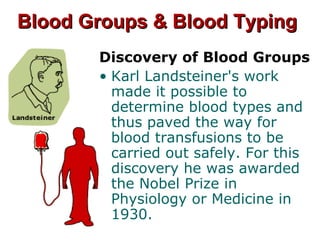
• Karl Landsteiner's work
made it possible to
determine blood types and
thus paved the way for
blood transfusions to be
carried out safely. For this
discovery he was awarded
the Nobel Prize in
Physiology or Medicine in
1930.
Blood Groups & Blood TypingBlood Groups & Blood Typing
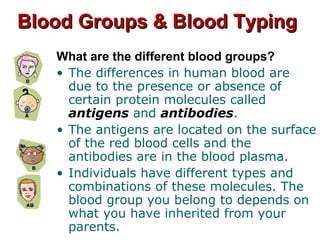
What are the different blood groups?
• The differences in human blood are
due to the presence or absence of
certain protein molecules called
antigens and antibodies.
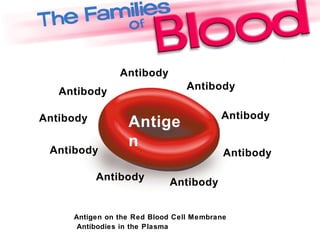
• The antigens are located on the surface
of the red blood cells and the
antibodies are in the blood plasma.
• Individuals have different types and
combinations of these molecules. The
blood group you belong to depends on
what you have inherited from your
parents.
A
B
AB
O
Antige
n
Antigen on the Red Blood Cell Membrane
Antibodies in the Plasma
Antibody
Antibody
Antibody
Antibody
Antibody
Antibody
Antibody
Antibody
Antibody
B
B
B
B
B
B
B
B
A
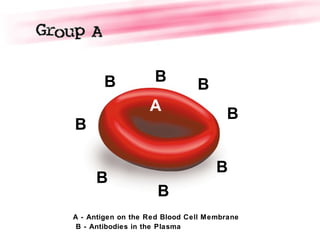
A - Antigen on the Red Blood Cell Membrane
B - Antibodies in the Plasma
A
A
A
A
A
A
A
A
B
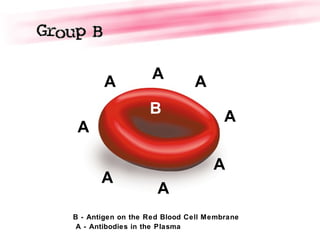
B - Antigen on the Red Blood Cell Membrane
A - Antibodies in the Plasma
AB
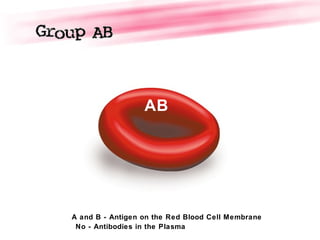
A and B - Antigen on the Red Blood Cell Membrane
No - Antibodies in the Plasma
B
A
B
B
A
A
B
A
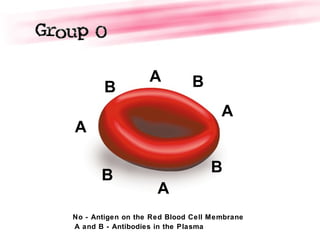
No - Antigen on the Red Blood Cell Membrane
A and B - Antibodies in the Plasma
Blood Groups & Blood TypingBlood Groups & Blood Typing
AB0 blood grouping system
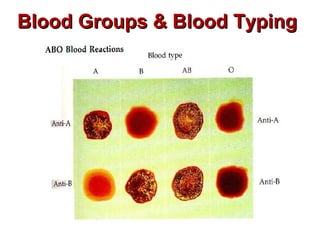
• According to the AB0 blood typing
system there are four different kinds of
blood types: A, B, AB or 0 (null).
Blood Groups & Blood TypingBlood Groups & Blood Typing
AB0 blood grouping system
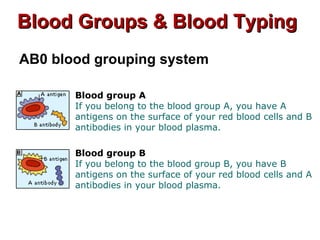
Blood group A
If you belong to the blood group A, you have A
antigens on the surface of your red blood cells and B
antibodies in your blood plasma.
Blood group B
If you belong to the blood group B, you have B
antigens on the surface of your red blood cells and A
antibodies in your blood plasma.
Blood Groups & Blood TypingBlood Groups & Blood Typing
AB0 blood grouping system
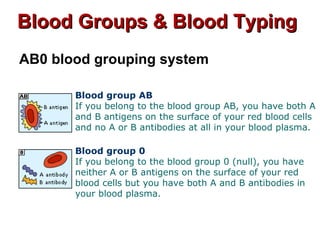
Blood group AB
If you belong to the blood group AB, you have both A
and B antigens on the surface of your red blood cells
and no A or B antibodies at all in your blood plasma.
Blood group 0
If you belong to the blood group 0 (null), you have
neither A or B antigens on the surface of your red
blood cells but you have both A and B antibodies in
your blood plasma.
Blood Groups & Blood TypingBlood Groups & Blood Typing
AB0 blood grouping system
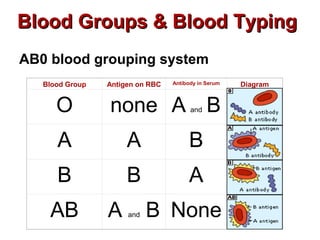
Blood Group Antigen on RBC Antibody in Serum Diagram
O none A and B
A A B
B B A
AB A and B None
Blood Groups & Blood TypingBlood Groups & Blood Typing
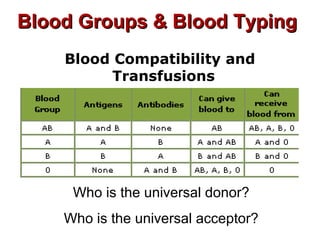
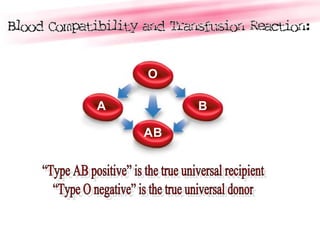
Blood Compatibility and
Transfusions
Who is the universal donor?
Who is the universal acceptor?
O
AB
BA
Blood Groups & Blood TypingBlood Groups & Blood Typing
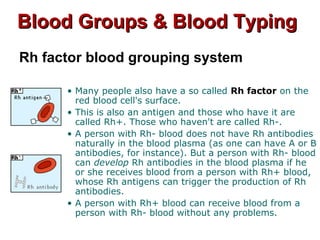
Rh factor blood grouping system
• Many people also have a so called Rh factor on the
red blood cell's surface.
• This is also an antigen and those who have it are
called Rh+. Those who haven't are called Rh-.
• A person with Rh- blood does not have Rh antibodies
naturally in the blood plasma (as one can have A or B
antibodies, for instance). But a person with Rh- blood
can develop Rh antibodies in the blood plasma if he
or she receives blood from a person with Rh+ blood,
whose Rh antigens can trigger the production of Rh
antibodies.
• A person with Rh+ blood can receive blood from a
person with Rh- blood without any problems.
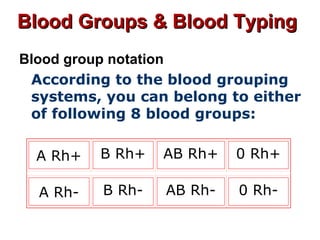
A Rh+ B Rh+ AB Rh+ 0 Rh+
A Rh- B Rh- AB Rh- 0 Rh-
Blood Groups & Blood TypingBlood Groups & Blood Typing
Blood group notation
According to the blood grouping
systems, you can belong to either
of following 8 blood groups:
Blood Groups & Blood TypingBlood Groups & Blood Typing
Blood Compatibility and Transfusions
• The ABO and Rh groups are factored
together to identify 1 of the previous 8
blood types.
• During blood transfusions, doctors
must be aware of these blood types to
prevent agglutination of the recipient’s
blood.
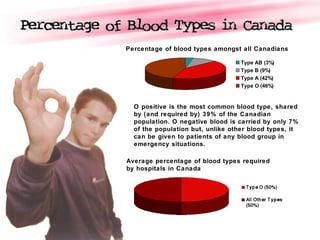
Type AB (3%)
Type B (9%)
Type A (42%)
Type O (46%)
Percentage of blood types amongst all Canadians
Average percentage of blood types required
by hospitals in Canada
O positive is the most common blood type, shared
by (and required by) 39% of the Canadian
population. O negative blood is carried by only 7%
of the population but, unlike other blood types, it
can be given to patients of any blood group in
emergency situations.
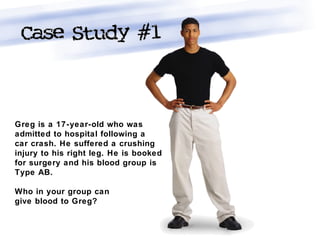
Greg is a 17-year-old who was
admitted to hospital following a
car crash. He suffered a crushing
injury to his right leg. He is booked
for surgery and his blood group is
Type AB.
Who in your group can
give blood to Greg?
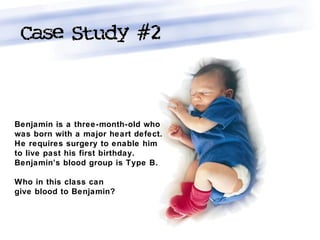
Benjamin is a three-month-old who
was born with a major heart defect.
He requires surgery to enable him
to live past his first birthday.
Benjamin’s blood group is Type B.
Who in this class can
give blood to Benjamin?
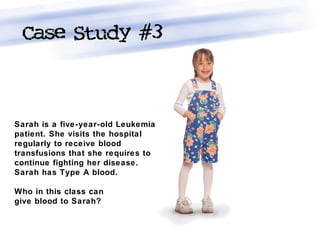
Sarah is a five-year-old Leukemia
patient. She visits the hospital
regularly to receive blood
transfusions that she requires to
continue fighting her disease.
Sarah has Type A blood.
Who in this class can
give blood to Sarah?
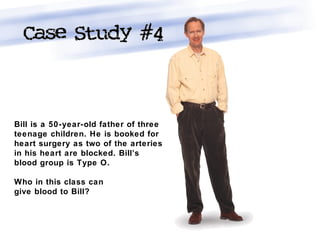
Bill is a 50-year-old father of three
teenage children. He is booked for
heart surgery as two of the arteries
in his heart are blocked. Bill’s
blood group is Type O.
Who in this class can
give blood to Bill?
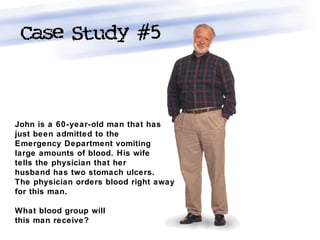
John is a 60-year-old man that has
just been admitted to the
Emergency Department vomiting
large amounts of blood. His wife
tells the physician that her
husband has two stomach ulcers.
The physician orders blood right away
for this man.
What blood group will
this man receive?
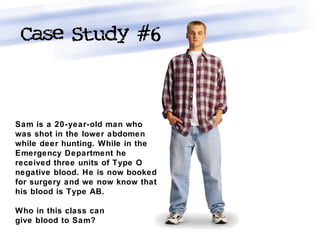
Sam is a 20-year-old man who
was shot in the lower abdomen
while deer hunting. While in the
Emergency Department he
received three units of Type O
negative blood. He is now booked
for surgery and we now know that
his blood is Type AB.
Who in this class can
give blood to Sam?
Blood Groups & Blood TypingBlood Groups & Blood Typing
Erythroblastosis Fetalis
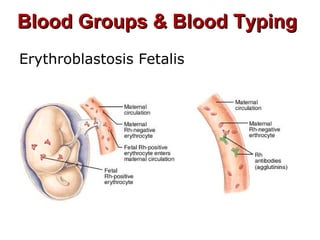
• Erythroblastosis fetalis is a blood disease of a
newborn infant caused by blood group
incompatibility between mother and child. With an
Rh-negative mother and an Rh-positive father, the
possibility exists that the fetus will be Rh positive.
Blood mixing during pregnancy permits fetal red
blood cells to enter the maternal circulation,
causing the mother to start to produce antibodies
against the Rh antigen from the fetus.
• Maternal antibodies pass through the placenta
into the fetus, where an excessive destruction of
fetal red blood cells occurs. When this destruction
begins during pregnancy, stillbirth may result.
Blood Groups & Blood TypingBlood Groups & Blood Typing
Erythroblastosis Fetalis
Blood Groups & Blood TypingBlood Groups & Blood Typing
Erythroblastosis Fetalis
• There is little danger of damage to the fetus during the
first pregnancy because not enough antibodies have
been produced by the mother. However, by the second
pregnancy, sufficient antibodies will have accumulated in
the mother’s bloodstream to cause increasing danger.
• The formation of maternal anti-Rh antibodies has been
largely prevented in Canada by the injection of human
immune globulin into the mother within 72 hours after
delivery. This globulin contains antibodies against the
Rh-positive fetal red blood cells, destroying them before
the maternal bloodstream reacts by producing its own
anti-Rh antibodies. Thus during the next pregnancy
there will be few, if any, antibodies in the maternal
bloodstream to destroy the fetal Rh-positive blood cells.
Blood Groups & Blood TypingBlood Groups & Blood Typing
?
Blood Groups & Blood TypingBlood Groups & Blood Typing
http://nobelprize.org/medicine/educational/landsteiner/readmore.html

Blood Typing

  • 2.
    Blood Groups &Blood TypingBlood Groups & Blood Typing
  • 3.
    Blood Groups &Blood TypingBlood Groups & Blood Typing Discovery of Blood Groups • Experiments with blood transfusions have been carried out for hundreds of years. Many patients have died and it was not until 1901, when the Austrian Karl Landsteiner discovered human blood groups, that blood transfusions became safer. • Mixing blood from two individuals can lead to blood clumping or agglutination. The clumped red cells can crack and cause toxic reactions. This can have fatal consequences. Karl Landsteiner discovered that blood clumping was an immunological reaction which occurs when the receiver of a blood transfusion has antibodies against the donor blood cells.
  • 4.
    Blood Groups &Blood TypingBlood Groups & Blood Typing Discovery of Blood Groups • Karl Landsteiner's work made it possible to determine blood types and thus paved the way for blood transfusions to be carried out safely. For this discovery he was awarded the Nobel Prize in Physiology or Medicine in 1930.
  • 5.
    Blood Groups &Blood TypingBlood Groups & Blood Typing What are the different blood groups? • The differences in human blood are due to the presence or absence of certain protein molecules called antigens and antibodies. • The antigens are located on the surface of the red blood cells and the antibodies are in the blood plasma. • Individuals have different types and combinations of these molecules. The blood group you belong to depends on what you have inherited from your parents.
  • 6.
  • 7.
    Antige n Antigen on theRed Blood Cell Membrane Antibodies in the Plasma Antibody Antibody Antibody Antibody Antibody Antibody Antibody Antibody Antibody
  • 8.
    B B B B B B B B A A - Antigenon the Red Blood Cell Membrane B - Antibodies in the Plasma
  • 9.
    A A A A A A A A B B - Antigenon the Red Blood Cell Membrane A - Antibodies in the Plasma
  • 10.
    AB A and B- Antigen on the Red Blood Cell Membrane No - Antibodies in the Plasma
  • 11.
    B A B B A A B A No - Antigenon the Red Blood Cell Membrane A and B - Antibodies in the Plasma
  • 12.
    Blood Groups &Blood TypingBlood Groups & Blood Typing AB0 blood grouping system • According to the AB0 blood typing system there are four different kinds of blood types: A, B, AB or 0 (null).
  • 13.
    Blood Groups &Blood TypingBlood Groups & Blood Typing AB0 blood grouping system Blood group A If you belong to the blood group A, you have A antigens on the surface of your red blood cells and B antibodies in your blood plasma. Blood group B If you belong to the blood group B, you have B antigens on the surface of your red blood cells and A antibodies in your blood plasma.
  • 14.
    Blood Groups &Blood TypingBlood Groups & Blood Typing AB0 blood grouping system Blood group AB If you belong to the blood group AB, you have both A and B antigens on the surface of your red blood cells and no A or B antibodies at all in your blood plasma. Blood group 0 If you belong to the blood group 0 (null), you have neither A or B antigens on the surface of your red blood cells but you have both A and B antibodies in your blood plasma.
  • 15.
    Blood Groups &Blood TypingBlood Groups & Blood Typing AB0 blood grouping system Blood Group Antigen on RBC Antibody in Serum Diagram O none A and B A A B B B A AB A and B None
  • 16.
    Blood Groups &Blood TypingBlood Groups & Blood Typing Blood Compatibility and Transfusions Who is the universal donor? Who is the universal acceptor?
  • 17.
  • 18.
    Blood Groups &Blood TypingBlood Groups & Blood Typing Rh factor blood grouping system • Many people also have a so called Rh factor on the red blood cell's surface. • This is also an antigen and those who have it are called Rh+. Those who haven't are called Rh-. • A person with Rh- blood does not have Rh antibodies naturally in the blood plasma (as one can have A or B antibodies, for instance). But a person with Rh- blood can develop Rh antibodies in the blood plasma if he or she receives blood from a person with Rh+ blood, whose Rh antigens can trigger the production of Rh antibodies. • A person with Rh+ blood can receive blood from a person with Rh- blood without any problems.
  • 19.
    A Rh+ BRh+ AB Rh+ 0 Rh+ A Rh- B Rh- AB Rh- 0 Rh- Blood Groups & Blood TypingBlood Groups & Blood Typing Blood group notation According to the blood grouping systems, you can belong to either of following 8 blood groups:
  • 20.
    Blood Groups &Blood TypingBlood Groups & Blood Typing Blood Compatibility and Transfusions • The ABO and Rh groups are factored together to identify 1 of the previous 8 blood types. • During blood transfusions, doctors must be aware of these blood types to prevent agglutination of the recipient’s blood.
  • 21.
    Type AB (3%) TypeB (9%) Type A (42%) Type O (46%) Percentage of blood types amongst all Canadians Average percentage of blood types required by hospitals in Canada O positive is the most common blood type, shared by (and required by) 39% of the Canadian population. O negative blood is carried by only 7% of the population but, unlike other blood types, it can be given to patients of any blood group in emergency situations.
  • 22.
    Greg is a17-year-old who was admitted to hospital following a car crash. He suffered a crushing injury to his right leg. He is booked for surgery and his blood group is Type AB. Who in your group can give blood to Greg?
  • 23.
    Benjamin is athree-month-old who was born with a major heart defect. He requires surgery to enable him to live past his first birthday. Benjamin’s blood group is Type B. Who in this class can give blood to Benjamin?
  • 24.
    Sarah is afive-year-old Leukemia patient. She visits the hospital regularly to receive blood transfusions that she requires to continue fighting her disease. Sarah has Type A blood. Who in this class can give blood to Sarah?
  • 25.
    Bill is a50-year-old father of three teenage children. He is booked for heart surgery as two of the arteries in his heart are blocked. Bill’s blood group is Type O. Who in this class can give blood to Bill?
  • 26.
    John is a60-year-old man that has just been admitted to the Emergency Department vomiting large amounts of blood. His wife tells the physician that her husband has two stomach ulcers. The physician orders blood right away for this man. What blood group will this man receive?
  • 27.
    Sam is a20-year-old man who was shot in the lower abdomen while deer hunting. While in the Emergency Department he received three units of Type O negative blood. He is now booked for surgery and we now know that his blood is Type AB. Who in this class can give blood to Sam?
  • 28.
    Blood Groups &Blood TypingBlood Groups & Blood Typing Erythroblastosis Fetalis • Erythroblastosis fetalis is a blood disease of a newborn infant caused by blood group incompatibility between mother and child. With an Rh-negative mother and an Rh-positive father, the possibility exists that the fetus will be Rh positive. Blood mixing during pregnancy permits fetal red blood cells to enter the maternal circulation, causing the mother to start to produce antibodies against the Rh antigen from the fetus. • Maternal antibodies pass through the placenta into the fetus, where an excessive destruction of fetal red blood cells occurs. When this destruction begins during pregnancy, stillbirth may result.
  • 29.
    Blood Groups &Blood TypingBlood Groups & Blood Typing Erythroblastosis Fetalis
  • 30.
    Blood Groups &Blood TypingBlood Groups & Blood Typing Erythroblastosis Fetalis • There is little danger of damage to the fetus during the first pregnancy because not enough antibodies have been produced by the mother. However, by the second pregnancy, sufficient antibodies will have accumulated in the mother’s bloodstream to cause increasing danger. • The formation of maternal anti-Rh antibodies has been largely prevented in Canada by the injection of human immune globulin into the mother within 72 hours after delivery. This globulin contains antibodies against the Rh-positive fetal red blood cells, destroying them before the maternal bloodstream reacts by producing its own anti-Rh antibodies. Thus during the next pregnancy there will be few, if any, antibodies in the maternal bloodstream to destroy the fetal Rh-positive blood cells.
  • 31.
    Blood Groups &Blood TypingBlood Groups & Blood Typing
  • 32.
    Blood Groups &Blood TypingBlood Groups & Blood Typing ?
  • 33.
    Blood Groups &Blood TypingBlood Groups & Blood Typing
  • 34.

Editor's Notes

  • #7 <number> In 1900 Dr. Karl Landsteiner identified the four major human blood groups. They are? A, B, AB and O. By mixing plasma and red blood cells taken from himself and five lab assistants he noted that the red cells introduced into foreign plasma either clumped together or they did not. ABO incompatibility is caused by the presence of antigens on the surface of the red blood cells, and antibodies (that react to antigens) in the plasma.
  • #8 <number> What determine the blood types are: Antigens (incorporated into the cell membrane of the red blood cell), and Antibodies (in the Plasma).
  • #9 <number> If you have type A blood you have: A antigens incorporated into the cell membrane of all your erythrocytes. B antibodies floating in your plasma.
  • #10 <number> If you have type B blood you have: B antigens incorporated into the cell membrane of all your erythrocytes. A antibodies floating in your plasma.
  • #11 <number> If you have type AB blood you have: A and B antigens incorporated into the cell membrane of all your erythrocytes. No antibodies floating in your plasma.
  • #12 <number> If you have type O blood you have: No antigens incorporated into the cell membrane of all your erythrocytes. A and B antibodies floating in your plasma.
  • #18 <number> From what we discussed we can create the following diagram indicates blood group compatibility. This does not include Rh factor. This diagram is correct, based on blood type only. When the Rh factor is introduced, it changes somewhat. O negative is the true universal donor. AB positive is the true universal recipient.
  • #22 <number> Point to and read the graphs for the class. Please identify that these are Canadian Statistics. Type O negative blood can be given to any blood type in emergency situations where there is no time to test for the patient’s own blood type.
  • #23 <number> Read these case studies and question the students: If Typing is complete: students know their blood type and should be able to answer the questions in the following six case studies. If Typing is ongoing: all students do not know their blood type and will have to answer the questions in the following six case studies generally ie “any student can give to Greg”. The teacher will be looking for a way to validate that the students have achieved the learning outcomes that we (CBS) have outlined. ANSWER: O, A, or B (type AB is the universal recipient).
  • #24 <number> ANSWER: O or B (O can be received as O is the universal donor, however type B, a perfect match, would be preferred).
  • #25 <number> ANSWER: O or A (O can be received as O is the universal donor, however type A, a perfect match, would be preferred).
  • #26 <number> ANSWER: O
  • #27 <number> ANSWER: O (since the blood type is unknown, type O, the universal donor, would be used).
  • #28 <number> ANSWER: AB (once the blood type is know, it is preferred to give the patient his/her blood type).