• Submitted to:
Dr. Sapna Sharma
Asst. Professor
Dept of genetics
MDU Rohtak
• Submitted by:
Deepak Saini
M.Sc. Forensic sc. (F)
Rollno. -1602
Blood typing from
Absorption-elution
technique
3/10/2016 1Deepak Saini
Introduction
• In 1923 Vittorio Siracusa was the first to use
the absorption-elution technique for the ABO
blood typing of blood stains.
• At crime scene, when there appear to spatters of dried blood,
investigators must follow a logical process in order to identify the
unknown substance.
• Whether material is blood or not?
• Whether it is of animal or not? Then it is of which animal species?
• Asuming sample is found to blood and blood is from animal that is human
the next task is to type the blood group.
3/10/2016 2Deepak Saini
• The absorption_elution test ,published by
Vittorio Siracusa, has tremendous forensic
utility, because it can be used to identify old
and severly dried bloodstains.
• When the detemination has been made that a
particular stain contains human blood, but the
stain is extremly dry, an absorption-elution
test can be conducted.
3/10/2016 3Deepak Saini
• The absorption-elution technique has been used
extensively to determine blood group from dried
stains, secretions, and teeth in various forensic
laboratories.
• This method is very sensitive, high specific, It also
has been found that the material once used is
available for re-use with practically no loss in its
antigenic properties.
3/10/2016 4Deepak Saini
• ABO blood grouping system is most widely known and
medically important blood type because of its importance in
transfusion medicine. Its discovery goes back to 1900, when
Karl Landsteiner was trying to solve the mystery that some
blood transfusions are life-threatning while others are life-
saving. In 1930, he was crowned with Nobel Price for his
excellent discovery.
• The four basic ABO phenotypes are A,B, AB andO. Apart from
man, this system is also found in apes, gorillas and
chimpanzee.
3/10/2016 5Deepak Saini
Importance in forensic biology
• In forensic science, blood typing is one of the
preliminary tests, which is done to exclude
some suspected sources of bloodstains.
Although this test doesn’t clearly indicate the
suspect involved because many people share
the same blood type.
3/10/2016 6Deepak Saini
Methods of grouping
* In fluid blood samples, the presence or absence of an antigen
is ascertained by whether or not the red cells are
agglutinated. In dried bloodstains, the cells have ruptured and
direct agglutination tests are no longer feasible.
* However, the antigens are not immediately denatured upon
drying. In ABO system, they survive for many years and retain
capability of combining with specific antibody.
* The formation of these antigen-antibody complexes is the basis
of all methods employed in the detection of red cell antigens
in dried bloodstains.
3/10/2016 7Deepak Saini
Absorption-elution assay
• The absorption-elusion assay is highly sensitive and
can be used for testing dried blood stains. It
indirectly detects the presence of antigens. The
successful agglutination reaction is usually require
intact cells. The agglutination reaction is, therefore
difficult to carry out because blood cells lyse when
they are dry. However, with this method , the lysed
cells containing antigen are immobilized on a solid
phase.
3/10/2016 8Deepak Saini
Assay…..
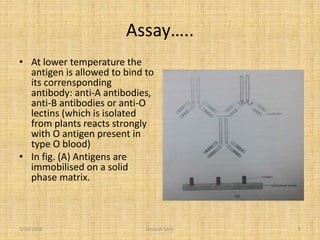
• At lower temperature the
antigen is allowed to bind to
its corrensponding
antibody: anti-A antibodies,
anti-B antibodies or anti-O
lectins (which is isolated
from plants reacts strongly
with O antigen present in
type O blood)
• In fig. (A) Antigens are
immobilised on a solid
phase matrix.
3/10/2016 9Deepak Saini
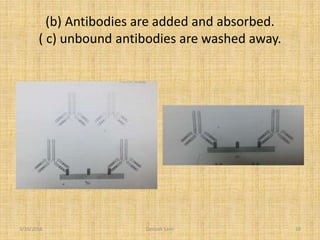
(b) Antibodies are added and absorbed.
( c) unbound antibodies are washed away.
3/10/2016 10Deepak Saini
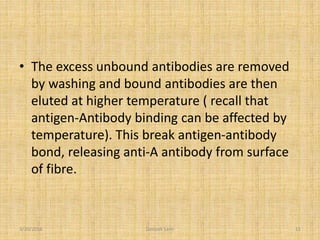
• The excess unbound antibodies are removed
by washing and bound antibodies are then
eluted at higher temperature ( recall that
antigen-Antibody binding can be affected by
temperature). This break antigen-antibody
bond, releasing anti-A antibody from surface
of fibre.
3/10/2016 11Deepak Saini
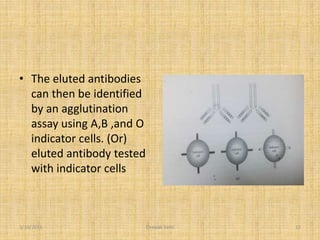
• The eluted antibodies
can then be identified
by an agglutination
assay using A,B ,and O
indicator cells. (Or)
eluted antibody tested
with indicator cells
3/10/2016 12Deepak Saini
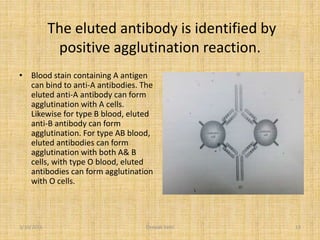
The eluted antibody is identified by
positive agglutination reaction.
• Blood stain containing A antigen
can bind to anti-A antibodies. The
eluted anti-A antibody can form
agglutination with A cells.
Likewise for type B blood, eluted
anti-B antibody can form
agglutination. For type AB blood,
eluted antibodies can form
agglutination with both A& B
cells, with type O blood, eluted
antibodies can form agglutination
with O cells.
3/10/2016 13Deepak Saini
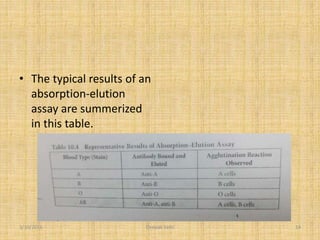
• The typical results of an
absorption-elution
assay are summerized
in this table.
3/10/2016 14Deepak Saini
Thank you,
Have a nice day
3/10/2016 15Deepak Saini

Blood grouping from absorption elution technique

  • 1.
    • Submitted to: Dr.Sapna Sharma Asst. Professor Dept of genetics MDU Rohtak • Submitted by: Deepak Saini M.Sc. Forensic sc. (F) Rollno. -1602 Blood typing from Absorption-elution technique 3/10/2016 1Deepak Saini
  • 2.
    Introduction • In 1923Vittorio Siracusa was the first to use the absorption-elution technique for the ABO blood typing of blood stains. • At crime scene, when there appear to spatters of dried blood, investigators must follow a logical process in order to identify the unknown substance. • Whether material is blood or not? • Whether it is of animal or not? Then it is of which animal species? • Asuming sample is found to blood and blood is from animal that is human the next task is to type the blood group. 3/10/2016 2Deepak Saini
  • 3.
    • The absorption_elutiontest ,published by Vittorio Siracusa, has tremendous forensic utility, because it can be used to identify old and severly dried bloodstains. • When the detemination has been made that a particular stain contains human blood, but the stain is extremly dry, an absorption-elution test can be conducted. 3/10/2016 3Deepak Saini
  • 4.
    • The absorption-elutiontechnique has been used extensively to determine blood group from dried stains, secretions, and teeth in various forensic laboratories. • This method is very sensitive, high specific, It also has been found that the material once used is available for re-use with practically no loss in its antigenic properties. 3/10/2016 4Deepak Saini
  • 5.
    • ABO bloodgrouping system is most widely known and medically important blood type because of its importance in transfusion medicine. Its discovery goes back to 1900, when Karl Landsteiner was trying to solve the mystery that some blood transfusions are life-threatning while others are life- saving. In 1930, he was crowned with Nobel Price for his excellent discovery. • The four basic ABO phenotypes are A,B, AB andO. Apart from man, this system is also found in apes, gorillas and chimpanzee. 3/10/2016 5Deepak Saini
  • 6.
    Importance in forensicbiology • In forensic science, blood typing is one of the preliminary tests, which is done to exclude some suspected sources of bloodstains. Although this test doesn’t clearly indicate the suspect involved because many people share the same blood type. 3/10/2016 6Deepak Saini
  • 7.
    Methods of grouping *In fluid blood samples, the presence or absence of an antigen is ascertained by whether or not the red cells are agglutinated. In dried bloodstains, the cells have ruptured and direct agglutination tests are no longer feasible. * However, the antigens are not immediately denatured upon drying. In ABO system, they survive for many years and retain capability of combining with specific antibody. * The formation of these antigen-antibody complexes is the basis of all methods employed in the detection of red cell antigens in dried bloodstains. 3/10/2016 7Deepak Saini
  • 8.
    Absorption-elution assay • Theabsorption-elusion assay is highly sensitive and can be used for testing dried blood stains. It indirectly detects the presence of antigens. The successful agglutination reaction is usually require intact cells. The agglutination reaction is, therefore difficult to carry out because blood cells lyse when they are dry. However, with this method , the lysed cells containing antigen are immobilized on a solid phase. 3/10/2016 8Deepak Saini
  • 9.
    Assay….. • At lowertemperature the antigen is allowed to bind to its corrensponding antibody: anti-A antibodies, anti-B antibodies or anti-O lectins (which is isolated from plants reacts strongly with O antigen present in type O blood) • In fig. (A) Antigens are immobilised on a solid phase matrix. 3/10/2016 9Deepak Saini
  • 10.
    (b) Antibodies areadded and absorbed. ( c) unbound antibodies are washed away. 3/10/2016 10Deepak Saini
  • 11.
    • The excessunbound antibodies are removed by washing and bound antibodies are then eluted at higher temperature ( recall that antigen-Antibody binding can be affected by temperature). This break antigen-antibody bond, releasing anti-A antibody from surface of fibre. 3/10/2016 11Deepak Saini
  • 12.
    • The elutedantibodies can then be identified by an agglutination assay using A,B ,and O indicator cells. (Or) eluted antibody tested with indicator cells 3/10/2016 12Deepak Saini
  • 13.
    The eluted antibodyis identified by positive agglutination reaction. • Blood stain containing A antigen can bind to anti-A antibodies. The eluted anti-A antibody can form agglutination with A cells. Likewise for type B blood, eluted anti-B antibody can form agglutination. For type AB blood, eluted antibodies can form agglutination with both A& B cells, with type O blood, eluted antibodies can form agglutination with O cells. 3/10/2016 13Deepak Saini
  • 14.
    • The typicalresults of an absorption-elution assay are summerized in this table. 3/10/2016 14Deepak Saini
  • 15.
    Thank you, Have anice day 3/10/2016 15Deepak Saini