The Blood Group Systems 
Dr. Yogendra Vijay 
Resident doctor 
SMS Medical college,Jaipur 
(Rajasthan)
•The blood group you belong to depends on 
what you have inherited from your parents.
• There are more than 20 genetically determined 
blood group systems known today 
• The AB0 and Rhesus (Rh) systems are the 
most important ones used for blood transfusions. 
• Not all blood groups are compatible with each 
other. Mixing incompatible blood groups leads to 
blood clumping or agglutination, which is 
dangerous for individuals.
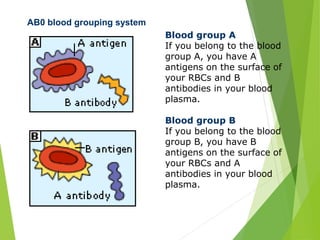
Blood group A 
If you belong to the blood 
group A, you have A 
antigens on the surface of 
your RBCs and B 
antibodies in your blood 
plasma. 
Blood group B 
If you belong to the blood 
group B, you have B 
antigens on the surface of 
your RBCs and A 
antibodies in your blood 
plasma. 
AB0 blood grouping system
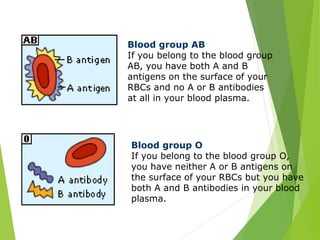
Blood group AB 
If you belong to the blood group 
AB, you have both A and B 
antigens on the surface of your 
RBCs and no A or B antibodies 
at all in your blood plasma. 
Blood group O 
If you belong to the blood group O, 
you have neither A or B antigens on 
the surface of your RBCs but you have 
both A and B antibodies in your blood 
plasma.
• The "A“ and "B" antigens are also produced 
by some other plants and microorganisms. 
Thus, individuals who do not recognize one or 
more of these antigens as "self" will produce 
antibodies against the plant or microbial 
antigens. 
• These antibodies will also react with human 
antigens of the same kind whether introduced 
via a blood transfusion or a tissue graft.
Significance of ABO Group 
 ABO mismatched transfusions: 
 Rare 
 May be life threatening 
 Can be caused by technical or clerical error 
 Intravascular haemolysis 
 More severe in group O patients 
7
ABO inheritance and genetics 
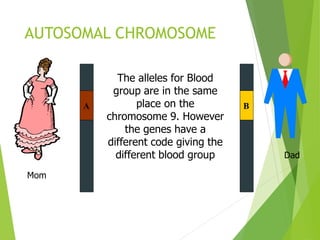
• The ABO gene is autosomal (the gene is not on either sex 
chromosomes) 
• The ABO gene locus is located on the chromosome 9. 
• A and B blood groups are dominant over the O blood group 
• A and B group genes are co-dominant 
• Each person has two copies of genes coding for their ABO blood 
group (one maternal and one paternal in origin)
Principles of Heredity 
 Antigens and enzymes are genetically controlled 
 Genes: responsible for transfer of hereditable material 
 Genes are found on chromosomes, which are found in the nucleus of every cell 
 Human Cells contain 46 chromosomes with the exception of the egg and sperm, 
which contain only 23. 
 23 of these chromosomes are inherited from mother 
 23 of these chromosomes are inherited from father
Genes Come in Pairs 
 The position a gene occupies on a chromosome is called a 
locus. 
 Genes for the same trait are located at the same locus on 
both the mother and the father’s chromosomes. 
 Alternative forms of genes that influence a given 
characteristic are called alleles. 
 Father: allele for brown eyes 
 Mother: allele for blue eyes
Blood Types are Genetic 
 A and B Blood Types are Dominant 
 Dominant: Characteristic is shown 
 Blood Type O is Recessive 
 Recessive: Characteristic is hidden 
 Recessive characteristics only appear when both alleles are recessive 
 Homozygous recessive OO
Phenotype V. Genotype 
 Phenotype: individual’s outward characteristics 
 Genotype: individual’s pair of allele genes together 
 Example: 
 Phenotype Genotype 
Type B Blood Could be BO or 
BB depending 
on parents
Important Parts for Forensic Science 
 Red Blood Cells—because of their importance in blood typing 
 Serum—because of its’ importance in carrying antibodies
ABO and H Antigen Genetics 
 Genes at three separate loci control the occurrence and 
location of ABO antigens 
 The presence or absence of the A, B, and H antigens is 
controlled by the H and ABO genes
Location 
 The presence or absence of the ABH antigens on the red 
blood cell membrane is controlled by the H gene 
 The presence or absence of the ABH antigens in 
secretions is indirectly controlled by the Se gene
ABO Antigen Genetics 
 H gene – H and h alleles (h is an amorph) 
 Se gene – Se and se alleles (se is an amorph) 
 ABO genes – A, B and O alleles
H Antigen 
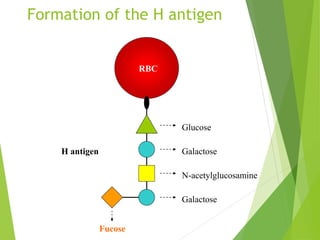
 The H gene codes for an enzyme that adds the sugar 
fucose to the terminal sugar of a precursor substance 
(PS) 
 The precursor substance (proteins and lipids) is formed 
on an oligosaccharide chain (the basic structure)
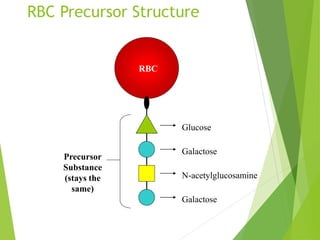
RBC Precursor Structure 
Glucose 
Galactose 
N-acetylglucosamine 
Galactose 
Precursor 
Substance 
(stays the 
same) 
RBC
Formation of the H antigen 
Glucose 
Galactose 
N-acetylglucosamine 
Galactose 
H antigen 
RBC 
Fucose
H antigen 
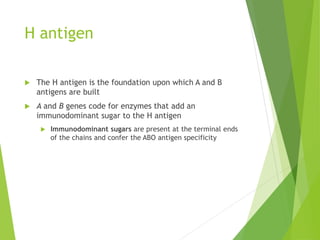
 The H antigen is the foundation upon which A and B 
antigens are built 
 A and B genes code for enzymes that add an 
immunodominant sugar to the H antigen 
 Immunodominant sugars are present at the terminal ends 
of the chains and confer the ABO antigen specificity
A and B Antigen 
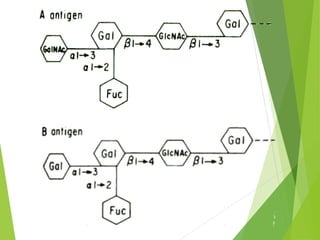
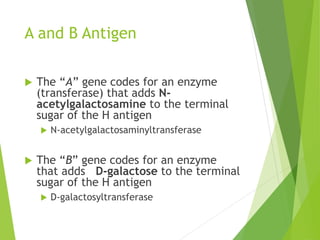
 The “A” gene codes for an enzyme 
(transferase) that adds N-acetylgalactosamine 
to the terminal 
sugar of the H antigen 
 N-acetylgalactosaminyltransferase 
 The “B” gene codes for an enzyme 
that adds D-galactose to the terminal 
sugar of the H antigen 
 D-galactosyltransferase
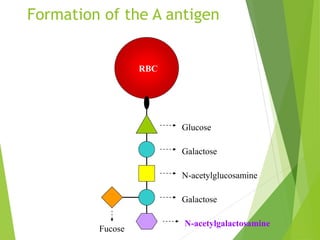
Formation of the A antigen 
Glucose 
Galactose 
N-acetylglucosamine 
Galactose 
RBC 
Fucose 
N-acetylgalactosamine
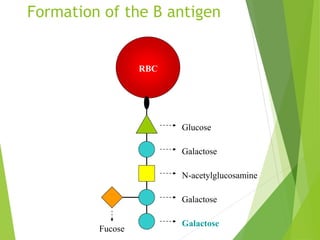
Formation of the B antigen 
Glucose 
Galactose 
N-acetylglucosamine 
Galactose 
RBC 
Fucose 
Galactose
Genetics 
 The H antigen is found on the RBC when you have the 
Hh or HH genotype, but NOT from the hh genotype 
 The A antigen is found on the RBC when you have the 
Hh, HH, and A/A, A/O, or A/B genotypes 
 The B antigen is found on the RBC when you have the 
Hh, HH, and B/B, B/O, or A/B genotypes
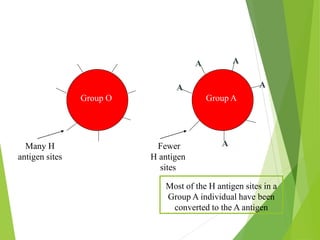
A A 
A A 
Group O Group A 
Many H 
antigen sites 
Fewer 
H antigen 
sites 
A 
Most of the H antigen sites in a 
Group A individual have been 
converted to the A antigen
ABO Antigens in Secretions 
 Secretions include body fluids like plasma, saliva, 
synovial fluid, etc 
 Blood Group Substances are soluble antigens (A, B, and 
H) that can be found in the secretions. This is 
controlled by the H and Se genes
Secretor Status 
 The secretor gene consists of 2 alleles (Se and se) 
 The Se gene is responsible for the expression of the H 
antigen on glycoprotein structures located in body 
secretions 
 If the Se allele is inherited as SeSe or Sese, the person is 
called a “secretor” 
 80% of the population are secretors
Secretors 
 Secretors express soluble forms of the H antigen in 
secretions that can then be converted to A or B antigens 
(by the transferases) 
 Individuals who inherit the sese gene are called 
“nonsecretors” 
 The se allele is an amorph (nothing expressed) 
 sese individuals do not convert antigen precursors to H 
antigen and has neither soluble H antigen nor soluble A or 
B antigens in body fluids
Secretor Status Summary 
 The Se gene codes for the presence of the H antigen in 
secretions, therefore the presence of A and/or B 
antigens in the secretions is contingent on the 
inheritance of the Se gene and the H gene 
Se gene (SeSe 
or Sese) 
H antigen in 
secretions 
A antigen 
B antigen 
se gene (sese) No antigens secreted 
in saliva or other 
body fluids 
and/or
ABO Subgroups 
 ABO subgroups differ in the amount of 
antigen present on the red blood cell 
membrane 
 Subgroups have less antigen 
 Subgroups are the result of less 
effective enzymes. They are not as 
efficient in converting H antigens to A 
or B antigens (fewer antigens are 
present on the RBC) 
 Subgroups of A are more common than 
subgroups of B
Subgroups of A 
 The 2 principle subgroups of A are: A1 and A2 
 Both react strongly with reagent anti-A 
 To distinguish A1 from A2 red cells, the lectin Dolichos 
biflorus is used (anti-A1) 
 80% of group A or AB individuals are subgroup A1 
 20% are A2 and A2B
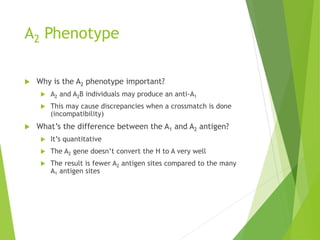
A2 Phenotype 
 Why is the A2 phenotype important? 
 A2 and A2B individuals may produce an anti-A1 
 This may cause discrepancies when a crossmatch is done 
(incompatibility) 
 What’s the difference between the A1 and A2 antigen? 
 It’s quantitative 
 The A2 gene doesn’t convert the H to A very well 
 The result is fewer A2 antigen sites compared to the many 
A1 antigen sites
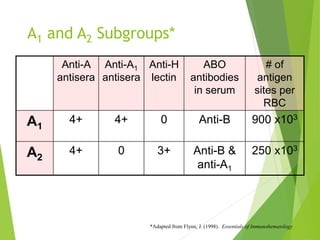
A1 and A2 Subgroups* 
Anti-A 
antisera 
Anti-A1 
antisera 
Anti-H 
lectin 
ABO 
antibodies 
in serum 
# of 
antigen 
sites per 
RBC 
A1 
4+ 4+ 0 Anti-B 900 x103 
A2 
4+ 0 3+ Anti-B & 
anti-A1 
250 x103 
*Adapted from Flynn, J. (1998). Essentials of Immunohematology
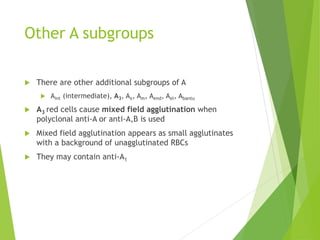
Other A subgroups 
 There are other additional subgroups of A 
 Aint (intermediate), A3, Ax, Am, Aend, Ael, Abantu 
 A3 red cells cause mixed field agglutination when 
polyclonal anti-A or anti-A,B is used 
 Mixed field agglutination appears as small agglutinates 
with a background of unagglutinated RBCs 
 They may contain anti-A1
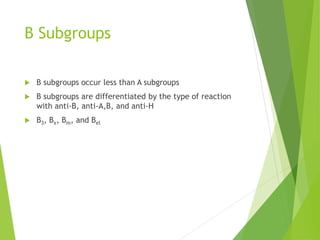
B Subgroups 
 B subgroups occur less than A subgroups 
 B subgroups are differentiated by the type of reaction 
with anti-B, anti-A,B, and anti-H 
 B3, Bx, Bm, and Bel
ABO Blood Group: 
ABO Antibodies
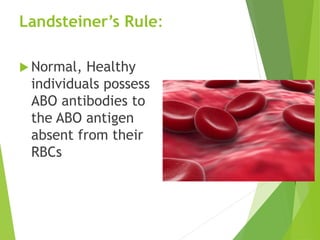
Landsteiner’s Rule: 
Normal, Healthy 
individuals possess 
ABO antibodies to 
the ABO antigen 
absent from their 
RBCs
Blood Group Systems 
 Most blood group systems (ABO and 
others) are made up of: 
 An antigen on a red cell and the 
absence of it’s corresponding antibody 
in the serum (if you’re A, you don’t 
have anti-A) 
 If you do NOT have a particular antigen 
on your red cells then it is possible (when 
exposed to foreign RBCs) to illicit an 
immune response that results in the 
production of the antibody specific for 
the missing antigen
ABO 
The ABO Blood Group System 
does NOT require the presence of 
a foreign red blood cell for the 
production of ABO antibodies 
 ABO antibodies are “non-red 
blood cell stimulated” probably 
from environmental exposure and 
are referred to as “expected 
antibodies”
Anti-A1 
 Group O and B individuals contain 
anti-A in their serum 
 However, the anti-A can be 
separated into different 
components: anti-A and anti-A1 
 Anti-A1 only agglutinates the A1 
antigen, not the A2 antigen 
 There is no anti-A2.
Anti-A,B 
 Found in the serum of group O 
individuals 
Reacts with A, B, and AB cells 
 Predominately IgG, with small 
portions being IgM 
 Anti-A,B is one antibody, it is 
not a mixture of anti-A and 
anti-B antibodies
ABO antibodies 
 IgM is the predominant antibody in Group 
A and Group B individuals 
 Anti-A 
 Anti-B 
 IgG (with some IgM) is the predominant 
antibody in Group O individuals 
 Anti-A,B (with some anti-A and anti-B)
ABO antibody facts 
 Reactions phase: Room 
temperature 
 Complement can be activated with 
ABO antibodies (mostly IgM, some 
IgG) 
 High titer: react strongly (4+)
ABO Antibodies 
 Usually present within the first 3-6 
months of life 
 Stable by ages 5-6 years 
 Decline in older age 
 Newborns may passively acquire maternal 
antibodies (IgG crosses placenta) 
 Reverse grouping (with serum) should 
not be performed on newborns or cord 
blood
Paternity Tests 
 No blood group can be present in a child without being 
present in one of the parents 
 Paternity tests can be resolved in this way unless disputed 
fathers have the same blood type 
 Paternity tests can also be determined by using DNA testing
Blood as Evidence 
 Blood typing not so useful anymore because of DNA technology 
 Scientists can now characterize biological evidence by 
selecting regions of our DNA
AUTOSOMAL CHROMOSOME 
Dad 
Mom 
The alleles for Blood 
group are in the same 
place on the 
A B 
chromosome 9. However 
the genes have a 
different code giving the 
different blood group
What do co-dominant genes mean? 
This meant that if a person inherited one A group gene and one 
B group gene their red cells would possess both the A and B 
blood group antigens. 
These alleles were termed A ( which produced the A antigen ), 
B (which produced the B antigen) and O (which was "non 
functional"and produced no A or B antigen)
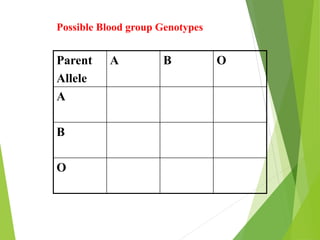
Possible Blood group Genotypes 
Parent 
Allele 
A B O 
A 
B 
O
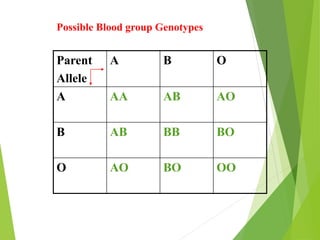
Possible Blood group Genotypes 
Parent 
Allele 
A B O 
A AA AB AO 
B AB BB BO 
O AO BO OO
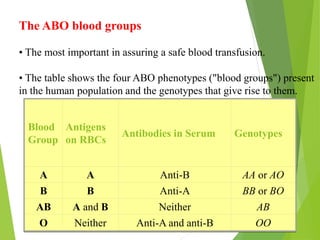
The ABO blood groups 
• The most important in assuring a safe blood transfusion. 
• The table shows the four ABO phenotypes ("blood groups") present 
in the human population and the genotypes that give rise to them. 
Blood 
Group 
Antigens 
on RBCs 
Antibodies in Serum Genotypes 
A A Anti-B AA or AO 
B B Anti-A BB or BO 
AB A and B Neither AB 
O Neither Anti-A and anti-B OO
The ABO Blood Group System 
Laboratory Determination of the 
ABO System
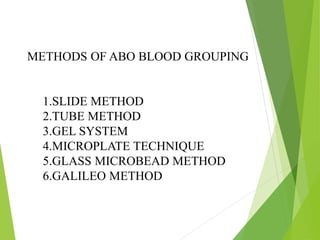
METHODS OF ABO BLOOD GROUPING 
1.SLIDE METHOD 
2.TUBE METHOD 
3.GEL SYSTEM 
4.MICROPLATE TECHNIQUE 
5.GLASS MICROBEAD METHOD 
6.GALILEO METHOD
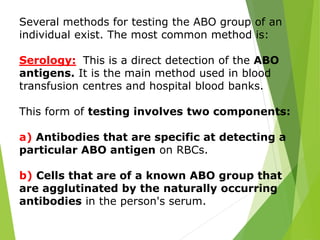
Several methods for testing the ABO group of an 
individual exist. The most common method is: 
Serology: This is a direct detection of the ABO 
antigens. It is the main method used in blood 
transfusion centres and hospital blood banks. 
This form of testing involves two components: 
a) Antibodies that are specific at detecting a 
particular ABO antigen on RBCs. 
b) Cells that are of a known ABO group that 
are agglutinated by the naturally occurring 
antibodies in the person's serum.
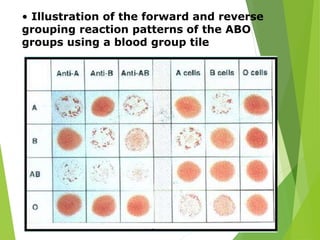
• Illustration of the forward and reverse 
grouping reaction patterns of the ABO 
groups using a blood group tile
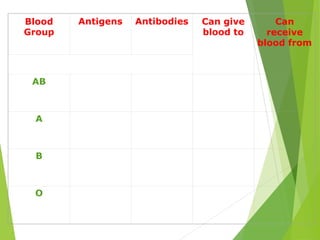
Blood 
Group 
Antigens Antibodies Can give 
blood to 
Can 
receive 
blood from 
AB 
A 
B 
O
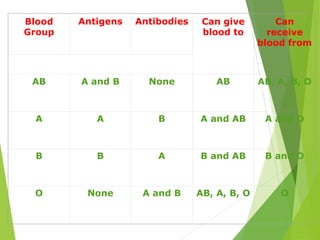
Blood 
Group 
Antigens Antibodies Can give 
blood to 
Can 
receive 
blood from 
AB A and B None AB AB, A, B, O 
A A B A and AB A and O 
B B A B and AB B and O 
O None A and B AB, A, B, O O

Abo blood groups

  • 1.
    The Blood GroupSystems Dr. Yogendra Vijay Resident doctor SMS Medical college,Jaipur (Rajasthan)
  • 2.
    •The blood groupyou belong to depends on what you have inherited from your parents.
  • 3.
    • There aremore than 20 genetically determined blood group systems known today • The AB0 and Rhesus (Rh) systems are the most important ones used for blood transfusions. • Not all blood groups are compatible with each other. Mixing incompatible blood groups leads to blood clumping or agglutination, which is dangerous for individuals.
  • 4.
    Blood group A If you belong to the blood group A, you have A antigens on the surface of your RBCs and B antibodies in your blood plasma. Blood group B If you belong to the blood group B, you have B antigens on the surface of your RBCs and A antibodies in your blood plasma. AB0 blood grouping system
  • 5.
    Blood group AB If you belong to the blood group AB, you have both A and B antigens on the surface of your RBCs and no A or B antibodies at all in your blood plasma. Blood group O If you belong to the blood group O, you have neither A or B antigens on the surface of your RBCs but you have both A and B antibodies in your blood plasma.
  • 6.
    • The "A“and "B" antigens are also produced by some other plants and microorganisms. Thus, individuals who do not recognize one or more of these antigens as "self" will produce antibodies against the plant or microbial antigens. • These antibodies will also react with human antigens of the same kind whether introduced via a blood transfusion or a tissue graft.
  • 7.
    Significance of ABOGroup  ABO mismatched transfusions:  Rare  May be life threatening  Can be caused by technical or clerical error  Intravascular haemolysis  More severe in group O patients 7
  • 8.
    ABO inheritance andgenetics • The ABO gene is autosomal (the gene is not on either sex chromosomes) • The ABO gene locus is located on the chromosome 9. • A and B blood groups are dominant over the O blood group • A and B group genes are co-dominant • Each person has two copies of genes coding for their ABO blood group (one maternal and one paternal in origin)
  • 9.
    Principles of Heredity  Antigens and enzymes are genetically controlled  Genes: responsible for transfer of hereditable material  Genes are found on chromosomes, which are found in the nucleus of every cell  Human Cells contain 46 chromosomes with the exception of the egg and sperm, which contain only 23.  23 of these chromosomes are inherited from mother  23 of these chromosomes are inherited from father
  • 10.
    Genes Come inPairs  The position a gene occupies on a chromosome is called a locus.  Genes for the same trait are located at the same locus on both the mother and the father’s chromosomes.  Alternative forms of genes that influence a given characteristic are called alleles.  Father: allele for brown eyes  Mother: allele for blue eyes
  • 11.
    Blood Types areGenetic  A and B Blood Types are Dominant  Dominant: Characteristic is shown  Blood Type O is Recessive  Recessive: Characteristic is hidden  Recessive characteristics only appear when both alleles are recessive  Homozygous recessive OO
  • 12.
    Phenotype V. Genotype  Phenotype: individual’s outward characteristics  Genotype: individual’s pair of allele genes together  Example:  Phenotype Genotype Type B Blood Could be BO or BB depending on parents
  • 13.
    Important Parts forForensic Science  Red Blood Cells—because of their importance in blood typing  Serum—because of its’ importance in carrying antibodies
  • 14.
    ABO and HAntigen Genetics  Genes at three separate loci control the occurrence and location of ABO antigens  The presence or absence of the A, B, and H antigens is controlled by the H and ABO genes
  • 15.
    Location  Thepresence or absence of the ABH antigens on the red blood cell membrane is controlled by the H gene  The presence or absence of the ABH antigens in secretions is indirectly controlled by the Se gene
  • 16.
    ABO Antigen Genetics  H gene – H and h alleles (h is an amorph)  Se gene – Se and se alleles (se is an amorph)  ABO genes – A, B and O alleles
  • 17.
    H Antigen The H gene codes for an enzyme that adds the sugar fucose to the terminal sugar of a precursor substance (PS)  The precursor substance (proteins and lipids) is formed on an oligosaccharide chain (the basic structure)
  • 18.
    RBC Precursor Structure Glucose Galactose N-acetylglucosamine Galactose Precursor Substance (stays the same) RBC
  • 19.
    Formation of theH antigen Glucose Galactose N-acetylglucosamine Galactose H antigen RBC Fucose
  • 21.
    H antigen The H antigen is the foundation upon which A and B antigens are built  A and B genes code for enzymes that add an immunodominant sugar to the H antigen  Immunodominant sugars are present at the terminal ends of the chains and confer the ABO antigen specificity
  • 22.
    A and BAntigen  The “A” gene codes for an enzyme (transferase) that adds N-acetylgalactosamine to the terminal sugar of the H antigen  N-acetylgalactosaminyltransferase  The “B” gene codes for an enzyme that adds D-galactose to the terminal sugar of the H antigen  D-galactosyltransferase
  • 23.
    Formation of theA antigen Glucose Galactose N-acetylglucosamine Galactose RBC Fucose N-acetylgalactosamine
  • 24.
    Formation of theB antigen Glucose Galactose N-acetylglucosamine Galactose RBC Fucose Galactose
  • 25.
    Genetics  TheH antigen is found on the RBC when you have the Hh or HH genotype, but NOT from the hh genotype  The A antigen is found on the RBC when you have the Hh, HH, and A/A, A/O, or A/B genotypes  The B antigen is found on the RBC when you have the Hh, HH, and B/B, B/O, or A/B genotypes
  • 26.
    A A AA Group O Group A Many H antigen sites Fewer H antigen sites A Most of the H antigen sites in a Group A individual have been converted to the A antigen
  • 27.
    ABO Antigens inSecretions  Secretions include body fluids like plasma, saliva, synovial fluid, etc  Blood Group Substances are soluble antigens (A, B, and H) that can be found in the secretions. This is controlled by the H and Se genes
  • 28.
    Secretor Status The secretor gene consists of 2 alleles (Se and se)  The Se gene is responsible for the expression of the H antigen on glycoprotein structures located in body secretions  If the Se allele is inherited as SeSe or Sese, the person is called a “secretor”  80% of the population are secretors
  • 29.
    Secretors  Secretorsexpress soluble forms of the H antigen in secretions that can then be converted to A or B antigens (by the transferases)  Individuals who inherit the sese gene are called “nonsecretors”  The se allele is an amorph (nothing expressed)  sese individuals do not convert antigen precursors to H antigen and has neither soluble H antigen nor soluble A or B antigens in body fluids
  • 30.
    Secretor Status Summary  The Se gene codes for the presence of the H antigen in secretions, therefore the presence of A and/or B antigens in the secretions is contingent on the inheritance of the Se gene and the H gene Se gene (SeSe or Sese) H antigen in secretions A antigen B antigen se gene (sese) No antigens secreted in saliva or other body fluids and/or
  • 31.
    ABO Subgroups ABO subgroups differ in the amount of antigen present on the red blood cell membrane  Subgroups have less antigen  Subgroups are the result of less effective enzymes. They are not as efficient in converting H antigens to A or B antigens (fewer antigens are present on the RBC)  Subgroups of A are more common than subgroups of B
  • 32.
    Subgroups of A  The 2 principle subgroups of A are: A1 and A2  Both react strongly with reagent anti-A  To distinguish A1 from A2 red cells, the lectin Dolichos biflorus is used (anti-A1)  80% of group A or AB individuals are subgroup A1  20% are A2 and A2B
  • 33.
    A2 Phenotype Why is the A2 phenotype important?  A2 and A2B individuals may produce an anti-A1  This may cause discrepancies when a crossmatch is done (incompatibility)  What’s the difference between the A1 and A2 antigen?  It’s quantitative  The A2 gene doesn’t convert the H to A very well  The result is fewer A2 antigen sites compared to the many A1 antigen sites
  • 34.
    A1 and A2Subgroups* Anti-A antisera Anti-A1 antisera Anti-H lectin ABO antibodies in serum # of antigen sites per RBC A1 4+ 4+ 0 Anti-B 900 x103 A2 4+ 0 3+ Anti-B & anti-A1 250 x103 *Adapted from Flynn, J. (1998). Essentials of Immunohematology
  • 35.
    Other A subgroups  There are other additional subgroups of A  Aint (intermediate), A3, Ax, Am, Aend, Ael, Abantu  A3 red cells cause mixed field agglutination when polyclonal anti-A or anti-A,B is used  Mixed field agglutination appears as small agglutinates with a background of unagglutinated RBCs  They may contain anti-A1
  • 36.
    B Subgroups B subgroups occur less than A subgroups  B subgroups are differentiated by the type of reaction with anti-B, anti-A,B, and anti-H  B3, Bx, Bm, and Bel
  • 37.
    ABO Blood Group: ABO Antibodies
  • 38.
    Landsteiner’s Rule: Normal,Healthy individuals possess ABO antibodies to the ABO antigen absent from their RBCs
  • 39.
    Blood Group Systems  Most blood group systems (ABO and others) are made up of:  An antigen on a red cell and the absence of it’s corresponding antibody in the serum (if you’re A, you don’t have anti-A)  If you do NOT have a particular antigen on your red cells then it is possible (when exposed to foreign RBCs) to illicit an immune response that results in the production of the antibody specific for the missing antigen
  • 40.
    ABO The ABOBlood Group System does NOT require the presence of a foreign red blood cell for the production of ABO antibodies  ABO antibodies are “non-red blood cell stimulated” probably from environmental exposure and are referred to as “expected antibodies”
  • 41.
    Anti-A1  GroupO and B individuals contain anti-A in their serum  However, the anti-A can be separated into different components: anti-A and anti-A1  Anti-A1 only agglutinates the A1 antigen, not the A2 antigen  There is no anti-A2.
  • 42.
    Anti-A,B  Foundin the serum of group O individuals Reacts with A, B, and AB cells  Predominately IgG, with small portions being IgM  Anti-A,B is one antibody, it is not a mixture of anti-A and anti-B antibodies
  • 43.
    ABO antibodies IgM is the predominant antibody in Group A and Group B individuals  Anti-A  Anti-B  IgG (with some IgM) is the predominant antibody in Group O individuals  Anti-A,B (with some anti-A and anti-B)
  • 44.
    ABO antibody facts  Reactions phase: Room temperature  Complement can be activated with ABO antibodies (mostly IgM, some IgG)  High titer: react strongly (4+)
  • 45.
    ABO Antibodies Usually present within the first 3-6 months of life  Stable by ages 5-6 years  Decline in older age  Newborns may passively acquire maternal antibodies (IgG crosses placenta)  Reverse grouping (with serum) should not be performed on newborns or cord blood
  • 46.
    Paternity Tests No blood group can be present in a child without being present in one of the parents  Paternity tests can be resolved in this way unless disputed fathers have the same blood type  Paternity tests can also be determined by using DNA testing
  • 47.
    Blood as Evidence  Blood typing not so useful anymore because of DNA technology  Scientists can now characterize biological evidence by selecting regions of our DNA
  • 48.
    AUTOSOMAL CHROMOSOME Dad Mom The alleles for Blood group are in the same place on the A B chromosome 9. However the genes have a different code giving the different blood group
  • 49.
    What do co-dominantgenes mean? This meant that if a person inherited one A group gene and one B group gene their red cells would possess both the A and B blood group antigens. These alleles were termed A ( which produced the A antigen ), B (which produced the B antigen) and O (which was "non functional"and produced no A or B antigen)
  • 50.
    Possible Blood groupGenotypes Parent Allele A B O A B O
  • 51.
    Possible Blood groupGenotypes Parent Allele A B O A AA AB AO B AB BB BO O AO BO OO
  • 52.
    The ABO bloodgroups • The most important in assuring a safe blood transfusion. • The table shows the four ABO phenotypes ("blood groups") present in the human population and the genotypes that give rise to them. Blood Group Antigens on RBCs Antibodies in Serum Genotypes A A Anti-B AA or AO B B Anti-A BB or BO AB A and B Neither AB O Neither Anti-A and anti-B OO
  • 53.
    The ABO BloodGroup System Laboratory Determination of the ABO System
  • 54.
    METHODS OF ABOBLOOD GROUPING 1.SLIDE METHOD 2.TUBE METHOD 3.GEL SYSTEM 4.MICROPLATE TECHNIQUE 5.GLASS MICROBEAD METHOD 6.GALILEO METHOD
  • 55.
    Several methods fortesting the ABO group of an individual exist. The most common method is: Serology: This is a direct detection of the ABO antigens. It is the main method used in blood transfusion centres and hospital blood banks. This form of testing involves two components: a) Antibodies that are specific at detecting a particular ABO antigen on RBCs. b) Cells that are of a known ABO group that are agglutinated by the naturally occurring antibodies in the person's serum.
  • 56.
    • Illustration ofthe forward and reverse grouping reaction patterns of the ABO groups using a blood group tile
  • 57.
    Blood Group AntigensAntibodies Can give blood to Can receive blood from AB A B O
  • 58.
    Blood Group AntigensAntibodies Can give blood to Can receive blood from AB A and B None AB AB, A, B, O A A B A and AB A and O B B A B and AB B and O O None A and B AB, A, B, O O