DONOR SELECTION AND
BLOOD COLLECTION
Presented By:
Dr Kriti Chaturvedi
BLOOD TRANSFUSION SERVICES (BTS)
AIM
 Provide safe, adequate, effective and timely supply of
blood and blood components
 Ensure safety of donor and recipient.
DONOR RECRUITMENT STRATEGIES
 Pure voluntary based donations
 Social persuasion based donations
 Remunerated based donations
PURE VOLUNTARY BASED DONORS
 A voluntary donor donates the blood on his/her own
free will
 Does not expect any monetary benefit
SOCIAL PERSUASION BASED DONATIONS
Blood donated with persuasion and pressure of:
• friends and colleagues
• heads of religious organizations
• political leaders
Replacement donors:
• Donate blood for specific patients
REMUNERATED BASED DONATIONS
These donations are done by blood sellers (paid professional
donors) .
Due to frequent donations their blood is mostly of poor
quality and may carry infection.
Donor Selection and Counseling
STEPS:
1. Pre-donation information
2. Pre-donation counseling
3. Donor Questionnaire and Health check up
4. Counseling during blood donation
5. Post-donation counseling
Pre-donation information:
•Blood donation process
•Use of blood and its components
•Eligibility for blood donation
•Pre-donation health assessment
•Options for the donor to withdraw or self-defer at any
time.
•Potential adverse donor reactions
•Common Transfusion transmitted infection (TTI),
modes of transmission.
•Basic information on tests performed on donated
blood
Medium:
•IEC material (Information education and communication) like
leaflets, posters etc.
•One-on-one group
•Integrated with the activities undertaken for donor recruitment
Pre-donation Counseling
•Understanding of Donor Questionnaire
•Understanding of TTI testing.
•Explain self-deferral
•Explain temporary and permanent deferral
•Familiarize donor to process of blood donation
•Obtain donor’s Informed consent
Donor Questionnaire and Health Check-up
Includes:
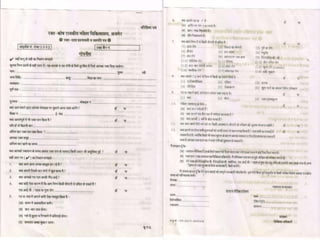
•Demographic details of the donor
•Relevant history
•Informed consent of the donor
•Limited physical examination and blood test.
Questionnaire -prepared in English and Local languages
For illiterate donors -assistance provided by staff.
Informed regarding testing of blood
Opportunity to ask questions and refuse consent
.
Basic health check up:
•History taking
•Limited physical examination
•Hb test
Counseling during donation
1. Reduce donor anxiety and minimizing the risk of any
adverse donor reactions such as fainting
2. Foster donor trust and confidence for donor retention
3. Thanking the donor for his valuable contribution
Post-donation counseling:
1.Instructions on self-care
o Drink plenty of fluids
o Avoid heavy work
o Avoid smoking or driving immediately post donation
2 Advice regarding care of the venipuncture site
3.Information about specific adverse donor reactions
4.Message on regular blood donation
5.Donor feedback
6.Issuance of donor card, donor certificate or a memento
DONOR’S DEMOGRAPHIC INFORMATION
 Donor’s full name
 Father/husband’s name
 Date of birth/age
 Gender
 Residential and official addresses with phone
numbers
Donor can be informed about abnormal test
results or may be called for future donations.
OCCUPATIONAL HISTORY
 Air crews
 drivers of long distance vehicles
 construction workers on high buildings
Advised not to give blood within 12 hours of going on duty.
 Health-care workers
 Police, military personnel
 Work with animals
Carry an increased risk of exposure to blood-borne infections.
Questioned about exposure risk .
Deferral period of 6–12 months , based on the incubation
period.
MEDICAL HISTORY
 Present health status
Time since last meal
Medicine intake
H/O alcohol intake
H/O recent vaccination or immunization
 H/O epileptic fits ,convulsions or mental disorders.
 H/O jaundice or hepatitis
 H/O HBV and HCV
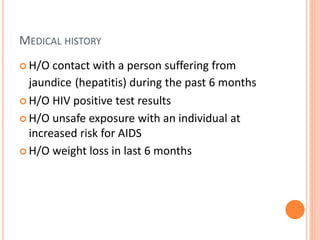
MEDICAL HISTORY
 H/O contact with a person suffering from
jaundice (hepatitis) during the past 6 months
 H/O HIV positive test results
 H/O unsafe exposure with an individual at
increased risk for AIDS
 H/O weight loss in last 6 months
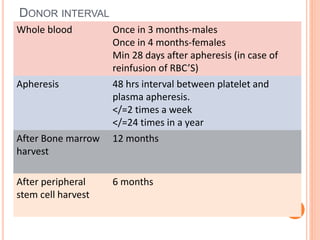
DONOR INTERVAL
Whole blood Once in 3 months-males
Once in 4 months-females
Min 28 days after apheresis (in case of
reinfusion of RBC’S)
Apheresis 48 hrs interval between platelet and
plasma apheresis.
</=2 times a week
</=24 times in a year
After Bone marrow
harvest
12 months
After peripheral
stem cell harvest
6 months
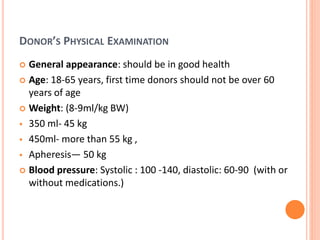
DONOR’S PHYSICAL EXAMINATION
 General appearance: should be in good health
 Age: 18-65 years, first time donors should not be over 60
years of age
 Weight: (8-9ml/kg BW)
 350 ml- 45 kg
 450ml- more than 55 kg ,
 Apheresis— 50 kg
 Blood pressure: Systolic : 100 -140, diastolic: 60-90 (with or
without medications.)
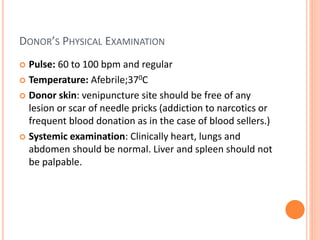
DONOR’S PHYSICAL EXAMINATION
 Pulse: 60 to 100 bpm and regular
 Temperature: Afebrile;370C
 Donor skin: venipuncture site should be free of any
lesion or scar of needle pricks (addiction to narcotics or
frequent blood donation as in the case of blood sellers.)
 Systemic examination: Clinically heart, lungs and
abdomen should be normal. Liver and spleen should not
be palpable.
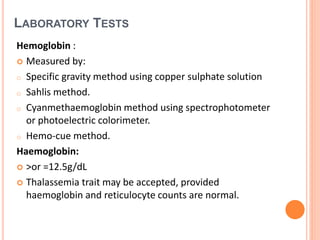
LABORATORY TESTS
Hemoglobin :
 Measured by:
o Specific gravity method using copper sulphate solution
o Sahlis method.
o Cyanmethaemoglobin method using spectrophotometer
or photoelectric colorimeter.
o Hemo-cue method.
Haemoglobin:
 >or =12.5g/dL
 Thalassemia trait may be accepted, provided
haemoglobin and reticulocyte counts are normal.
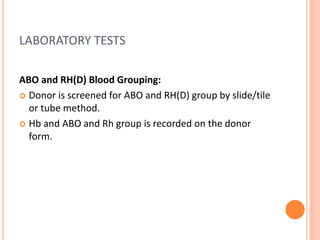
LABORATORY TESTS
ABO and RH(D) Blood Grouping:
 Donor is screened for ABO and RH(D) group by slide/tile
or tube method.
 Hb and ABO and Rh group is recorded on the donor
form.
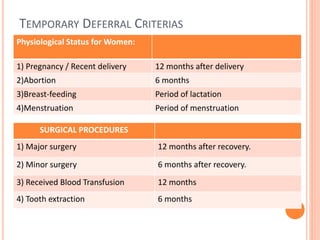
TEMPORARY DEFERRAL CRITERIAS
Physiological Status for Women:
1) Pregnancy / Recent delivery 12 months after delivery
2)Abortion 6 months
3)Breast-feeding Period of lactation
4)Menstruation Period of menstruation
SURGICAL PROCEDURES
1) Major surgery 12 months after recovery.
2) Minor surgery 6 months after recovery.
3) Received Blood Transfusion 12 months
4) Tooth extraction 6 months
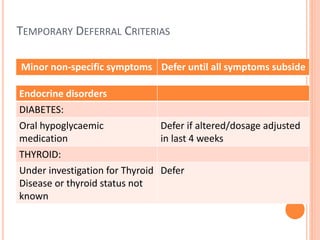
Endocrine disorders
DIABETES:
Oral hypoglycaemic
medication
Defer if altered/dosage adjusted
in last 4 weeks
THYROID:
Under investigation for Thyroid
Disease or thyroid status not
known
Defer
TEMPORARY DEFERRAL CRITERIAS
Minor non-specific symptoms Defer until all symptoms subside
TEMPORARY DEFERRAL CRITERIAS
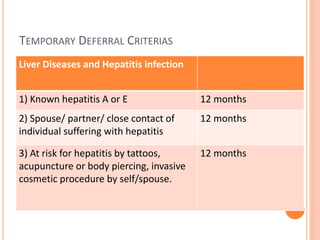
Liver Diseases and Hepatitis infection
1) Known hepatitis A or E 12 months
2) Spouse/ partner/ close contact of
individual suffering with hepatitis
12 months
3) At risk for hepatitis by tattoos,
acupuncture or body piercing, invasive
cosmetic procedure by self/spouse.
12 months
TEMPORARY DEFERRAL CRITERIAS
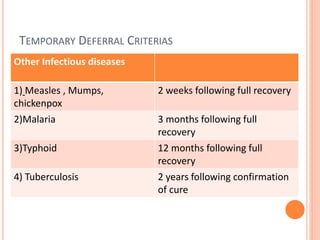
Other Infectious diseases
1) Measles , Mumps,
chickenpox
2 weeks following full recovery
2)Malaria 3 months following full
recovery
3)Typhoid 12 months following full
recovery
4) Tuberculosis 2 years following confirmation
of cure
TEMPORARY DEFERRAL CRITERIAS
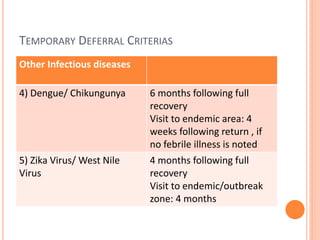
Other Infectious diseases
4) Dengue/ Chikungunya 6 months following full
recovery
Visit to endemic area: 4
weeks following return , if
no febrile illness is noted
5) Zika Virus/ West Nile
Virus
4 months following full
recovery
Visit to endemic/outbreak
zone: 4 months
TEMPORARY DEFERRAL CRITERIAS
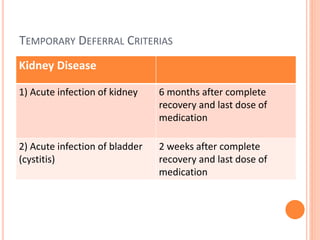
Kidney Disease
1) Acute infection of kidney 6 months after complete
recovery and last dose of
medication
2) Acute infection of bladder
(cystitis)
2 weeks after complete
recovery and last dose of
medication
TEMPORARY DEFERRAL CRITERIAS
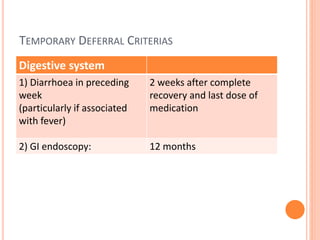
Digestive system
1) Diarrhoea in preceding
week
(particularly if associated
with fever)
2 weeks after complete
recovery and last dose of
medication
2) GI endoscopy: 12 months
TEMPORARY DEFERRAL CRITERIAS
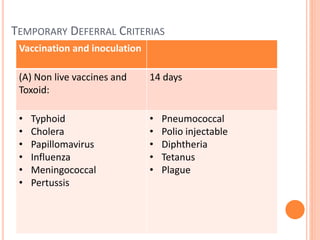
Vaccination and inoculation
(A) Non live vaccines and
Toxoid:
14 days
• Typhoid
• Cholera
• Papillomavirus
• Influenza
• Meningococcal
• Pertussis
• Pneumococcal
• Polio injectable
• Diphtheria
• Tetanus
• Plague
TEMPORARY DEFERRAL CRITERIAS
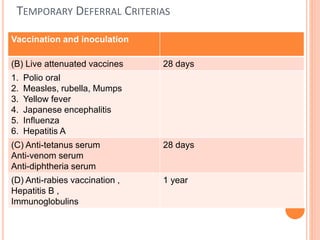
Vaccination and inoculation
(B) Live attenuated vaccines 28 days
1. Polio oral
2. Measles, rubella, Mumps
3. Yellow fever
4. Japanese encephalitis
5. Influenza
6. Hepatitis A
(C) Anti-tetanus serum
Anti-venom serum
Anti-diphtheria serum
28 days
(D) Anti-rabies vaccination ,
Hepatitis B ,
Immunoglobulins
1 year
TEMPORARY DEFERRAL CRITERIAS
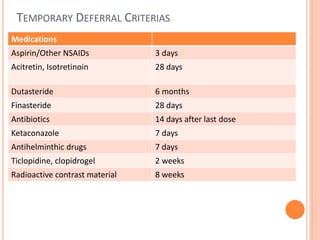
Medications
Aspirin/Other NSAIDs 3 days
Acitretin, Isotretinoin 28 days
Dutasteride 6 months
Finasteride 28 days
Antibiotics 14 days after last dose
Ketaconazole 7 days
Antihelminthic drugs 7 days
Ticlopidine, clopidrogel 2 weeks
Radioactive contrast material 8 weeks
PERMANENT DEFERRAL CRITERIAS
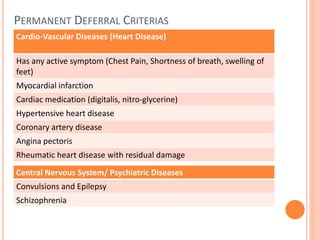
Cardio-Vascular Diseases (Heart Disease)
Has any active symptom (Chest Pain, Shortness of breath, swelling of
feet)
Myocardial infarction
Cardiac medication (digitalis, nitro-glycerine)
Hypertensive heart disease
Coronary artery disease
Angina pectoris
Rheumatic heart disease with residual damage
Central Nervous System/ Psychiatric Diseases
Convulsions and Epilepsy
Schizophrenia
PERMANENT DEFERRAL CRITERIAS
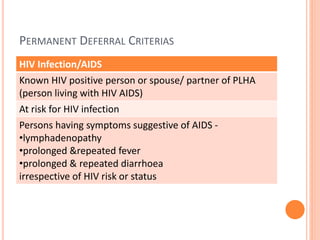
HIV Infection/AIDS
Known HIV positive person or spouse/ partner of PLHA
(person living with HIV AIDS)
At risk for HIV infection
Persons having symptoms suggestive of AIDS -
•lymphadenopathy
•prolonged &repeated fever
•prolonged & repeated diarrhoea
irrespective of HIV risk or status
PERMANENT DEFERRAL CRITERIAS
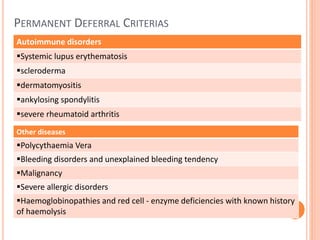
Autoimmune disorders
Systemic lupus erythematosis
scleroderma
dermatomyositis
ankylosing spondylitis
severe rheumatoid arthritis
Other diseases
Polycythaemia Vera
Bleeding disorders and unexplained bleeding tendency
Malignancy
Severe allergic disorders
Haemoglobinopathies and red cell - enzyme deficiencies with known history
of haemolysis
PERMANENT DEFERRAL CRITERIAS
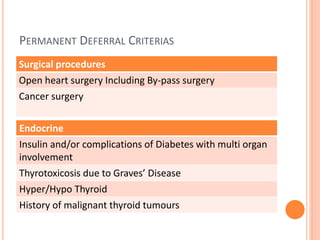
Surgical procedures
Open heart surgery Including By-pass surgery
Cancer surgery
Endocrine
Insulin and/or complications of Diabetes with multi organ
involvement
Thyrotoxicosis due to Graves’ Disease
Hyper/Hypo Thyroid
History of malignant thyroid tumours
PERMANENT DEFERRAL CRITERIAS
Liver Diseases and Hepatitis infection
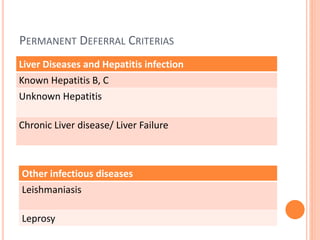
Known Hepatitis B, C
Unknown Hepatitis
Chronic Liver disease/ Liver Failure
Other infectious diseases
Leishmaniasis
Leprosy
PERMANENT DEFERRAL CRITERIAS
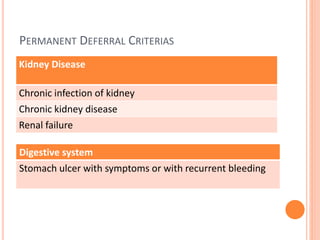
Kidney Disease
Chronic infection of kidney
Chronic kidney disease
Renal failure
Digestive system
Stomach ulcer with symptoms or with recurrent bleeding
PERMANENT DEFERRAL CRITERIAS
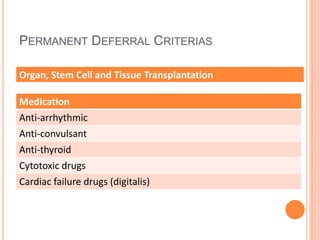
Organ, Stem Cell and Tissue Transplantation
Medication
Anti-arrhythmic
Anti-convulsant
Anti-thyroid
Cytotoxic drugs
Cardiac failure drugs (digitalis)
BLOOD COLLECTION
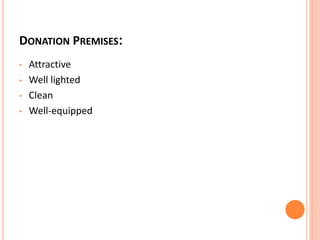
DONATION PREMISES:
• Attractive
• Well lighted
• Clean
• Well-equipped
Out-door blood collection:
 Advance visit
 Personnel -trained to recognize unsafe conditions and
understand infection control policies and procedures.
 Hand washing
 Carpeted or difficult-to-clean surfaces can be protected with a
clean suitable overlay
 Portable screens to protect and maintain safe work areas.
 Refreshment area- separate from area of blood collection
 Blood-contaminated waste- packaged and returned to a central
location for disposal
Equipment and Materials
•Blood Containers:
Polyvinyl chloride (PVC) plastic bags-
closed system
 single, double or triple bags for collection of 350 ml or 450 ml blood.
 anticoagulant solutions:
citrate-phosphate-dextrose (CPD) or citrate-phosphate-dextrose-
adenine (CPDA-1)
volume :49 ml for 350 ml or 63 ml for 450 ml of blood
(14 ml CPD or CPDA-1 for 100 ml blood).
•Sphygmomanometer
•Donor couch
Equipment and material:
•Automatic mixing of blood and weighing of blood bag machine
•Plastic clips, di-electric tube sealer or aluminium clips
•Sterile cotton swabs and band-aids/bandages
•Methylated spirit, tincture of iodine, providone-iodine solution (1
%) & alcohol
EMERGENCY DRUGS
• Intravenous crystalloid normal saline (sodium chloride 0.9%)
• Inj Rantac
• Inj Metaclopromide
• Inj Pheniramine
• Inj Dopamine
• Inj Hydrocortisone
• Inj Adrenaline
• Inj Atropine
• Inj. Furosemide
• Inj. Calcium gluconate
• Oxygen cylinder with regulator and mask
METHOD OF PHLEBOTOMY:
• Wash hands with soap and water and wear sterile
gloves.
• Inspect the bag for leakage or any other defect.
• The anticoagulant solution must be clear.
• Check the donor name, donation number on the form
bag and pilot tube.
• Place the bag on a balance which is below the level of
the arm.
METHOD OF PHLEBOTOMY:
• Choose the site of venipuncture in the anticubital area
of the arm (area that is free of any skin lesion/needle
marks.)
• Apply blood pressure cuff, inflate to 50-60 mm of Hg
• Select a prominent and firm vein (Asking the donor to
close the fist helps in bringing the vein into
prominence. )
• Release the blood pressure cuff
METHOD OF PHLEBOTOMY:
• Clean 4-5 cm area on proposed site of venipuncture
,starting at the site of venipuncture and moving
outwards in a concentric spiral way with methylated
spirit/alcohol.
• Apply 10% providone-iodine solution (betadine) or
tincture of iodine in the same way ,allow it to dry.
• Clean with methylated spirit or alcohol ,allow the
solution to dry.
• The cleaned area is should not be touched.
.
METHOD OF PHLEBOTOMY:
• Inflate blood pressure cuff to maintain pressure 50-60
mm of Hg.
• Ask the donor to close the fist.
• Uncover the sterile needle and perform venipuncture
immediately
• Ask the donor to open and close hand or to squeeze a
rubber ball.
METHOD OF PHLEBOTOMY:
• The donor should be under constant observation
throughout the phlebotomy and should never be left
unattended.
• Mix the blood and anticoagulant gently and periodically
during collection of blood. Mixing can be done by hand
or blood collection monitor -Scale/Mixer.
• The flow of blood should be uninterrupted and constant
METHOD OF PHLEBOTOMY:
• Monitor the volume of blood being drawn
• Once donation is complete clamp the tubing of the bag
with plastic clip
• Deflate the cuff or release the tourniquet.
• Place the sterile swab at the venipuncture site
• Apply light pressure and withdraw the needle.
• Remove blood pressure cuff or tourniquet
METHOD OF PHLEBOTOMY:
• Ask the donor to put the fingers of the other hand on
the swab at the venipuncture site and to raise the arm.
• Take the bag to the processing table.
• Loosen the plastic clip and apply light pressure on the
bag to transfer 5-6 ml of blood in the pilot tube.
• Seal the tube with di-electric tube sealer and separate
the needle.
METHOD OF PHLEBOTOMY:
• Strip blood bag tubing, starting at seal, pushing blood
into bag. Do it quickly, to avoid allowing the blood to clot
in the tubing.
• Invert bag several times to mix blood thoroughly; then
allow tubing to refill with anticoagulated blood from the
bag.
• Repeat the process a second time.
• Seal the tubing attached to the bag with di-electrictube
sealer.
METHOD OF PHLEBOTOMY:
• Keep the blood bag at 2-6°C in the refrigerator
immediately after collection.
• If platelets are to be harvested, blood bag should be
kept at 20-24°C until platelets are separated.
• Platelets should be separated within 6-8 hours after the
collection.
• The donor should remain on the bleeding couch for 8-10
minutes under the observation of the staff.
METHOD OF PHLEBOTOMY:
• Check the arm and apply band-aid after bleeding stops.
• Then the donor is allowed to sit up and go for
refreshment.
• Light refreshment are given to donors
• The donor should be given donation card
ADVERSE DONOR REACTION
Personnel in the phlebotomy area must be trained
to respond quickly to adverse donor reactions.
In general, if adverse reactions occur:
 Remove/deflate the tourniquet and withdraw the
needle from the donor’s vein .
 Put the sterile swab at the venipuncture site and apply
pressure with thumb.
 Call for assistance from other personnel.
 Remove the donor to an area where he/she can be
attended to in privacy.
ADVERSE DONOR REACTION
 Syncope (fainting or vasovagal syndrome):
• Sweating
• Weakness
• Dizziness
• Pallor
• Loss of consciousness
• Cold skin
• Low blood pressure
• Thready pulse
ADVERSE DONOR REACTION
 Management
• Place the donor on his/her back and raise the legs
above the level of the donor’s head.
• Loosen tight clothings.
• Ensure adequate air-way.
• Administer inhalation of aromatic spirit of ammonia.
• Apply cold compresses to donor’s head.
• Check the blood pressure, pulse and respiration until
donor recover.
ADVERSE DONOR REACTION
 Tetany (Twitching or Muscular spasm)
• Anxiety and deep breathing causes loss of excess of
carbon dioxide, which may cause tetany; characterized
by twitching or muscular spasm due to hyperventilation.
o Management :
• Breathing into a paper bag.
• Don’t give oxygen.
ADVERSE DONOR REACTION
 Nausea and vomiting.
 Management:
• Make the donor comfortable.
• Ask the donor to breath slowly and deeply.
• Turn the donor’s head to a side to avoid aspiration of
vomits.
ADVERSE DONOR REACTION
 Hematoma
 Management
• Deflate the blood pressure cuff, ask the donor to open
the fist and withdraw the needle from the vein.
• Place 3 or 4 sterile gauze pieces or cotton swabs over
the haematoma
• Apply digital pressure for 7-10 min with the donors arm
held above the heart level.
• Apply ice to the area for 5 min.
ADVERSE DONOR REACTION
 Convulsions
• Prevent the donor from injuring himself/herself
• Place tongue blade between the teeth to prevent
him/her from biting the tongue
• Ensure adequate air way
 Cardiac problems
• Very rare
• If cardiac arrest occurs, begin CPR till medical aid arrives
THANKYOU

Donor selection and blood collection

  • 1.
    DONOR SELECTION AND BLOODCOLLECTION Presented By: Dr Kriti Chaturvedi
  • 2.
    BLOOD TRANSFUSION SERVICES(BTS) AIM  Provide safe, adequate, effective and timely supply of blood and blood components  Ensure safety of donor and recipient.
  • 3.
    DONOR RECRUITMENT STRATEGIES Pure voluntary based donations  Social persuasion based donations  Remunerated based donations
  • 4.
    PURE VOLUNTARY BASEDDONORS  A voluntary donor donates the blood on his/her own free will  Does not expect any monetary benefit
  • 5.
    SOCIAL PERSUASION BASEDDONATIONS Blood donated with persuasion and pressure of: • friends and colleagues • heads of religious organizations • political leaders Replacement donors: • Donate blood for specific patients
  • 6.
    REMUNERATED BASED DONATIONS Thesedonations are done by blood sellers (paid professional donors) . Due to frequent donations their blood is mostly of poor quality and may carry infection.
  • 7.
    Donor Selection andCounseling STEPS: 1. Pre-donation information 2. Pre-donation counseling 3. Donor Questionnaire and Health check up 4. Counseling during blood donation 5. Post-donation counseling
  • 8.
    Pre-donation information: •Blood donationprocess •Use of blood and its components •Eligibility for blood donation •Pre-donation health assessment •Options for the donor to withdraw or self-defer at any time. •Potential adverse donor reactions •Common Transfusion transmitted infection (TTI), modes of transmission. •Basic information on tests performed on donated blood
  • 9.
    Medium: •IEC material (Informationeducation and communication) like leaflets, posters etc. •One-on-one group •Integrated with the activities undertaken for donor recruitment
  • 11.
    Pre-donation Counseling •Understanding ofDonor Questionnaire •Understanding of TTI testing. •Explain self-deferral •Explain temporary and permanent deferral •Familiarize donor to process of blood donation •Obtain donor’s Informed consent
  • 12.
    Donor Questionnaire andHealth Check-up Includes: •Demographic details of the donor •Relevant history •Informed consent of the donor •Limited physical examination and blood test. Questionnaire -prepared in English and Local languages For illiterate donors -assistance provided by staff. Informed regarding testing of blood Opportunity to ask questions and refuse consent . Basic health check up: •History taking •Limited physical examination •Hb test
  • 13.
    Counseling during donation 1.Reduce donor anxiety and minimizing the risk of any adverse donor reactions such as fainting 2. Foster donor trust and confidence for donor retention 3. Thanking the donor for his valuable contribution
  • 14.
    Post-donation counseling: 1.Instructions onself-care o Drink plenty of fluids o Avoid heavy work o Avoid smoking or driving immediately post donation 2 Advice regarding care of the venipuncture site 3.Information about specific adverse donor reactions 4.Message on regular blood donation 5.Donor feedback 6.Issuance of donor card, donor certificate or a memento
  • 16.
    DONOR’S DEMOGRAPHIC INFORMATION Donor’s full name  Father/husband’s name  Date of birth/age  Gender  Residential and official addresses with phone numbers Donor can be informed about abnormal test results or may be called for future donations.
  • 17.
    OCCUPATIONAL HISTORY  Aircrews  drivers of long distance vehicles  construction workers on high buildings Advised not to give blood within 12 hours of going on duty.  Health-care workers  Police, military personnel  Work with animals Carry an increased risk of exposure to blood-borne infections. Questioned about exposure risk . Deferral period of 6–12 months , based on the incubation period.
  • 18.
    MEDICAL HISTORY  Presenthealth status Time since last meal Medicine intake H/O alcohol intake H/O recent vaccination or immunization  H/O epileptic fits ,convulsions or mental disorders.  H/O jaundice or hepatitis  H/O HBV and HCV
  • 19.
    MEDICAL HISTORY  H/Ocontact with a person suffering from jaundice (hepatitis) during the past 6 months  H/O HIV positive test results  H/O unsafe exposure with an individual at increased risk for AIDS  H/O weight loss in last 6 months
  • 20.
    DONOR INTERVAL Whole bloodOnce in 3 months-males Once in 4 months-females Min 28 days after apheresis (in case of reinfusion of RBC’S) Apheresis 48 hrs interval between platelet and plasma apheresis. </=2 times a week </=24 times in a year After Bone marrow harvest 12 months After peripheral stem cell harvest 6 months
  • 21.
    DONOR’S PHYSICAL EXAMINATION General appearance: should be in good health  Age: 18-65 years, first time donors should not be over 60 years of age  Weight: (8-9ml/kg BW)  350 ml- 45 kg  450ml- more than 55 kg ,  Apheresis— 50 kg  Blood pressure: Systolic : 100 -140, diastolic: 60-90 (with or without medications.)
  • 22.
    DONOR’S PHYSICAL EXAMINATION Pulse: 60 to 100 bpm and regular  Temperature: Afebrile;370C  Donor skin: venipuncture site should be free of any lesion or scar of needle pricks (addiction to narcotics or frequent blood donation as in the case of blood sellers.)  Systemic examination: Clinically heart, lungs and abdomen should be normal. Liver and spleen should not be palpable.
  • 23.
    LABORATORY TESTS Hemoglobin : Measured by: o Specific gravity method using copper sulphate solution o Sahlis method. o Cyanmethaemoglobin method using spectrophotometer or photoelectric colorimeter. o Hemo-cue method. Haemoglobin:  >or =12.5g/dL  Thalassemia trait may be accepted, provided haemoglobin and reticulocyte counts are normal.
  • 24.
    LABORATORY TESTS ABO andRH(D) Blood Grouping:  Donor is screened for ABO and RH(D) group by slide/tile or tube method.  Hb and ABO and Rh group is recorded on the donor form.
  • 25.
    TEMPORARY DEFERRAL CRITERIAS PhysiologicalStatus for Women: 1) Pregnancy / Recent delivery 12 months after delivery 2)Abortion 6 months 3)Breast-feeding Period of lactation 4)Menstruation Period of menstruation SURGICAL PROCEDURES 1) Major surgery 12 months after recovery. 2) Minor surgery 6 months after recovery. 3) Received Blood Transfusion 12 months 4) Tooth extraction 6 months
  • 26.
    Endocrine disorders DIABETES: Oral hypoglycaemic medication Deferif altered/dosage adjusted in last 4 weeks THYROID: Under investigation for Thyroid Disease or thyroid status not known Defer TEMPORARY DEFERRAL CRITERIAS Minor non-specific symptoms Defer until all symptoms subside
  • 27.
    TEMPORARY DEFERRAL CRITERIAS LiverDiseases and Hepatitis infection 1) Known hepatitis A or E 12 months 2) Spouse/ partner/ close contact of individual suffering with hepatitis 12 months 3) At risk for hepatitis by tattoos, acupuncture or body piercing, invasive cosmetic procedure by self/spouse. 12 months
  • 28.
    TEMPORARY DEFERRAL CRITERIAS OtherInfectious diseases 1) Measles , Mumps, chickenpox 2 weeks following full recovery 2)Malaria 3 months following full recovery 3)Typhoid 12 months following full recovery 4) Tuberculosis 2 years following confirmation of cure
  • 29.
    TEMPORARY DEFERRAL CRITERIAS OtherInfectious diseases 4) Dengue/ Chikungunya 6 months following full recovery Visit to endemic area: 4 weeks following return , if no febrile illness is noted 5) Zika Virus/ West Nile Virus 4 months following full recovery Visit to endemic/outbreak zone: 4 months
  • 30.
    TEMPORARY DEFERRAL CRITERIAS KidneyDisease 1) Acute infection of kidney 6 months after complete recovery and last dose of medication 2) Acute infection of bladder (cystitis) 2 weeks after complete recovery and last dose of medication
  • 31.
    TEMPORARY DEFERRAL CRITERIAS Digestivesystem 1) Diarrhoea in preceding week (particularly if associated with fever) 2 weeks after complete recovery and last dose of medication 2) GI endoscopy: 12 months
  • 32.
    TEMPORARY DEFERRAL CRITERIAS Vaccinationand inoculation (A) Non live vaccines and Toxoid: 14 days • Typhoid • Cholera • Papillomavirus • Influenza • Meningococcal • Pertussis • Pneumococcal • Polio injectable • Diphtheria • Tetanus • Plague
  • 33.
    TEMPORARY DEFERRAL CRITERIAS Vaccinationand inoculation (B) Live attenuated vaccines 28 days 1. Polio oral 2. Measles, rubella, Mumps 3. Yellow fever 4. Japanese encephalitis 5. Influenza 6. Hepatitis A (C) Anti-tetanus serum Anti-venom serum Anti-diphtheria serum 28 days (D) Anti-rabies vaccination , Hepatitis B , Immunoglobulins 1 year
  • 34.
    TEMPORARY DEFERRAL CRITERIAS Medications Aspirin/OtherNSAIDs 3 days Acitretin, Isotretinoin 28 days Dutasteride 6 months Finasteride 28 days Antibiotics 14 days after last dose Ketaconazole 7 days Antihelminthic drugs 7 days Ticlopidine, clopidrogel 2 weeks Radioactive contrast material 8 weeks
  • 35.
    PERMANENT DEFERRAL CRITERIAS Cardio-VascularDiseases (Heart Disease) Has any active symptom (Chest Pain, Shortness of breath, swelling of feet) Myocardial infarction Cardiac medication (digitalis, nitro-glycerine) Hypertensive heart disease Coronary artery disease Angina pectoris Rheumatic heart disease with residual damage Central Nervous System/ Psychiatric Diseases Convulsions and Epilepsy Schizophrenia
  • 36.
    PERMANENT DEFERRAL CRITERIAS HIVInfection/AIDS Known HIV positive person or spouse/ partner of PLHA (person living with HIV AIDS) At risk for HIV infection Persons having symptoms suggestive of AIDS - •lymphadenopathy •prolonged &repeated fever •prolonged & repeated diarrhoea irrespective of HIV risk or status
  • 37.
    PERMANENT DEFERRAL CRITERIAS Autoimmunedisorders Systemic lupus erythematosis scleroderma dermatomyositis ankylosing spondylitis severe rheumatoid arthritis Other diseases Polycythaemia Vera Bleeding disorders and unexplained bleeding tendency Malignancy Severe allergic disorders Haemoglobinopathies and red cell - enzyme deficiencies with known history of haemolysis
  • 38.
    PERMANENT DEFERRAL CRITERIAS Surgicalprocedures Open heart surgery Including By-pass surgery Cancer surgery Endocrine Insulin and/or complications of Diabetes with multi organ involvement Thyrotoxicosis due to Graves’ Disease Hyper/Hypo Thyroid History of malignant thyroid tumours
  • 39.
    PERMANENT DEFERRAL CRITERIAS LiverDiseases and Hepatitis infection Known Hepatitis B, C Unknown Hepatitis Chronic Liver disease/ Liver Failure Other infectious diseases Leishmaniasis Leprosy
  • 40.
    PERMANENT DEFERRAL CRITERIAS KidneyDisease Chronic infection of kidney Chronic kidney disease Renal failure Digestive system Stomach ulcer with symptoms or with recurrent bleeding
  • 41.
    PERMANENT DEFERRAL CRITERIAS Organ,Stem Cell and Tissue Transplantation Medication Anti-arrhythmic Anti-convulsant Anti-thyroid Cytotoxic drugs Cardiac failure drugs (digitalis)
  • 42.
  • 43.
    DONATION PREMISES: • Attractive •Well lighted • Clean • Well-equipped
  • 44.
    Out-door blood collection: Advance visit  Personnel -trained to recognize unsafe conditions and understand infection control policies and procedures.  Hand washing  Carpeted or difficult-to-clean surfaces can be protected with a clean suitable overlay  Portable screens to protect and maintain safe work areas.  Refreshment area- separate from area of blood collection  Blood-contaminated waste- packaged and returned to a central location for disposal
  • 45.
    Equipment and Materials •BloodContainers: Polyvinyl chloride (PVC) plastic bags- closed system  single, double or triple bags for collection of 350 ml or 450 ml blood.  anticoagulant solutions: citrate-phosphate-dextrose (CPD) or citrate-phosphate-dextrose- adenine (CPDA-1) volume :49 ml for 350 ml or 63 ml for 450 ml of blood (14 ml CPD or CPDA-1 for 100 ml blood). •Sphygmomanometer •Donor couch
  • 46.
    Equipment and material: •Automaticmixing of blood and weighing of blood bag machine •Plastic clips, di-electric tube sealer or aluminium clips •Sterile cotton swabs and band-aids/bandages •Methylated spirit, tincture of iodine, providone-iodine solution (1 %) & alcohol
  • 47.
    EMERGENCY DRUGS • Intravenouscrystalloid normal saline (sodium chloride 0.9%) • Inj Rantac • Inj Metaclopromide • Inj Pheniramine • Inj Dopamine • Inj Hydrocortisone • Inj Adrenaline • Inj Atropine • Inj. Furosemide • Inj. Calcium gluconate • Oxygen cylinder with regulator and mask
  • 48.
    METHOD OF PHLEBOTOMY: •Wash hands with soap and water and wear sterile gloves. • Inspect the bag for leakage or any other defect. • The anticoagulant solution must be clear. • Check the donor name, donation number on the form bag and pilot tube. • Place the bag on a balance which is below the level of the arm.
  • 49.
    METHOD OF PHLEBOTOMY: •Choose the site of venipuncture in the anticubital area of the arm (area that is free of any skin lesion/needle marks.) • Apply blood pressure cuff, inflate to 50-60 mm of Hg • Select a prominent and firm vein (Asking the donor to close the fist helps in bringing the vein into prominence. ) • Release the blood pressure cuff
  • 50.
    METHOD OF PHLEBOTOMY: •Clean 4-5 cm area on proposed site of venipuncture ,starting at the site of venipuncture and moving outwards in a concentric spiral way with methylated spirit/alcohol. • Apply 10% providone-iodine solution (betadine) or tincture of iodine in the same way ,allow it to dry. • Clean with methylated spirit or alcohol ,allow the solution to dry. • The cleaned area is should not be touched.
  • 51.
    . METHOD OF PHLEBOTOMY: •Inflate blood pressure cuff to maintain pressure 50-60 mm of Hg. • Ask the donor to close the fist. • Uncover the sterile needle and perform venipuncture immediately • Ask the donor to open and close hand or to squeeze a rubber ball.
  • 52.
    METHOD OF PHLEBOTOMY: •The donor should be under constant observation throughout the phlebotomy and should never be left unattended. • Mix the blood and anticoagulant gently and periodically during collection of blood. Mixing can be done by hand or blood collection monitor -Scale/Mixer. • The flow of blood should be uninterrupted and constant
  • 53.
    METHOD OF PHLEBOTOMY: •Monitor the volume of blood being drawn • Once donation is complete clamp the tubing of the bag with plastic clip • Deflate the cuff or release the tourniquet. • Place the sterile swab at the venipuncture site • Apply light pressure and withdraw the needle. • Remove blood pressure cuff or tourniquet
  • 54.
    METHOD OF PHLEBOTOMY: •Ask the donor to put the fingers of the other hand on the swab at the venipuncture site and to raise the arm. • Take the bag to the processing table. • Loosen the plastic clip and apply light pressure on the bag to transfer 5-6 ml of blood in the pilot tube. • Seal the tube with di-electric tube sealer and separate the needle.
  • 55.
    METHOD OF PHLEBOTOMY: •Strip blood bag tubing, starting at seal, pushing blood into bag. Do it quickly, to avoid allowing the blood to clot in the tubing. • Invert bag several times to mix blood thoroughly; then allow tubing to refill with anticoagulated blood from the bag. • Repeat the process a second time. • Seal the tubing attached to the bag with di-electrictube sealer.
  • 56.
    METHOD OF PHLEBOTOMY: •Keep the blood bag at 2-6°C in the refrigerator immediately after collection. • If platelets are to be harvested, blood bag should be kept at 20-24°C until platelets are separated. • Platelets should be separated within 6-8 hours after the collection. • The donor should remain on the bleeding couch for 8-10 minutes under the observation of the staff.
  • 57.
    METHOD OF PHLEBOTOMY: •Check the arm and apply band-aid after bleeding stops. • Then the donor is allowed to sit up and go for refreshment. • Light refreshment are given to donors • The donor should be given donation card
  • 58.
    ADVERSE DONOR REACTION Personnelin the phlebotomy area must be trained to respond quickly to adverse donor reactions. In general, if adverse reactions occur:  Remove/deflate the tourniquet and withdraw the needle from the donor’s vein .  Put the sterile swab at the venipuncture site and apply pressure with thumb.  Call for assistance from other personnel.  Remove the donor to an area where he/she can be attended to in privacy.
  • 59.
    ADVERSE DONOR REACTION Syncope (fainting or vasovagal syndrome): • Sweating • Weakness • Dizziness • Pallor • Loss of consciousness • Cold skin • Low blood pressure • Thready pulse
  • 60.
    ADVERSE DONOR REACTION Management • Place the donor on his/her back and raise the legs above the level of the donor’s head. • Loosen tight clothings. • Ensure adequate air-way. • Administer inhalation of aromatic spirit of ammonia. • Apply cold compresses to donor’s head. • Check the blood pressure, pulse and respiration until donor recover.
  • 61.
    ADVERSE DONOR REACTION Tetany (Twitching or Muscular spasm) • Anxiety and deep breathing causes loss of excess of carbon dioxide, which may cause tetany; characterized by twitching or muscular spasm due to hyperventilation. o Management : • Breathing into a paper bag. • Don’t give oxygen.
  • 62.
    ADVERSE DONOR REACTION Nausea and vomiting.  Management: • Make the donor comfortable. • Ask the donor to breath slowly and deeply. • Turn the donor’s head to a side to avoid aspiration of vomits.
  • 63.
    ADVERSE DONOR REACTION Hematoma  Management • Deflate the blood pressure cuff, ask the donor to open the fist and withdraw the needle from the vein. • Place 3 or 4 sterile gauze pieces or cotton swabs over the haematoma • Apply digital pressure for 7-10 min with the donors arm held above the heart level. • Apply ice to the area for 5 min.
  • 64.
    ADVERSE DONOR REACTION Convulsions • Prevent the donor from injuring himself/herself • Place tongue blade between the teeth to prevent him/her from biting the tongue • Ensure adequate air way  Cardiac problems • Very rare • If cardiac arrest occurs, begin CPR till medical aid arrives
  • 65.