BLOOD GROUP
Ferguson College ,Pune
Chemistry Department
[ Autonomous ]
Mangesh Jadhav
ABO BLOOD GROUP
 History
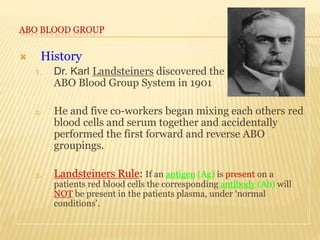
1. Dr. Karl Landsteiners discovered the
ABO Blood Group System in 1901
2. He and five co-workers began mixing each others red
blood cells and serum together and accidentally
performed the first forward and reverse ABO
groupings.
3. Landsteiners Rule: If an antigen (Ag) is present on a
patients red blood cells the corresponding antibody (Ab) will
NOT be present in the patients plasma, under ‘normal
conditions’.
I. THE ABO SYSTEM
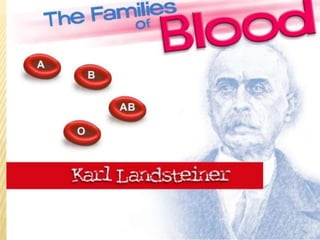
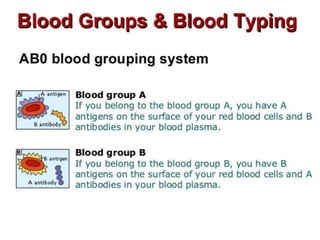
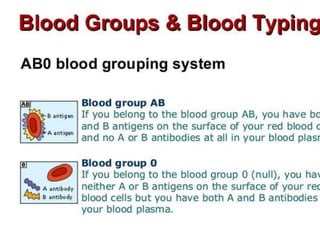
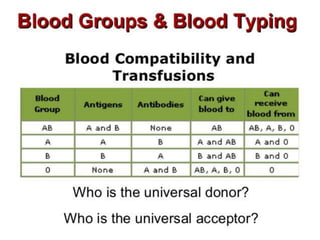
 4 main phenotypes (A, B, AB, O)
 ABO gene located on long arm of
chromosome 9.
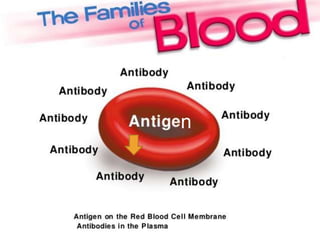
 Antigens/agglutinogens Type A and Type B
on the surface of the RBCs are the cause of
blood transfusion reactions [BTR]
 Thus, the presence or absence of these Ag’s
is the essential basis that blood is grouped
for the purpose of transfusion.
3
n
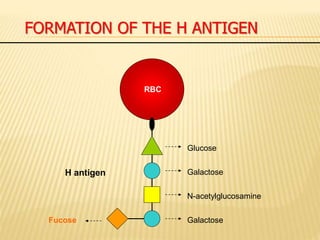
FORMATION OF THE H ANTIGEN
Glucose
Galactose
N-acetylglucosamine
Galactose
H antigen
RBC
Fucose
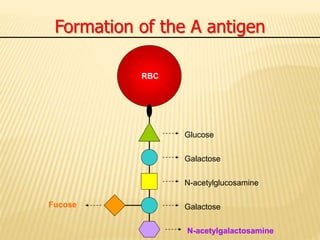
Formation of the A antigen
Glucose
Galactose
N-acetylglucosamine
Galactose
RBC
N-acetylgalactosamine
Fucose
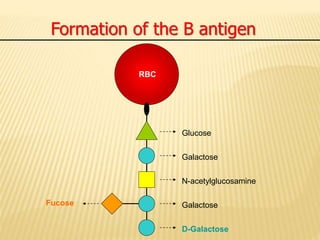
Formation of the B antigen
Glucose
Galactose
N-acetylglucosamine
Galactose
RBC
D-Galactose
Fucose
14
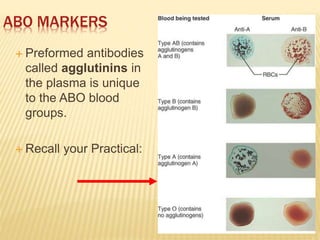
ABO MARKERS
 Preformed antibodies
called agglutinins in
the plasma is unique
to the ABO blood
groups.
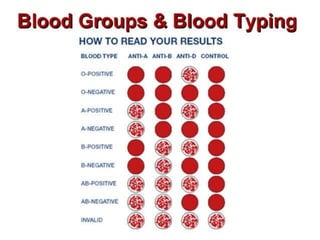
 Recall your Practical:
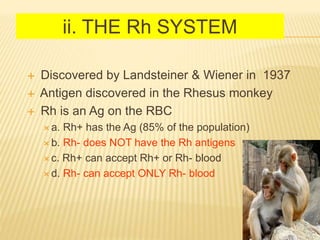
 Discovered by Landsteiner & Wiener in 1937
 Antigen discovered in the Rhesus monkey
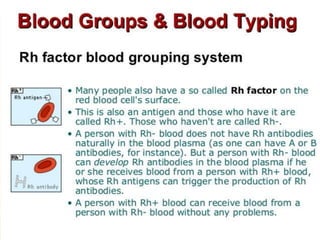
 Rh is an Ag on the RBC
 a. Rh+ has the Ag (85% of the population)
 b. Rh- does NOT have the Rh antigens
 c. Rh+ can accept Rh+ or Rh- blood
 d. Rh- can accept ONLY Rh- blood
15
ii. THE Rh SYSTEM
16
RH FACTOR
There are 45 different types of Rh
agglutinogens.
 Common : C, D, and E
~ 85% of Americans are Rh positive, carrying
the D antigen.
Presence of the Rh agglutinogens on RBCs
is indicated as Rh+
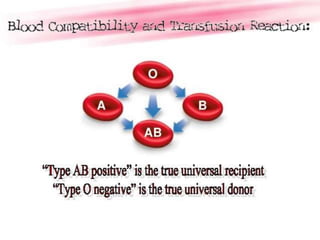
As a rule, a person’s ABO and Rh blood
groups are reported together, for example,
O+, A-, and so on.
RH ANTIGENS
• D antigen is the most common and most
immunogenic
• Approximately 80-85% Caucasians have D
antigen
• Individuals lacking this allele are called “Rh-
negative”
• Only develop antibodies against the D
antigen after exposure
(transfusion/pregnancy)
17
RH ANTIBODIES
• IgG class of immunoglobulins
• Lack capacity to bind complements
18
SIGNIFICANCE OF RH(D)
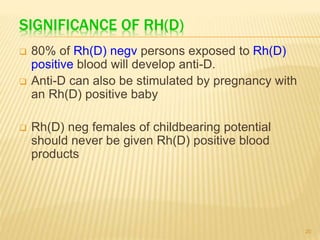
 80% of Rh(D) negv persons exposed to Rh(D)
positive blood will develop anti-D.
 Anti-D can also be stimulated by pregnancy with
an Rh(D) positive baby
 Rh(D) neg females of childbearing potential
should never be given Rh(D) positive blood
products
20
Characteristics of Bombay Phenotype
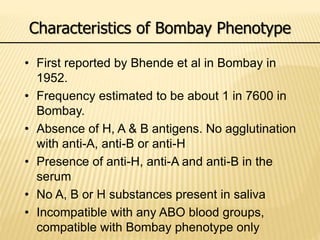
• First reported by Bhende et al in Bombay in
1952.
• Frequency estimated to be about 1 in 7600 in
Bombay.
• Absence of H, A & B antigens. No agglutination
with anti-A, anti-B or anti-H
• Presence of anti-H, anti-A and anti-B in the
serum
• No A, B or H substances present in saliva
• Incompatible with any ABO blood groups,
compatible with Bombay phenotype only
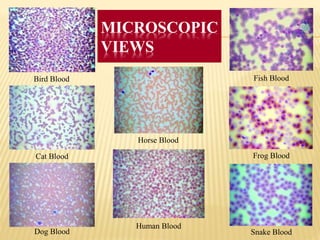
MICROSCOPIC
VIEWS
Bird Blood
Cat Blood
Dog Blood
Fish Blood
Frog Blood
Snake Blood
Human Blood
Horse Blood
Blood group

Blood group

  • 1.
    BLOOD GROUP Ferguson College,Pune Chemistry Department [ Autonomous ] Mangesh Jadhav
  • 2.
    ABO BLOOD GROUP History 1. Dr. Karl Landsteiners discovered the ABO Blood Group System in 1901 2. He and five co-workers began mixing each others red blood cells and serum together and accidentally performed the first forward and reverse ABO groupings. 3. Landsteiners Rule: If an antigen (Ag) is present on a patients red blood cells the corresponding antibody (Ab) will NOT be present in the patients plasma, under ‘normal conditions’.
  • 3.
    I. THE ABOSYSTEM  4 main phenotypes (A, B, AB, O)  ABO gene located on long arm of chromosome 9.  Antigens/agglutinogens Type A and Type B on the surface of the RBCs are the cause of blood transfusion reactions [BTR]  Thus, the presence or absence of these Ag’s is the essential basis that blood is grouped for the purpose of transfusion. 3
  • 6.
  • 9.
    FORMATION OF THEH ANTIGEN Glucose Galactose N-acetylglucosamine Galactose H antigen RBC Fucose
  • 10.
    Formation of theA antigen Glucose Galactose N-acetylglucosamine Galactose RBC N-acetylgalactosamine Fucose
  • 11.
    Formation of theB antigen Glucose Galactose N-acetylglucosamine Galactose RBC D-Galactose Fucose
  • 14.
    14 ABO MARKERS  Preformedantibodies called agglutinins in the plasma is unique to the ABO blood groups.  Recall your Practical:
  • 15.
     Discovered byLandsteiner & Wiener in 1937  Antigen discovered in the Rhesus monkey  Rh is an Ag on the RBC  a. Rh+ has the Ag (85% of the population)  b. Rh- does NOT have the Rh antigens  c. Rh+ can accept Rh+ or Rh- blood  d. Rh- can accept ONLY Rh- blood 15 ii. THE Rh SYSTEM
  • 16.
    16 RH FACTOR There are45 different types of Rh agglutinogens.  Common : C, D, and E ~ 85% of Americans are Rh positive, carrying the D antigen. Presence of the Rh agglutinogens on RBCs is indicated as Rh+ As a rule, a person’s ABO and Rh blood groups are reported together, for example, O+, A-, and so on.
  • 17.
    RH ANTIGENS • Dantigen is the most common and most immunogenic • Approximately 80-85% Caucasians have D antigen • Individuals lacking this allele are called “Rh- negative” • Only develop antibodies against the D antigen after exposure (transfusion/pregnancy) 17
  • 18.
    RH ANTIBODIES • IgGclass of immunoglobulins • Lack capacity to bind complements 18
  • 20.
    SIGNIFICANCE OF RH(D) 80% of Rh(D) negv persons exposed to Rh(D) positive blood will develop anti-D.  Anti-D can also be stimulated by pregnancy with an Rh(D) positive baby  Rh(D) neg females of childbearing potential should never be given Rh(D) positive blood products 20
  • 21.
    Characteristics of BombayPhenotype • First reported by Bhende et al in Bombay in 1952. • Frequency estimated to be about 1 in 7600 in Bombay. • Absence of H, A & B antigens. No agglutination with anti-A, anti-B or anti-H • Presence of anti-H, anti-A and anti-B in the serum • No A, B or H substances present in saliva • Incompatible with any ABO blood groups, compatible with Bombay phenotype only
  • 23.
    MICROSCOPIC VIEWS Bird Blood Cat Blood DogBlood Fish Blood Frog Blood Snake Blood Human Blood Horse Blood