Biosphere reserves, forest research
institutes
Sankrita Gaonkar
Assistant Professor in Botany
sankrita002@gmail.com
Contents
• Biosphere reserves
• Forest research institutes
• References
Biosphere reserve
• Special protected areas of terrestrial or coastal environments, where people are
integrated components of system
• Are examples of natural biomes – unique biological communities
• Concept launched in 1971 – UNESCO’s Man and Biosphere (MAB)
programme
• India – 18 biosphere reserves – rich biodiversity
• Are nominated by national government and controlled by state government
Objectives of Biosphere reserve:
1) A conservation function – to contribute to conservation of landscapes,
ecosystems and species variation
2) A development function – to foster economic and human development which
is socio-culturally and ecologically sustainable
3) A logistic function – to provide support for research, monitoring, education
and information exchange related to local, national and global issues of
conservation and development
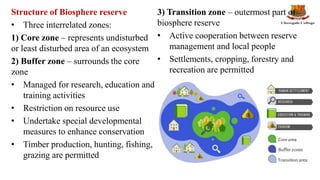
Structure of Biosphere reserve
• Three interrelated zones:
1) Core zone – represents undisturbed
or least disturbed area of an ecosystem
2) Buffer zone – surrounds the core
zone
• Managed for research, education and
training activities
• Restriction on resource use
• Undertake special developmental
measures to enhance conservation
• Timber production, hunting, fishing,
grazing are permitted
3) Transition zone – outermost part of
biosphere reserve
• Active cooperation between reserve
management and local people
• Settlements, cropping, forestry and
recreation are permitted
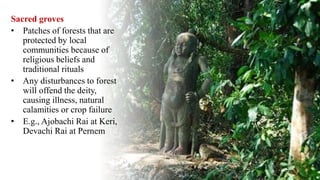
Sacred groves
• Patches of forests that are
protected by local
communities because of
religious beliefs and
traditional rituals
• Any disturbances to forest
will offend the deity,
causing illness, natural
calamities or crop failure
• E.g., Ajobachi Rai at Keri,
Devachi Rai at Pernem
• There are 18 biosphere reserves in
India:
1) Cold Desert, Himachal Pradesh
2) Nanda Devi, Uttrakhand
3) Khangchendzonga, Sikkim
4) Dehang-Debang, Arunachal
Pradesh
5) Manas, Assam
6) Dibru-Saikhowa, Assam
7) Nokrek, Meghalaya
8) Panna, Madhya Pradesh
9) Pachmarhi, Madhya Pradesh
10) Achanakmar-Amarkantak,
Madhya Pradesh-Chhattisgarh
11) Kachchh, Gujarat (Largest
Area)
12) Similipal, Odisha
13) Sundarban, West Bengal
14) Seshachalam, Andhra Pradesh
15) Agasthyamala, Karnataka-
Tamil Nadu-Kerala
16) Nilgiri, Tamil Nadu-Kerala
(First to be Included)
17) Gulf of Mannar, Tamil Nadu
18) Great Nicobar, Andaman &
Nicobar Island
Forest Research Institutes of India
https://www.collegedekho.com/articles/forest-research-institutes-in-india/
References
• https://www.collegedekho.com/articles/forest-research-
institutes-in-india/
• Kumar P and Mina U. 2020. Fundamentals of ecology and
environment. 2ND Edition. Pathfinder Publication, New Delhi.
160-162

Biosphere reserves

  • 1.
    Biosphere reserves, forestresearch institutes Sankrita Gaonkar Assistant Professor in Botany sankrita002@gmail.com
  • 2.
    Contents • Biosphere reserves •Forest research institutes • References
  • 3.
    Biosphere reserve • Specialprotected areas of terrestrial or coastal environments, where people are integrated components of system • Are examples of natural biomes – unique biological communities • Concept launched in 1971 – UNESCO’s Man and Biosphere (MAB) programme • India – 18 biosphere reserves – rich biodiversity • Are nominated by national government and controlled by state government
  • 4.
    Objectives of Biospherereserve: 1) A conservation function – to contribute to conservation of landscapes, ecosystems and species variation 2) A development function – to foster economic and human development which is socio-culturally and ecologically sustainable 3) A logistic function – to provide support for research, monitoring, education and information exchange related to local, national and global issues of conservation and development
  • 5.
    Structure of Biospherereserve • Three interrelated zones: 1) Core zone – represents undisturbed or least disturbed area of an ecosystem 2) Buffer zone – surrounds the core zone • Managed for research, education and training activities • Restriction on resource use • Undertake special developmental measures to enhance conservation • Timber production, hunting, fishing, grazing are permitted 3) Transition zone – outermost part of biosphere reserve • Active cooperation between reserve management and local people • Settlements, cropping, forestry and recreation are permitted
  • 6.
    Sacred groves • Patchesof forests that are protected by local communities because of religious beliefs and traditional rituals • Any disturbances to forest will offend the deity, causing illness, natural calamities or crop failure • E.g., Ajobachi Rai at Keri, Devachi Rai at Pernem
  • 7.
    • There are18 biosphere reserves in India: 1) Cold Desert, Himachal Pradesh 2) Nanda Devi, Uttrakhand 3) Khangchendzonga, Sikkim 4) Dehang-Debang, Arunachal Pradesh 5) Manas, Assam 6) Dibru-Saikhowa, Assam 7) Nokrek, Meghalaya 8) Panna, Madhya Pradesh 9) Pachmarhi, Madhya Pradesh 10) Achanakmar-Amarkantak, Madhya Pradesh-Chhattisgarh 11) Kachchh, Gujarat (Largest Area) 12) Similipal, Odisha 13) Sundarban, West Bengal 14) Seshachalam, Andhra Pradesh 15) Agasthyamala, Karnataka- Tamil Nadu-Kerala 16) Nilgiri, Tamil Nadu-Kerala (First to be Included) 17) Gulf of Mannar, Tamil Nadu 18) Great Nicobar, Andaman & Nicobar Island
  • 8.
    Forest Research Institutesof India https://www.collegedekho.com/articles/forest-research-institutes-in-india/
  • 9.
    References • https://www.collegedekho.com/articles/forest-research- institutes-in-india/ • KumarP and Mina U. 2020. Fundamentals of ecology and environment. 2ND Edition. Pathfinder Publication, New Delhi. 160-162