PRESENTATION ON
Biosphere reserves in
India
A Guide by RAJNISH
1. Intro
● Biosphere Reserve (BR) is an international designation by
United Nations Educational, Scientific and Cultural
Organization (UNESCO) for representative parts of natural
and cultural landscapes extending over large areas of
terrestrial or coastal/marine ecosystems or a combination of
both.
● Biosphere Reserves tries to balance economic and social
development and maintenance of associated cultural values
along with the preservation of nature.
● Biosphere Reserves are thus special environments for both
people and nature and are living examples of how human
beings and nature can co-exist while respecting each
others’ needs.
Knowledge...
Man and the Biosphere
Programme (MAB) is an
intergovernmental scientific
programme, launched in
1971 by UNESCO, that aims
to establish a scientific basis
for the improvement of
relationships between people
and their environments.
2. Criteria for Designation of Biosphere Reserve
 A site must contain a protected and minimally
disturbed core area of value of nature conservation.
 Core area must be a bio-geographical unit and
should be large enough to sustain a viable
populations representing all trophic levels.
 The involvement of local communities and use of
their knowledge in biodiversity preservation.
 Areas potential for preservation of traditional tribal
or rural modes of living for harmonious use of the
environment.
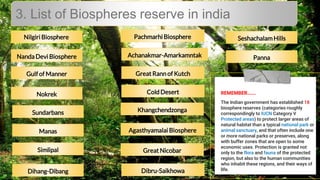
3. List of Biospheres reserve in india
Nilgiri Biosphere
Nanda Devi Biosphere
ColdDesert
SeshachalamHills
Panna
Pachmarhi Biosphere
Dibru-Saikhowa
Great Nicobar
Agasthyamalai Biosphere
Khangchendzonga
Great Rann of Kutch
Achanakmar-Amarkamntak
Dihang-Dibang
Simlipal
Manas
Sundarbans
Nokrek
Gulfof Manner
REMEMBER…….
The Indian government has established 18
biosphere reserves (categories roughly
correspondingly to IUCN Category V
Protected areas) to protect larger areas of
natural habitat than a typical national park or
animal sanctuary, and that often include one
or more national parks or preserves, along
with buffer zones that are open to some
economic uses. Protection is granted not
only to the flora and fauna of the protected
region, but also to the human communities
who inhabit these regions, and their ways of
life.
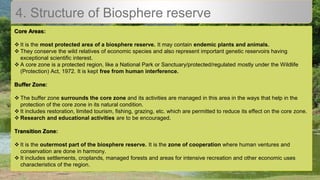
4. Structure of Biosphere reserve
Core Areas:
 It is the most protected area of a biosphere reserve. It may contain endemic plants and animals.
 They conserve the wild relatives of economic species and also represent important genetic reservoirs having
exceptional scientific interest.
 A core zone is a protected region, like a National Park or Sanctuary/protected/regulated mostly under the Wildlife
(Protection) Act, 1972. It is kept free from human interference.
Buffer Zone:
 The buffer zone surrounds the core zone and its activities are managed in this area in the ways that help in the
protection of the core zone in its natural condition.
 It includes restoration, limited tourism, fishing, grazing, etc. which are permitted to reduce its effect on the core zone.
 Research and educational activities are to be encouraged.
Transition Zone:
 It is the outermost part of the biosphere reserve. It is the zone of cooperation where human ventures and
conservation are done in harmony.
 It includes settlements, croplands, managed forests and areas for intensive recreation and other economic uses
characteristics of the region.
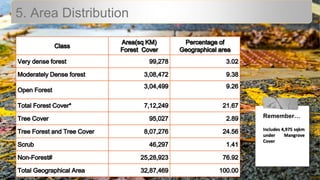
Includes 4,975 sqkm
under Mangrove
Cover
Remember…
5. Area Distribution
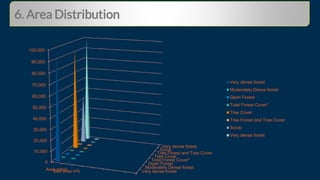
6. Area Distribution
Very dense forest
Moderately Dense forest
Open Forest
Total Forest Cover*
Tree Cover
Tree Forest and Tree Cover
Scrub
Very dense forest
0
10,000
20,000
30,000
40,000
50,000
60,000
70,000
80,000
90,000
100,000
Area sqkm
Geo area in%
Very dense forest
Moderately Dense forest
Open Forest
Total Forest Cover*
Tree Cover
Tree Forest and Tree Cover
Scrub
Very dense forest
7. Potential sites
The following is a list of potential sites for Biosphere Reserves as selected by Ministry of Forests and
Environment.
● Abujmarh, Chhattisgarh
● Andaman and Nicobar, North Islands
● Chintapalli, Visakhapatnam Andhra Pradesh
● Kanha, Madhya Pradesh
● Kovalam, Kerala
● Lakshadweep Islands, Lakshadweep
● Little Rann of Kutch, Gujarat
● Phawngpui (Blue Mountain), Mizoram
● Namdapha, Arunachal Pradesh
● Singhbhum, Jharkhand
● Tawang and West Kameng, Arunachal Pradesh
● Thar Desert, Rajasthan
● Tadoba National Park and Sanjay Gandhi National Park, Maharashtra
The following is a list of potential sites for Biosphere Reserves as selected by Ministry of Forests and
Environment……….
 Abujmarh, Chhattisgarh
 Andaman and Nicobar, North Islands
 Chintapalli, Visakhapatnam Andhra Pradesh
 Kanha, Madhya Pradesh
 Kovalam, Kerala
 Lakshadweep Islands, Lakshadweep
 Little Rann of Kutch, Gujarat
 Phawngpui (Blue Mountain), Mizoram
 Namdapha, Arunachal Pradesh
 Singhbhum, Jharkhand
 Tawang and West Kameng, Arunachal Pradesh
 Thar Desert, Rajasthan
 Tadoba National Park and Sanjay Gandhi National Park, Maharashtra
 "Biosphere Reserves in India". Ministry of Environment,
Forest and Climate Change. 2019. Retrieved 5 February
2020.
 20 new Biosphere Reserves added to UNESCO's Man
and the Biosphere (MAB) Programme". UNESCO. 11
July 2012. Retrieved 5 February 2020.
 Man and the Biosphere Programme". UNESCO.
Retrieved 5 February 2020.
 20 sites added to UNESCO's World Network of
Biosphere Reserves". UNESCO. 19 March 2016.
Retrieved 5 February 2020.
 Mohan, Vishwa (8 August 2018). "Kanchenjunga
Biosphere Reserve gets entry into the UNESCO's gloal
list". The Economic Times (India). Retrieved 5 February
2020.
 Status of Biosphere reserves in India" (PDF). ENVIRO
NEWS, Ministry of Environment and Forests. January–
March 2008. p. 9. Archived from the original (PDF) on
20 January 2013. Retrieved 1 June 2013.
8. References
9. External Links
Thank you

Biosphere in india1

  • 1.
    PRESENTATION ON Biosphere reservesin India A Guide by RAJNISH
  • 3.
    1. Intro ● BiosphereReserve (BR) is an international designation by United Nations Educational, Scientific and Cultural Organization (UNESCO) for representative parts of natural and cultural landscapes extending over large areas of terrestrial or coastal/marine ecosystems or a combination of both. ● Biosphere Reserves tries to balance economic and social development and maintenance of associated cultural values along with the preservation of nature. ● Biosphere Reserves are thus special environments for both people and nature and are living examples of how human beings and nature can co-exist while respecting each others’ needs.
  • 4.
    Knowledge... Man and theBiosphere Programme (MAB) is an intergovernmental scientific programme, launched in 1971 by UNESCO, that aims to establish a scientific basis for the improvement of relationships between people and their environments. 2. Criteria for Designation of Biosphere Reserve  A site must contain a protected and minimally disturbed core area of value of nature conservation.  Core area must be a bio-geographical unit and should be large enough to sustain a viable populations representing all trophic levels.  The involvement of local communities and use of their knowledge in biodiversity preservation.  Areas potential for preservation of traditional tribal or rural modes of living for harmonious use of the environment.
  • 5.
    3. List ofBiospheres reserve in india Nilgiri Biosphere Nanda Devi Biosphere ColdDesert SeshachalamHills Panna Pachmarhi Biosphere Dibru-Saikhowa Great Nicobar Agasthyamalai Biosphere Khangchendzonga Great Rann of Kutch Achanakmar-Amarkamntak Dihang-Dibang Simlipal Manas Sundarbans Nokrek Gulfof Manner REMEMBER……. The Indian government has established 18 biosphere reserves (categories roughly correspondingly to IUCN Category V Protected areas) to protect larger areas of natural habitat than a typical national park or animal sanctuary, and that often include one or more national parks or preserves, along with buffer zones that are open to some economic uses. Protection is granted not only to the flora and fauna of the protected region, but also to the human communities who inhabit these regions, and their ways of life.
  • 6.
    4. Structure ofBiosphere reserve Core Areas:  It is the most protected area of a biosphere reserve. It may contain endemic plants and animals.  They conserve the wild relatives of economic species and also represent important genetic reservoirs having exceptional scientific interest.  A core zone is a protected region, like a National Park or Sanctuary/protected/regulated mostly under the Wildlife (Protection) Act, 1972. It is kept free from human interference. Buffer Zone:  The buffer zone surrounds the core zone and its activities are managed in this area in the ways that help in the protection of the core zone in its natural condition.  It includes restoration, limited tourism, fishing, grazing, etc. which are permitted to reduce its effect on the core zone.  Research and educational activities are to be encouraged. Transition Zone:  It is the outermost part of the biosphere reserve. It is the zone of cooperation where human ventures and conservation are done in harmony.  It includes settlements, croplands, managed forests and areas for intensive recreation and other economic uses characteristics of the region.
  • 7.
    Includes 4,975 sqkm underMangrove Cover Remember… 5. Area Distribution
  • 8.
    6. Area Distribution Verydense forest Moderately Dense forest Open Forest Total Forest Cover* Tree Cover Tree Forest and Tree Cover Scrub Very dense forest 0 10,000 20,000 30,000 40,000 50,000 60,000 70,000 80,000 90,000 100,000 Area sqkm Geo area in% Very dense forest Moderately Dense forest Open Forest Total Forest Cover* Tree Cover Tree Forest and Tree Cover Scrub Very dense forest
  • 9.
    7. Potential sites Thefollowing is a list of potential sites for Biosphere Reserves as selected by Ministry of Forests and Environment. ● Abujmarh, Chhattisgarh ● Andaman and Nicobar, North Islands ● Chintapalli, Visakhapatnam Andhra Pradesh ● Kanha, Madhya Pradesh ● Kovalam, Kerala ● Lakshadweep Islands, Lakshadweep ● Little Rann of Kutch, Gujarat ● Phawngpui (Blue Mountain), Mizoram ● Namdapha, Arunachal Pradesh ● Singhbhum, Jharkhand ● Tawang and West Kameng, Arunachal Pradesh ● Thar Desert, Rajasthan ● Tadoba National Park and Sanjay Gandhi National Park, Maharashtra The following is a list of potential sites for Biosphere Reserves as selected by Ministry of Forests and Environment……….  Abujmarh, Chhattisgarh  Andaman and Nicobar, North Islands  Chintapalli, Visakhapatnam Andhra Pradesh  Kanha, Madhya Pradesh  Kovalam, Kerala  Lakshadweep Islands, Lakshadweep  Little Rann of Kutch, Gujarat  Phawngpui (Blue Mountain), Mizoram  Namdapha, Arunachal Pradesh  Singhbhum, Jharkhand  Tawang and West Kameng, Arunachal Pradesh  Thar Desert, Rajasthan  Tadoba National Park and Sanjay Gandhi National Park, Maharashtra
  • 10.
     "Biosphere Reservesin India". Ministry of Environment, Forest and Climate Change. 2019. Retrieved 5 February 2020.  20 new Biosphere Reserves added to UNESCO's Man and the Biosphere (MAB) Programme". UNESCO. 11 July 2012. Retrieved 5 February 2020.  Man and the Biosphere Programme". UNESCO. Retrieved 5 February 2020.  20 sites added to UNESCO's World Network of Biosphere Reserves". UNESCO. 19 March 2016. Retrieved 5 February 2020.  Mohan, Vishwa (8 August 2018). "Kanchenjunga Biosphere Reserve gets entry into the UNESCO's gloal list". The Economic Times (India). Retrieved 5 February 2020.  Status of Biosphere reserves in India" (PDF). ENVIRO NEWS, Ministry of Environment and Forests. January– March 2008. p. 9. Archived from the original (PDF) on 20 January 2013. Retrieved 1 June 2013. 8. References
  • 11.
  • 12.