Strategies for biodiversity
conservation
By
s.Srividhya
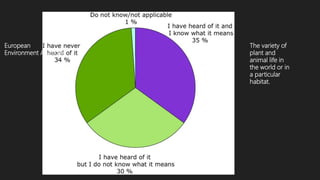
European
Environment Agencies
The variety of
plant and
animal life in
the world or in
a particular
habitat.
Why conserve biodiversity?
Indicators of healthy ecosystem
Edutainment
We share and affect their locality
All organisms play an important role
Boosts ecosystem’s productivity
Healthy ecosystems can better withstand and recover from a
variety of disasters
Primary strategy
Maintain intact (viable) landscapes.
Reverse declines.
Recover threatened species and ecological communities.
Control emerging threats.
Threat to biodiversity
 Habitat destruction
 Habitat fragmentation
 Pollution
 Over exploitation
 Introduction of exotic species
 Diseases
 Poaching of wild life - make the species distinct
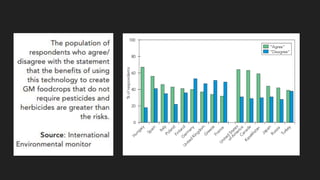
GMO
 Virus, bacteria and fungi tolerance
 Hybrid (golden rice)
 Drought and flood tolerance
 Disease resistance
 Climate change adaptation and production
 Herbicides, pesticides, insects and fertilizers resistance
 High yield and fast growth
 Delayed softening in fruits – prolonging storage life.
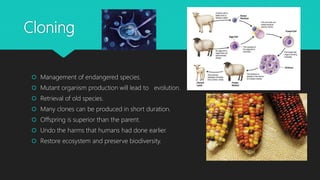
Cloning
 Management of endangered species.
 Mutant organism production will lead to evolution.
 Retrieval of old species.
 Many clones can be produced in short duration.
 Offspring is superior than the parent.
 Undo the harms that humans had done earlier.
 Restore ecosystem and preserve biodiversity.
National parks
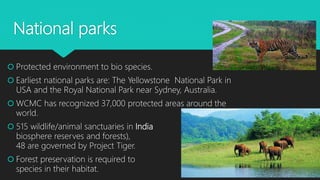
 Protected environment to bio species.
 Earliest national parks are: The Yellowstone National Park in
USA and the Royal National Park near Sydney, Australia.
 WCMC has recognized 37,000 protected areas around the
world.
 515 wildlife/animal sanctuaries in India (including
biosphere reserves and forests),
48 are governed by Project Tiger.
 Forest preservation is required to preserve
species in their habitat.
Biosphere Reserve Programme
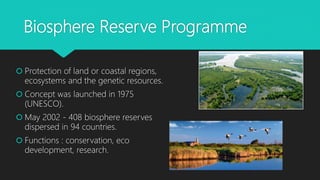
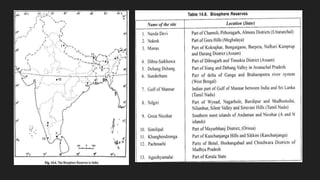
 Protection of land or coastal regions,
ecosystems and the genetic resources.
 Concept was launched in 1975
(UNESCO).
 May 2002 - 408 biosphere reserves
dispersed in 94 countries.
 Functions : conservation, eco
development, research.
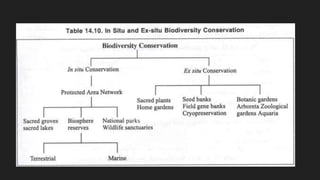
Cryopreservation
In vitro conservation is done in liquid
nitrogen at a temperature of -196°C.
Vegetative propagated crops, e.g.,
potato.
Either by very rapid cooling (seeds) or by
gradual cooling and simultaneous
dehydration (tissue culture).
Stored for long time.
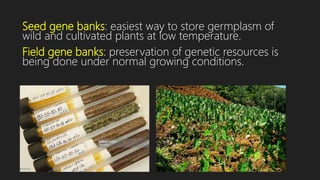
Seed gene banks: easiest way to store germplasm of
wild and cultivated plants at low temperature.
Field gene banks: preservation of genetic resources is
being done under normal growing conditions.
Botanical Gardens
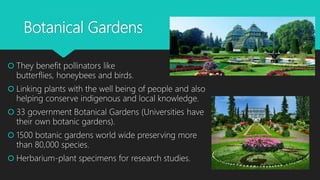
 They benefit pollinators like
butterflies, honeybees and birds.
 Linking plants with the well being of people and also
helping conserve indigenous and local knowledge.
 33 government Botanical Gardens (Universities have
their own botanic gardens).
 1500 botanic gardens world wide preserving more
than 80,000 species.
 Herbarium-plant specimens for research studies.
General measures
 Important and endangered species should be identified.
 Preservation of unique eco systems.
 Avoiding of poaching and hunting.
 Reducing pollutions.
 Public awareness and education.
 NGO.
 Prevention of over exploitation of natural resources.
 Environmental laws should be strictly followed.
Steps that an individual can take
 Sugar for ants
 Inform corporation about street dogs
 Kitchen garden
 Terrace garden
 Back yard
 Avoid pesticides
 Honey comb
 Fish tanks
 Water for birds
Thank you

Strategies for biodiversity conservation

  • 1.
  • 2.
    European Environment Agencies The varietyof plant and animal life in the world or in a particular habitat.
  • 3.
    Why conserve biodiversity? Indicatorsof healthy ecosystem Edutainment We share and affect their locality All organisms play an important role Boosts ecosystem’s productivity Healthy ecosystems can better withstand and recover from a variety of disasters
  • 4.
    Primary strategy Maintain intact(viable) landscapes. Reverse declines. Recover threatened species and ecological communities. Control emerging threats.
  • 5.
    Threat to biodiversity Habitat destruction  Habitat fragmentation  Pollution  Over exploitation  Introduction of exotic species  Diseases  Poaching of wild life - make the species distinct
  • 6.
    GMO  Virus, bacteriaand fungi tolerance  Hybrid (golden rice)  Drought and flood tolerance  Disease resistance  Climate change adaptation and production  Herbicides, pesticides, insects and fertilizers resistance  High yield and fast growth  Delayed softening in fruits – prolonging storage life.
  • 8.
    Cloning  Management ofendangered species.  Mutant organism production will lead to evolution.  Retrieval of old species.  Many clones can be produced in short duration.  Offspring is superior than the parent.  Undo the harms that humans had done earlier.  Restore ecosystem and preserve biodiversity.
  • 10.
    National parks  Protectedenvironment to bio species.  Earliest national parks are: The Yellowstone National Park in USA and the Royal National Park near Sydney, Australia.  WCMC has recognized 37,000 protected areas around the world.  515 wildlife/animal sanctuaries in India (including biosphere reserves and forests), 48 are governed by Project Tiger.  Forest preservation is required to preserve species in their habitat.
  • 11.
    Biosphere Reserve Programme Protection of land or coastal regions, ecosystems and the genetic resources.  Concept was launched in 1975 (UNESCO).  May 2002 - 408 biosphere reserves dispersed in 94 countries.  Functions : conservation, eco development, research.
  • 13.
    Cryopreservation In vitro conservationis done in liquid nitrogen at a temperature of -196°C. Vegetative propagated crops, e.g., potato. Either by very rapid cooling (seeds) or by gradual cooling and simultaneous dehydration (tissue culture). Stored for long time.
  • 14.
    Seed gene banks:easiest way to store germplasm of wild and cultivated plants at low temperature. Field gene banks: preservation of genetic resources is being done under normal growing conditions.
  • 15.
    Botanical Gardens  Theybenefit pollinators like butterflies, honeybees and birds.  Linking plants with the well being of people and also helping conserve indigenous and local knowledge.  33 government Botanical Gardens (Universities have their own botanic gardens).  1500 botanic gardens world wide preserving more than 80,000 species.  Herbarium-plant specimens for research studies.
  • 16.
    General measures  Importantand endangered species should be identified.  Preservation of unique eco systems.  Avoiding of poaching and hunting.  Reducing pollutions.  Public awareness and education.  NGO.  Prevention of over exploitation of natural resources.  Environmental laws should be strictly followed.
  • 17.
    Steps that anindividual can take  Sugar for ants  Inform corporation about street dogs  Kitchen garden  Terrace garden  Back yard  Avoid pesticides  Honey comb  Fish tanks  Water for birds
  • 18.