ENDEMISM AND ENDEMIC SPECIES
Dr. Nagabhushan Charantimath
Assistant Professor, Dept. of studies in zoology,
Vijayanagara Sri Krishnadevaraya University.
VIAJAYANAGARA SRI KRISHNADEVARAYA UNIVERSITY, BALLARI
DEPARTMENT OF STUDIES IN ZOOLOGY
endemism
The species which are conned to a local or given
geographical area.
It may be an ISLAND, LOCAL REGION, STATE, NATION OR
COUNTRY.
The word endemic is from New Latin endēmicus, from Greek ενδήμος,
endēmos, "native". Endēmos is formed of en meaning "in", and dēmos
meaning "the people". (wikipedia)
2
Are all endemic ?
All species are not endemics,
some species may be cosmopolitan.
All endemics are not necessarily rare -some might be common where
they occur.
All rare species are not necessarily endemics, some may have a large
range but be rare throughout this range
3
Why endemism ?
Stability in the climatic factors and habitat through time might have
contributed to high rates of endemism.
biological factors : low rate of dispersal or returning to the spawning areas
(philopatry).
Birds are less likely to be endemic to a region as they can disperse via flight YET
there are 2500 species of birds that are endemic.
MICRO-ORGANISMS are not believed to form endemics.
4
Four categories of endemism:
HOLOENDEMICS
EURYENDEMICS
STENOENDEMICS
RHOENDEMICS :
cryptoendemics and
euendemics
5
Myers and
de Grave’s
classication.
Holoendemics is a cosmopolitan species.
Stenoendemics is a local endemic species with a
reduced distribution. ✨
Euryendemics have larger distribution.
Rhoendemics is a disjunct distribution.
Euendemics having variance is GEOLOGICAL and
Cryptoendemics is due to EXTINCTION of the
intervening populations.
6
Types of endemism
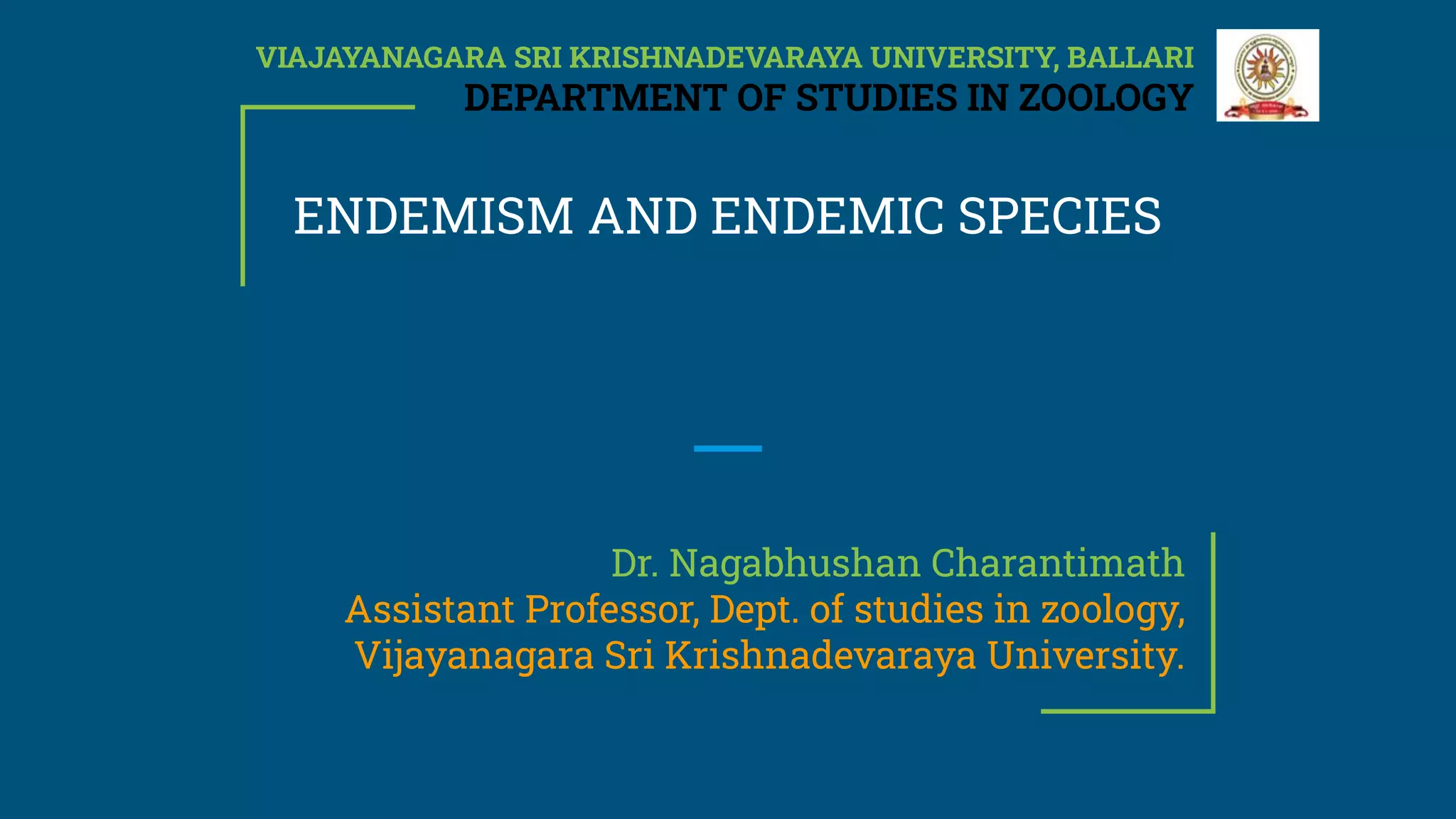
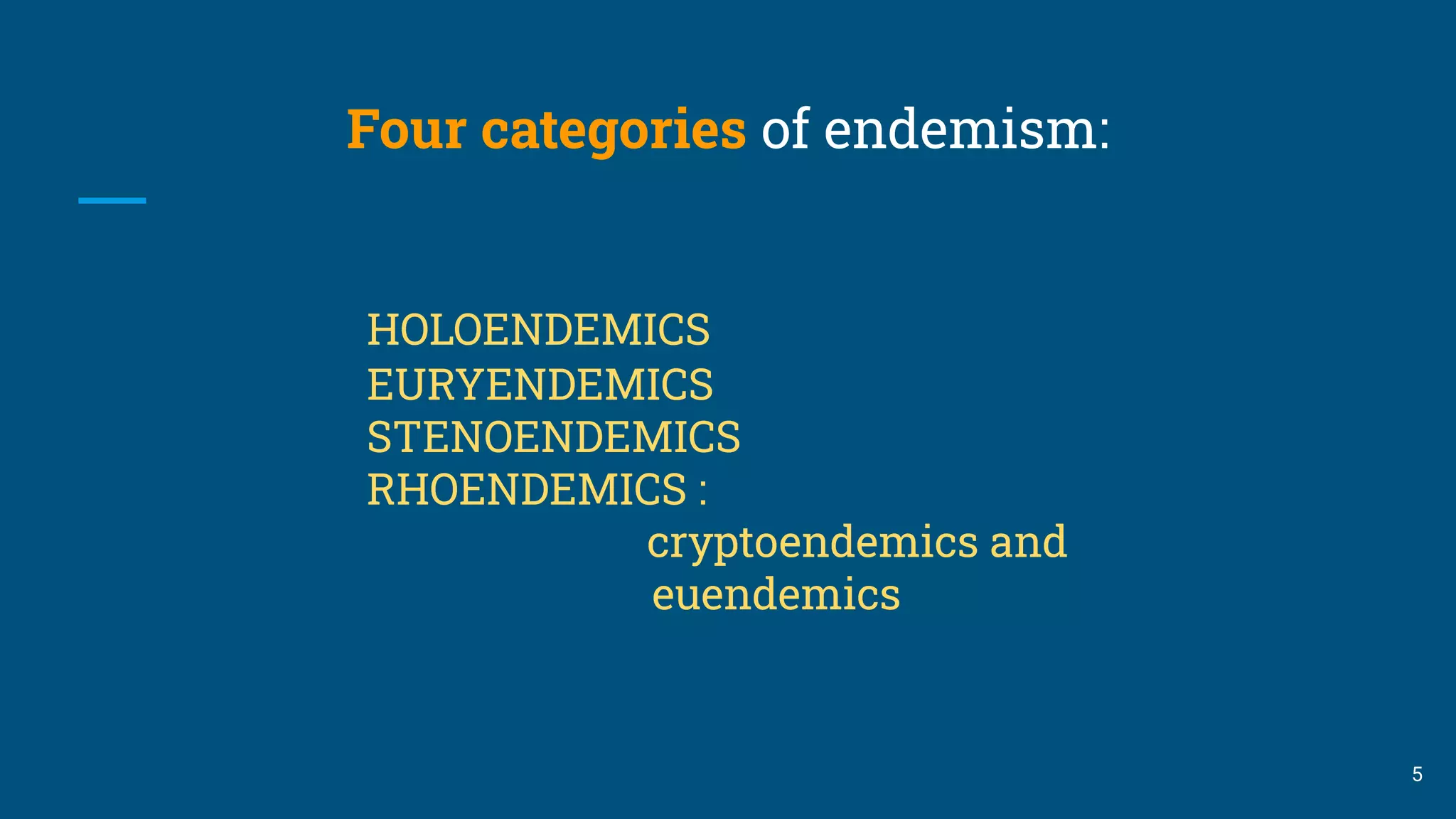
NEO-ENDEMISM an evolutionary young taxon and not spread over ex. Senecia
PAELEO-ENDEMISM was once widely distributed and pocketed due to climate
/soil types.
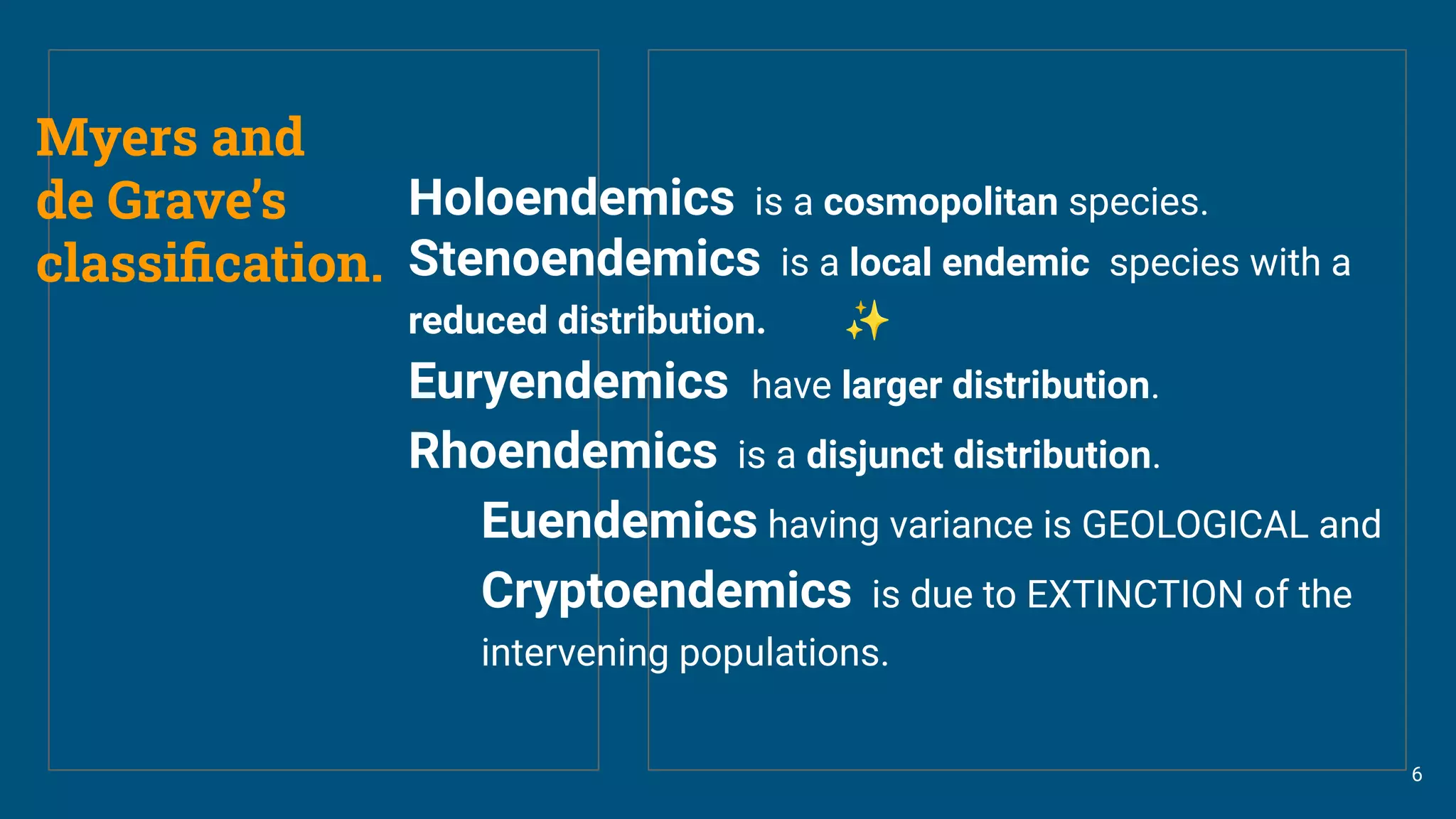
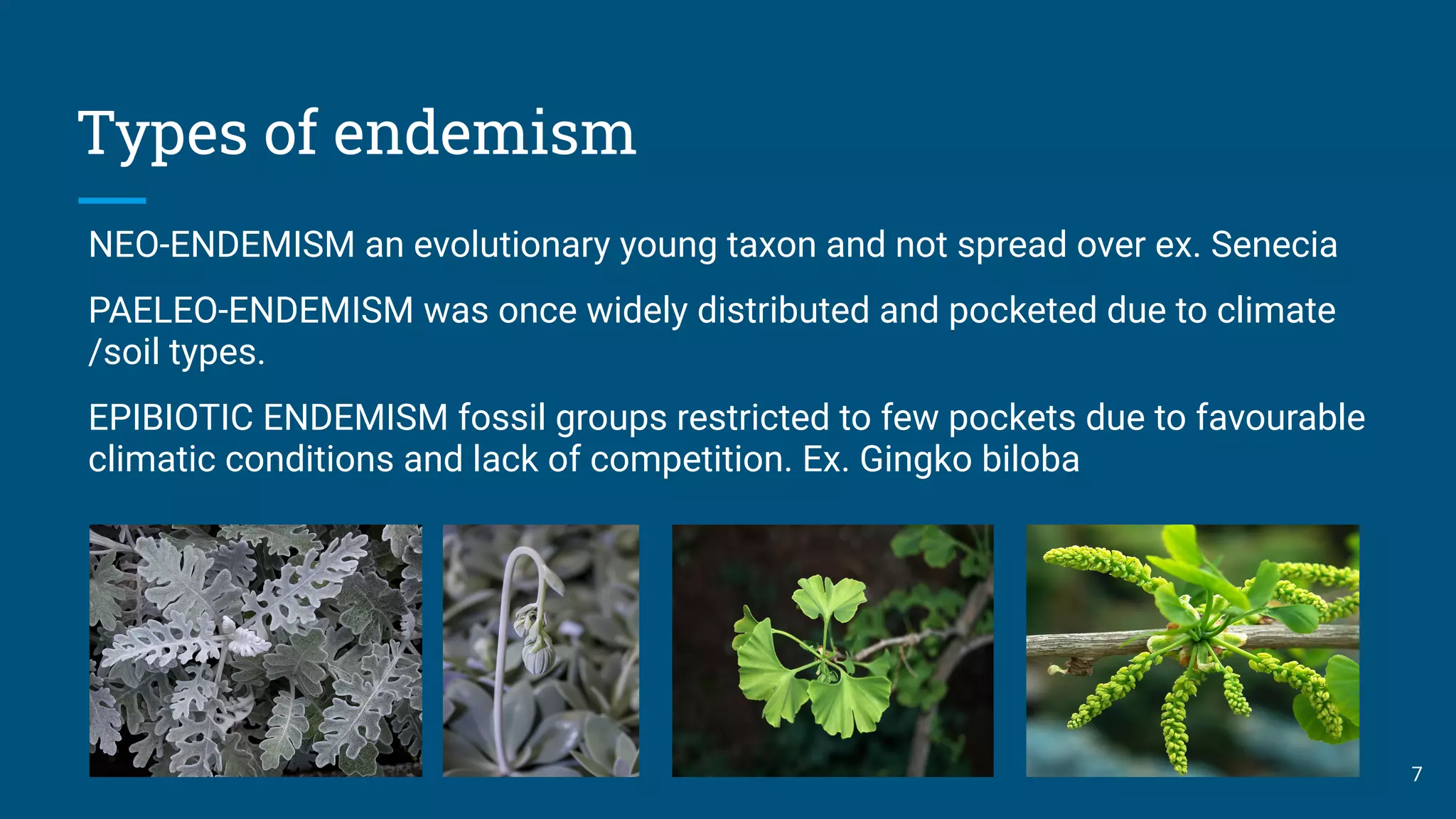
EPIBIOTIC ENDEMISM fossil groups restricted to few pockets due to favourable
climatic conditions and lack of competition. Ex. Gingko biloba
7
Neoendemism is further classied based on
cytotaxonomic studies (Favager in 1961)
Schizoendemics: derived from a common ancestor and
widespread taxon of same chromosome number.
Patroendemics: Restricted diploid given rise to
widespread polyploids.
Apoendemics restricted polyploids given rise to
widespread diploids.
8
Characters of endemics
1. localised , narrow ecological amplitude, unable to invade
new areas.
2. Lack potentiality to migrate because of saturated
genomes.
3. Dispersed propagules are unable to sustain during
migration or due to physical barriers.
9
2 Theories of endemism
First theory believes that
the last survivors of once flourished flora/fauna are now declining are the relics
or epibiotics which are endemics.
Second theory believes that
these are recent and young forms in the course of gradual extinction.
10
2 Theories of endemism
1st theory supporters are: geographers
1. ex. Sequoia semipenirens,
2. Sequoia gigantea
2nd theory supporters are:
Impatiens, Rhododendron, Coleus barbatus, C elongatus, Coleus varieties.
11
Causes of endemism
CHANGING CLIMATIC CONDITIONS
GEOGRAPHICAL BARRIERS
POOR ADAPTABILITY
NARROW ECOLOGICAL AMPLITUDES
12
FACTORS responsible for endemism
Natural crossing among closely related species.
Mutations.
More pronounced effect of isolated condition.
Climatic conditions
13
a few Endemic
species
14
Asiatic lion
Endemic and endangered in Gujarat
15
Sangai deer
Endemic and endangered in Loktak lake, manipur
16
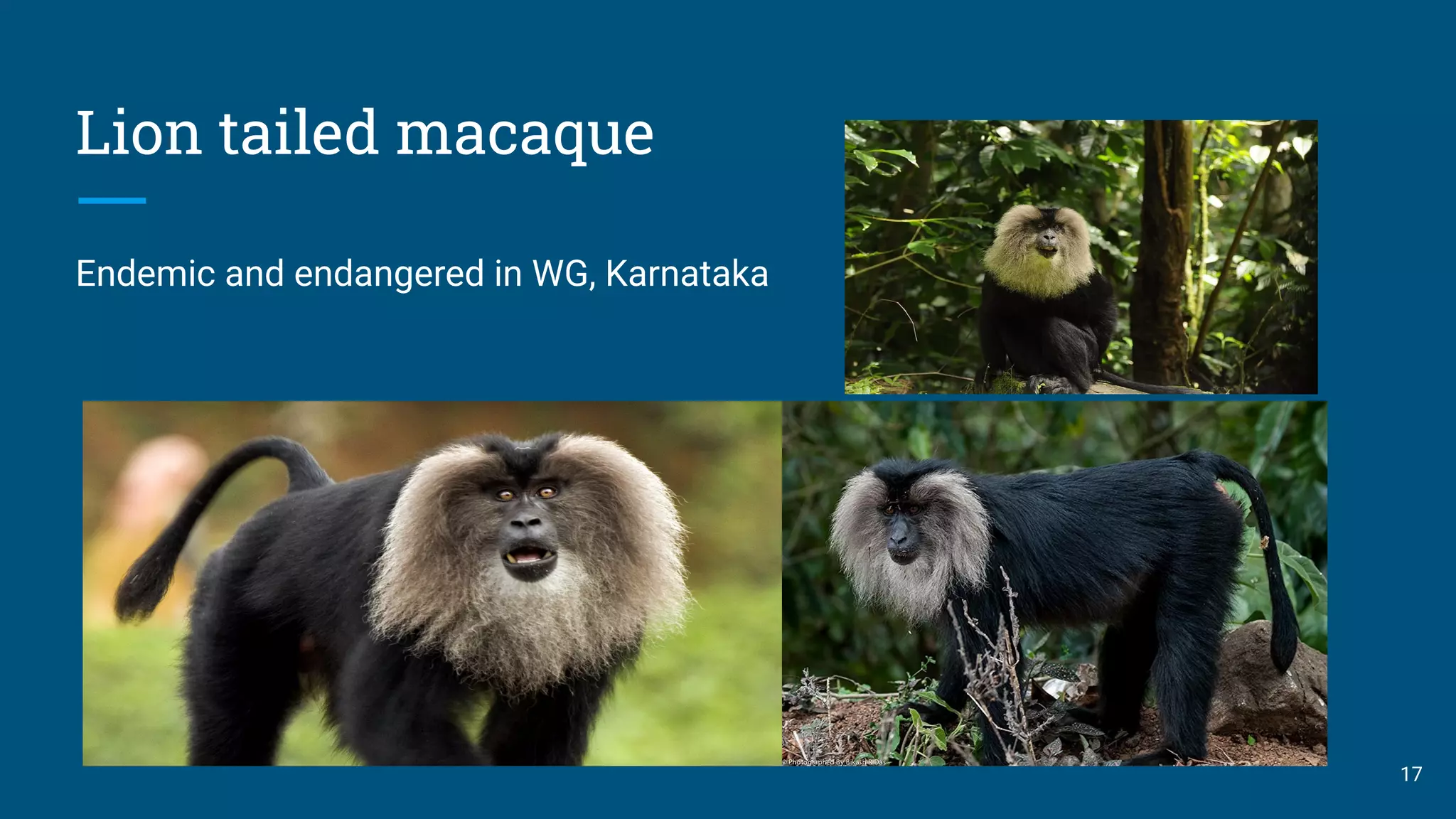
Lion tailed macaque
Endemic and endangered in WG, Karnataka
17
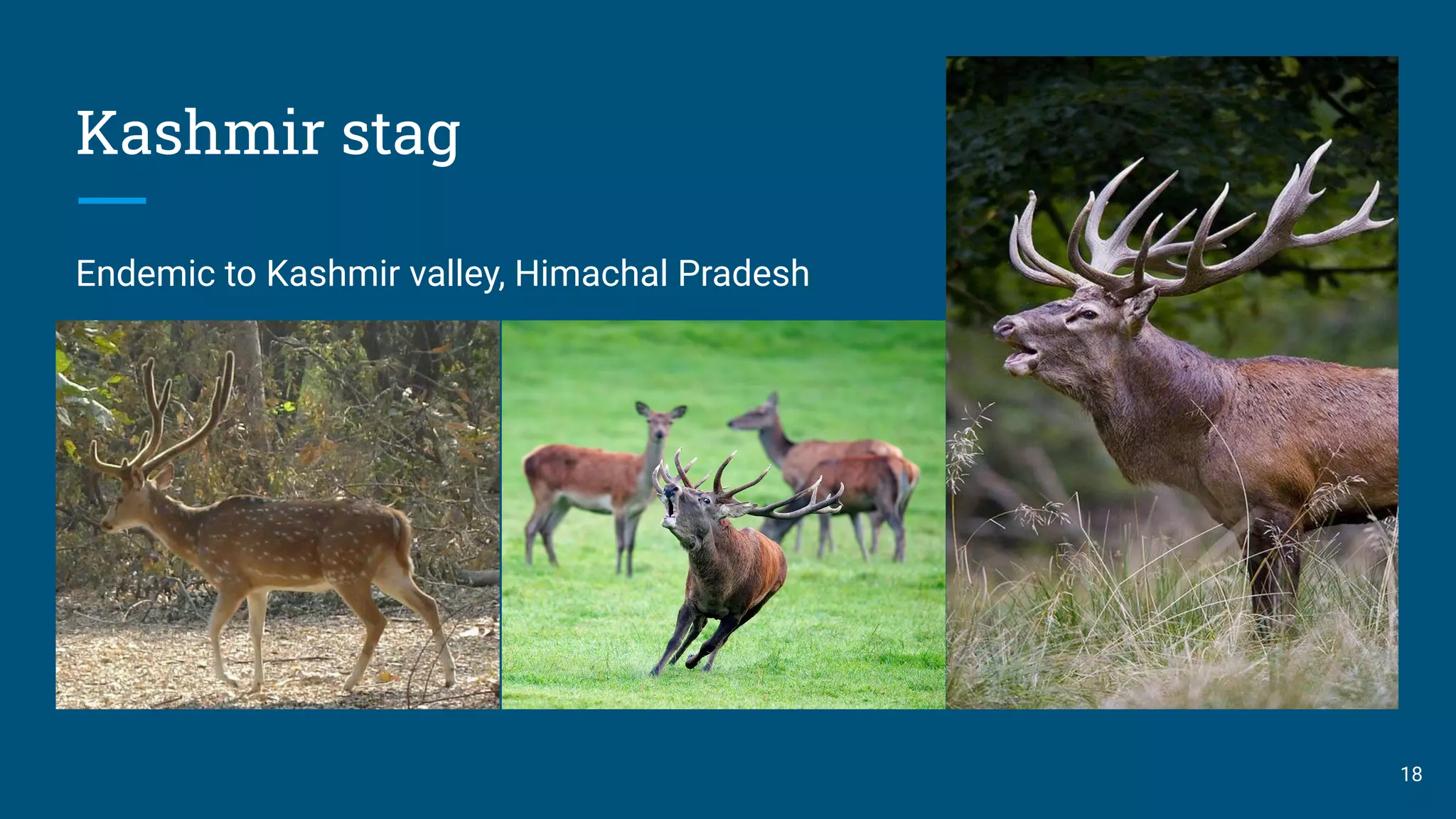
Kashmir stag
Endemic to Kashmir valley, Himachal Pradesh
18
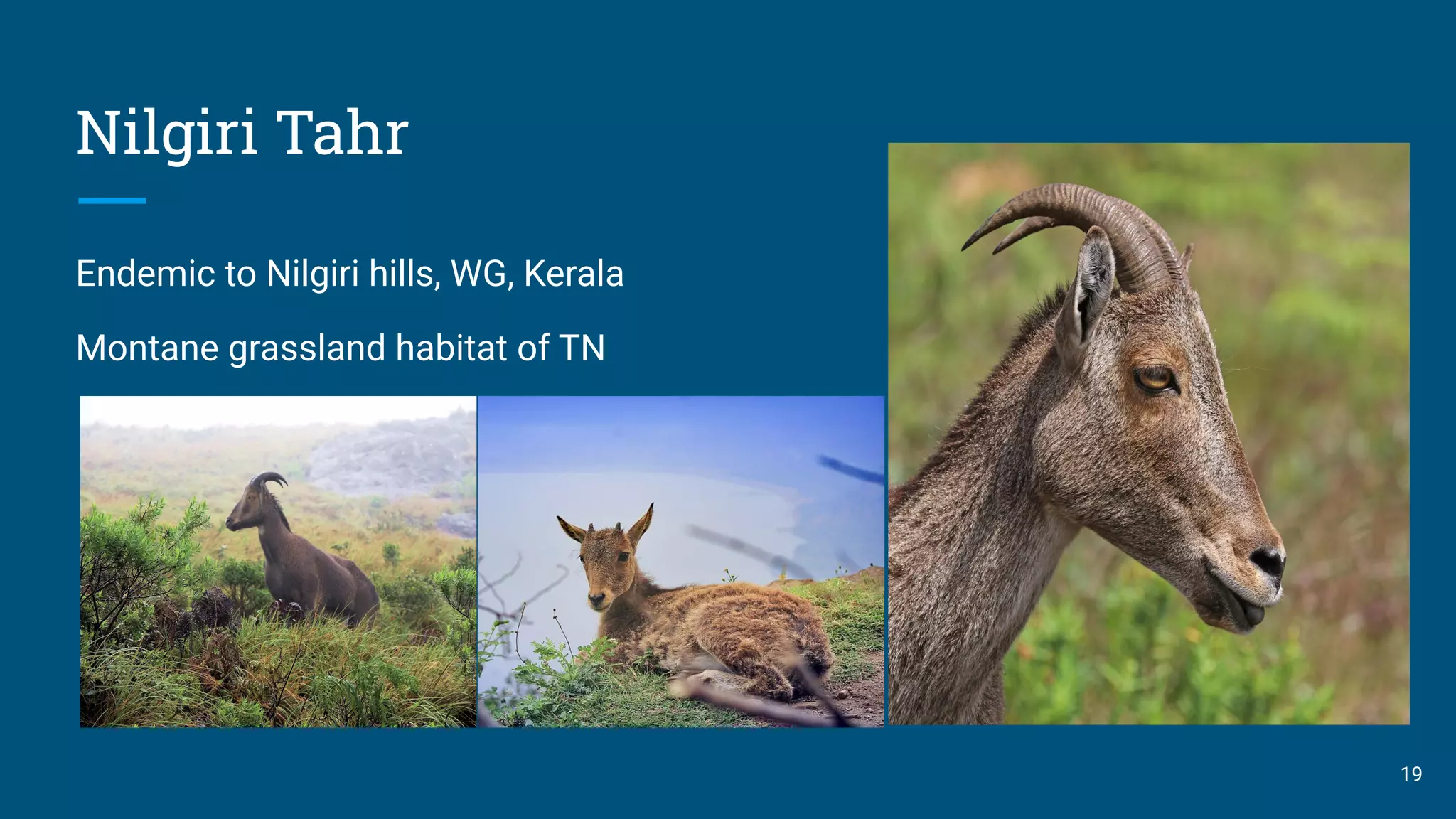
Nilgiri Tahr
Endemic to Nilgiri hills, WG, Kerala
Montane grassland habitat of TN
19
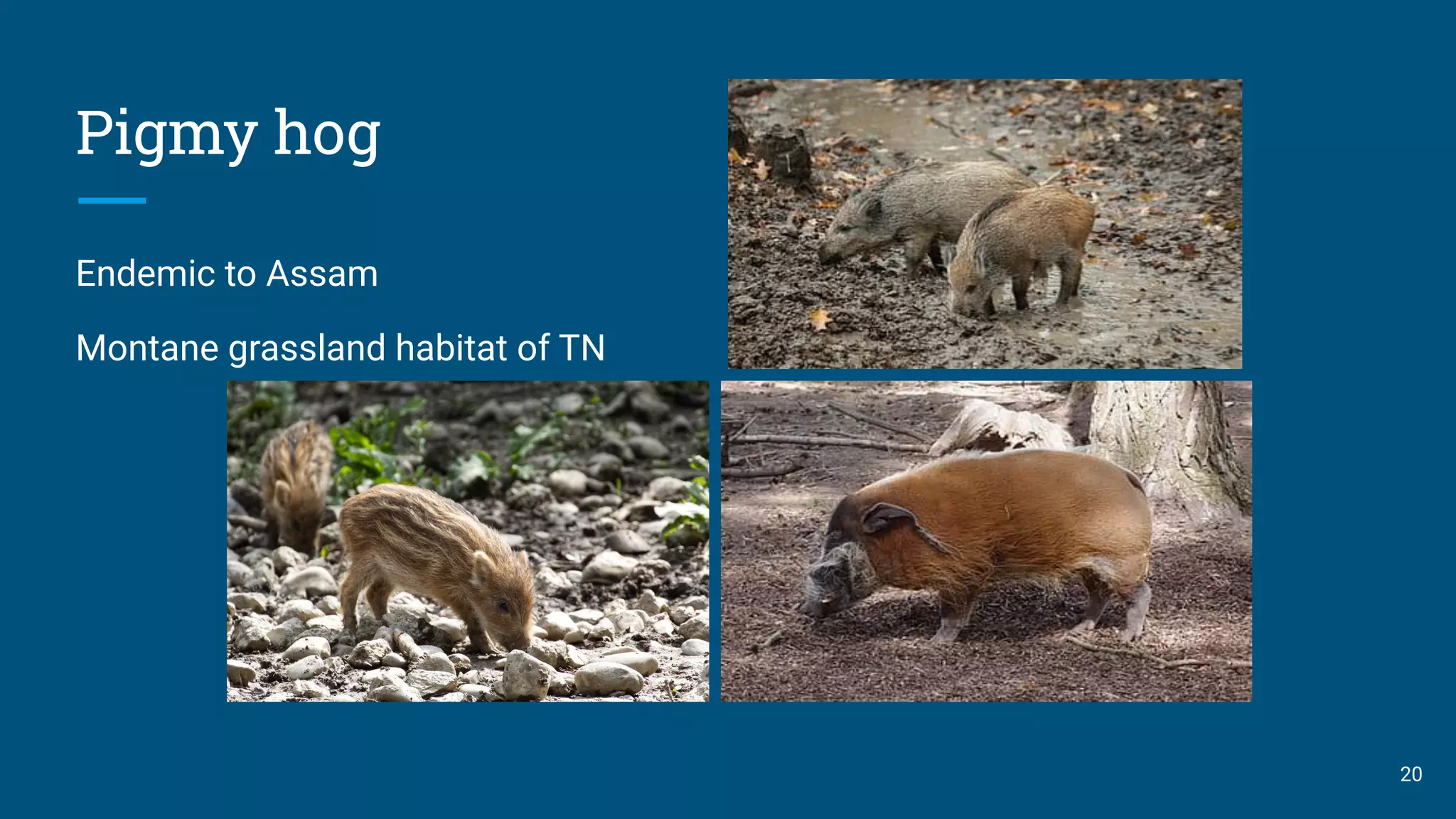
Pigmy hog
Endemic to Assam
Montane grassland habitat of TN
20
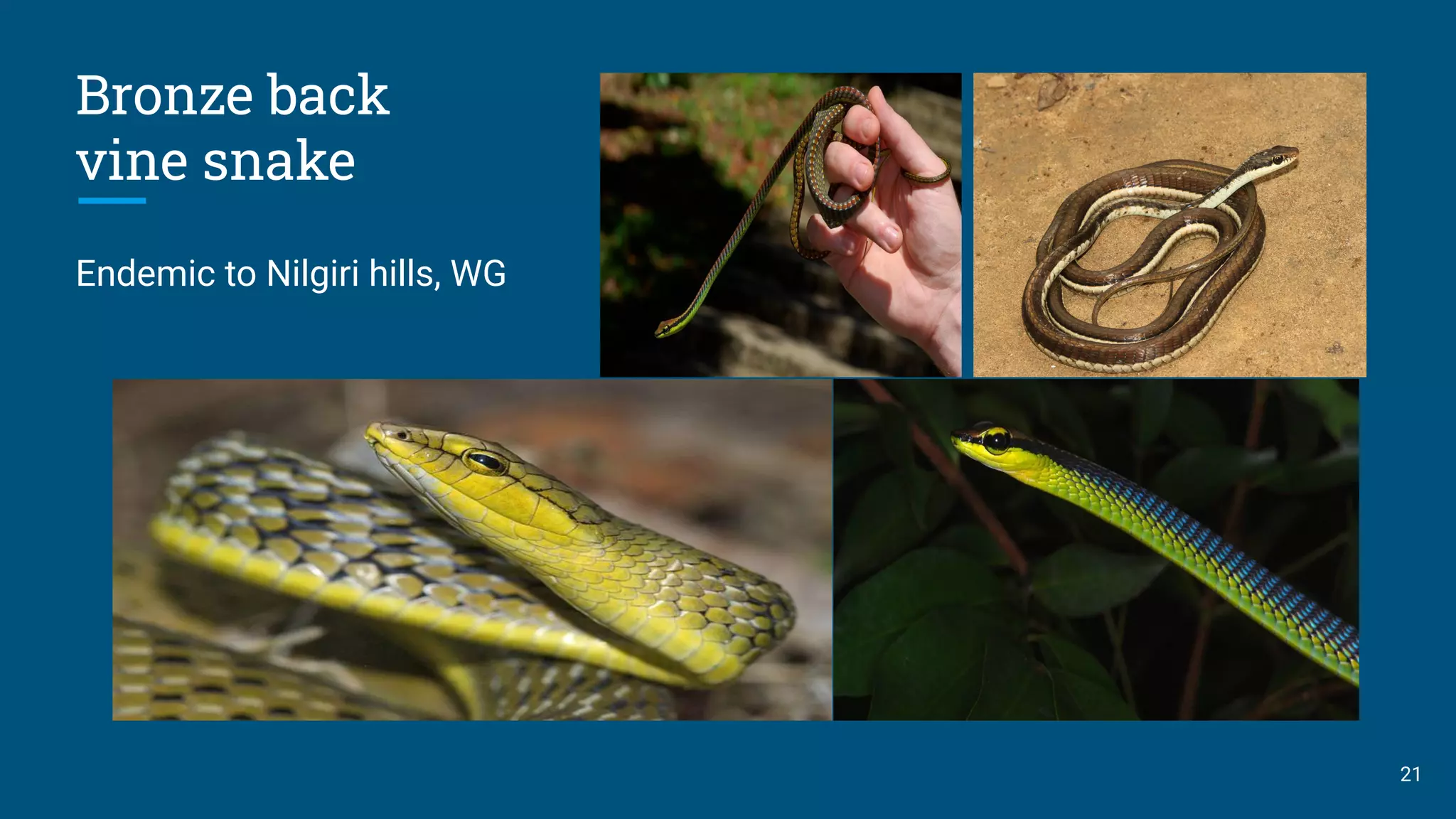
Bronze back
vine snake
Endemic to Nilgiri hills, WG
21
Nilgiri blue robin
Endemic to Shola forest of south India,
22
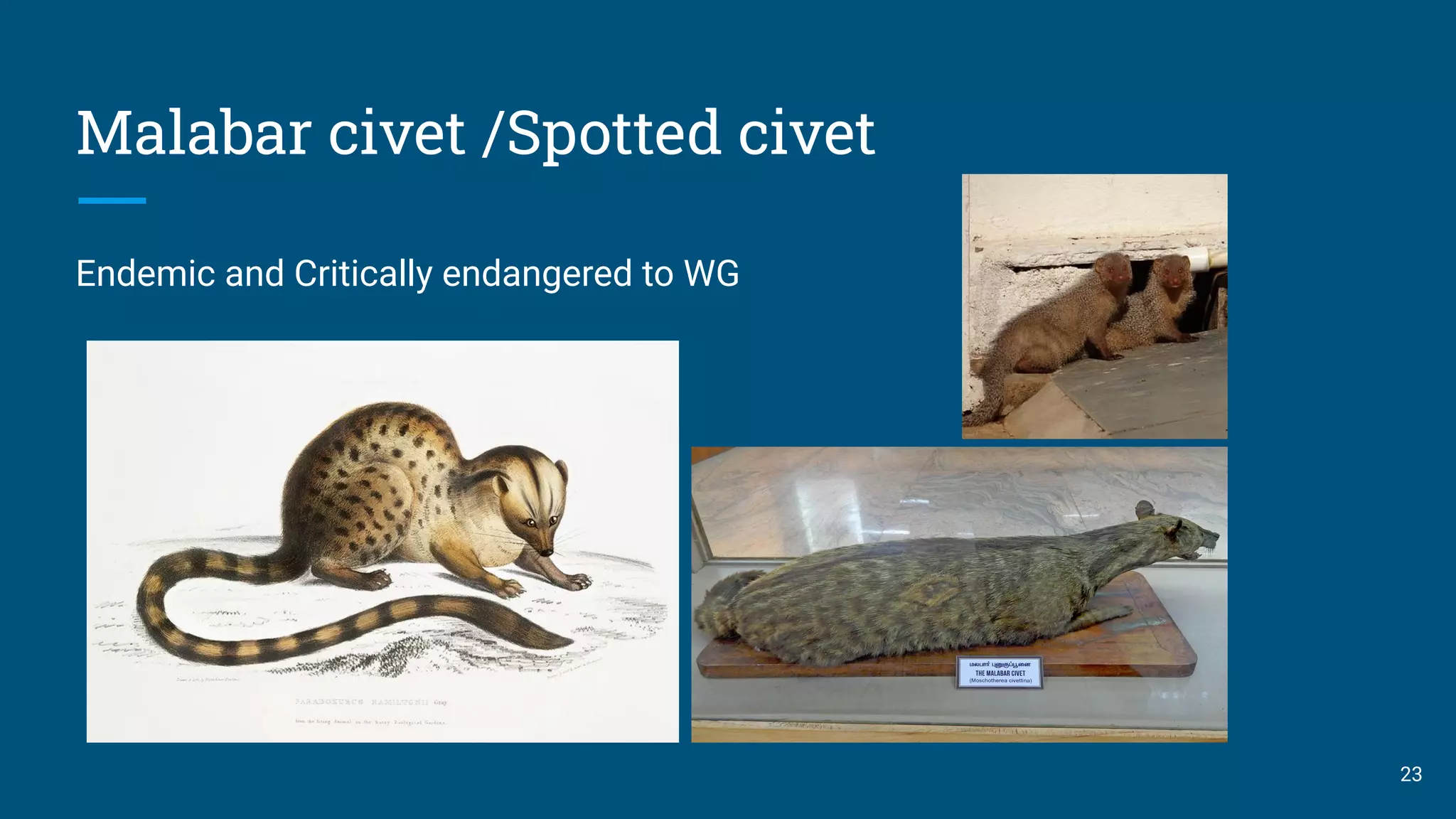
Malabar civet /Spotted civet
Endemic and Critically endangered to WG
23
Namdapha Flying squirrel
Endemic to Arunachal Pradesh
Arboreal and nocturnal.
24
Madras hedgehog
25
Golden langur
26
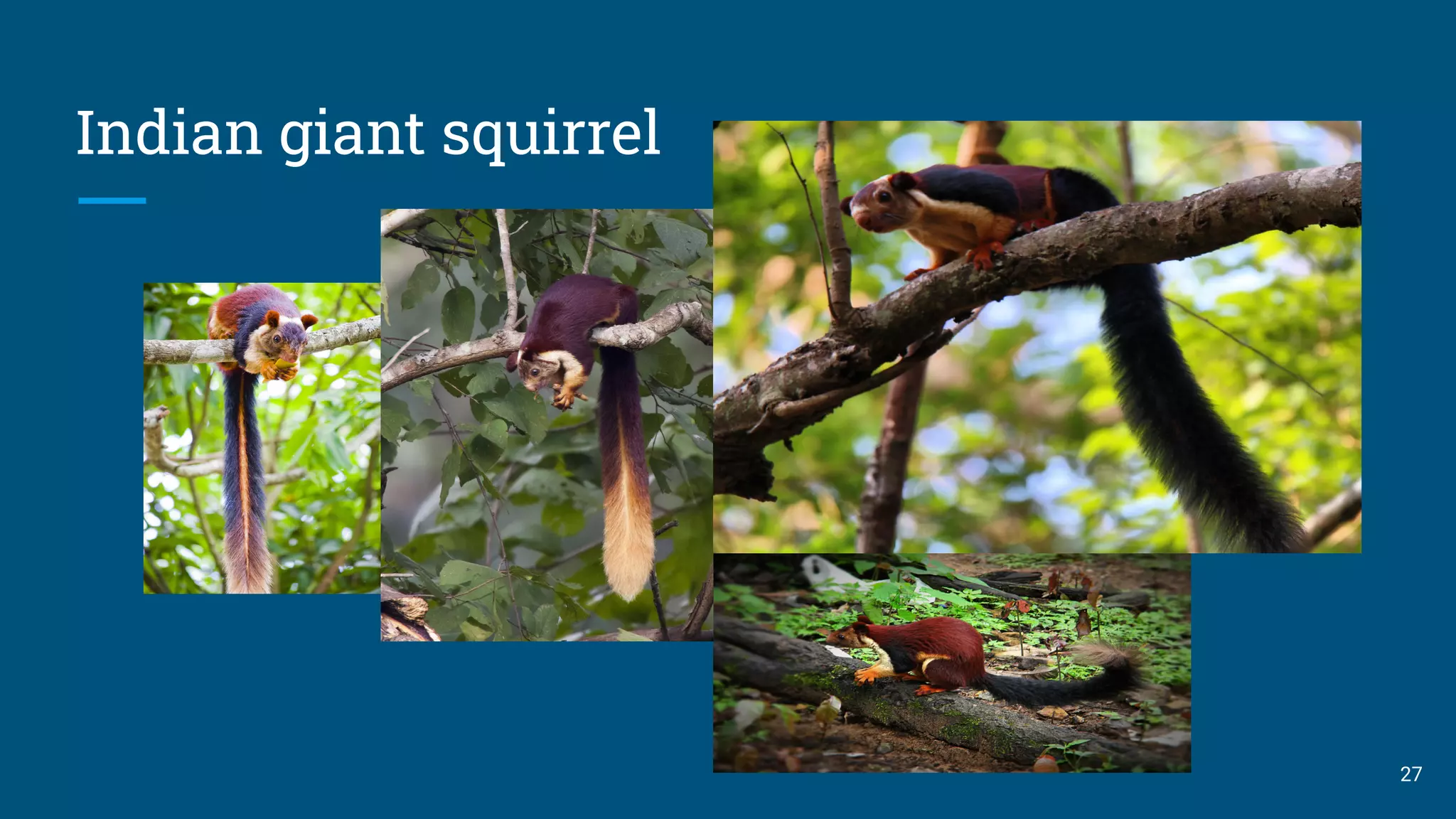
Indian giant squirrel
27
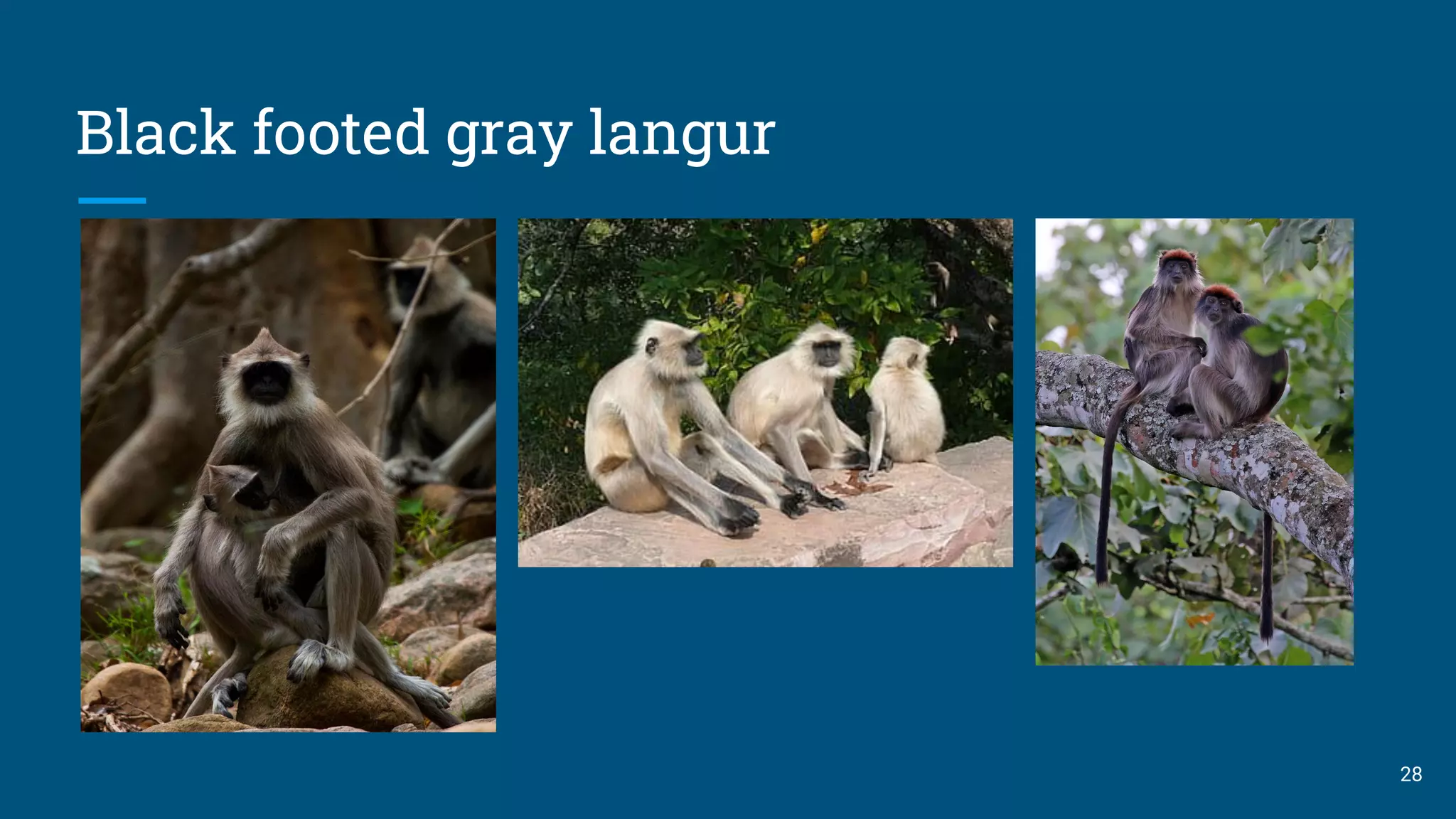
Black footed gray langur
28
And many more as per IUCN
Do not harm them but conserve in their habitats
29
Acknowledgement and references
https://www.biologydiscussion.com/angiosperm/taxonomy-angiosperm/endemics-types-characters-and-theories/34819
http://ccnet.vidyasagar.ac.in:8450/pluginle.php/2055/mod_resource/content/1/Endemism%40Prof.A.K.Mondal-BOTVU-2020.pdf
http://www.walkthroughindia.com/wildlife/12-endangered-endemic-species-found-india/
copyright free images from google
Wikipedia
30
Thank you
Dr. Nagabhushan Charantimath
Assistant Professor, Dept. of studies in zoology,
Vijayanagara Sri Krishnadevaraya University.

ENDEMISM and ENDEMIC SPECIES