MAN AND THE BIOSPHERE
PROGRAMME
By : Aryan Mohan Sem-1,Pol Sc.
(Hons), Roll no. 2712
What is Man and Biosphere
Programme ?
• UNESCO’s Man and the Biosphere Programme (MAB) is an
Intergovernmental Scientific Programme that aims to establish a scientific
basis for the improvement of relationships between people and their
environments.
• It was launched in 1971.
• MAB's work engages fully with the international development agenda—specially
with the Sustainable Development Goals.
It addresses challenges linked to scientific, environmental, societal and
development issues in diverse ecosystems; from mountain regions to marine,
coastal and island areas; from tropical forests to dry lands and urban areas.
There are currently 738 biosphere reserves in 134 countries, including 22
transboundary sites. There are total 12 biosphere reserves of India.
Biosphere Reserves
• Biosphere reserves are areas comprising terrestrial, marine and coastal
ecosystems. Each reserve promotes solutions reconciling the conservation
of biodiversity with its sustainable use.
• Biosphere reserves are ‘Science for Sustainability support sites’.
Biosphere reserves have three interrelated zones:
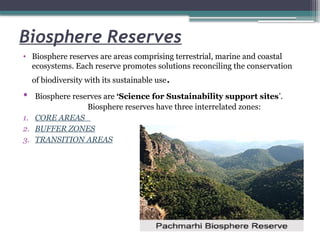
1. CORE AREAS
2. BUFFER ZONES
3. TRANSITION AREAS
Structure Of Biosphere Reserves
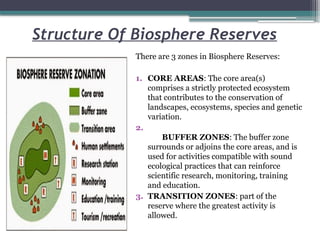
There are 3 zones in Biosphere Reserves:
1. CORE AREAS: The core area(s)
comprises a strictly protected ecosystem
that contributes to the conservation of
landscapes, ecosystems, species and genetic
variation.
2.
BUFFER ZONES: The buffer zone
surrounds or adjoins the core areas, and is
used for activities compatible with sound
ecological practices that can reinforce
scientific research, monitoring, training
and education.
3. TRANSITION ZONES: part of the
reserve where the greatest activity is
allowed.
What are the Criteria for Designation of Biosphere Reserve?
• A site must contain a protected and minimally disturbed core
area of value of nature conservation.
• The core area must be a bio-geographical unit and should be
large enough to sustain a viable populations representing all
trophic levels.
• The involvement of local communities and use of their
knowledge in biodiversity preservation.
• Area's potential for preservation of traditional tribal or rural
modes of living for harmonious use of the environment.
Functions of Biosphere Reserves
• Conservation: Managing Biosphere Reserve’s resources,
ecosystems, plants and landscapes.
• Development: Promoting Human growth that is sustainable on
ecological levels.
• Promoting research activities ,environmental
education,training and monitoring in the context of
local,national and international consevation and sustainable
development.
P
• Biosphere Reserves tries to balance economic and social
development and maintenance of associated cultural values along
with the preservation of nature
• Biosphere Reserves are thus special environments for both people
and nature and are living examples of how human beings and
nature can co-exist while respecting each other’s need
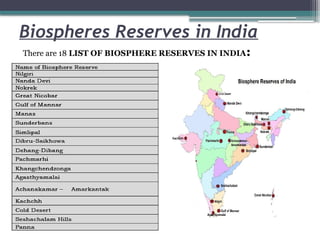
Biospheres Reserves in India
There are 18 LIST OF BIOSPHERE RESERVES IN INDIA:
CONCLUSION
• The MAB Programme develops the basis within the natural and
social sciences for the rational and sustainable use and conservation
of the resources of the biosphere and for the improvement of the
overall relationship between people and their environment
BIBLOGRAPHY
• https://
www.unccd.int/resources/knowledge-sharing-system/unesco-man-
and-biosphere-programme-mab
• https://
www.drishtiias.com/to-the-points/paper3/biosphere-reserves-in-in
dia
• https://byjus.com/free-ias-prep/biosphere-reserve-in-india/
• https://
prepp.in/news/e-492-man-and-biosphere-programme-mab-of-unes
J

MAN AND THE BIOSPHERE PROGRAMME.pptx IND

  • 1.
    MAN AND THEBIOSPHERE PROGRAMME By : Aryan Mohan Sem-1,Pol Sc. (Hons), Roll no. 2712
  • 2.
    What is Manand Biosphere Programme ? • UNESCO’s Man and the Biosphere Programme (MAB) is an Intergovernmental Scientific Programme that aims to establish a scientific basis for the improvement of relationships between people and their environments. • It was launched in 1971.
  • 3.
    • MAB's workengages fully with the international development agenda—specially with the Sustainable Development Goals. It addresses challenges linked to scientific, environmental, societal and development issues in diverse ecosystems; from mountain regions to marine, coastal and island areas; from tropical forests to dry lands and urban areas. There are currently 738 biosphere reserves in 134 countries, including 22 transboundary sites. There are total 12 biosphere reserves of India.
  • 4.
    Biosphere Reserves • Biospherereserves are areas comprising terrestrial, marine and coastal ecosystems. Each reserve promotes solutions reconciling the conservation of biodiversity with its sustainable use. • Biosphere reserves are ‘Science for Sustainability support sites’. Biosphere reserves have three interrelated zones: 1. CORE AREAS 2. BUFFER ZONES 3. TRANSITION AREAS
  • 5.
    Structure Of BiosphereReserves There are 3 zones in Biosphere Reserves: 1. CORE AREAS: The core area(s) comprises a strictly protected ecosystem that contributes to the conservation of landscapes, ecosystems, species and genetic variation. 2. BUFFER ZONES: The buffer zone surrounds or adjoins the core areas, and is used for activities compatible with sound ecological practices that can reinforce scientific research, monitoring, training and education. 3. TRANSITION ZONES: part of the reserve where the greatest activity is allowed.
  • 6.
    What are theCriteria for Designation of Biosphere Reserve? • A site must contain a protected and minimally disturbed core area of value of nature conservation. • The core area must be a bio-geographical unit and should be large enough to sustain a viable populations representing all trophic levels. • The involvement of local communities and use of their knowledge in biodiversity preservation. • Area's potential for preservation of traditional tribal or rural modes of living for harmonious use of the environment.
  • 7.
    Functions of BiosphereReserves • Conservation: Managing Biosphere Reserve’s resources, ecosystems, plants and landscapes. • Development: Promoting Human growth that is sustainable on ecological levels. • Promoting research activities ,environmental education,training and monitoring in the context of local,national and international consevation and sustainable development.
  • 8.
    P • Biosphere Reservestries to balance economic and social development and maintenance of associated cultural values along with the preservation of nature • Biosphere Reserves are thus special environments for both people and nature and are living examples of how human beings and nature can co-exist while respecting each other’s need
  • 9.
    Biospheres Reserves inIndia There are 18 LIST OF BIOSPHERE RESERVES IN INDIA:
  • 10.
    CONCLUSION • The MABProgramme develops the basis within the natural and social sciences for the rational and sustainable use and conservation of the resources of the biosphere and for the improvement of the overall relationship between people and their environment
  • 11.
    BIBLOGRAPHY • https:// www.unccd.int/resources/knowledge-sharing-system/unesco-man- and-biosphere-programme-mab • https:// www.drishtiias.com/to-the-points/paper3/biosphere-reserves-in-in dia •https://byjus.com/free-ias-prep/biosphere-reserve-in-india/ • https:// prepp.in/news/e-492-man-and-biosphere-programme-mab-of-unes
  • 12.